Archive for ‘Bengali’

30/11/2019

Rediscovering the forgotten Indian artists of British India

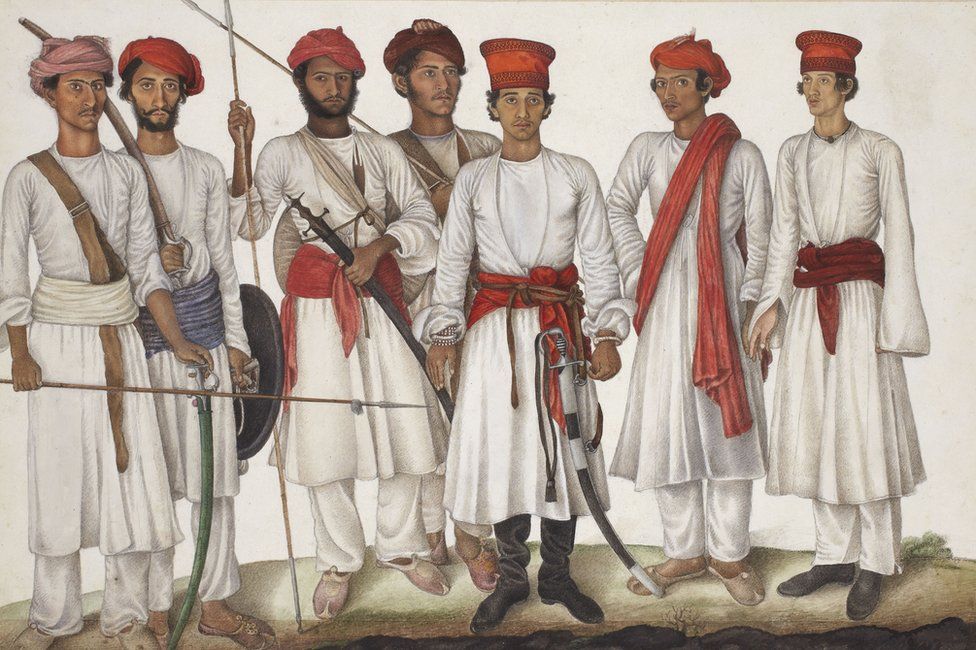
A group of Indian troopers who fought for the English by Ghulam Ali Khan, 1815-16Image copyright PEMILLE KLEMP
Image caption A group of Indian troopers who fought for the English, Ghulam Ali Khan, 1815-16

The English East India Company, founded in 1600, was established for trading. But as the powerful multinational corporation expanded its control over India in the late 18th Century, it commissioned many remarkable artworks from Indian painters who had previously worked for the Mughals. Writer and historian William Dalrymple writes about these hybrid paintings which explore life and nature.

Calcutta in the late 1770s was Asia’s biggest boom town: known as the City of Palaces, the East India Company’s bridgehead in Bengal had doubled in size to 400,000 inhabitants in a decade.

It was now unquestionably the richest and largest colonial city in the East – though certainly not the most orderly.

“It would have been so easy to turn it into one of the most beautiful cities in the world,” wrote the Count de Modave, a friend of Voltaire who passed through at this time. “One cannot fathom why the English allowed everyone the freedom to build in the most bizarre taste, with the most outlandish planning.”

Nor were visitors much taken by its English inhabitants. Most had come East with just one idea: to amass a fortune in the quickest possible time.
Impey
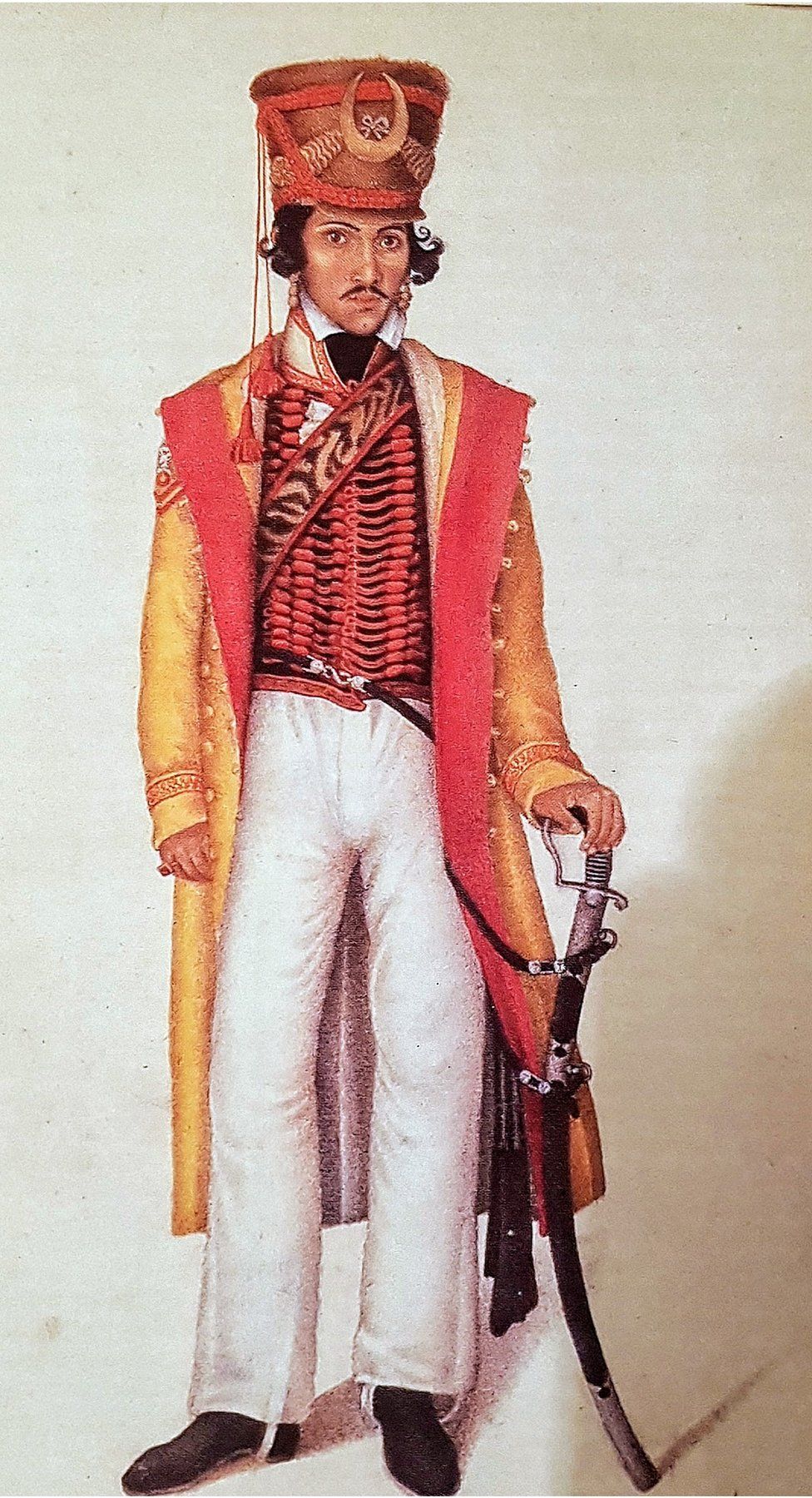
Image caption An Indian trooper who fought for the English, Ghulam Ali Khan, 1819
Calcutta (now Kolkata) was a city where great wealth could be accumulated in a matter of months, then lost in minutes in a wager or at the whist table. Death, from disease or excess, was a commonplace, and the constant presence of mortality made men hard and callous.

Rising with Olympian detachment above the mercantile bawdiness of his contemporaries was the rotund figure of the chief justice of the new Supreme Court, Sir Elijah Impey.

A portrait of him by Johan Zoffany still hangs, a little lopsidedly, in the Kolkata High Court. It shows him pale and plump, ermine gowned and dustily bewigged.

Impey was, however, a serious scholar and unusual in taking a serious interest in the land to which he had been posted.
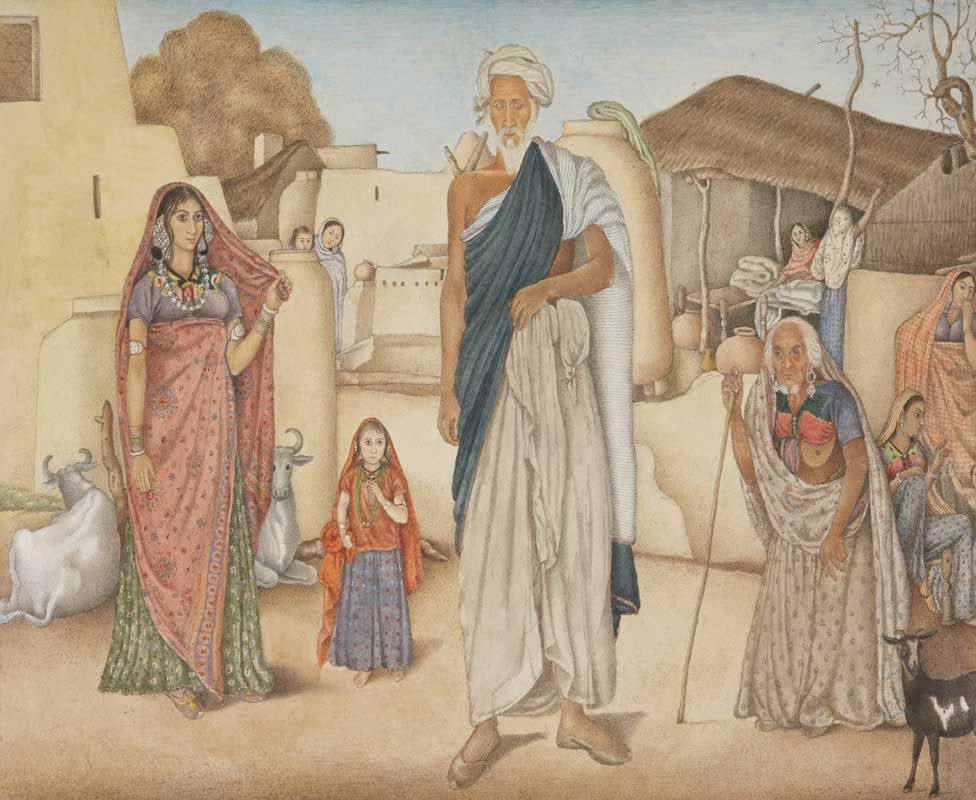
Indian villagers by Ghulam Ali Khan, 1815-16Image copyright PEMILLE KLEMP
Image caption Indian villagers by Ghulam Ali Khan, 1815-16Presentational white space

On the journey out to India, a munshi (administrator) had accompanied him to teach him Bengali and Urdu, and on arrival the new chief justice began to learn Persian and collect Indian paintings. His house became a meeting place where the more cultured elements of Calcutta society could discuss history and literature.

Impey and his wife Mary were also greatly interested in natural history and began to collect a menagerie of rare Indian animals.

At some stage in the mid-1770s, the Impeys decided to bring a group of leading Mughal artists – Sheikh Zain ud-Din, Bhawani Das and Ram Das – to paint their private zoo.

It was probably not the first commission of Indian artists by British patrons. “The Study of Botany is of late Years become a very general Amusement,” noted one enthusiast, and we know that the Scottish nurseryman James Kerr was sending Indian-painted botanical drawings back to Edinburgh as early as 1773.

But the Impeys’ albums of natural history painting remain among the most dazzlingly successful of all such commissions: today, a single page usually reaches prices of more than £330,000 ($387,000) at auctions, and the 197 images from the Impey Album are now widely recognised as among the very greatest glories of Indian painting.
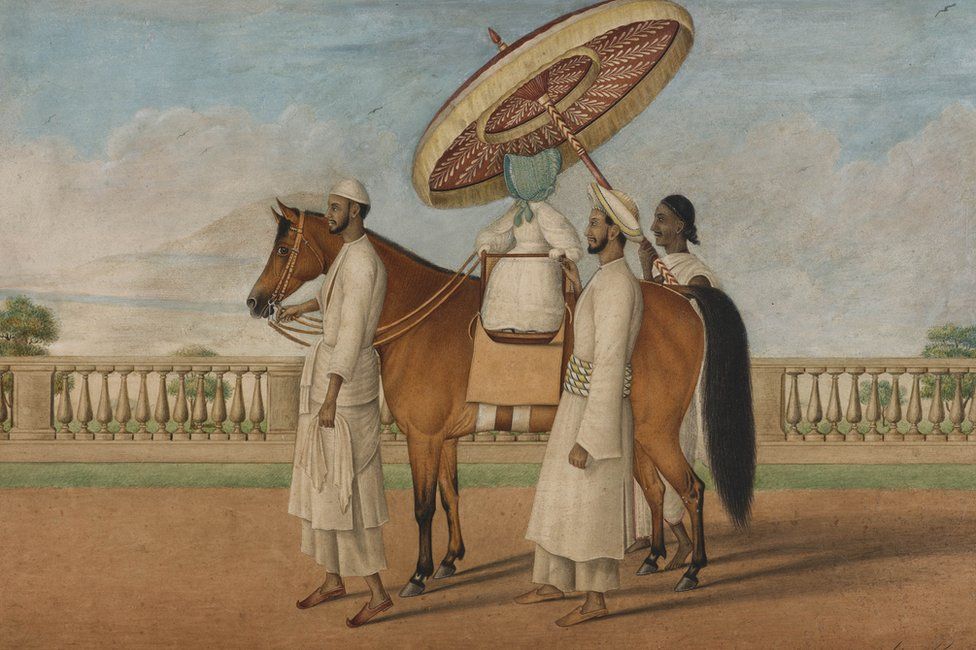
English child seated on a pony and surrounded by three Indian servants, 1830-1850Image copyright FRANCIS WARE
Image caption English child seated on a pony and surrounded by three Indian servants by Shaikh Muhammad Amir

This month, for the first time since the Impey Album was split up in the 18th Century, around 30 of its pages will be reassembled for a major exhibition in the Wallace Collection in London.

Forgotten Masters: Indian Painting for the East India Company celebrates some of the extraordinary work which resulted from commissions made by East India Company patrons from master Indian artists between the 1770s and 1840s.

It will be a unique chance to see some of the finest Indian paintings which are now scattered in private collections around the world.

The three artists who Impey summoned to his fine classical house in Middleton Street were all from Patna, 200 miles (320km) up the Ganges.

The most prolific was a Muslim, Shaikh Zain-al-Din, while his two colleagues, Bhawani Das and Ram Das, were both Hindus.
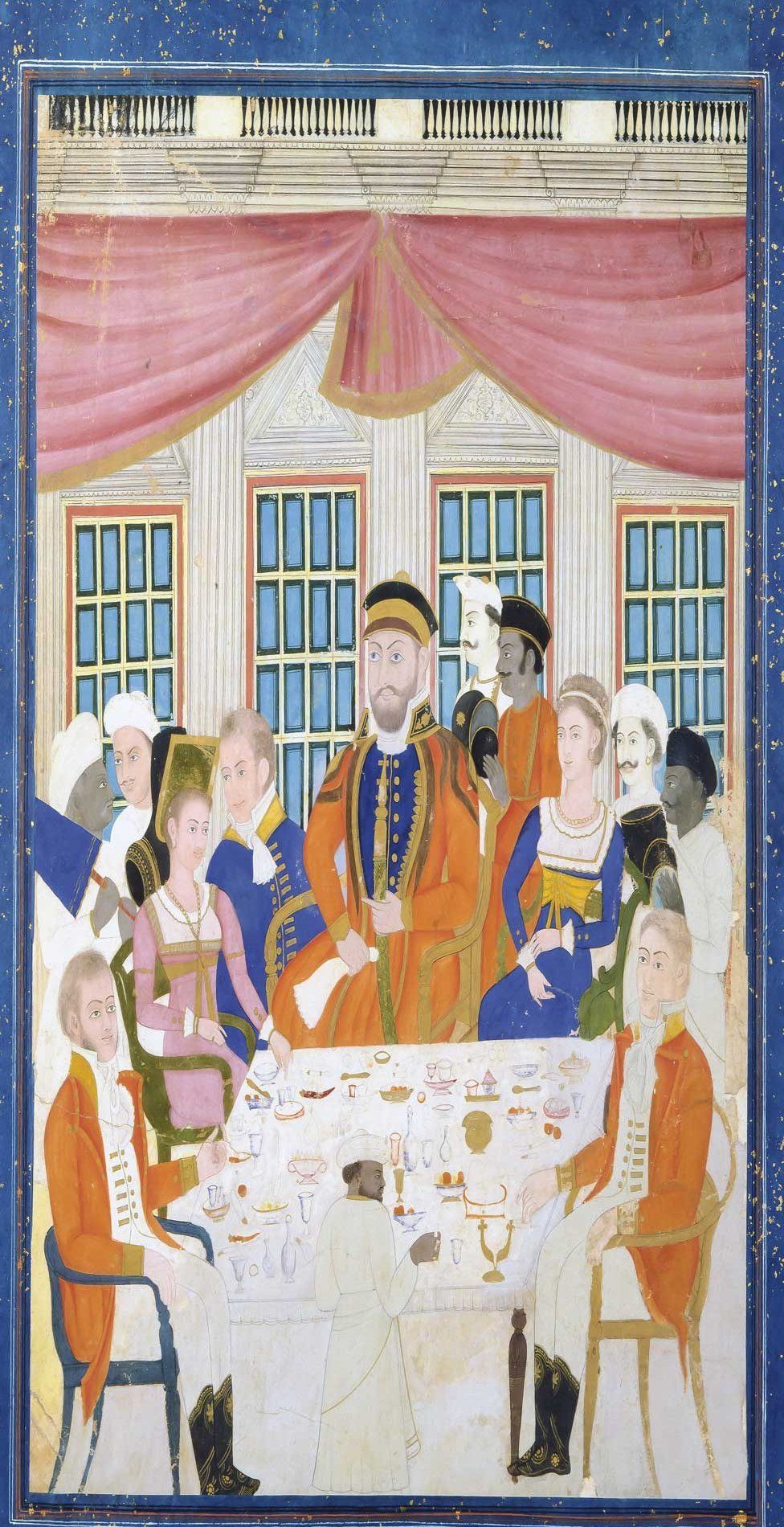
A finely painted miniature depicting four British officers with their wives taking refreshments at a table
Image caption A finely painted miniature depicting four British officers with their wives taking refreshments at a table, artist unknown

Trained in the late Mughal style and patronised by the Nawabs of Murshidabad and Patna, they quickly learned to use English watercolours on English Watman watercolour paper, and take English botanical still lives as their models. In this way an extraordinary fusion of English and Mughal artistic impulses took place.

Zain ud-Din’s best works reveal a superb synthesis between a coldly scientific European natural history specimen illustration, warmed with a profoundly Indian sensibility and vital feeling for nature.

At his best – whether by instinct or inherited knowledge and training – he channels the outstanding Mughal achievement in natural history painting of 150 years earlier, when the great Mughal artist Mansur painted animals and birds for the Emperor Jahangir.
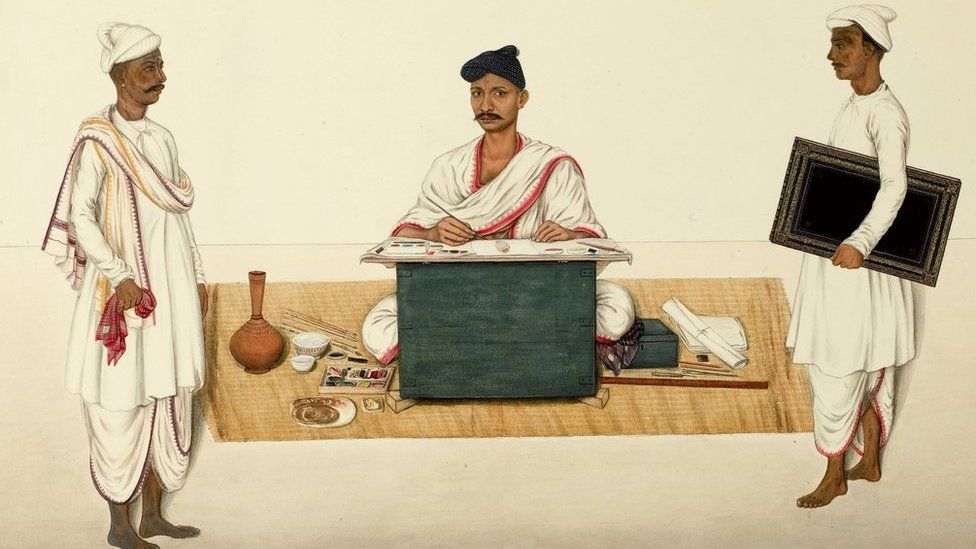
A man sits and draws while attended by two other men
Image caption Portrait of a Mughal artist, by Yellapah Of Vellore, 1832-1835

Nowhere are the merits of Company Painting better illustrated than in Zain ud-Din’s astonishing portrait of a Black Headed Oriole (No. 27).

At first glance, it could pass for a remarkably skilful English natural history painting. Only gradually does its hybrid origins become manifest.

The brilliance and simplicity of the colours, the meticulous attention to detail, the gem-like highlights, the way the picture seems to glow, all these point unmistakably towards Zain ud-Din’s Mughal training.
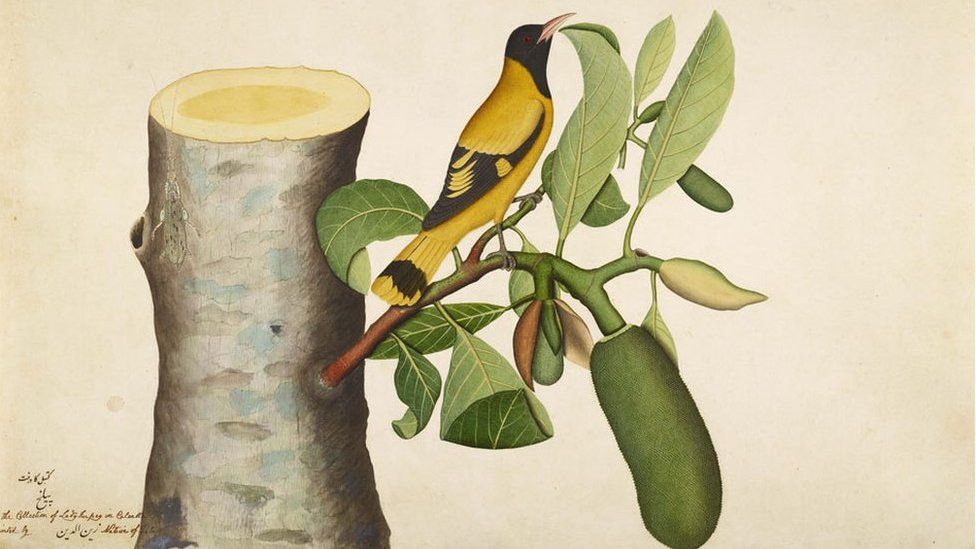
Zain Ud din’s portrait of black headed oriole
Image caption Portrait of a black headed oriole by Zain ud-Din

An idiosyncratic approach to perspective also hints at this background: the tree trunk is rounded, yet the grasshopper which sits on it is as flat as a pressed flower, with only a hint of outline shading to give it depth – the same technique used by Mansur.

Yet no artist working in a normal Mughal atelier would have placed his bird detached from a landscape against a white background, with the jackfruit tree on which its sits cut into a perfect, scientific cross-section.

Equally no English artist would have thought of painting the bark of that cross section the same brilliant yellow as the oriole; the tentative washes of a memsahib’s watercolour are a world away.

The two traditions have met head on, and from that blinding impact an inspirational new fusion has taken place.

Bhawani Das, who seems to have started off as an assistant to Zain ud-Din, is almost as fine an artist as Zain ud-Din.
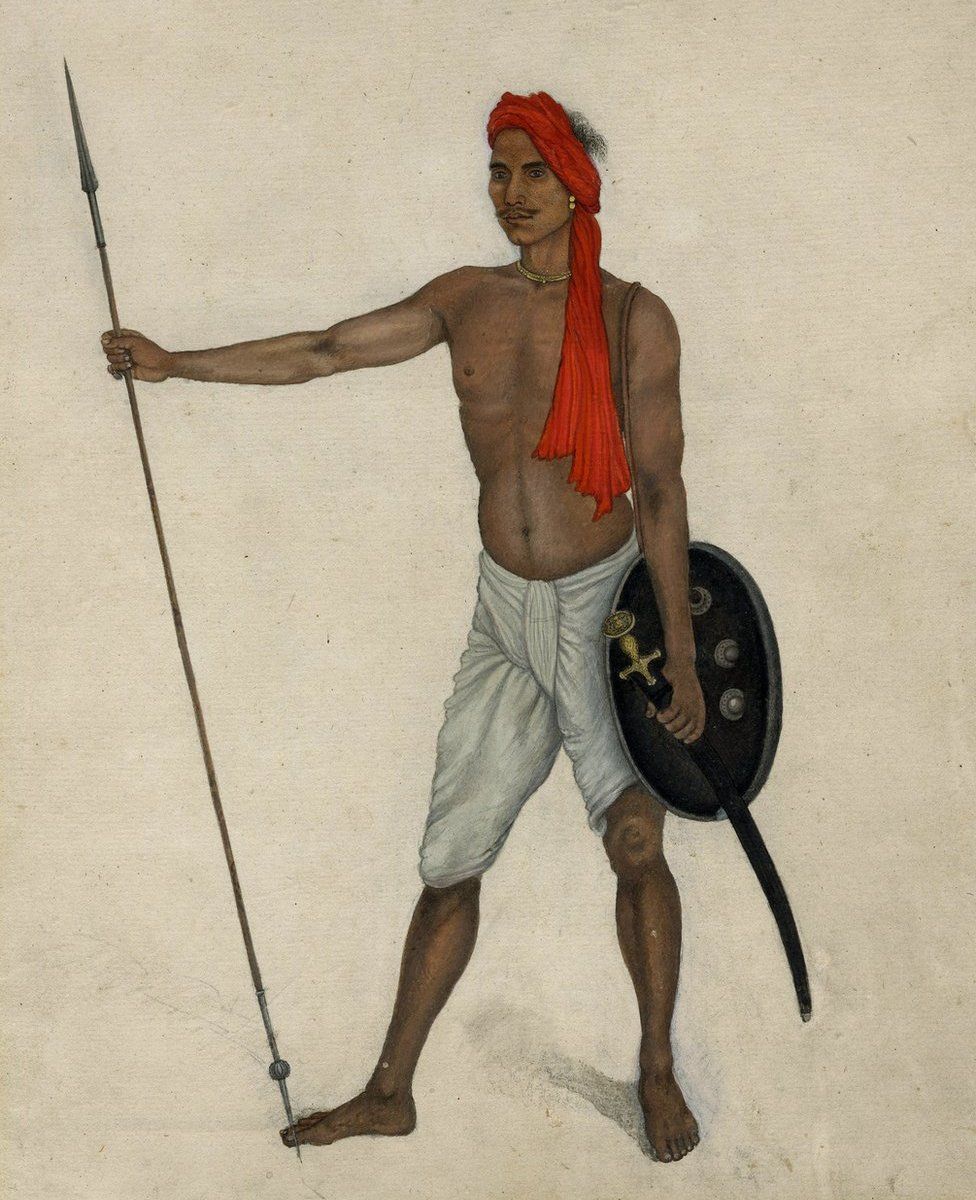
Indian trooper holding a spear by Ghulam Ali Khan, 1815-186
Image caption Indian trooper holding a spear by Ghulam Ali Khan, 1815-186

He is acutely sensitive to shape, texture and expression, as for example in his celebrated study of a great fruit bat with the contrast between its soft, furry body with the angular precision of its blackly outstretched wings, as if it were some caped Commendatore ushering a woman into a Venetian opera rather than a creature in a colonial menagerie.

Now, for the first time, the work of these great Indian artists painting in this brilliantly hybrid Anglo-Indian style are beginning to get the attention they deserve.

The first-ever museum show of this work in the UK aims to highlight and showcase the work of a series of extraordinary Indian artists, each with their own style and tastes and agency. Indeed the greatest among them – such as Zain ud-Din- deserve to be remembered as among the most remarkable Indian artists of all time.

William Dalrymple is the author, most recently, of The Anarchy: The Relentless Rise of the East India Company and Forgotten Masters: Indian Painting for the East India Company (Bloomsbury)

Source: The BBC
31/08/2019

Assam NRC: What next for 1.9 million ‘stateless’ Indians?

Final Draft of National Register of Citizens of India (NRC) released on July 30, 2018Image copyright GETTY IMAGES
Image caption Four million people were stripped of their citizenship in the draft list last July

India has published the final version of a list which effectively strips about 1.9 million people in the north-eastern state of Assam of their citizenship.

The National Register of Citizens (NRC) is a list of people who can prove they came to the state by 24 March 1971, the day before neighbouring Bangladesh declared independence from Pakistan.

People left off the list will have 120 days to appeal against their exclusion.

It is unclear what happens next.

India says the process is needed to identify illegal Bangladeshi migrants.

It has already detained thousands of people suspected of being foreigners in temporary camps which are housed in the state’s prisons, but deportation is currently not an option for the country.

The process has also sparked criticism of “witch hunts” against Assam’s ethnic minorities.

A draft version of the list published last year had four million people excluded.

What is the registry of citizens?

The NRC was created in 1951 to determine who was born in Assam and is therefore Indian, and who might be a migrant from neighbouring Bangladesh.

The register has been updated for the first time.

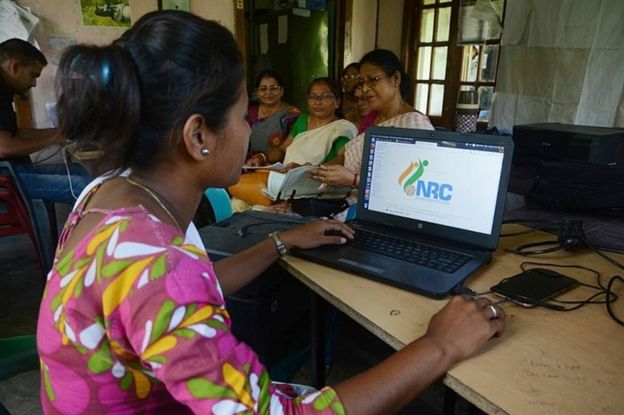
Indian worker of National Register of Citizens (NRC) office checks different documents which were submitted by people for NRC ahead of the release of the final draft of NRC in Guwahati, Assam, India, 26 August 2019.Image copyright EPA
Image caption The NRC was created in 1951 to determine who was born in the state and is Indian

Families in the state have been required to provide documentation to show their lineage, with those who cannot prove their citizenship deemed illegal foreigners.

Prime Minister Narendra Modi’s Hindu nationalist Bharatiya Janata Party (BJP) has long railed against illegal immigration in India but has made the NRC a priority in recent years.

Presentational grey line

An anxious wait

By Rajini Vaidyanathan, BBC News, Assam

A small community centre in the village of Katajhar is being guarded by two members of the Indian army. Outside, a line of people wait. Some are clutching plastic bags containing documents.

As they enter one of two rooms, an official runs his eyes down a print-out to see if their names or photos are on it. This list – the National Register of Citizens – is one with huge consequences. And so there’s fear and trepidation as people here find out whether they’ve been included.

Many here who haven’t made it tell me it’s a mistake as they show me paperwork they say proves they belong in this country.

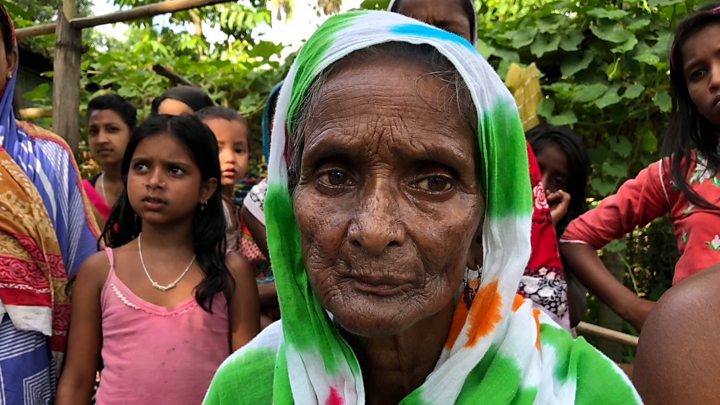
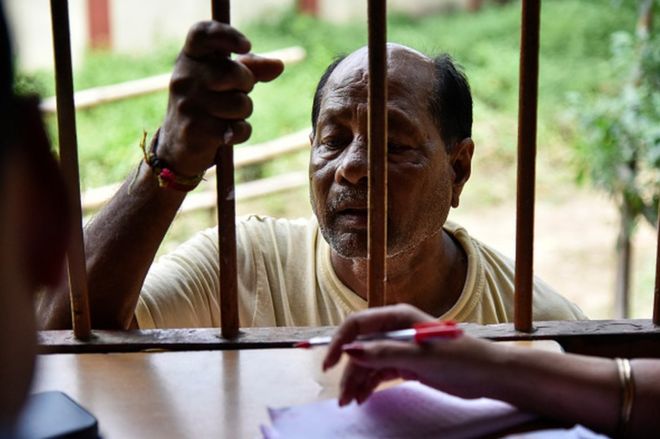
None of Asia Khatun’s family of nine made the list. They now have the chance to appeal but there’s real fear about what might come next. “I’d rather die than go to a detention centre,” she tells me. People here are angry but they’re also scared.

Presentational grey line

Why is the registry happening in Assam?

Assam is one India’s most multi-ethnic states. Questions of identity and citizenship have long vexed a vast number of people living there.

Among its residents are Bengali and Assamese-speaking Hindus, as well as a medley of tribespeople.

A third of the state’s 32 million residents are Muslims, the second-highest number after Indian-administered Kashmir. Many of them are descendants of immigrants who settled there under British rule.

But illegal migration from neighbouring Bangladesh, which shares a 4,000-km long border with India, has been a concern there for decades now. The government said in 2016 that an estimated 20 million illegal immigrants were living in India.

So have 1.9 million people effectively become stateless?

Not quite. Residents excluded from the list can appeal to the specially formed courts called Foreigners Tribunals, as well as the high court and Supreme Court.

However, a potentially long and exhaustive appeals process will mean that India’s already overburdened courts will be further clogged, and poor people left off the list will struggle to raise money to fight their cases.

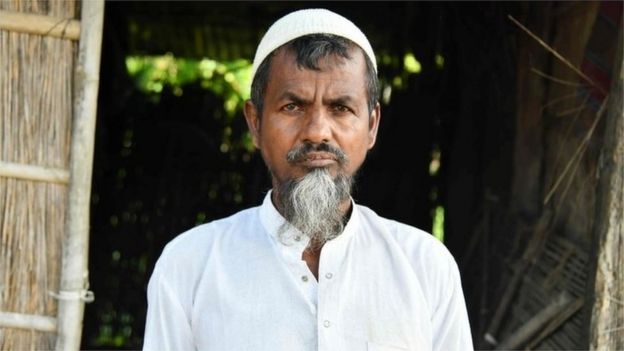
In this photo taken on August 29, 2019, Saheb Ali, 55, poses for a photograph at his home in Khutamari village in Goalpara district, some 160km from Guwahati, the capital city of India's north-eastern state of AssamImage copyright AFP
Image caption Saheb Ali, 55, from Goalpara district, has not been included in the list

If people lose their appeals in higher courts, they could be detained indefinitely.

Some 1,000 people declared as foreigners earlier are already lodged in six detention centres located in prisons. Mr Modi’s government is also building an exclusive detention centre, which can hold 3,000 detainees.

“People whose names are not on the final list are really anxious about what lies ahead. One of the reasons is that the Foreigners Tribunal does not have a good reputation, and many people are worried that they will have to go through this process,” Sangeeta Barooah Pisharoty, author of Assam: The Accord, The Discord, told the BBC.

Why have been the courts so controversial?

The special courts were first set up in 1964, and since then they have declared more than 100,000 people foreigners. They regularly identify “doubtful voters” or “illegal infiltrators” as foreigners to be deported.

But the workings of the specially formed Foreigners Tribunals, which have been hearing the contested cases, have been mired in controversy.

There are more than 200 such courts in Assam today, and their numbers are expected to go up to 1,000 by October. The majority of these tribunals were set up after the BJP came to power in 2014.

The courts have been accused of bias and their workings have often been opaque and riddled with inconsistencies.

Media caption Living in limbo: Assam’s four million unwanted

For one thing, the burden of proof is on the accused or the alleged foreigner.

For another, many families are unable to produce documents due to poor record-keeping, illiteracy or because they lack the money to file a legal claim.

People have been declared foreigners by the courts because of differences in spellings of names or ages in voter rolls, and problems in getting identity documents certified by authorities. Amnesty International has described the work by the special courts as “shoddy and lackadaisical”.

Journalist Rohini Mohan analysed more than 500 judgements by these courtsin one district and found 82% of the people on trial had been declared foreigners. She also found more Muslims had been declared foreigners, and 78% of the orders were delivered without the accused being ever heard – the police said they were “absconding”, but Mohan found many of them living in their villages and unaware they had been declared foreigners.

“The Foreigners Tribunal,” she says, “must be made more transparent and accountable.”

A decorated Indian army veteran, Mohammed Sanaullah spent 11 days in a detention camp in June after being declared a “foreigner”, prompting national outrage.

Both the citizen’s register and the tribunals have also sparked fears of a witch hunt against Assam’s ethnic minorities.

Have the minorities been targeted?

Many say the list has nothing to do with religion, but activists see it as targeting the state’s Bengali community, a large portion of whom are Muslims.

They also point to the plight of Rohingya Muslims in neighbouring Bangladesh.

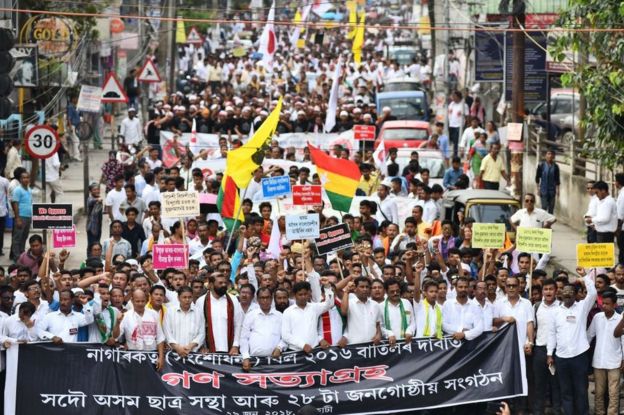
Activists in Assam take part in a protest against the a bill that seeks to give Hindu migrants more rights.Image copyright GETTY IMAGES
Image caption The move to make millions of people stateless will probably spark protests

However significant numbers of Bengali-speaking Hindus have also been left off the citizenship list, underscoring the communal and ethnic tensions in the state

“One of the communities worst affected by the list are the Bengali Hindus. There are as many of them in detention camps as Muslims. This is also the reason just days before NRC is to be published the BJP has changed tack, from taking credit for it to calling it error-ridden. That is because the Bengali Hindus are a strong voter base of the BJP,” says Barooah Pisharoty.

The human tragedy

Fearing possible loss of citizenship and detention after exclusion from the list, scores of Bengali Hindus and Muslims have killed themselves since the process to update the citizen register started in 2015, activists say.

And in an echo of US President Donald Trump’s policy to separate undocumented parents and children, families have been similarly broken up in Assam.

Detainees have complained of poor living conditions and overcrowding in the detention centres.

Bhaben Das' family get ready to perform his final ritesImage copyright CITIZENS FOR JUSTICE AND PEACE
Image caption A father and son killed themselves 30 years apart because of citizenship doubts (photo shows funeral)

One detainee told a rights group after his release he had been taken to a room which had a capacity for 40 people, but was filled with around 120 people. People who have been declared foreigners as well as many inmates have been suffering from depression. Children have also been detained with their parents.

Human rights activist Harsh Mander, who visited two detention centres, has spoken about a situation of “grave and extensive human distress and suffering”.

What happens to people who are declared foreigners?

The BJP which rules the state, has insisted in the past that illegal Muslim immigrants will be deported. But neighbouring Bangladesh will definitely not accede to such a request.

Many believe that India will end up creating the newest cohort of stateless people, raising the spectre of a homegrown crisis that will echo that of the Rohingya people who fled Myanmar for Bangladesh.

It is not clear whether the people stripped of their Indian citizenship will be able to access welfare or own property.

One possibility is that once they are released, they will be given work permits with some basic rights, but will not be allowed to vote.

Source: The BBC

Law of Unintended Consequences

continuously updated blog about China & India

ChiaHou's Book Reviews

continuously updated blog about China & India

What's wrong with the world; and its economy

continuously updated blog about China & India