20/09/2019
- As well as earning three times the industry average, successful candidates are promised 165 days’ leave
- Social media posts linked to story attract more than 60 million views
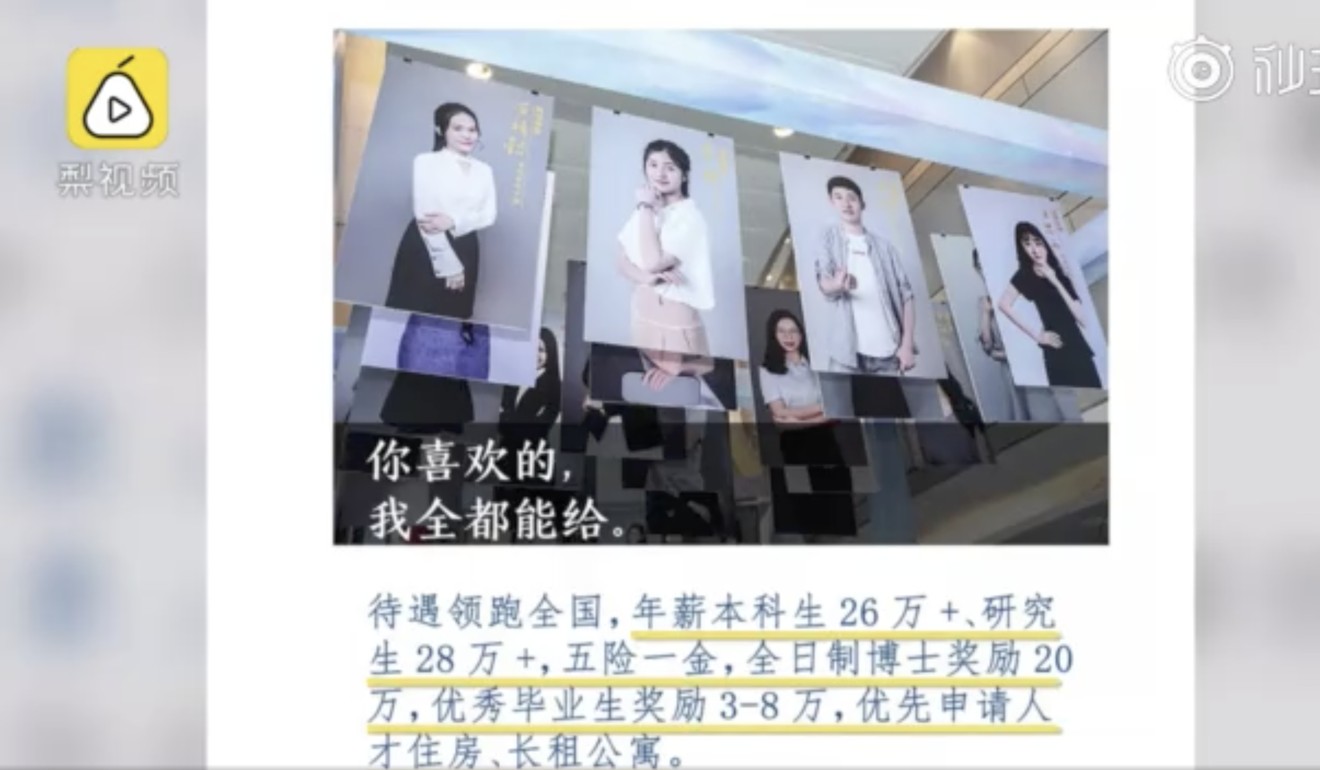
Authorities in Shenzhen are offering three times the national average salary to attract more teachers. Photo: Weibo
A recruitment advertisement offering schoolteachers in southern China the chance to earn up to 280,000 yuan (US$39,500) a year – more than three times the industry average – has sparked a massive response on social media.
Published by the Longhua district education bureau in Shenzhen, Guangdong province, the advert said it was looking for 400 high, middle and primary schoolteachers. As well as an annual salary of between 260,000 yuan and 280,000 yuan, depending on qualifications, the very best candidates would receive a bonus of between 30,000 and 80,000 yuan, it said.
New recruits would also be entitled to 165 days’ leave per year, though the advert – published on Tuesday on WeChat, China’s most popular messaging platform – did not make clear if that included weekends.
The Longhua district education bureau says it is looking for 400 new teachers. Photo: Weibo
The hashtag “Shenzhen middle schoolteachers are being recruited for almost 300,000 yuan a year” racked up almost 60 million views on Weibo, China’s Twitter-like platform.
While some people praised the authority for trying to attract the best possible candidates – it said itself that hundreds of teachers currently working in the district were graduates of China’s top universities, including Peking and Beijing Normal – others said that even with a sky-high salary most young professionals would find it hard to get by in Shenzhen.
“Do you know how expensive houses are in Shenzhen?” one person wrote on Weibo. “You need to wait several years after graduation before buying a house, unless you already have money.”
“Even if your starting salary is 200,000 yuan or 300,000 yuan, you’ll still need to wait 10 years before you’ve saved up enough to buy a house,” said another.
The advert said the new teachers will be get 165 days’ leave per year. Photo: Xinhua
The education bureau has not released any additional information about the recruitment campaign and calls to its offices on Friday went unanswered.
However, it said in a recent Q&A on its website that teachers’ salaries were in line with those of civil servants in the district, and had been steadily rising under a reform of the pay system.
Longhua is not the first district in Shenzhen to offer attractive salary packages, however. In May, 21st Century Business Herald reported that authorities in Yantian district had recruited 20 teachers from Beijing with the offer of between 290,000 yuan and 330,000 yuan a year.
According to central government figures released in May, teachers in China’s public schools earned an average of 92,383 yuan last year.
While Shenzhen has grown from a once sleepy fishing village to a vast metropolis, and is now slated to become a
model city for China, its education facilities have failed to keep pace with other areas of development. It also faces competition from more established centres, like Beijing and Shanghai.
Despite having a population of about 15 million, the city has just 344 primary schools. By comparison, the provincial capital Guangzhou, which has a similar population, has 961 primary schools and about 17,000 more primary schoolteachers.
According to official figures, of the nearly 80,000 students who applied for places at public secondary schools in Shenzhen last year, just 35,000 were accepted. That left the parents of the remainder having no option but to pay for places at private schools in the city or, in some cases, send their children overseas to study.
The problem is set to get worse as Shenzhen’s preschool system is already straining under the pressure of the city’s high birth rate.
Source: SCMP
Posted in attract, authorities, Beijing, Beijing Normal, best graduates, Birth rate, buy, Century Business Herald, Chinese city, education bureau, Guangdong, guangdong province, high, middle and primary schoolteachers, House, industry average, Longhua district education bureau, metropolis, model city, nation’s top universities, offers, overseas, Peking, preschool system, qualifications, recruitment advertisement, recruits, saved up enough, Shanghai, Shenzhen, sleepy fishing village, study, teachers, Twitter, Uncategorized, WeChat, Weibo, Yantian District |
Leave a Comment »
11/05/2019
- Birth rate continues to fall three years after one-child policy was relaxed
- Survey finds high cost of raising children biggest deterrent to second baby
Chinese mothers say financial pressures are stopping them from having another child. Photo: Shutterstock
Half of China’s working mothers do not want a second child, mainly because of financial pressures, a survey released ahead of Mother’s Day has found.
Another 40 per cent said they hoped to have a second child, but dared not to, according to the 2019 working mothers’ living condition survey by Chinese recruitment website Zhaopin.com, which polled 8,739 women over the past two weeks.
The biggest obstacle deterring the mothers from having a second child was economic pressure, with 85 per cent saying they could not afford the high cost of raising children.
China’s low birth rate has been a top concern for the government since it introduced a universal two-child policy in 2016. After decades of a rigidly enforced restriction on couples to have only one child, the number of newborns has not risen as expected.
Births across the country have continued to fall over the past three years, from 17.86 million in 2016, to 17.23 million in 2017, and 15.23 million last year, according to data from the National Bureau of Statistics.
Social demography professor Yang Juhua, from the Centre for Population and Development Studies at Renmin University of China in Beijing, said there were several factors influencing Chinese women’s decision to stick to one child, despite the policy relaxation.
“People are reluctant to give birth because of two reasons: no money to raise kids and no people to look after them, especially when the babies are too young to be admitted to kindergartens,” she said.
The economic stress of raising a child was not about basic living costs, but the expense of extracurricular courses and tuition fees at elite private schools, she said.
“Parents have to send their kids to learn various subjects in order to keep up with their peers amid fierce competition. So the kids are called cash-smashers.”
‘Burden’ of homework leaves kids sleep-deprived Doris Ding, a mother of an eight-year-old boy in Shanghai, said she decided years ago not to have another child.
The senior manager at an audit firm and her husband, an IT engineer at a technology company, pay more than 200,000 yuan (US$30,000) a year for their son to attend an international primary school. His after-school classes, which include piano and public speaking, cost another 50,000 yuan a year.
“So it’s out of our reach to raise a second kid,” Ding said.
Yang said that for many families the second major challenge was an inability to find relatives or other trustworthy people to take care of their children while they were at work.
“Grandparents are too old or not strong enough to do that. We often hear complaints from old people that they are tired of raising the first kid and don’t want to help raise the second one. Otherwise, they don’t have a personal life at all for many years,” she said.
Chinese database lists whether 1.8 million women are ‘BreedReady’
Nurseries providing places for children under the age of three was far from sufficient to resolve the problem, Yang said.
On Thursday, China’s executive State Council proposed a raft of policies aimed at easing the childcare burden for new parents, including encouraging companies to set up day care services for children aged three and under, as well as extended childcare and maternity leave.
According to research by Zhu Qin, a professor from the Centre for Population and Development Policy Studies at Shanghai’s Fudan University, China’s total fertility rate is just 1.54 per woman, putting the country among the lowest birth rates in the world.
As well as the economic factors, Zhu said women were not willing to give birth because of the lack of support from society.
The latest survey from Zhaopin.com showed only 8 per cent of companies had designated rooms for mothers and infants, while 40 per cent of working mothers said they did not take their legally entitled maternity or breastfeeding leave.
“In big cities, white-collar women face the challenge that their career progress will be affected by having babies,” Zhu said.
Source: SCMP
Posted in Beijing, Birth rate, can’t afford them, Centre for Population and Development Studies, China’s mothers, Fudan University, no to more babies, One-child policy, professor from the Centre for Population and Development Policy Studies, Renmin University of China, Social demography professor, Uncategorized, Yang Juhua, Zhu Qin |
Leave a Comment »




 CHINDIA ALERT: You'll be living in their world, very soon