Archive for ‘bookseller’

29/05/2020

Under shadow of Beijing’s security law, Taiwan president thanks Hong Kong bookseller for supporting democracy

  • Tsai Ing-wen visited exiled Hong Kong bookseller a day after NPC voted in favour of legislation
  • Lam Wing-kee said fleeing Hongkongers saw Taiwan as a step towards applying for asylum in the West
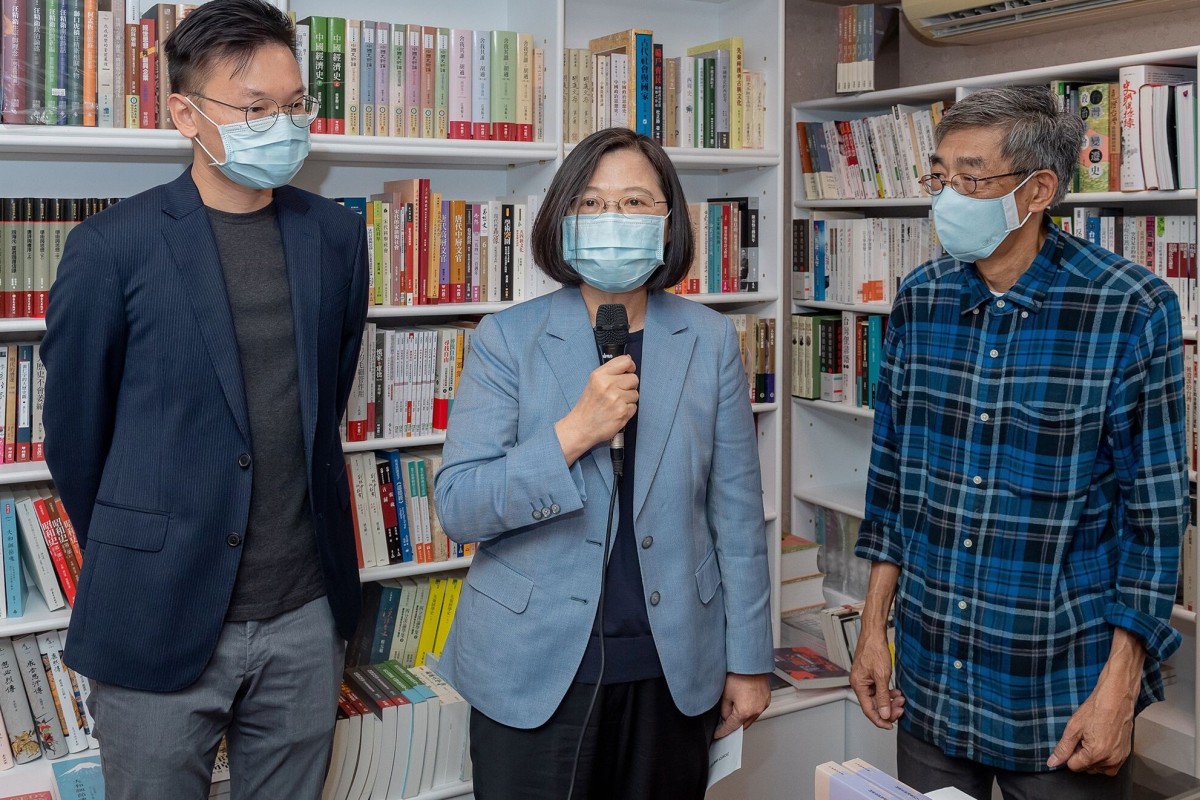
President Tsai Ing-wen (centre) shows her support for Hong Kong bookseller Lam Wing-kee (right) with Lin Fei-fan, deputy secretary general of the ruling Democratic Progressive Party. Photo: Taiwan presidential office/AFP
Taiwan’s President Tsai Ing-wen visited exiled Hong Kong bookseller Lam Wing-kee
on Friday in a show of support for Hongkongers amid Beijing’s plan to introduce a controversial national security law.
Her visit came a day after China’s legislature, the National People’s Congress, voted in favour of a resolution to initiate the legal process for a national security law to be imposed on Hong Kong, despite concerns from the United States, the European Union and elsewhere that the move would erode human rights, freedom and autonomy in the city.
“We want to thank the bookstore boss Lam Wing-kee for his persistent support of human rights, freedom and democracy in Hong Kong from the past to the present stage,” Tsai told Lam, who recently reopened the now-defunct Hong Kong Causeway Bay Books in Taipei.

Tsai said on behalf of all Taiwanese people, she welcomed Lam to stay in Taiwan where he could bolster the island’s efforts to further freedom and democracy.

Hongkongers who want to flee to Taiwan ‘will go through strict screening’
28 May 2020

Lam, one of the five shareholders and staff at Hong Kong’s Causeway Bay Books, fled to Taiwan in April last year after he was detained by Chinese agents for eight months in 2015 for selling books critical of the Chinese leadership.

All five went missing

between October and December that year and it emerged they had been detained on the Chinese mainland.
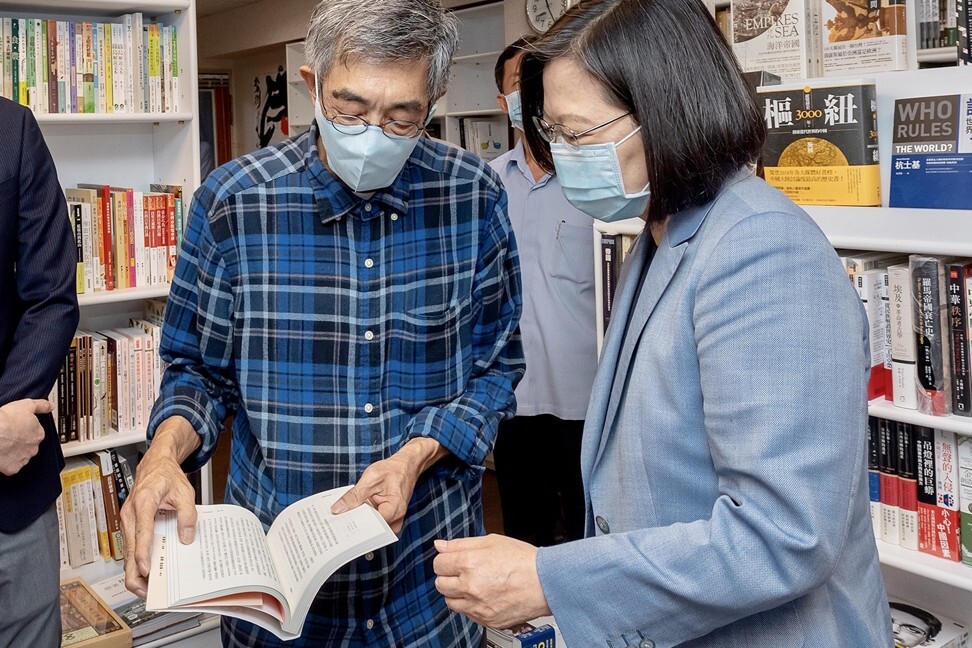
President Tsai Ing-wen looks at a book while visiting Lam Wing-kee on Friday. Photo: Taiwan presidential office/AFP
Lam later said he had been detained and blindfolded by police after crossing the border into mainland China from Hong Kong in October 2015.

The case triggered a huge controversy and raised fears of growing Chinese control in the city.

Seeing Lam as a representative of Hongkongers fleeing to Taiwan to avoid political persecution, Tsai said she wanted to understand what challenges these exiles faced and what help they needed during their stay on the self-ruled island.

“I want to tell Boss Lam [Wing-kee] and our Hong Kong friends that the government here has set up an ad hoc committee to offer help to them very soon,” she said.

On Wednesday, Tsai called for the government to set up an ad hoc committee to work out a “humanitarian help action plan” for Hong Kong people seeking to live in Taiwan or immigrate to the island. It was borne out of concern they would be arrested or prosecuted for taking part in months of anti-government protests triggered last year by the now-shelved extradition bill.

Chen Ming-tong, head of the Mainland Affairs Council, the island’s top mainland policy planner, said on Thursday his council would draft the measures for cabinet’s approval in a week.

Under the plan, the Mainland Affairs Council would issue special measures and coordinate with the island’s authorities on how to help Hongkongers relocate to Taiwan and take care of them.

Bookseller Lam told Tsai what Hongkongers needed most was to have their stay in Taiwan extended.

Lam said that currently, because of the absence of a political asylum law, Hongkongers could only apply to live in Taiwan through study, work, investment, their professional skills or close relatives.

He said fleeing Hongkongers usually came to Taiwan on tourist permits, which at most allowed them to stay for up to six months, giving them not enough time to apply for long-term residence in Taiwan.

“It would be better if they can stay for nine months and preferably one year,” he said.

Lam said some fleeing Hongkongers saw Taiwan as an intermediary base as they hoped to apply for asylum in the West, but it took a long time for Western countries to screen and approve their asylum requests.

Meanwhile, Premier Su Tseng-chang said Article 18 of the Laws and Regulations Regarding Hong Kong and Macau Affairs was good enough to deal with the current crisis in the absence of a political asylum law in Taiwan.

That article states that “necessary help shall be provided to Hong Kong or Macau residents whose safety and liberty are immediately threatened for political reasons”.

Source: SCMP
25/02/2020

Gui Minhai: Hong Kong bookseller gets 10 years jail

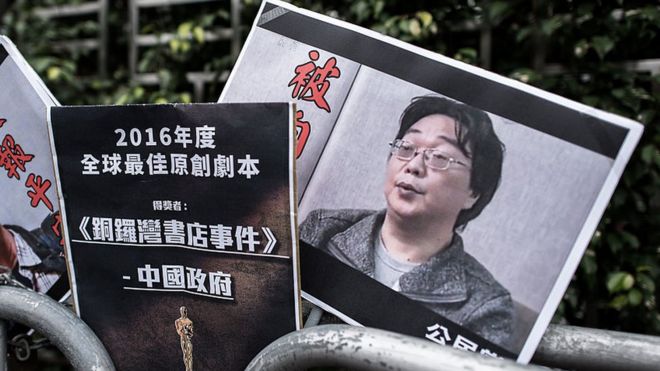
Mr Gui Minhai on a placardImage copyright GETTY IMAGES
Image caption Mr Gui has been in and out of Chinese detention for years

A Chinese court has sentenced Hong Kong bookseller Gui Minhai to 10 years in jail for “illegally providing intelligence overseas”.

Mr Gui, who holds Swedish citizenship, has been in and out of Chinese detention since 2015, when he went missing during a holiday in Thailand.

He is known to have previously published books on the personal lives of Chinese Communist Party members.

Rights groups condemned the “harsh sentence” and called for his release.

He was one of five owners of a small bookstore in Hong Kong who went missing in 2015. It later emerged that they had been taken to China. Four were later freed, but Mr Gui remained in Chinese detention.

In delivering its verdict, the Ningbo Intermediate People’s Court said that his Chinese citizenship had been reinstated in 2018. China does not recognise dual citizenship.

Sweden’s foreign minister on Tuesday called for Mr Gui’s release, referring to him a “citizen”.

“We have not had access to the trial,” said Ann Linde in a tweet. “[We] demand that Gui be released and that we have access to our citizens to provide consular support.”

But according to a Reuters report, a Chinese foreign ministry spokesman said consular arrangements had been put on hold because of the latest coronavirus outbreak, and would be restored once the health problem was “resolved”.

Zhao Lijian added that Mr Gui’s “rights and interests… [had] been fully guaranteed”.

Human rights group Amnesty International on Tuesday also called for Mr Gui to be released immediately and said the charges were “completely unsubstantiated”.

A forced confession?

Mr Gui first made headlines in 2015 when he vanished from Thailand and resurfaced in China.

After his disappearance, there were allegations that he had been abducted by Chinese agents. Chinese officials, however, say Mr Gui and the four other men all went to China voluntarily.

The bookseller ultimately confessed to being involved in a fatal traffic accident more than a decade earlier – a confession supporters say was forced.

He served two years in prison but he was arrested months after his release while he was travelling to the Chinese capital of Beijing with two Swedish diplomats.

China later released a video interview featuring Mr Gui. In it, he accused Sweden of “sensationalising” his case. It is not uncommon for Chinese criminal suspects to appear in “confessional” videos.

Earlier in 2019, Sweden recalled its ambassador to China Anna Lindstedt, who was accused of brokering an unauthorised meeting between Angela Gui – the daughter of Mr Gui – and two Chinese businessmen.

Ms Gui – who has been vocal in campaigning for her father’s release – said one of the men had pressured her to accept a deal where her father would go to trial and might be sentenced to “a few years” in prison, and in return she would stop all publicity around her father’s detention.

Source: The BBC

14/02/2019

Sweden replaces China envoy in furore over dissident bookseller

STOCKHOLM (Reuters) – Sweden said on Thursday it had replaced its ambassador to China after her “incorrect” handling of unauthorized meetings intended to help free dissident bookseller Gui Minhai.

The Hong Kong-based, Swedish publisher of books critical of China’s communist leaders was abducted in Thailand in 2015 and later appeared in custody in mainland China.

His daughter Angela Gui said this week she had met ambassador Anna Lindstedt and two businessmen in Stockholm in January, where she was advised to keep quiet about her father’s case while negotiations were proceeding.

Sweden’s Foreign Ministry said that was not an official meeting, and Lindstedt had now returned to Sweden with an interim envoy sent to Beijing during an inquiry.

“Neither the Foreign Ministry nor the Foreign Minister were informed until after the event,” ministry spokesman Rasmus Eljanskog said in an emailed statement.

“As a consequence of the incorrect manner in which the said meetings were handled, we are now conducting an internal investigation.”

Gui, 54, became a Swedish citizen after studying there in the 1980s. After the abduction, he was released in October 2017, but his whereabouts were unclear until January last year when his daughter said he was seized by Chinese agents on a Beijing-bound train in the presence of Swedish diplomats.

China later confirmed it had detained him again.

In her blog, Angela Gui said Lindstedt invited her to Stockholm to meet two businessmen who could help secure her father’s release.

“OUTRAGEOUS SCANDAL”

“The businessman said, ‘you care about Anna (Lindstedt), right? If you keep talking to the media it’ll damage her career. You don’t want her to come to any harm, do you?’”, she said in the post on blog portal Medium.

“In order for this to happen (negotiations), I was told I needed to be quiet. I wasn’t to tell anyone about this, or say anything publicly about the case,” she added.

“I’m not going to be quiet in exchange for … an arbitrary promise that my father ‘might’ be released. Threats, verbal abuse, bribes, or flattery won’t change that.”

China’s Foreign Ministry declined comment, with spokeswoman Hua Chunying saying she knew nothing about Gui’s latest situation. On its website, China’s embassy in Stockholm said it had not authorized anyone to “engage” with Gui’s daughter.

“The Chinese side handles the Gui Minhai case in accordance with law and legal procedure,” it said.

Gui’s original abduction – along with four others in the Hong Kong book trade – fed worries about interference from Beijing despite guarantees of wide-ranging freedoms for the former British colony which returned to Chinese rule in 1997.

The four others have since returned to Hong Kong. The United States and European Union have urged Gui’s release.

Sweden said it was continuing to seek Gui’s freedom, as Lindstedt faced scathing criticism for what the leader of Sweden’s Left Party called an “outrageous scandal”.

“A Swedish ambassador has done the bidding of a dictatorship and tried to silence the daughter of a Swedish political prisoner in China,” Jonas Sjostedt told local TV.

“I don’t think we have seen a worse scandal in Swedish foreign administration for decades.”

Lindstedt could not immediately be reached for comment.

Source: Reuters

Law of Unintended Consequences

continuously updated blog about China & India

ChiaHou's Book Reviews

continuously updated blog about China & India

What's wrong with the world; and its economy

continuously updated blog about China & India