Chindia Alert: You’ll be Living in their World Very Soon
aims to alert you to the threats and opportunities that China and India present. China and India require serious attention; case of ‘hidden dragon and crouching tiger’.
Without this attention, governments, businesses and, indeed, individuals may find themselves at a great disadvantage sooner rather than later.
The POSTs (front webpages) are mainly 'cuttings' from reliable sources, updated continuously.
The PAGEs (see Tabs, above) attempt to make the information more meaningful by putting some structure to the information we have researched and assembled since 2006.
Visiting Chinese special representative, State Councilor and Foreign Minister Wang Yi (L) shakes hands with Indian special representative and National Security Advisor Ajit Doval at the 22nd meeting between Chinese and Indian special representatives on boundary issues in New Delhi, India, Dec. 21, 2019. (Xinhua/Javed Dar)
NEW DELHI, Dec. 21 (Xinhua) — China and India agreed here Saturday to enhance mutual political trust so as to properly handle border issues and jointly safeguard peace and tranquility in the border areas.
At the 22nd meeting between Chinese and Indian special representatives on boundary issues, visiting Chinese special representative, State Councilor and Foreign Minister Wang Yi said the annual meeting serves as a main channel for the two countries to discuss border issues, and it is also an important platform for the two sides to carry out strategic communication.
China and India should positively press forward the talks on border issues in accordance with the important instructions made by the leaders of the two countries, and work out the framework of the negotiation roadmap in a bid to reach a final solution which is fair, reasonable and accepted by both sides, Wang said.
In addition, both sides should also advance consultations which can yield early results, promote mutual trust and enhance cooperation in the border areas so as to jointly safeguard peace and tranquility in the border areas, Wang said.
The two countries should further strengthen communication and coordination, and jointly safeguard multilateralism, fairness and justice, Wang added.
Indian special representative and National Security Advisor Ajit Doval said Chinese and Indian leaders have provided a new vision and strategic guidance for the development of bilateral ties and the solution of boundary issues.
Both sides should comprehensively implement the important consensus reached by the two leaders, strengthen strategic communication, enhance political mutual trust, deepen mutually beneficial cooperation, solve the China-India boundary issues at an early date through dialogue and negotiation, so as to promote India-China relationship to gain further development.
The two sides exchanged views on the early harvest of boundary negotiations, reached consensus on strengthening trust measures, and agreed to make regulations on safeguarding peace and tranquility in border areas, enhance communication and exchanges between the border troops of the two countries, as well as expand border trade and personnel exchanges.
The two sides also agreed to hold the 23nd Special Representatives’ Meeting on the China-India Boundary Question next year in China.
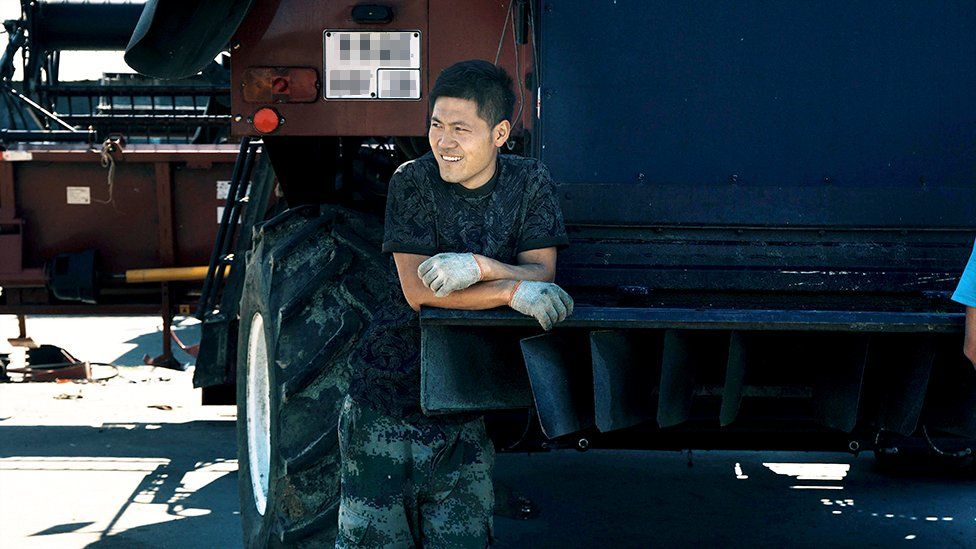
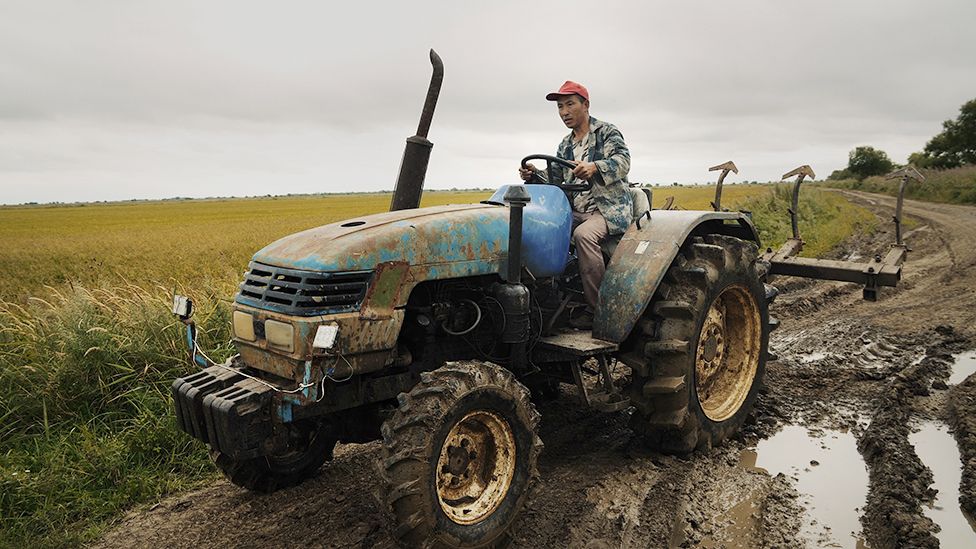
Image caption Chinese farmers are trying to bring workers across the border into Russia
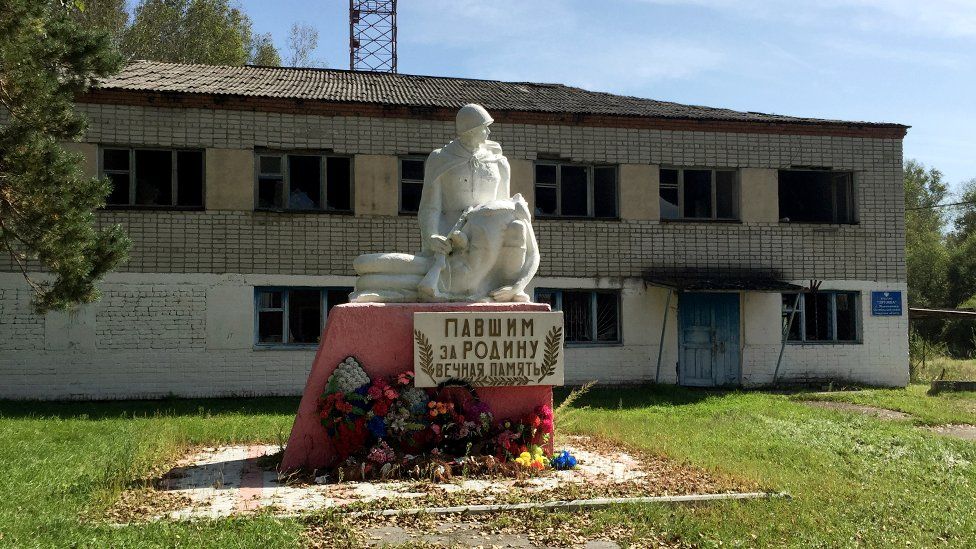
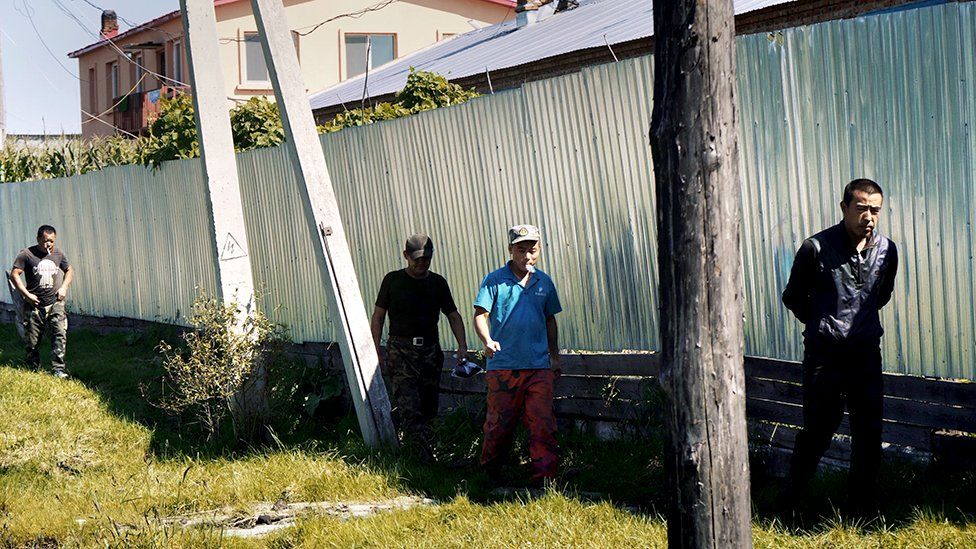
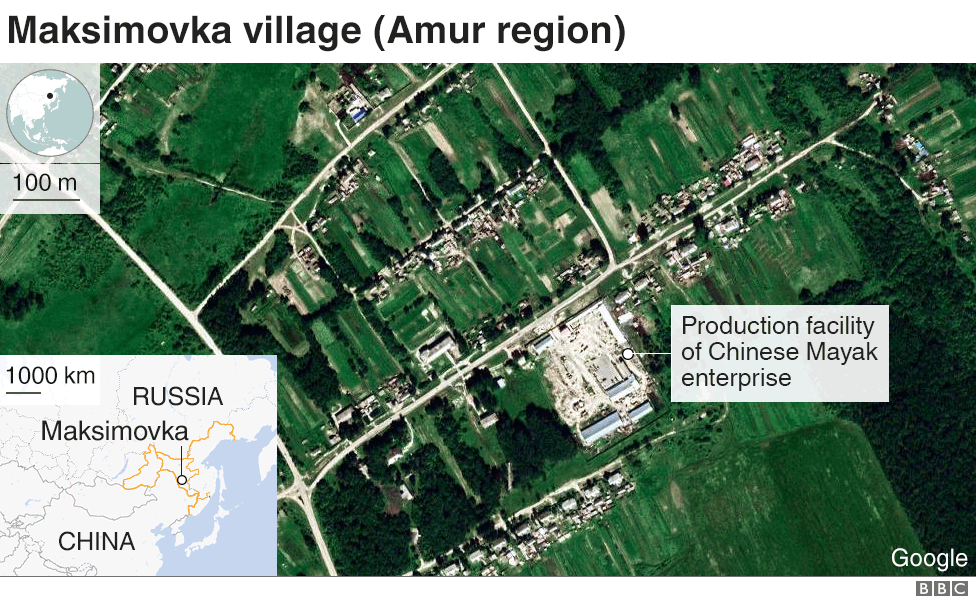
The farm in Maksimovka is surrounded by high metal fences. The Chinese migrants who work there only leave the site to go shopping. At the centre of this village in Russia’s Far East sits an old abandoned building – there is no lock on the door and inside, the floor is littered with papers dating back to the 1980s and 90s.
Here lie clues to why a farm that once provided work to some 400 Russians was unable to survive.
Like many of the collective farms in rural Russia, the Mayak farm collapsed with the old Soviet Union.
That is when the Chinese workers arrived, in five border regions, and Russians have not always been happy to welcome their new neighbours.
Image caption Little remains of the old farm at Mayak, apart from a monument to those killed in World War Two
“Working in Russia is much the same as in China. You get up in the morning and go to work,” says Chom Vampen.
He is one of thousands of Chinese who have moved to this vast, under-populated part of Russia since the early 1990s.
Most seek work at Russian- or Chinese-owned farms or buy the lease on the land to develop their own agricultural enterprises.
As Russia’s relations with the West have deteriorated, President Vladimir Putin has welcomed China’s growing footprint here.
Image caption Chinese farm workers from Maksimovka
Mayak’s chairman, Yevgeny Fokin, leased thousands of hectares to Chinese entrepreneurs, attracted by low rents and large farms.
“We gave the shares to Fokin, thinking it would be better if the land belonged to the collective. But he gave it all to the Chinese and left, and we lost everything,” a local resident of Maksimovka village, Tatyana Ivanovna, said.
“No way,” says Mr Fokin. “There was nothing unusual about it.”
How Chinese companies took over
Chinese companies first appeared in Russia’s Far East in the early 2000s, but Beijing’s interest in the region increased after the global financial crisis of 2008.
“There was panic, [the Chinese] were looking at where to invest,” the head of a Chinese-owned farm told BBC Russian, preferring not to give his name.
Chinese investment was followed by an influx of Chinese migrants.
“We have little land and a lot of people,” said one Chinese farmer.
Based on data released by the state land register, BBC Russian calculated that Chinese citizens either owned or leased at least 350,000 hectares (3,500 sq km) of Far Eastern land in Russia. In 2018, around 2.2 million hectares of Russian land in the region was used for agricultural purposes.
The actual proportion could be higher, the BBC has learned
Chinese farmers are, according to BBC research, represented in 40% of the Far East, most significantly in the Jewish autonomous region of Birobidzhan.
Regional governor Alexander Levintal said that in many cases land officially leased by Russians was in reality managed by Chinese nationals.
“Almost all the land that belonged to collectives was handed over to the Chinese,” said the head of the Jewish autonomous region’s peasant association, Alexander Larik.
Why relations are uneasy
Most of the farms run by Chinese migrants resemble fortresses. At Babstovo, a half-hour drive from the Chinese border, lies Friendship farm, which is surrounded by a high fence and a red flag.
Image caption Chinese workers here are main seasonal and rarely settle in Russia
But things are different in the village of Opitnoye Polye, where Xin Jie employs Russian as well as Chinese workers.
Like many Chinese here, he adopted a Russian name and is now known as Chinese Dima.
Chinese Dima moved to Russia in the 1990s and leased more than 2,500 hectares of land to develop a soya plantation. He is actively involved in the community, buying presents for nursery school children and sending his tractor to help clear the snow in remote villages in the winter.
Conflicts between Russians and Chinese are not uncommon. In 2015, three Russians entered a Chinese factory in the Far Eastern Amur region and threatened a Chinese guard with a stick, demanding he give them food.
A few days later, when they returned to steal a tractor engine, they were confronted by the same Chinese guard who this time carried an axe.
They were given prison sentences ranging from five to nine years.
Most Chinese cross the border for seasonal work, for sowing or harvesting, and then return home.
But many Russians are unhappy with the Chinese influx. More than one in three people said they viewed China’s Russia policy as expansion, according to a poll conducted in 2017 by the Russian Academy of Sciences.
Almost half said that China threatened Russia’s territorial integrity, while a third believed that it endangered their country’s economic development.
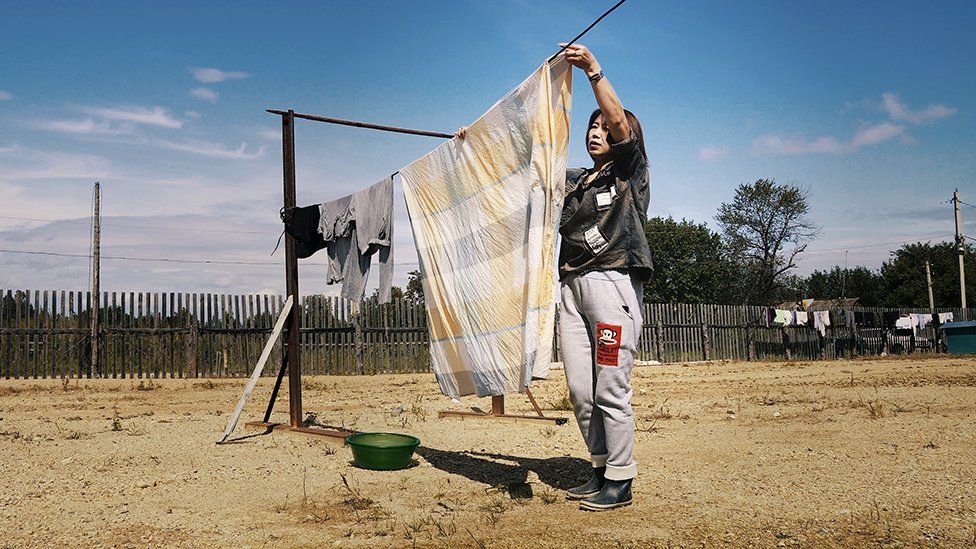
Image caption A Chinese woman hangs out the washing on a farm at Dimitrovo
“They leave at seven in the morning and return after dark. I don’t see them and they don’t see me,” says Ivanovich of his Chinese neighbours in the village of Dimitrovo.
But some Russians have struck up friendships with the Chinese.
“They bring beer, we drink. I give them eggs and honey,” says Alexander.
Why Russian workers struggle to compete
Chinese farm workers in Russia’s Far East often have a better reputation than their Russian counterparts.
“The Chinese do not drink and they have nowhere to run; they come here for the season. Our citizens come to work for a week, plead for money and then go on a bender,” complained one Russian agricultural boss who declined to give his name.
Mr Larik, of the peasant association in the Jewish autonomous region, said Chinese farm owners generally preferred hiring Chinese migrants and gave Russian nationals low-skilled jobs.
A Chinese farmer who asked to stay anonymous complained about the drinking habits of Russian employees.
“All Russians drink. Today you pay them, tomorrow they do not show up. There are problems with discipline,” he said.
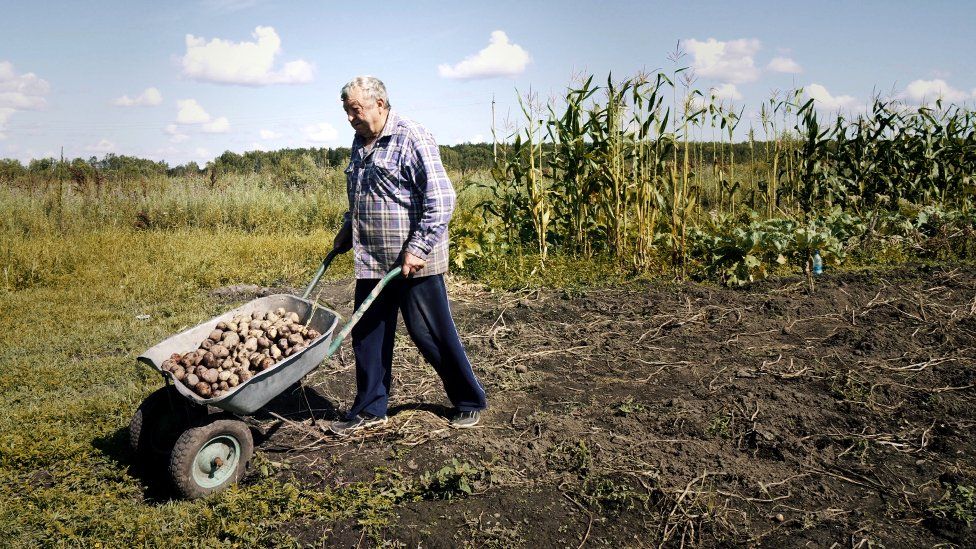
Image caption Residents in Maksimovka complain that young people tend to head to the cities, leaving only pensioners behind
Russia has a poor record of protecting workers’ rights, especially in the agriculture industry, which is generally low paid.
Not everyone here has a low opinion of local workers.
“What is the difference between Russian and Chinese workers? Russian workers are smarter than the Chinese,” says Chom Vampen.
BEIJING, Feb. 9 (Xinhua) — The Chinese Foreign Ministry on Saturday expressed strong opposition to Indian Prime Minister Narendra Modi’s visit to a region on the east section of the China-India border.
Spokeswoman Hua Chunying’s remarks came in response to a query about news reports saying that Prime Minister Modi visited the so-called “Arunachal Pradesh” earlier in the day.
“China’s position on the China-India border issue is consistent and clear-cut,” said Hua, stressing that the Chinese government has never recognized the so-called “Arunachal Pradesh.”
While urging the Indian side to bear in mind the common interests of the two countries, Hua called on the neighboring country to respect interests and concerns of the Chinese side, cherish the momentum of improvement in bilateral ties and refrain from “any action that may lead to an escalation of disputes or complicate the border issue.”
China has either deployed or plans to induct cutting-edge weaponry for its land border troops to use. Last August, China said it was building rockets for its artillery brigades that will be propelled by the “electromagnetic catapult” technology and can be used in the high altitude plateaus of the TAR.
China has equipped its forces in Tibet, which has a long border with India, with new vehicle-mounted howitzers to improve combat capability at high altitudes, reports sourced from the People’s Liberation Army (PLA) said on Tuesday.(Reuters File Photo)
China has equipped its forces in Tibet, which has a long border with India, with new vehicle-mounted howitzers to improve combat capability at high altitudes, reports sourced from the People’s Liberation Army (PLA) said on Tuesday.
It is the same cannon used by an artillery brigade during the 73-day Sino-India border standoff at Doklam (Donglang in Chinese), a state media report said, indicating that since then it has been inducted in high-altitude brigades on a wider scale in the border areas of the Tibet Autonomous Region (TAR).
The deployment comes at a time with China’s border issues, with India and Bhutan, remain unresolved and “…challenged by pro-Tibet independence forces and terrorists,” an analyst told the state media.
The deployed weapon is said to be the rarely seen PLC-181 vehicle-mounted howitzer cannons, capable of firing and then rapidly changing positions. It is said to be a new addition in the arsenal of the PLA ground forces (PLAGF).
The information was first released on a social media app by the PLAGF, saying the PLA in the Tibet Military Command is equipped with the new howitzer, which Chinese military analysts said is supposed to be the PLC-181 vehicle-mounted howitzer.
Song Zhongping, a military expert, told the nationalistic tabloid Global Times the howitzer has 52-caliber cannon with a range of over 50 kilometres and shoots laser-guided and satellite-guided projectiles.
“It will boost the high-altitude combat capability of the PLA in Tibet,” Song said.
“As part of military training in 2019, an artillery brigade in the Tibet Military Command ordered soldiers to take part in a military skills competition at a training ground on the Qinghai-Tibet Plateau 3,700 meters above sea level,” the report said.
Video from the China News Service on Sunday shows soldiers engaged in military boxing, standstill shooting and firing in motion, as well as assembling guns on the snowfields to improve their attack capability.
The information about the new deployment comes within days of President Xi Jinping commanding China’s armed forces to be ready for combat and be prepared for unexpected crisis and war.
The armed forces should have enhanced awareness of danger, crisis and war, Xi told a meeting of the central military commission (CMC), the top military organisation in the country of which he is the chairperson.
The deployment is not to provoke neighbours but defensive in nature, Zhao Gancheng, director of the Centre for Asia-Pacific Studies at the Shanghai Institute for International Studies told the Global Times.
China has either deployed or plans to induct cutting-edge weaponry for its land border troops to use.
Last August, China said it was building rockets for its artillery brigades that will be propelled by the “electromagnetic catapult” technology and can be used in the high altitude plateaus of the TAR.
Calling the innovation “unprecedented”, the report said the catapult-propelled rockets, which can hit targets beyond 200 km, will be more powerful and effective than conventional artillery guns.





 CHINDIA ALERT: You'll be living in their world, very soon