Archive for ‘Brasilia’

14/11/2019

China ready to achieve common prosperity with Brazil: Xi

BRAZIL-BRASILIA-XI JINPING-BRAZILIAN PRESIDENT-TALKS

Chinese President Xi Jinping holds talks with Brazilian President Jair Bolsonaro in Brasilia, Brazil, Nov. 13, 2019. (Xinhua/Ding Haitao)

BRASILIA, Nov. 13 (Xinhua) — Chinese President Xi Jinping said on Wednesday China is fully confident in China-Brazil cooperation and stands ready to achieve common prosperity with Brazil.

Xi made the remarks when meeting here with Brazilian President Jair Bolsonaro.

Noting that Bolsonaro paid a successful state visit to China in October, Xi said the consensus reached by the two sides is being actively implemented.

At the recently concluded second China International Import Expo (CIIE), the transaction volume of Brazilian businesses grew 3.6 times compared with that at the first CIIE last year, Xi said, calling the results gratifying.

As the largest emerging-market country in the eastern and western hemispheres, respectively, Xi said, China and Brazil share broad common interests.

China is optimistic about Brazil’s development prospects and fully confident in bilateral cooperation, Xi said, adding that China stands ready to share development experience and gains with Brazil, so as to achieve common prosperity.

Xi expressed willingness to work with Bolsonaro to properly grasp and guide the direction of the development of China-Brazil relations.

China and Brazil are both major countries and the two sides should maintain strategic focus, adhere to mutual respect, treat each other as equals, strengthen exchanges and cement mutual trust, Xi stressed.

He urged both sides to open markets to each other and explore ways to establish long-term, stable and direct supply channels for basic products, including agricultural products, iron ore and crude oil.

China supports its enterprises to actively participate in Brazil’s infrastructure construction to promote connectivity, Xi said.

Xi called on both sides to advance cooperation in areas such as digital economy, next-generation communications, material science and biotechnology, wishing another successful launch of the China-Brazil Earth Resources Satellite in the near future, and urging the two sides to jointly promote the follow-up cooperation.

Xi also urged both sides to expand cultural and people-to-people exchanges and facilitate personnel exchanges.

China supports the Brazilian government’s efforts to combat the disaster in the Amazon rainforest and believes that Brazil is capable of overcoming the disaster, Xi said.

Both sides should work together to promote all-round exchanges and cooperation between China and Latin American countries, uphold multilateralism, build an open world economy, and safeguard the legitimate development rights and interests of emerging markets, Xi said.

The Chinese president added that China supports Brazil in hosting the upcoming BRICS summit and stands ready to work with all parties to make the summitry a success.

For his part, Bolsonaro said he has instructed relevant government departments to implement as soon as possible the consensus reached during his state visit to China, calling that visit a success.

Noting that China is a significant major country and Brazil’s largest trading partner, Bolsonaro said the Brazilian people hold admiration, respect and friendly feelings toward the Chinese people, and Brazil-China cooperation boasts increasing significance to Brazil’s future development.

Economies of Brazil and China are highly complementary and the areas of cooperation continue to expand, Bolsonaro said, adding that his country welcomes Chinese investment to Brazil and stronger cooperation in infrastructure construction, iron ore, and the energy sector, including oil and gas.

The Brazilian side values the important opportunities brought about by China’s opening-up of its market, he said, expressing the hope to expand bilateral trade and promote export of more Brazilian agricultural products to China.

His country is also willing to offer favorable conditions for Chinese enterprises and products to enter Brazil, he said, adding that Brazil stands ready to facilitate personnel exchanges and cultural and people-to-people exchanges.

Bolsonaro thanked China for supporting Brazil’s sovereignty over the Amazon rainforest issue and expressed his willingness to cooperate with China on biodiversity conservation.

He also thanked China for supporting Brazil in hosting the BRICS summit, adding that Brazil is ready to strengthen coordination and cooperation with other parties for a summit that produces positive outcomes.

Brazil is grateful for China’s trust and friendship, said Bolsonaro, adding that from a long-term perspective, Brazil attaches importance to strengthening cooperation with China in a wide range of areas, so as to deepen their traditional friendship and benefit the two peoples.

After the meeting, the two heads of state jointly met the press and witnessed the exchange of a number of documents on bilateral cooperation.

Source: Xinhua

11/11/2019

Spotlight: China-Brazil trade set to reach new heights

SAO PAULO, Nov. 11 (Xinhua) — Though separated by oceans and continents, China and Brazil have fostered deepening bilateral cooperation over the years, especially in  investment, trade and finance.

With the upcoming 11th BRICS summit in Brazil’s capital Brasilia, expectations are high for the development of closer ties between the two countries.

STRENGTHENING INVESTMENT

China and Brazil have bolstered investment ties in recent years, and the Asian country has become Brazil’s largest source of foreign investment.

The two countries are not only deepening cooperation in the traditional areas of agriculture, electricity, mining and infrastructure, but also fostering growth in new areas such as technology innovation and the digital economy.

Last month, Brazilian telecommunications giant Oi put Chinese company Huawei’s 5G technology to the test during a local music festival — the largest trial of the 5G technology in Brazil.

Chinese Internet giant Alibaba’s website AliExpress has become one of Brazil’s most popular cross-border e-commerce platforms. Chinese Internet company Tencent and mobile ride-hailing platform DiDi have also invested in Brazilian companies.

Finally, the participation of Latin American countries — including Brazil — in jointly building the Belt and Road will provide a great opportunity for these countries to enhance investment cooperation with China, said Oliver Stuenkel, an expert of international relations at Brazil’s Getulio Vargas Foundation.

INCREASING TRADE

Although the global economy is facing downward pressure, bilateral trade between China and Brazil has continuously climbed, as both countries are committed to opening up their markets.

China has been Brazil’s largest trading partner and largest export market for a decade. In 2018, bilateral trade hit a record 100 billion U.S. dollars, official data showed.

Cheese bread, Brazil’s favorite breakfast and snack food, is now available at cafeterias in China, thanks to the first China International Import Expo (CIIE) in Shanghai last year.

In May, Brazil’s leading cheese bread maker Forno de Minas shipped its first container of 10 tons of cheese bread to China, supplying cafeterias in Shanghai. Two months later, the bakery shipped a second batch of 18 tons to China.

Brazil is also dedicated to opening up by optimizing its business environment. Li Tie, general manager of the Brazilian branch of BYD, a leading Chinese manufacturer of electric vehicles and batteries, said that the Brazilian government has actively promoted pension and labor law reforms and is planning to carry out tax reforms.

China and Brazil should further enhance their economic and trade relations, which have been fruitful and mutually beneficial, said Sergio Segovia, president of the Brazilian Trade and Investment Promotion Agency.

FINANCIAL COOPERATION

The two countries have enhanced cooperation in the financial sector.

In September, the Brazil government relaxed restrictions on the establishment of financial institutions. Bank XCMG, affiliated to China’s Xuzhou Construction Machinery Group, has become the first foreign bank that was approved by Brazil’s central bank after the release of the new regulation, and the bank’s foreign shareholding ratio is as high as 100 percent.

Wang Yansong, XCMG’s vice president, said that Bank XCMG will carry out financial leasing and other services in Brazil and help companies reduce exchange rate risks and financing costs.

As cross-border trade grows, fin-tech companies from both countries have carried out in-depth cooperation, such as that between Brazilian financial payment company Ebanx and AliExpress, in providing consumers with cross-border payment solutions.

In 2018, Ebanx handled 35 million cross-border transactions related to Chinese merchants, said its co-founder and CFO Wagner Ruiz. He expressed the hope that the company can help Chinese merchants sell more in Latin America in the future.

The BRICS leaders’ meeting is an excellent opportunity for Brazil to deepen business, investment and financial cooperation with China and other BRICS countries, said Marcos Trojan, special secretary for foreign trade and international affairs of Brazil’s Ministry of Economy.

Source: Xinhua

08/11/2019

Xi Focus: Xi’s trip to Greece, Brazil to advance bilateral ties, BRICS cooperation

BEIJING, Nov. 7 (Xinhua) — Chinese President Xi Jinping’s upcoming visit to Greece and Brazil is expected to intensify China’s relations with the two countries and enhance BRICS cooperation, officials said here Thursday.

At the invitation of Greek President Prokopis Pavlopoulos, Xi will pay a state visit to Greece from Nov. 10 to 12, said Vice Foreign Minister Qin Gang.

This will be the first visit to the European country by a Chinese president after an interval of 11 years, which will exert a historic influence of China-Greece ties and push forward China-Europe relations and Belt and Road cooperation, Qin said.

He noted that China and Greece, both with old civilizations, are trustworthy and helpful friends respecting and supporting each other on core interests and major concerns.

Greece is among the first European Union (EU) countries to sign an intergovernmental cooperation document with China to jointly construct the Belt and Road, Qin said, adding that Greek prime ministers attended the first and second Belt and Road Forum on International Cooperation in Beijing.

The two sides have conducted fruitful cooperation on the principle of mutual benefit and win-win cooperation and witnessed increased bilateral trade and investment, Qin said.

“The Piraeus Port project, a flagship project for the Belt and Road cooperation, has made important contributions to the local economic and social development of Greece and played an important role in advancing connectivity in various regions around the globe,” said the vice foreign minister.

Speaking of people-to-people and cultural exchanges, Qin said peoples of the two countries respect each other and advocate openness and inclusiveness in their close interactions.

“Both China and Greece hold that different civilizations should respect each other and facilitate experience sharing, mutual learning and conversation among civilizations,” he said.

China and Greece are new friends of the “17 +1” cooperation. In April this year, Greece became a full member of the China-Central and Eastern European Countries Cooperation Mechanism, adding new opportunities to the development of this mechanism, which is also conducive to developing China-EU relations and China-EU connectivity, Qin said.

Greek Prime Minister Kyriakos Mitsotakis led a delegation to the ongoing second China International Import Expo (CIIE). Xi met with him, and the two leaders visited the Greek pavilion, Qin said.

According to Qin, in Greece, Xi is scheduled to hold talks respectively with Pavlopoulos and Mitsotakis, in a bid to consolidate political mutual trust and traditional friendship between the two countries, intensify pragmatic cooperation in trade, investment, infrastructure and other fields, uphold multilateralism and free trade and build an open world economy.

Besides, Qin noted that the Chinese and Greek leaders will conduct cultural exchanges and advocate dialogues among civilizations.

The two sides will issue a joint statement on strengthening the comprehensive strategic partnership, draw up a blueprint for the development of bilateral ties, sign intergovernmental cooperation documents on investment and education, and ink commercial agreements in such fields as ports, finance, and energy.

Greece, in the West, and China, in the East, are heirs of ancient civilizations. Noting that both China and Greece are faced with the mission of rejuvenation and prosperity, Qin said the two countries can enlighten the world to deal with various problems and challenges.

Xi’s upcoming visit to Greece shows respect and appreciation of the ancient Chinese civilization to the ancient Greek civilization, as well as the expectation of jointly building a community with a shared future for humanity, Qin said.

It is believed the visit will elevate the level of bilateral cooperation in an all-round way and inject new impetus to the development of China-EU relations with fruitful results, Qin stressed.

According to Vice Foreign Minister Ma Zhaoxu, at the invitation of Brazilian President Jair Messias Bolsonaro, Xi will attend the 11th BRICS summit in Brasilia, the capital of Brazil, from Nov. 13 to 14.

BRICS is the acronym for an emerging-market bloc that groups Brazil, Russia, India, China and South Africa.

Xi is scheduled to attend the closing ceremony of the BRICS business forum, closed and public meetings of the BRICS leaders’ meeting and the BRICS leaders’ dialogue with the BRICS Business Council and the New Development Bank. The leaders’ declaration is expected to be released, Ma said.

Xi will hold talks with Bolsonaro, sign cooperation documents in various fields, and hold bilateral meetings with leaders of other participating countries to exchange views on ties and BRICS cooperation, Ma said.

As the world is undergoing changes rarely seen in a century and confronted with unprecedented opportunities and challenges, BRICS countries have drawn ever-growing attention worldwide, Ma said, stressing that China appreciates the efforts made by Brazil in its preparation and stands ready to jointly prompt the meeting to achieve fruitful results.

He voiced expectations of the Chinese side.

“The Chinese side hopes that BRICS countries will further enhance political mutual trust, boost mutually beneficial cooperation and forge a more comprehensive, closer and broader partnership,” Ma said.

As for safeguarding multilateralism and strengthening global governance, Ma voiced China’s determination to make joint efforts with other BRICS countries to safeguard the rules-based multilateral trade system, the international order based on international law, and the international system with the UN at the core.

This aims to promote a more equitable, open, transparent and inclusive global governance system and safeguard common interests and development space of emerging markets and developing countries, Ma said.

“China believes the five BRICS countries should follow the trend of the new industrial revolution and facilitate economic transformation and upgrading,” Ma noted.

As an important outcome of last year’s Johannesburg meeting, the BRICS partnership for a new industrial revolution has progressed well in the past year, he said, adding that China is willing to work with concerned parties to accelerate the development of the partnership and tap more potential for cooperation projects, so as to propel high-quality development of the five countries.

“China looks forward to more cooperation on economy, trade, finance, political security and people-to-people exchanges, with projects meeting the development needs of the five countries and serving the interests of their peoples,” he said.

The Chinese side believes that with concerted efforts of all parties and under the political guidance of the five countries’ leaders, the 11th BRICS Summit will be a full success, Ma said, stressing that the BRICS countries will continue to contribute to world peace and development and the building of a community with a shared future for humanity.

Source: Xinhua

31/10/2019

Brazilian editions of “Xi Jinping: The Governance of China” released in Sao Paulo

BRAZIL-SAO PAULO-XI JINPING-BOOK-RELEASE

Liang Yanshun (2nd L), deputy head of the Publicity Department of the Communist Party of China Central Committee, presents books to Sao Paulo State Governor Joao Doria (2nd R) during the release ceremony held at Palacio dos Bandeirantes, the seat of the state government, in Sao Paulo, Brazil, Oct. 29, 2019. The Brazilian editions of the first and second volumes of “Xi Jinping: The Governance of China” in Portuguese were released here Tuesday, prior to the 11th BRICS summit to be held next month in Brazil. (Xinhua/Gao Chunyu)

SAO PAULO, Oct. 29 (Xinhua) — The Brazilian editions of the first and second volumes of “Xi Jinping: The Governance of China” in Portuguese were released here Tuesday, prior to the 11th BRICS summit to be held next month in Brasilia.

More than 260 guests, including Liang Yanshun, deputy head of the Publicity Department of the Communist Party of China Central Committee, Chinese Consul General in Sao Paulo Chen Peijie and Sao Paulo State Governor Joao Doria, attended the release ceremony held in Palacio dos Bandeirantes, the seat of the state government.

In his address, Liang said the book reflects the evolution and main points of Xi Jinping Thought on Socialism with Chinese Characteristics for a New Era, expounded on China’s path of development and its solutions to some of the common challenges facing mankind.

The publication of the book will inject new vitality into the China-Brazil efforts to strengthen exchanges on governance and chart a new course for bilateral ties, Liang added.

The book also talks about China’s approaches to keeping world peace and promoting human development, said Chen, adding that it will help Brazilian readers better understand China’s ideas and stances regarding international affairs as well as its diplomatic policies and practices.

For his part, Doria said that he felt honored that the release event was held in Sao Paulo.

Noting that China has set an example in national governance and economic development, the governor suggested Brazilians study the book, so as to draw inspiration from China’s experiences in facing various challenges.

The event was jointly held by the Chinese State Council Information Office, the Chinese Embassy in Brazil, China International Publishing Group and the Chinese Consulate General in Sao Paulo.

Source: Xinhua

28/07/2019

Chinese FM says BRICS cooperation a strategic choice, urges bigger BRICS role in world affairs

BRAZIL-RIO DE JANEIRO-CHINA-WANG YI-BRICS-MEETING

Chinese State Councilor and Foreign Minister Wang Yi (2nd L) poses for a group photo with Brazilian Foreign Minister Ernesto Araujo (3rd L), Russian Foreign Minister Sergey Lavrov (1st L), South African Foreign Minister Naledi Pandor (2nd R) and India’s Minister of State for External Affairs Vijay Kumar Singh in Rio de Janeiro, Brazil, July 26, 2019. Wang Yi attended the Formal Meeting of the BRICS Ministers of Foreign Affairs in Rio de Janeiro. (Xinhua/Xin Yuewei)

RIO DE JANEIRO, July 27 (Xinhua) — The rise of emerging markets and developing countries, represented by the BRICS countries, has bolstered a more multi-polar world, Chinese State Councilor and Foreign Minister Wang Yi said here on Friday.

At the Formal Meeting of the BRICS Ministers of Foreign Affairs, Wang also said BRICS cooperation is not a band-aid solution for the five countries but a strategic choice that focuses on common and long-term development and harbors bright prospects.

The five countries are Brazil, Russia, India, China and South Africa.

Wang said no matter how the international landscape changes, the direction of the BRICS cooperation must not change. Faced with new challenges, the five countries should let their voices be heard, offer more solutions to pressing global issues and play a greater role in world affairs.

Wang pointed out that unilateralism undermines international rules and challenges the international rule of law, which exacerbates the instability and uncertainty of the world.

The BRICS countries must take the lead in maintaining multilateralism and safeguarding the global governance system with the UN as its core and under international law.

Furthermore, the bloc should safeguard the multilateral trading system represented by the WTO and protect the common interests and development space of emerging market and developing countries, he said.

The five countries together must continue to integrate the interests of other emerging market countries and developing countries through flexible and diverse platforms such as “BRICS Plus.”

At the meeting, the five foreign ministers all agreed to safeguard the purposes and principles of the UN Charter, defend multilateralism and free trade, oppose unilateralism and protectionism, strengthen global governance, and build a community with a shared future for humankind.

They agreed that regional hotspot issues should be resolved through dialogue and consultation and that BRICS cooperation should work to benefit the peoples of the five countries.

The foreign ministers also agreed to maintain vigilance on cybersecurity issues and expressed opposition to the use of cybersecurity to suppress the development of science and technology in other countries. They agreed to strive toward an open and non-discriminatory environment for the application of information technology.

The foreign ministers were tasked with preparing for the BRICS summit to be held in Brasilia in November.

Source: Xinhua

19/05/2019

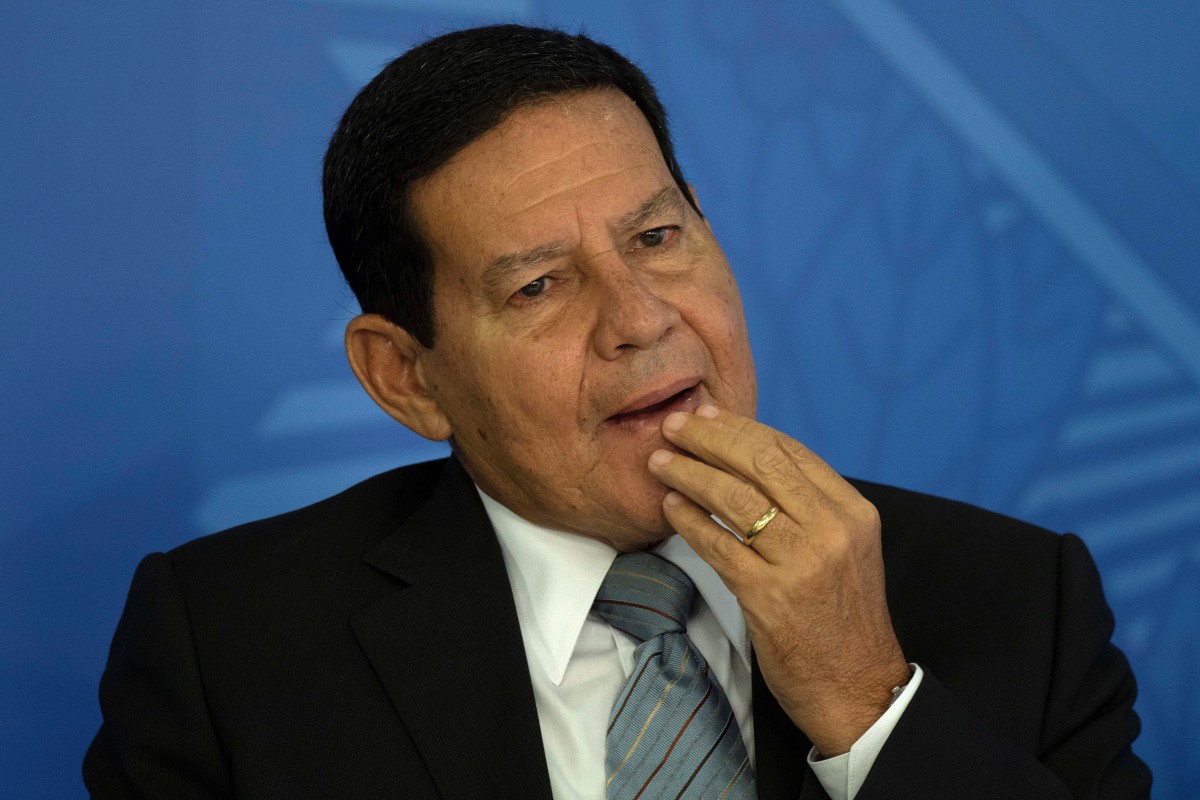
Brazil’s vice-president Hamilton Mourao heads to China to mend relations

  • General will spend five days meeting top Chinese leaders including President Xi Jinping
  • Mission seeks to patch up wounds caused by Brazilian President Jair Bolsonaro’s anti-China rhetoric
Hamilton Mourao favours maximising engagement with China. Photo: EPA-EFE
Brazil’s vice-president is expected to land in Beijing on Sunday on a mission to patch up wounds caused by President Jair Bolsonaro’s lacerating anti-China rhetoric.
General Hamilton Mourao will spend five days in China rubbing shoulders with some of the country’s most powerful leaders, culminating in an audience with President Xi Jinping, in an effort to shore up the relationship between the two emerging market giants. Bolsonaro himself is due to visit later this year, while Xi is due to visit Brasilia in November for the BRICS summit.
China – Brazil’s most important trading partner for the past decade – remains a sensitive subject in the Bolsonaro administration. While Mourao and the other business-oriented members of government favour maximising engagement with the Asian giant, Bolsonaro and his more radical appointees view China with a high degree of suspicion, as a predatory economy that wishes not merely to invest in Brazil, but to own it.

“The Chinese can buy in Brazil, but they can’t buy Brazil,” the president said at a breakfast with journalists last month.

Brazilian President Jair Bolsonaro said last month that the “Chinese can buy in Brazil, but they can’t buy Brazil”. Photo: AFP

Still, in comparison with his pre-election criticism of China as “heartless”, Bolsonaro in office has dialled down his anti-Beijing sentiment. Mourao’s visit is part of an effort to reset that relationship.

“The Chinese understand that Mourao plays a central role in toning down Bolsonaro’s rhetoric,” said Oliver Stuenkel, a specialist on BRICS – an association of five major emerging economies, namely Brazil, Russia, India, China and South Africa – at the FGV business school. “They know that the Mourao-China relationship will be fundamental.”

Should China be worried about Bolsonaro’s bromance with Trump?

Speaking to reporters recently, Mourao recognised the need to balance the Bolsonaro administration’s desire to pivot towards the United States with practical considerations of China’s economic significance.

“The US are the champions of democracy and freedom and our government has left it very clear what this represents,” the vice-president said. “But on the other side we have to be sufficiently pragmatic to understand the importance of China for Brazil’s economic development.”

Chinese investment in Brazil reached almost US$134 billion between 2003 and 2018, Brazilian government figures showed.

Chinese President Xi Jinping is expected to meet the visiting Brazilain vice-president. Photo: AP

While the trade war between the US and China may offer Brazil some short-term gains, particularly for its agricultural sector, the downsides outweigh the benefits, according to Renata Amaral, a foreign trade analyst at Barral MJorge consultancy.

“In truth this war is no good for anyone,” she said.

Mourao said that Brazil was monitoring the situation “critically and cautiously”.

Why US-China trade war could be good for Brazil
From the Chinese perspective, Beijing is looking for Brazil’s formal support for its “Belt and Road Initiative” – Chinese President Xi Jinping’s signature global infrastructure megaproject. Asked whether Brazil might sign up to the programme, Mourao said that any agreement would have to be approved by Bolsonaro in the second half of the year.
After trips to the Great Wall of China and the Shanghai Stock Exchange, Mourao will meet Xi, in a clear sign of Brazil’s importance to China. “The visit of vice-president Mourao will reinforce mutual political confidence, deepen our friendly cooperation and add new dimensions to our strategic partnership,” according to Chinese foreign ministry spokesman Geng Shuang.
With Beijing both uncertain about the direction of Brazilian foreign policy under Bolsonaro and eager to strike deals on infrastructure and food security, it makes sense for the Chinese to roll out the red-carpet for Mourao, according to Hussein Kalout, a specialist in foreign policy and a researcher at Harvard.
China trade vs economic growth: the dilemma for Brazil’s president
While the federal government remains ambivalent about its relationship with China, some of Brazil’s powerful state governors are seeking to develop their own relationship with the Asian country. One of them is Carlos Massa Ratinho Junior, the governor of the southern state of Parana, who travelled to China recently to discuss agriculture and railroad projects.
“We’re open to talk with any country that wants to and understands that the state of Parana is the best to place to invest in Brazil,” the governor said in an interview, adding that his actions did not conflict with the federal government’s stance towards Beijing.

But in a sign of the domestic pressure Bolsonaro is under not to abandon entirely his sceptical attitude to China, Luiz Philippe de Orleans e Braganca, the vice-president of the lower house’s foreign affairs committee and a lawmaker from Bolsonaro’s own party, said the government should set limits to the partnership.

“It’s good to talk to China, but it depends what is being discussed,” he said. “For example, the 5G network set up by China is dangerous because it will give the Chinese more information about Brazilian citizens than the Brazilian government.”

Source: SCMP

Law of Unintended Consequences

continuously updated blog about China & India

ChiaHou's Book Reviews

continuously updated blog about China & India

What's wrong with the world; and its economy

continuously updated blog about China & India