Archive for ‘Brazil’

19/03/2020

Rich world pumps aid to fight coronavirus, epicentre Europe reeling

LONDON/BEIJING (Reuters) – The world’s wealthiest nations poured unprecedented aid into the traumatized global economy on Thursday as coronavirus cases ballooned in the current epicentre Europe even as they waned at the pandemic’s point of origin, China.

With almost 219,000 infections and more than 8,900 deaths so far, the epidemic has stunned the world and drawn comparisons with painful periods such as World War Two, the 2008 financial crisis and the 1918 Spanish flu.

“This is like an Egyptian plague,” said Argentinian hotelier Patricia Duran, who has seen bookings dry up for her two establishments near the famous Iguazu Falls.

“The hotels are empty – tourist activity has died.”

Tourism and airlines have been particularly battered, as the world’s citizens hunker down to minimize contact and curb the spread of the flu-like COVID-19. But few sectors have been spared by a crisis threatening lengthy global recession.

On markets, investors have dumped assets everywhere, many switching to U.S. dollars as a safe haven. Other currencies hit historic lows, with Britain’s pound near its weakest since 1985.

Policymakers in the United States, Europe and Asia have slashed interest rates and opened liquidity taps to try to stabilise economies hit by quarantined consumers, broken supply chains, disrupted transport and paralysed businesses.

The virus, thought to have originated from wildlife on mainland China late last year, has jumped to 172 other nations and territories with more than 20,000 new cases reported in the past 24 hours – a new daily record.

Cases in Germany, Iran and Spain rose to over 12,000 each. An official in Tehran tweeted that the coronavirus was killing one person every 10 minutes.

LONDON LOCKDOWN?

Britain, which had sought to take a gradual approach to containment, was closing dozens of underground stations in London and ordering schools shut from Friday.

Some 20,000 military personnel were on standby to help and Queen Elizabeth was due to leave Buckingham Palace in the capital for her ancient castle at Windsor. Britain has reported 104 deaths and 2,626 cases, but scientific advisers say the real number of infections may be more than 50,000.

Italian soldiers transported corpses overnight from an overwhelmed cemetery in Europe’s worst-hit nation where nearly 3,000 people have died. Germany’s military was also readying to help despite national sensitivities over its deployment dating back to the Nazi era.

Supermarkets in many countries were besieged with shoppers stocking up on food staples and hygiene products. Some rationed sales and fixed special hours for the elderly.

Solidarity projects were springing up in some of the world’s poorest corners. In Kenya’s Kibera slum, for example, volunteers with plastic drums and boxes of soap on motorbikes set up handwashing stations for people without clean water.

Russia reported its first coronavirus death on Thursday.

Amid the gloom, China provided a ray of hope, as it reported zero new local transmissions in a thumbs-up for its draconian containment policies since January. Imported cases, however, surged, accounting for all 34 new infections.

The United States, where President Donald Trump had initially played down the coronavirus threat, saw infections close in on 8,000 and deaths reach at least 151.

Trump has infuriated Beijing’s communist government by rebuking it for not acting faster and drawn accusations of racism by referring to the “Chinese virus”.

“EXTRAORDINARY TIMES”

In a bewildering raft of financial measures around the world, the European Central Bank launched new bond purchases worth 750 billion euros ($817 billion). That brought some relief to bond markets and also halted European shares’ slide, though equities remained shaky elsewhere.

“Extraordinary times require extraordinary action,” ECB President Christine Lagarde said, amid concerns that the strains could tear apart the euro zone as a single currency bloc.

The U.S. Federal Reserve rolled out its third emergency credit programme in two days, aimed at keeping the $3.8 trillion money market mutual fund industry functioning.

China was to unleash trillions of yuan of fiscal stimulus and South Korea pledged 50 trillion won ($39 billion).

The desperate state of industry was writ large in Detroit, where the big three automakers – Ford Motor Co (F.N), General Motors Co (GM.N) and Fiat Chrysler Automobiles NV (FCHA.MI) (FCAU.N) – were shutting U.S. plants, as well as factories in Canada and Mexico.

With some economists fearing prolonged pain akin to the 1930s Great Depression but others anticipating a post-virus bounceback, gloomy data and forecasts abounded.

In one of the most dire calls, J.P. Morgan economists forecast the Chinese economy to drop more than 40% this quarter and the U.S. economy to shrink 14% in the next.

There was a backlash against conspiracy theories and rumours circulating on social media, with Morocco arresting a woman who denied the disease existed.

And in Brazil, where President Jair Bolsonaro initially labelled the virus “a fantasy”, more members of the political elite fell ill. At night, housebound protesters banged pots and pans, shouting “Bolsonaro out!” from their windows.

Source: Reuters
12/03/2020

Coronavirus: China’s mask-making juggernaut cranks into gear, sparking fears of over reliance on world’s workshop

  • China is now making more than 100 million masks a day, up from 20 million before the coronavirus outbreak, and may start to export more to other countries
  • Mask shortages elsewhere once more raise the debate about an over-reliance on China, with critics pointing to a lack of US industrial policy
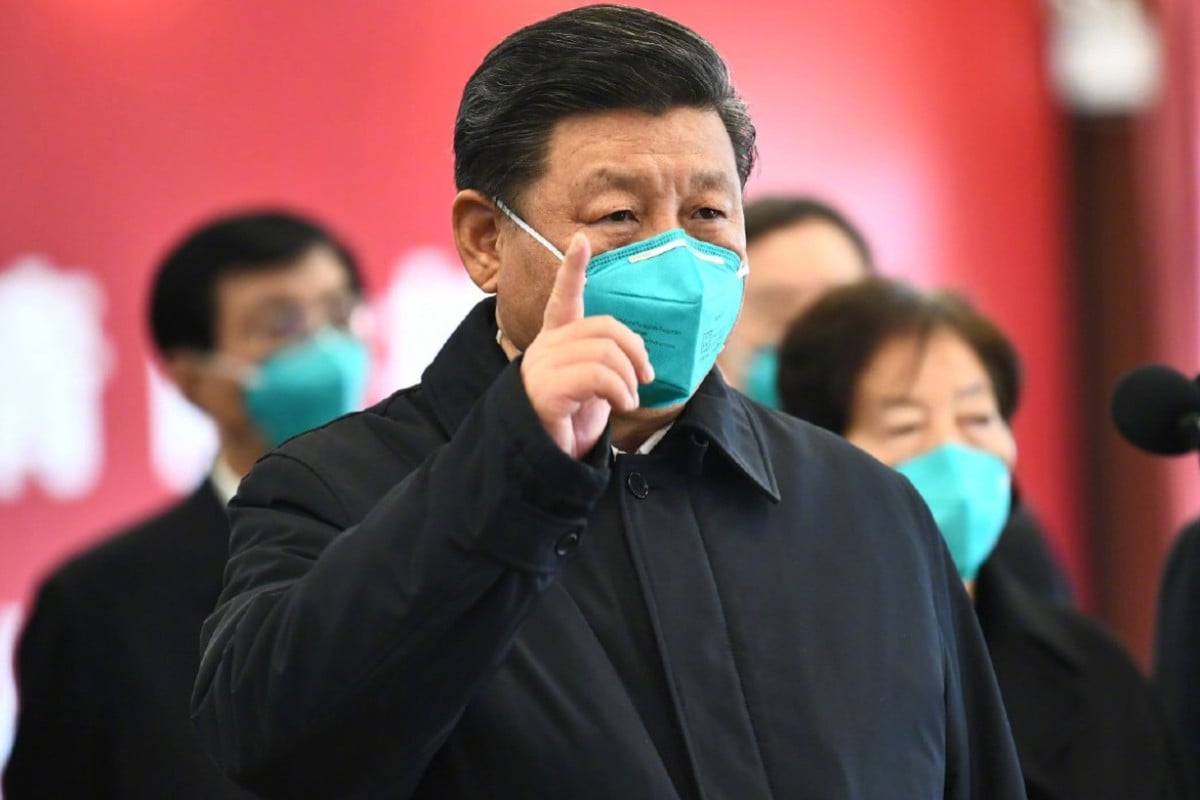
China was producing 116 million masks per day of February 29, including a mix of disposable and high-end masks like the American-designed N95 model worn by President Xi Jinping on his trip on Tuesday to Wuhan. Photo: Xinhua

The Liu family factory has been making diapers and baby products in the Chinese city of Quanzhou for over 10 years, but in February, for the first time, it started making face masks, as demand soared spectacularly due to the coronavirus outbreak.

The business – which employs 100 people in the Southeastern Fujian province – has added two production lines to make up to 200,000 masks a day.
And while the decision was primarily commercial, “encouragement” from the Chinese government – in the form of subsidies, lower taxes, interest-free loans, fast-track approvals for expansion and help alleviating labour shortages – made the decision an obvious one, said Mr Liu who preferred only to give his family name.
“The government is advocating an expansion in production,” Liu said. “With faster approvals, producers need to prioritise the government’s needs over exports.”
WHO declares coronavirus crisis a pandemic
The factory is one of thousands of refitted pop-ups around China making masks and other protective equipment for the first time, part of a massive industrial drive to respond to the spread of the coronavirus.
Before the outbreak, China already made about half the world’s supply of masks, at a rate of 20 million units a day. That rose to 116 million as of February 29, according to China’s state planning agency, a mix of disposable and high-end masks like the American-designed N95 model worn by President Xi Jinping on his trip on Tuesday to Wuhan, the epicentre of the outbreak.

This exponential jump is the result of a wartime-like shift in industrial policy, with Beijing directing its powerful state-owned enterprises to lead the nationwide mask-making effort, and the country’s sprawling manufacturing engine following their lead.

For me, this is the big advantage of China, the speed Thomas Schmitz

“For me, this is the big advantage of China, the speed,” said Thomas Schmitz, president of the China branch of Austrian engineering giant Andritz, which has seen a big uptick in demand for its wet wipe-making machines in recent weeks, also due to the virus. “When you need to run, people know how to run, and this is something which has been lost in other countries since their industrial heydays.”

Chinese oil and gas major Sinopec upped production of mask raw materials such as polypropylene and polyvinyl chloride in January. This week, it set up two production lines in Beijing to produce melt-blown non-woven fabric, intended to make four tonnes of the fabric each day, which can then be used to produce 1.2 million N95 respirators or six million surgical masks a day.

The maker of China’s new J-20 stealth fighter jet, Chengdu Aircraft Industry Group, repurposed part of its factory to design a mask production line, according to local media reports. The Sichuan Daily said 258 of the company’s engineers spent three days fast-tracking development of an assembly line with more than 1,200 components.

Coronavirus: From mysterious origins to a global threat
More than 2,500 companies in China have reportedly started making masks, among them 700 technology companies including iPhone assembler Foxconn and smartphone makers Xiaomi and Oppo, in an extraordinary mobilisation of resources.

The result resembles “the war effort” in the middle of the last century in the United States and western Europe, but arguably no other nation could undergo such a transformation so quickly today.

It is a reminder of what can happen in a centrally-planned economy with a strong manufacturing base, but also brings into sharp focus some of the geopolitical issues which have characterised China’s at-times difficult relationship with the rest of the world, particularly the European Union and US, over the past couple of years.

China’s dominance in manufacturing has become all the more evident as the rest of the world scrambles to shore up their own dwindling medical supplies, leading many to wonder why the world is so dependent on it for vital supplies.

The lesson for Washington is not that we need to emulate the Chinese economic model, but rather that we need to better steward the industrial base in key sectors Rush Doshi

The Italian government, which is dealing with the highest number of coronavirus cases and deaths after China, is to take shipment of 1,000 ventilators, 2 million masks, 100,000 respirators, 200,000 protective suits and 50,000 testing kits from China.
Italian foreign minister Luigi Di Maio said after a phone call with Chinese counterpart Wang Yi, they had agreed the export deal in the same week that European neighbours France and Germany banned masks from being exported because of low domestic supplies.
The Italy export deal showed that “China is emerging as a global public goods provider as the US proves unable and unwilling to lead,” said Rush Doshi, the director of the China Strategy Initiative at the Washington-based Brookings Institute think tank.
“China’s ability to produce what is needed to fight coronavirus is not simply a product of its economic model – it’s also a product of its industrial capacity,” Doshi said. “The US once had this capacity too, but it has lost important parts of it. The lesson for Washington is not that we need to emulate the Chinese economic model, but rather that we need to better steward the industrial base in key sectors.”

The frustration is felt acutely by Michael Einhorn, president of medical equipment distributor Dealmed-Park Surgical in New York, who has been trying to source stock from China for weeks, “but cannot get straight answers” from vendors.

Unaware that Wuhan was still under heavy economic lockdown,
 Einhorn said he placed an order with a private seller in China’s virus-stricken city last week, but that the goods had not been shipped.
“Everyone is running out here, people are panicking in hospitals and we want to be able to help our most important customers,” Einhorn said. “We are dealing with hospitals that do not have products, how in the United States of America in 2020 did this happen?”
With the number of confirmed coronavirus cases in China falling daily, it is not inconceivable that the sort of export deal struck with Italian leaders becomes commonplace, although for now, it deal can be chalked up as a significant public relations coup for Beijing.

The World Medical Association is unable to specify how many masks are required to supply frontline medical staff in virus-hit areas, but said that “this crisis should be a wake up call for politicians and societies to make the necessary investment in emergency preparedness and to look into the vulnerability of our supply chains”.

Australian-listed manufacturer Eagle Health announced on Friday that it had installed production lines at its Xiamen factory in southern China to make 300 million masks a year and said it had already received orders from China and would be securing further larger orders internationally.

The group, which normally makes products including amino acids, protein supplements and lozenges in China, said it would prioritise meeting the large domestic demand, but was aware of an impending global shortage.

Eagle Health has already commenced production of its first order of 3.2 million medical masks for the Yiling Hospital Management Group in China, a process which will take 10 days. It has other smaller orders from Chinese government agencies and expects to receive more orders outside China.

The decision to make more masks came from increased demand. These are opportunities. The global demand for high quality masks will be significant Xu Gang

“The decision to make more masks came from increased demand. These are opportunities,” said chief executive Xu Gang. “The global demand for high quality masks will be significant. Imagine when the schools open. The situation will take some time to peak.”
Last week, the Australian Dental Association said supplies of masks at many practices were expected to run out within four weeks. The Australian government has since arranged a supply of 54 million masks for both the dental and medical industries.
At the same time, the US only has 1 per cent of the 3.5 billion masks it would need to counter a serious outbreak, Bloomberg reported.
While China has no quota on the volume of masks that had to be hived off for local consumption, the government has said domestic demand needs to be prioritised.

Businesses are free to export but overseas demand has yet to explode like it has in China, said Fujian factory owner Liu.

Wendy Min, sales director of Pluscare, a manufacturer based near the virus’ epicentre in Hubei province, said her company is making 200,000 masks per day, much of which are sold to the government, with exports still restricted by partial lockdown of workers and cargo transport.

“We previously exported to Europe, South America and other parts of Asia,” Min said. “But at the moment we can’t export. We are trying to discuss this with the government, but we cannot wait any more – we have to export soon.”

Min said that while she was receiving countless cold calls up until last week from people in China looking for masks, these have stopped, perhaps unsurprising given the abundance in supplies becoming available.

An influx of Chinese-made masks, though, is likely to be welcomed in other virus-stricken parts of the world.

Self-quarantine of all international travellers to Beijing as China fights import of coronavirus
Miguel Luiz Gricheno, CEO of Brazilian mask manufacturer Destra, said that his company is making 30,000 masks a day, but cannot meet local demand due to a lack of supplies, including the non-woven fabric from which masks are made.
“In disposable masks, most Brazilian companies are paralysed due to the lack of raw materials,” Gricheno said. “With the arrival of the coronavirus in Brazil, the demand has increased a lot but the main raw material comes from abroad.”
However, a short-term supply fix will not answer underlying questions about how so many countries found themselves in such dire straits, meaning the geopolitical fallout of the coronavirus will be extensive.
Decades of weak industrial policy helped elect US President Donald Trump, who said he would bring manufacturing jobs back to America at China’s expense. While he has waged a bruising two-year trade war with China in response, the current situation shows just how difficult it will be to change the global manufacturing processes, which are so heavily controlled by China.

One of the great flaws of globalisation is that everyone wanted things cheaper, but did you compromise your health care infrastructure in the process? Stephen Roach

“In the guise of trying to improve efficiency and create value for price-sensitive consumers, we’ve created a global production network that is very difficult to unwind,” said Stephen Roach, a professor of economics at Yale University and a veteran China watcher. “One of the great flaws of globalisation is that everyone wanted things cheaper, but did you compromise your health care infrastructure in the process.
Reuters reported that Trump is considering invoking the emergency provisions of the Defence Production Act, which would allow the government to instruct companies to alter production to help address the domestic shortage of medical supplies like masks. If a company is producing 20 per cent N95 masks and 80 per cent standard masks, the White House could order them to rejig the ratio, an unnamed official said.
The New York Times reported on Wednesday that the White House is preparing an executive order that would allow the government to buy medical supplies from overseas in the hope that it will incentivise companies to make them within the US.

But these changes still do not give Trump the sort of sweeping powers enjoyed by Chinese counterpart Xi.

“When you have a pluralistic, democratic situation that Trump is overseeing, it becomes more unwieldy” to take the steps necessary to address a crisis situation, said Harry Broadman, chair of the emerging markets practise at the Berkeley Research Group and a senior US government official in the 1980s and 1990s.

“That is why I think Trump looks at Xi with envy, because he doesn’t have to deal with a disparity of views or democratic interests,” Broadman said. “I think Trump is at heart a bilateral guy, as you saw with the phase one [US-China] trade deal and the state-to-state purchases. That is why he likes dealing with [Russian President Vladimir] Putin and Xi, because each of them can move mountains. I think Trump is very envious of that ability.”

Source: SCMP

13/02/2020

Why do many India MPs have criminal records?

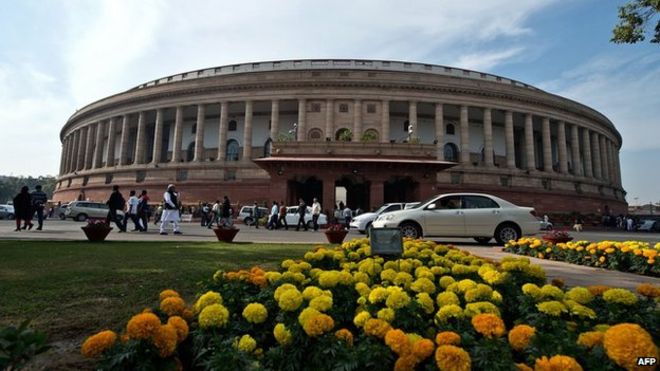
Indian parliamentImage copyright AFP
Image caption A third of the current members of parliament have criminal cases pending against them

“We need to build a consensus on how to prevent individuals with a criminal record from contesting elections.”

A necessary, even obvious fundamental you would think of building the world’s largest democracy.

And when Sonia Gandhi, India’s most powerful politician, uttered those words three years ago, even her main opponent, the leader of the BJP agreed.

Yet since then, things have gone in the opposite direction – with more alleged lawbreakers among India’s lawmakers than ever, a third of the current parliament according to a watchdog called the Association for Democratic Reforms.

By some calculations, politicians with a criminal record are more likely to be elected than those with a clean slate – because, says the ADR, they have more illicit funds with which to buy votes.

And on Tuesday night, India’s cabinet sought to ensure there was even less chance of criminal politicians facing their own laws.

It issued an order overturning a Supreme Court ruling demanding the disqualification of any politician convicted for crimes punishable with more than two years in jail.

This was “to ensure that governance is not adversely impacted“, the government had argued, with no apparent irony intended.

Unusual speed

Arguably, of course, the government is right. Losing tainted local or national politicians – among them many accused murderers, rapists and fraudsters – could upset delicate political alliances and make it even harder to get laws passed.

So often derided for doing nothing, this time round the cabinet acted with unusual speed.

The urgency it appears is the impending conclusion of two cases involving key politicians, due before Prime Minister Manmohan Singh gets back to India from a trip to the US.

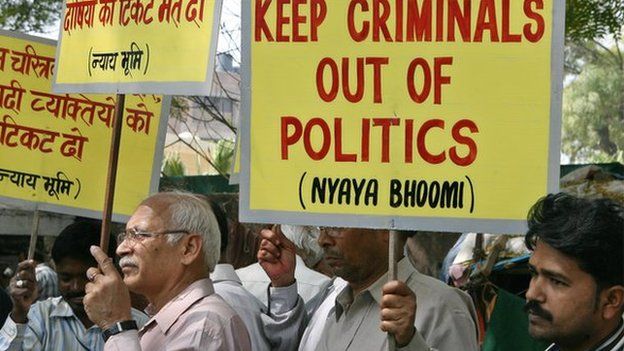
Protest against criminals contesting the parliamentary elections in Delhi on March 14, 2009Image copyright AFP
Image caption There’s been some criticism of criminal politicians

One concerns Lalu Prasad Yadav, a former railways minister and Congress party ally, charged with pocketing millions of dollars in subsidies for non-existent livestock.

Another concerns Congress MP Rashid Masood, already convicted of corruption and due to be sentenced next week. When the BBC asked his office for a comment, his assistant told us “he is unwell”.

“Don’t know whether to laugh or cry” tweeted MP Baijayant Panda in response to the government’s protective move.

He is a rare voice though inside the chamber campaigning against criminals sitting alongside him.

There’s been some other criticism outside, but not much. Indians have become very used to these kinds of shenanigans.

Almost forgotten already are calls in the Verma commission report into the December 16 Delhi gang rape case for all politicians accused of sexual crimes to be barred from office. Instead, six politicians charged with rape remain in office.

The opposition BJP has said it will oppose the cabinet order. But its record is just as murky, with even more accused criminals among its elected members in parliament and state assemblies than the Congress.

And with elections round the corner, none of the parties want to risk real reform right now, whatever they have signed up to in the past.

The world’s largest democracy is not alone in allowing so many questionable people to run it. Fellow Brics member Brazil has similar numbers of alleged criminals running the country.

The difference though is that in Brazil, brazen political abuses have provoked major protest.

But, says Indian MP Baijayant Panda: “This is a phase all democracies have gone through – look at the US.”

Voters will start to demand change, he predicts: “This is the last era of brazenness.”

Source: The BBC

26/01/2020

India, Brazil sign 15 accords to deepen ties across range of sectors

(Reuters) – India and Brazil have signed 15 accords aimed at forging closer ties between the two emerging market giants across a range of sectors, especially defence, both countries’ leaders tweeted on Saturday.

Indian Prime Minister Narendra Modi and Brazilian President Jair Bolsonaro took to social media to hail the closer cooperation and agreements struck during Bolsonaro’s official visit to India.

“Several agreements signed in ​​infrastructure, justice, science and technology, agriculture, oil exploration, mining, health, culture and tourism,” Bolsonaro tweeted, adding: “The world’s confidence in Brazil is back!”

For his part, Modi tweeted: “India and Brazil are focussing on expanding cooperation in the defence sector,” adding that the two countries share “immense synergies” on several key issues such as the environment and fighting terrorism.

Separately, Brazil’s foreign minister Ernesto Araujo tweeted that the 15 accords signed by the two countries represent a move “against the structures of globalist thought”.

“Brazil is rising to be a great among the greats,” he tweeted.

Source: Reuters

20/12/2019

China, Brazil deepen aerospace cooperation

TAIYUAN, Dec. 20 (Xinhua) — China and Brazil will continue to develop more satellites together and deepen aerospace cooperation, said Chinese and Brazilian officials after a new satellite jointly produced by the two countries was sent into space on Friday.

The launch of the China-Brazil Earth Resource Satellite-4A (CBERS-4A) also marks the 45th anniversary of the establishment of diplomatic relations between China and Brazil.

The two countries will expand the application of the CBERS satellite data in their own countries and those participating in the Belt and Road Initiative, said Wu Yanhua, deputy director of the China National Space Administration (CNSA).

China and Brazil have devised a 10-year plan to collaborate in developing remote-sensing, meteorological and communication satellites. The cooperation could also be expanded to deep space exploration, lunar exploration, manned space and aerospace education, said Wu.

In 1988, the two countries signed an agreement to start the China-Brazil earth resource satellite program. They shared the costs and separately developed its systems. Both sides brought different advantages to the table and were highly complementary.

In 1999, the first China-Brazil earth resource satellite was successfully launched, giving each country their first transmission-type remote-sensing satellite. It was rated one of the top 10 scientific and technological advances of the year in China.

It was also the first satellite jointly developed by China and another country, and was a model for space technology cooperation among developing countries.

The partnership has lasted more than 30 years. The two countries have sent six satellites into space, and the resolution of the images has gradually improved.

The China-Brazil earth resource satellites have provided more than 6 million images to users in the two countries, and the data have been widely used in agriculture, forestry, water conservation, land and resources, environmental protection, and disaster prevention and mitigation, helping the Brazilian government monitor the Amazon rainforest and the country’s environmental changes, according to the CNSA.

The remote-sensing data are also provided to developing countries for free, and have helped monitor disasters such as forest fires in Australia, floods in Pakistan, and an earthquake and tsunami in Japan.

China has also helped train Brazilian personnel, and scientists and technologists of the two countries have conducted many exchanges over the past 30 years.

“The space cooperation between China and Brazil has been very successful, and sets a good example for space cooperation among developing countries,” Wu said.

Brazilian Minister of Science, Technology, Innovation and Communication Marcos Cesar Pontes said the cooperation has contributed to international economic and social development.

Source: Xinhua

27/11/2019

China overtakes United States to boast world’s biggest diplomatic network, think tank says

  • But Washington still commands more diplomatic influence, analyst says
  • Beijing extends its reach as its interests grow abroad and as Taipei loses allies
China has 276 embassies, consulates and other missions around the world, surpassing the US with 273 missions, according to a global index. Photo: AP
China has overtaken the United States to have the biggest number of diplomatic outposts around the world, as its international ambitions and economic interests expand.
According to the 2019 Global Diplomacy Index, released by the Lowy Institute in Australia on Wednesday, China has 276 embassies, consulates and other missions globally, surpassing the US with 273 missions. France was third on 267.

Bonnie Bley, the index report’s lead researcher, said that while a country’s total did not equate to diplomatic influence, “diplomatic infrastructure is still important”

“China’s newly held lead serves as a telling metric of national ambition and international priorities,” Bley said.

Beijing has 169 embassies or high commissions, while Washington has 168. However, China had 96 consulates while the US had 88, suggesting that Beijing’s diplomatic expansion was closely linked to its economic interests, she said.
Beijing bulks up diplomacy budget as China extends global reach

Renmin University international relations professor Shi Yinhong said China had close and growing trade and investment ties with many developing countries, especially those taking part in the Belt and Road Initiative, increasing the need for consulates.

“One of the consulates’ main goals is to serve the citizens and businesses located in those countries,” Shi said.

Beijing has also expanded its reach at Taipei’s expense. Since 2016, when the index was first published, Taiwan’s total number of embassies fell from 22 to 15, the biggest drop among the 61 places ranked.

China opened five new embassies – in El Salvador, Burkina Faso, Gambia, São Tomé and Príncipe and the Dominican Republic – countries that severed official diplomatic ties with Taiwan. This directly contributed to China’s lead over the US, the report said.

Beijing’s diplomatic expansion also comes as the US, under the administration of President Donald Trump, is taking an “America first” approach to foreign policy.
Sri Lanka rejects fears of China’s ‘debt-trap diplomacy’ in belt and road projects
Trump has sought to cut funding to the US State Department and the White House has not appointed US ambassadors for at least 17 countries, including Brazil and Egypt, according to the American Foreign Service Association.
“Even though the US has a strong diplomatic base but it is not so proactive any more. It has fewer consulates and fewer foreign service workers,” Shi said.
“For the long term, China is in a more advantageous position.”
But a country’s diplomatic ability and influence did not rest on the number of foreign service postings and the US still held more international diplomatic sway than China, he added.
Some of China’s biggest diplomatic missions include Islamabad in Pakistan, Washington and London.
Source: SCMP
15/11/2019

Xi urges BRICS countries to champion multilateralism

BRAZIL-BRASILIA-CHINA-XI JINPING-BRICS-SUMMIT

Chinese President Xi Jinping delivers a speech entitled “Together for a New Chapter in BRICS Cooperation” at the 11th summit of BRICS in Brasilia, Brazil, Nov. 14, 2019. The 11th summit of BRICS, an emerging-market bloc that groups Brazil, Russia, India, China and South Africa was held on Thursday in Brasilia. Brazilian President Jair Bolsonaro presided over the summit. Chinese President Xi Jinping, Russian President Vladimir Putin, Indian Prime Minister Narendra Modi and South African President Cyril Ramaphosa also attended the summit. (Xinhua/Li Xueren)

BRASILIA, Nov. 14 (Xinhua) — Chinese President Xi Jinping on Thursday called on the BRICS countries to undertake their due obligations in championing and practicing multilateralism.

Xi made the appeal in a speech entitled “Together for a New Chapter in BRICS Cooperation” at the 11th summit of BRICS, an emerging-market bloc that groups Brazil, Russia, India, China and South Africa.

Noting that the summit was held at a time when crucial developments are taking place in the world economy and international landscape, Xi pointed out that a new round of technological revolution and industrial transformation is in the ascendant, and the unstoppable rise of emerging markets and developing countries has injected strong impetus to the reform of the global economic governance system.

Nevertheless, there are also causes for concern, Xi said, referring to rising protectionism and unilateralism; greater deficit of governance, development and trust; and growing uncertainties and destabilizing factors in the world economy.

Faced with profound changes rarely seen in a century, Xi said, the BRICS countries should grasp the trend of the times, respond to the call of the people, and shoulder their responsibilities.

“We must remain true to our unwavering commitment to development and strengthen solidarity and cooperation for the well-being of our people and for the development of our world,” he said, before laying out a three-pronged proposal.

First, the BRICS countries should work to foster a security environment of peace and stability, he said, urging the five members to safeguard peace and development for all, uphold fairness and justice, and promote win-win results.

“It is important that we uphold the purposes and principles of the UN Charter and the UN-centered international system, oppose hegemonism and power politics, and take a constructive part in settling geopolitical flash points,” he said.

The BRICS countries should also maintain close strategic communication and coordination and speak in one voice for a more just and equitable international order, he added.

Second, the BRICS countries should pursue greater development prospects through openness and innovation, said the Chinese president.

The five-member bloc should deepen the BRICS Partnership on New Industrial Revolution, and strive for more productive cooperation in such fields as trade and investment, digital economy and connectivity, so as to achieve high-quality development, Xi said.

He called for the five countries to advocate extensive consultation, joint contribution and shared benefits in global governance, and push for reform of the global economic governance system.

The BRICS countries should stand firm against protectionism, uphold the WTO-centered multilateral trading system, and increase the voice and influence of emerging markets and developing countries in international affairs, Xi said.

The Chinese president also urged the BRICS member states to prioritize development in the global macro policy framework, follow through the UN 2030 Agenda for Sustainable Development and the Paris Agreement on climate change, and promote coordinated progress in the economic, social and environmental spheres.

Third, the BRICS countries should promote mutual learning through people-to-people exchanges and take their people-to-people exchanges to greater breadth and depth, said Xi.

Xi proposed to leverage “BRICS Plus” cooperation as a platform to increase dialogue with other countries and civilizations to win BRICS more friends and partners.

In his speech, the president also stressed that China will open up still wider. “We will import more goods and services, ease market access for foreign investments, and step up intellectual property protection. With these efforts, we will break new ground in pursuing all-dimensional, multi-tiered and all-sectoral opening-up in China,” he said.

China will continue to act in the principle of extensive consultation, joint contribution and shared benefits, and pursue open, green and clean cooperation within the framework of the Belt and Road Initiative, Xi said.

“We will continue to follow a high-standard, people-centered, and sustainable approach to promote high-quality Belt and Road cooperation with partner countries,” he said.

China, added the president, will stay committed to an independent foreign policy of peace and to the path of peaceful development, and continue to enhance friendship and cooperation with all other countries on the basis of the Five Principles of Peaceful Coexistence.

China is committed to working with Africa for an even stronger China-Africa community with a shared future, Xi said, adding that China will pursue closer cooperation with Latin America and the Caribbean (LAC) in various areas and build a China-LAC community with a shared future and common progress.

Meanwhile, China strives for an Asia-Pacific community with a shared future that features openness and inclusiveness, innovation-driven growth, greater connectivity, and mutually beneficial cooperation, Xi said.

“All in all, China will work with the rest of the international community toward the goal of building a new type of international relationship and of building a community with a shared future for mankind,” he said.

Source: Xinhua

15/11/2019

Xi’s remarks point way to stabilizing Hong Kong situation: spokesperson

BEIJING, Nov. 15 (Xinhua) — President Xi Jinping’s latest remarks on the Hong Kong situation are the strongest voice from the central government on the work of ending violence and chaos in Hong Kong, a spokesperson said Friday.

Xi’s remarks on Thursday in Brazil have pointed the way to stabilizing the situation in the Hong Kong Special Administrative Region (SAR), said Yang Guang, a spokesperson for the Hong Kong and Macao Affairs Office of the State Council.

The president’s words came as the disturbances in Hong Kong have lasted more than five months and radical violent crimes have been escalating recently, the spokesperson said.

His remarks are a strong support to the Hong Kong SAR government led by Chief Executive Carrie Lam, a great inspiration to Hong Kong residents, and a stern warning to the rioters and their backroom supporting forces, Yang said.

The office will work with resolve to implement the president’s requirements to firmly support the chief executive in leading the SAR government to govern in accordance with the law, firmly support the Hong Kong police in strictly enforcing the law, and firmly support the Hong Kong judicial bodies in severely punishing the violent criminals in accordance with the law, Yang said.

The spokesperson pledged various means of supporting and encouraging the Hong Kong people from all walks of life to build up “overwhelming positive energy” in countering violence and safeguarding rule of law, for the end of chaos and the restoration of social stability in Hong Kong as soon as possible.

“The central government and 1.4 billion people of China will always be the strongest backing for Hong Kong to overcome any challenges and risks,” he said.

Source: Xinhua

14/11/2019

China ready to achieve common prosperity with Brazil: Xi

BRAZIL-BRASILIA-XI JINPING-BRAZILIAN PRESIDENT-TALKS

Chinese President Xi Jinping holds talks with Brazilian President Jair Bolsonaro in Brasilia, Brazil, Nov. 13, 2019. (Xinhua/Ding Haitao)

BRASILIA, Nov. 13 (Xinhua) — Chinese President Xi Jinping said on Wednesday China is fully confident in China-Brazil cooperation and stands ready to achieve common prosperity with Brazil.

Xi made the remarks when meeting here with Brazilian President Jair Bolsonaro.

Noting that Bolsonaro paid a successful state visit to China in October, Xi said the consensus reached by the two sides is being actively implemented.

At the recently concluded second China International Import Expo (CIIE), the transaction volume of Brazilian businesses grew 3.6 times compared with that at the first CIIE last year, Xi said, calling the results gratifying.

As the largest emerging-market country in the eastern and western hemispheres, respectively, Xi said, China and Brazil share broad common interests.

China is optimistic about Brazil’s development prospects and fully confident in bilateral cooperation, Xi said, adding that China stands ready to share development experience and gains with Brazil, so as to achieve common prosperity.

Xi expressed willingness to work with Bolsonaro to properly grasp and guide the direction of the development of China-Brazil relations.

China and Brazil are both major countries and the two sides should maintain strategic focus, adhere to mutual respect, treat each other as equals, strengthen exchanges and cement mutual trust, Xi stressed.

He urged both sides to open markets to each other and explore ways to establish long-term, stable and direct supply channels for basic products, including agricultural products, iron ore and crude oil.

China supports its enterprises to actively participate in Brazil’s infrastructure construction to promote connectivity, Xi said.

Xi called on both sides to advance cooperation in areas such as digital economy, next-generation communications, material science and biotechnology, wishing another successful launch of the China-Brazil Earth Resources Satellite in the near future, and urging the two sides to jointly promote the follow-up cooperation.

Xi also urged both sides to expand cultural and people-to-people exchanges and facilitate personnel exchanges.

China supports the Brazilian government’s efforts to combat the disaster in the Amazon rainforest and believes that Brazil is capable of overcoming the disaster, Xi said.

Both sides should work together to promote all-round exchanges and cooperation between China and Latin American countries, uphold multilateralism, build an open world economy, and safeguard the legitimate development rights and interests of emerging markets, Xi said.

The Chinese president added that China supports Brazil in hosting the upcoming BRICS summit and stands ready to work with all parties to make the summitry a success.

For his part, Bolsonaro said he has instructed relevant government departments to implement as soon as possible the consensus reached during his state visit to China, calling that visit a success.

Noting that China is a significant major country and Brazil’s largest trading partner, Bolsonaro said the Brazilian people hold admiration, respect and friendly feelings toward the Chinese people, and Brazil-China cooperation boasts increasing significance to Brazil’s future development.

Economies of Brazil and China are highly complementary and the areas of cooperation continue to expand, Bolsonaro said, adding that his country welcomes Chinese investment to Brazil and stronger cooperation in infrastructure construction, iron ore, and the energy sector, including oil and gas.

The Brazilian side values the important opportunities brought about by China’s opening-up of its market, he said, expressing the hope to expand bilateral trade and promote export of more Brazilian agricultural products to China.

His country is also willing to offer favorable conditions for Chinese enterprises and products to enter Brazil, he said, adding that Brazil stands ready to facilitate personnel exchanges and cultural and people-to-people exchanges.

Bolsonaro thanked China for supporting Brazil’s sovereignty over the Amazon rainforest issue and expressed his willingness to cooperate with China on biodiversity conservation.

He also thanked China for supporting Brazil in hosting the BRICS summit, adding that Brazil is ready to strengthen coordination and cooperation with other parties for a summit that produces positive outcomes.

Brazil is grateful for China’s trust and friendship, said Bolsonaro, adding that from a long-term perspective, Brazil attaches importance to strengthening cooperation with China in a wide range of areas, so as to deepen their traditional friendship and benefit the two peoples.

After the meeting, the two heads of state jointly met the press and witnessed the exchange of a number of documents on bilateral cooperation.

Source: Xinhua

12/11/2019

Feature: Xi spearheads closer China-LatAm cooperation for common prosperity

MEXICO CITY, Nov. 12 (Xinhua) — China and Latin America sit on the opposite sides of the globe, but the formidably vast Pacific Ocean that separates them did not stop them from sharing a long history of exchanges.

Today, the major developing country in the East is forging an increasingly close partnership with the dynamic region in the Western Hemisphere, especially since Chinese President Xi Jinping took office in 2013, and set into motion what is now known as Xiplomacy.

In the past six years, Xi has visited 11 Latin American and the Caribbean (LAC) countries. On Tuesday, he is setting foot on the region for the fifth time as president, as he arrives in Brazil for the upcoming 11th BRICS summit.

Thanks in no small part to Xi’s push, the time-honored, distance-defying China-Latin America relationship is flourishing with new vitality. China has become the second largest trading partner of Latin America, while the latter is one of the fastest growing sources of exports to China. Two-way trade rose 18.9 percent year on year to 307.4 billion U.S. dollars in 2018.

GRAND VISION

Every time Xi visited Latin America, he reaffirmed China’s commitment to cementing bilateral friendship and expanding win-win cooperation.

His first trip to the region as head of state, in 2013, took him to Trinidad and Tobago, Costa Rica and Mexico. The following year saw him travel to Brazil, Argentina, Venezuela and Cuba.

It was in Brazil that Xi met with leaders from 11 LAC countries, and for the first time laid out his grand vision for building a China-Latin American community with a shared future.

“Let us seize the opportunities presented to us and work together to blaze new trails in building a community of shared destiny for common progress and usher in a bright future for the relations between China and Latin America and the Caribbean,” Xi said in a keynote speech at the first ever China-Latin American and Carribean Countries Leaders’ Meeting in 2014.

He then proposed a “1+3+6” cooperation framework to “promote faster, broader and deeper cooperation between the two sides for real results.”

The “1” refers to “one plan,” the Chinese-Latin American and Caribbean Cooperation Plan (2015-2019), formulated to promote inclusive growth and sustainable development.

The “3” alludes to “three engines” for driving practical cooperation for comprehensive development, namely trade, investment and financial cooperation.

The “6” means the six priority cooperation fields of energy and resources, infrastructure building, agriculture, manufacturing, scientific and technological innovation, and information technologies.

In 2016, Xi visited Ecuador, Peru and Chile. Two years later, he traveled to Argentina for the Group of 20 summit as well as Panama, a Central American country which established diplomatic ties with China in June 2017.

In a landmark speech at the Peruvian Congress in Lima in 2016, Xi expounded the significance of strengthening China-Latin America cooperation.

“With one fifth of the world’s total area and nearly one third of the world’s population, China and Latin America and the Caribbean are crucial forces for world peace and stability,” he said.

China, he added, “will increase sharing of governance experience and improve planning and coordination of macro policies with Latin American and Caribbean states to better synergize our development plans and strategies.”

Besides top-level engagement, Xi also reaches out to local people from all walks of life, in order to keep cementing the China-Latin America friendship and the public support for bilateral cooperation.

While in Costa Rica, Xi visited a family-run coffee plantation and tried some local brew. “I think some more coffee can well be exported to China,” Xi told his hosts with a smile.

Today, Costa Rica exports coffee to the Asian market, along with pork, dairy, pineapples and other high-quality agricultural goods, especially after the inauguration of the China International Import Expo in 2018.

NEW OPPORTUNITIES

With international cooperation within the framework of the Belt and Road Initiative (BRI) gaining steam worldwide, the Xi-proposed vision is creating new opportunities for China-Latin America cooperation.

The BRI, designed to promote common development along and beyond the ancient Silk Road trade routes, comprises the Silk Road Economic Belt and the 21st Century Maritime Silk Road, and the latter is closely connected to Latin America.

For two and a half centuries, from the mid-1500s to the early 1800s, galleons laden with Chinese silk, spices, porcelain and other goods sailed across the ocean to today’s port city of Acapulco on the Mexican Pacific coast.

Latin America is the natural extension of the 21st Century Maritime Silk Road, Xi said in a meeting with visiting Argentine President Mauricio Macri in May 2017.

In a congratulatory message to the second Ministerial Meeting of the China-Community of Latin American and Caribbean States (CELAC) Forum held in Chile on Jan. 22, 2018, Xi stressed that China and LAC countries “need to draw a new blueprint for our joint effort under the Belt and Road Initiative and open a path of cooperation across the Pacific Ocean that will better connect the richly endowed lands of China and Latin America and usher in a new era of China-LAC relations.”

During Xi’s visits, the Chinese president is always dedicated to better aligning the BRI — an open platform for cooperation — with the development plans of LAC countries.

In his meeting with Macri, Xi called for dovetailing the BRI with Argentina’s development strategy, expanding cooperation in such sectors as infrastructure, energy, agriculture, mining and manufacturing, and implementing existing major cooperation projects in hydro-power, railway and other fields.

Similarly, during the state visit to Panama in December 2018, Xi said the National Logistics Strategy of Panama 2030 and the BRI are highly compatible, calling on the two sides to synergize their respective development strategies, boost cooperation and promote connectivity.

So far, 19 LAC countries have signed BRI cooperation agreements with China. China-Latin America cooperation in various areas has effectively promoted local economic and social development, bringing visible and tangible benefits to the Latin American people.

Just as Xi said in his speech at the Peruvian Congress in 2016, “China will share its development experience and opportunities with the rest of the world and welcome other countries to board the express train of its development, so that we can all develop together.”

SOurce: Xinhua

Law of Unintended Consequences

continuously updated blog about China & India

ChiaHou's Book Reviews

continuously updated blog about China & India

What's wrong with the world; and its economy

continuously updated blog about China & India