Chindia Alert: You’ll be Living in their World Very Soon
aims to alert you to the threats and opportunities that China and India present. China and India require serious attention; case of ‘hidden dragon and crouching tiger’.
Without this attention, governments, businesses and, indeed, individuals may find themselves at a great disadvantage sooner rather than later.
The POSTs (front webpages) are mainly 'cuttings' from reliable sources, updated continuously.
The PAGEs (see Tabs, above) attempt to make the information more meaningful by putting some structure to the information we have researched and assembled since 2006.
LONDON (Reuters) – China has betrayed the people of Hong Kong so the West should stop kowtowing to Beijing for an illusory great pot of gold, said Chris Patten, the last governor of the former British colony.
Beijing is set to impose new national security legislation on Hong Kong after a sustained campaign of pro-democracy protests last year in the city, which enjoys many freedoms not allowed on mainland China.
“The Hong Kong people have been betrayed by China,” Patten was quoted as saying by The Times newspaper. Britain has a “moral, economic and legal” duty to stand up for Hong Kong, he said.
Patten watched as the British flag was lowered over Hong Kong when the colony was handed back to China in 1997 after more than 150 years of British rule.
Hong Kong’s autonomy was guaranteed under the “one country, two systems” agreement principle enshrined in the 1984 Sino-British Joint Declaration signed by then Chinese Premier Zhao Ziyang and British Prime Minister Margaret Thatcher.
But China’s plans to impose national security laws on Hong Kong risk destroying the Declaration, Patten said. The United States has branded the laws a “death knell” for the city’s autonomy.
“What we are seeing is a new Chinese dictatorship,” Patten said. “The British government should make it clear that what we are seeing is a complete destruction of the Joint Declaration.”
Hong Kong leader Carrie Lam said her government will “fully cooperate” with the Chinese parliament to safeguard national security, which she said would not affect rights, freedoms or judicial independence.
Patten said the West should stop chasing the illusory promise of Chinese gold.
“We should stop being fooled that somehow at the end of the all the kowtowing there’s this great pot of gold waiting for us. It’s always been an illusion,” Patten said.
“We keep on kidding ourselves that unless we do everything that China wants we will somehow miss out on great trading opportunities. It’s drivel.”
The British government did not immediately comment on Saturday.
Prime Minister Boris Johnson’s spokesman said on Friday the government was monitoring the situation and as a party to the Joint Declaration the UK was committed to the upholding Hong Kong’s autonomy and respecting the one country, two systems model.
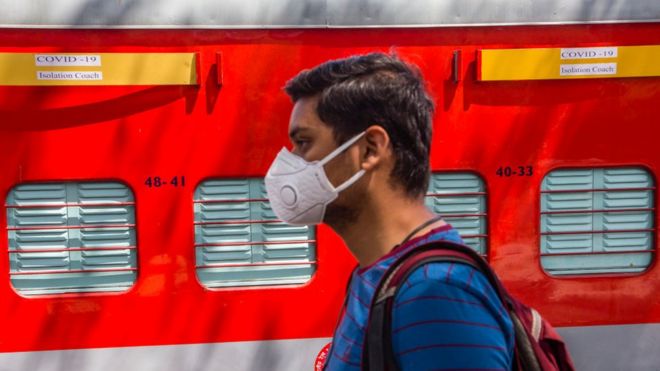
Image copyright GETTY IMAGESImage caption India’s railways are hoping to ease the burden on hospitals
India is preparing for a potential surge in Covid-19 patients by tapping into an unusual resource: its trains, which power the world’s fourth biggest rail network.
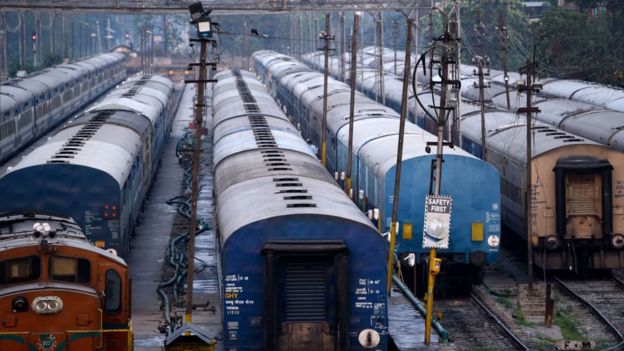
The country suspended its passenger trains for the first time after it announced a three-week lockdown on 25 March to contain the coronavirus. As of Wednesday, it had reported 4,643 active cases and 149 deaths, and the numbers are rapidly increasing.
“We, at the railways, thought: how can we contribute?” its spokesman, Rajesh Bajpai, told the BBC. “So we came up with this idea and everyone liked it.”
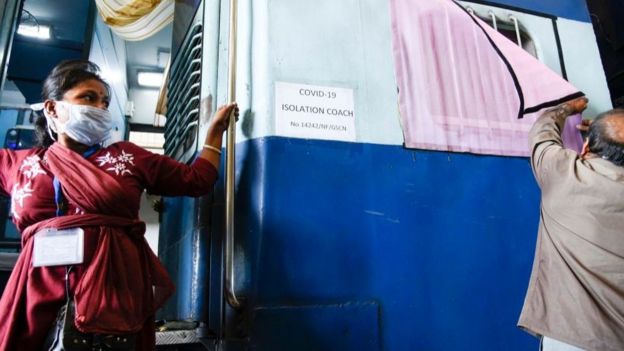
Work has already begun to convert 5,000 train coaches into quarantine or isolation wards, which amounts to 40,000 beds. And the railway ministry says it’s prepared to convert 15,000 more coaches.
The Indian railways – as the ministry is known – is a behemoth. Largely constructed during British rule, it’s still the mainstay of India’s public transport, and includes some of the world’s busiest urban rail systems. It transports 23 million passengers a day and its 12,000 trains crisscross 65,000km (40,389 miles) of tracks, connecting the remotest parts of India.
Mr Bajpai says the coaches can be spared as they are mostly trying to convert older ones, and passengers will be fewer than ever in the coming months even if restrictions are eased.
He adds that this is not unusual for the railways, which already runs several “special” trains, from luxury trains to exhibition trains to a hospital train, complete with operation theatres.
“The coach is a shell and inside, you can provide anything – a drawing room, a dining room, a kitchen, a hospital.”
A looming crisis?
And India may well need the extra beds.
States have already turned all sorts of spaces – sports centres, stadiums, wedding venues, hotels, resorts – into quarantine or isolation centres. But officials fear they will run out of space as the country ramps up testing.
Image copyright GETTY IMAGESImage caption India suspended all passenger trains last month
For every person who tests positive, there are scores more who need to be traced, quarantined and, if necessary, isolated. But isolation at home is not always an option in India’s joint family households – and especially not in its densely-populated slums.
“There are so many options available and this [the coaches] is one of the options,” Mr Bajpai says.
He doesn’t foresee them being used until beds in existing quarantine or isolation centres are filled. But, he adds, they will keep them ready with the necessary facilities.
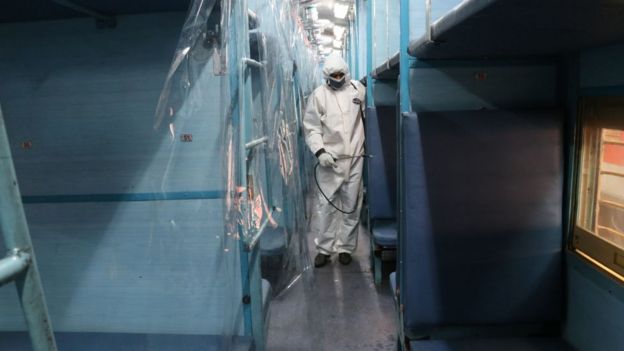
That includes converting one of the two toilets in each coach into a “bathing room”, providing oxygen cylinders in every coach, and modifying all the cabins so they can hold medical equipment. And then there are measures that are specific to Covid-19 – such as replacing taps that turn with those that have long handles, and fitting dustbins with foot pedals.
Image copyright GETTY IMAGESImage caption It takes up to three days to turn a coach into an isolation ward
The ministry has also ordered extra coat hooks and mosquito nets for every cabin, and has instructed officials to make sure that charging points are working, the upholstery “is in good condition” and “broken panels are replaced”.
The coaches are being readied in 130 different locations across the country, but it’s yet to be decided where they will be stationed.
Mr Bajpai says it’s up to states to decide which stations they want the coaches in. But that in itself is a process because the coaches need regular water and electric supply.
And there are other concerns too. Summer has begun and large parts of India record scorching temperatures, often more than 40C. And the coaches that are being converted are not air-conditioned.
“The patient will be very uncomfortable. Doctors and nurses will be wearing protective gear, and they will find it very difficult,” says Vivek Sahai, a former chairman of the railway board.
Image copyright GETTY IMAGESImage caption Staff member of Northeast Frontier Railway (NFR) prepare train coaches to convert them into isolation wards for COVID-19 patients.
He also says not everyone might be comfortable squatting to use Indian-style toilets; and he wonders if all the designated coaches have a proper system of waste management. (Indian coaches are designed to dispose of human waste onto the tracks although new technologies have begun to be adopted in recent years.)
“I am not saying it cannot be done but they have to take care of these things,” he says. “But if anybody can do it, it’s the railways.”
However, some experts say that this by itself is not going to help solve India’s problems.
“You don’t just need space,” says Dr Sumit Sengupta, a pulmonologist. “We need thousands of doctors and nurses if you really have to make a dent.”
India is severely short of both, and at least three hospitals have been sealed this week alone after members of the staff tested positive.
Media caption As cases of coronavirus rise and the virus hits India’s congested slums, will the country cope?
“Why isolate someone who has symptoms when there is no treatment? Because you don’t want them to spread the infection,” Dr Sengupta says.
But, he adds, the virus is spreading anyway because so many patients are asymptomatic. He says isolating symptomatic patients will not help unless India starts testing aggressively.
“This will work only as part of a larger strategy,” he adds. “Test, trace and isolate. Test should come first.”
He is expected to join a trilateral dialogue with his counterparts from Pakistan and Afghanistan, and observers say he may try to mediate in Kashmir dispute
Trip also includes a stop in Nepal that could pave way for a visit by Xi Jinping
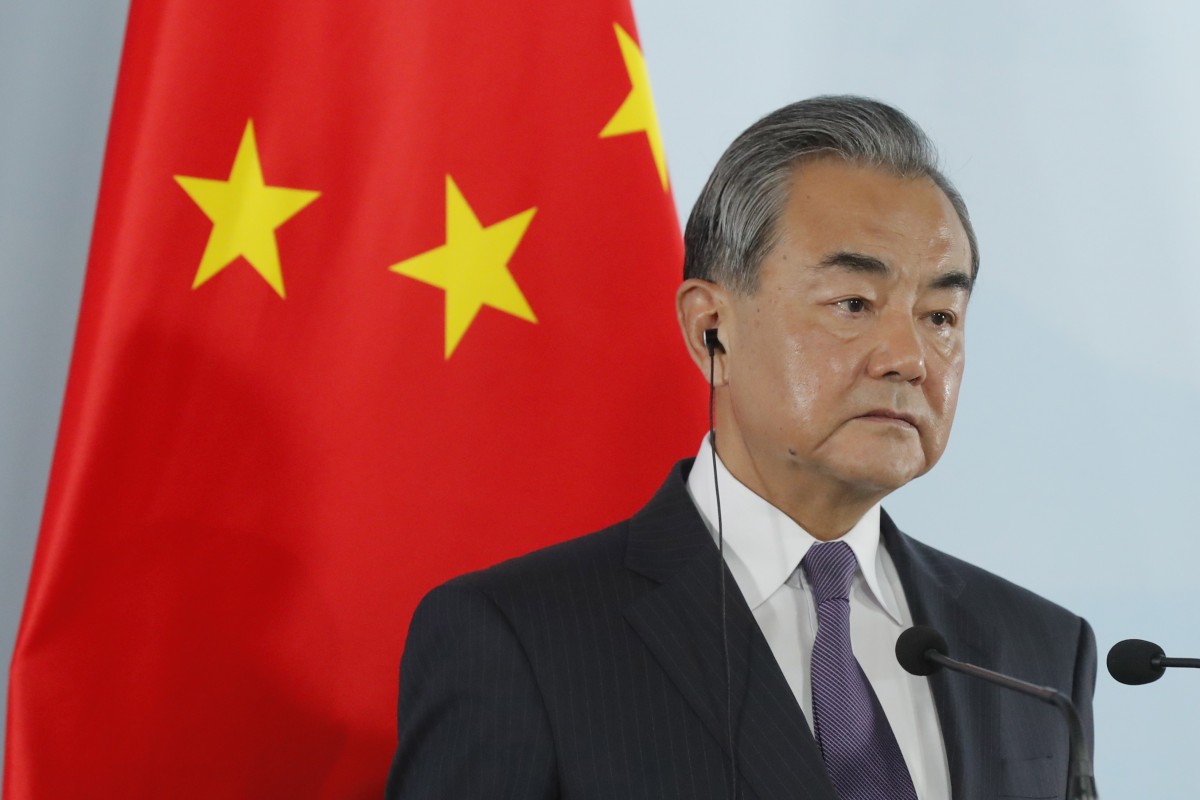
Chinese Foreign Minister Wang Yi may try to act as a negotiator in the Kashmir dispute. Photo: EPA-EFE
Chinese Foreign Minister Wang Yi began a four-day trip to Pakistan and Nepal on Saturday, amid escalating tensions between Islamabad and New Delhi over
Wang was expected to join a trilateral dialogue with the foreign ministers of Pakistan and Afghanistan in Islamabad, foreign ministry spokesman Geng Shuang said on Friday. He will also travel to Nepal.
Beijing has criticised India’s decision last month to strip the Jammu and Kashmir autonomous state of its special status and break it into two federally controlled territories, calling it “unacceptable”.
China also formally backed Pakistan’s request for the United Nations Security Council to hold “closed consultations” on the revocation of the state’s autonomy.
Meanwhile, observers say the Chinese foreign minister could attempt to act as a negotiator in the complex border dispute.
“Wang might try to play a role to mediate between the two sides to resolve the crisis,” said Wang Dehua, head of the Institute for South and Central Asia Studies at the Shanghai Municipal Centre for International Studies. “This has been China’s long-held position on the issue.”
Pang Zhongying, an international relations researcher at Ocean University of China in Qingdao, agreed.
“[Indian Prime Minister] Narendra Modi has visited China a couple of times and it is likely [Chinese President] Xi Jinping will visit India soon,” he said. “If Xi is to visit India later this year, China may try to contain its differing views with India on Kashmir.”
Modi has proposed an informal summit with Xi later this year that may be held in the religious hub of Varanasi, Modi’s parliamentary constituency. New Delhi said in May that Indian officials were working with the Chinese side to finalise the details, but Beijing has yet to confirm Xi’s visit.
India dismisses Beijing’s concerns over Kashmir because ‘it won’t have any impact on China’
Wang Yi was also due to visit India later this month for border talks, but the trip had to be postponed at the request of New Delhi because of scheduling problems, Hindustan Times reported, citing China’s foreign ministry.
The row over Kashmir has escalated in the past month. Pakistani Prime Minister Imran Khan said on Friday that Islamabad would make the fullest possible response to New Delhi’s actions in disputed Kashmir and that the global community would be responsible for any “catastrophic” aftermath.
Since Modi withdrew special rights for Indian-administered Kashmir on August 5, India has flooded the Kashmir valley with troops, restricted the movements of residents and cut off communication.
Both India and Pakistan claim the whole of Kashmir, which was partitioned between the two following the end of British rule in 1948, and they have subsequently fought wars over the territory.
China has its own territorial dispute with India over the part of Kashmir it controls. In early August, Chinese foreign ministry spokeswoman Hua Chunying
and said it was not binding. Beijing later appeared to soften its rhetoric, with Hua calling for a solution through dialogue and negotiation, without criticising either side.
The Chinese foreign minister will also visit Nepal, where he is expected to meet his counterpart, the president and prime minister. The trip could pave the way for an expected visit by Xi to Nepal.



 CHINDIA ALERT: You'll be living in their world, very soon