Chindia Alert: You’ll be Living in their World Very Soon
aims to alert you to the threats and opportunities that China and India present. China and India require serious attention; case of ‘hidden dragon and crouching tiger’.
Without this attention, governments, businesses and, indeed, individuals may find themselves at a great disadvantage sooner rather than later.
The POSTs (front webpages) are mainly 'cuttings' from reliable sources, updated continuously.
The PAGEs (see Tabs, above) attempt to make the information more meaningful by putting some structure to the information we have researched and assembled since 2006.
A pedestrian waits to cross a street in Brussels, Belgium, May 6, 2020. (Xinhua/Zhang Cheng)
— New single-day COVID-19 deaths continue to drop in France
— Italy sees fewer COVID-19 patients, number of active infections falls to 70,187
— New deaths from COVID-19 keep falling in Spain as PM seeks final extension of State of Alarm
— Deaths from coronavirus top 9,000 in Belgium
BRUSSELS, May 16 (Xinhua) — The following are the latest developments of the COVID-19 pandemic in European countries.
A man makes a phone call near the Eiffel Tower at the Trocadero Palace, Paris, France, May 15, 2020. (Xinhua/Gao Jing)
PARIS — France had registered 96 new deaths from COVID-19 over the past 24 hours, fewer than the previous two 24-hour periods, while the balance of the coronavirus-related hospitalization remains negative, France’s Health Ministry said on Saturday.
According to the ministry, the 96 new single-day deaths were lower than 104 registered on Friday and 351 on Thursday. So far, 27,625 people have succumbed to the coronavirus-caused disease across France.
Meanwhile, France is now the world’s fourth worst-hit country in terms of human loss caused by COVID-19 after the United States, Britain and Italy.
As of Saturday, the country had recorded 142,291 confirmed cases, a single-day increase of 372, slower than Friday’s 563. A total of 61,066 patients had recovered and returned home since early March.
People wait in line outside a cocktail bar in Rome, Italy, May 12, 2020. (Xinhua/Cheng Tingting)
ROME — The number of COVID-19 hospitalizations and intensive care (ICU) patients dropped in Italy over the past 24 hours, according to the latest tally posted by the Civil Protection Department on Saturday.
Recoveries rose by 2,605 from a day earlier, bringing the total to 122,810.
Nationwide, the number of active infections fell to 70,187, down from 72,070 on Friday.
Of those who tested positive for the new coronavirus, 775 are in intensive care, down by 33 from Friday, and 10,400 are hospitalized with symptoms, down by 392.
The death toll on Saturday was 153, bringing the total to 31,763 since the outbreak was first recorded in Italy’s northern Lombardy region in February.
The total number of COVID-19 cases combining infections, fatalities and recoveries has risen to 224,760, up from 223,885 on Friday.
A security guard offers disinfectant gel to a woman at the entrance of a building in Barcelona, Spain, on May 11, 2020. (Photo by Sergi Camara/Xinhua)
MADRID — The Spanish Ministry of Health, Consumer Affairs and Social Welfare confirmed on Saturday falls in the number of new deaths from COVID-19 as well as new cases.
The total number of deaths in Spain rose to 27,563 after 102 people lost their lives to COVID-19 in the 24-hour period until 21:00 hours local time on Friday.
This was the lowest number of deaths in a 24-hour period since March 16, with 50 of the deaths in the regions of Madrid and Catalonia.
The same period also saw a slight fall in the number of new cases. The Health Ministry reported 539 new infections, down from 549 reported 24 hours earlier, taking the total number of confirmed cases to 230,698.
Also on Saturday, Spanish Prime Minister Pedro Sanchez said he will seek a fifth and final extension of the State of Alarm, which was imposed on March 15 to control the spread of the coronavirus.
Speaking in a televised speech, Sanchez said the upcoming final State of Alarm, which will come into effect on May 24 if approved, will be “different” from others.
“It is expected to be the last State of Alarm. We are going to request in the Congress of Deputies that it should last for a month,” he said. All the previous four extensions have been 15 days.
Few people are seen at the Saint-Hubert Royal Galleries shopping street in Brussels, Belgium, May 6, 2020. (Xinhua/Zhang Cheng)
BRUSSELS — With an increase of 47 deaths reported in the last 24 hours, the novel coronavirus had caused a total of 9,005 deaths in Belgium since the beginning of the epidemic, said the public health institute Sciensano on Saturday.
Of the 9,005 deaths, 48 percent took place in hospitals, 51 percent in nursing homes, and about 0.6 percent elsewhere, according to Sciensano. Deaths in hospitals were all confirmed COVID-19 cases. Of the fatalities in nursing homes, 23 percent were confirmed by test while the other were presumed by symptoms.
Also in the past 24 hours, 345 new cases of COVID-19 have been confirmed, raising the cumulative cases to 54,989 in Belgium.
BRUSSELS (Reuters) – The euro zone’s trade surplus with the rest of the world grew in February, with a decline in imports from China as well as sharply lower energy needs because of mild winter weather.
The unadjusted goods trade surplus grew to 23.0 billion euros ($25.1 billion) in February, compared with 18.5 billion euros a year earlier. Exports rose by 1.6%, while imports fell by 1.0%.
For China, which already had widespread coronavirus restrictions in place in February, exports from the European Union as a whole were slightly lower than in February 2019. However, imports were down by 8.1%, according to data on Eurostat’s website.
Energy imports as a whole also declined by 9.6% in February, when comparing Jan-Feb data issued on Monday and January data from a month ago. That translated into 10.1% lower imports from Russia and 5.9% less from Norway.
The trade surplus with the United States, by contrast, grew by 21% in the month as exports increased and imports declined. The persistent surplus in goods has been a source of transatlantic tension.
On a seasonally adjusted basis the euro zone trade surplus also rose to 25.8 billion euros in February from 18.2 billion euros in January. Exports were 1.8% higher month-on-month and imports 2.3% lower.
FRANKFURT (Reuters) – The German economy may miss growth forecasts this year as the coronavirus epidemic hits demand as well as supply in China, the country’s central bank governor, Jens Weidmann, said on Friday.
Weidmann joined a number of European Central Bank policymakers in saying it was too early to gauge the economic fallout of coronavirus, but he acknowledged the Bundesbank’s prediction of a 0.6% GDP expansion this year, which had already been halved from the previous forecast, may be out of date.
“All in all, economic growth this year could come in slightly lower than our experts estimated in December,” Weidmann said.
China is Germany’s top source of imports and its third-largest export market.
Investors were ramping up expectations for an ECB rate cut as soon as June on fears that coronavirus, now spreading to a number of European countries, could tip the world economy into recession.
Speaking in Brussels, Lithuania’s central bank governor, Vitas Vasiliauskas, said he did not expect ECB policymakers to take any action when they met on March 12, but that they could call an emergency meeting if needed.
Weidmann merely acknowledged that the latest events were lengthening the odds on a rate increase, previously expected for 2022. But he said the ECB should “not lose sight of the exit” from its ultra-easy policy of massive bond purchases and negative rates.
“The Governing Council must not lose sight of the exit from loose monetary policy,” he said. “For the very loose monetary policy is also associated with risks and side effects.”
He also criticised the notion of raising the ECB’s inflation target, saying its current formulation as a rate of price growth “below but close to 2%” was “understandable, forward-looking and realistic”.
BRUSSELS, Dec. 16 (Xinhua) — China and Europe are partners, not rivals, Chinese State Councilor and Foreign Minister Wang Yi said in a speech here on Monday evening.
“In recent years, we have heard an argument suggesting that China has become a rival of Europe in the economic field and should be subjected to all sorts of restrictions,” Wang said while speaking at an event hosted by the European Policy Center, a think tank.
“Although it is not the mainstream view, we must raise our vigilance and not allow it to go unchecked. In fact, any cool-headed person with an objective view will see that, for China and the EU, cooperation far outweighs competition, and our areas of consensus far exceed differences. We are partners, not rivals,” he said.
Over the years, Europe has benefited tremendously from cooperation with China, Wang said.
Between 2001 and 2018, EU’s exports to China grew by 14.7 percent on average each year, more than twice the EU’s average export growth, supporting about four million local jobs. Investment of Chinese companies in the EU has also been growing. As of the end of 2017, Chinese companies have set up over 2,900 ventures in EU countries through direct investment, creating 176,000 jobs for the local people, according to Wang.
Acquisition of Volvo by China’s automaker Geely injected new energy to the Volvo factory in Ghent, Belgium, retaining and creating over 6,000 jobs, said the senior Chinese official, noting that China is now the most profitable market for European companies — as many as 7 million cars, or nearly a quarter of all automobiles sold in China, are produced by European automakers.
Wang said that despite trade friction and the world economy in downward pressure, economic and trade cooperation between China and the EU has bucked the trend and kept growing.
He pointed out that in the first 11 months of this year, trade between China and the EU, according to statistics, was estimated to grow by 7.7 percent from last year. From January to July, EU investment in China was up by 18.3 percent year on year, and sixty percent of EU companies regard China as a leading destination of investment.
China, as a major developing country with some 1.4 billion people, a 900-million-strong labor force and 120 million market entities, has solid internal growth momentum, great resilience, and enormous economic potential, said Wang, adding that China is bound to offer a new round of cooperation opportunities and share the development dividend with countries in Europe.
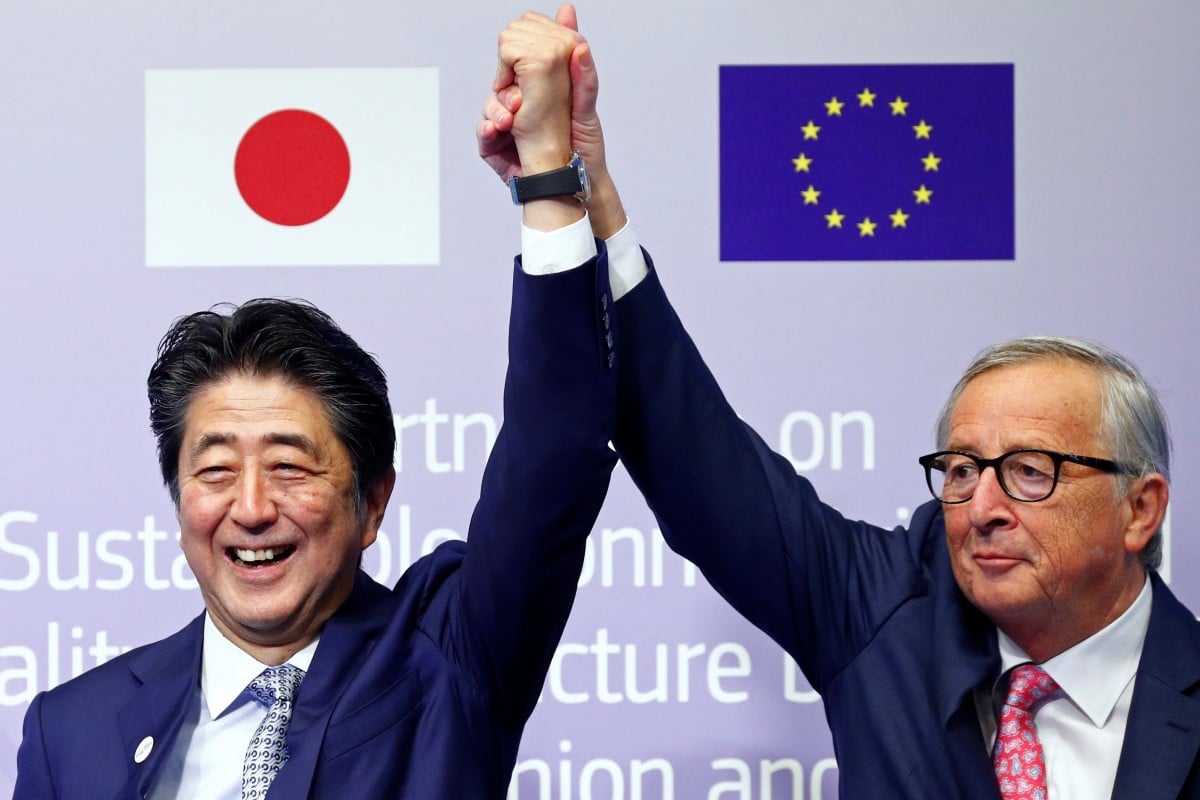
Japan’s Prime Minister Shinzo Abe and EC President Jean-Claude Juncker mark first anniversary of EU-Asia Connectivity scheme with swipes at China
Partners reach out to countries in Balkans and Africa and agree US$65.5 billion development plan
Japan’s Prime Minister Shinzo Abe (left) and European Commission President Jean-Claude Juncker mark the anniversary of the EU-Asia Connectivity scheme in Brussels, Belgium. Photo: Reuters
The European Union and Japan are stepping up their efforts to counter China’s
, with their leaders vowing to be “guardians of universal values” such as democracy, sustainability and good governance.
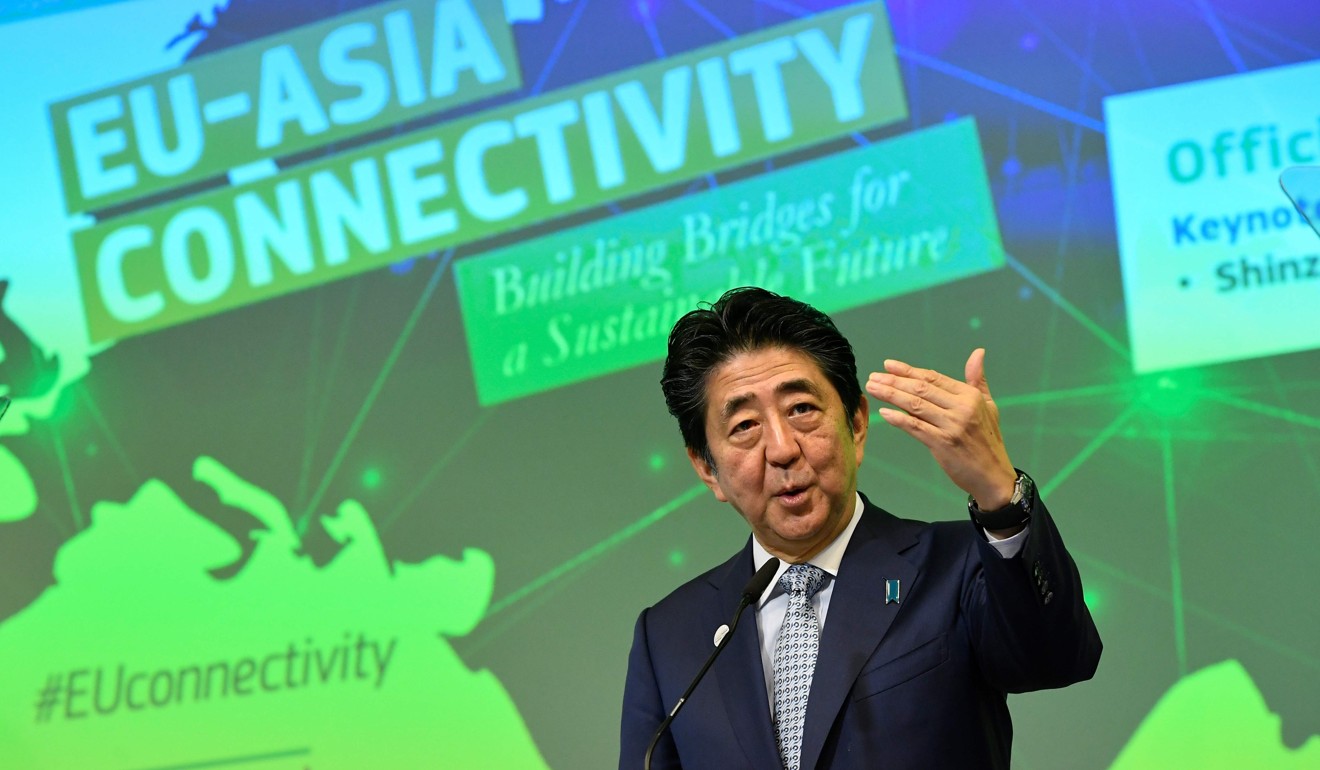
Speaking in Brussels on Friday, Japanese Prime Minister Shinzo Abe said the world’s third-biggest economy would work with the EU to strengthen their transport, energy and digital ties to Africa and the Balkans – key regions for China’s flagship trade and development project.
At a forum to mark the first anniversary of the EU-Asia Connectivity scheme, Abe and European Commission President Jean-Claude Juncker signed an agreement formalising Japan’s involvement in the Europe-Asia plan that will be backed by a €60 billion (US$65.54 billion) EU guarantee fund, development banks and private investors.
Abe said Japan would ensure that officials from 30 African countries would be trained in sovereign debt management over the next three years, a veiled attack on what Western diplomats claim is China’s debt trap for its belt and road partners.
“The EU and Japan are linked through and through,” Abe said. “The infrastructure we build from now on must be [high] quality infrastructure.
“Whether it be a single road or a single port, when the EU and Japan undertake something, we are able to build sustainable, comprehensive and rules-based connectivity, from the Indo-Pacific to the west Balkans and Africa.”
Japan wants to extend its business reach through its alliance with the EU as its economy slows and geopolitical competition from China takes its toll.
Japan indicates China is bigger threat than North Korea in latest defence review
China’s low-key delegation to the forum was led by Guo Xuejun, deputy director general of international affairs at the foreign ministry.
The US was represented by its deputy assistant secretary of state for cyber policy, Robert Strayer, who was in Europe to lobby against Chinese telecoms giant Huawei Technologies and its involvement in fifth-generation telecoms networks.
Abe and Juncker made cybersecurity the highlight of their addresses. Juncker, who will step down from the presidency by the end of October, repeated his attack on China’s trade policies without naming the country.
“Openness is reciprocal, based on high standards of transparency and good governance, especially for public procurement, and equal access to businesses while respecting intellectual property rights,” he said.
Prime Minister Shinzo Abe says Japan will train officials from 30 African countries in sovereign debt management in three years. Photo: AFP
European policymakers and businesses have for years complained about China’s refusal to allow foreign companies in without a Chinese joint venture partner, a practice that critics claimed involved forced transfer of intellectual property to the Chinese side.
“One of the keys to successful connectivity is to respect basic rules and common sense,” Juncker said, stressing that EU-Japanese cooperation focused on the “same commitment to democracy, rule of law, freedom and human dignity”.
European businesses urge EU to take ‘defensive’ measures against China’s state-owned enterprises
When the commission proposed improved transport, energy and digital infrastructure links with Asia last year, it denied it was seeking to stymie Chinese ambitions.
The EU plan, which would be backed by additional funds from the EU’s common budget from 2021, private sector loans and development banks, amounted to a response to China’s largesse in much of central Asia and south-eastern Europe, where Beijing has invested billions of dollars.
It was close to midnight and Vlada, a Serbian engineer, was speeding towards his apartment in Belgrade. He had taken his 20-year-old son out that evening but bombs had started to fall across the Yugoslav capital. The power grid was down and he wanted to get home.
Nato, the world’s most powerful military alliance, had been pummelling Yugoslavia from the skies since late March to try to bring a halt to atrocities committed by President Slobodan Milosevic’s forces against ethnic Albanians in the province of Kosovo. It was now 7 May 1999 and the US-dominated air campaign was only growing more intense.
Vlada’s family had spent many nights in recent weeks huddled with others in the basement of their apartment building as air raid sirens blared outside, praying that an errant missile wouldn’t strike their homes.
They were lucky, some thought, to live just next to the Chinese embassy – an important diplomatic mission. Being there would surely protect them.
But as Vlada and his son approached the glass doors of their building in the dark, US B-2 stealth warplanes were in the skies above Belgrade. They were locked-on to the precise co-ordinates of a target selected and cleared by the CIA. All Vlada heard at first was the whoosh of an incoming missile. There was no time to move. The doors shattered, spraying glass at them.
“The force of the first bomb lifted us off the ground and we fell… Then one after the other [more bombs landed] – bam, bam, bam. All the shutters on the block were ripped off by the blast, it broke all the windows.”
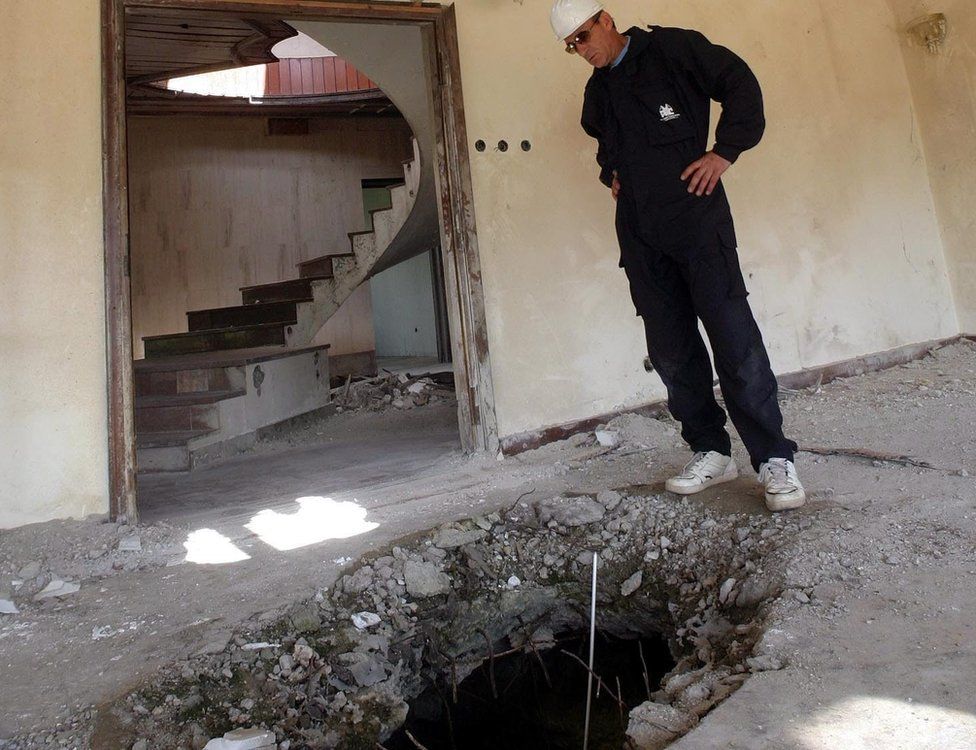
They were terrified but uninjured. All five bombs had hit the embassy, 100 metres away.
The US and Nato were already facing scrutiny over mounting civilian casualties in a bombing campaign conducted without UN authorisation and fiercely opposed by China and Russia. They had now attacked a symbol of Chinese sovereignty in the heart of the Balkans.
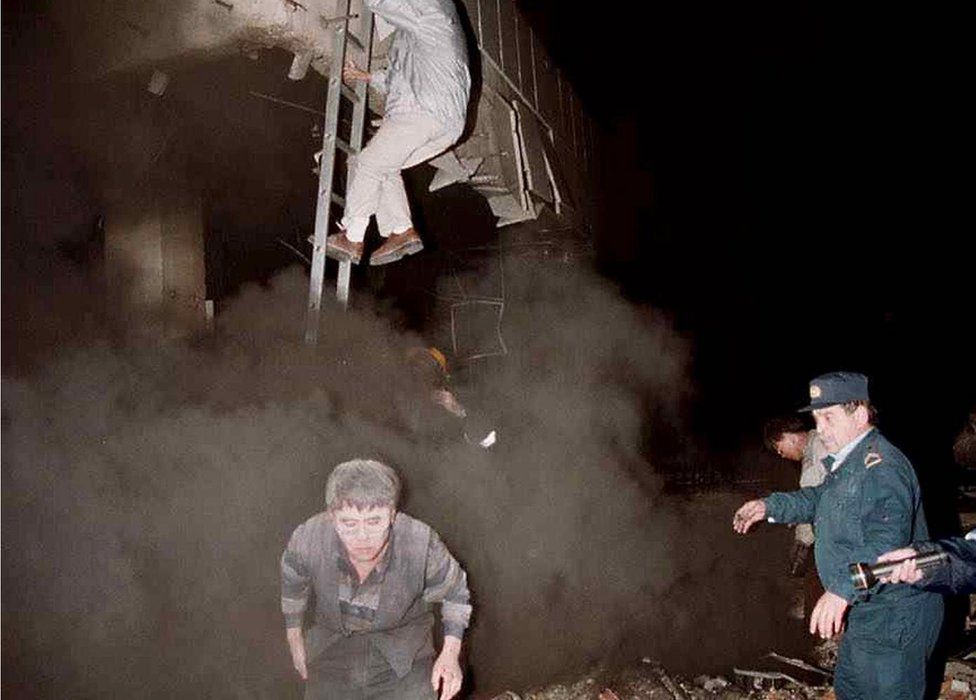
Image copyright SASA STANKOVIC/EPA/REX/SHUTTERSTOCKImage caption Embassy workers escaped through windows after the strikesAcross town, Shen Hong, a well-connected Chinese businessman, was getting word that the embassy had been hit. He refused to believe it. Just a few days earlier, his father had phoned from Shanghai and joked that his son should park his new Mercedes at the diplomatic compound to keep it safe.
“I called a policeman who I knew and he said, ‘Yes, Shen, it’s really hit’. He said come right away, so then I knew it was real, it was true.”
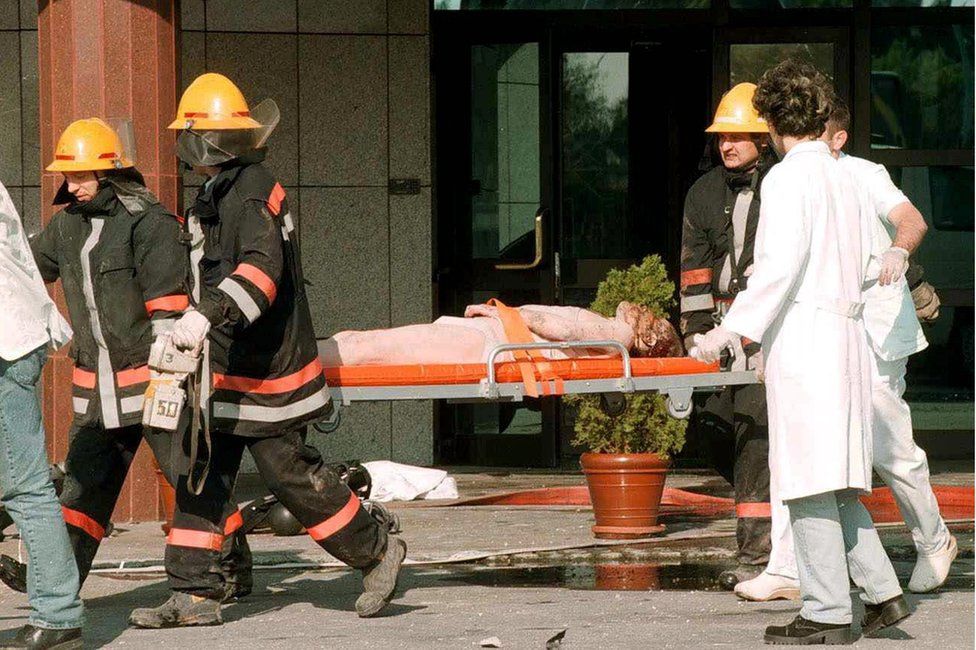
He arrived to a scene of chaos. The embassy was burning; workers covered in blood and dust were climbing out of windows to escape. Politicians close to Milosevic – who had been charged two weeks earlier with crimes against humanity by an international tribunal – were already arriving to denounce the bombing as the latest example of Nato barbarity.
“We could not go inside. There was a lot of smoke, there wasn’t any electricity and we couldn’t see anything. It was horrible,” said Shen.
Image copyright LAZARA MARINKOVICImage caption Shen Hong lost close friends in the bombingHe spotted the cultural attaché, a man he knew, who had knotted together curtains to get out of a first-floor window. “We didn’t see that he was injured and he didn’t notice it either. It was only when I shook his hand that I realised my hands were covered in blood. I told him ‘you’re injured, you’re injured!’ – but when he saw this he passed out.”
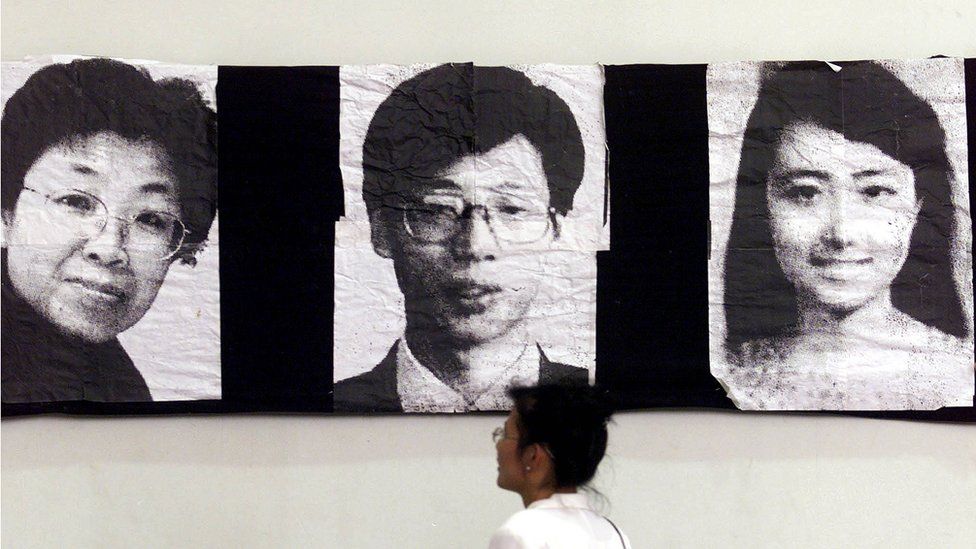
The next day Shen would learn that two close friends – newlywed journalists Xu Xinghu, 31, and Zhu Ying, 27 – had been killed by a bomb that hit the sleeping quarters of the embassy. Their bodies were found under a collapsed wall.
The pair had worked for the Guangming (Enlightenment) Daily – a communist party newspaper. Xu, a language graduate who spoke fluent Serbian, had chronicled life in Belgrade during the bombings in a series of special reports called “Living Under Gunfire”.
Image copyright DRASKO GAGOVIC/EPA
Zhu Ying worked as an art editor in the paper’s advertising department. Her mother collapsed with grief and was sent to hospital when she learned of her daughter’s death so Zhu’s father travelled alone to Belgrade to see the body.
A third journalist, 48-year-old Shao Yunhuan, of the Xinhua news agency, also died. Her husband, Cao Rongfei, was blinded. The embassy’s military attaché, who is believed to have run an intelligence cell from the building, was sent back to China in a coma. In total, three people were killed and at least 20 injured.
For Shen, this was an act of war. The next day he led a protest through the streets of Belgrade carrying a sign reading “NATO: Nazi American Terrorist Organisation”
It was a sign of what was to come.
Image copyright REUTERSImage caption Three journalists were killed in the embassy
Within hours of the bombing, two competing narratives began to emerge. They would harden over the coming months and form the basis of how the incident – which continues to linger over the US-China relationship – remains debated today.
The bombing fuelled speculation, and there was no shortage of unanswered questions and missing pieces that were put together by some to imply a grand conspiracy. Intrigue continued to hang over the incident and, months afterwards, two respected European newspapers suggested the strikes were by design.
But, as former Nato officials point out, in 20 years no clear evidence has come to light proving what almost all of China believes and America strenuously denies: that it was deliberate.
In those first hours after the bombs fell, the US and Nato wasted no time to announce that it was an accident. China’s representative at the UN, meanwhile, denounced a “crime of war” and a “barbarian act”.
In Brussels, Jamie Shea – the British Nato spokesman who became the public face of the war – was woken up in the middle of the night and told he would have to face the world’s press in the morning. The information available in those early hours was thin but he would give one of the first explanations of what had happened, along with an apology. The warplanes, he said from the briefing podium, had “struck the wrong building”.
“It’s like a train accident or a car crash – you know what has happened but what you don’t know is why it has happened,” he says 20 years later. “That took a lot longer to establish… But it was clear right from the get-go, that targeting a foreign embassy was not part of the Nato plan.”
Image copyright BORIS SUBASIC/EPAImage caption The father of Zhu Ying weeps over her coffin in BelgradeIt would take more than a month for the US to give Beijing a full explanation: that a series of basic errors had led to five GPS-guided bombs striking China’s embassy – including one that hurtled through the roof of the ambassador’s residence next to the main building but didn’t explode, likely sparing his life.
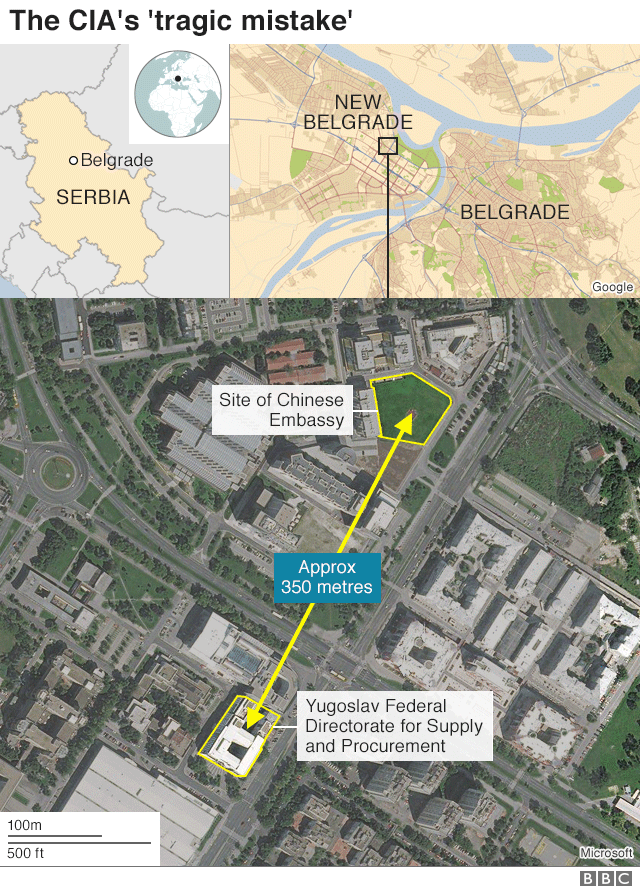
The real target, officials said, was the headquarters of the Yugoslav Federal Directorate for Supply and Procurement (FDSP) – a state agency that imported and exported defence equipment. The grey office building is still there today – hundreds of metres down the road from the embassy site.
Nato had initially hoped the bombing campaign would only last a few days until Milosevic gave up, pulled his forces out of Kosovo and allowed peacekeepers in. But by the time the embassy was hit it had stretched to more than six weeks. In the rush to find hundreds of new targets to sustain the aerial assault, the CIA, which was not normally involved in target-picking, had decided the FDSP should be struck.
But America’s premier intelligence agency said it had used a bad map.
“In simple terms, one of our planes attacked the wrong target because the bombing instructions were based on an outdated map,” US defence secretary William Cohen said two days after the bombing. He was referring to a US government map that apparently did not show the correct location of the Chinese embassy nor the FDSP.
All US intelligence officers had was an address for the FDSP – 2 Bulevar Umetnosti – and a basic military navigation technique was used to approximate its co-ordinates. The technique used was so imprecise, CIA chief George Tenet later said, that it should never have been used to pick out a target for aerial bombing.
To compound the initial error, Tenet said, intelligence and military databases used to cross-check targets did not have the embassy’s new location listed, despite the fact that many US diplomats had actually been inside the building.
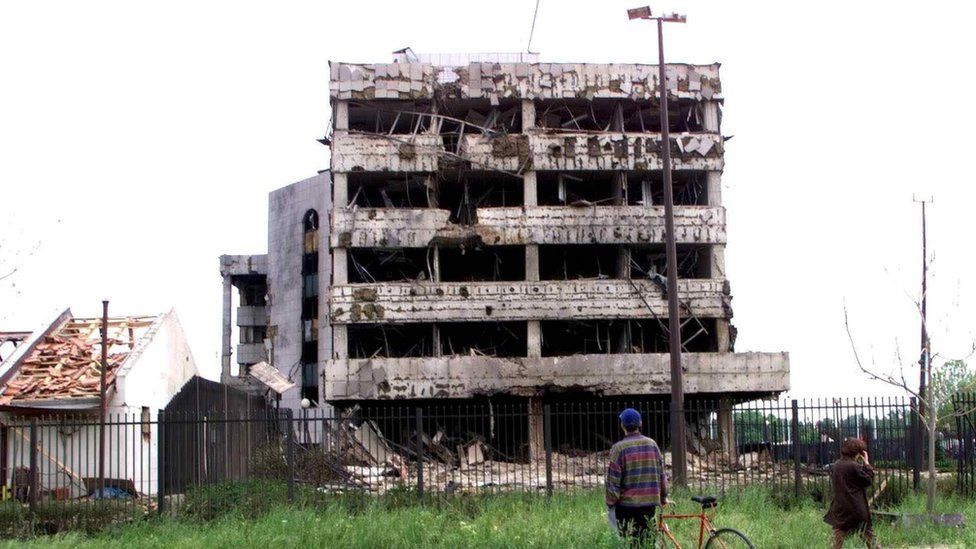
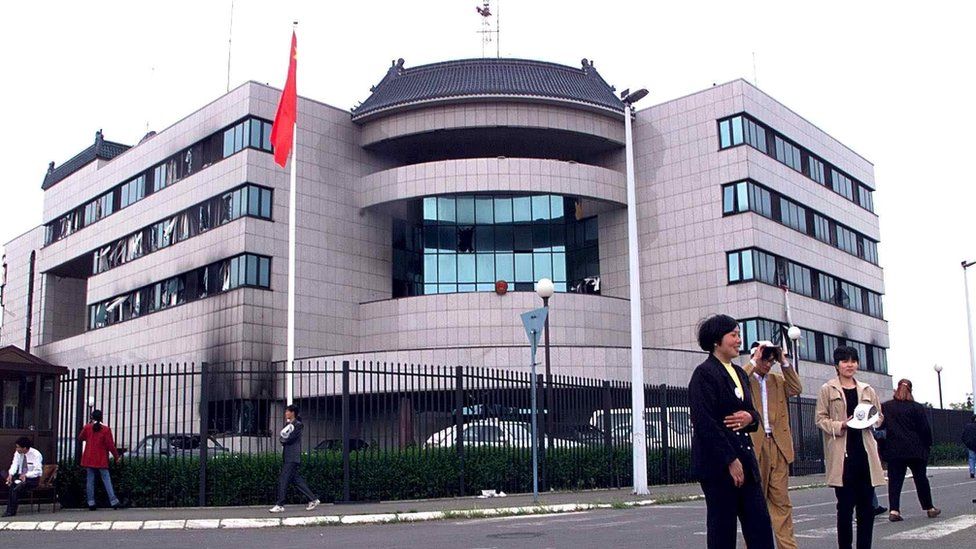
Had anyone on the ground visited the site to be bombed they would have found a gated compound, a five-storey building with a green-tiled oriental sloped roof, a bronze plaque announcing the embassy’s presence and a large, bright red Chinese flag fluttering more than 10 metres in the air.
Image copyright SASA STANKOVIC/EPA/REX/SHUTTERSTOCKImage caption The front of the embassy was largely undamagedThe crux of the CIA’s explanation was hard for many to believe: the world’s most advanced military had bombed a fellow UN Security Council member and one of the most vocal opponents of the Nato air campaign because of a mapping error. China was having none of it. The story, it said, was “not convincing”.
“The Chinese government and people cannot accept the conclusion that the bombing was a mistake,” the foreign minister told a US envoy sent to Beijing in June 1999 to explain what had happened.
But why would the US intentionally attack China?
It wasn’t long after the Sun rose on the morning of Saturday, 8 May 1999, that David Rank, a US diplomat, got out of bed in Beijing.
He turned on the television and switched to CNN. The American news network was carrying live pictures of the smouldering Chinese embassy in pitch-dark Belgrade.
By that afternoon, thousands of irate Chinese protesters would be gathered outside. But Rank, at that stage, was fairly calm. He rang his boss, the head of the political section: “I said, you know, Jim, this is the damndest thing.”
The diplomat rushed from his residence to the embassy down the road, where US officials were trying to figure out what had happened. Something had clearly gone wrong but this must have been, had to have been, a tragic mistake.
“It was so patently obvious that it was a sort of fog of war accident… At that point I didn’t think that down the road this was going to be a major problem. Obviously, it was a major problem, but not the sort of convulsive incident that it turned out to be,” said Rank.
But in the next hours, the shape of how the Chinese government and people would respond started to become clear.
Image copyright PETER ROGERS/GETTY IMAGESRank began receiving calls from liberal Chinese friends who were outraged at the bombing. American journalists got similar calls from Chinese contacts with pro-US views, expressing shock and a sense of betrayal.
Chinese state media was already laying out a clear narrative – the US had breached international law by bombing a Chinese diplomatic outpost. “The language that I heard from lots and lots of Chinese, it was identical. It was the same almost word-for-word lines of real anger,” said Rank.
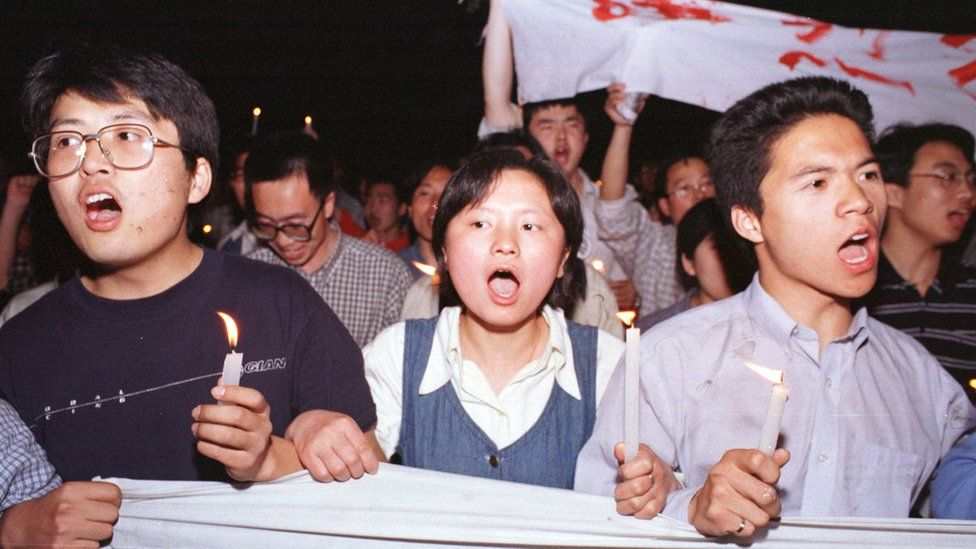
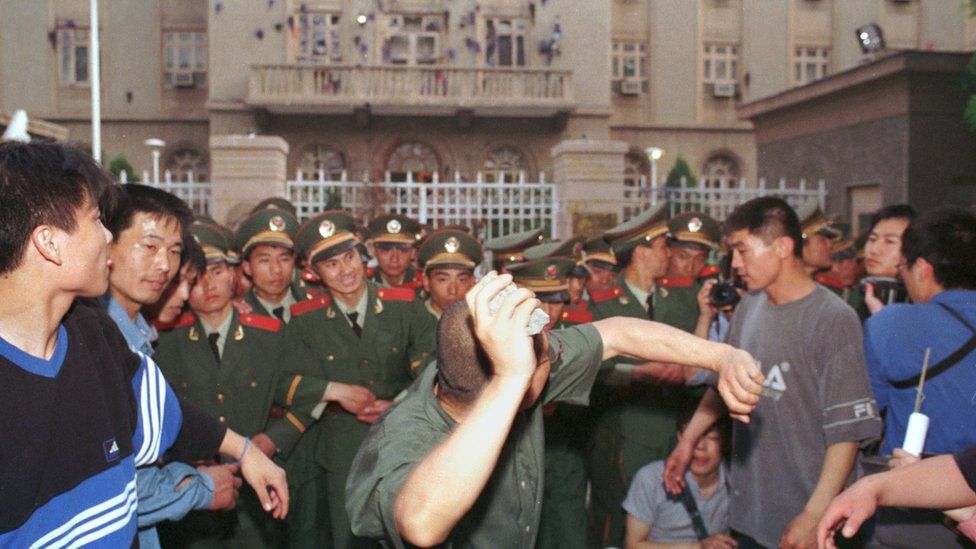
By that afternoon thousands of students were streaming onto the streets of Beijing. They gathered outside the embassy and things quickly turned violent.
“They were pulling up the paving stones. Beijing sidewalks aren’t paved, they have big tiles and they were pulling those up and smashing them and throwing them over the walls.”
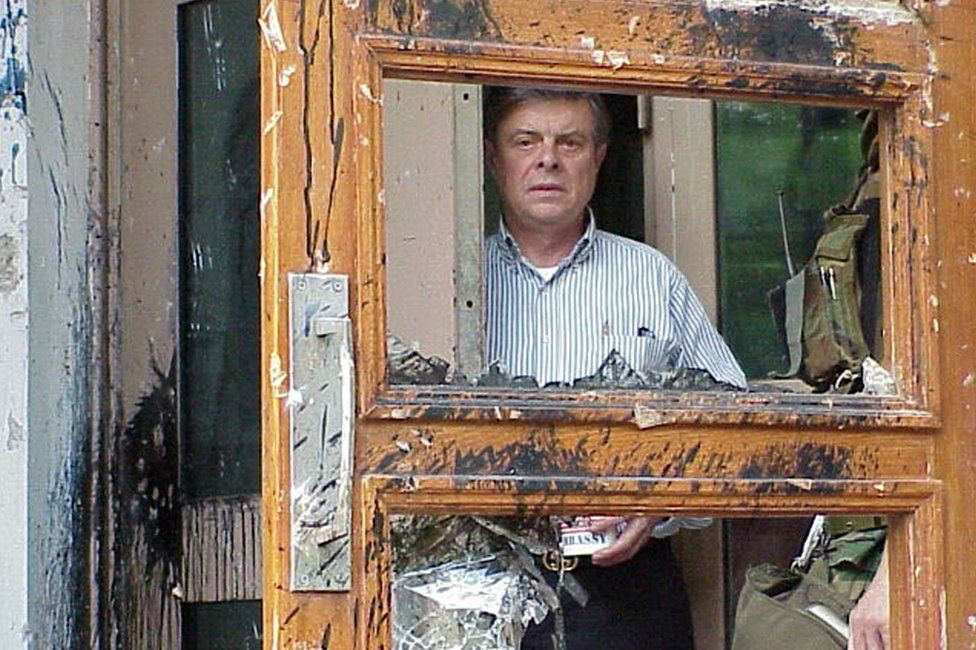
Image copyright PETER ROGERS/GETTY IMAGESMany of those bits of concrete were crashing through the windows of a building where more than a dozen embassy staff, including US Ambassador James Sasser, had hunkered down. Embassy cars were being defaced and attacked.
The message was clear: the bombing was intentional and, as one slogan went, “the blood of Chinese must be repaid”. The protests would continue the next day, with even more people – some reports said 100,000 – storming the diplomatic district, and pelting stones, paint, eggs and concrete at the British and American embassies.
“We feel like we’re hostages,” Bill Palmer, an embassy spokesman trapped in one of the buildings, said at the time.
Demonstrations of this scale had not been seen in tightly-controlled China in the decade since students led a pro-democracy uprising in Beijing’s Tiananmen Square in 1989. This time the anger was directed away from the Communist Party but, with the 10th anniversary of the crackdown on students in Tiananmen approaching, the government had to strike a balance between giving vent to public anger and remaining in control.
In a rare TV address Vice-President Hu Jintao endorsed the protests but also warned they had to remain “in accordance with the law”.
Image copyright REUTERSImage caption US Ambassador James Sasser was trapped in the embassy for four days as protests ragedThe uproar was not isolated to Beijing. Crowds also took to the streets of Shanghai and other cities that weekend. In central Chengdu, the US consul’s residence was set alight.
Weiping Qin, a then 19-year-old student leader at the maritime college in southern Guangzhou city, said demonstrators were not informed that Nato had already apologised for what it said was an accident. “The government was hiding this important message. They didn’t tell us – so young people, everybody, felt angry. We just wanted to go in the streets and protest against the United States.”
He said that initially students at his college were told they had to stay in their dormitories. But 24 hours after the bombing, the university leadership told him that they needed 30,000 students in the streets around the US consulate – 500 of whom would come from the maritime college.
The fired-up students drew lots to choose who could attend. They were loaded onto buses and given statements to read that echoed the stilted official language being broadcast by state media. “They gave us long sentences. But in the street, to speak out in long sentences is very hard.” He decided to yell slogans about the evils of Nato and the US instead.
Image copyright WEIPING QINImage caption Weiping Qin (right) was a student leader at Guangzhou Maritime College in 1999“We were just young people and we just felt angry. Our emotions came out like a wave,” said Qin, who now lives in the US and criticises the Chinese government in YouTube videos.
David Rank agreed that the anger was genuine. “I think it would really sell the Chinese people short to say this was manufactured by the system,” he said. “There was real outrage.”
Since the early 1990s, China had embarked on a concerted campaign to instil nationalism and “patriotic education” in its people. The narrative pushed in school textbooks, university classrooms and the media was that China – home to a great and benevolent civilisation – had been subjugated and humiliated at the hands of Western powers. The Belgrade embassy bombing fit the story.
“The anger that ordinary Chinese felt I think can only be understood in that historical context, being socialised to resent the West,” said Peter Gries, a professor of Chinese politics at Manchester University and an expert on Chinese nationalism.
For Liu Mingfu – a retired People’s Liberation Army colonel known for his hardline views of the US – the embassy bombing was part of a series of events that proved the US was engaged in a “new Cold War against China”.
“It was totally intentional. It was a purposeful, planned bombing, rather than an accident,” he said.
China would receive $28m in compensation from the US for the bombing, but had to give back close to $3m for the damage to US diplomatic property in Beijing and elsewhere. The US paid another $4.5m to the families of the dead and injured.
On the day of the bombing, Dusan Janjic, an academic and advocate for ethnic reconciliation in Yugoslavia, was having lunch at an upscale restaurant in central Belgrade with a man he considered a good friend.
Ren Baokai was the military attaché at the Chinese embassy and Janjic said he was surprisingly open with him about the fact that China was spying on Nato and US operations and tracking warplanes from its Belgrade outpost. The attaché invited him to dinner at the embassy that night because he knew he liked Chinese food.
“And I started making jokes. ‘Come on, you’re going to be bombed! I’m not coming!’,” Janjic recalled. He was being facetious: he did not actually think the embassy would be hit.
But Janjic couldn’t make it to dinner and that evening, when the missiles flew into the building, Ren was thrown to the ceiling by the blast and then fell through a crater left by a bomb. He was found in the basement in a coma only the next morning.
Citing Nato sources, they reported that the embassy was being used as a rebroadcast station for Yugoslav army communications and was as a result removed from a prohibited target list. US Secretary of State Madeleine Albright decried the story as “balderdash”, while British Foreign Secretary Robin Cook said there was “not a single shred of evidence” to support it.
But two decades later, Jens Holsoe, Politiken’s correspondent in the Balkans from 1995 to 2004, and John Sweeney, formerly of the Observer and now with the BBC, said they stood by their reporting that the bombing was intentional.
Holsoe said what made him investigate in the first place was CIA Chief George Tenet publicly saying that satellite images gave no indication the target was an embassy – “no flags, no seals, no clear markings” – when in fact all three were present.
One of his sources – a very senior Danish military figure – almost went on the record to confirm publicly that the bombing was intentional, he said. “Then he suddenly backed out and said if he uttered another word to me about this story that not only did he risk being fired but also prosecuted.”
Holsoe said it was clear at the time that there was military co-operation between Serb forces and the Chinese – and that he personally saw military vehicles entering and exiting the Chinese embassy. American officials told the New York Times that after the bombing they learned the embassy was China’s most significant intelligence collection platform in Europe.
“This was, and always will be, a murky story,” said Sweeney.
Ren Baokai survived and was later given the rank of general. He declined an interview with the BBC, saying he was now retired.
The Chinese ambassador who narrowly survived the strike, Pan Zhanlin, denied in a book that the embassy had been used for re-broadcasting and that China, in exchange, had been given parts of the US F-117 stealth fighter jet that Serbian forces had shot down in the early stages of the Nato campaign.
Getty Images
I think it’s complete nonsense – it was a bad map-reading error and a bad mistake.
It’s widely assumed that China did get hold of pieces of the plane to study its technology. It’s also been speculated that China was using the Nato air campaign to test technology to track stealth bombers that are normally undetectable.
But even if all these stories are true – the question remains: would the US really take the risk of bombing a Chinese embassy on purpose?
Even among ex-Yugoslav insiders there is no consensus. One former military intelligence officer told the BBC he believed the bombing was intentional and that the CIA’s explanation was ludicrous; while another, a retired colonel, said he believed America’s story.
“When something bad happens everybody thinks there has to be a secret reason – not a cock-up but a conspiracy,” said the former Nato spokesman Jamie Shea. “I think it’s complete nonsense – it was a bad map-reading error and a bad mistake.”
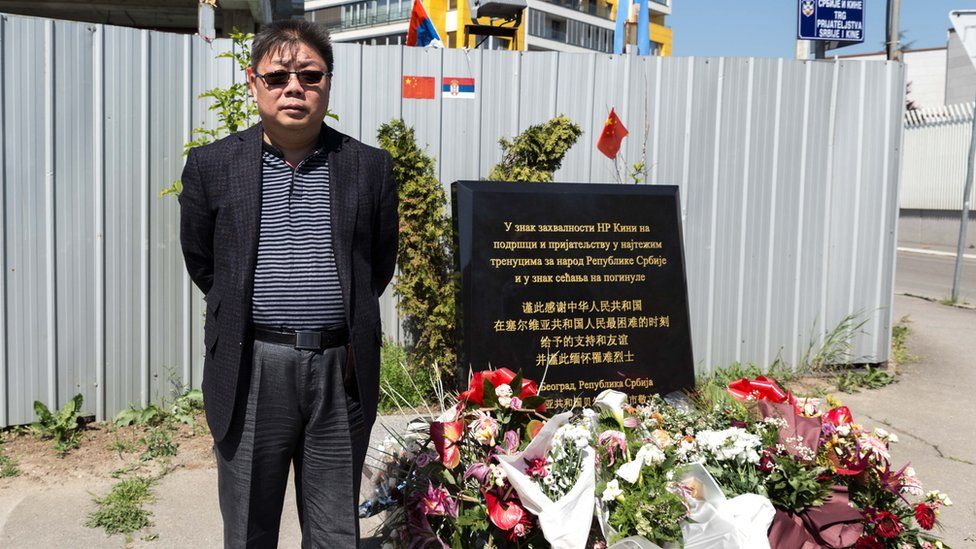
On a sunny day in late April, more than a dozen fresh bouquets were stacked up neatly against the memorial stone, but Shen Hong still felt compelled to re-arrange them. He comes to the site of the embassy bombing regularly, to remember his friends that died. But these days, it’s rare that he is alone.
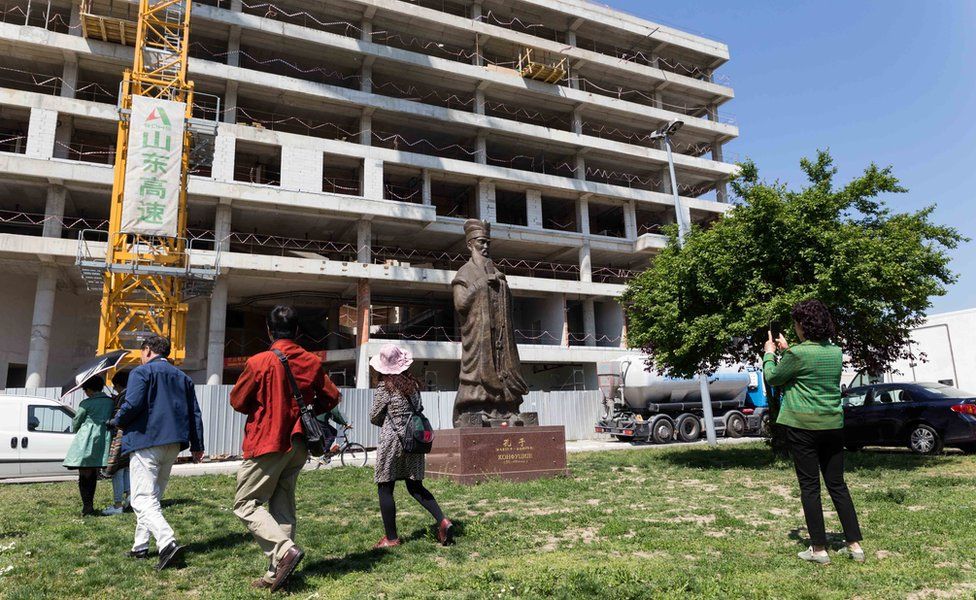
Busloads of Chinese tourists arrive every day to gaze at the memorial and the statue of the Chinese sage and philosopher Confucius that now stands nearby.
A young Chinese couple, Zhang and He, were in Belgrade for their honeymoon and decided to visit the memorial. They are around the same age that Xu Xinghu and Zhu Ying were when they were killed in 1999. “Three of our countrymen died here. We knew about this since we were kids and we came to see it,” said He.
Yang, a guide who was leading some 30 middle-aged Chinese tourists on a two-week bus tour through the Balkans, said the embassy site was a mandatory stop. “Our embassy was destroyed by Americans. Every Chinese knows this.”
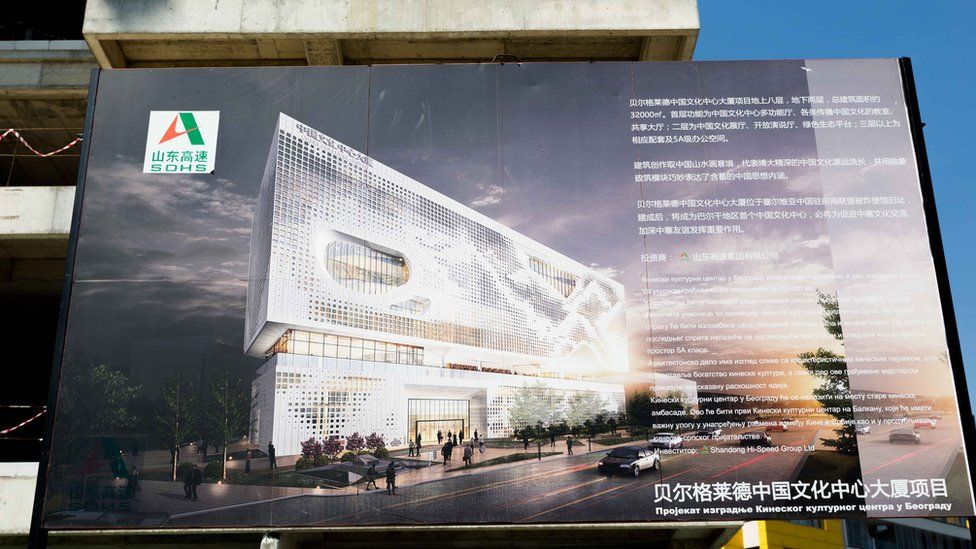
Image copyright LAZARA MARINKOVICImage caption The embassy site is being turned into one of the largest Chinese cultural centres in EuropeIn 1999, China was not the economic, technological and military giant it is now. It was focused on getting wealthy and had a much less visible foreign policy. But 20 years later the country knows it sits at the top table with America and its ambitions around the world reflect that.
The Belgrade embassy site is being turned into a Chinese cultural centre that will be one of the biggest in Europe. The symbolism is hard to miss: a site of national humiliation and tragedy at the hands of the West re-born as a shiny edifice to China’s glorious history.
It’s a sign that Beijing has no plans to forget a bombing that allows it to paint the US as an imperialist superpower looking to hurt China. Diplomats who have served in Beijing say the incident is still brought up regularly in conversations.
Image copyright LAZARA MARINKOVICBut even those who called for immediate retaliation in 1999 now realise it was fortunate that China’s reaction did not spiral out of control: no Americans were killed during the protests and the compensation agreement allowed Beijing to draw a line – if a thin one – under the incident.
“We were the fastest developing country, every year our economy grew by double-digits. And if we would have stopped that because of war back then, we would have lost a lot,” said Shen, as another group of tourists arrived at the memorial.
“By nature, I’m a radical. I am always more for war than for a conversation. But when I look back, they did a good thing. Because now we can sit equally with the Americans.”
BRUSSELS (Reuters) – Chinese Premier Li Keqiang and EU institution leaders meet in Brussels on Tuesday for an annual EU-China summit set to be overshadowed by differences over trade and investment.
After years of offering free access to its markets, the European Union has said it is losing patience with Beijing over the pace of liberalising reforms. It also has growing concerns over state-led Chinese companies’ dominance of some EU markets and acquisitions of strategic industries.
Like the United States, many EU countries want to crack down on industrial subsidies and forced technology transfers, although prefer dialogue to the trade war Washington has triggered.
The European Commission set out a 10-point action plan last month, seeing scope for greater cooperation in fields such as climate change, but demanding greater reciprocity, such as access for EU firms to Chinese public tenders.
“The old narrative is absolutely obsolete,” Commission Vice President Jyrki Katainen told Reuters.
Beijing and Brussels have been wrestling for weeks over the text of a joint declaration to be presented as the fruit of Tuesday’s summit between Li and Commission President Jean-Claude Juncker and European Council chiefDonald Tusk.
“China aims to have a feel-good summit, whereas we aim to have a meaningful summit, with a meaningful outcome,” Peter Berz, acting Asia director at the Commission’s trade section, told the European Parliament last week.
EU diplomats said on Monday negotiators had made some progress, but were still short of an agreed text. Talks would continue until the summit, due to start at 1 p.m. (1100 GMT).
China points to a new foreign investment law due to take effect at the start of 2020. It includes provisions to ban forced technology transfers and ensure foreign companies have access to public tenders.
EU officials say the law lacks detail and question how effective it will be in reality in protecting foreign firms.
Li wrote in a German newspaper on Monday that China wanted to work with the European Union on issues including trade and denied Beijing was trying to split the bloc by investing in eastern European states.
BRUSSELS, April 6 (Xinhua) — China-European Union (EU) relations in tourism get a boost as the 2018 EU-China Tourism Year has scored a success, an official recently said.
During the tourism year, China and the EU held more than 100 promotional activities. It “has been extremely successful,” said Eduardo Santander, executive director of the European Travel Commission (ETC).
There was a 5.1-percent year-on-year increase in Chinese arrivals in EU destinations in 2018, and among the top ones in terms of the volume of Chinese arrivals were Britain, Germany and France, according to the latest figures from the ETC and the air travel analysis agency ForwardKeys.
“We continue to see the benefits in 2019,” Santander added. “The growth in Chinese travellers has been solid, and the near future, judging by current bookings, will see the EU continuing to increase its share of this valuable market, not just to traditional destinations, but lesser-known and emerging ones as well.”
Chinese bookings to the EU for the first four months of 2019 are 16.9 percent ahead of where they were at the end of 2017, said the ETC, adding that this compares very favorably to the global trend, which is 9.3 percent ahead.
According to a recent report by China Tourism Academy and China’s online travel agency Ctrip, 70 percent of Chinese tourists in 2018 chose “package tours” when traveling in Europe, due to language, visa, culture and other factors.
Nevertheless, the proportion of independent and customized travel continues to rise. In 2018, the demand for customized European tours booked by the travel website increased by 127 percent over the past year, far higher than the growth rate of the overall market, said the report.
In addition, a number of new routes were launched between China and Europe in 2018, including direct flights from Fuzhou to Moscow, Changsha to London, Jinan to Paris, and Shenzhen to Brussels. In 2018, there were more than 600 flights a week between China and Europe, according to the report.
Ctrip in 2018 forecast that consumption of each tourist in Europe will exceed 25,000 yuan (about 3,721 U.S. dollars) in two years, with the total annual consumption to reach 150 billion yuan (about 22.3 billion dollars).
“Our findings confirm what a concerted effort to boost tourism can achieve. It also appears to have lasting effects, as we can see in the forward booking figures,” said Olivier Jager, CEO of ForwardKeys.
China’s domestic travel agencies are also deepening the cooperation with Europe. For example, the SkyScanner, Ctrip’s online travel search platform, set up its first overseas calling service center in Edinburgh in April 2018.








 CHINDIA ALERT: You'll be living in their world, very soon