Archive for ‘Caixin/Markit Manufacturing Purchasing Managers’ Index (PMI)’

04/04/2020

Coronavirus: China’s deserted shops and restaurants show that even as lockdown ends, scars remain

  • Lockdown may have been lifted, but shops, bars and restaurants remain empty in Beijing, showing struggle facing economic recovery
  • Controls have been returning in other parts of China, where cinemas and tourist attractions shut amid fears of new wave of infections
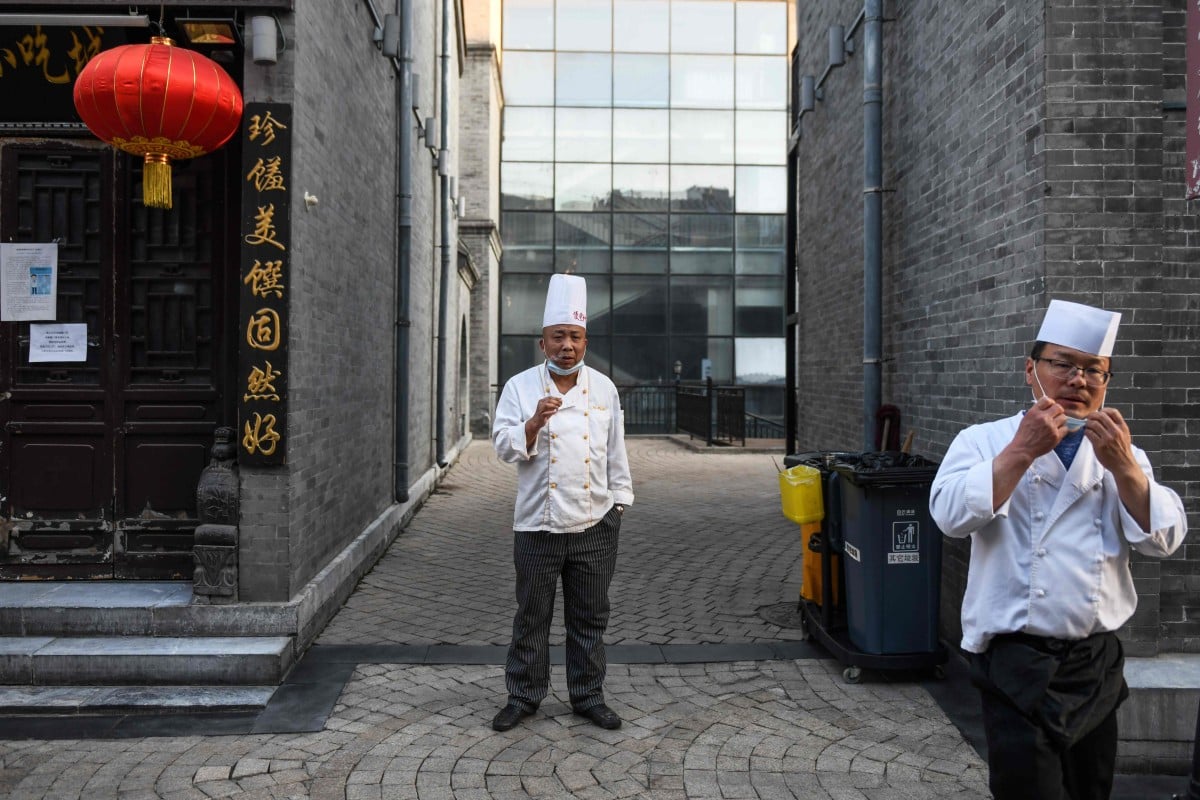
The nearly two month-long lockdown has changed the consumption behaviour of Chinese residents, many of whom have turned to home cooking to cut their spending. Photo: AFP

China’s urban lockdown may have eased, but deserted streets and stores in the capital Beijing this week suggest that for the services sector, the impact of the coronavirus outbreak could be deeper and longer than expected.

Many restaurants, cafes and pubs remained closed in the city, where vigilance remains high about a second wave of infections. Among those that were open, there were few customers to be seen.

The usually crowded Wangfujing shopping street was quiet on Wednesday, with just a few shoppers patronising what is usually the heartbeat of the city’s commerce and tourism. There were more staff than consumers at the Apple store, while everyone wore a mask. Shops along the pedestrianised zone closed their doors before sunset, but many did not open at all.

In a downtown food court, a handful of people dined during what would usually be the lunch rush hour, each restricted to their own small table to maintain social distancing, in great contrast with the usual frantic dash for seats.

Coronavirus: What impact will the economic fallout from the Covid-19 pandemic have on you?
While China has largely stemmed the domestic spread of Covid-19, threats of imported cases, with the virus having infected over one million people worldwide, and asymptomatic carriers continue to hamper the recovery in China’s 
A survey published on Friday showed that in March, sentiment among small service sector firms remained depressed. The Caixin / Markit services purchasing managers’ index (PMI) was 43.0 for last month, with a number below 50 meaning the sector is shrinking. “There are too few people now. We only sold about a hundred bowls of noodles, that was just half of our normal level,” said one Beijing street vendor, who had also cut many items from the menu due to insufficient demand.

A bookstore in the city centre held an official opening ceremony after a soft opening followed by a two and a half month-long forced shutdown, but received only four visitors on a morning, one of which was the South China Morning Post reporter. All four were required to go through a body temperature check and write down their personal contact details before entering.

Service sector workers said the situation was surreal and that they were worried that there was no end in sight.

“I have never seen KFC look like this,” said an employee of the fast food chain restaurant at Wangfujing, pointing to the virtually empty dining hall.

A grocer at a nearby food market continually shook her head when talking about the decline in customers, but said she felt lucky that she could come back to Beijing from her hometown before the 14-day mandatory quarantine requirement was imposed on February 14.

This situation is not restricted to Beijing. When the Chinese government reopened around 500 cinemas nationwide in March, each one attracted on average

only two customers

per day.

Now, many places across China are reimposing controls amid fears of a new spike in infections, the same fear leading people to stay home instead of going to those venues which have reopened.

Shanghai has closed tourist attractions while Sichuan has again closed karaoke lounges. Cinemas have also been reclosed across the country.

President Xi Jinping said during a visit to Hangzhou last Sunday that China must remain alert. “If you want to watch a movie, rather than going to a cinema, you can watch it online,” Xi said.

Services account for 60 per cent of China’s economy and the majority of employment. The slowness of the sector’s recovery is placing huge pressure on the world’s second 

largest economy

at a time when manufacturers are seeing export orders nosedive.

Liang Zhonghua, chief macro analyst at Zhongtai Securities, a brokerage, said that China’s damaged consumption alone could drag economic growth down by 4.5 per cent in the second quarter.
“(Chinese) residents’ fear of the epidemic is not over,” he wrote in a note this week.
Beijing’s malls still empty after coronavirus lockdown lifted
In Beijing all travellers entering the city are required to undergo a 14-day quarantine, while mass gatherings are still forbidden.
The containment measures have stopped many migrant workers from getting back to 
their jobs

, if they still exist. Many local residents still choose to work from home, even though authorities had been trying to encourage people to go out and spend money.

On April 1, the traffic flow on Beijing’s subway system was 3.05 million passengers a day, less than a third of the level a year ago, according to the operator, while car traffic was still about 15 per cent less than it was last year, government data showed.

I will keep cooking for myself, even when everything goes back to normal, it is much healthier and cheaper – Beijing resident

The nearly two month-long lockdown has changed the consumption behaviour of Chinese residents, many of whom have turned to home cooking to cut their spending.

“I will keep cooking for myself, even when everything goes back to normal, it is much healthier and cheaper,” said a Beijing lawyer whose family name is Li.

The effect of this behavioural shift is borne out in the 17.9 per cent drop in retail sales in the capital over the first two months of the year, only slightly better than the nationwide drop of 20.5 per cent.

Beijing businesses have clubbed together to issue some 150 million yuan in 

vouchers

to lure customers in since March 18. But with more economic hardship ahead, businesses and consumers alike are hunkering down for the storm.

Source: SCMP
01/04/2019

China manufacturing returns to growth in March: Caixin PMI

BEIJING (Reuters) – China’s manufacturing sector unexpectedly returned to growth for the first time in four months in March, in a sign that government stimulus measures may be slowly gaining traction, a private business survey showed on Monday.

But growth in new domestic and exports orders was marginal, suggesting the economy will remain under pressure in coming months and will likely require more policy support before it can convincingly stabilize.

The Caixin/Markit Manufacturing Purchasing Managers’ Index (PMI) expanded at the strongest pace in eight months in March, rising to 50.8 from 49.9 in February, above the neutral 50-mark dividing expansion from contraction on a monthly basis and the highest level seen since July 2018.

Economists polled by Reuters had forecast the reading for March would stay unchanged at 49.9. The surprise expansion seen in the Caixin survey echoed that seen in the official PMI released on Sunday, which also showed factory activity defying expectations for another contraction in March.

“With a more relaxed financing environment, government efforts to bail out the private sector and positive progress in Sino-U.S. trade talks, the situation across the manufacturing sector recovered in March,” Zhengsheng Zhong, director of macroeconomic analysis at CEBM Group, said in a commentary accompanying the data release.

China has made proposals in talks with the United States on a range of issues that go further than it has before, including on forced technology transfer, as the two sides work to overcome obstacles to a deal to end their protracted trade war, U.S. officials told Reuters on Wednesday.

But sources close to the talks have stressed that a deal is by no means certain, and tit-for-tat tariffs on both sides have remained in place.

Zhang noted the employment situation improved significantly in March, a trend that may ease some government and investor concerns after the unemployment rate in urban areas for February rose to the highest since early 2017.

Caixin’s findings showed factories added headcount in March for the first time in 65 months, arresting a relentless spell of job shedding since October 2013. Some firms were hiring to support higher production and new business development, the release said.

New orders — an indicator of future activity — increased for the second month running, though the pace of growth was marginal. Output also grew for the second straight month.

New export orders expanded after contracting in the previous month. Though the rate of increase was fractional, Caixin said the broad trend appeared to have steadied in the first quarter.

Chinese manufacturers also signaled an improvement in pricing power in March, which could ease pressure on profit margins. Output charges edged up into expansionary territory and outpaced growth in input prices, reflecting reduced pressure from raw material costs.

“The producer price index might have risen faster year-on-year in March, and increased month-on-month, compared with a monthly decline in February,” Zhong added.

Optimism among businesses edged up to a 10-month high partly on expectations that market conditions, both at home and abroad, will improve, the statement said.

But purchasing activity declined for the third straight month, suggesting some firms remain cautious.
Economists at Nomura have forecast that China’s industrial production growth will moderate again in April and May after a brief rebound in March mainly due to last year’s low base.
Source: Reuters
Law of Unintended Consequences

continuously updated blog about China & India

ChiaHou's Book Reviews

continuously updated blog about China & India

What's wrong with the world; and its economy

continuously updated blog about China & India