Archive for ‘CEO’

09/04/2020

Pass the salt: The minute details that helped Germany build virus defences

MUNICH (Reuters) – One January lunchtime in a car parts company, a worker turned to a colleague and asked to borrow the salt.

As well as the saltshaker, in that instant, they shared the new coronavirus, scientists have since concluded.

That their exchange was documented at all is the result of intense scrutiny, part of a rare success story in the global fight against the virus.

The co-workers were early links in what was to be the first documented chain of multiple human-to-human transmissions outside Asia of COVID-19, the disease caused by the coronavirus.

They are based in Stockdorf, a German town of 4,000 near Munich in Bavaria, and they work at car parts supplier Webasto Group. The company was thrust under a global microscope after it disclosed that one of its employees, a Chinese woman, caught the virus and brought it to Webasto headquarters. There, it was passed to colleagues – including, scientists would learn, a person lunching in the canteen with whom the Chinese patient had no contact.

The Jan. 22 canteen scene was one of dozens of mundane incidents that scientists have logged in a medical manhunt to trace, test and isolate infected workers so that the regional government of Bavaria could stop the virus from spreading.

That hunt has helped Germany win crucial time to build its COVID-19 defences.

The time Germany bought may have saved lives, scientists say. Its first outbreak of locally transmitted COVID-19 began earlier than Italy’s, but Germany has had many fewer deaths. Italy’s first detected local transmission was on Feb. 21. By then Germany had kicked off a health ministry information campaign and a government strategy to tackle the virus which would hinge on widespread testing. In Germany so far, more than 2,100 people have died of COVID-19. In Italy, with a smaller population, the total exceeds 17,600.

CHART: Contrasting curves reut.rs/3c2UZA4

“We learned that we must meticulously trace chains of infection in order to interrupt them,” Clemens Wendtner, the doctor who treated the Munich patients, told Reuters.

Wendtner teamed up with some of Germany’s top scientists to tackle what became known as the ‘Munich cluster,’ and they advised the Bavarian government on how to respond. Bavaria led the way with the lockdowns, which went nationwide on March 22.

Scientists including England’s Chief Medical Officer Chris Whitty have credited Germany’s early, widespread testing with slowing the spread of the virus. “‘We all know Germany got ahead in terms of its ability to do testing for the virus and there’s a lot to learn from that,’” he said on TV earlier this week.

Christian Drosten, the top virologist at Berlin’s Charite hospital, said Germany was helped by having a clear early cluster. “Because we had this Munich cohort right at the start … it became clear that with a big push we could inhibit this spreading further,” he said in a daily podcast for NDR radio on the coronavirus.

Drosten, who declined to be interviewed for this story, was one of more than 40 scientists involved in scrutiny of the cluster. Their work was documented in preliminary form in a working paper at the end of last month, intended for The Lancet. The paper, not yet peer-reviewed, was shared on the NDR site.

ELECTRONIC DIARIES

It was on Monday, Jan. 27, that Holger Engelmann, Webasto’s CEO, told the authorities that one of his employees had tested positive for the new coronavirus. The woman, who was based in Shanghai, had facilitated several days of workshops and attended meetings at Webasto’s HQ.

The woman’s parents, from Wuhan, had visited her before she travelled on Jan. 19 to Stockdorf, the paper said. While in Germany, she felt unusual chest and back aches and was tired for her whole stay. But she put the symptoms down to jet lag.

She became feverish on the return flight to China, tested positive after landing and was hospitalised. Her parents also later tested positive. She told her managers of the result and they emailed the CEO.

In Germany, Engelmann said he immediately set up a crisis team that alerted the medical authorities and started trying to trace staff members who had been in contact with their Chinese colleague.

The CEO himself was among them. “Just four or five days before I received the news, I had shaken hands with her,” he said.

Now known as Germany’s “Case #0,” the Shanghai patient is a “long-standing, proven employee from project management” who Engelmann knows personally, he told Reuters. The company has not revealed her identity or that of others involved, saying anonymity has encouraged staff to co-operate in Germany’s effort to contain the virus.

The task of finding who had contact with her was made easier by Webasto workers’ electronic calendars – for the most part, all the doctors needed was to look at staff appointments.

“It was a stroke of luck,” said Wendtner, the doctor who treated the Munich patients. “We got all the information we needed from the staff to reconstruct the chains of infection.”

For example, case #1 – the first person in Germany to be infected by the Chinese woman – sat next to her in a meeting in a small room on Jan. 20, the scientists wrote.

Where calendar data was incomplete, the scientists said, they were often able to use whole genome sequencing, which analyses differences in the genetic code of the virus from different patients, to map its spread.

By following all these links, they discovered that case #4 had been in contact several times with the Shanghai patient. Then case #4 sat back-to-back with a colleague in the canteen.

When that colleague turned to borrow the salt, the scientists deduced, the virus passed between them. The colleague became case #5.

Webasto said on Jan. 28 it was temporarily closing its Stockdorf site. Between Jan. 27 and Feb. 11, a total of 16 COVID-19 cases were identified in the Munich cluster. All but one were to develop symptoms.

All those who tested positive were sent to hospital so they could be observed and doctors could learn from the disease.

Bavaria closed down public life in mid-March. Germany has since closed schools, shops, restaurants, playgrounds and sports facilities, and many companies have shut to aid the cause.

HAMMER AND DANCE

This is not to say Germany has defeated COVID-19.

Its coronavirus death rate of 1.9%, based on data collated by Reuters, is the lowest among the countries most affected and compares with 12.6% in Italy. But experts say more deaths in Germany are inevitable.

“The death rate will rise,” said Lothar Wieler, president of Germany’s Robert Koch Institute for infectious diseases.

The difference between Germany and Italy is partly statistical: Germany’s rate seems so much lower because it has tested widely. Germany has carried out more than 1.3 million tests, according to the Robert Koch Institute. It is now carrying out up to 500,000 tests a week, Drosten said. Italy has conducted more than 807,000 tests since Feb. 21, according to its Civil Protection Agency. With a few local exceptions, Italy only tests people taken to hospital with clear and severe symptoms.

Germany’s government is using the weeks gained by the Munich experience to double the number of intensive care beds from about 28,000. The country already has Europe’s highest number of critical care beds per head of the population, according to a 2012 study.

Even that may not be enough, however. An Interior Ministry paper sent to other government departments on March 22 included a worst-case scenario with more than 1 million deaths.

Another scenario saw 12,000 deaths – with more testing after partial relaxation of restrictions. That scenario was dubbed “hammer and dance,” a term coined by blogger Tomas Pueyo. It refers to the ‘hammer’ of quick aggressive measures for some weeks, including heavy social distancing, followed by the ‘dance’ of calibrating such measures depending on the transmission rate.

The German government paper argued that in the ‘hammer and dance’ scenario, the use of big data and location tracking is inevitable. Such monitoring is already proving controversial in Germany, where memories of the East German Stasi secret police and its informants are still fresh in the minds of many.

A subsequent draft action plan compiled by the government proposes the rapid tracing of infection chains, mandatory mask-wearing in public and limits on gatherings to help enable a phased return to normal life after Germany’s lockdown. The government is backing the development of a smartphone app to help trace infections.

Germany has said it will re-evaluate the lockdown after the Easter holiday; for the car parts maker at the heart of its first outbreak, the immediate crisis is over. Webasto’s office has reopened.

All 16 people who caught COVID-19 there have recovered.

Source: Reuters

19/10/2019

China’s door will ‘only open wider’, Xi Jinping tells delegates at Qingdao Multinationals Summit

  • ‘Only when China is good, can the world get better,’ president says in congratulatory letter read out at launch of event to promote global trade
  • Summit opens two weeks after South Korean giant Samsung closes its last factory in mainland China with the loss of thousands of jobs
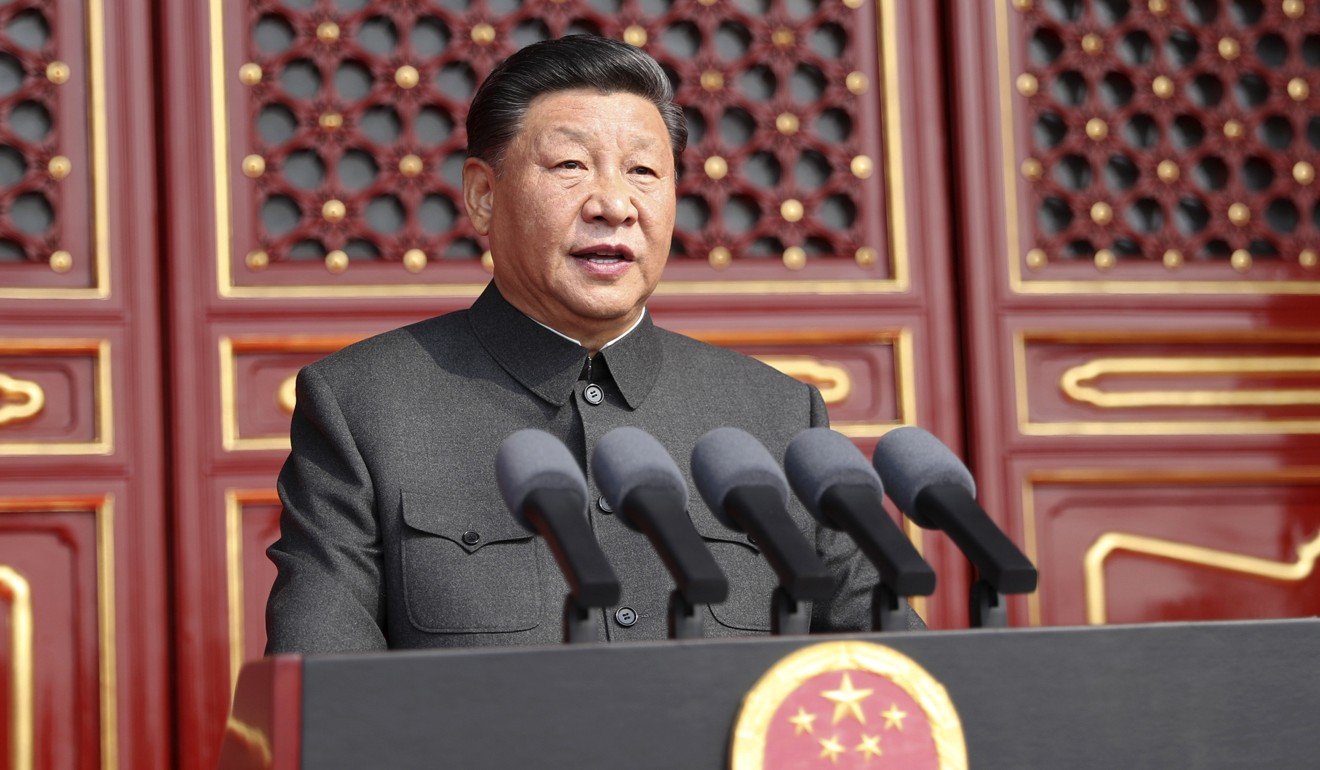
Xi Jinping has praised multinational companies for the role they have played in China’s opening up over the past four decades. Photo: AFP
Just a day after China reported its slowest ever quarterly economic growth,

President Xi Jinping

on Saturday reiterated his promise to keep opening up the nation’s markets to companies and investors from around the world.

“The door of China’s opening up will only open wider and wider, the business environment will only get better and better, and the opportunities for global multinational companies will only be more and more,” he said in a congratulatory letter read out by Vice-Premier Han Zheng at the inaugural Qingdao Multinationals Summit in the east China city.
The two-day event, which ends on Sunday, was organised by China’s commerce ministry and the provincial government of Shandong with the aim, according to its website, of giving multinational companies “the opportunity to articulate their business values and vision” and “promote cooperation with host countries”.

In his letter, Xi praised multinational companies for the role they had played in China’s opening up and reform over the past four decades, describing them as “important participants, witnesses and beneficiaries”.

China was willing to continue opening up to benefit not only itself but the world as a whole, he said.

“Only when the world is good, China is good. Only when China is good, can the world get better.”

Despite its upbeat tone, Xi’s message comes as Beijing is facing intense scrutiny from the international business community over its state-led economic model – one of the main bones of contention in its trade war with the US – and its attempts to prevent foreign firms from speaking out on issues it deems too sensitive, from Hong Kong to human rights.
Foreign firms have also long complained about the barriers they face when trying to access China’s markets and the privileged treatment it gives to state-owned enterprises. Even though Beijing has promised to reform its state sector, foreign businesses have complained of slow progress, and just last month the European Union Chamber of Commerce urged the EU to take more defensive measures against China’s “resurgent” state economy.
Xi promised “more and more” opportunities for global firms. Photo: AP

Sheman Lee, executive director of Forbes Global Media Holding and CEO of Forbes China, said at the Qingdao summit that foreign firms were facing a difficult trading environment in the world’s second-largest economy.

“Multinationals have seen their growth in China slow in recent years because of the growing challenge from local firms, a gradually saturating market and rising operation costs,” he said.

Craig Allen, president of the US-China Business Council, said that many multinational companies were reluctant to release their best products in China out of fear of losing their intellectual property.

China still not doing enough to woo foreign investment

In his letter, Xi said that over the next 15 years, the value of China’s annual imports of goods would rise beyond US$30 trillion, while the value of imported services would surpass US$10 trillion a year, creating major opportunities for multinational companies.

China would also reduce tariffs, remove non-tariff barriers and speed up procedures for customs clearance, he said.

Commerce Minister Zhong Shan said at the opening ceremony that China would also continue to improve market access and intellectual property protection.

The country supported economic globalisation and would safeguard the multilateral trade system, he said, adding that it was willing to work with the governments of other countries and multinational corporations to promote economic globalisation.

Xi Jinping says the value of China’s annual goods imports will rise beyond US$30 trillion over the next 15 years. Photo: Bloomberg
The promise to continue to open up China’s markets came after the State Council
– the nation’s cabinet – made exactly the same pledge at its weekly meeting on Wednesday.
After the latest round of trade war negotiations in Washington, Beijing said it had achieved “substantive progress” on intellectual property protection, trade cooperation and technology transfers, all of which have been major bones of contention for the United States.
Despite its pledge to welcome multinational companies into its market, China is in the process of creating a list of “unreliable foreign entities” it considers damaging to the interests of Chinese companies. The roster, which is expected to include FedEx, is seen as a response to a similar list produced earlier by the United States.
Xi’s gesture would also appear to have come too late for South Korean multinational 
Samsung Electronics

, which announced on October 4 it had ended the production of smartphones at its factory in Huizhou, Guangdong province – its last in China – with the loss of thousands of jobs.

Source: SCMP
18/10/2019

Does Huawei’s future lie with India after US ban?

HuaweiImage copyright GETTY IMAGES
Image caption The US says Huawei equipment has back doors that would enable Chinese surveillance

Chinese tech giant Huawei, which has been banned from selling 5G equipment to US telecom companies, is making an aggressive push to market itself in India.

“It’s been squeezed out of countries by a few governments already, and so a possible contract with India for 5G would be especially important,” Arun Sukumar, a tech analyst at the Observer Research Foundation, told the BBC.

“It’s worth noting that even though Huawei is comfortable at the moment, it will need to continue to invest across the world and into new markets in order to stay afloat – and what’s a bigger market than India?”

Huawei has also been banned in Australia, and several other countries are considering following suit.

The US says Huawei equipment contains back doors that would enable Chinese surveillance.

But the company has repeatedly denied claims that the use of its products poses security risks, and says it is independent from the Chinese government.

The size of India’s wireless market – dwarfed only by China – make it a vital market for any company, but the troubles Huawei is facing at present make could make India critical to its future.

The US has been pressurising India and its other allies to boycott the company and has not ruled out punitive measures against those who fail to do so.

US Commerce Secretary Wilbur Ross said during a visit to Delhi that the US hoped that its “geopolitical partner India does not inadvertently subject itself to untoward security risk”.

Jay Chen, CEO of Huawei India, told the BBC’s Devina Gupta that the company was even willing to sign an undertaking with the Indian government, promising that its equipment would contain no back doors as alleged by the US.

“We have read in the media that the US government is trying to lobby with the Indian government but I still believe that we should focus on what we can do and try our best,” he said.

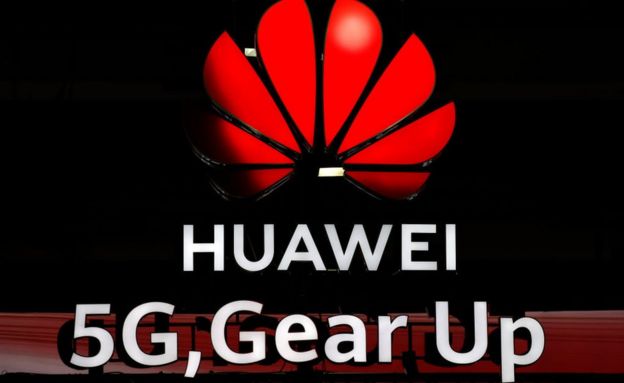
Illuminated Huawei and 5G signs are on display during the 10th Global mobile broadband forum hosted by Chinese tech giant Huawei in Zurich on October 15, 2019.Image copyright GETTY IMAGES
Image caption The company provides technology infrastructure to launch 5G networks

India has not commented on US charges against Huawei and has invited it to participate in its upcoming 5G spectrum trials, although a date for this has not been announced yet.

Mr Sukumar told the BBC that to exclude Huawei from the 5G process could actually prove detrimental to India.

“No more than five companies have the infrastructure to launch 5G, and Huawei’s infrastructure is more affordable than other Western ones like Nokia and Erikson. India’s telecom industry is already struggling, so to ally with Huawei – which could provide the service at the lowest rate – is very attractive,” he said.

India does not have a homegrown alternative to Huawei’s technology – and the company is well aware of this.

Mr Chen told the Economic Times newspaper that Huawei was now a vital part of India’s digital ecosystem and that to exclude it at this stage would risk “breaking” it entirely.

“I think the loss will not only be financial but also about losing technology development,” the newspaper quoted him as saying.

Source: The BBC

23/09/2019

‘Howdy, Modi!’: Trump hails Indian PM at ‘historic’ Texas rally

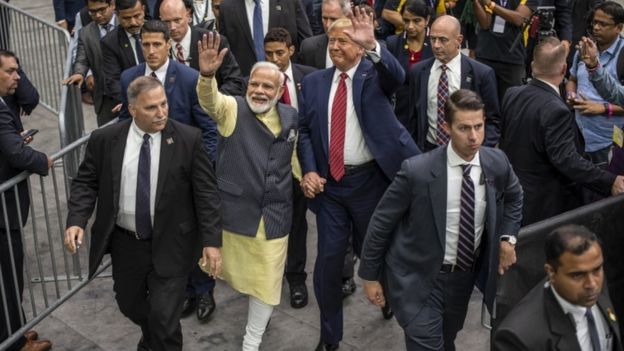
US President Donald Trump and Indian Prime Minister Narendra Modi exchanged warm words of friendship in Texas at a rare mass rally for a foreign leader.

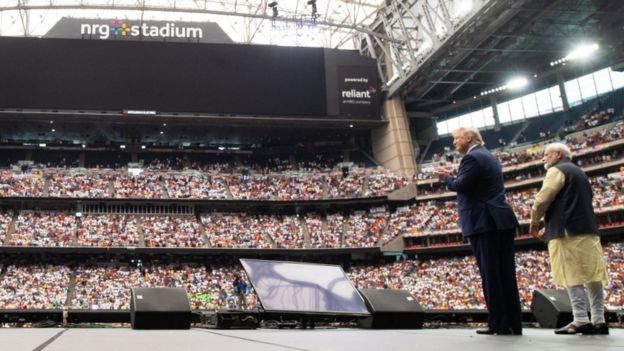
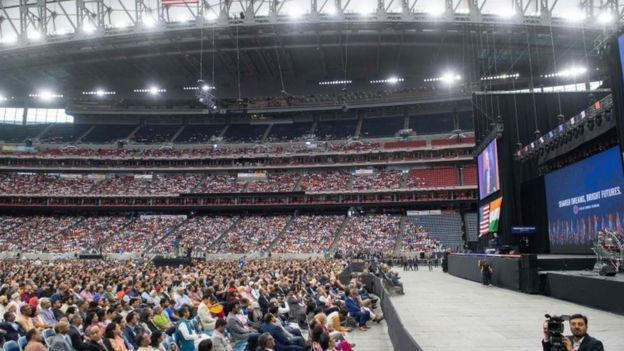
Around 50,000 people gathered for what Mr Trump called a “profoundly historic event” on Sunday in Houston.

The “Howdy, Modi!” event was billed as one of the largest ever receptions of a foreign leader in the US.

Mr Modi, however, may face a frostier reception at the UN General Assembly.

He is likely to face criticism over tensions in Indian-administered Kashmir, which he stripped of its special status last month, promising to restore the region to its “past glory”.

The region has been in lockdown for more than a month with thousands of activists, politicians and business leaders detained.

Trade talks and the UN General Assembly are on the Indian prime minister’s agenda during his week-long visit to the United States.

Pakistani Prime Minister Imran Khan, who has been the most vocal international leader to oppose India’s Kashmir move, is also in the US for the UN conference. Like Mr Modi, he will have a one-on-one meeting with Mr Trump on the sidelines of the summit.

A 90-minute show, featuring 400 performers, warmed up the crowd before Mr Modi and Mr Trump shared the stage.

“I’m so thrilled to be here in Texas with one of America’s greatest, most devoted and most loyal friends, Prime Minister Modi of India,” Mr Trump told the crowd.

Narendra Modi and Donald Trump leave the stage holding hands at NRG Stadium, HoustonImage copyright GETTY IMAGES
Image caption Narendra Modi and Donald Trump leave the stage holding hands at Houston’s NRG Stadium

In his speech, Mr Modi said India has a “true friend” in the White House, describing Mr Trump as “warm, friendly, accessible, energetic and full of wit”.

“From CEO to commander-in-chief, from boardrooms to the Oval Office, from studios to the global stage… he has left a lasting impact everywhere,” Mr Modi said.

Presentational grey line

Personal-touch diplomacy played to perfection

Brajesh Upadhyay, BBC News, Houston

This was exactly the kind of crowd size and energy President Trump loves at his rallies.

Only here the chants were for Indian Prime Minister Narendra Modi and Mr Trump was the superstar invited to the party. But the crowd did not disappoint him either and greeted him with chants of “USA!”, most heard at Trump rallies.

The personal-touch diplomacy with Mr Modi’s trademark bear hugs was played to perfection.

This rally has been called a win-win for both the leaders. For President Trump, it was a chance to court Indian-Americans for the 2020 presidential election race where Texas could emerge as a battleground state. For Mr Modi, a PR triumph and picture with the president of the United States may help him shrug off the criticism over his recent strong-arm policies at home.

Presentational grey line

Houston’s NRG Stadium, where the event was hosted, was the first stop for Mr Modi, whose Hindu nationalist Bharatiya Janata Party (BJP) won a landslide victory in this year’s Indian elections.

Greeted by a standing ovation, Mr Trump used his speech to heap praise on Mr Modi, who he said was doing a “truly exceptional job for India” and its people.

Mr Trump also paid tribute to the Indian-American community, telling them “we are truly proud to have you as Americans”.

The US has a population of about 4 million Indians who are seen as an increasingly important vote bank in the country.

Apart from Mr Trump, organisers also invited Democrats to the event – House Majority Leader Steny Hoyer was among those who spoke.

The 2010 US census shows that Texas is home to the fourth-largest Indian-American population in the country after California, New York and New Jersey.

Analysis of voting patterns shows the community tends overwhelmingly to support the Democrat party.

Narendra Modi said Donald Trump attend a mass rally in TexasImage copyright GETTY IMAGES
Image caption The event, dubbed “Howdy, Modi!”, was attended by an estimated 50,000 people

No stranger to nationalist rhetoric himself, Mr Trump compared security at the US-Mexico border to the tensions between India and Pakistan in the tinderbox Kashmir region.

“Both India and US also understand that to keep our communities safe, we must protect our borders,” Trump said.

Donald Trump described Narendra Modi as one of America's most "loyal friends"Image copyright GETTY IMAGES
Image caption Donald Trump described Narendra Modi as one of America’s most “loyal friends”

In India, the rally was closely watched, with most mainstream media outlets running live news updates of what was transpiring on stage.

The event had been making headlines for days before as well.

On Twitter, many people shared instant analysis and opinions of what was taking place on the stage with the sentiment being overwhelmingly positive. Many praised Mr Modi for what they saw as his statesmanship and diplomatic acumen with a lot of praise coming in for the US president as well.

Source: The BBC

02/02/2019

Chanda Kochhar: The rise and fall of India’s celebrated CEO

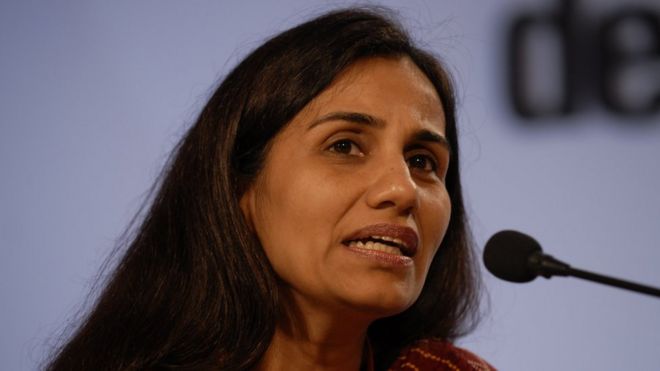
Chanda KochharImage copyrightGETTY IMAGES

The fall of Chanda Kochhar, the iconic banking CEO and a poster woman for Indian industry, holds a cautionary tale for the entire business community, writes the BBC’s business correspondent Sameer Hashmi.

India’s third-largest lender, ICICI Bank, on Wednesday found the former chief executive guilty of violating internal bank policies and professional misconduct.

It was the culmination of an investigation set up by the bank to look into allegations of conflict of interest. It concluded that she had failed to make mandatory disclosures and her actions were not in line with the bank’s internal processes.

The bank also announced it planned to “claw back” all bonuses paid to Ms Kochhar between April 2009 and March 2018, an amount estimated to run into millions of dollars.

Ms Kochhar had risen through the ranks of ICICI to become its chief executive in 2009.

But she went on indefinite leave in June 2018, following which she announced her retirement in October 2018 even as the investigation against her was still continuing.

‘The face of a movement’

Ms Kochhar was one of India’s most celebrated bankers and arguably the most prominent female chief executive in the country.

For nearly a decade, various surveys consistently called her one of the world’s most powerful and influential female CEOs. For many Indian women, especially those working in the corporate sector, Ms Kochhar was a role model.

“She was the face of a movement that encouraged women entrepreneurs. Her downfall has done immeasurable harm to Indian chief executives, especially women business leaders,” Gurcharan Das, author and former chief executive of Procter & Gamble India, told the BBC.

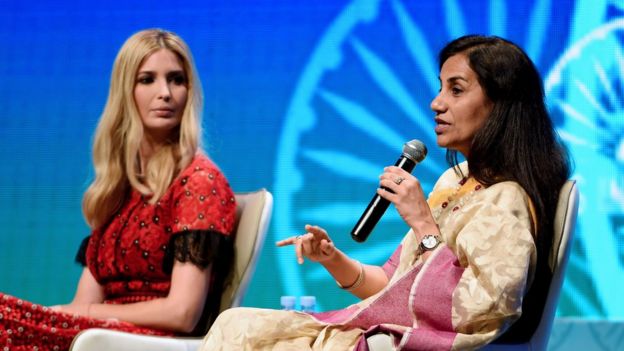
Advisor to the US President Ivanka Trump (L) looks on as Chanda Kochhar, Managing Director and CEO of ICICI bank limited speaks during a panel discussion at the Global Entrepreneurship Summit at the Hyderabad convention centre (HICC) in Hyderabad on November 29, 2017Image copyrightGETTY IMAGES
Image captionMs Kochhar with Ivanka Trump, daughter of the US president and his adviser

Ms Kochhar began her career as a trainee at ICICI in 1984 after getting her MBA. At the time, ICICI was a financial institution that helped companies with project financing. It got a banking licence in 1994, following the liberalisation of India’s economy.

Ms Kochhar’s ascent mirrored ICICI’s journey from a small financial institution to one of India’s largest technology-driven financial service behemoths.

Under the tutelage of KV Kamath – the larger-than-life boss who headed the bank through much of the 1990s and 2000s – Ms Kochhar was given charge of several significant projects which saw ICICI set itself apart in a market dominated by public-owned banks.

In 2009, at the age of 48, she beat several other strong candidates to succeed Mr Kamath as chief executive.

Unlike her predecessors, who followed a more inclusive leadership approach, Ms Kochhar ran a tight ship with complete control and authority.

She was credited with navigating the bank out of troubled waters following the 2008 global recession.

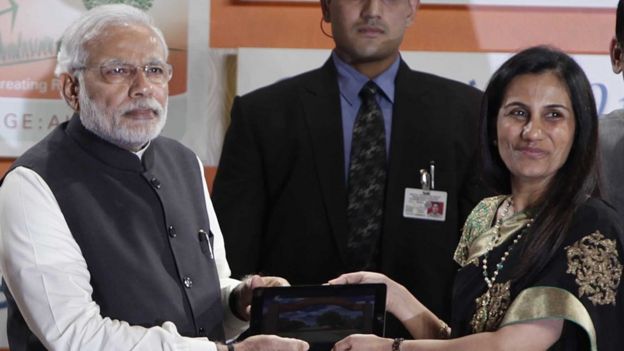
Prime Minister Narendra Modi with ICICI Bank's MD and CEO Chanda Kochhar during the launch of 'Digital Village' project and adopting a village in Gujarat, at ICICI Headquarters, Bandra Kurla Complex, on January 2, 2015 in Mumbai, IndiaImage copyrightGETTY IMAGES
Image captionMs Kochhar is credited with navigating ICICI out of troubled waters following the 2008 global recession

Ms Kochhar was also renowned for her attention to detail – not only when it came to running the company but also when making public appearances or being interviewed.

She invested in a very strong PR machinery that ensured her public profile was meticulous. When I interviewed Ms Kochhar at her office in 2012, her communications team had a number of requests and queries ranging from the type of questions that would be asked to camera angles and even the size of the plant in the background.

Her love for saris and diamonds was well known. Her former colleagues say she was very particular about picking the right sari to match the mood and tone of an occasion. She even wore them while attending international conferences like the World Economic Forum in Davos – making it a style statement.

The fall from grace

Ironically perhaps, it was her lack of attention to disclosing allegedly critical information about her husband’s business dealings with a client of her bank that led to her downfall.

Ms Kochhar’s problems began in October 2016 when a whistleblower raised allegations of conflict of interest against her.

Initially the issue did not attract much media attention, but in March 2018 the story began to gain traction in the Indian press.

The scandal centres around a $456m (£347m) loan issued by ICICI bank to consumer electronics company Videocon Industries.

It had been alleged that Ms Kochhar sanctioned loans to Videocon Industries, violating the bank’s lending policies, in exchange for an investment by its owner Venugopal Dhoot in a business headed by Ms Kochhar’s husband.

Ms Kochhar, her husband and Mr Dhoot have denied the claims.

Soon after the allegations surfaced in April, Mr Kochhar said they were all “false”.

Speaking to India Today TV, he said, “Where is the conflict of interest? ICICI Bank will have relationship with all top corporates in India. If I can’t touch any corporate who deals with ICICI, is it fair to me? Can I function like this? I am a Bajaj MBA and a Harvard alumnus. I am an educated professional. Should I sit at home just because my wife is the CEO of ICICI?”

Mr Dhoot also denied any wrongdoing, insisting in an interview with the PTI news agency that the loan to his company was given on merit. He also said he knew all 12 members of the panel that approved it, not just Ms Kochhar.

Initially, ICICI’s board dismissed all the allegations against Ms Kochhar.

But continuous media glare and questions from investors forced the bank to set up an inquiry to investigate if Ms Kochhar had violated the bank’s rules with regards to conflict of interest and internal lending.

Even then Ms Kochhar did not step down, choosing instead to go on indefinite leave in June 2018. She resigned four months later.

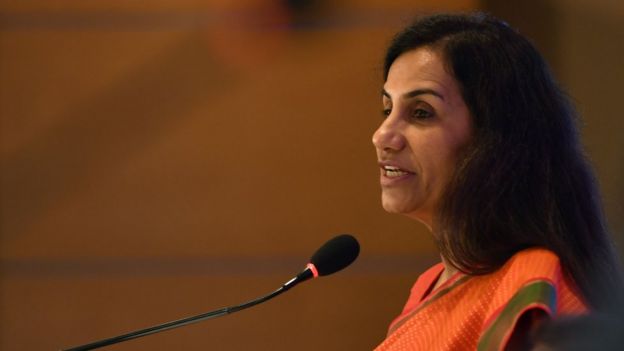
Indian CEO of ICICI Bank Chanda Kochhar speaks during the ICICI Securities Limited Initial Public Offering (IPO) press conference in Mumbai on March 15, 2018Image copyrightGETTY IMAGES
Image captionMs Kochhar has denied all the charges against her

But after the investigative committee – headed by a former Supreme Court judge – submitted its report, the bank decided to treat her resignation as termination. The report did not, however, investigate whether Videocon invested in her husband’s company in exchange for loans.

Speaking soon after that, Ms Kochhar issued a statement talking about her “disappointment” with the decision.

‘I am utterly disappointed, hurt and shocked by the decision. I have not been given a copy of the report. I reiterate that none of the credit decisions at the bank are unilateral. ICICI is an institution with established robust processes and systems which involve committee based collective decision making with several professionals of high calibre participating in the decision making,” it read.

The controversy has also raised questions about the credibility of the board and its failure to investigate the matter when it was first raised.

Shiriram Subramaniun, who heads InGovern, a corporate governance advisory firm, called the episode a lesson for company boards across the country.

“Companies need to recognise that their primary duty is toward the shareholders and not star chief executives,” he told the BBC.

But Ms Kochhar’s troubles didn’t stop there. Last week, the country’s federal investigating agency, the CBI, filed a case of criminal conspiracy and fraud against her and her husband Deepak Kochhar.

They are looking closely into Ms Kochhar’s role in the ICICI decision to sanction the loan to Videocon. In its preliminary complaint report, the organisation accused her of receiving “illegal gratification through her husband” to sanction the money.

It also accuses her of cheating, dishonesty and “abusing her official position” by sanctioning the loan to Videocon. It has also filed a case against Mr Dhoot and is investigating the roles of senior ICICI bank executives who were part of the bank committee that sanctioned the loans.

The bank told the BBC that they were not willing to comment about the investigation at this stage.

Source: The BBC

18/12/2018

Xi meets with Macao SAR chief executive

CHINA-BEIJING-XI JINPING-MACAO SAR CHIEF EXECUTIVE-MEETING (CN)

Chinese President Xi Jinping (R) meets with Chief Executive of the Macao Special Administrative Region (SAR) Chui Sai On, who is on a duty visit, in Beijing, capital of China, Dec. 17, 2018. (Xinhua/Xie Huanchi)

BEIJING, Dec. 17 (Xinhua) — President Xi Jinping on Monday met with Chief Executive of the Macao Special Administrative Region (SAR) Chui Sai On, who is on a duty visit to Beijing.

During the meeting, Xi heard a report by Chui on Macao’s current situation and the Macao SAR government’s work.

Xi said that over the past year, the Macao SAR government, under Chui’s leadership, had faithfully fulfilled its duties, been prudent and steady in its work style, and implemented the “one country, two systems” policy and the Macao SAR Basic Law.

The Macao SAR government had improved the institutions and mechanisms for safeguarding national security, proactively taken part in the development of the Guangdong-Hong Kong-Macao Greater Bay Area and in the Belt and Road Initiative, promoted the proper diversification of the economy, improved the livelihood of the people, and strengthened the disaster prevention and reduction system, winning the praise of the Macao society, Xi said.

“The central government fully endorses the work by Chui and the Macao SAR government,” he said.

In the process of reform and opening up of the new era, Hong Kong and Macao still have a special status and unique advantages, and can still play an irreplaceable role, Xi said.

Xi said he believed the compatriots of Macao would seize the opportunities, expand the space of development and foster new drivers of growth by integrating the SAR’s own development into the development of the country, and greet the 20th anniversary of Macao’s return to the motherland with new achievements.

12/12/2018

Google has ‘no plans’ to launch Chinese search engine – CEO

WASHINGTON (Reuters) – Google has “no plans” to relaunch a search engine in China though it is continuing to study the idea, Chief Executive Sundar Pichai told a U.S. congressional panel on Tuesday amid increased scrutiny of big tech firms.

Lawmakers and Google employees have raised concerns the company would comply with China’s internet censorship and surveillance policies if it re-enters the Asian nation’s search engine market.

Google’s main search platform has been blocked in China since 2010, but the Alphabet Inc unit has been attempting to make new inroads into the country, which has the world’s largest number of smartphone users.

“Right now, there are no plans to launch search in China,” Pichai told the U.S. House of Representatives Judiciary Committee.

But he added that internally Google has “developed and looked at what search could look like. We’ve had the project underway for a while. At one point, we’ve had over 100 people working on it is my understanding.”

Pichai said there are no current discussions with the Chinese government. He vowed that he would be “fully transparent” with policymakers if the company brings search products to China.

In a letter in August to U.S. lawmakers, Pichai said providing such a search engine would give “broad benefits” to China but that it was unclear whether Google could launch the service there.

A Chinese government official, speaking on the condition of anonymity, told Reuters last month that it was unlikely Google would get clearance to launch a search service in 2019.

Pichai did not say what steps Google would take to comply with Chinese laws if it re-entered the market.

Under questioning from Democratic Representative David Cicilline, Pichai said he would “happy to engage” to discuss legislation that would empower the Federal Trade Commission to address discriminatory conduct online.

Cicilline told Pichai it was “hard for me to imagine that you could operate in the Chinese market under the current government framework and maintain a commitment to universal values, such as freedom of expression and personal privacy.”

The company’s rivals in shopping and travel searches have long complained about being demoted in Google search results.

Much of the House hearing focused on Republican concerns that Google’s search results are biased against conservatives and that the company had sought to influence the outcome of the 2016 presidential election.

Democrats rejected that claim as “fantasy,” and at least one said the search results highlighted more conservative voices.

Pichai said the search engine attempts to help people register to vote or find a polling place, but rejected assertions the company paid for Latino voters’ transportation to polls in some states.

“We don’t engage in partisan activities,” Pichai told the panel.

Law of Unintended Consequences

continuously updated blog about China & India

ChiaHou's Book Reviews

continuously updated blog about China & India

What's wrong with the world; and its economy

continuously updated blog about China & India