Archive for ‘Chandrayaan-2’

03/12/2019

Chandrayaan-2: Indian helps Nasa find Moon probe debris

Nasa pictureImage copyright NASA
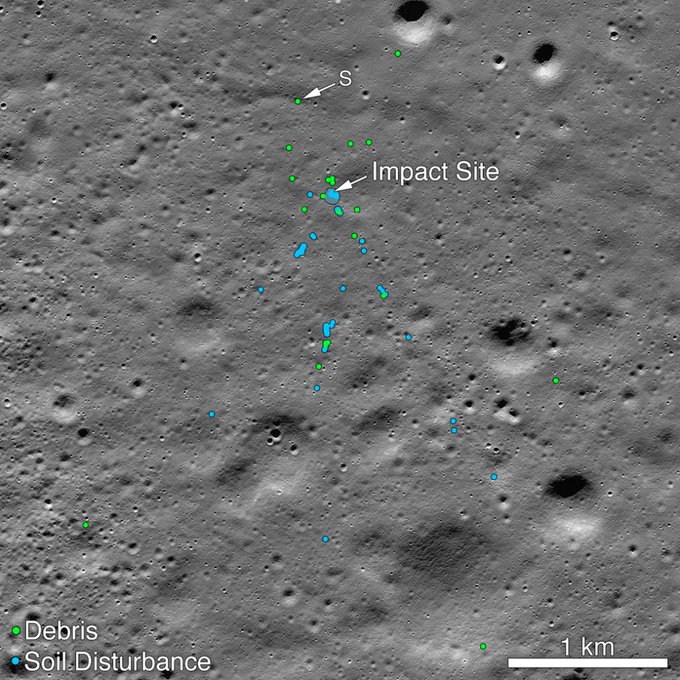
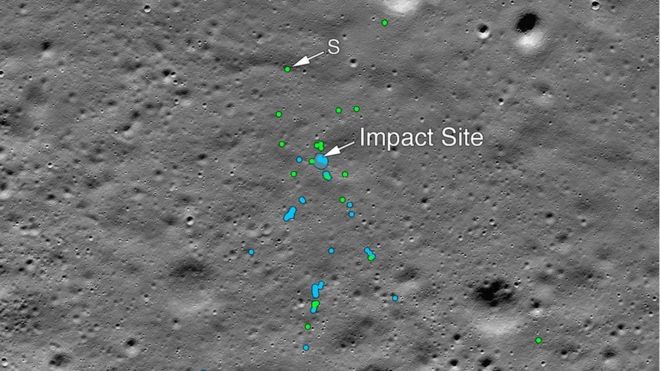
Image caption Nasa released a picture showing the site of the rover’s impact

Nasa says one of its satellites has found the debris of India’s Moon rover which crashed on the lunar surface in September.

The space agency released a picture showing the site of the rover’s impact and the “associated debris field”.

Nasa has credited an Indian engineer, Shanmuga Subramanian, with helping locate the site of the debris.

Mr Subramanian examined a Nasa picture and located the first debris about 750m north-west of the crash site.

Chandrayaan-2 was due to touch down at the lunar South Pole on 7 September, over a month after it first took off.

It approached the Moon as normal until an error occurred about 2.1km (1.3 miles) from the surface, moments before it was to touch down.

The rover lost contact and had a “hard landing” about 600km (370 miles) from the South Pole in a “relatively ancient terrain”.

Announcing the discovery of the Vikram lander, Nasa tweeted a mosaic image of the site.

In late September, pictures from a Nasa spacecraft had showed the targeted landing site of the Vikram rover.

Many people had downloaded the image released by Nasa’s Lunar Reconnaissance Orbiter Camera (LROC) team, a statement by the space agency said.

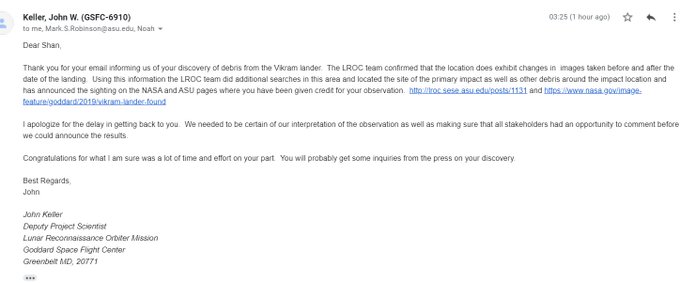
It said after receiving Mr Subramanian’s tip about the location of the debris, the LROC team “confirmed the identification by comparing before and after images”.

Mr Subramanian has tweeted an email sent to him by the space agency congratulating him for his effort.

“We had the images from Nasa [of] the lander’s last location. We knew approximately where it crashed. So I searched pixel-by-pixel around that impact area,” the 33-year-old Chennai-based engineer told BBC Tamil.

Mr Subramanian said he had always “been interested in space” and had watched the July launch of the rocket.

Presentational grey line

What was this mission all about?

Chandrayaan-2 (Moon vehicle 2) was the most complex mission ever attempted by India’s space agency, Isro.

“It is the beginning of a historical journey,” Isro chief K Sivan said after launch in July.

The lander (named Vikram, after the founder of Isro) carried within its belly a 27kg (59lbs) Moon rover with instruments to analyse the lunar soil.

The rover (called Pragyan – wisdom in Sanskrit) had the capacity to travel 500m from the lander in its 14-day life span, and would have sent data and images back to Earth for analysis.

The mission would have focussed on the lunar surface, searching for water and minerals and measuring moonquakes, among other things.

Why would it have been significant?

A soft landing on another planetary body – a feat achieved by just three other countries so far – would have been a huge technological achievement for Isro and India’s space ambitions, says science writer Pallava Bagla.

He adds that it would also have paved the way for future Indian missions to land on Mars, and opened up the possibility of India sending astronauts into space.

For the first time in India’s space history, the interplanetary expedition was led by two women – project director Muthaya Vanitha and mission director Ritu Karidhal.
Media caption Is India a space superpower?

It was also a matter of national pride – the satellite’s lift-off in July was broadcast live on TV and Isro’s official social media accounts.

The mission also made global headlines because it was so cheap – the budget for Avengers: Endgame, for instance, was more than double at an estimated $356m. But this wasn’t the first time Isro has been hailed for its thrift. Its 2014 Mars mission cost $74m, a tenth of the budget for the American Maven orbiter.

Source: The BBC
09/09/2019

Chandrayaan 2: What may have gone wrong with India’s Moon mission?

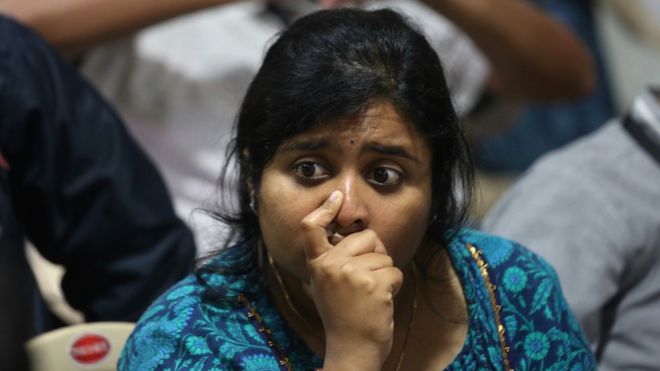
Isro employee reacts after the communication and data were lost from the vikram lander at ground station Indian Space Research Organization (ISRO) Telementry Tracking and Command Network (ISTRAC) Command Centre in Bangalore, India, 07 September 2019.Image copyright EPA
Image caption Indian scientists say contact with the lander was lost seconds before it was scheduled to touch down

India’s space agency, Isro, has not yet released information on how it lost contact with its Moon lander seconds before it was due to touch down on the lunar surface. But former members of the agency tell the BBC what may have gone wrong.

Chandrayaan-2 (Moon vehicle 2) entered the Moon’s orbit on 20 August and was due to land on the lunar surface a little after midnight India local time (1800 GMT) on 7 September – a month after it first shot into space.

But contact was lost moments before the lander (named Vikram, after Isro founder Vikram Sarabhai) was expected to touch down at the lunar south pole.

The orbiter has since spotted the lander on the surface of the Moon – unbroken, but tilted on its side. So far, scientists have not been able to establish contact with it.

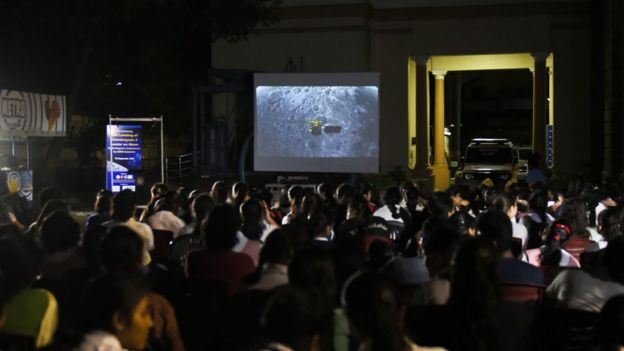
In Kolkata, India, 07 September, 2019, school students watch the live streaming screen of Chandrayaan2 landing on the lunar surface. According to ISRO (Indian Space Research Organisation), Vikram Lander was as planned and normal performance was observed upto an altitude of 2.1kmImage copyright GETTY IMAGES
Image caption The event was watched by millions across India

The lander’s final heart-stopping descent were monitored on screens, complete with readings which reflected the movement of the lander as it headed towards the surface of the Moon.

The screens carrying the readings also appeared on television and various social media accounts as the landing was broadcast live.

When the countdown began, the lander was moving at a velocity of 1,640 metres per second. Scientists say it appeared to be moving as planned during the first two phases of deceleration, known as the rough braking and fine braking operations.

It was during the final stage, known as the “hovering” stage, that the problem occurred.

The problem could well have been with the lander’s central engine, according to Prof Roddam Narasimha, a former member of Isro. He said that his theory was based on the readings on the screen.

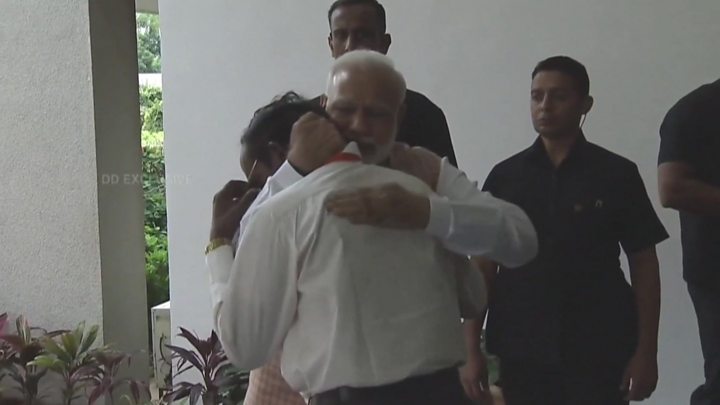
Media caption Modi consoles scientists after India Moon-lander loses contact

“One plausible explanation was that the lander started falling more rapidly,” he told BBC Hindi’s Imran Qureshi. “It’s supposed to come down at a velocity of two metres per second when it hits the Moon’s surface. But the gravity on the moon would have made it fall somewhat more rapidly.”

He believes this could be because the central engine was not “producing the thrust that is required and, therefore, the deceleration was no longer what it was supposed to be”.

And this, in turn, may have led to eventually losing communication with the lander itself.

The head of India’s first Moon mission, Mylswamy Annadurai, also said the anomaly in the velocity profile was an indication that something had malfunctioned in the lander as it hurtled towards the Moon.

“Most likely the orientation [of the lander] could have been disrupted. Once we look at the data we will be able to say for sure what happened, but it is likely that either a sensor or a thruster could have malfunctioned,” he told BBC Tamil.

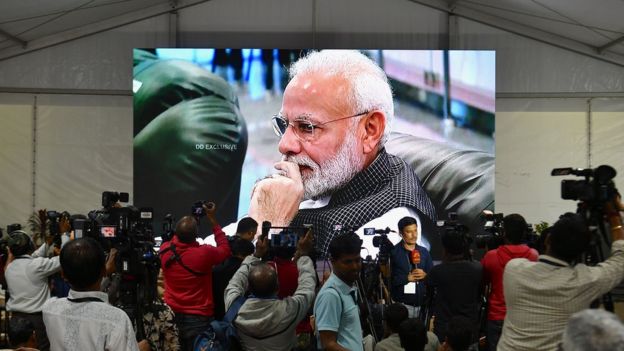
Members of the media cover the development as India's Prime Minister Narendra Modi is seen on a tv screen as he watches the live broadcast of the soft landing of spacecraft Vikram Lander of Chandrayaan-2 on the surface of the Moon at ISRO Telemetry, Tracking and Command Network (ISTRAC) centre in Bangalore early on September 7, 2019.Image copyright GETTY IMAGES
Image caption Prime Minister Narendra Modi also watched the event live

Dr Rajeswari Rajagopalan, the head of the Nuclear and Space Policy Initiative of the Observer Research Foundation (ORF), also said an engine malfunction was the likeliest reason.

“In the absence of data parameters, it is difficult to come to a conclusion, but the readings on the screen did show that something was wrong,” she told BBC Hindi.

“The other possibility is that when you do a landing at a higher speed, you cause a lot of dust to rise that also shakes up the spacecraft because of the gravitational pull. But it’s more likely the malfunctioning of one of the engines.”

Chandrayaan-2 was the most complex mission ever attempted by Isro.

The lander carried within its belly a 27kg Moon rover (called Pragyan, which translates as wisdom in Sanskrit), which included instruments to analyse the lunar soil.

The rover had the capacity to travel 500m from the lander in its 14-day life span, and would have sent data and images back to Earth for analysis.

The mission would have focused on the lunar surface, searching for water and minerals and measuring moonquakes, among other things.

Source: The BBC

07/09/2019

Chandrayaan-2: Modi proud despite Moon landing setback

Indian Prime Minister Narendra Modi told his country’s space scientists he was proud of a programme that had come so near to putting a probe on the Moon.

Contact with Chandrayaan-2 was lost moments before its Vikram module was due to touch down at the lunar south pole.

The fate of the craft is not yet known, but Mr Modi said there would be further opportunities.

India would have been the fourth nation to make a soft landing on the Moon.

“The best is yet to come in our space programme. India is with you,” said Mr Modi.

The Chandrayaan-2 approached the Moon as normal until an error occurred about 2.1km (1.3 miles) from the surface, officials said.

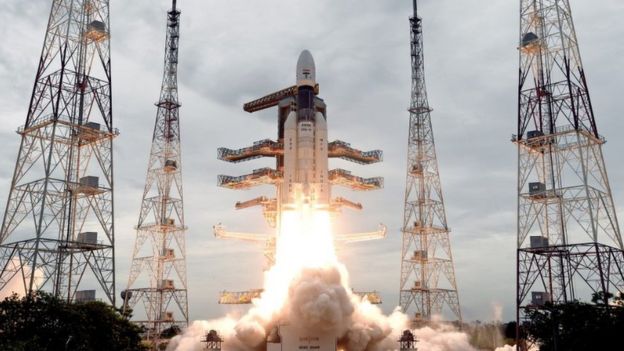
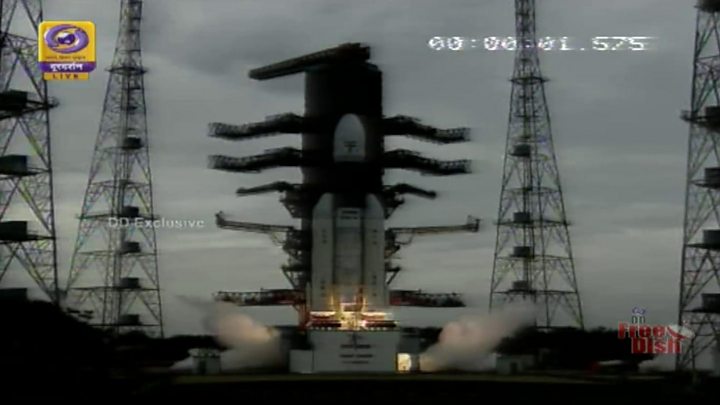
Chandrayaan-2 taking offImage copyright ISRO
Image caption The mission’s lift-off was broadcast live to an audience of hundreds of millions

India’s Space Research Organization (Isro) said it lost contact seconds before the ship was expected to land.

The country’s first Moon mission – Chandrayaan-1, in 2008 – carried out the first and most detailed search for water on the lunar surface using radars.

What happened?

Chandrayaan-2 entered the Moon’s orbit on 20 August and was due to make a controlled descent to the surface early on Saturday, Indian time, over a month after it first took off.

Staff at mission control were glued to the screens at Isro’s Bangalore space centre as the spacecraft made its descent towards the surface.

The control room burst into applause during the so-called rough breaking phase of the descent, with Prime Minister Modi watching the action from behind a glass screen.

Isro chairman Kailasavadivoo Sivan announced to staff that the ship’s initial descent had been “normal,” and that the mission’s data would be analysed.

Mr Sivan had earlier described the final descent as “15 minutes of terror”.

What was this mission all about?

Chandrayaan-2 (Moon vehicle 2) was the most complex mission ever attempted by India’s space agency, Isro. “It is the beginning of a historical journey,” Isro chief K Sivan said after launch in July.

The lander (named Vikram, after the founder of Isro) carried within its belly a 27kg Moon rover with instruments to analyse the lunar soil.

The rover (called Pragyan – wisdom in Sanskrit) had the capacity to travel 500m from the lander in its 14-day life span, and would have sent data and images back to Earth for analysis.

The mission would have focused on the lunar surface, searching for water and minerals and measuring moonquakes, among other things.

Why would it have been significant?

A soft landing on another planetary body – a feat achieved by just three other countries so far – would have been a huge technological achievement for Isro and India’s space ambitions, writes science writer Pallava Bagla.

He adds that it would also have paved the way for future Indian missions to land on Mars, and opened up the possibility of India sending astronauts into space.

For the first time in India’s space history, the interplanetary expedition was led by two women – project director Muthaya Vanitha and mission director Ritu Karidhal.

Media caption Is India a space superpower?

It is also a matter of national pride – the satellite’s lift-off in July was broadcast live on TV and Isro’s official social media accounts.

The mission has also made global headlines because it’s so cheap – the budget for Avengers: Endgame, for instance, was more than double at an estimated $356m. But this isn’t the first time Isro has been hailed for its thrift. Its 2014 Mars mission cost $74m, a tenth of the budget for the American Maven orbiter.

Source: The BBC
20/08/2019

Chandrayaan-2: India spacecraft begins orbiting Moon

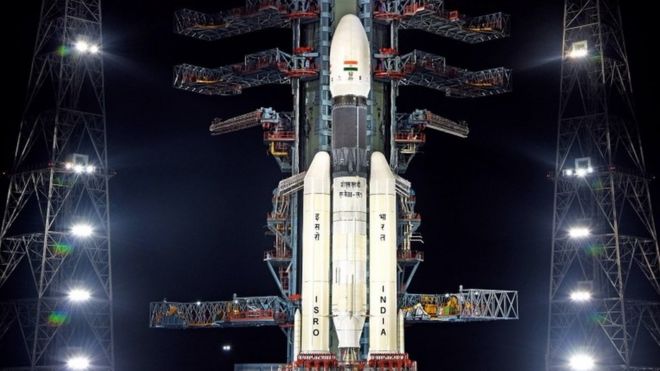
The rocket that will carry the Chandrayaan-2 satelliteImage copyright EPA
Image caption The rocket weighs as much as a fully-loaded jumbo jet

India’s second lunar module has begun orbiting the Moon, nearly a month after blasting off, officials have confirmed.

The manoeuvre to put the module into the lunar orbit was completed at 09:02 local time (04:32 GMT) on Tuesday.

Chandrayaan-2 was launched from the Sriharikota space station on 22 July, a week after the scheduled blast-off was halted due to a technical snag.

India hopes the $145m (£116m) mission will be the first to land on the Moon’s south pole.

Last month’s launch was the beginning of a 384,000km (239,000-mile) journey. Scientists hope the lander will touch down on the Moon on 6 or 7 September as planned.Presentational white space

What is this mission all about?

India’s first lunar mission, Chandrayaan-1, was launched in 2008 but it did not land on the lunar surface. However it carried out the first and most detailed search for water on the Moon using radars.

Chandrayaan-2 (Moon vehicle 2) will try to land near the little-explored south pole of the Moon.

The mission will focus on the lunar surface, searching for water and minerals and measuring moonquakes, among other things.

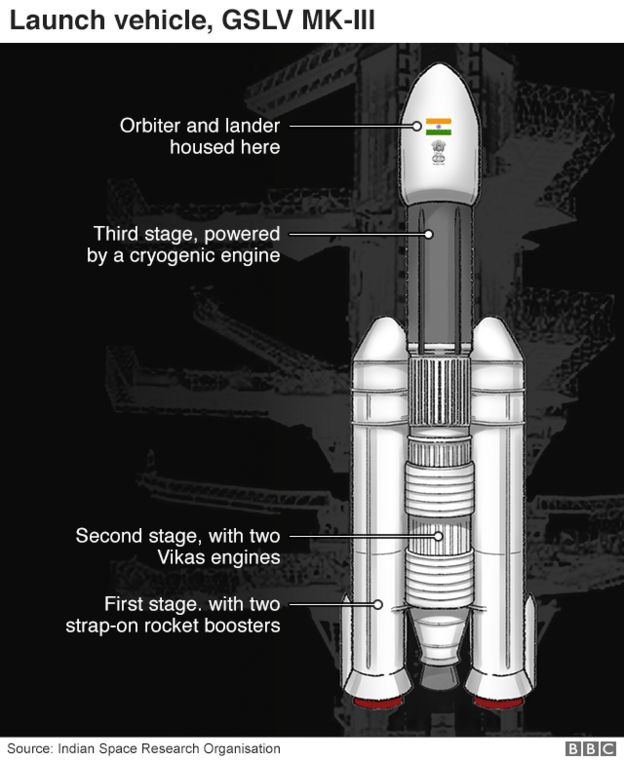
India used its most powerful rocket, the Geosynchronous Satellite Launch Vehicle Mark III (GSLV Mk-III), in this mission. It weighed 640 tonnes (almost 1.5 times the weight of a fully-loaded 747 jumbo jet) and, at 44 metres (144ft), was as high as a 14-storey building.

Graphic showing the launch vehicle with different parts labelled
The spacecraft used in the mission has three distinct parts: an orbiter, a lander and a rover.

The orbiter, which weighs 2,379kg (5,244lb) and has a mission life of a year, will take images of the lunar surface.

The lander (named Vikram, after the founder of Isro) weighs about half as much, and carries within its belly a 27kg Moon rover with instruments to analyse the lunar soil. In its 14-day life, the rover (called Pragyan – wisdom in Sanskrit) can travel up to a half a kilometre from the lander and will send data and images back to Earth for analysis.

Media caption Is India a space superpower?

How long is the journey to the Moon?

The journey of more than six weeks is a lot longer than the four days the Apollo 11 mission 50 years ago took to land humans on the lunar surface for the first time.

In order to save fuel, India’s space agency has chose a circuitous route to take advantage of the Earth’s gravity, which will help slingshot the satellite towards the Moon. India does not have a rocket powerful enough to hurl Chandrayaan-2 on a direct path. In comparison, the Saturn V rocket used by the Apollo programme remains the largest and most powerful rocket ever built.

“There will be 15 terrifying minutes for scientists once the lander is released and is hurled towards the south pole of the Moon,” Isro chief K Sivan said prior to the first launch attempt.

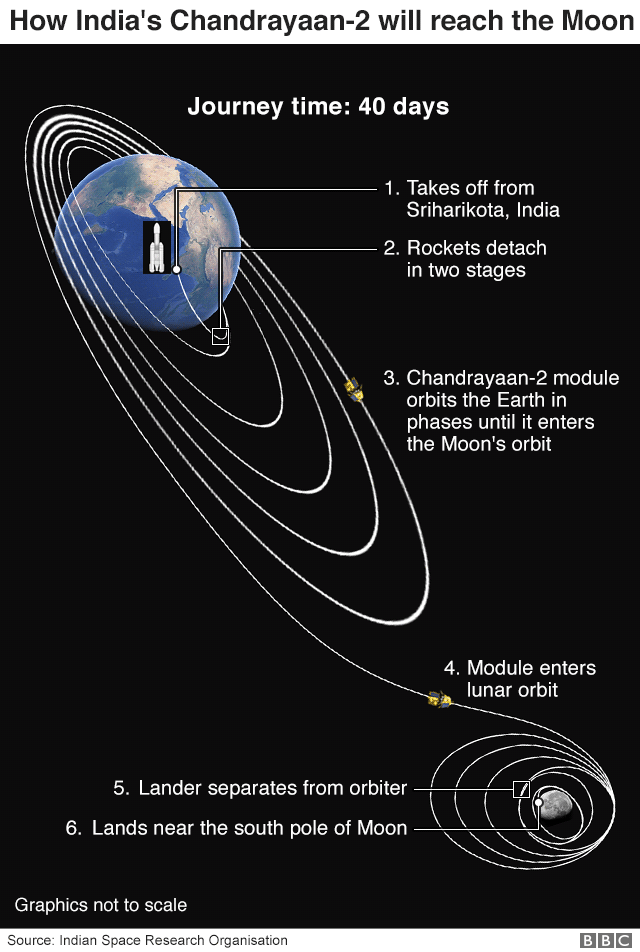
Graphic: How India's Chandrayaan-2 will reach the moon
He explained that those who had been controlling the spacecraft until then would have no role to play in those crucial moments. So, the actual landing would happen only if all the systems performed as they should. Otherwise, the lander could crash into the lunar surface.

Earlier this year, Israel’s first Moon mission crash-landed while attempting to touch down.

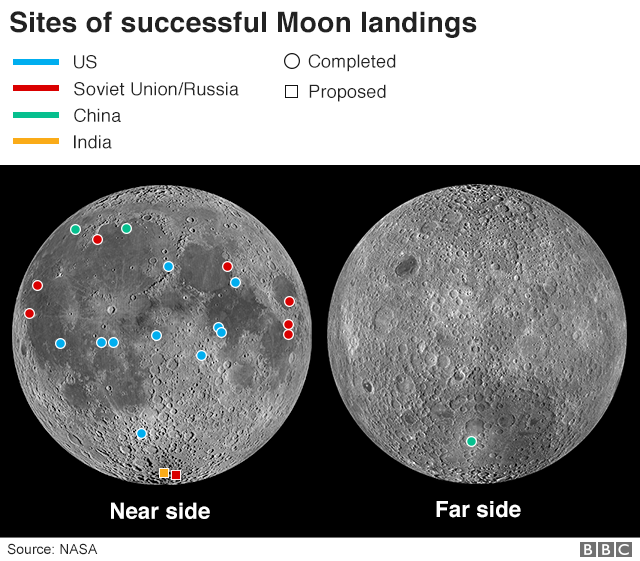
Site of successful moon landings graphic showing where other countries have landed on the moon

Source: The BBC

22/07/2019

Chandrayaan-2: India set to re-attempt Moon mission launch

The rocket that will carry the Chandrayaan-2 satelliteImage copyright EPA
Image caption The rocket weighs as much as a fully-loaded jumbo jet

India is set to re-attempt the launch of its second lunar mission a week after it halted the scheduled blast-off due to a technical snag.

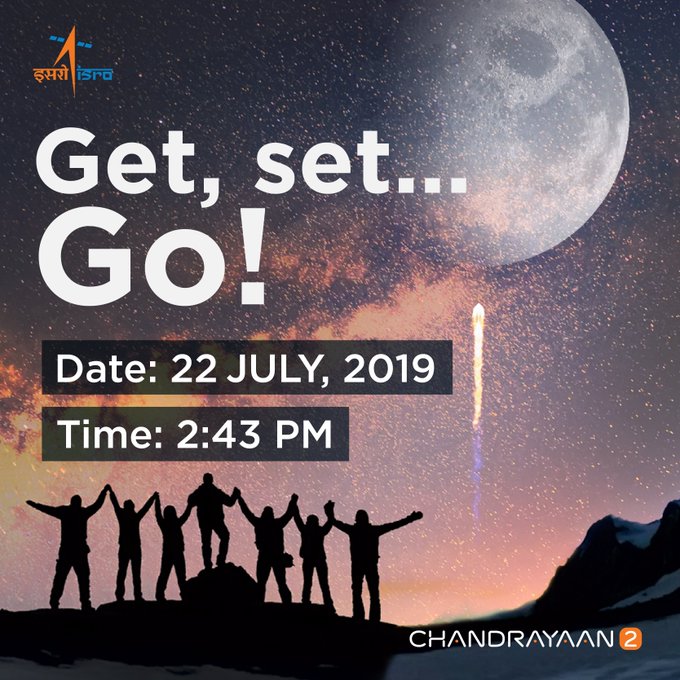
Chandrayaan-2 will be launched at 14:43 local time (09:13 GMT) on Monday, space agency Isro said.

It added the spacecraft was ready “to take a billion dreams to the Moon – now stronger than ever before”.

The space agency hopes the $150m (£120m) mission will be the first to land on the Moon’s south pole.

The countdown on 15 July was stopped 56 minutes before launch after a “technical snag was observed in [the] launch vehicle system”, according to Isro. Indian media have reported that a leak from a helium gas bottle in the cryogenic engine of the rocket was to blame.

The fuel from the rocket was drained and the scientists resolved the glitch.

“It was a simple to fix [but it was] a serious problem that could have resulted in total failure,” says a source at Isro.

Isro thanked people for supporting the mission despite the delay.

What is this mission all about?

India’s first lunar mission in 2008 – Chandrayaan-1 – did not land on the lunar surface, but it carried out the first and most detailed search for water on the Moon using radars.

Chandrayaan-2 (Moon vehicle 2) will try to land near the little-explored south pole of the Moon.

The mission will focus on the lunar surface, searching for water and minerals and measuring moonquakes, among other things.

India is using its most powerful rocket, the Geosynchronous Satellite Launch Vehicle Mark III (GSLV Mk-III), in this mission. It weighs 640 tonnes (almost 1.5 times the weight of a fully-loaded 747 jumbo jet) and at 44 metres (144ft) is as high as a 14-storey building.

Graphic showing the launch vehicle with different parts labelled
The spacecraft weighs 2.379kg (5.244lb) and has three distinct parts: an orbiter, a lander and a rover.

The orbiter, which has a mission life of a year, will take images of the lunar surface, and “sniff” the tenuous atmosphere.

The lander (named Vikram, after the founder of Isro) weighs about half as much, and carries within its belly a 27kg Moon rover with instruments to analyse the lunar soil. In its 14-day life, the rover (called Pragyan – wisdom in Sanskrit) can travel up to a half a kilometre from the lander and will send data and images back to Earth for analysis.

“India can hope to get the first selfies from the lunar surface once the rover gets on its job,” Dr K Sivan, the Isro chief, said before the first launch attempt.

Media caption Is India a space superpower?

How long is the journey to the Moon?

The launch is only the beginning of a 384,000km (239,000-mile) journey – Isro is still hoping the lander will touch down on the Moon on 6 or 7 September as planned, despite the week-long delay of the launch.

The journey of more than six weeks is a lot longer than the four days the Apollo 11 mission 50 years ago took to reach the Moon- and land humans on the lunar surface for the first time.

In order to save fuel, India’s space agency has chosen a circuitous route to take advantage of the Earth’s gravity, which will help slingshot the satellite towards the Moon. India does not have a rocket powerful enough to hurl Chandrayaan-2 on a direct path. In comparison, the Saturn V rocket used by the Apollo programme remains the largest and most powerful rocket ever built.

“There will be 15 terrifying minutes for scientists once the lander is released and is hurled towards the south pole of the Moon,” Dr Sivan said.

Graphic: How India's Chandrayaan-2 will reach the moon
He explained that those who had been controlling the spacecraft until then would have no role to play in those crucial moments. The actual landing, he added, was an autonomous operation dependent on all systems performing as they should. Otherwise, the lander could crash into the lunar surface.

Earlier this year, Israel’s first Moon mission crash-landed while attempting to touch down.

Site of successful moon landings graphic showing where other countries have landed on the moon
Who is on the team?

Nearly 1,000 engineers and scientists have worked on this mission. But for the first time, Isro has chosen women to lead an interplanetary expedition.

Two women are steering India’s journey to the Moon. While programme director Muthaya Vanitha has nurtured Chandrayaan-2 over the years, it will be navigated by Ritu Karidhal.

Source: The BBC

15/07/2019

Chandrayaan-2: India space launch delayed by technical problem

The rocket that will carry the Chandrayaan-2 satelliteImage copyright EPA
Image caption The rocket weighs as much as a fully-loaded jumbo jet

The launch of India’s second lunar mission has been halted less than an hour before the scheduled blast-off, due to a technical problem.

The countdown stopped 56 minutes before the launch after a “technical snag was observed in launch vehicle system,” India’s space agency said.

The satellite had been scheduled for launch at 02:51 local time on Monday (21:21 GMT Sunday) from Sriharikota space station on India’s eastern coast.

A new launch date will follow soon.

What is this mission all about?

India hopes the $150m mission, Chandrayaan-2, will be the first to land on the Moon’s south pole.

It will focus on the lunar surface, searching for water and minerals and measuring moonquakes, among other things.

If successful, India will become the fourth country to make a soft landing on the Moon’s surface.

Only the US, China and the former Soviet Union have been able to do so.

India’s Prime Minister, Narendra Modi has championed the country’s space programmes, but critics would like to see poverty at home tackled first.

Presentational white space

The chief of the Indian Space Research Organisation (Isro), K Sivan, said this was “the most complex space mission ever to be undertaken by the agency”.

If the launch had gone to plan, the lander and rover would have been expected to touch down in early September.

India’s space agency is yet to give more details on why the launch was delayed and how it will affect the timeline.

The country’s first lunar mission in 2008 – Chandrayaan-1 – did not land on the lunar surface, but it carried out the first and most detailed search for water on the Moon using radars.

How will it get to the Moon?

Chandrayaan-2 (Moon vehicle 2) will attempt a soft landing near the little-explored south pole of the Moon.

India is using its most powerful rocket, the Geosynchronous Satellite Launch Vehicle Mark III (GSLV Mk-III), in this mission. It weighs 640 tonnes (almost 1.5 times the weight of a fully-loaded 747 jumbo jet) and at 44 metres (144ft) is as high as a 14-storey building.

Graphic showing the launch vehicle with different parts labelled
The spacecraft weighs 2,379kg (5,244lb) and has three distinct parts: an orbiter, a lander and a rover.

The orbiter, which has a mission life of a year, will take images of the lunar surface, and “sniff” the tenuous atmosphere.

The lander (named Vikram, after the founder of Isro) weighs about half as much, and carries within its belly a 27kg Moon rover with instruments to analyse the lunar soil. In its 14-day life, the rover (called Pragyan – wisdom in Sanskrit) can travel up to a half a kilometre from the lander and will send data and images back to Earth for analysis.

“India can hope to get the first selfies from the lunar surface once the rover gets on its job,” Dr Sivan said.

Presentational grey line

A new frontier for India’s space programme

By science writer Pallava Bagla

A soft landing on another planetary body – a feat achieved by just three other countries so far – would be a huge technological achievement for Isro and India’s space ambitions.

It would pave the way for future Indian missions to land on Mars and an asteroid. More importantly, it would open up the possibility of India sending astronauts to the Moon. India hopes to carry out a crewed space flight by 2022.

India also wants to assert itself as a space power to be reckoned with – and national pride is riding high as it aims to hoist its flag on the surface of the Moon.

A successful mission to the Moon would also be a win for India’s ambitious space agency, which has had a string of successes recently.

Media caption Is India a space superpower?

In 2014, it successfully put a satellite into orbit around Mars, becoming only the fourth nation to do so. In 2017, India created history by successfully launching 104 satellites on a single mission, overtaking the previous record of 37 satellites launched by Russia in 2014.

All eyes are on Isro again. Global interest in India’s frugal Moon mission is peaking, according to Simonetta Di Pippo, director of the UN office of Outer Space Affairs.

“The mission’s studies of lunar topography, mineralogy, elemental abundance, the lunar exosphere, and signatures of hydroxyl and water ice will contribute to scientific progress for all of humankind,” she says.

The Indian space community is nervous and Dr Sivan says “there is churning in his stomach”.

“Unknown-unknowns can kill a mission, [although] no stone has been left unturned to understand all the complexities”.

Presentational grey line

How long is the journey to the Moon?

The launch is only the beginning of a 384,000km (239,000-mile) journey – the robotic craft is expected to land on the Moon some 54 days later.

Isro chose a circuitous route to take advantage of the Earth’s gravity, which will help slingshot the satellite towards the Moon. India does not have a rocket powerful enough to hurl Chandrayaan-2 on a direct path.

“There will be 15 terrifying minutes for scientists once the lander is released and is hurled towards the south pole of the Moon,” Dr Sivan says.

Graphic: How India's Chandrayaan-2 will reach the moon
He explains that those who had been controlling the spacecraft until then will have no role to play in those crucial moments. The actual landing, he adds, is an autonomous operation dependent on all systems performing as they should. Otherwise, the lander could crash into the lunar surface.

Earlier this year, Israel’s first Moon mission crash-landed while attempting to touch down.

Site of successful moon landings graphic showing where other countries have landed on the moon

Who is on the team?

Nearly 1,000 engineers and scientists have worked on this mission. But for the first time, Isro has chosen women to lead an interplanetary expedition.

Two women are steering India’s journey to the Moon. While programme director Muthaya Vanitha has nurtured Chandrayaan-2 over the years, it will be navigated by Ritu Karidhal.

“Women power is powering India’s Moon ambitions,” Dr Sivan said, adding that at Isro, “women and men are all equal. Only talent matters – not the gender.”

Source: The BBC

12/06/2019

Chandrayaan-2: India unveils spacecraft for second Moon mission

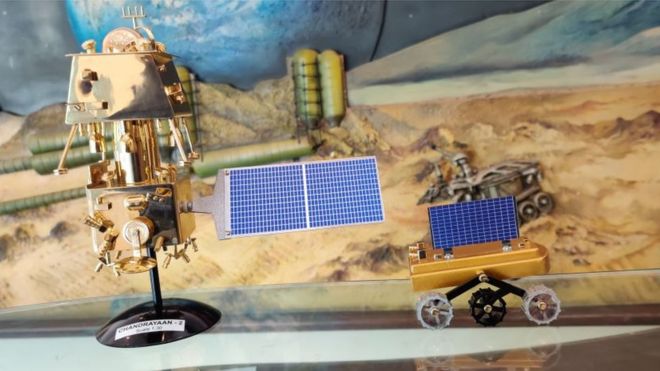
Lander of Chandrayaan-2Image copyright PRESS INFORMATION BUREAU, INDIA

India’s space agency has unveiled its spacecraft that it hopes to land on the Moon by September.

If successful, India will be the fourth country to achieve a soft landing on the Moon, following the US, the former Soviet Union and China.

Chandrayaan-2 will be the country’s second lunar mission.

Its first mission, Chandrayaan-1 which launched in 2008, was an orbiter and did not actually land on the surface of the Moon.

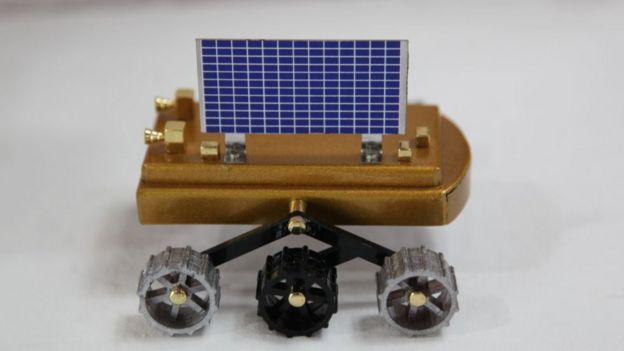
Rover of Chandrayaan-2Image copyright PRESS INFORMATION BUREAU, INDIA

This mission will focus on the lunar’s surface and gather data on water, minerals and rock formations.

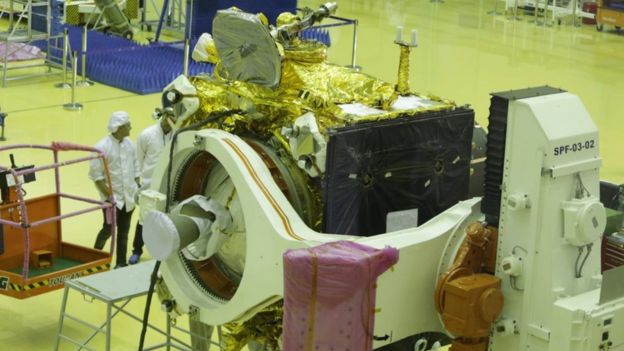
The new spacecraft will have a lander, an orbiter and rover.

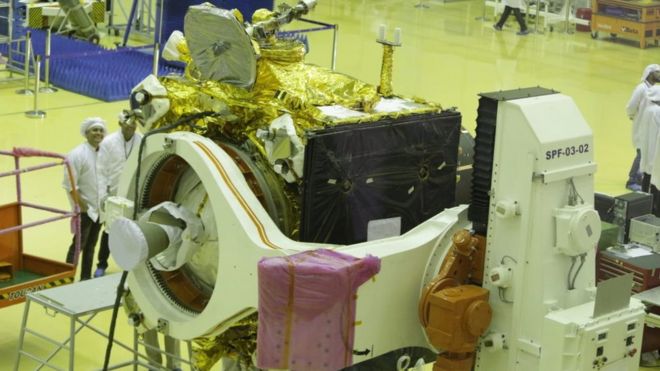
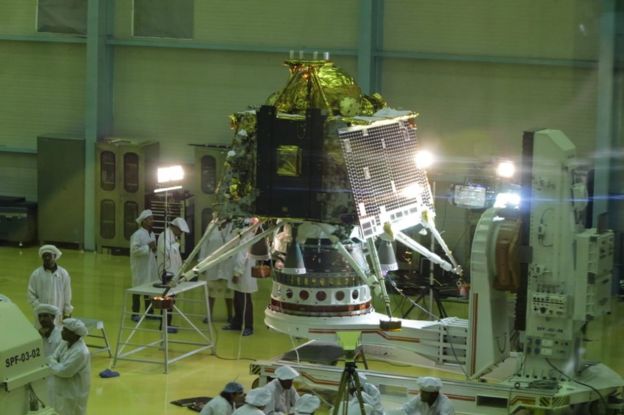
These are photos of the craft in the Indian Space and Research Organisation’s (ISRO) lab, where scientists have been busy getting the spacecraft ready:

Lander of Chandrayaan-2Image copyright PRESS INFORMATION BUREAU, INDIA

Media caption Is India’s prime minister right when he calls his country a space superpower?

If all goes according to plan, the lander and rover will touch down near the lunar south pole in September. If successful, it would be the first ever spacecraft to land in that region.

The rover is expected to operate for 14 days on the Moon, ISRO chairperson K Sivan told the Times of India newspaper. “The rover will analyse the content of the lunar surface and send data and images back to the earth,” he said.

Source: The BBC

Law of Unintended Consequences

continuously updated blog about China & India

ChiaHou's Book Reviews

continuously updated blog about China & India

What's wrong with the world; and its economy

continuously updated blog about China & India