Archive for ‘Chang’e-4 lunar exploration mission’

04/06/2019

China’s lunar rover Yutu ends 60-year riddle of moon’s mantle with discovery of mineral olivine

  • Yutu’s discovery of olivine helps pave the way for scientists to confirm existence of a mantle beneath the moon’s crust
  • Crystallised mineral likely came from a crater caused by a meteor strike
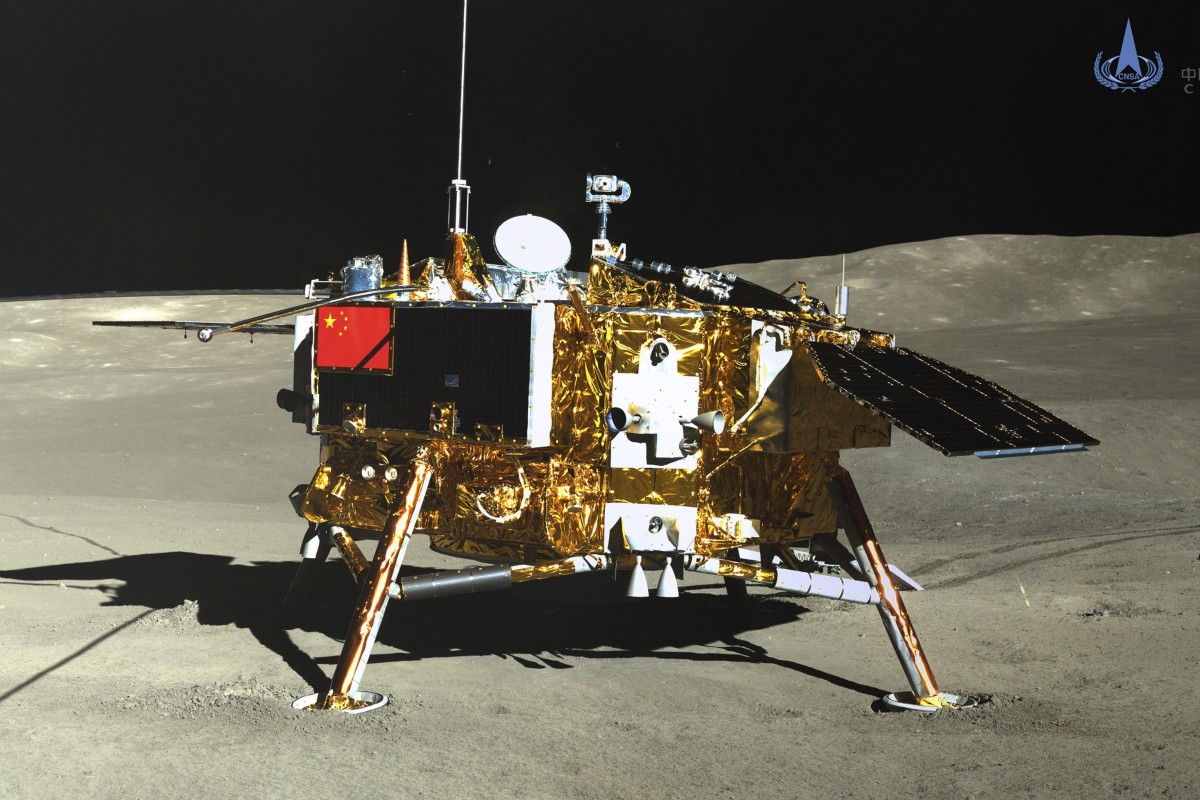
China’s lunar rover, Yutu, has made a groundbreaking discovery. Photo: Xinhua
China’s lunar rover, Yutu, has made a groundbreaking discovery that proves what scientists have been thinking for decades: that the moon has a mantle.
Scientists have long suspected that the moon has a mantle under its crust, just like the Earth, but for the past 60 years lunar explorations, including the US Apollo missions, have failed to provide proof. While there were clues, there was no direct evidence.
“Now we have it,” said Professor Li Chunlai, deputy director of the National Astronomical Observatory of China and a lead scientist on the Chang’e-4 mission that put Yutu, or Jade Rabbit as it is known in English, on the moon.
The findings, published in the latest issue of journal Nature on Thursday, answer some fundamental questions about the moon, such as its internal structure and history of its formation.
The rover discovered olivine in surface samples collected near its landing site. Photo: Xinhua

During its first mission on January 3, Yutu discovered olivine, a green, crystallised mineral usually found deep underground – like the upper mantle of the Earth – in surface samples collected near its landing site.

Further analysis showed that the olivine was not local, but had originated from a 72km diameter (45-mile) crater nearby.

The far side of the moon has more craters than the near side, which faces the Earth, and a meteor strike probably penetrated to the mantle and brought up materials to the surface.

What you need to know about Chang’e 4’s mission to the moon
Yutu’s landing site used to be littered by rocks, but cosmic rays and solar wind weathered them to dust, Li said.

“What we found is the first direct evidence of materials from deep below the lunar crust,” though how deep is still unknown, he said.

It is generally believed that the moon was once covered by oceans of molten rock. Lighter substances rose to the surface and formed a crust while heavier ones sank to form the mantle and core. The new findings support that theory.

China is the first country to land a rover on the far side on the moon and is planning to send a larger spacecraft there later this year to bring back samples.

The first Chinese astronauts will land on the moon between 2025 to 2030, according to Beijing’s latest schedule.

The Apollo missions brought back many rock samples, some of which contained olivine, but some scientists suspected they might have come from a volcanic eruption.

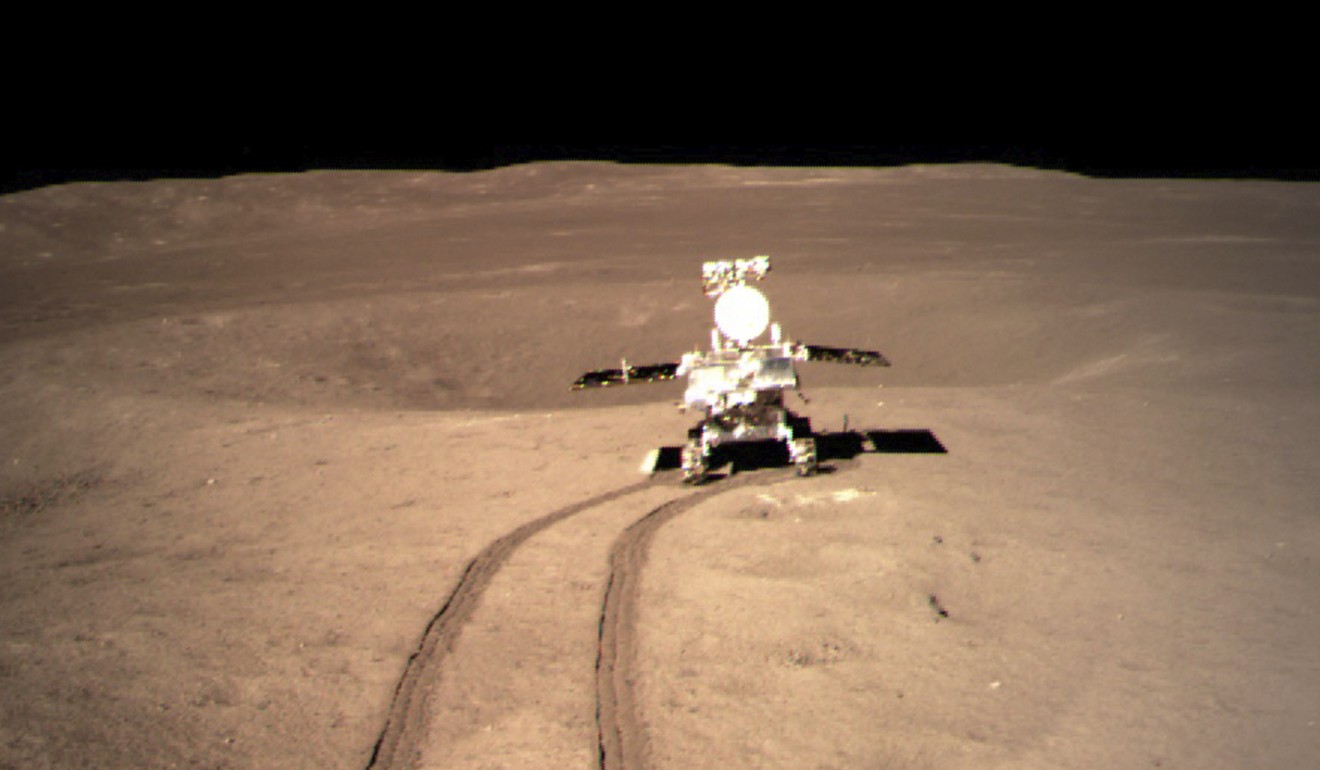
First photo of lunar rover leaving ‘footprints’ on moon

China, the United States and other nations have all announced plans to launch missions to exploit the moon’s resources within the next decade or two.

Yutu’s discovery could help scientists to draw a more accurate map of those resources, including the volume and distribution of minerals, researchers said.

In Chinese folklore, Yutu or Jade Rabbit as it is known in English, is a companion of the moon goddess Chang’e. Photo: Handout

US President Donald Trump gave Nasa an additional US$1.6 billion budget to put Americans back on the moon by 2024.

Li said Chinese scientists were willing to work with their colleagues in the US, but Washington had blocked any such collaboration.

“Our door remains open,” he said.

Source: SCMP

11/03/2019

India engaged with China for lunar mission, talks failed to take off

China’s Chang’e-4 lunar exploration mission was the first one to land on the far side of the moon – the side that’s not visible from earth – on January 3.

INDIA Updated: Mar 11, 2019 13:47 IST

Sutirtho Patranobis
Sutirtho Patranobis
Hindustan Times, Beijing
India,China space mission,space mission
The top space agencies – the China National Space Administration (CNSA) and Indian Space Research Organisation (ISRO) – confirmed the information but did not share details why the cooperation failed to take off.(Corbis via Getty Images)
A rare opportunity for India and China to cooperate in a high-profile space mission fell through after the two countries disagreed on the nature of the Indian payload to be carried on the Chang’e-4 lunar mission, it has emerged.
China’s Chang’e-4 lunar exploration mission was the first one to land on the far side of the moon – the side that’s not visible from earth – on January 3. Since landing, the mission has sent back stunning first-time images from the moon’s surface. It has been carrying out a series of scientific research tasks involving multiple countries and organisations.
China’s lunar exploration chief Wu Weiren called the mission a “huge stride” for China.
It could have been a breakthrough stride for Sino-India cooperation in space – both countries have successful space programs – as well had Chang’e-4 carried the Indian payload.
The top space agencies – the China National Space Administration (CNSA) and Indian Space Research Organisation (ISRO) – confirmed the information but did not share details why the cooperation failed to take off.
“In April 2015, Xu Dazhe, the incumbent administrator of CNSA wrote a letter to the heads of the world’s major space agencies, invited them to participate in the piggy-back cooperation of Chang’ e-4 mission, which received positive responses from more than a dozen national space agencies,” the Chinese agency told HT over email.
“China also received applications from India for the piggy-back cooperation. However, due to the different nature of the missions of the two sides, the Indian payload on Chang’ e-4 could not be carried through (after) the evaluation,” the agency said.
The payload in this context could have been a satellite or space probe equipment.
“No, we will not be able to comment on that … Yes, we will not comment on that,” an ISRO spokesperson said.
Several countries including Germany, Sweden, the Netherlands, and Russia have cooperated in the ongoing mission.
India and China formally established the Sino-Indian Joint Committee on Space Cooperation in 2015. In the same year, the first meeting of the joint committee was held in Beijing, and the outline of Sino-Indian space cooperation was signed.
“The outline includes 19 projects in seven areas: Remote sensing satellites, space-based meteorology, space science and lunar and deep space exploration, education and training, piggy-back launch services, satellite navigation, and space components,” CNSA said.
“The MoUs signed have provided a platform (for the two countries) to work but there is nothing as of now; all at dialogue stage. There are international forums where they are there and we are there but nothing (bilateral),” ISRO’s spokesperson said.
Last year, the then Indian ambassador to China Gautam Bambawale visited CNSA twice in half a year and exchanged views with Zhang Kejian, the CNSA head, on promoting Sino-Indian space cooperation.
“The two sides reviewed the course of Sino-Indian space cooperation in recent years, agreed to further promote the process of Sino-Indian space cooperation with an active and open attitude of cooperation, and agreed to convene the second meeting of the Sino-Indian Space Joint Committee in 2019,” CNSA said.
The Chinese space agency said it is open to cooperating with India.
“CNSA is open to international cooperation in lunar and deep space exploration… and international cooperation for a series of deep space exploration activities, such as Chang’ e 6 sampling return, the Mars exploration, and asteroid exploration, Jupiter galaxy, and planetary crossing exploration,” it said.
“We are willing to work hand in hand with space agencies, space institutions, and foreign space exploration enthusiasts to explore the mysteries of the universe.”
Source: Hindustan Times
Law of Unintended Consequences

continuously updated blog about China & India

ChiaHou's Book Reviews

continuously updated blog about China & India

What's wrong with the world; and its economy

continuously updated blog about China & India