Archive for ‘children’s diapers’

19/05/2019

Modi’s jobs deficit: J&J’s largest India plant idle three years after completion

ENJERLA/NEW DELHI, India (Reuters) – It was supposed to be Johnson & Johnson’s biggest manufacturing plant in India. It was to eventually employ at least 1,500 people and help bring development to a rural area near Hyderabad in southern India.

Yet, three years after the U.S. healthcare company completed construction of production facilities for cosmetics and baby products on the 47-acre site, they stand idle.

Two sources familiar with J&J’s operations in India and one state government official told Reuters production at the plant, at Penjerla in Telangana state, never began because of a slowing in the growth in demand for the products.

One of them said that demand didn’t rise as expected because of two shock policy moves by Prime Minister Narendra Modi: a late 2016 ban on then circulating high-value currency notes, and the nationwide introduction of a goods and services tax (GST) in 2017.

J&J spokespeople in its Mumbai operations in India and at its global headquarters in New Brunswick, New Jersey, declined to respond to a list of questions from Reuters.

Modi’s office did not respond to a call and an email with questions.

Aimed at rooting out corruption and streamlining the tax system, the double whammy of ‘demonetization’ and GST – were two of Modi’s signature policy moves. But instead of encouraging economic activity as intended, they did the opposite, at least in 2016-2018, by sapping consumer demand, according to some economists.

Many businesses, especially small and medium-sized enterprises, complained publicly – some in their financial statements – that they suffered a drop off in orders. The suspended J&J project stands as one of the most vivid examples of the impact on the broader investment picture.

In the first month after demonetization, some business surveys showed that sales of products such as shampoos and soap fell more than 20 percent.

Lack of jobs growth and a farm-income crisis because of low crop prices have hurt Modi in the current general election, according to several political strategists.

Still, Modi and his ruling Hindu nationalist Bharatiya Janata Party are expected by many of the strategists to be in a position to get a second term – probably with support of some other parties – when votes are counted on Thursday, partly because of his strong stance on national security issues.

BIG INVESTMENTS, GREAT EXPECTATIONS

A range of Modi’s business policies, such as capping prices of medical devices, forcing tech companies to store more data locally and stricter e-commerce regulations have in the past two years hurt plans of American multinationals such as J&J, Mastercard, Amazon and Walmart-owned Flipkart.

The groundbreaking of the J&J facility in Penjerla, its third in the country, was carried out with much fanfare in 2014, attended by Telangana state’s Chief Minister Chandrashekar Rao, who hailed the foreign investment as a big win for local communities. A document dated April 2017 that lists products the company planned to make at the facility, submitted to the Telangana government and reviewed by Reuters, names baby oil, baby shampoo, baby lotion, baby hair oil, face wash and creams.

Shaukat Ali, running a tea shop under a bamboo stall on barren land outside the plant, said local workers check in routinely for possible vacancies at the J&J site, but nothing has come up in years.

At the local pollution control board office, the member secretary Satyanarayana Reddy said the J&J plant had all the required approvals and he was not sure why it hadn’t started production.

“It is unusual for such a big plant to stay idle for so long,” he said. “But there is no problem from our side.”

Chandrasekhar Babu, an additional director at the Telangana industries department, said a J&J company official told him the plant hadn’t started due to lack of demand.

GST and demonetization were two key reasons the plan didn’t kick off, one of the sources said, adding that lack of consumer demand since then dented company’s plans.

The second source familiar with J&J’s plans said the company miscalculated Indian market demand.

On a recent visit by a Reuters reporter to the J&J plant, plush, furnished conference rooms and cubicles sat inactive; M. Sairam, who said he was the site manager, told Reuters production areas with machines were idle too.

PLANNED FURTHER EXPANSION

Local officials had hoped the initial J&J plant would be only the beginning. After the groundbreaking in 2014, Pradeep Chandra, who was Telangana’s special chief secretary of industries, told Business Today magazine that “based on the extent of land (J&J) have acquired we believe that they are looking at much larger expansion here.”

Local media reports at the time said the J&J facility would employ some 1,500 people.

A J&J official, who was not identified by name, was reported subsequently in December 2016 in India’s Business Standard assaying that the $85 million plant would be operational by 2018 after it had overcome procedural delays. The official was quoted as saying the company had earmarked an additional $100 million for expansion.

Vikas Srivastava, the managing director of J&J Consumer(India), who was at the 2014 groundbreaking, did not respond to calls for comment.

Reuters also talked to two workers outside a sprawling Procter & Gamble facility making detergents and diapers, which is next to the J&J plant. They said they were part of the P&G plant’s production team and the plant had been running below capacity.

A P&G spokesperson denied that, saying the plant was “operating at full capacity in line with our business plans”. “India is a priority market for P&G globally and in recent quarters, P&G’s business in India has registered strong double-digit growth consistently,” the company said.

The weak rural economy, where most Indians work, has also hurt growth in sales of basic items such as detergents and shampoo in the past year.

Hindustan Unilever Ltd, an industry bellwether that would compete with the likes of J&J and P&G in some categories, said its volume growth shrank to 7 percent in the quarter ended March 31, down from double-digit growth in the previous five quarters.

The company warned that the daily consumer goods segment in India was “recession resistant … not recession proof.”

Source: Reuters
25/02/2019

Oscars 2019: The Indian sanitary pad makers’ story wins award

Sneh
Image captionSneh, 22, attended the awards ceremony where the film won an Oscar
Presentational white space

A film based on young women in an Indian village who make sanitary pads has won an Oscar for best documentary short. The BBC’s Geeta Pandey met with the women in their village before the ceremony.

Sneh was 15 when she started menstruating. The first time she bled, she had no idea what was happening to her.

“I was very scared. I thought I was sick with something very serious and began crying,” she told me when I visited her home in Kathikhera village not far from Delhi earlier this week.

“I didn’t have the courage to tell my mother so I confided in my aunt. She said: ‘You’re a grown woman now, don’t cry, it’s normal.’ It was her who told my mother.”

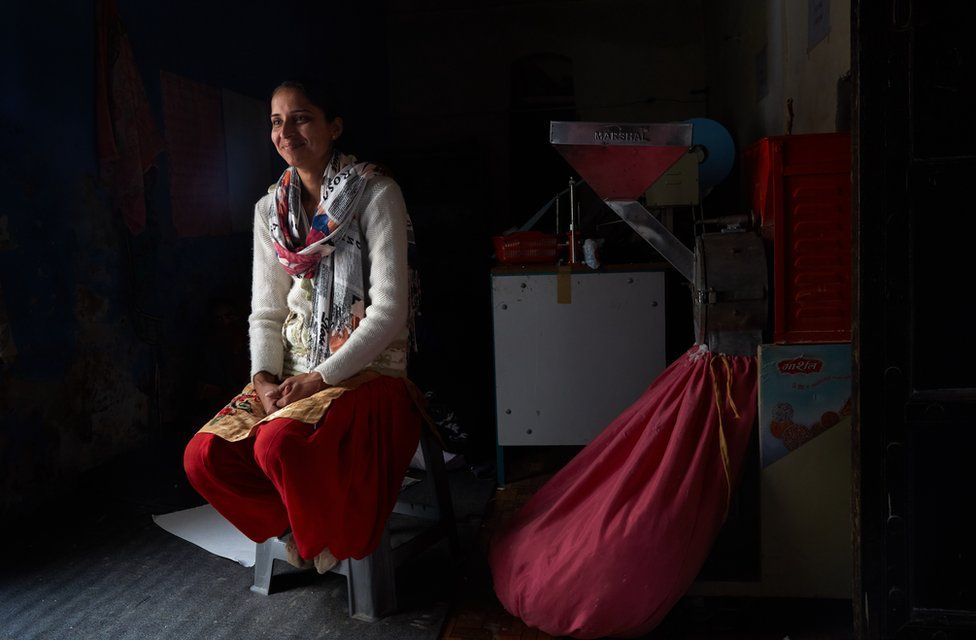
Sneh, now 22, has travelled a long way from that point. She works in a small factory in her village that makes sanitary pads and is the protagonist of Period. End of Sentence., a documentary that has been nominated for an Oscar. She will be attending Sunday’s ceremony in Los Angeles.

The film came about after a student group in North Hollywood used crowdfunding to send a pad-making machine – and Iranian-American filmmaker Rayka Zehtabchi – to Sneh’s village.

Just 115km (71 miles) from Delhi, Kathikhera village in Hapur district is a world far removed from the glitzy malls and high-rises of the Indian capital. Normally, it’s a two-and-a-half-hour drive from Delhi, but construction work on the highway slows it down to four hours for us. And the final 7.5km drive to the village from Hapur town is a crawl, on narrow winding roads lined with open drains on both sides.

The documentary is filmed in the farms and fields – and classrooms – of Kathikhera. Like in the rest of India, periods are a taboo topic; menstruating women are considered impure and barred from entering religious places and often excluded from social events too.

Presentational white space
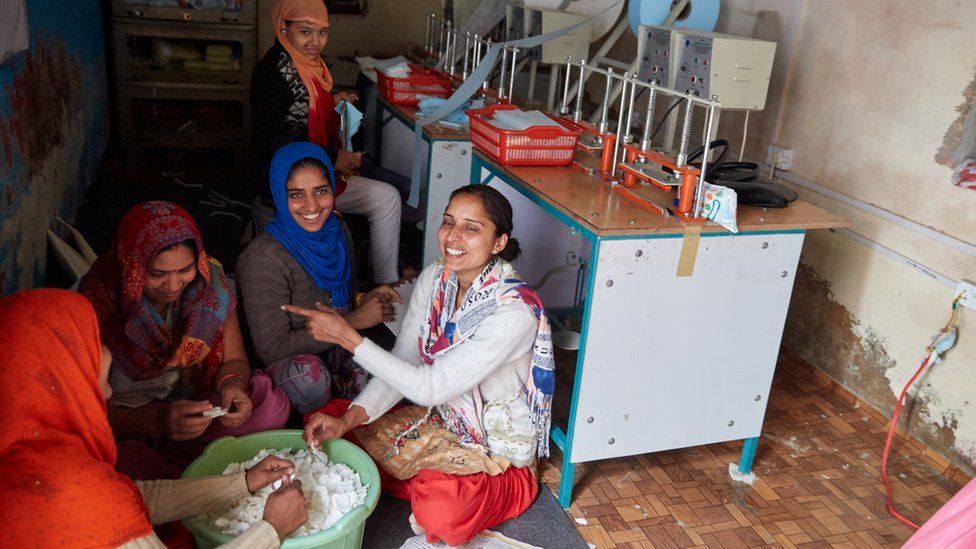
Women making sanitary pads
Image captionSneh says that previously, menstruation was not discussed – even among girls
Presentational white space

With so much stigma surrounding the issue, it’s no surprise that Sneh had never heard of periods before she started getting them herself.

“It was not a topic that was discussed – even among girls,” she says.

But things began to change when Action India, a charity that works on reproductive health issues, set up a sanitary napkin manufacturing unit in Kathikhera.

Presentational white space
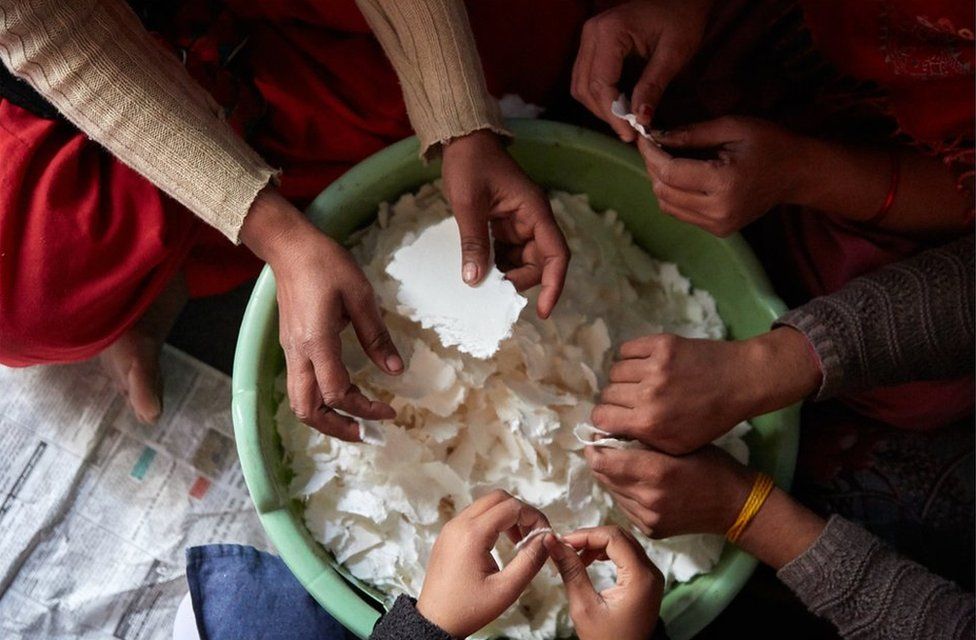
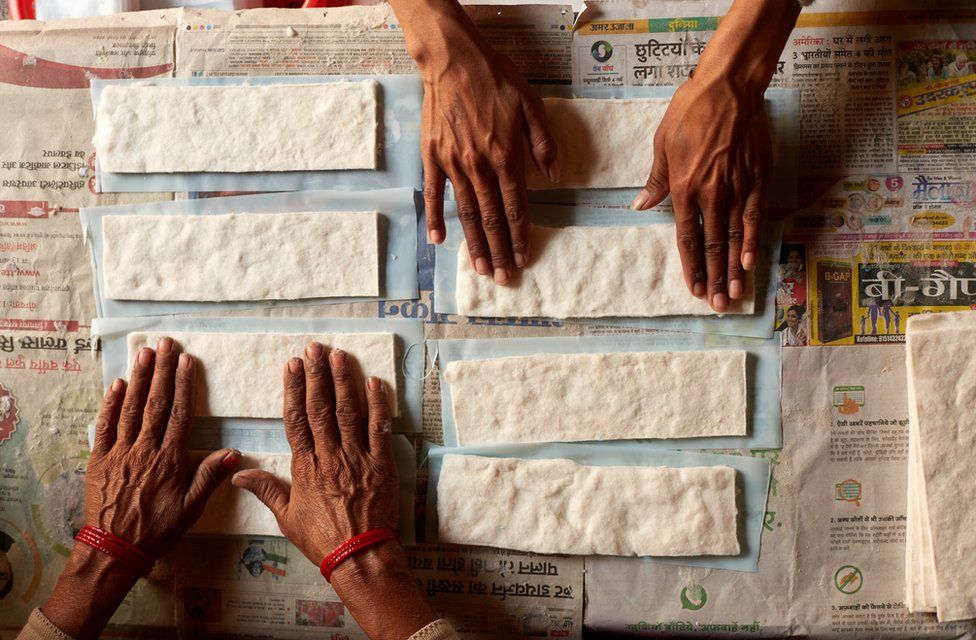
Women prepare the material for making sanitary napkins
Image captionThe women employees work from 9-5 six days a week
Presentational white space
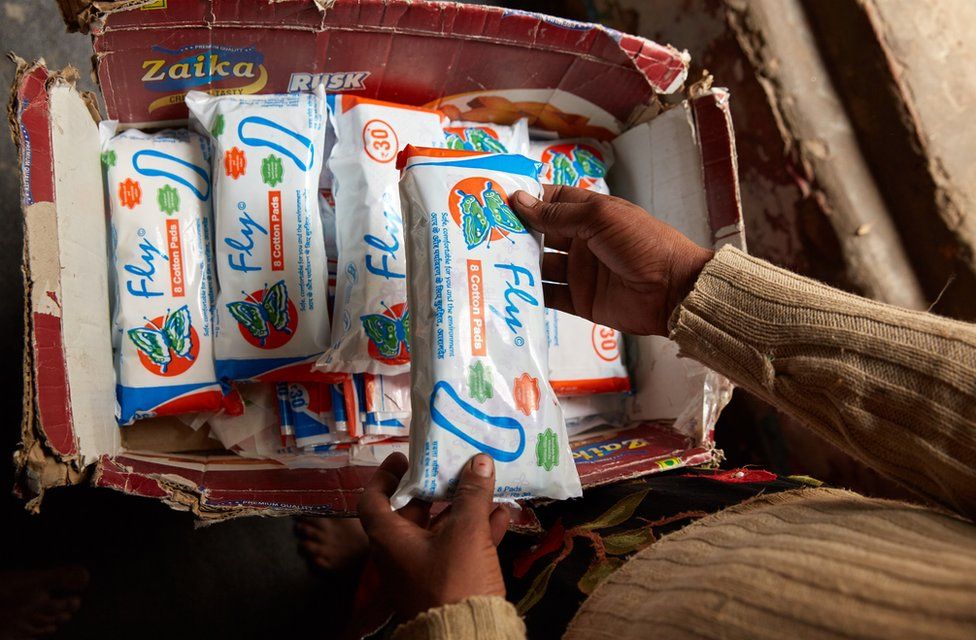
The final product
Image captionA pack is priced at 30 rupees ($0.40; £0.30)
Presentational white space

In January 2017, Sneh was asked by Suman, a neighbour who works with Action India, if she wanted to work in the factory.

A college graduate who dreams of working for the Delhi police one day, Sneh says she was excited. After all, there were “no other job opportunities” in the village.

“When I sought my mum’s permission, she said, ‘ask your father’. In our families, all important decisions are taken by men.”

She was too embarrassed to tell her father that she was going to be making pads so she told him that she would be making children’s diapers.

“It was two months into the job that mum told him that I was making pads,” she laughs. Much to her relief, he said, “That’s alright, work is work.”

Today, the unit employs seven women, between 18 and 31 years of age. They work from 9-5, six days a week and are paid a monthly salary of 2,500 rupees ($35; £27). The centre produces 600 pads a day and they are sold under the brand name Fly.

Presentational white space
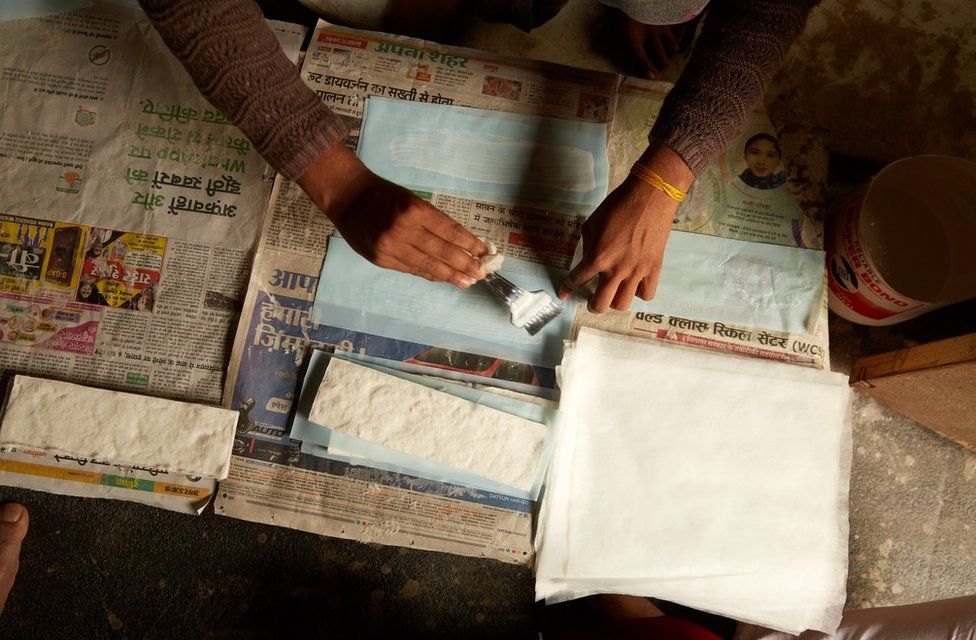
Women making sanitary pads
Image captionThe centre produces 600 pads a day
Presentational white space
Women making sanitary pads
Image captionMost women in the village used to use old clothes when they got their periods, now 70% use pads
“The biggest problem we face is power cuts. Sometimes we have to come back at night to work when the power is back to meet the targets,” Sneh says.

This little business, run from two rooms in a village home, has helped improve feminine hygiene. Until it was set up most women in the village were using pieces of cloth cut out from old saris or bedsheets when they had their period, now 70% use pads.

It’s also de-stigmatised menstruation and changed attitudes in a conservative society in ways that were unimaginable just a couple of years ago.

Sneh says menstruation is now discussed openly among women. But, she says, it’s not been an easy ride.

“It was difficult at the start. I had to help my mother with housework, I had to study and do this job. Sometimes during my exams, when the pressure became too much, my mother went to work instead of me,” she says.

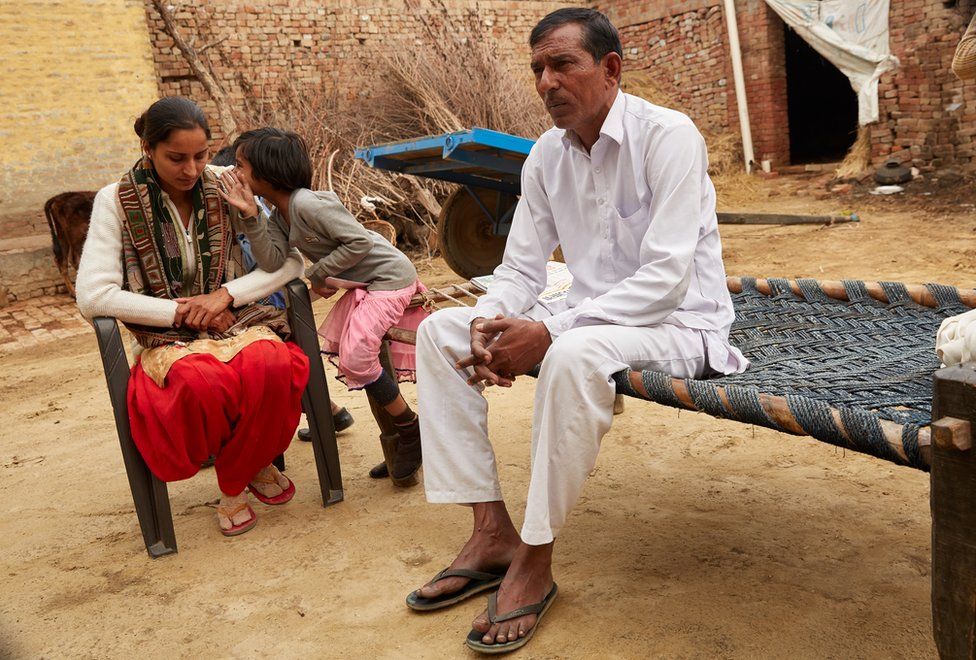
Her father, Rajendra Singh Tanwar, says he is “very proud” of his daughter. “If her work benefits the society, especially women, then I feel happy about it.”

Presentational white space
Sneh with her father
Image captionRajendra Singh Tanwar says he’s proud of what Sneh (left) has done
Presentational white space
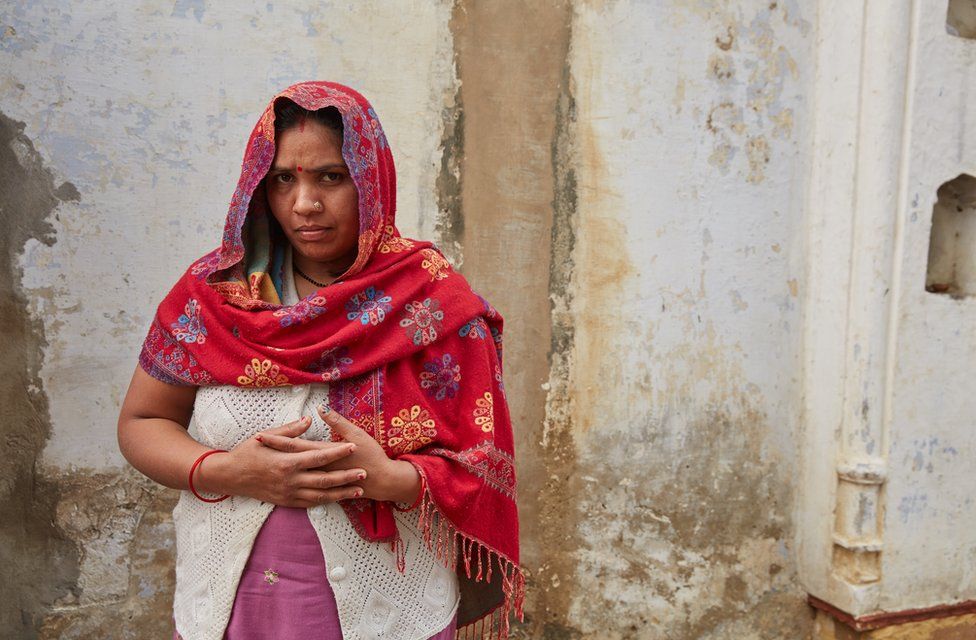
Sushma Devi
Image captionSushma Devi’s husband does not want her to work there – but she won’t give it up
Presentational white space

Initially, the women faced objections from some villagers who were suspicious about what was happening at the factory. And once the film crew arrived, there were questions about what they were doing.

And some, like 31-year-old Sushma Devi, still have to fight daily battles at home.

The mother-of-two says her husband agreed to let her work only after Sneh’s mother spoke to him. He also insisted that she finish all the housework before going to the factory.

“So I wake up at 05:00, clean the house, do the laundry, feed the buffaloes, make dung cakes which we use as cooking fuel, bathe, and make breakfast and lunch before I step out. In the evening, I cook dinner once I get back.”

But her husband is still unhappy with the arrangement. “He often gets angry with me. He says there’s enough work at home, why do you have to go out to work? My neighbours too say it’s not a good job, they also say the salary is low.”

Two of Sushma’s neighbours had worked at the factory too, but left after a few months. Sushma has no intention of doing the same: “Even if my husband beats me up, I will not give up my job. I enjoy working here.”

Presentational white space
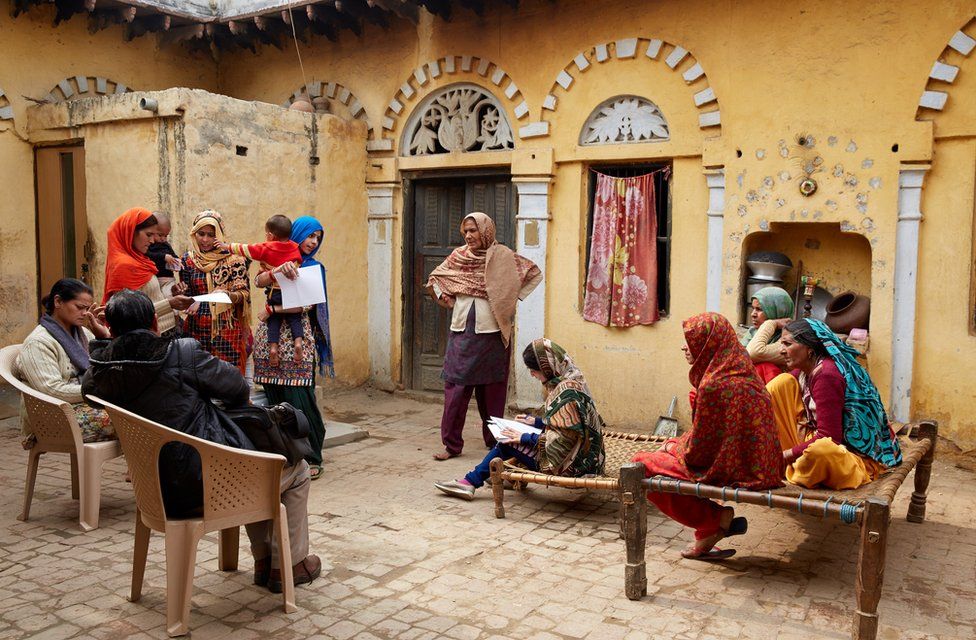
Members of Action India and some of the factory workers
Image captionAction India, a charity that works on reproductive health issues, set up the manufacturing unit two years ago
Presentational white space

In the documentary, Sushma is heard saying she’d spent some of her earnings to buy clothes for her younger brother. “If I’d known this was going to go to Oscars, I would have said something more intelligent,” she says, laughing.

For Sushma, Sneh and their fellow workers, the Oscar nomination has come as a big boost. The film, which is available on Netflix, is nominated in the Best Short Documentary category.

As Sneh prepares to leave for Los Angeles, her neighbours are appreciative of the “prestige and fame” she has brought the village.

“No-one from Kathikhera has ever travelled abroad so I’ll be the first one to do so,” she says. “I’m now recognised and respected in the village, people say they are proud of me.”

Sneh says she had heard of Oscars and knew they were the biggest cinema awards in the world. But she had never watched a ceremony, and certainly didn’t think that one day she would be on the red carpet.

“I never thought I would go to America. Even now I can’t fully process what’s happening. For me, the nomination itself is an award. It’s a dream that I’m dreaming with my eyes open.”

Source: The BBC

Law of Unintended Consequences

continuously updated blog about China & India

ChiaHou's Book Reviews

continuously updated blog about China & India

What's wrong with the world; and its economy

continuously updated blog about China & India