Archive for ‘China Academy of Launch Vehicle Technology’

10/03/2020

China launches new BeiDou navigation satellite

(EyesonSci)CHINA-XICHANG-SATELLITE-LAUNCH (CN)

China launches a new satellite of the BeiDou Navigation Satellite System (BDS) from the Xichang Satellite Launch Center in southwest China’s Sichuan Province, March 9, 2020, only one step away from completing the whole global system. The satellite, the 54th of the BeiDou family, was sent into a geostationary orbit as planned by a Long March-3B carrier rocket. The newly launched satellite is the second geostationary earth orbit satellite of the BDS-3 system, and the last one is expected to be launched in May. (Photo by Guo Wenbin/Xinhua)

XICHANG, March 9 (Xinhua) — China launched a new satellite of the BeiDou Navigation Satellite System (BDS) from the Xichang Satellite Launch Center in southwest China’s Sichuan Province at 7:55 p.m. Monday (Beijing Time), only one step away from completing the whole global system.

The satellite, the 54th of the BeiDou family, was sent into a geostationary orbit as planned by a Long March-3B carrier rocket.

China began to construct its navigation system, named after the Chinese term for the Big Dipper constellation, in the 1990s and started serving the Asia-Pacific Region in 2012. At present, all the first generation BDS-1 satellites have ended operations, and a total of 54 BDS-2 and BDS-3 satellites have been sent into space.

Compared with other navigation systems in the world, the design of the BDS constellation is unique, including medium earth orbit, inclined geosynchronous earth orbit and geostationary earth orbit satellites.

The BDS-3 system will consist of a total of 30 satellites, including 24 medium earth orbit satellites, three geostationary earth orbit satellites and three inclined geosynchronous earth orbit satellites.

The newly launched satellite is the second geostationary earth orbit satellite of the BDS-3 system, and the last one is expected to be launched in May.

The satellite and the carrier rocket were developed by the China Academy of Space Technology (CAST) and the China Academy of Launch Vehicle Technology, respectively.

Space engineers have overcome difficulties during the novel coronavirus epidemic to ensure the success of the mission.

Monday’s launch was the 327th mission of the Long March rocket series.

The new satellite has the most functions and signals, the largest size and the longest designed life span among all the BDS-3 satellites, said Chen Zhonggui, chief designer of BDS-3 satellites from CAST.

The satellite is based on the Dongfanghong-3B platform, currently one of the largest satellite platforms being used in China, and can carry more fuels to ensure its long life, said Chen.

The satellite has integrated the functions of navigation and communication. The accuracy of dynamic positioning can reach the decimeter level, according to Liu Tianxiong, deputy chief designer of BDS-3 satellites.

It can provide services for the driverless vehicles, accurate berthing of ships, as well as takeoff and landing of airplanes. It will be widely used in the fields of communication, electric power, finance, mapping, transportation, fishery, agriculture and forestry.

The ability of short message communication has been improved 10 times on this satellite. Users can send a message of over 1,000 Chinese characters at one time as well as pictures via the satellite, quite useful in emergencies.

The satellite’s ability to receive signals has also been greatly improved, which could help miniaturize users’ terminals, said Pan Yuqian, one of the satellite’s designers.

China aims to complete the construction of the BDS constellation in May and provide high-precision, reliable positioning, navigation and timing services anywhere in the world.

Source: Xinhua

20/09/2019

China launches new remote-sensing satellites

(SCI-TECH)CHINA-JIUQUAN-SATELLITES-LAUNCH (CN)

A Long March-11 carrier rocket carrying five new remote-sensing satellites blasts off from the Jiuquan Satellite Launch Center in northwest China’s Gansu Province, Sept, 19, 2019. Five new remote-sensing satellites were sent into planned orbit on Thursday. The satellites belong to a commercial remote-sensing satellite constellation project “Zhuhai-1,” which will comprise 34 micro-nano satellites. (Photo by Wang Jiangbo/Xinhua)

JIUQUAN, Sept. 19 (Xinhua) — Five new remote-sensing satellites were sent into planned orbit from the Jiuquan Satellite Launch Center in northwest China’s Gobi Desert Thursday.

The five satellites were launched by a Long March-11 carrier rocket at 2:42 p.m. (Beijing Time).

The satellites belong to a commercial remote-sensing satellite constellation project “Zhuhai-1,” which will comprise 34 micro-nano satellites, including video, hyperspectral, and high-resolution optical satellites, as well as radar and infrared satellites.

The carrier rocket was developed by the China Academy of Launch Vehicle Technology, and the satellites were produced by the Harbin Institute of Technology and operated by the Zhuhai Orbita Aerospace Science and Technology Co. Ltd.

Thursday’s launch was the 311th mission for the Long March series carrier rockets.

The newly launched satellites comprise four hyperspectral satellites with 256 wave-bands and a coverage width of 150 km, and a video satellite with a resolution of 90 centimeters.

The Zhuhai-1 hyperspectral satellites have the highest spatial resolution and the largest coverage width of their type in China.

The data will be used for precise quantitative analysis of vegetation, water and crops, and will provide services for building smart cities, said Orbita, the largest private operator of hyperspectral satellites in orbit.

The company aims to cooperate with government organizations and enterprises to expand the big data satellite services.

Source: Xinhua

25/06/2019

China launches new BeiDou satellite

BEIJING, June 25 (Xinhua) — China sent a new satellite of the BeiDou Navigation Satellite System (BDS) into space from the Xichang Satellite Launch Center in Sichuan Province at 2:09 a.m. Tuesday.

Launched on a Long March-3B carrier rocket, the satellite was sent to the inclined geosynchronous earth orbit. It is the 46th satellite of the BDS satellite family and the 21st satellite of the BDS-3 system.

The design of the BDS constellation is unique, including medium earth orbit (MEO), geostationary earth orbit (GEO) and inclined geosynchronous earth orbit (IGEO) satellites.

So far, there are already 18 MEO BDS-3 satellites, one GEO BDS-3 satellite, and two IGEO BDS-3 satellites sent into space.

After in-orbit tests, the new satellite will work with those BDS satellites already in orbits to improve the coverage and positioning accuracy of the system.

The new satellite and the carrier rocket were developed by the China Academy of Space Technology and the China Academy of Launch Vehicle Technology under the China Aerospace Science and Technology Corporation.

The launch was the 307th mission for the Long March series of carrier rockets.

Source: Xinhua

17/06/2019

China rockets to forefront of global space race with sea launch success

  • China has become the first nation to fully own and operate a floating launch platform for its space missions
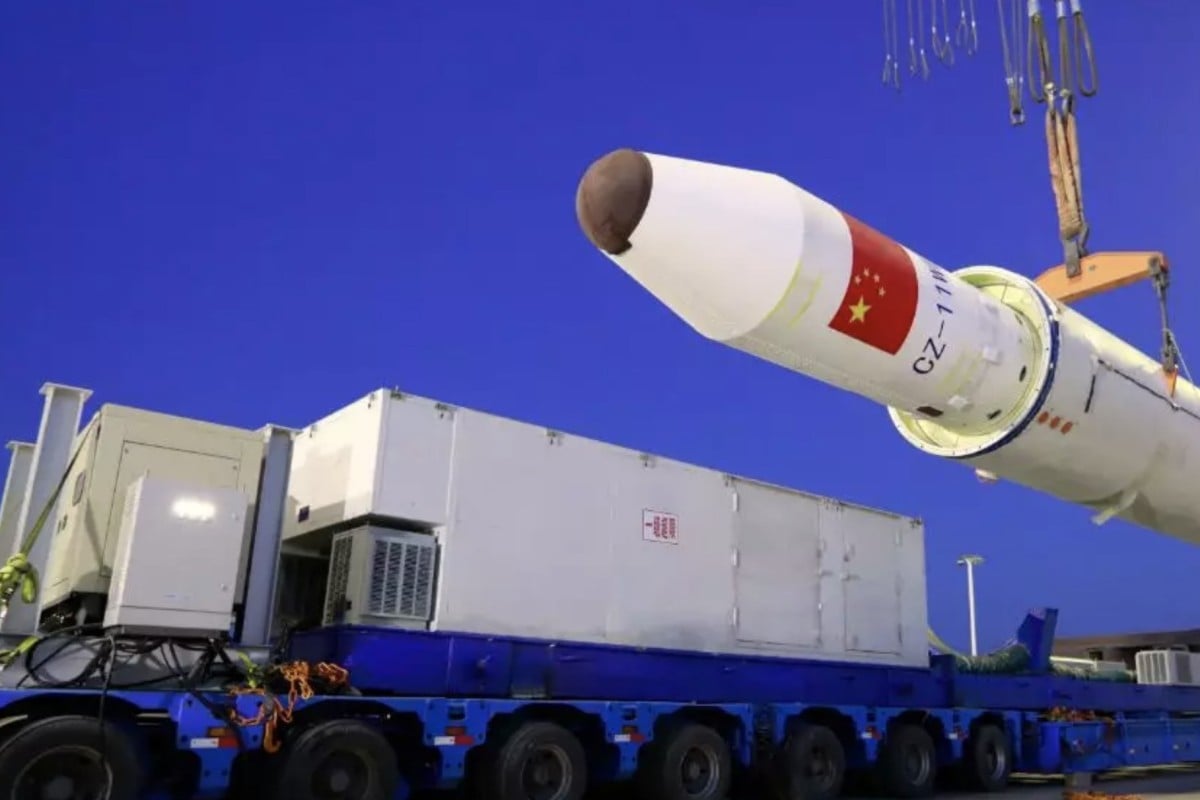
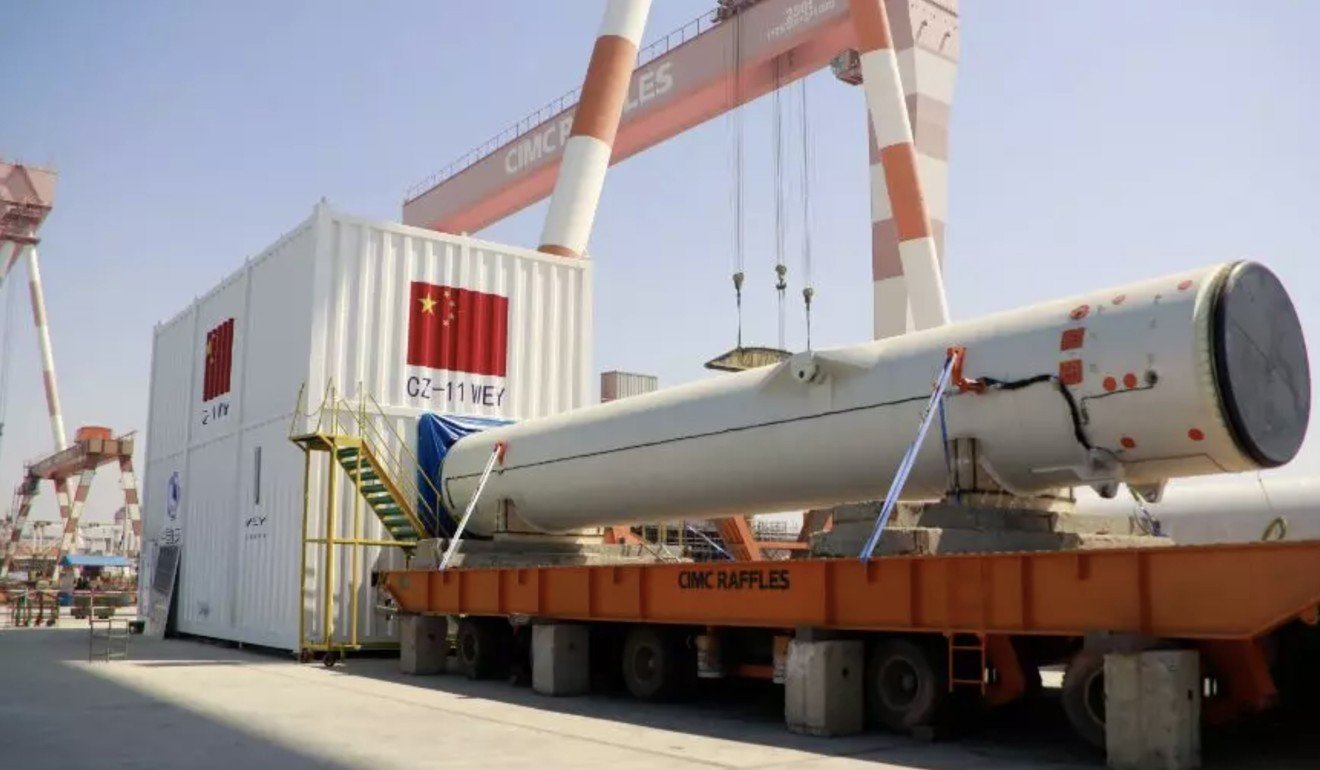
China has successfully launched a rocket into space from the Yellow Sea, making it the first nation to fully own and operate a floating sea launch platform. Photo: China National Space Administration
China successfully launched a rocket into space from a civilian cargo ship at sea on Wednesday, becoming the first nation to fully own and operate a floating sea launch platform, a technology expected to significantly reduce the cost and risk of space missions.
A Long March 11WEY rocket blasted off from the ship in the Yellow Sea at noon Beijing time, according to the China National Space Administration.
About six minutes later, five commercial satellites and a pair of “technical experiment” probes – called Bufeng, or Wind Catchers – reached their designated orbits.

The Wind Catchers will work together to detect winds on the surface of the world’s oceans. They will boost China’s ability to monitor and forecast typhoons and other extreme weather events, according to the administration.

“Launching a rocket from the sea has the advantages of high flexibility, good adaptability for specific tasks, and excellent launch economy,” said a statement on the administration’s website.

“It can flexibly select the launch point and touchdown area to meet the needs of various payloads for different orbits, and provide better aerospace commercial launch services for countries along the belt and road,” it added, referring to the Belt and Road Initiative, China’s plan to grow global trade.

The Long March 11 is a four-stage, solid fuel rocket with a design similar to a ballistic missile. It can carry a payload of about 700kg to the Earth’s lower orbit.

The first two stages of the rocket dropped in open waters in the northern Pacific Ocean, according to the administration. The rocket was equipped with a flight suspension system in case of any abnormal situation, but none occurred.

“The rocket debris will not cause damage to surrounding waters,” the administration said.

The world’s first ocean rocket launch platform, the Sea Launch, was jointly built by companies from Russia, the United States, Norway and Ukraine in the late 1990s. Its operation was halted in 2014 after military conflicts broke out between Russia and Ukraine.

Li Hong, president of the China Academy of Launch Vehicle Technology, told state media in March that the Chinese rocket and launch platform were designed and owned entirely by China, so it would not have similar problems caused by international disputes as the Sea Launch.

The launch was expected to encounter many technical and engineering challenges, including simplified procedures for pre-launch testing, the rocking motion of the ship and heat dissipation in a confined space.

But Chinese space authorities have argued the inconvenience would be offset by numerous advantages. For instance, the technology would allow China to move its launch site to as far away as Hawaii for quicker, cheaper satellite insertion to certain orbits, according to Xinhua.

Preparations get under way for Wednesday’s successful Chinese space launch from the northern Pacific ocean. Photo: China National Space Administration

A maritime launch is also expected to reduce the risk of rocket debris falling into densely populated areas.

Chinese space launch sites are typically located inland for defence purposes.

China has built its sea launch capability mainly to bolster the commercial space sector, according to Chinese space authorities.

In this mission, the rocket was sponsored and named after WEY, a young luxury car brand by Chinese sports utility vehicle manufacturer Great Wall Motor.

Chang’e 4 landing marks start of new China-US space race
Some cutting-edge car technology, such as new paint materials, will go into space for testing in the most extreme environments, according to state media reports.
The payloads include the Jilin 03A, the latest addition to a high-definition Earth observation satellite network, according to Changguang Satellite Technology Corporation, the satellite’s owner.
The company said the constellation, which will eventually comprise more than 20 satellites, would achieve global coverage for commercial applications.
One of the satellites launched on Wednesday belongs to Shanghai-based LinkSure Network, which has ambitious plans to provide free Wi-fi to everyone on the planet. The company has said it plans to eventually launch more than 200 satellites as part of the project.
Source: SCMP
05/06/2019

China completes first offshore rocket launch

CHINA-QINGDAO-ROCKET-LAUNCH (CN)

A Long March-11 solid propellant carrier rocket is launched from a mobile launch platform in the Yellow Sea off east China’s Shangdong Province, June 5, 2019. China successfully launched a rocket from a mobile launch platform in the Yellow Sea off Shandong Province on Wednesday, sending two technology experiment satellites and five commercial satellites into space. A Long March-11 solid propellant carrier rocket blasted off at 12:06 p.m. from the mobile platform. It is China’s first space launch from a sea-based platform and the 306th mission of the Long March carrier rocket series. (Xinhua/Zhu Zheng)

QINGDAO, June 5 (Xinhua) — China successfully launched a rocket from a mobile launch platform in the Yellow Sea off Shandong Province on Wednesday, sending two technology experiment satellites and five commercial satellites into space.

A Long March-11 solid propellant carrier rocket blasted off at 12:06 p.m. from the mobile platform. It is China’s first space launch from a sea-based platform and the 306th mission of the Long March carrier rocket series.

The rocket is also named “CZ-11 WEY” under an agreement between the China Academy of Launch Vehicle Technology, China Space Foundation and a Chinese automobile producer.

Launching a carrier rocket from an ocean-based platform has many advantages over a land launch.

The closer to the equator a rocket launch can get, the greater the speed boost it will receive. It reduces the amount of energy required to get into space and means that less fuel is required.

The launch site is flexible and falling rocket remains pose less danger. Using civilian ships to launch rockets at sea would lower launch costs and give it a commercial edge.

The seaborne launch technology will meet the growing launch demand of low inclination satellites and help China provide launch services for countries participating in the Belt and Road Initiative, according to experts.

The two satellites, developed by China Academy of Space Technology, are expected to step up all-weather monitoring of ocean wind fields and improve typhoon monitoring and accuracy of the weather forecast in China.

Among the five commercial satellites, the two satellites, developed by China Electronics Technology Group Corporation, are China’s first small satellite system based on Ka-band.

The Long March-11, developed by China Academy of Launch Vehicle Technology, is the only rocket using solid propellants among China’s new generation carrier rockets. It is mainly used to carry small satellites and can take multiple satellites into orbit at the same time.

Source: Xinhua

Law of Unintended Consequences

continuously updated blog about China & India

ChiaHou's Book Reviews

continuously updated blog about China & India

What's wrong with the world; and its economy

continuously updated blog about China & India