05/05/2020
- Modified version of country’s most powerful rocket carries next-generation capsule designed to take astronauts to its planned space station
- It will be able to launch and land with three crew members and up to 500kg of cargo, according to state media
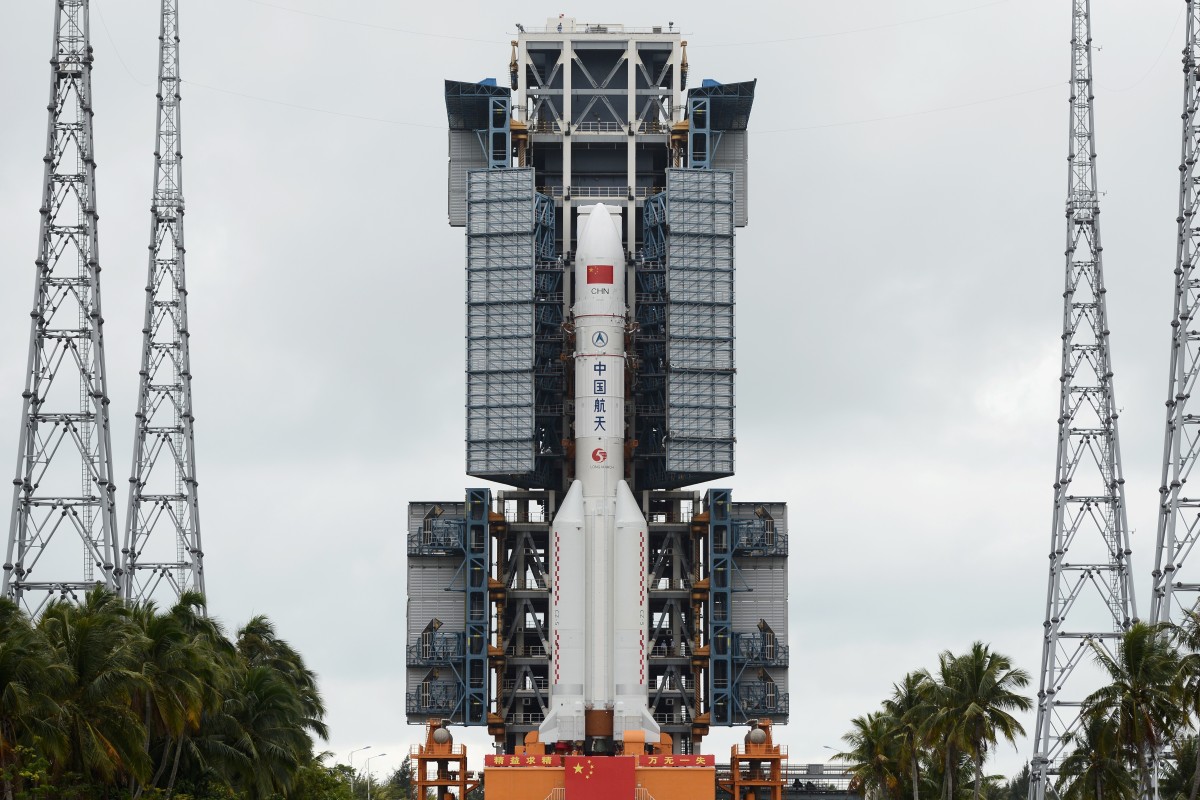
China launched a new version of its heavy-lift Long March 5 rocket on Tuesday. Photo: Reuters
China successfully launched a prototype of its next-generation manned spacecraft – without astronauts – along with a new version of its heavy-lift Long March 5 rocket on Tuesday, its space agency said.
The Long March 5B rocket was launched into low-Earth orbit from the Wenchang Satellite Launch Centre on Hainan Island in the country’s south.
The launch marks a significant step forward for China’s two big space exploration ambitions – building a space station and a mission to Mars.
A modified version of China’s most powerful rocket, the Long March 5B is 53.7 metres (176 feet) tall. It will carry the next-generation crew capsule prototype designed to replace the Shenzhou spacecraft, to transport astronauts to its planned space station in low-Earth orbit.
China aims to launch the core module of that space station designed for three crew members, the Tianhe, in 2021. Beijing has been planning to build its own space station for decades as an alternative to the International Space Station, from which China has been excluded by the United States over security concerns.
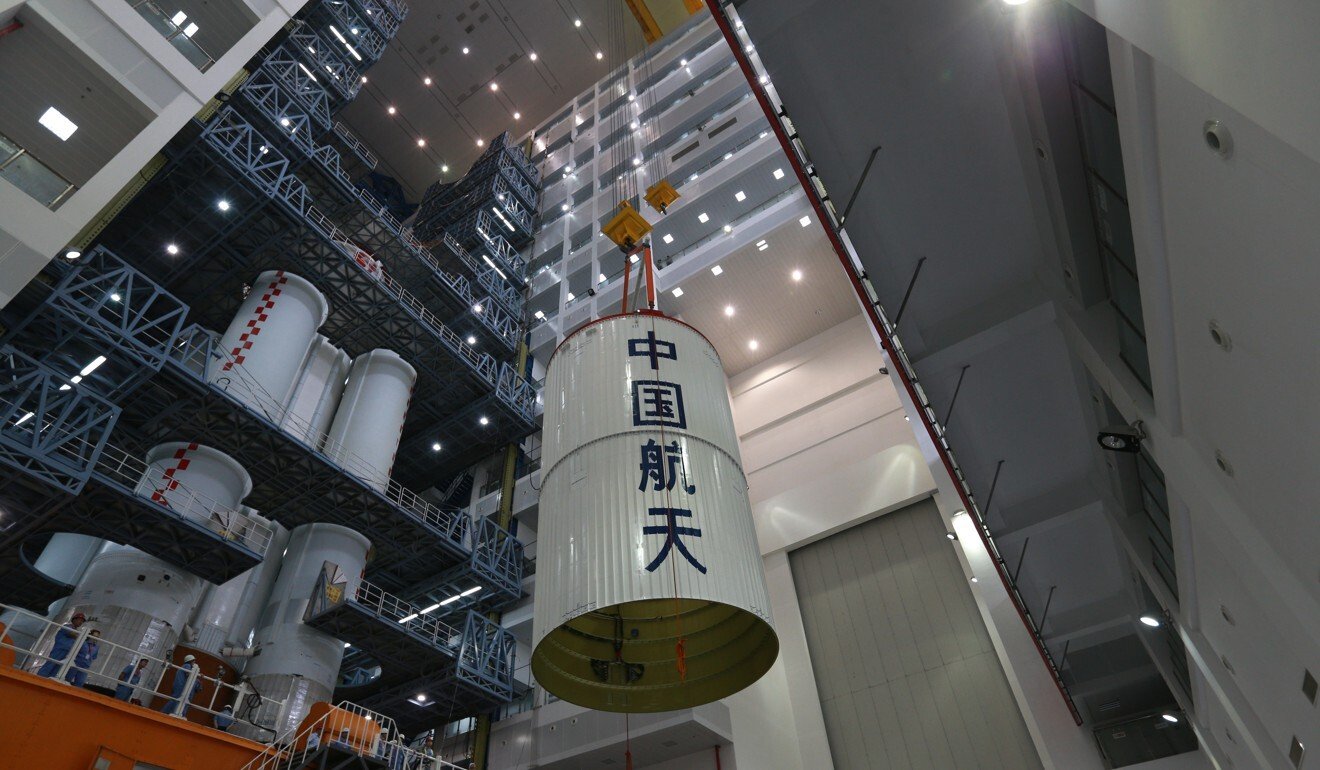
China’s space station project has been delayed by problems with its heavy-lift rockets. Photo: Xinhua
The prototype capsule has a different configuration to Shenzhou’s and it will be able to launch and land with three astronauts on board as well as up to 500kg of cargo, according to state news agency Xinhua. That will mean it can be used to transport research specimens and hardware from the space station back to Earth.
While the Shenzhou can ferry three astronauts, the new capsule design will be able to accommodate up to six crew members and, unlike the Shenzhou, it will be capable of carrying them to the moon, according to Chinese media reports.
Its systems, performance in orbit and parachute deployment are among the areas that will be put to the test during the launch.
Why China’s next Long March 5 rocket mission will be about restoring national pride
14 Dec 2019
The long-anticipated space station project has been delayed by problems in the development of heavy-lift rockets to carry the modules. In 2017, an oxygen supply problem caused the failure of the second Long March 5 launch, and it
plunged into the Pacific Ocean shortly after take-off. But in December it successfully
carried a Shijian-20 satellite into orbit, while the liquid oxygen-liquid hydrogen engines used in both the Long March 5 and 5B rockets passed testing in January.
China’s other space ambitions include a Mars probe, and landing astronauts on the moon within the next decade. For the Mars mission, the unmanned orbiter and rover Tianwen-1 will be launched by the Long March 5 and it is expected to take up to seven months for the probe to reach the red planet. China would be the third country to do so – after the United States and the Soviet Union.
Zhang Kejian, head of the China National Space Administration, said China was on track to launch the mission this year, with July the likely launch date.
Source: SCMP
Posted in 2021, ambitions, astronauts, Beijing, cargo, China, China National Space Administration, country’s south, crew members, December, delayed, designed, Earth, Excluded, Hainan, hardware, heavy-lift rockets, International Space Station, island, July, launches, liquid oxygen-liquid hydrogen engines, Long March 5B rocket, Low Earth orbit, manned, Mars probe, mission to Mars, Moon, national pride, next-generation capsule, orbit, oxygen supply, Pacific Ocean, parachute, planned, problems, prototype, research specimens, restoring, rover, security concerns, Shenzhou spacecraft, Shijian-20 satellite, Soviet Union, Space exploration, space station, space station project, spacecraft, third country, Three, Tianhe, Tianwen-1, Transport, Tuesday, Uncategorized, United States, Wenchang Satellite Launch Centre |
Leave a Comment »
17/04/2020
BEIJING, April 17 (Xinhua) — The lander and rover of the Chang’e-4 probe have resumed work for the 17th lunar day on the far side of the moon after “sleeping” during the extremely cold night.
The lander woke up at 1:24 p.m. Friday (Beijing time), and the rover awoke at 8:57 p.m. Thursday. Both are in normal working order, according to the Lunar Exploration and Space Program Center of the China National Space Administration.
The Chang’e-4 probe, launched on Dec. 8, 2018, made the first-ever soft landing on the Von Karman Crater in the South Pole-Aitken Basin on the far side of the moon on Jan. 3, 2019.
A lunar day equals 14 days on Earth, and a lunar night is the same length. The Chang’e-4 probe, switching to dormant mode during the lunar night due to the lack of solar power, has survived about 470 Earth days on the moon.
The rover Yutu-2, or Jade Rabbit-2, has worked much longer than its three-month design life, becoming the longest-working lunar rover on the moon.
Carrying scientific instruments such as panoramic camera, lunar penetrating radar, infrared imaging spectrometer and neutral atom detector, the rover will continue to move northwest to conduct scientific detection.
The scientific tasks of the Chang’e-4 mission include conducting low-frequency radio astronomical observation, surveying the terrain and landforms, detecting the mineral composition and shallow lunar surface structure and measuring neutron radiation and neutral atoms.
The Chang’e-4 mission embodies China’s hope to combine wisdom in space exploration with four payloads developed by the Netherlands, Germany, Sweden and Saudi Arabia.
Source: Xinhua
Posted in "sleeping", 14 days, 17th, 2018, 2019, 8, Beijing, Carrying, Chang'e-4, Chang'e-4 probe, China National Space Administration, China's, combine, conduct, conducting, day, Dec., detecting, developed, dormant mode, Earth, equals, extremely cold night, far side on the moon, first-ever, four, Friday, Germany, infrared imaging spectrometer, Jan. 3, lack of, lander, lander and rover, launched, longest-working, low-frequency radio astronomical observation, lunar, lunar day, Lunar Exploration and Space Program Center, lunar night, lunar penetrating radar, measuring, mineral composition, mission, neutral atom detector, neutral atoms, neutron radiation, normal working order, northwest, panoramic camera, payloads, probe, resumes, rover, Saudi Arabia, scientific detection, scientific instruments, scientific tasks, shallow lunar surface structure, solar power, South Pole-Aitken Basin, Space exploration, surveying, Sweden, terrain and landforms, the Netherlands, Thursday, Uncategorized, Von Karman Crater, wisdom, work |
Leave a Comment »
17/06/2019
- China has become the first nation to fully own and operate a floating launch platform for its space missions
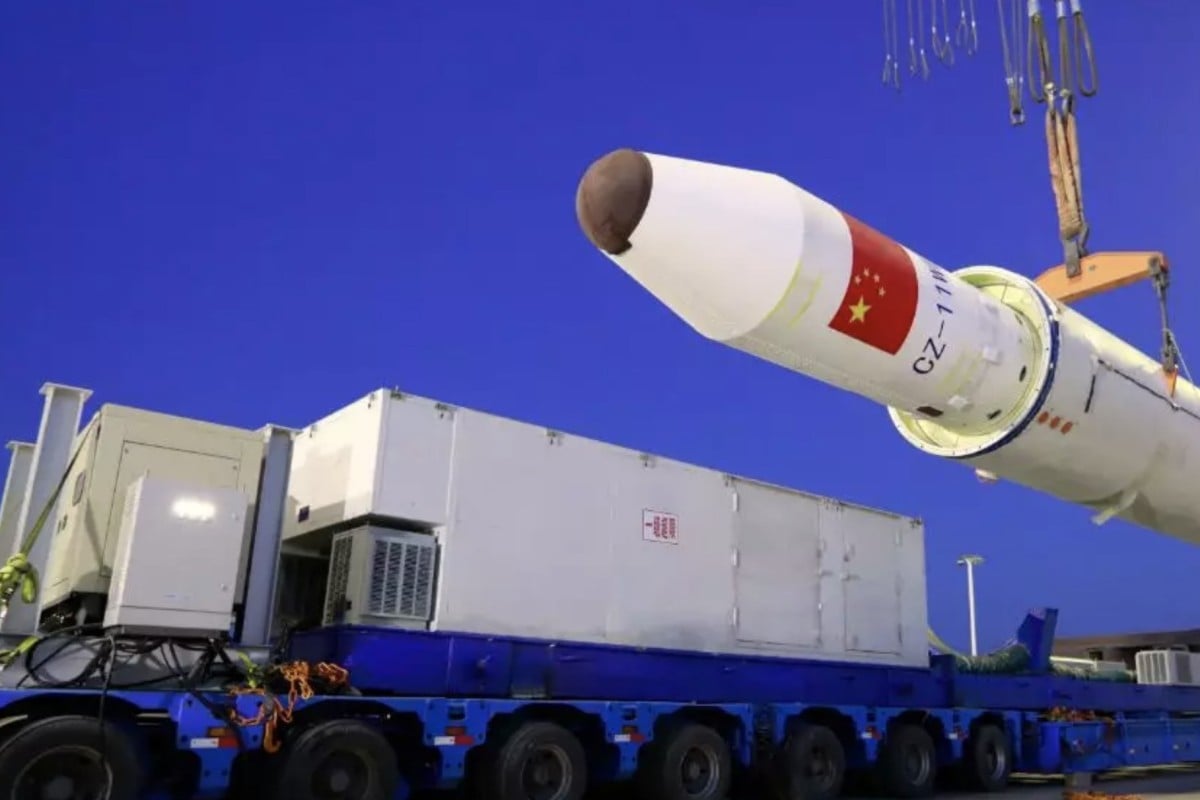
China has successfully launched a rocket into space from the Yellow Sea, making it the first nation to fully own and operate a floating sea launch platform. Photo: China National Space Administration
China successfully launched a rocket into space from a civilian cargo ship at sea on Wednesday, becoming the first nation to fully own and operate a floating sea launch platform, a technology expected to significantly reduce the cost and risk of space missions.
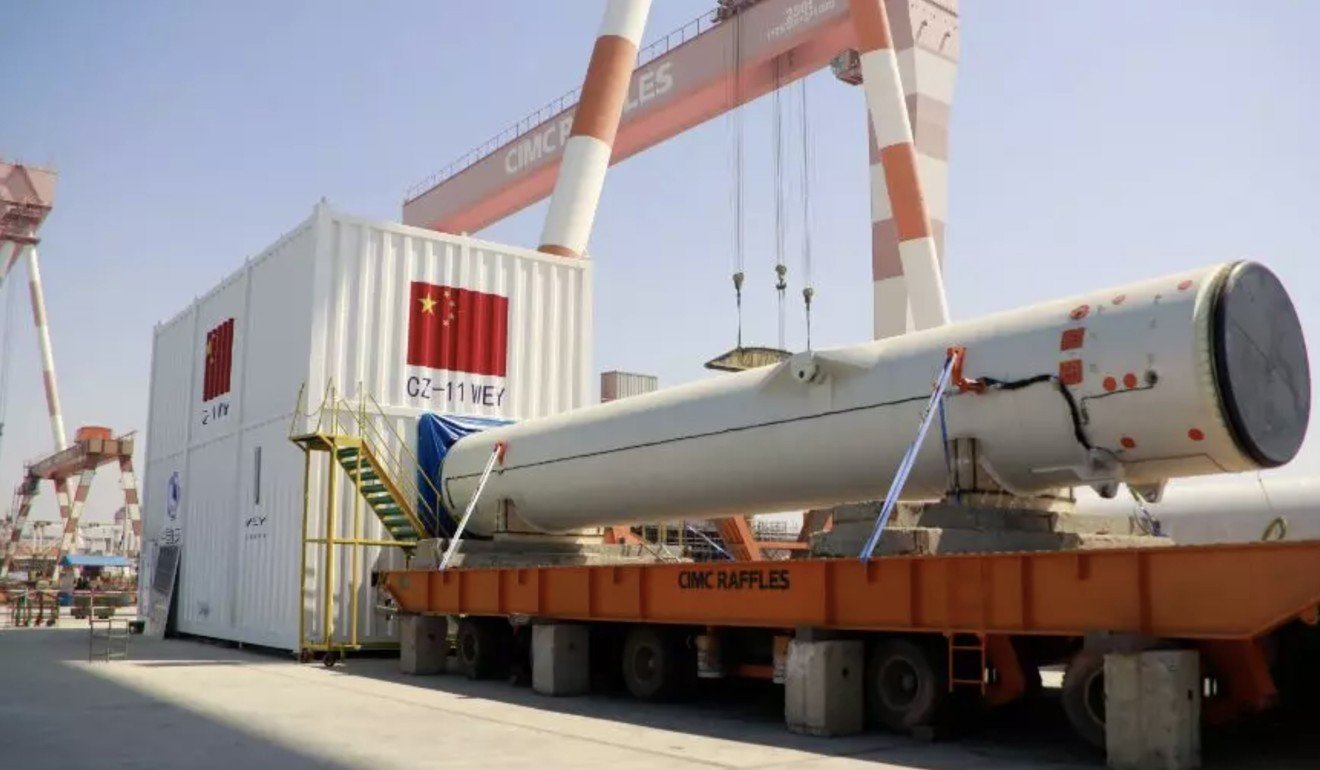
A Long March 11WEY rocket blasted off from the ship in the Yellow Sea at noon Beijing time, according to the China National Space Administration.
About six minutes later, five commercial satellites and a pair of “technical experiment” probes – called Bufeng, or Wind Catchers – reached their designated orbits.
The Wind Catchers will work together to detect winds on the surface of the world’s oceans. They will boost China’s ability to monitor and forecast typhoons and other extreme weather events, according to the administration.
“Launching a rocket from the sea has the advantages of high flexibility, good adaptability for specific tasks, and excellent launch economy,” said a statement on the administration’s website.
“It can flexibly select the launch point and touchdown area to meet the needs of various payloads for different orbits, and provide better aerospace commercial launch services for countries along the belt and road,” it added, referring to the Belt and Road Initiative, China’s plan to grow global trade.
The Long March 11 is a four-stage, solid fuel rocket with a design similar to a ballistic missile. It can carry a payload of about 700kg to the Earth’s lower orbit.
The first two stages of the rocket dropped in open waters in the northern Pacific Ocean, according to the administration. The rocket was equipped with a flight suspension system in case of any abnormal situation, but none occurred.
“The rocket debris will not cause damage to surrounding waters,” the administration said.
The world’s first ocean rocket launch platform, the Sea Launch, was jointly built by companies from Russia, the United States, Norway and Ukraine in the late 1990s. Its operation was halted in 2014 after military conflicts broke out between Russia and Ukraine.
Li Hong, president of the China Academy of Launch Vehicle Technology, told state media in March that the Chinese rocket and launch platform were designed and owned entirely by China, so it would not have similar problems caused by international disputes as the Sea Launch.
The launch was expected to encounter many technical and engineering challenges, including simplified procedures for pre-launch testing, the rocking motion of the ship and heat dissipation in a confined space.
But Chinese space authorities have argued the inconvenience would be offset by numerous advantages. For instance, the technology would allow China to move its launch site to as far away as Hawaii for quicker, cheaper satellite insertion to certain orbits, according to Xinhua.
Preparations get under way for Wednesday’s successful Chinese space launch from the northern Pacific ocean. Photo: China National Space Administration
A maritime launch is also expected to reduce the risk of rocket debris falling into densely populated areas.
Chinese space launch sites are typically located inland for defence purposes.
China has built its sea launch capability mainly to bolster the commercial space sector, according to Chinese space authorities.
In this mission, the rocket was sponsored and named after WEY, a young luxury car brand by Chinese sports utility vehicle manufacturer Great Wall Motor.
Chang’e 4 landing marks start of new China-US space race
Some cutting-edge car technology, such as new paint materials, will go into space for testing in the most extreme environments, according to state media reports.
The payloads include the Jilin 03A, the latest addition to a high-definition Earth observation satellite network, according to Changguang Satellite Technology Corporation, the satellite’s owner.
The company said the constellation, which will eventually comprise more than 20 satellites, would achieve global coverage for commercial applications.
One of the satellites launched on Wednesday belongs to Shanghai-based LinkSure Network, which has ambitious plans to provide free Wi-fi to everyone on the planet. The company has said it plans to eventually launch more than 200 satellites as part of the project.
Source: SCMP
Posted in Bufeng, Changguang Satellite Technology Corporation, China Academy of Launch Vehicle Technology, China alert, China National Space Administration, civilian cargo ship, floating launch platform, free Wi-fi, global space race, Great Wall Moto, Great Wall Motor, Hawaii, Jilin 03A, Long March 11WEY rocket, monitor and forecast typhoons, Norway, Pacific Ocean, Planet, rockets to forefront, Russia, sea launch, Shanghai-based LinkSure Network, success, Ukraine, Uncategorized, United States, Wind Catchers, Yellow Sea |
Leave a Comment »




 CHINDIA ALERT: You'll be living in their world, very soon