Archive for ‘Chindia Alert’

29/12/2019

China ends forced labour for sex workers

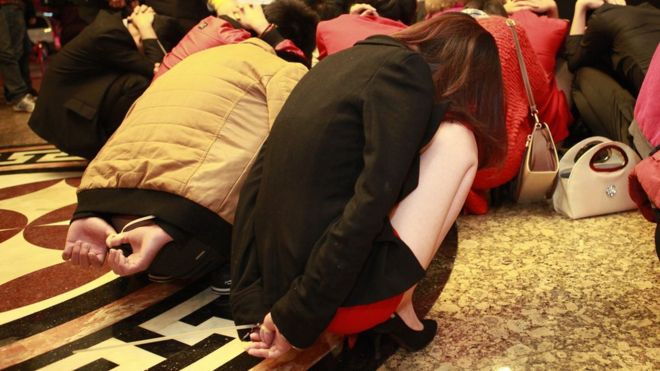
Sex workers and clients are rounded up in DongguanImage copyright AFP
Image caption Past detainees claim they were forced to work making toys and household goods

China is to end a punishment system for prostitution that allowed police to hold sex workers and their clients in custody for up to two years at so-called education centres.

Detainees were forced to work, allegedly making toys and household goods.

The detention system will come to an end on 29 December. Those still in custody will be released, according to Xinhua, China’s state media.

Prostitution remains illegal in China.

It carries punishments of up to 15 days in detention and fines of up to 5,000 yuan (£546).

China’s state media claims the “custody and education” system has helped to maintain a “good social atmosphere and public order” since it was introduced more than 20 years ago.

It added that over time, the system has become less and less appropriate.

A study by NGO Asia Catalyst in 2013 questioned whether this scheme was effective.

The report included interviews with 30 female sex workers from two cities.

It claimed detainees were unable to learn new skills during detention that could help them after their release. The report added that the detainees typically undertake manual labour.

It said: “All of the sex workers we interviewed returned to the sex trade immediately after release.”

A 2013 report by Human Rights Watch interviewed 140 sex workers, clients, police and specialists and found that many sex workers were beaten by police in an attempt to coerce confessions.

One worker claimed she had been deceived into signing a confession.

“The police told me it was fine, all I needed to do was sign my name and they would release me after four or five days,” she said.

“Instead, I was locked up in [a] Custody and Education centre for six months.”

Shen Tingting, director of Asia Catalyst, said the move to abolish forced labour detention centres is positive but only a small step towards safeguarding the rights of sex workers.

“Chinese law and policies focus on prohibition and cracking down on sex work, rather than providing a framework to ensure the health and safety of sex work as a profession,” she said.

In 2013, China announced it had abolished its system of “re-education through labour camps” for petty criminals.

That decision came after several high-profile miscarriages of justice, including a case where a mother was sent to a labour camp after demanding justice for her daughter who had been raped.

However, the abolition did not extend to the “custody and education” system affecting sex workers and their clients.

China isn’t totally abandoning the idea of re-education. Authorities in the country claim a number of camps in the north-west region of Xinjiang are voluntary education camps that help to combat extremism.

However rights groups claim many Chinese Uighur people have been rounded up into the camps and made to criticise or denounce their faith.

Source: The BBC

28/12/2019

China, Senegal continue to deepen comprehensive strategic cooperative partnership in 2019

DAKAR, Dec. 27 (Xinhua) — China has continued to be a key partner for Senegal in 2019, supporting its implementation of the Plan for an Emerging Senegal, proposed by Senegalese president Macky Sall.

Fourteen years after the resumption of diplomatic relations between Beijing and Dakar, China occupies an essential place in Senegal’s political and trade relationships.

At the beginning of the year, during a visit of Chinese State Councilor and Foreign Minister Wang Yi, Senegalese president Sall said the Senegal-China relationship is dynamic, practical and effective, hailing it as a model. He said the Senegalese side hopes to further deepen cooperation with China in various fields.

According to the Chinese Embassy in Senegal, trade between the two partners, at 2.27 billion U.S. dollars in 2018, accelerated in 2019, and China has become one of the most popular destinations among Senegalese businesspeople.

The year 2019 was marked also by numerous visits by Chinese businessmen to study the Senegalese market for potential investments opportunities. The return of Chinese traders in the marketing campaign of peanuts has been hailed by many agricultural stakeholders.

Also in 2019, the inauguration of the Chinese-built Diamniadio Industrial Park, about 30 km from Dakar, won positive response from Senegalese authorities.

In terms of infrastructure, cooperation continued in a good momentum after the opening of the Museum of Black Civilizations, the Thies-Touba, Dakar-Mbour and Dakar-Thies highways, the Grand Theater in Dakar, and the Children Hospital in Diamniadio.

Chinese expertise has won acclaim in Senegal in the construction of the first Bus Rapid Transit (BRT) serving the Senegalese capital and its suburbs. China Road and Bridge Corporation (CRBC) won the international tender for the project mostly funded by the World Bank.

Senegal also counts on China for the construction of sports facilities for the organization of the Youth Olympic Games in 2022. China built Senegal’s largest stadium, Leopold Sedar Senghor Stadium, in the 1980s, and three other regional stadiums will be rehabilitated.

In the political field, Senegal is now co-chair of the Forum on China-Africa Cooperation (FOCAC). China and Senegal have worked closely to push forward their comprehensive strategic cooperative partnership, setting a good example of high-quality and sustainable cooperation.

Throughout the year, the two sides have had in-depth exchanges on bilateral ties and other issues of common interest.

Senegalese President Macky Sall reiterated, during the last visit to Senegal by Yang Jiechi, member of the Political Bureau of the Central Committee of the Communist Party of China (CPC), Senegal firmly supports and actively participates in the Belt and Road Initiative, which was launched in 2013 by his Chinese counterpart, Xi Jinping.

On several occasions, the Senegalese authorities have welcomed the support of China for the realization of development projects in the Plan for an Emerging Senegal.

Senegal and China also increased cultural exchanges in 2019. In November, Dakar hosted an international seminar on China-Africa Cooperation and the joint construction of the Belt and Road Initiative. The event was organized by the Chinese Academy of Social Sciences and the National School of Administration of Senegal.

Senegalese Minister of Infrastructure Oumar Youm said the Belt and Road Initiative meets the real needs of China and African countries.

The initiative reflects the “sincere and firm commitment of both parties to building together a common destiny even stronger and more prosperous,” he said.

In 2019, the Chinese Embassy in Senegal granted scholarships to 48 Senegalese students for them to continue their studies in China in various fields.

Local Confucius Institute students competed in the Senegal country final of the 18th edition of the worldwide “Chinese Bridge” contest.

To mark the 70th anniversary of the People’s Republic of China, Hangzhou Art Troupe performed at the Grand Theater in Dakar to showcase Chinese culture.

In the Museum of Black Civilizations, Shanghai University presented an exhibition, “The emergence of the Chinese countryside through development,” to tell the story of China’s development.

For Birane Niang, secretary general of the Senegalese Ministry of Culture and Communication, “cultural dialogue has this ability to bring people together and strengthen their friendship and mutual respect of their differences.”

China and Senegal have also continued to strengthen cooperation in the field of public health. This year, the 17th Chinese medical team, composed of 13 health professionals, treated 76,489 patients, including nearly 200 critically ill ones, performing 5,000 operations, in Senegal.

A further deepening of relations between China and Senegal is expected in 2020.

Source: Xinhua

28/12/2019

China offers new pre-election inducement to Taiwan with revised law

BEIJING (Reuters) – China’s largely rubber stamp parliament revised a law on Saturday to simplify investment procedures for Taiwan companies, in another attempt by Beijing to show goodwill to the Chinese-claimed island ahead of elections there on Jan. 11.

China, with its 1.3 billion people, is Taiwan’s favourite investment destination with Taiwan companies investing more than $100 billion there since China began landmark economic reforms in the late 1970s, drawn by a common culture and low costs.

China has extended what it views as olive branches to Taiwan in the run-up to the election, including opening further sectors to Taiwanese investors, with the ultimate goal of enticing the island to accept Beijing’s control.

Taiwan’s government has warned against falling for China’s inducements and has called on China instead to grant its own people democracy and freedom of speech. China has never renounced the use of force to bring Taiwan under its control.

The revised law removes several layers of bureaucracy to simplify procedures for investment from Taiwan, with the aim of encouraging more of it.

Chinese commerce ministry official Jiang Chenghua told reporters the central government “paid great attention” to protecting and encouraging Taiwan investment and it had support from the highest levels, including President Xi Jinping.
“Although the revised clauses are not many, they are of great significance and are conducive to optimising the investment environment for Taiwan compatriots in the mainland and to further expand economic and trade exchanges and cooperation between the two sides,” Jiang added.
The revision is designed to dovetail with a new foreign investor law which comes into force on Jan. 1. Chinese Commerce Minister Zhong Shan said this week he wanted “our Taiwan compatriots to share the benefit of this great change”.
Taiwan says China has been stepping up its efforts to sway electors and is planning an anti-infiltration law to counter Chinese influence efforts, which could pass next week.
Next month’s elections pit President Tsai Ing-wen of the pro-independence Democratic Progressive Party against Han Kuo-yu of the main opposition party the Kuomintang, which favours close ties with China.

China is Taiwan’s top trading partner, with trade totalling $226 billion in 2018. Taiwan runs a large trade surplus with China.

Taiwan has been trying to wean itself off its reliance on China and to encourage Taiwan companies to come back home or to shift their investments to other parts of the world, notably Southeast Asia.

Taiwan’s economy has benefited from its firms moving manufacturing back to the island to escape higher tariffs from the China-U.S. trade war, though the dispute has also caused some disruption for Taiwan’s economy.

Source: Reuters

27/12/2019

China launches heaviest satellite to test key technologies

CHINA-HAINAN-LONG MARCH-5-LAUNCH (CN)


Long March-5 Y3 blasts off from Wenchang Space Launch Center in south China’s Hainan Province, Dec. 27, 2019. The rocket, coded as Long March-5 Y3, blasted off from the coastal launch center at 8:45 p.m. (Beijing time), carrying the Shijian-20 technological experiment satellite weighing over eight tonnes, the heaviest and most advanced communications satellite of the country. About 2,220 seconds later, the satellite was sent into its planned orbit. (Xinhua/Yang Guanyu)

by Xinhua writers Quan Xiaoshu, Yu Fei

WENCHANG, Hainan, Dec. 27 (Xinhua) — Aboard the third Long March-5 rocket, China’s largest carrier rocket, Shijian-20, a new technology test and verification satellite, successfully entered its orbit Friday night.

The rocket, coded as Long March-5 Y3, blasted off from the Wenchang Space Launch Center in south China’s Hainan Province at 8:45 p.m. (Beijing time).

Shijian-20, weighing more than eight tonnes, is the country’s heaviest and most advanced communications satellite in geosynchronous orbit, according to its maker, the China Academy of Space Technology (CAST) under the China Aerospace Science and Technology Corporation (CASC).

It will carry out orbit experiments for a series of key technologies, the CAST said in a press release.

It will demonstrate in orbit its heat transfer technology based on cryogenic loop heat pipes, an efficient thermal control device for space applications, to lay the foundation for the development of highly sensitive space probes.

The satellite will test the controllable deformation of shape memory polymers, a type of smart material that can switch between temporary shapes, to pave the way for the development of large variable space structures.

It will also carry out satellite-ground communication tests using Q/V bands, which lie between 33-75 GHz, within the extremely high frequency (EHF) area of the radio spectrum. These frequencies are used mainly for satellite communications.

“The major way to improve the satellite communication capacity is to expand the bandwidth of available frequency bands. If we liken the geostationary orbit to an expressway, which is now the most crowded in space, the use of Q/V bands will help to widen the expressway by four to five times,” said Li Feng, chief designer of the satellite with the CAST.

The test is key to the development of the next generation of high throughput satellites capable of delivering 1Tbps bandwidth for ultrafast speeds, he said.

Shijian-20 has the largest solar wings among all China’s satellites, with the total wingspan 10 meters wider than that of a Boeing 737 aircraft.

The solar wings will unfold twice, the first time after the satellite enters its orbit and the second after it flies around the orbit for about a week. The increase of the solar wing area will supply the satellite with abundant power.

The satellite adopts a hybrid propulsion system. Chemical propulsion is powerful but inefficient, and is used in rapid orbit change or satellite attitude adjustment to send it to the planned orbit as soon as possible. Electric propulsion is more precise and efficient but less powerful, which is suitable for long-term delicate adjustments in orbit.

Electric propulsion is also a preferred technology for future deep space exploration. Missions to explore Mars, Jupiter and asteroids are all too far away from Earth to be fulfilled by chemical propulsion alone, as it is impossible to bring the amount of fuel needed.

Shijian-20 will also test the adaptability of the DFH-5 satellite platform, which may serve the needs of high-capacity satellites for high orbit communications, microwave remote sensing, optical remote sensing, space scientific exploration, in-orbit service and other purposes in the next 20 years.

“With the government’s consistent support for the communications satellite industry in the past decades, we have developed the DFH-3 and DFH-4 satellite platforms, making China one of the few countries in the world that can independently develop large communications satellites and provide in-orbit commercial services,” said Hao Yanyan, product assurance manager of Shijian-20 with the CAST.

So far, there are more than 20 communications satellites based on the DFH-4 platforms running stably in orbit.

To meet the pressing needs of economic development, the research and development of the DFH-5 platform started in 2010.

According to the design, the takeoff weight of a satellite based on the DFH-5 platform can reach eight to nine tonnes, and its payload capacity 1,500 to 1,800 kg. The power for the whole satellite is more than 28 kilowatts, while the power for its payload above 18 kilowatts.

“According to these technical indicators, a satellite based on the DFH-5 platform in orbit can provide services equivalent to that of two or three satellites on the DFH-4 platform,” Hao said.

The new technologies verified by Shijian-20 will further promote the development of new satellites, especially the high throughput communications satellite and high resolution remote sensing satellite, which is of great significance to the progress of China’s space technology, Li said.

Source: Xinhua

27/12/2019

China-Bangladeshi joint venture constructs mega expressway bypassing Dhaka

DHAKA, Dec. 27 (Xinhua) — A Chinese and Bangladeshi joint venture has started construction of a mega expressway bypassing Dhaka.

Sichuan Road and Bridge (group) Co., Ltd won the deal jointly with local Unique Dream Consultant and Shamim Enterprise Limited to construct the 48-km Dhaka Bypass Expressway.

A total of 40 billion taka will be spent for construction of the expressway within the next three years. The expressway will pave the way for vehicles to drive at a speed of 120 kmph.

The construction of the four-lane expressway which is expected to be completed by 2022.

Bangladeshi Road Transport and Bridges Minister Obaidul Quader on Thursday opened the groundbreaking work of the project at Purbachal on the outskirts of Dhaka under the country’s first major public private partnership (PPP) initiative.

Also on Thursday night, a project commencement ceremony was held in Dhaka with participation of senior officials and dignitaries from various sectors.

The expressway, connecting Joydevpur, Debugram, Vulta and Modonpur, will establish an easy link for the industrial belts around Dhaka with the seaport city Chattogram and northeastern Sylhet region bypassing the capital city.

In his speech at the groundbreaking ceremony, Chinese Ambassador to Bangladesh Li Jiming said the Dhaka bypass project will greatly improve the city’s transportation network, ease congestion problems, reduce logistics costs, and bring huge economic and social benefits.

Facility connectivity is the main focus of the China-proposed Belt and Road Initiative, and infrastructure is the key area of cooperation between China and Bangladesh, he said.

In addition to the bypass project, the ambassador said Chinese enterprises have engaged in investment and projects regarding road and bridge, tunnel and other sectors as well, such as the Padma Bridge, the Mujibur Rahman Tunnel under the Karnaphuli River, Payra 1,320-MW thermal power Plant.

“At present, these projects are progressing smoothly. I hope that the Chinese enterprises involved in these projects will make full use of China’s advantages in terms of capital, technology and management, and combine those with Bangladesh’s advantages in human resources, to achieve complementary effects, and smoothly carry out project construction operations,” he said.

Source: Xinhua

23/12/2019

China presses for nuclear talks in last days till North Korea’s deadline for US

  • Summit between Chinese, South Korean and Japanese leaders could yield results for future of Korean peninsula, analyst says
North Korea has promised an unwelcome “Christmas present” if the US does not show the “right attitude” for talks. Photo: KCNA
Chinese President Xi Jinping has again stressed the need for tensions on the Korean peninsula to be resolved through dialogue, as the deadline looms in North Korea’s threat to give the United States an unwelcome “Christmas gift”
.

With just over a week to go until Pyongyang’s year-end deadline for Washington to change what it says a policy of hostility, Xi held separate talks with South Korean President Moon Jae-in and Japanese Prime Minister Shinzo Abe in Beijing on Monday.

Moon and Abe will also join Chinese Premier Li Keqiang for a trilateral summit in Chengdu, Sichuan province, on Tuesday.

The first trilateral leadership talks took place in 2008, but were not held in 2013 and 2014, or in 2016 and 2017.

Xi said China and South Korea “both insist on maintaining peace and stability on the peninsula, and advocate solving problems through dialogue and consultation”, state news agency Xinhua reported on Monday.
“China supports South Korea in continuing to improve its relationship with

North Korea,

and injecting impetus for the Korean peninsula peace talks,” the report said.

Moon said the suspension of talks between the US and North Korea and heightened tensions along the peninsula “are not beneficial to both our countries and North Korea”, according to South Korean news agency Yonhap.

Moon also said that China had played an “important role” in efforts for the denuclearise the peninsula, the report said.

North Korea has signalled impatience over the stalled talks with the US, and the fading hopes for an end to Washington’s economic sanctions.

In April, North Korean leader Kim Jong-un said that he would “wait” until the end of the year to decide whether the US had the “right attitude” to allow a resumption of negotiations, but no signs of further talks have emerged.

Then earlier this month Pyongyang warned that Washington would receive a “Christmas gift”, and US actions would determine whether the present would be good or bad.

In an apparent sign of frustration with the US, North Korean news agency KCNA reported on Sunday that Kim held a meeting of the Workers’ Party of Korea to “bolster the overall armed forces of the country” to deal with the “the fast-changing situation”.

The US imposed crippling sanctions on North Korea’s economy in 2017, though many countries, including China, South Korea and Japan, have also tightened measures against the North.

South Korea and Japan both scaled back people-to-people links in 2016, China banned coal exports to the North in 2017. Earlier this year, Trump thanked China and Russia for maintaining sanctions against Pyongyang.

As diplomats make last-ditch attempts to stop renewed confrontation, US special envoy for North Korea Stephen Biegun shuttled around the region last week, meeting senior officials in China, South Korea and Japan. Biegun urged North Korea to return to negotiations, and said the US “does not have a deadline” for talks.

China and Russia also proposed last week that the United Nations Security Council 

lift some sanctions

, saying it was necessary to break the deadlock.

Xi’s meeting with Moon also comes as Beijing tries to mend ties with Seoul to prevent neighbouring nations from getting closer to Washington.
Relations between China and South Korea deteriorated in 2017 after Seoul deployed a US-led missile defence system known as THAAD, which Beijing deemed as a security threat to its own territory.
On Monday, both Xi and Moon said in their meeting that they looked forward to improving relations between their countries.
“We have been friends and partners that have continued close cooperation,” Xi said. “We have a wide range of common understandings in various fields, including on further developing bilateral relations, facilitating regional peace, stability and prosperity, and defending multilateralism and a free trade system.”
Sun Xingjie, a North Korea specialist at Jilin University, said the US signal was “very clear” in Beigun’s comments.
“They still want to continue discussions,” he said.
Sun also said the talks in Chengdu on Tuesday would likely play an important role in the future of resolving problems on the Korean peninsula.
“After returning to the platform these last couple years, I believe this will become an important, normalised place for discussions. Whatever problems they run into, the platform should continue to move forward,” Sun said.
Source: SCMP
23/12/2019

Tesco Christmas card factory in China denies ‘forced labour’

The card opened by Florence Widdicombe
Image caption The pack of cards cost £1.50 from Tesco

A factory in China has denied it used forced labour after a six-year-old girl found a message from workers inside a Tesco charity Christmas card.

The card supplier, Zhejiang Yunguang Printing, told China’s Global Times it had “never done such a thing”.

Tesco halted production at the factory on Sunday over the message, allegedly written by prisoners claiming they were “forced to work against our will”.

The Chinese foreign ministry said the allegation was “a farce”.

Speaking to the nationalist newspaper Global Times on Monday, a spokesman for the card supplier said: “We only became aware of this when some foreign media contacted us. We have never done such a thing.

“Why did they include our company’s name?”

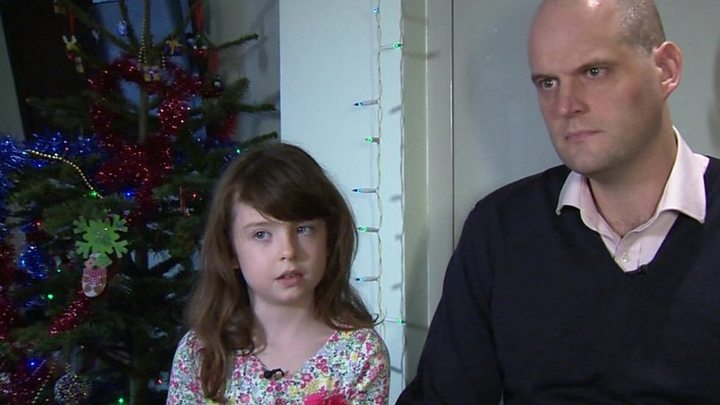
The message – first reported by the Sunday Times – was found by Florence Widdicombe, who was writing cards to her school friends. She found that one of them – featuring a kitten with a Santa hat – had already been written in.

In block capitals, it said: “We are foreign prisoners in Shanghai Qingpu prison China. Forced to work against our will. Please help us and notify human rights organisation.”

The message in the card asked whoever found the message to contact Peter Humphrey, a British journalist who was himself imprisoned there four years ago.

Chinese foreign ministry spokesman Geng Shuang told reporters on Monday the allegation was “a farce” created by Mr Humphrey.

“Shanghai’s Qingpu prison has no such foreign prisoners undergoing forced labour,” Mr Shuang said.

Zhejiang Yunguang Printing’s factory manager, Shu Yunjia, told the BBC it had not outsourced any of its work to the Qingpu prison.

Media caption Florence Widdicombe was writing the cards last Sunday when she discovered the message

Florence, from Tooting in south London, said she was writing her “sixth or eighth card” when she saw “somebody had already written in it”.

“It made me feel shocked,” she said, adding that when it was explained to her what the message meant she felt “sad”.

Tesco added that it would de-list Zhejiang Yunguang if it was found to have used prison labour.

A Tesco spokeswoman said: “We were shocked by these allegations and immediately halted production at the factory where these cards are produced and launched an investigation.”

The supermarket said it has a “comprehensive auditing system” to ensure suppliers are not exploiting forced labour.

The factory in question was checked only last month and no evidence of it breaking the ban on prison labour was found, it said.

Sales of charity Christmas cards at the company’s supermarkets raise £300,000 a year for the British Heart Foundation, Cancer Research UK and Diabetes UK.

Tesco has not received any other complaints from customers about messages inside Christmas cards.

‘Very bleak life’

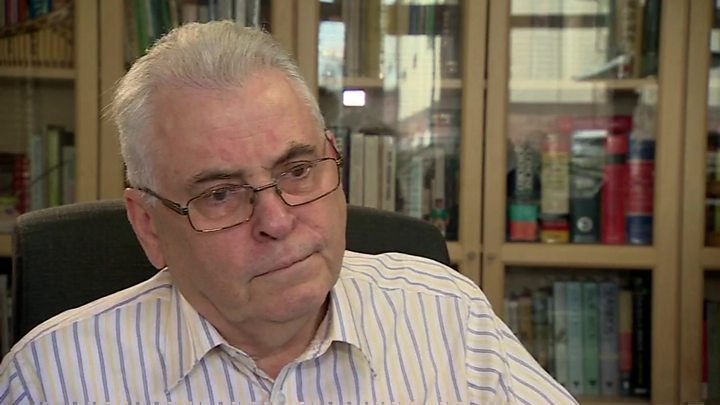
The message in the card urged the recipient to contact Peter Humphrey, who was formerly imprisoned at Qingpu on what he described as “bogus charges that were never heard in court”.

After the Widdicombe family sent him a message via Linkedin, Mr Humphrey said he then contacted ex-prisoners who confirmed inmates had been forced to work.

Media caption Peter Humphrey: “I think I know who it was but I will never disclose the name”

Mr Humphrey told the BBC that the cell block of foreign prisoners has about 250 people in it, who are living a “very bleak daily life” with 12 prisoners per cell.

He added that when he was in there, manufacturing labour work was voluntary – to earn money to buy soap or toothpaste – but that work has now become compulsory.

Mr Humphrey told the BBC: “I spent two years in captivity in Shanghai between 2013 and 2015 and my final nine months of captivity was in this very prison in this very cell block where this message has come from.

“So this was written by some of my cellmates from that period who are still there serving sentences.

“I’m pretty sure this was written as a collective message. Obviously one single hand produced this capital letters’ handwriting and I think I know who it was, but I will never disclose that name.”

It is not the first time that prisoners in China have reportedly smuggled out messages in products they have been forced to make for Western markets.

In 2012, Julie Keith from Portland, Oregon, discovered an account of torture and persecution by a prisoner who said he was forced to manufacture the Halloween decorations she had purchased.

And in 2014, Karen Wisinska from Co Fermanagh in Northern Ireland, found a note on a pair of Primark trousers reading: “Our job inside the prison is to produce fashion clothes for export. We work 15 hours per day and the food we eat wouldn’t even be given to dogs or pigs.”

Under the UN’s guidance for human rights and prisons, prisoners “should not be subordinated merely to making a profit either for the prison authorities or for a private contractor”.

The standard minimum rules for the treatment of prisoners state: “Prison labour must not be of an afflictive nature.”


Source: The BBC

22/12/2019

Economic Watch: Smart economy fledging in China as AI empowers industries, individuals

BEIJING, Dec. 21 (Xinhua) — Ask the silver-haired residents of the elderly care community Yinheyuan in central Beijing what they know about artificial intelligence (AI), and they will probably throw the question to the smart speakers within their reach.

These smart speakers, capable of interacting with users with voice-recognition technologies, are also part of the answer. Via voice command, senior residents can control lights, TVs and other home appliances, order food or ask for help.

AI is no longer a technical term used exclusively by professionals in China. Both young and old are enjoying the benefits of the growing smart economy.

After personal computers (PC), PC internet and mobile internet, the growth focus of China’s digital economy is shifting to smart technologies like AI, said Baidu Chairman and CEO Robin Li at the World Internet Conference in October.

In the smart economy era, Li predicted a declining reliance on cellphones and a rising popularity of other smart devices. AI chips, cloud computing services, among others, would become the new digital infrastructure, while innovative businesses will flourish as transport, health, education and other sectors go smart.

Wearable devices, smart home appliances, autonomous driving and smart cities are among the fastest-growing fields in the smart economy.

China is the largest smart speaker market in the world, accounting for 36 percent of global shipments in the third quarter of 2019, according to global market firm Strategy Analytics. It found in a July and August survey that 63 percent of Chinese people without a smart speaker planned to buy one within the following year. Another 22 percent planned to make a purchase later on.

Chinese firms are stepping up investment in 5G, AI and the Internet of Things to gain a foothold in the emerging field. By end-June, China had over 1,200 AI-related enterprises, according to the Ministry of Industry and Information Technology.

Baidu launched its autonomous driving open platform ApollBo in 2017 to coordinate cross-sector efforts in this field. It has launched several L4 autonomous driving vehicles in partnership with leading automobile companies, and a fleet of Apollo-powered robotaxis are now taking test runs in central China’s Changsha.

Nurturing a smart economy is also on the government agenda. China has passed a guideline to boost the integration of AI and the real economy this year, and plans to build some 20 national AI innovative development pilot zones by 2023.

The country’s AI sector is forecast to be worth more than 160 billion yuan (about 22.83 billion U.S. dollars) in 2020, spurring related sectors to exceed 1 trillion yuan, said Lin Nianxiu, deputy director with the National Development and Reform Commission, citing industrial data.

Lin said China would focus on 100 firms dedicated to AI technologies and relevant applications, improve the industrial ecosystem, facilitate the deep integration of AI and the real economy, and intensify its international collaboration on AI technology, standards, industries, laws and regulations and ethics.

Source: Xinhua

22/12/2019

China, India agree to enhance mutual political trust to properly handle border issues

INDIA-NEW DELHI-CHINA-BORDER ISSUES-22ND MEETING

Visiting Chinese special representative, State Councilor and Foreign Minister Wang Yi (L) shakes hands with Indian special representative and National Security Advisor Ajit Doval at the 22nd meeting between Chinese and Indian special representatives on boundary issues in New Delhi, India, Dec. 21, 2019. (Xinhua/Javed Dar)

NEW DELHI, Dec. 21 (Xinhua) — China and India agreed here Saturday to enhance mutual political trust so as to properly handle border issues and jointly safeguard peace and tranquility in the border areas.

At the 22nd meeting between Chinese and Indian special representatives on boundary issues, visiting Chinese special representative, State Councilor and Foreign Minister Wang Yi said the annual meeting serves as a main channel for the two countries to discuss border issues, and it is also an important platform for the two sides to carry out strategic communication.

China and India should positively press forward the talks on border issues in accordance with the important instructions made by the leaders of the two countries, and work out the framework of the negotiation roadmap in a bid to reach a final solution which is fair, reasonable and accepted by both sides, Wang said.

In addition, both sides should also advance consultations which can yield early results, promote mutual trust and enhance cooperation in the border areas so as to jointly safeguard peace and tranquility in the border areas, Wang said.

The two countries should further strengthen communication and coordination, and jointly safeguard multilateralism, fairness and justice, Wang added.

Indian special representative and National Security Advisor Ajit Doval said Chinese and Indian leaders have provided a new vision and strategic guidance for the development of bilateral ties and the solution of boundary issues.

Both sides should comprehensively implement the important consensus reached by the two leaders, strengthen strategic communication, enhance political mutual trust, deepen mutually beneficial cooperation, solve the China-India boundary issues at an early date through dialogue and negotiation, so as to promote India-China relationship to gain further development.

The two sides exchanged views on the early harvest of boundary negotiations, reached consensus on strengthening trust measures, and agreed to make regulations on safeguarding peace and tranquility in border areas, enhance communication and exchanges between the border troops of the two countries, as well as expand border trade and personnel exchanges.

The two sides also agreed to hold the 23nd Special Representatives’ Meeting on the China-India Boundary Question next year in China.

Source: Xinhua

22/12/2019

North Korea threat looms as China, Japan, South Korea leaders meet

BEIJING (Reuters) – The spectre of new confrontation between Pyongyang and Washington hangs over meetings between China, Japan and South Korea this week, with growing risks North Korean actions could end an uneasy detente and upend recent diplomatic efforts.

South Korean President Moon Jae-in and Japanese Prime Minister Shinzo Abe are expected to meet Chinese President Xi Jinping separately on Monday. They will then travel to the southwestern city of Chengdu for a trilateral meeting with Chinese Premier Li Keqiang. Though they are expected to discuss various economic matters, North Korea appears likely to dominate the agenda.

Pyongyang has grown increasingly frustrated that its halt of nuclear and long-range missile tests has not ended the crippling economic sanctions against it. It set a Dec. 31 deadline for the United States to make concessions, but Washington has been unmoved.

Some experts believe North Korea may be readying to test an intercontinental ballistic missile launch soon, which would likely end the 2018 agreement struck by its leader, Kim Jong Un, and U.S. President Donald Trump.

“Safeguarding the stability and peace of the Korean Peninsula and pushing for a political solution to the Korean Peninsula issue are in the interests of China, Japan and South Korea,” Chinese Vice Foreign Minister Luo Zhaohui told reporters on Thursday at a briefing on the trilateral meetings.

U.S. special envoy for North Korea Stephen Biegun met with two senior Chinese diplomats during his two-day visit to Beijing this week, following similar meeting in South Korea and Japan days earlier, as diplomats make last-ditch attempts to prevent new confrontation.

North Korea has not responded to his public call to resume dialogue, however.

“The silence, even after Biegun’s speech in Seoul, makes me concerned,” Jenny Town, managing editor at the North Korea monitoring website 38 North, said on Twitter.

Beijing, jointly with Russia, proposed on Monday that the United Nations Security Council lift some sanctions in what it calls an attempt to break the current deadlock and seeks to build support. But it’s unclear whether Beijing can convince Seoul and Tokyo to break ranks from Washington, which has made its opposition clear and can veto any resolution.

Though South Korea sees China as instrumental in reviving negotiations, it has so far sidestepped questions on whether it supports the new proposal by Beijing and Moscow. Japan, which has historically been a staunch supporter of sanctions against North Korea, has also refrained from commenting on the proposal.

“With the (2020 Tokyo) Olympics coming up, North Korea going wild would pose a problem for Japan,” said Narushige Michishita, professor at Japan’s National Graduate Institute for Policy Studies.

“But bilateral talks with North Korea, for example, will probably be a better approach for Japan than easing UN sanctions.”

Source: Reuters

Law of Unintended Consequences

continuously updated blog about China & India

ChiaHou's Book Reviews

continuously updated blog about China & India

What's wrong with the world; and its economy

continuously updated blog about China & India