Archive for ‘China alert’

01/12/2018

Chinese scientists discover spider species nurses young with milk

BEIJING, Nov. 30 (Xinhua) — Chinese scientists have discovered a species of spiders that can produce milk and care for their young, providing a new take on the understanding of invertebrate animals’ maternal care.

The study, published online Thursday on the U.S. journal Science, was conducted by researchers from the Chinese Academy of Sciences (CAS).

The findings focus on Toxeus Magnus, a species of jumping spider native to southeastern Asia, which lives in nests and looks like ants.

According to the study, spider mothers in their laboratory-based nests were found to feed a milk-like substance to their spiderlings and continue to care for them as they matured.

During the first 20 days, the spider babies were found to first drink droplets of spider milk left on the surface of the nest and then suck directly from their mother’s abdomen area.

Compared with cow’s milk, spider milk has nearly four times the protein but less fat and sugar.

From about day 20 to day 40, the young spiders were able to leave the nest to hunt food, but they were still allowed to drink milk from their mothers.

The most intriguing part starts after 40 days when the spiders reach sexual maturity. Only daughters were allowed to stay with their mother in the nest, while the sons were attacked by the females and not allowed to return home.

In the study, maternal care and milk provisioning appeared to work together to ensure the long-term survival of young spiders.

Of the 187 spiderlings observed in 19 different nests, the survival rate was 76 percent for spiders that received both. Separated from the mother at day 20, the survival rate of the spiderlings dropped to 50 percent.

Previous studies show that maternal care, which continues after the offspring reach maturity, only exist among some long-lived advanced social vertebrates like humans and elephants.

Chen Zhanqi, lead author of the study from Xishuangbanna Tropical Botanical Garden, CAS, told Xinhua the findings demonstrate that mammal-like provisioning and parental care for sexually mature offspring also evolved in invertebrates.

He noted that the new findings encourage researchers to reevaluate this “parenting style” among animals, especially in invertebrates. Invertebrates make up over 95 percent of Earth’s species.

Nicole Royle, a senior lecturer in the behavioral ecology of Exeter University in Britain, said it is the most comprehensive study that proves long-term maternal care also exists in invertebrates.

“It will help researchers gain a better understanding of the evolution process of milk provisioning and parental care for sexually mature offspring across the animal kingdom,” he said.

01/12/2018

Boeing delivers 2,000th airplane to China

U.S.-SEATTLE-CHINA-BOEING AIRPLANE-2000TH

Rick Anderson (L, front), Boeing vice president of Northeast Asia sales, and Che Shanglun (R, front), chairman of Xiamen Airlines, attend the signing ceremony during the delivering of the 2,000th Boeing airplane to China in Seattle, the United States on Nov. 30, 2018. Top U.S. aircraft manufacturer Boeing Company on Friday delivered its 2,000th airplane to China, which is a milestone for the U.S. aircraft maker in the world’s largest commercial aviation market. (Xinhua/Wu Xiaoling)

SAN FRANCISCO, Nov. 30 (Xinhua) — Top U.S. aircraft manufacturer Boeing Company on Friday delivered its 2,000th airplane to China, which is a milestone for the U.S. aircraft maker in the world’s largest commercial aviation market.

The aircraft, a Boeing 737 MAX, is the eighth of the same model that Boeing has delivered to Xiamen Airlines, a fast growing carrier that operates the largest all-Boeing fleet in China with more than 200 jets.

“Our long-standing industrial relationship in this market has been mutually beneficial, fueling significant growth in Boeing’s business, the U.S. economy, and the Chinese aviation industry,” said Ihssane Mounir, senior vice president of Commercial Sales and Marketing at Boeing.

Che Shanglun, chairman of Xiamen Airlines, said his company has steadily grown in the past 34 years, doubling its fleet size over the past five years and achieving profits for 31 years in a row.

“Throughout that time, Boeing has been a valued partner in our growth and expansion by providing safe and reliable airplanes,” he said.

Xiamen Airlines is one of Boeing’s more than 30 commercial customers in China. Boeing-made jets comprise more than half of the over 3,000 jetliners flying in the Asian country.

Boeing delivered its first 1,000 airplanes to Chinese airlines over four decades, but the next 1,000 Boeing jets have been delivered over the past five years.

The next 20 years will witness China’s commercial fleet more than doubled, and Boeing predicts China, the world’s second largest economy, will need 7,690 new airplanes valued at 1.2 trillion U.S. dollars by 2038.

The commercial services market in China will be driven by a growing demand of 1.5 trillion dollars over the next two decades, accounting for 17 percent of the world total, Boeing said.

01/12/2018

Xi urges G20 to steer world economy responsibly

ARGENTINA-BUENOS AIRES-XI JINPING-G20-SUMMIT-SPEECH

The 13th summit of the Group of 20 (G20) is held in Buenos Aires, Argentina, Nov. 30, 2018. Chinese President Xi Jinping delivered a speech titled “Look Beyond the Horizon and Steer the World Economy in the Right Direction” at the first session of the summit. (Xinhua/Li Tao)

BUENOS AIRES, Nov. 30 (Xinhua) — Chinese President Xi Jinping on Friday urged the Group of 20 (G20) to stick to openness, partnership, innovation and inclusiveness and steer world economy responsibly.

Xi made the remarks while addressing the 13th G20 summit in the Argentine capital of Buenos Aires.

He warned the G20 leaders of accelerated accumulation of risks in global economy and pledged that China will firmly push forward a new round of reform and opening-up, with increased efforts in intellectual property rights (IPR) protection and more imports.

Noting that it has been 10 years since the global financial crisis broke out and the first G20 summit was convened, the Chinese president said the global economy today, while maintaining growth on the whole, is still not free from the underlying impacts of the crisis.

Old growth drivers are yet to be replaced by new ones, while various risks are rapidly building up, he said, adding that the world economy is facing another historical choice.

“We G20 members must closely follow the underlying historical trend so as to chart the course for the future. In mankind’s relentless quest for development and progress, the trend toward openness and integration among countries is unstoppable despite ups and downs in the global economy,” Xi said.

Greater coordination and complementarity among countries meet the need of productivity growth and will also shape the future of relations of production, he said.

In this process, countries are increasingly becoming a community with shared interests, shared responsibilities and a shared future, Xi said, stressing that win-win cooperation is the only choice going forward.

“Facing various challenges, we must have a stronger sense of urgency, be rational in approach and look beyond the horizon. We must fulfill our responsibility and steer the global economy in the right direction,” he told the G20 leaders.

Noting that the G20 was born out of the international community’s need to maintain stable growth of the global economy, Xi said the group has braced difficulties together, navigated the global economy out of recession and brought it back to the track of recovery and growth over the past decade.

“Ten years later, let us work with the same courage and strategic vision and ensure that the global economy grows on the right track,” he said, putting forward a four-point proposal to the summit.

Firstly, Xi called on G20 members to stay committed to openness and cooperation and uphold the multilateral trading system.

“We should firmly uphold free trade and the rules-based multilateral trading system,” he said.

China supports necessary reform of the World Trade Organization, and believes that it is critical to uphold the WTO’s core values and fundamental principles such as openness, inclusiveness and non-discrimination and ensure the development interests and policy space of developing countries, according to the Chinese president.

During the process, all sides need to conduct extensive consultation to achieve gradual progress, he said.

Secondly, Xi urged the G20 to forge strong partnership and step up macro-policy coordination.

All participating sides should employ the three tools of fiscal and monetary policies and structural reform in a holistic way to ensure strong, balanced, sustainable and inclusive growth of the global economy, Xi said.

Developed economies, when adopting monetary and fiscal policies, should give more consideration to and work to minimize the impact such policies may exert on emerging markets and developing economies, he said.

The international monetary system should become more diversified, and the global financial safety net should continue to be strengthened, he added.

Thirdly, the G20 should stay committed to innovation and create new momentum for growth, Xi said.

He called on the group to encourage innovation and leverage the role of the digital economy in growing the real economy.

“We need to watch out for risks and challenges brought by the application of new technologies, and strengthen the legal and regulatory framework,” Xi said, adding that more efforts are needed to boost education and vocational training.

“We should give priority to achieving development through fully tapping our innovation potential. At the same time, we also need to keep our doors open and encourage the spread of new technologies and knowledge so that innovation will benefit more countries and peoples,” said the Chinese president.

To better adapt to and guide technological innovation, Xi proposed that the G20 carry out an in-depth study on the application and impact of new technologies on a priority basis to explore new thinking and new ways of cooperation in this area.

Fourthly, Xi urged the G20 to stay committed to win-win cooperation to promote inclusive global development.

“We need to continue to follow a people-centered development philosophy and endeavor to deliver a sense of fulfillment, happiness and security to our people,” Xi said.

He encouraged the G20 members to continue to prioritize development in global macro-policy coordination, implement in real earnest the 2030 Agenda for Sustainable Development and give strong support to work in this area within the UN framework.

Calling on the group to protect the development interests and space of developing countries, Xi said the G20 should also continue to support Africa’s development by helping Africa with its infrastructure and connectivity building and new industrialization.

Noting that this year marks the 40th anniversary of China’s reform and opening-up, Xi recalled that during the past 40 years, with the support of the international community, the Chinese people have forged ahead with perseverance and made historic achievements in development.

China owes its progress to reform and opening-up, and will continue to advance on this path, Xi told the G20 leaders, pledging to continue to deepen market-oriented reform, protect property rights and IPR, encourage fair competition and do more to expand imports.

China will continue to improve its business environment, and hopes that all countries will work together for a free, open, inclusive and orderly international economic environment, Xi said.

The Chinese president arrived in Buenos Aires on Thursday night to attend the G20 summit and pay a state visit to Argentina.

Argentina is the second stop of Xi’s Europe and Latin America trip from Nov. 27 to Dec. 5, which had taken him to Spain and also includes state visits to Panama and Portugal.

01/02/2018

Theresa May in talks with Chinese president Xi Jinping

Theresa May has met President Xi Jinping for talks on the second day of her visit to China.

At a joint press conference with Mr Xi, Mrs May said Britain and China were enjoying a “golden era” in their relationship.

And she wanted to “take further forward the global strategic partnership that we have established”.

The UK prime minister is in China at the head of a 50-strong business delegation.

With Mrs May’s discussions with Premier Li Keqiang on Wednesday largely given over to trade and Brexit, the talks with Mr Xi were due to focus on global issues, including North Korea’s nuclear ambitions.

After shaking hands for the cameras, Mrs May and Mr Xi were seated with their delegations on opposite sides of a large conference table at the Diaoyutai State Guesthouse in Beijing.

Mrs May hailed improved trading links between the two nations since Mr Xi’s state visit to Britain in 2015.

She added: “I’m very pleased with the people-to-people links we have been able to build on in education and in culture too.

“Also as you say we are both significant players on the world stage of outward looking countries.

“And as we both sit together as permanent members of the security council of the united nations, there are global challenges which we both face, as do others in the world.”

Image captionTheresa May outside the British Embassy in Beijing

Mrs May is understood to have raised environmental issues with Mr Xi – and she presented him with a box-set of the BBC’s Blue Planet II series, with a personal message from presenter Sir David Attenborough.

The show examined the effect of human behaviour on the environment and was referenced by Mrs May last month when she pledged to eradicate all avoidable plastic waste in the UK by 2042 as part of a 25-year green strategy.

Warm words

On the first day of her trip the prime minister announced a UK-China effort to strengthen international action against the illegal trade in ivory.

After meeting Mrs May in Beijing on Wednesday, Chinese Premier Li Keqiang said China would further open up its markets to the UK, including to agricultural products and financial services.

UK-China trade is currently worth a £59bn a year and Mrs May has said she expects deals worth a further £9bn to be signed during the course of her visit.

One of the UK companies travelling with the PM, health-tech firm Medopad, has said it signed more than £100m of commercial projects and partnerships with organisations including China Resources, GSK China, Peking University and Lenovo.

BBC political editor Laura Kuenssberg said the prime minister would want to build on the warm words from China when she meets Mr Xi, amid pressure on her from her own party and Brussels in recent days.

Fox urges Tories to focus on the ‘big picture’

By Laura Kuenssberg, political editor

International Trade Secretary Liam Fox is in China and wants his restive colleagues at home to focus on the big picture.

Listing the number of deals that have been done already this week during the prime minister’s visit he told me that building levels of trade with China is a real “success story”.

No 10 is confident that by the end of this marathon trip well over £9bn of new contracts will have been secured – such a high profile political investment edging deals over the line.

Dr Fox accepts it will take some to get trade deals done in the longer term. The UK will be limited not just before Brexit, but also during the transition period, in how much can get done.

31/01/2018

Theresa May unveils education deal at start of China visit

Theresa May has announced new education links with China as she arrives for a three-day visit to boost trade and investment after Brexit.

The initiative includes the extension of a Maths teacher exchange programme and a campaign to promote English language learning in China.

The UK prime minister has claimed her visit “will intensify the golden era in UK-China relations”.

But she has stressed China must adhere to free and fair trade practices.

In an article for the Financial Times ahead of her arrival, she acknowledged that London and Beijing did not see “eye-to-eye” on a number of issues – and she promised to raise concerns from UK industry about the over-production of steel and the protection of intellectual property against piracy.

‘Two great nations’

Other issues likely to be discussed include North Korea and climate change. It is not clear whether they will include human rights in Hong Kong.

Mrs May, who will hold talks with Chinese President Xi Jinping, is travelling at the head of a 50-strong business delegation, including BP and Jaguar Land Rover, as well as small firms and universities including Manchester and Liverpool.

Her first stop, Wuhan, in central China, is home to the largest number of students of any city in the world.

The education deal includes:

  • Extension of a maths teacher exchange programme for a further two years to 2020, enabling around 200 English teachers to visit China
  • Joint training of pre-school staff in the UK and China
  • Better information-sharing on vocational education
  • The launch of an “English is GREAT” campaign to promote English language learning in China
  • Education deals worth more than £550m, which it is claimed will create 800 jobs in the UK

Mrs May said new agreements signed on her trip would “enable more children and more young people than ever to share their ideas about our two great nations”, helping to ensure that “our golden era of co-operation will endure for generations to come”.

During the three-day trip, Mrs May is expected to focus on extending existing commercial partnerships rather than scoping out new post-Brexit deals.

She said she expected China to play a “huge role” in the economic development of the world, adding: “I want that future to work for Britain, which is why, during my visit, I’ll be deepening co-operation with China on key global and economic issues that are critical to our businesses, to our people, and to what the UK stands for.”

She acknowledged that her agenda “will not be delivered in one visit: it must be our shared objective over the coming years”.

Hong Kong concerns

But she added: “I’m confident that, as China continues to open up, co-operation and engagement will ensure its growing role on the global stage delivers not just for China, but for the UK and the wider world.”

In a statement ahead of the visit, a Chinese Ministry of Foreign Affairs spokesman said Beijing saw Mrs May’s trip as “an opportunity to achieve new development of the China-UK global comprehensive strategic partnership”.

But asked whether the UK had achieved its aim of becoming China’s closest partner in the West, he replied: “Co-operation can always be bettered. As to whether China and Britain have become the closest partners, we may need to wait and see how Prime Minister May’s visit this time plays out.”

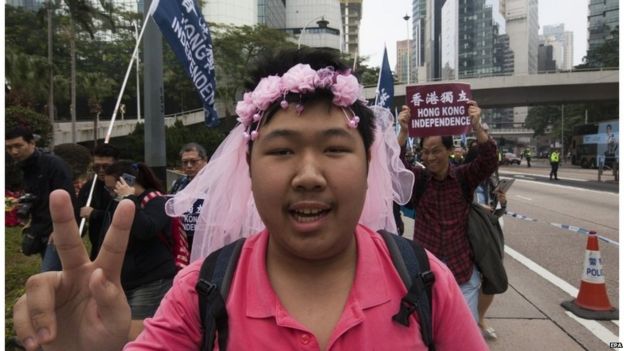
Pro-democracy protester in Hong KongImage copyrightEPA
Image captionCritics accuse China of abandoning its “one country, two systems” pledge on Hong Kong

In recent years, both countries have hailed a “golden era” in UK-Sino relations.

China has signalled its desire to invest in high-profile UK infrastructure projects, including the building of a new nuclear reactor at Hinkley Point – although its involvement has raised some national security concerns.

British trade with China has increased by 60% since 2010 and UK ministers are expected to use the trip to stress that the UK will remain an “excellent place to do business” after it leaves the EU next year.

The UK has said it will prioritise negotiating free trade agreements with major trading partners such as the United States, Australia and Canada after it leaves the EU in March 2019.

Earlier this year, the UK said it would not rule out becoming a member of the Trans Pacific Partnership free-trade zone, whose members include Japan, South Korea and Vietnam and which is considered by many as a counter-weight to Chinese influence in the region.

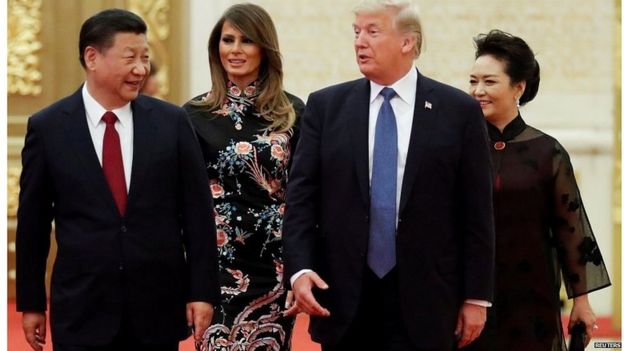
Chinese President Xi Jinping with his US counterpart Donald Trump in NovemberImage copyrightREUTERS
Image captionUS President Donald Trump and French counterpart Emmanuel Macron have both visited China recently

Lord Patten, the last British governor of Hong Kong, has urged Mrs May to use the visit to privately raise what he says has been the steady erosion of freedoms and rights in the former British colony in recent years.

Hong Kong is supposed to have distinct legal autonomy under the terms of its handover to China in 1997.

In a letter to the PM, Lord Patten and ex-Lib Dem leader Lord Ashdown said its residents needed assurances that the UK’s growing commercial relationship with China would not “come at the cost of our obligations to them”.

22/01/2018

China’s ambitions in space are growing

America is keeping its distance

The base in a township of Wenchang city is the newest of China’s four space-launch facilities. It is also by far the easiest to visit—thanks in part to the enthusiasm of officials in Hainan, a haven for tourists and rich retirees. Wenchang’s local government has adopted a logo for the city reminiscent of Starfleet badges in “Star Trek”. It is building a space-themed tourist village near the launch site, with attractions that include a field of vegetables grown from seeds that have been carried in spaceships.

If the dream is to turn this palm-fringed corner of Hainan into a tourist trap comparable to Florida’s balmy space coast, there is still a lot to do. Several idle building sites suggest that some investors have gambled rashly. Signs have been taken down from a patch of scrub that was once earmarked for an amusement centre. On a recent weekday, pensioners wintering nearby were among the few visitors to the launch site. A local says that people often come out feeling like they have had a lesson in patriotism, but not much fun.

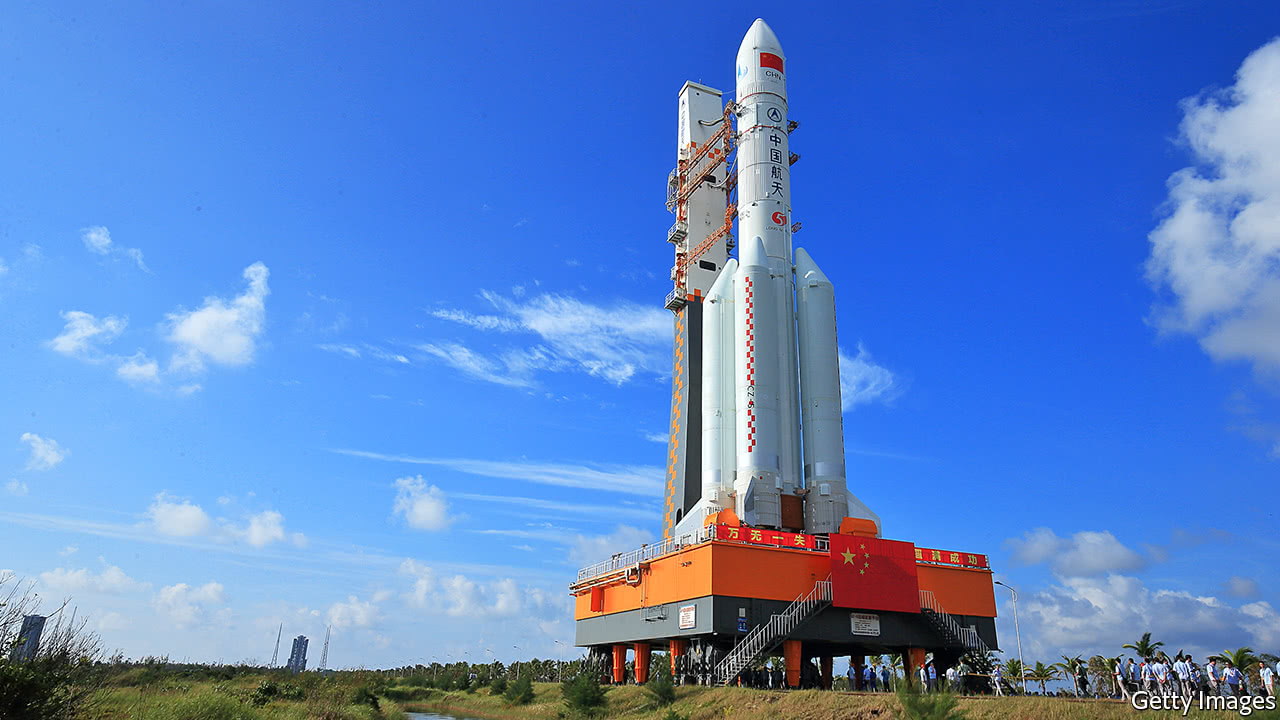
Perhaps this will change when Wenchang gets up to speed. The base is crucial to China’s extraterrestrial ambitions because it is the only site from which it can launch its latest and largest rocket, the Long March 5 (pictured). Narrow railway tunnels limit the size of the components that can be delivered to the three other bases. Rockets are anyway more efficient the closer they are launched to the equator, where the faster rotation of Earth provides extra lift. Of China’s launch centres, Wenchang is by far the nearest to that sweet spot.

The Long March 5 can carry about 25 tonnes into low orbit, roughly double the maximum load of China’s next most powerful rocket. This is only a bit less than the biggest rocket currently used by America’s space agency, NASA, can carry—but far less than the Falcon Heavy, a behemoth being developed by SpaceX, a private American firm (see article). The Long March 5’s maiden launch, in 2016, was a success. But the second one last summer failed a few minutes after lift-off. Wenchang’s two launch pads have stood empty ever since.

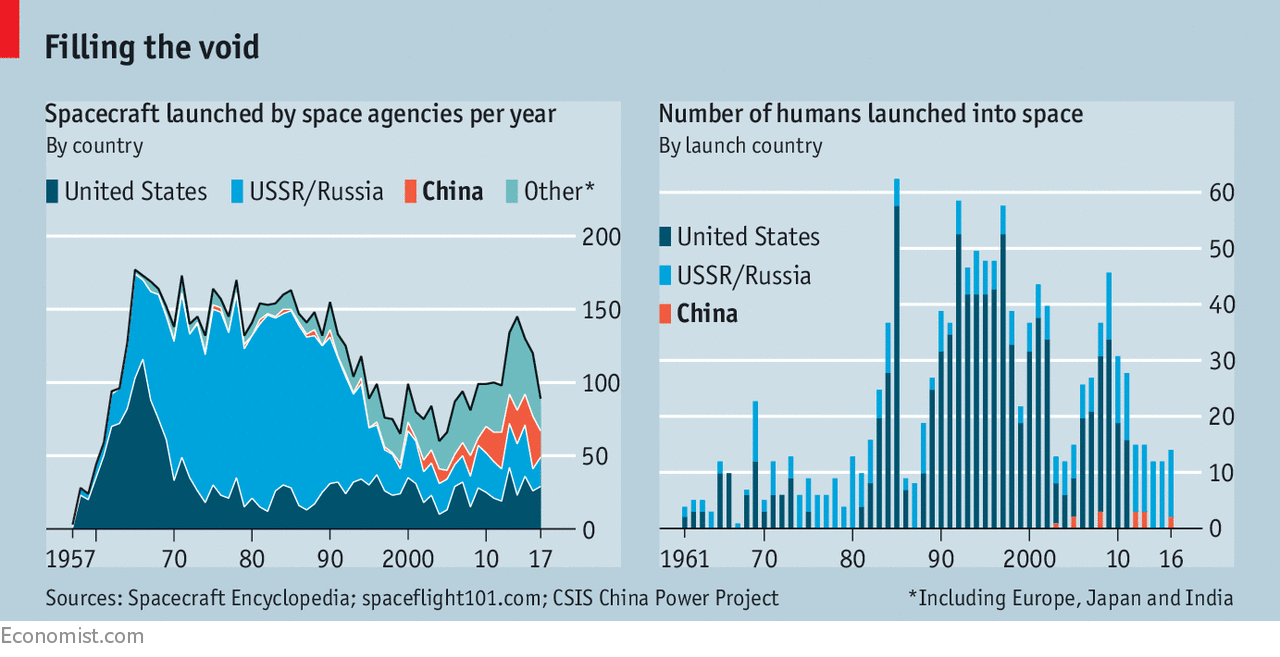
That failure, and another one last year involving another type of Long March rocket, slowed China’s space efforts. Officials had hoped to launch around 30 rockets of one type or another in 2017 but only managed 18 (there were 29 launches in America and another 20 of Russian ones—see chart). But they promise to bounce back in 2018, with 40-or-so lift-offs planned this year. These will probably include a third outing for the Long March 5—assuming its flaws can be fixed in time—and missions that will greatly expand the number of satellites serving BeiDou, China’s home-grown satellite navigation system.

The next two years could see big progress in China’s two highest-profile civil programmes in space: lunar exploration and building a space station. In 2013 China sent a rover to the moon’s surface, the first soft landing there since Russia and America discontinued such efforts in the 1970s. Towards the end of this year China hopes to put a robot on the far side of the moon, a region never yet explored from the lunar surface. That landing will help preparations for an attempt—tentatively planned for 2019—to collect rocks from the surface and return them to Earth.

China talks of launching the main module of a permanent space station as soon as 2019, and expanding it with two bolt-ons early in the following decade. It is going it alone with this programme. America passed a law in 2011 that forbids NASA from sharing knowledge or resources with its Chinese equivalent. This ensured that China remained locked out of the International Space Station; America was never keen on letting it in because of the military uses of China’s space programme. China has instead experimented with two temporary orbiters of its own, the newest of which it crewed for a month in 2016 (the older one has reached the end of its mission and looks likely to tumble to the Earth sometime in the next few months).

Eventually, China would like to send its taikonauts to the moon. There is no target date for achieving this, but in 2016 an official speculated that a Chinese citizen might step on the lunar surface within 15 to 20 years. The country has Mars in its sights, too. It plans to land a rover there in 2020 or shortly thereafter. It wants to retrieve rocks from Mars sometime in the 2030s.

China still lags far behind America in its space accomplishments, but it does not appear bent on a cold-war-style race. It spends far less on its civil space programme than the $19.7bn that NASA was allocated last year. China is doggedly pursuing its goals, however. Joan Johnson-Freese of the US Naval War College compares China to Aesop’s tortoise.

One of the Communist Party’s aims is to boost national pride at home. In 2016 Mr Xi declared that April 24th would be celebrated annually as “space day”: it is the anniversary of China’s first satellite launch in 1970. Even if outshining America remains a distant goal, China is mindful of the progress being made by India, another big developing country that dreams of the stars. India is planning its first soft-landing on the moon in March, more than four years after China’s.

Europe is keen to collaborate. Chinese and European scientists launched their first joint satellite in 2003. They are now co-operating in a study of solar wind. Astronauts from the European Space Agency (ESA) recently trained with Chinese counterparts in survival skills. Karl Bergquist, an ESA official, says a few European astronauts are learning Chinese to prepare for possible joint missions.

But America’s worries are growing about the military aspects of China’s space programme. Marco Aliberti of the European Space Policy Institute in Vienna says this has been particularly evident since 2013, when China showed it could launch projectiles into the lofty orbits traced by America’s most sensitive satellites, suggesting it was developing an ability to knock them out. Many American scientists favour a more relaxed approach. But in an era of “America First”, the chances are slim of NASA being allowed to befriend China.

All this rankles among Chinese officials. They note that tense relations between America and Russia have not prevented those two countries’ space agencies from working together (since retiring the space shuttle, America has been dependent on Russian rockets to get astronauts into space). As many people in China see it, America’s behaviour is further confirmation of a long-held belief that America wants to create impediments to China’s rise. Jiao Weixin, a space expert at Peking University, says America is locked in “cold-war thinking”. If American authorities do not wish to work with China, he says, there are others who will.

This article appeared in the China section of the print edition under the headline “Hainan aims high”
18/01/2018

China’s growth in 2017

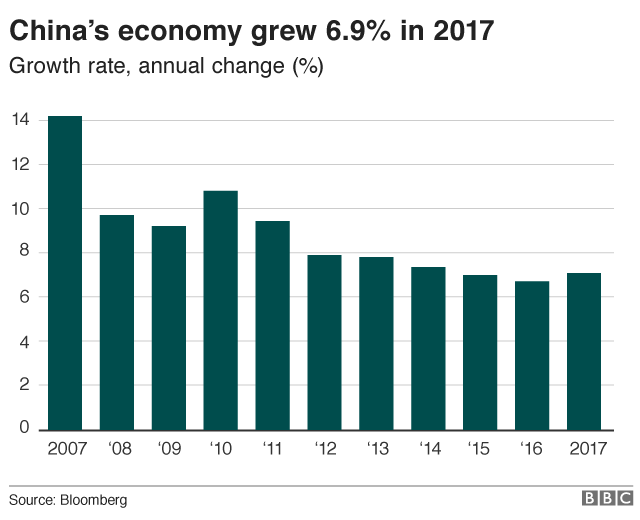
China’s economy grew by 6.9% in 2017 according to official data – the first time in seven years the pace of growth has picked up.

The figure beats Beijing’s official annual expansion target of about 6.5%.

China is a key driver of the global economy and so the better-than-expected data is likely to cheer investors around the world.

But many China watchers believe the GDP numbers are much weaker than the official figures suggest.

This month alone, the governments of Inner Mongolia and of the large industrial city of Tianjin have admitted their economic numbers for 2016 were overstated.

Taking the figures at face value, the 2017 growth rate is China’s highest in two years. And it represents the first time the economy has expanded faster than the previous year since 2010.

However as Beijing ramps up efforts to reduce risky debt and to increase air quality, analysts said this may impact 2018 growth.

The numbers released on Thursday also showed that in the last three months of 2017, the economy grew at an annual rate of 6.8% – slightly higher than analysts had been expecting.


Analysis

Robin Brant, BBC China Correspondent, Shanghai

Two things stand out.

First, it looks like stronger exports – as the world economy picked up – and the final sputter of (another) government infrastructure investment spurt helped make 2017 better than expected.

But that’s the model China is trying – gently – to get away from.

Second, is it true?

China’s figures can be so stable, so in line with government targets, that it’s hard to really believe them.

In the run up to these figures being published there’s also been an unusual spate of honesty from several provincial governments, who’ve admitted faking their GDP or fiscal figures. All of which fed into the national picture.


China’s debt has risen significantly in recent years, with worrying numbers around local government loans, corporate and household debt and non-performing bank loans.

The International Monetary Fund (IMF) said recently that the country’s debt had ballooned and was now equivalent to 234% of the total output. It said Beijing needed to concentrate less on growth and instead help improve banks’ finances, among other efforts.

Beijing meanwhile says it has been taking steps to contain risky debt despite the impact that might have on economic growth – efforts the IMF said it recognised.

The government has promised to continue tackling local government debt, among other efforts, and on Thursday vowed to help state-owned enterprises “leverage and cut debt … and to repay their bonds on time this year”.

China's economic growth

Blue skies v economic growth

China’s strict anti-pollution measures, which were introduced across 28 cities last year, are also expected to hurt economic growth in the short term.

The measures have included shutting down or cutting back production at factories in heavy industry like cement and steel.

Households have also been asked to switch to natural gas and electricity from coal, in an effort to curb pollution.

However this policy left millions without proper heating, and so was temporarily abandoned in December.

Chinese officials have said Beijing’s air quality improved sharply in the winter of 2017 and heralded their efforts as a “new reality” for the country.

Tags:
12/01/2018

As China rushes forward, more people seek their roots

A tech billionaire’s quest exposes gaps in Chinese genealogies

WHEN Richard Liu asked for help in tracing his family history, thousands of people offered suggestions. Little wonder: Mr Liu, the founder of JD.com, a popular online mall, is worth about $10bn. There are more than 65m people in China who share his surname—some would love to connect their family branches to his bountiful tree. But constructing an accurate lineage could be tough, not only because of the huge number of Lius. In a country that in recent decades has seen the biggest movement of people in history away from their ancestral homes, genealogical records are patchy.

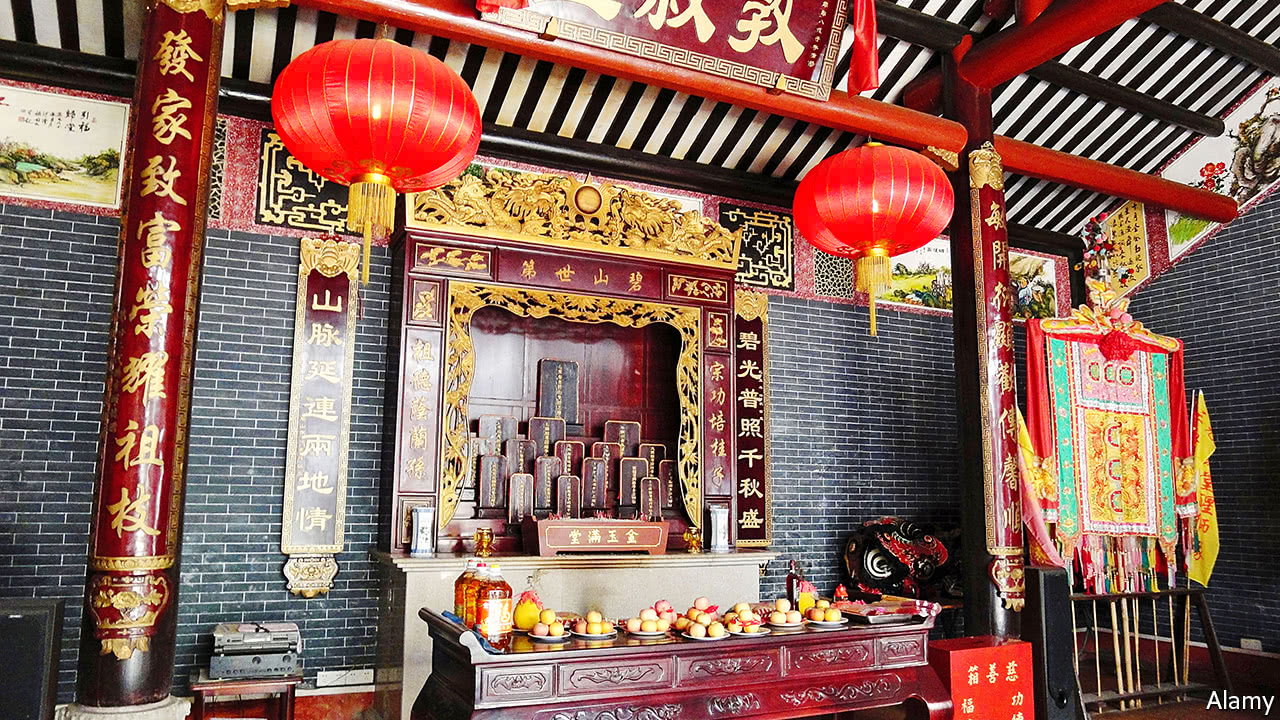
Veneration of ancestors is part of Chinese culture. Traditionally this required the scrupulous updating of genealogies by family elders. These were recorded in books known as zupu that listed members of each generation—though typically only the men. Zupu were often kept in ancestral shrines (such as the one pictured, dedicated to a clan surnamed Li in the southern city of Guangzhou). But war and migration in the past two centuries have complicated matters. Under Mao, the Communist Party tried to stamp out ancestor worship. Many zupu were destroyed. Mr Liu was born in Jiangsu, an eastern province, and can trace his heritage back to a branch of the Liu family in the central province of Hunan. There the trail goes cold because the relevant zupu is missing, say local media.

In the West, people trying to trace their lineage often consult websites that provide data from sources such as census records and church registers. Such sites enable users to link their trees with others. But in China there is little in the way of official historical records that contain genealogical data and are open to commercial databases. Local gazettes often provided information about members of prominent families, but were silent about the masses.

Yet not all is lost. Over the past couple of decades, clan associations have re-established themselves and worked to compile records again. Zupu that were hidden in Mao’s day, or taken abroad, have helped to fill in gaps. Some family elders have “put their collective memory down on paper”, says Huihan Lie, founder of My China Roots, a genealogy service. The paucity of surnames in China—almost 85% of people share just 100 family names—is not necessarily an obstacle. Given names can also provide clues. They are usually made up of two characters, with the first one sometimes chosen from a generational sequence of names ordained by the recipient’s clan. Mr Liu knows the sequence for eight generations in his family.

Websites are helping to make the search easier. My China Roots recently received private funding to build an online zupu database, starting with records from southern provinces where they are often more complete. Eventually the plan is to include Hunan, where Mr Liu’s search is focused. With luck, searching for ancestors will someday be as easy as online shopping.

This article appeared in the China section of the print edition under the headline “Ancestral longings”
28/12/2017

Chengdu runs 1,000 cargo trains to Europe in 2017 – Xinhua | English.news.cn

A cargo train loaded with 41 containers of electronic products departed from Chengdu, capital of southwest China’s Sichuan Province, for the Netherlands on Wednesday.It brings the total number of cargo trains from Chengdu to Europe to 1,000 this year, and 1,700 since the city launched the service in 2013.The city has rail routes to 14 European countries.”Rail freight is one of the fields where the Sino-European cooperation has made very important progress and will continue to do so in the future,” said Filippo Nicosia, Italy Consul General in Chongqing.In 2018, at least 1,000 cargo trains are expected to run from Chengdu to Europe.Demand for rail cargo between China and Europe, an alternative to slower and riskier sea freight and much costlier air cargo, has exploded in recent years.About 35 Chinese cities run cargo trains to Europe.

Source: Chengdu runs 1,000 cargo trains to Europe in 2017 – Xinhua | English.news.cn

07/12/2017

China claims Indian drone ‘invaded airspace in crash’ – BBC News

An Indian drone has “invaded China’s airspace and crashed” on its territory, Chinese state media said.Zhang Shuili, deputy director of the western theatre combat bureau, said the incident took place in “recent days”.

He did not give an exact location.

He was quoted in Xinhua news agency as saying that India had “violated China’s territorial sovereignty”.The Indian army said the drone had been deployed on a training mission and developed a technical problem.

Indian army spokesperson Colonel Aman Anand told reporters that they had lost control of the drone which then crossed into Chinese airspace. They alerted their Chinese counterparts soon after, he added.

The two countries saw relations worsen this summer when they became locked in a dispute over a Himalayan plateau.

What was behind the China-India border row?

China ‘racist’ video on India sparks fury

China and India now in water ‘dispute’In remarks carried widely by state media outlets, Mr Zhang said Chinese border forces had conducted “verifications” of the drone.He added that China expresses “our strong dissatisfaction and opposition regarding this matter” and that it would “steadfastly protect the country’s rights and safety”.

Relations between the two countries soured in June when India said it opposed a Chinese attempt to extend a road on the Doklam/Donglang plateau, at the border of China, India and Bhutan.

China and Bhutan have competing claims on the plateau, and India supports Bhutan’s claim.

After weeks of escalating tensions, including heated rhetoric from both sides, the stand-off ended in August when both countries pulled back their troops.

The two nations fought a bitter war over the border in 1962, and disputes remain unresolved in several areas which cause tensions to rise periodically.

Source: China claims Indian drone ‘invaded airspace in crash’ – BBC News

Law of Unintended Consequences

continuously updated blog about China & India

ChiaHou's Book Reviews

continuously updated blog about China & India

What's wrong with the world; and its economy

continuously updated blog about China & India