Archive for ‘China alert’

01/09/2017

‘We must send our best to the front line’: Xi Jinping goes all out to rid China of poverty in three years | South China Morning Post

If China success, it will have proven wrong Matthew 26:11: “The poor will always be with you”.

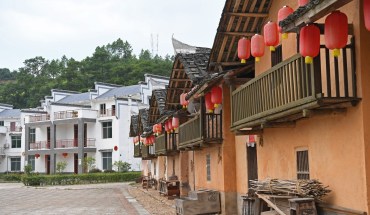
China is going all out in an unprecedented effort to lift its population out of poverty by 2020, while simultaneously strengthening its grip at the grassroots level.

Xinhua has released the full transcript of President Xi Jinping’s remarks in June on the ambitious campaign. The speech contains many specific details regarding how Xi intends to achieve the goal of meeting the basic needs of all of the country’s rural poor in three years.

The transcript was released on the same day as Beijing’s announcement of the October 18 opening date for the 19th Party Congress. Poverty alleviation is expected to be a policy priority for Xi in his second term.
In the June speech, Xi highlighted the importance of combining the building out of the Communist Party’s grassroots apparatus with poverty alleviation.

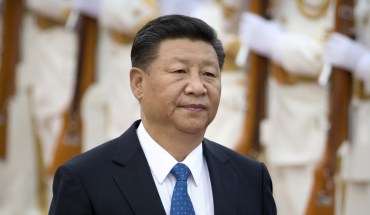
“We must send our best talents to the front line of the tough battle with extreme poverty,” Xi told cadres while announcing his precise measures aimed at reducing poverty.

Beijing vows to get tough in war on poverty“All levels of government should actively send cadres to station in poor villages in an effort to fortify the party leadership,” he said.

County governments should take the lead in poverty alleviation, Xi said, adding that having stable leadership at the county level was essential. County leaders who perform well in poverty alleviation should be promoted, he said.Xi said the government should precisely identify its poor and the reasons for their poverty to derive appropriate measures to help them.“
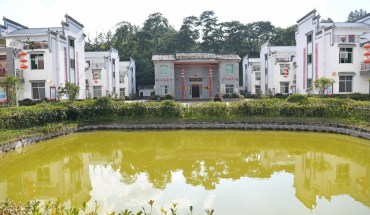
The priority for the next stage is to solve the problems of social services, infrastructure and a basic medical services shortage in areas with deep-rooted poverty issues,” Xi said.

He said the government would step up the campaign to move residents from areas with extremely poor living conditions, hire local people to protect forests in ecologically fragile areas, and strengthen assistance to rural poor who suffer with serious illness.

Xi Jinping’s biggest ally returns to the limelight to support Chinese leader’s war against poverty

Meanwhile, Xi also is prepared to strengthen government funding and prioritise land distribution to meet development needs as part of a basket of precise measures aimed at eradicating extreme poverty.

His programme also includes improving public services such as medical care, education, vocational training, transportation and infrastructure to add jobs and develop industries in some of China’s poorest areas.

Ever since taking the helm, Xi has researched and travelled extensively to extremely poor areas as poverty reduction is a key political target for the Communist Party and the central government. The official goal is to eliminate poverty, defined as annual income of less than 2,300 yuan (HK$2,728), and build an “all-round well-off society” by 2020 with all resources available.

In China, rural rich get richer and poor get poorer

The 13th Five Year Plan has set important targets for the country on this matter and progress in poverty alleviation would play a role in assessing cadres’ performance.

Shanghai-based political commentator Chen Daoyin said poverty alleviation is close to Xi’s heart as it helps the party to solidify its political support in the grassroots where most of the nation’s population lives.
“As his next term begins, one can expect that’s where he will dedicate his power on,” Chen said in an interview.

“Not only it is an easy way out for him to win hearts of the mass but also a way to justify the party’s governance on a grassroots level in order to maintain political stability.

China’s final push to eradicate poverty will be difficult but not impossible if handled in a clean, transparent manner“

China’s poorest takes up the majority of the population and all their problems are about staying warm and fed, which is easy to address compared to the more affluent bunch on the eastern part of the nation,” Chen said.

As of last year, China still has more than 55 million people in rural areas who live below the poverty line. Twelve million people were lifted out of poverty last year and another 10 million people would be taken off the rolls this year.
Source: ‘We must send our best to the front line’: Xi Jinping goes all out to rid China of poverty in three years | South China Morning Post

15/08/2017

China imposes import bans on North Korean iron, coal and seafood – BBC News

China is to stop importing coal, iron, iron ore and seafood from North Korea.

The move is an implementation of UN sanctions, which were imposed in response to North Korea’s two missile tests last month.

China accounts for more than 90% of North Korea’s international trade.

Beijing had pledged to fully enforce the sanctions after the US accused it of not doing enough to rein in its neighbour.

Economic impact

The UN approved sanctions against Pyongyang earlier this month that could cost the country $1bn (£770m) a year in revenue, according to the figures provided to the Security Council by the US delegation.

Although China’s coal imports from North Korea totalled $1.2bn last year, the figure will be much lower this year because China had already imposed a ban in February, experts said.”China has already imported its quota of coal under sanctions for 2017. So no net impact there, and North Korean exports to other countries are minimal,” said David Von Hippel, from the Nautilus Institute -a think tank based in Oregon -who has researched North Korea’s coal sector.

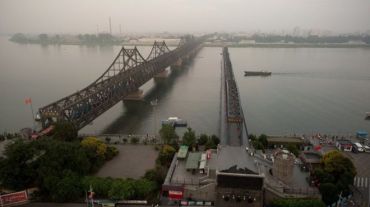
North Korean labourers work beside coal mound near the Yalu River

The sanctions might have more of an impact on iron and seafood, experts said.

Although they are both much smaller sources of export revenue for North Korea, the two industries have seen a rise in exports this year.

Iron ore exports grew to $74.4m in the first five months of this year, almost equalling the figure for all of 2016. Fish and seafood imports totalled $46.7m in June, up from $13.6m in May.

The sanctions do not apply to the growing clothing assembly industry in North Korea.Mr Von Hippel said in gross terms, it is nearly as large as coal, but in reality it is worth much less because North Korea has to import the inputs.

Trade and security tensions

The sanctions come against a backdrop of increased tensions between the US and North Korea, as well as heightened trade tensions between the US and China.

After weeks of heated rhetoric between the US and North Korea, on Tuesday North Korea’s leader Kim Jong-un has decided to hold off on a strike towards the US territory of Guam, state news agency KCNA reported.

The apparent pause in escalating tensions comes after US President Donald Trump warned of “fire and fury like the world has never seen” if Pyongyang persisted with its threats.

On Monday, the US President Donald Trump ordered a trade probe into China’s alleged theft of US intellectual property, which the Chinese state press saw as an attempt to force China to act more decisively on North Korea.

Officially, the US has denied any link between the two issues, although the president had previously suggested he might take a softer line on China in exchange for help on North Korea.

Source: China imposes import bans on North Korean iron, coal and seafood – BBC News

05/08/2017

China tries to keep foreign rubbish out

CHINA dominates international trade in many goods, but few more than waste for recycling.

It sucked in more than half the world’s exports of scrap copper and waste paper in 2016, and half of its used plastic. All in all, China spent over $18bn on imports of rubbish last year. America, meanwhile, is an eager supplier. In 2016 nearly a quarter of America’s biggest exporters by volume were recyclers of paper, plastic or metal. Topping the list was America Chung Nam, a California-based supplier of waste paper which last year exported a whopping 333,900 containers, almost all of them to China.

This may soon change. On July 18th China told the World Trade Organisation that by the end of the year, it will no longer accept imports of 24 categories of solid waste as part of a government campaign against yang laji or “foreign garbage”. The Ministry of Environmental Protection says restricting such imports will protect the environment and improve public health. But the proposed import ban will disrupt billions of dollars in trade. Recyclers worry that other categories of waste may soon receive the same treatment.

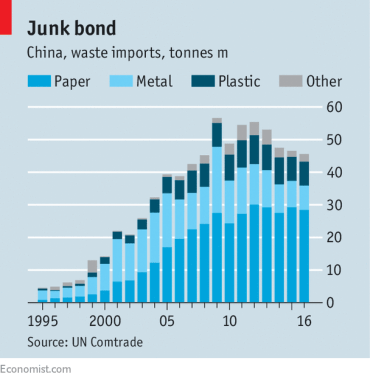
Imports of rubbish have helped feed China’s voracious appetite for raw materials. It is often cheaper to recycle scrap copper, iron and steel, as well as waste paper and plastic, than to make such materials from scratch, especially when commodity prices are high. So as commodity prices rose during the 2000s, the burgeoning trade in waste benefited both exporters, who made money from previously worthless trash, and importers, who gained access to a reliable stream of precious feedstock. Between 1995 and 2016 Chinese imports of waste grew tenfold, from 4.5m to 45m tonnes.

But imports of recyclable waste are often dirty, poorly sorted or contaminated with hazardous substances such as lead or mercury. In 1996 factories in Xinjiang inadvertently imported more than 100 tonnes of radioactive metal from Kazakhstan. The following year an American businessman was convicted of smuggling over 200 tonnes of unsorted rubbish labelled as waste paper. Even when the intended material is imported, it is often recycled improperly. In 2002 the authorities faced widespread criticism after a documentary showed workers in Guangdong province crudely dismantling discarded electronic devices and dumping the toxic remains into a river. Officials may have been spurred into the latest restrictions by the release of Plastic China, an unflattering documentary about the plastic-recycling industry which was screened at Sundance, a grand American film festival, in January.

The government had already been campaigning to block imports of illegal and low-quality waste under a crackdown called Operation Green Fence launched in 2013. Customs officials have ramped up inspections of scrap metal for circuit boards, plastic for syringes and other medical waste, and waste paper for plastic or wood. Since then, China’s imports of waste have fallen sharply (see chart).

Whereas Green Fence was aimed at improving the quality of imported waste, the government’s latest move bans several types of waste outright, threatening some $5bn in trade. The Ministry of Environmental Protection says the ban will cut pollution. But most of the waste consumed by China’s recycling industry comes from domestic sources, not imports, notes Joshua Goldstein of the University of Southern California: “This is not really where the problem lies.” Indeed, recyclers who rely on imports may now switch to grubbier domestic stock. “This is going to be very hard on our industry,” says Adina Renee Adler of the Institute of Scrap Recycling Industries. As it is, Operation Green Fence has put lots of small recyclers out of business. Exporters will suffer too. Derek Kellenberg of the University of Montana says, “My suspicion is that the lower-quality stuff is more likely to end up in a landfill.”

Source: China tries to keep foreign rubbish out

27/07/2017

Britain plans to send warship to South China Sea in move likely to irk Beijing

Britain plans to send a warship to the disputed South China Sea next year to conduct freedom of navigation exercises, Defence Minister Michael Fallon said on Thursday, a move likely to anger Beijing.

Britain would increase in presence in the waters after it sent four British fighter planes for joint exercises with Japan in the region last year, he said.

China claims most of the energy-rich sea where neighbors Brunei, Malaysia, the Philippines, Taiwan and Vietnam also have claims.

“We hope to send a warship to region next year. We have not finalised exactly where that deployment will take place but we won’t be constrained by China from sailing through the South China Sea,” Fallon told Reuters.

“We have the right of freedom of navigation and we will exercise it.”

The presence of a British vessel threatens to stoke tensions, escalated by China’s naval build-up and its increasingly assertive stance.

China’s construction of islands and military facilities in the South China Sea has stoked international condemnation, amid concern Beijing is seeking to restrict free movement and extend its strategic reach.

Britain’s Secretary of State for Defence, Michael Fallon, arrives in Downing Street for a cabinet meeting, in central London, Britain July 18, 2017

Toby Melville

Britain’s move could also upset ties between London and Beijing, undermining efforts to shore up what the two governments have called a “golden era” in their relationship as Britain heads towards a divorce with the European Union.

“We flew RAF Typhoons through the South China Sea last October and we will exercise that right whenever we next have the opportunity to do so, whenever we have ships or planes in the region,” Fallon said.

The United States estimates Beijing has added more than 3,200 acres (1,300 hectares) on seven features in the South China Sea over the past three years, building runways, ports, aircraft hangars and communications equipment.

To counter the perceived Chinese aggression, the United States has conducted regular freedom of navigation exercises that have angered Beijing.

Earlier this month, the United States sent two bombers over the region, coming just a few months after it sent a warship to carry out a maneuvering drill within 12 nautical miles of one of China’s artificial islands.

China has repeatedly denounced efforts by countries from outside the region to get involved in the South China Sea dispute.

The South China Sea is expected to dominate a regional security meeting in Manila next week, where Chinese Foreign Minister Wang Yi will meet counterparts from the Association of Southeast Asian Nations (ASEAN) countries.

Meeting ASEAN diplomats in Beijing on Wednesday, Wang told them both sides must “exclude disturbances on the South China Sea issue, and maintain positive momentum”, China’s Foreign Ministry said.

Source: http://www.reuters.com/article/us-southchinasea-britain-idUSKBN1AC1CB

24/07/2017

China warns India not to harbor illusions in border stand-off

China’s defense ministry on Monday warned India not to harbor any illusions about the Chinese military’s ability to defend its territory, amid a festering border dispute.

The stand-off on a plateau next to the mountainous Indian state of Sikkim, which borders China, has ratcheted up tension between the neighbors, who share a 3,500-km (2,175-mile) frontier, large parts of which are disputed.

“Shaking a mountain is easy but shaking the People’s Liberation Army is hard,” ministry spokesman Wu Qian told a briefing, adding that its ability to defend China’s territory and sovereignty had “constantly strengthened”.

Early in June, according to the Chinese interpretation of events, Indian guards crossed into China’s Donglang region and obstructed work on a road on the plateau.

The two sides’ troops then confronted each other close to a valley controlled by China that separates India from its close ally, Bhutan, and gives China access to the so-called Chicken’s Neck, a thin strip of land connecting India and its remote northeastern regions.India has said it warned China that construction of the road near their common border would have serious security implications.

The withdrawal of Indian border guards was a precondition for resolving the situation, Wu reiterated.

“India should not leave things to luck and not harbor any unrealistic illusions,” Wu said, adding that the military had taken emergency measures in the region and would continue to increase focused deployments and drills.

“We strongly urge India to take practical steps to correct its mistake, cease provocations, and meet China halfway in jointly safeguarding the border region’s peace and tranquillity,” he said.

Speaking later, Chinese Foreign Ministry spokesman Lu Kang said Ajit Doval, India’s national security adviser, would attend a meeting in Beijing this week of security officials from the BRICS grouping that includes Brazil, Russia, India, China and South Africa.

Lu would not be drawn on whether the border issue would be discussed at the meeting, hosted by China’s top diplomat, State Councillor Yang Jiechi, meant to discuss multilateral issues.

“China hopes to maintain the peace and stability of the China-India border area, but certainly will not make any compromise on issues of territorial sovereignty,” Lu said.

Indian Prime Minister Narendra Modi is to visit China early in September for a summit of BRICS leaders.Indian officials say about 300 soldiers from either side are facing each other about 150 meters (yards) apart on the plateau.

They have told Reuters that both sides’ diplomats have quietly engaged to try to keep the stand-off from escalating, and that India’s ambassador to Beijing is leading the effort to find a way for both sides to back down without loss of face.

Chinese state media have warned India of a fate worse than its defeat suffered in a brief border war in 1962. China’s military has held live fire drills close to the disputed area, they said this month.

Source: China warns India not to harbor illusions in border stand-off

21/07/2017

India says in quiet diplomacy with China to tackle border stand-off

When Chinese President Xi Jinping and Indian Prime Minister Narendra Modi met on the sidelines of a regional conference last month, officials said they reached an understanding not to let the two countries’ long-standing “differences become disputes”.

Yet within days, Chinese and Indian soldiers were jostling in a desolate but disputed border region in the Himalayas that has since grown into an eyeball-to-eyeball confrontation from which neither army is ready to back off.

The flare-up is the latest incident in a steadily deteriorating relationship between the Asian giants who are unable to agree on their 3,500 km (2,175 miles) border, over which they went to war in 1962.

Indian officials said diplomats from the two sides were now quietly trying to ensure the stand-off near the three-way border between India, its ally Bhutan, and China does not escalate into a conflict, invoking the agreement reached by their leaders at the Shanghai Cooperation Organisation summit in Astana.

Behind the scenes, India’s ambassador to Beijing is leading the effort to find a way for both sides to back down from confrontation on the Doklam plateau – which China calls Donglang – without losing face, an Indian government source aware of the sensitive negotiations told Reuters.

In public, the two sides are saying little about the delicate diplomatic engagement.

“We want both sides to call back troops and work things out with talks,” Indian Foreign Minister Sushma Swaraj told parliament on Thursday.

China says India must first pull back its troops from the area before meaningful discussions can take place.

“Of course, we have said before, China-India bilateral diplomatic channels are always open,” said Foreign Ministry spokesman Lu Kang, when asked whether talks with India were being held to defuse the situation.

“But with regard to this incident, we have emphasised many times that the Indian border defence personnel who illegally crossed the boundary withdrawing to the Indian side of the line is the basis and precondition for China and India conducting any kind of meaningful dialogue.

“Chinese state media have warned India of a fate worse than then the defeat it suffered in their border war in 1962.

Strategic Rivals

In recent years, the two have clashed over China’s strategic ties with India’s arch rival Pakistan, including a massive trade corridor that China is building through the disputed territory of Kashmir.

New Delhi has also been stung by China’s veto of United Nations sanctions against the leader of a Pakistan-based militant group and Beijing’s refusal to let it become a member of the Nuclear Suppliers Group, a global cartel.Beijing has bristled at the Modi government’s public embrace of the Dalai Lama, the Tibetan spiritual leader whom it regards as a dangerous splittist. It has also grown concerned at India’s military ties with both the United States and Japan.Indian Foreign Ministry spokesman Gopal Baglay said diplomatic channels between Delhi and Beijing were open and being used to tackle the border crisis.

“Diplomatic communications to the best of my understanding have never stopped,” he said. “There are diplomatic communications taking place.”

He would not go into further details.

Flashpoint

The latest trouble began when Chinese forces were spotted constructing a road with bulldozers and other heavy equipment in an area claimed by the tiny kingdom of Bhutan, prompting an intervention by Indian troops stationed nearby.

Groups of soldiers pushed and shoved each other, military officials said, but no weapons were used.

India said its action was guided by its special relationship with Bhutan as part of a 2007 treaty to cooperate on security issues, but also by the threat posed by the alleged Chinese incursion in Doklam to its own security.

The plateau lies close to the “Chicken’s Neck”, a 20-km wide corridor that links India to its northeastern states. The biggest fear among India’s military planners is that a Chinese offensive there could cut off the link.

China, which is engaged in a massive regional infrastructure drive to boost trade, says the area where the road was being constructed is part of its territory, and that in any case India does not have a role in what it sees as a bilateral matter with Bhutan.

About 300 soldiers from either side are facing each other about 150 metres (yards) apart on the Doklam/Donglang plateau, 10,000 feet (3,050 metres) above sea level, Indian officials say.

Behind them in the barracks below are thousands of troops ready to be deployed on either side. So far there has been no sign of either side trying to mobilise more troops, military officials in New Delhi said.

One possibility is that the weather may force the two sides to quietly disengage, the Indian government source said. Construction activity in the area can only take place between June and September before it becomes snowbound.

Source: http://uk.reuters.com/article/uk-india-china-idUKKBN1A51S9

12/07/2017

China sends troops to open first overseas military base in Djibouti | Reuters

Ships carrying personnel for China’s first overseas military base, in Djibouti in the Horn of Africa, have set sail to begin setting up the facility, as China’s rapidly modernizing military extends its global reach.

Soldiers of China’s People’s Liberation Army (PLA) stand on a ship sailing off from a military port in Zhanjiang, Guangdong province, July 11, 2017.

Djibouti’s position on the northwestern edge of the Indian Ocean has fuelled worry in India that it would become another of China’s “string of pearls” of military alliances and assets ringing India, including Bangladesh, Myanmar and Sri Lanka.

China began construction of a logistics base in Djibouti last year. It will be used to resupply navy ships taking part in peacekeeping and humanitarian missions off the coasts of Yemen and Somalia, in particular.

It will be China’s first overseas naval base, though Beijing officially describes it as a logistics facility.

State news agency Xinhua said late on Tuesday the ships had departed from Zhanjiang in southern China “to set up a support base in Djibouti”.

Navy commander Shen Jinlong “read an order on constructing the base in Djibouti”, but the news agency did not say when the base would begin operations.

Xinhua said the establishment of the base was a decision made by the two countries after “friendly negotiations, and accords with the common interest of the people from both sides”.

The base will ensure China’s performance of missions, such as escorting, peace-keeping and humanitarian aid in Africa and west Asia,” it said.

“The base will also be conducive to overseas tasks including military cooperation, joint exercises, evacuating and protecting overseas Chinese and emergency rescue, as well as jointly maintaining security of international strategic seaways,” Xinhua said.

Foreign ministry spokesman Geng Shuang told a daily news briefing the base would enable China to make “new and greater contributions” to peace in Africa and the world and would benefit Djibouti’s economic development.

Djibouti, which is about the size of Wales, is at the southern entrance to the Red Sea on the route to the Suez Canal. The tiny, barren nation sandwiched between Ethiopia, Eritrea and Somalia also hosts U.S., Japanese and French bases.

‘NOT MILITARY EXPANSIONISM’

The People’s Liberation Army Daily said in a front-page commentary the facility was a landmark that would increase China’s ability to ensure global peace, especially because it had so many U.N. peacekeepers in Africa and was so involved in anti-piracy patrols.China would not seek military expansionism or get into arms races no matter what happened, the newspaper said.

“These promises will not change because of the construction of the overseas logistics base,” it said.

The state-run Global Times said in an editorial there could be no mistake that this was in fact a military base.

“Certainly this is the People’s Liberation Army’s first overseas base and we will base troops there. It’s not a commercial resupply point. It makes sense there is attention on this from foreign public opinion,” said the paper, which is published by the official People’s Daily.

China’s military development was about protecting its own security, it said.

“It’s not about seeking to control the world.”

There has been persistent speculation in diplomatic circles that China would build other such bases, in Pakistan for example, but the government has dismissed this.

Source: China sends troops to open first overseas military base in Djibouti | Reuters

05/07/2017

What’s behind the India-China border stand-off? – BBC News

For four weeks, India and China have been involved in a stand-off along part of their 3,500km (2,174-mile) shared border.

The two nations fought a war over the border in 1962 and disputes remain unresolved in several areas, causing tensions to rise from time to time.

Since this confrontation began last month, each side has reinforced its troops and called on the other to back down.

How did the row begin?

It erupted when India opposed China’s attempt to extend a border road through a plateau known as Doklam in India and Donglang in China.

The plateau, which lies at a junction between China, the north-eastern Indian state of Sikkim and Bhutan, is currently disputed between Beijing and Thimphu. India supports Bhutan’s claim over it.

India is concerned that if the road is completed, it will give China greater access to India’s strategically vulnerable “chicken’s neck”, a 20km (12-mile) wide corridor that links the seven north-eastern states to the Indian mainland.

Indian military officials told regional analyst Subir Bhaumik that they protested and stopped the road-building group, which led Chinese troops to rush Indian positions and smash two bunkers at the nearby Lalten outpost.

“We did not open fire, our boys just created a human wall and stopped the Chinese from any further incursion,” a brigadier said on condition of anonymity because he was not authorised to speak to the press.

Chinese officials say that in opposing the road construction, Indian border guards obstructed “normal activities” on the Chinese side, and called on India to immediately withdraw.

What is the situation now?

Despite hostilities, the two countries have growing trade and economic ties

Both India and China have rushed more troops to the border region, and media reports say the two sides are in an “eyeball to eyeball” stand-off.

China also retaliated by stopping 57 Indian pilgrims who were on their way to the Manas Sarovar Lake in Tibet via the Nathu La pass in Sikkim. The lake is a holy Hindu site and there is a formal agreement between the neighbours to allow devotees to visit.Bhutan, meanwhile, has asked China to stop building the road, saying it is in violation of an agreement between the two countries.

What does India say?

Indian military experts say Sikkim is the only area through which India could make an offensive response to a Chinese incursion, and the only stretch of the Himalayan frontier where Indian troops have a terrain and tactical advantage.

They have higher ground, and the Chinese positions there are squeezed between India and Bhutan.

India and China fought a bitter war in 1962. Photograph: Hulton Archive

“The Chinese know this and so they are always trying to undo our advantage there,” retired Maj-Gen Gaganjit Singh, who commanded troops on the border, told the BBC.Last week, the foreign ministry said that the construction “would represent a significant change of status quo with serious security implications for India”.

Indian Defence Minister Arun Jaitley also warned that the India of 2017 was not the India of 1962, and the country was well within its rights to defend its territorial integrity.

What does China say?

China has reiterated its sovereignty over the area, saying that the road is in its territory and accusing Indian troops of “trespassing”.

It said India would do well to remember its defeat in the 1962 war, warning Delhi that China was also more powerful than it was then.

India opens its longest bridge

China and India in border stand-off

India’s wrestling blockbuster delights China

Why border stand-offs between India and China are increasing

On Monday, a Chinese foreign ministry spokesman said that the border in Sikkim had been settled in an 1890 agreement with the British, and that India’s violation of this was “very serious”.

The Global Times newspaper, meanwhile, accused India of undermining Bhutan’s sovereignty by interfering in the road project, although Bhutan has since asked China to stop construction.

What’s Bhutan’s role in this?

Bhutan’s Ambassador to Delhi Vetsop Namgyel says China’s road construction is “in violation of an agreement between the two countries”.

Bhutan and China do not have formal relations but maintain contact through their missions in Delhi.

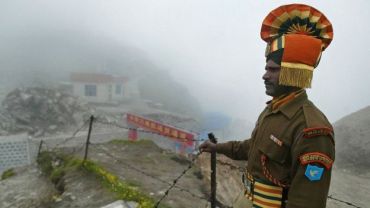
An Indian soldier on the China border – Beijing has reiterated what it says is its right to territory

Security analyst Jaideep Saikia told the BBC that Beijing had for a while now been trying to deal directly with Thimphu, which is Delhi’s closest ally in South Asia.

“By raising the issue of Bhutan’s sovereignty, they are trying to force Thimphu to turn to Beijing the way Nepal has,” he said.

What next?

The fact that Tibet’s spiritual leader, the Dalai Lama resides in India has also been a sticking point between the two countries.

This stand-off in fact, comes within weeks of China’s furious protests against the Dalai Lama’s visit to Arunachal Pradesh, an Indian state that China claims and describes as its own.

The Dalai Lama during his visit to Tawang near the India-China border in Arunachal Pradesh on April 10, 2017Image copyrightGETTY IMAGES
Image captionChina recently protested against Tibetan spiritual leader Dalai Lama’s visit to Arunachal Pradesh, an Indian state Beijing claims as its own

Relations between the Asian giants, however, may not slide further as China has allowed 56 Hindu pilgrims, who entered through the Indian state of Himachal Pradesh, to visit the Manas Sarovar site.

“They are heading for the lake and they are safe,” senior tourism official Dheeraj Garbiyal said last week.

This, experts say, shows that the Chinese are not raising tensions on the whole border but specifically on the Sikkim-Bhutan stretch.

Source: What’s behind the India-China border stand-off? – BBC News

05/07/2017

Too much rain: China’s floods roil hydropower, corn supplies | Reuters

Severe flooding across southern China has forced the world’s largest power plant to slash capacity on Tuesday, delayed grain on barges and damaged farms along the Yangtze River, as the death toll rose to 56 and economic costs hit almost $4 billion.

Heavy rainfall, mudslides and hail caused by the annual rainy season has killed 56 people and 22 people were missing across 11 provinces and regions as of Tuesday morning, according to the Ministry of Civil Affairs.

More than 750,000 hectares (1.85 million acres) of crops have been damaged and direct economic losses totaled more than 25.3 billion yuan ($3.72 billion), it said.The government said it had disbursed 700 million yuan ($103 million) in emergency aid to four flood-hit provinces – Zhejiang, Jiangxi, Hunan and Guizhou.

Rain in the southern provinces is expected to ease in the coming days, but weather forecasters predict downpours will move to the southwestern province of Sichuan.

In what analysts said was a move unprecedented in its scale, the Three Gorges and Gezhouba, two of China’s top hydropower plants, closed as much as two-thirds of their capacity to avert flooding further downstream on the Yangtze River.

The move stoked concerns about electricity supplies from China’s second-largest power source as a heatwave continued to scorch northern parts of the country, raising the export prices of coal, the fuel the country uses to produce most of its power.

A man sits in the attic of his flooded house after a flood in Zhaoqing, Guangdong province, China July 4, 2017.

The annual rainy season, which arrived in the second half of June, has hit southern Hunan province, one of the nation’s largest hog and freshwater fish producers, the most.

High water levels on the Yangtze, Asia’s largest river, also slowed barges carrying grain from northern ports to the south, spurring a rise in freight rates and physical corn prices in some regions, analysts and corn buyers said.

Zhang Yi, a purchase manager at a feed producer in Hunan, said he had three ships carrying about 5,000 tonnes of corn stuck on waterways near the port of Changsha, the capital of Hunan, since Friday.

Spot corn prices at major ports along the Yangtze and its tributaries, including Changsha, Nanchang in Jiangxi province, and Wuhan in Hubei province, have risen by 30 yuan to 1,800 yuan a ton since last week, according to data provided by China National Grain and Oils Information Center, a government think tank.

China usually transports corn from northern growing regions to the ports in the south. Then the grain is shipped along the Yangtze and its branches, to central and western provinces including Hunan, Hubei, and Sichuan.

The Yangtze river’s large watershed also accounts for 60 percent of the nation’s freshwater fish output.Cao Delian, manager of the Dabeinong Changlin fish farm, estimated that he has lost about one-third of his carp due to the deluge.”It’s the biggest loss we’ve seen in at least 5 years,” he told Reuters.

On Monday, a natural gas pipeline in Guizhou owned by China National Petroleum Corp collapsed due to a mudslide, causing an explosion that killed at least eight people and injured another 35.

In his office in Liuyang, a city near Changsha, Zhang was hoping water levels would continue to subside on Wednesday.”I have stocks of corn that can last for four to five days. As long as it does not rain tomorrow, Changsha port can resume operation and I will get my corn offloaded,” Zhang said.

Source: Too much rain: China’s floods roil hydropower, corn supplies | Reuters

01/07/2017

China exposes US$120 million local government debt scandal | South China Morning Post

Beijing vows to punish officials involved in using taxpayers’ money to pay off debts incurred by authorities in central China city

A fresh scandal involving 818 million yuan (US$120 million) of murky local government debt has been exposed by China’s finance ministry, in another demonstration of Beijing’s determination to clean up the troublesome sector.

The municipal government of Zhumadian, a city in central China’s Henan province, is the latest to be caught out by the central government for borrowing irregularities. It is the third local authority to be named and shamed this year, following Qianjiang, Chongqing municipality in March and Zoucheng, Shandong province in April.

China’s spiralling local government debt still out of control, says outspoken lawmaker

According to a statement posted on the finance ministry’s website on Friday, the Zhumadian government in September 2015 used taxpayers’ money to repay loans and cover interest payments incurred by one of its financing vehicles, which it then billed as “government service procurement”.

“We have closely coordinated with the National Audit Office to crack down on such irregularities or violation of laws,” Wang Kebing, deputy head of the finance ministry’s budget management department, told a media briefing in Beijing.

The county at the centre of a Chinese debt crisis“Our provincial authorities are following some investigations … and we will punish [the officials involved] once confirmed,” he said.

The finance ministry is currently playing a game of cat-and-mouse with several local governments. Despite Beijing’s efforts to set clear boundaries between government debt and corporate liabilities, it is often hard to separate local governments from the debts incurred by their corporate vehicles.

Earlier this year, Moody’s downgraded China’s sovereign rating for the first time since 1989, citing the country’s rising debt level.

Rising bad debts in China a boon for some investors

After years of investment stimulus since 2008, China’s local governments have built up a mountain of debt, and raised fears at home and abroad of its potential to weigh on the banking system and bring an unprecedented level of risk to the country’s financial stability.

Since auditing the scale of local debt in 2013, Beijing has sought to regulate its growth by setting a cap on annual bond issuances and preventing illegal financing via the new Budget Law, which came into effect in January 2015.

China’s bad loan problem could reappear later this year, analysts say

According to official figures, China’s local government debt totalled 15.3 trillion yuan at the end of last year, comprising 10.6 trillion yuan of bonds and 4.7 trillion yuan pending bond replacement.

A growing concern is that many local governments are accumulating more implicit debt through a variety of means, including guarantees, trust products and, most recently, the public-private partnership (PPP). The fear for Beijing is that this, together with the contingent debt incurred by financing vehicles, will end up being shouldered by the central government.

Until it breaks: China debt risks exposed after 85pc fall in dairy firm’s stock price

“Local financing vehicles are ordinary corporations and [since the enactment of the new Budget Law] receive no more government backing for their debt. Their debt will not be paid with taxpayer’s money,” Wang said.

Meanwhile, the finance ministry said in its circular released in May that it has stepped up its scrutiny of project financing.

Wei Qiang, spokesman for the National Audit Office, said that the government has set a red line on PPP projects that do not belong to the government debt.

How China’s young people became addicted to debt

“Overall it functions well and no … violations have been found yet,” he said.The audit office said last week that the outstanding debt of 16 selected cities around the country has risen by 87 per cent over the past four years, but claimed that China’s debt level is “overall controllable”.

Source: China exposes US$120 million local government debt scandal | South China Morning Post

Tags:
Law of Unintended Consequences

continuously updated blog about China & India

ChiaHou's Book Reviews

continuously updated blog about China & India

What's wrong with the world; and its economy

continuously updated blog about China & India