Archive for ‘China alert’

21/11/2016

A China-America romance? | The Economist

AFTER the wildest political upsets this year, here’s a prediction for next: China will deem its relations with America to be entering something of a golden period.

The prediction is no more outlandish than others that have recently come true. But is it madness? On the campaign trail, Donald Trump singled out China as the prime culprit ripping jobs and business out of the United States “like candy from a baby”. Mr Trump threatened a trade war. He promised that, on day one as president, he would label China a currency manipulator. He said he would slap a punitive tariff of 45% on Chinese imports. For good measure, he also promised to tear up the climate agreement that President Barack Obama signed with his counterpart, Xi Jinping, in September—a rare bright point in the bilateral relationship.Throw in, too, amid all the disarray inside Mr Trump’s transition team, the names being bandied about for those who will be in charge of dealings with China. They hardly reassure leaders in Beijing. Possibles for secretary of state, for instance, are Rudy Giuliani, New York’s former mayor, who has little experience of China, and John Bolton, a hawk who is actively hostile to it.

And yet China is starting to look on the bright side. Driving the growing optimism in Beijing is a calculation that, if Mr Trump is serious about jobs and growth at home, he will end up in favour of engagement and trade. Put simply, protectionism is inconsistent with “Make America Great Again”. From that it flows, or so Chinese officials hope, that Mr Trump’s campaign threats are mainly bluster. Yes, he is likely formally to label China a currency manipulator. But that will trigger investigations that will not be published until a year later. Even after that, there may be few immediate practical consequences.

What is more, China’s leaders may divine in Mr Trump someone in their mould—not delicate about democratic niceties and concerned above all about development and growth. Reporting on the first phone conversation earlier this week between Mr Xi and Mr Trump, the normally rabid Global Times, a newspaper in Beijing, was gushing. After Mr Xi urged co-operation, Mr Trump’s contribution to the phone call was “diplomatically impeccable”; it bolstered “optimism”, the paper said, in the two powers’ relationship over the next four years. Indeed, thanks to his “business and grass-roots angles”, and because he has not been “kidnapped by Washington’s political elites”, Mr Trump “is probably the very American leader who will make strides in reshaping major-power relations in a pragmatic manner.”

No doubt optimism among more hawkish Chinese is based upon calculations that Mr Trump’s administration will prove chaotic and incompetent, harming America first and playing to China’s advantage in the long game of America’s decline and China’s rise. “We may as well…see what chaos he can create,” the same newspaper was saying only a week ago. And Chinese leaders are delighted to see the back of Barack Obama. They hate his “pivot” to Asia. They are bitter that Mr Obama’s “zero-sum mindset” never allowed him to accept Mr Xi’s brilliant proposal in 2013 for a “new type of great-power relations” involving “win-win” co-operation. How could Mr Obama possibly think that the doctrine boils down to ceding hegemony in East Asia to China?

And so, it is not hard to imagine what gets discussed in the first meeting between the two leaders, after Mr Trump’s inauguration. In his victory speech, the builder-in-chief promised a lot of concrete-pouring: “highways, bridges, tunnels, airports, schools, hospitals”. Mr Xi will point out that he has a fair amount of expertise in construction, too. It comes from running a vast country with more than 12,000 miles (18,400km) of bullet-train track where America has none, and a dam at the Yangzi river’s Three Gorges which is nearly as tall as the Hoover Dam and six times its length. Mr Xi will offer money and expertise for the president-elect’s building efforts, emphasising that China’s help will generate American jobs. In return, it would be an easy goodwill gesture for Mr Trump to reverse Mr Obama’s opposition to American membership of the Chinese-led Asian Infrastructure Investment Bank, and to lend more support to Mr Xi’s “Belt and Road” plans for building infrastructure across Asia and Europe. Advisers to Mr Trump suggest that is already on the cards.

The other leadership transition

A honeymoon, then, that few predicted. China certainly wills it. A calm external environment is critical for Mr Xi right now. He is preparing to carry out a sweeping reshuffle of the party’s leadership in the coming year or so. His aim is to consolidate his own power and ensure that he will have control over the choice of his eventual successors. That will demand much of his attention.

But don’t expect the honeymoon to last. For one, China may well have underestimated the strength of Mr Trump’s mercantilist instincts. It may also have second thoughts should a sustained dollar rally complicate management of its own currency. And even though America’s panicked friends have been this week, as the New York Times put it, “blindly dialling in to Trump Tower to try to reach the soon-to-be-leader of the free world”, Trumpian assurances of support have been growing for the alliances that China resents but that have reinforced American power in East Asia since the second world war. (As The Economist went to press, Japan’s prime minister, Shinzo Abe, was about to become the first national leader to meet the president-elect; he will reassure Mr Trump that Japan is taking on a bigger role in defending itself.)

And then who knows what might roil the world’s most important relationship? No crisis has recently challenged the two countries’ leaders like the mid-air collision in 2001 of a Chinese fighter jet and an American spy plane. Yet some similar incident is all too thinkable in the crowded, and contested, South and East China Seas. Remember, it is not just Mr Trump who is wholly untested in a foreign-policy crisis of that scale. Mr Xi is, too.

Source: A China-America romance? | The Economist

21/11/2016

U.S. panel urges ban on China state firms buying U.S. companies | Reuters

U.S. lawmakers should take action to ban China’s state-owned firms from acquiring U.S. companies, a congressional panel charged with monitoring security and trade links between Washington and Beijing said on Wednesday.

In its annual report to Congress, the U.S.-China Economic and Security Review Commission said the Chinese Communist Party has used state-backed enterprises as the primary economic tool to advance and achieve its national security objectives.

The report recommended Congress prohibit U.S. acquisitions by such entities by changing the mandate of CFIUS, the U.S. government body that conducts security reviews of proposed acquisitions by foreign firms.

“The Commission recommends Congress amend the statute authorizing the Committee on Foreign Investment in the United States (CFIUS) to bar Chinese state-owned enterprises from acquiring or otherwise gaining effective control of U.S. companies,” the report said.CFIUS, led by the U.S. Treasury and with representatives from eight other agencies, including the departments of Defense, State and Homeland Security, now has veto power over acquisitions from foreign private and state-controlled firms if it finds that a deal would threaten U.S. national security or critical infrastructure.

If enacted, the panel’s recommendation would essentially create a blanket ban on U.S. purchases by Chinese state-owned enterprises.

The report “has again revealed the commission’s stereotypes and prejudices,” Chinese Foreign Ministry spokesman Geng Shuang said in Beijing.

“We ask that Chinese companies investing abroad abide by local laws and regulations, and we hope that relevant countries will create a level playing field,” he told a daily news briefing.

EXTRA WEIGHT

The panel’s report is purely advisory, but could carry extra weight this year because they come as President-elect Donald Trump’s transition team is formulating its trade and foreign policy agenda and vetting candidates for key economic and security positions.

Congress also could be more receptive, after U.S. voter sentiment against job losses to China and Mexico helped Republicans retain control of both the House and the Senate in last week’s election.

Trump strongly criticized China throughout the U.S. election campaign, grabbing headlines with his pledges to slap 45 percent tariffs on imported Chinese goods and to label the country a currency manipulator on his first day in office.

“Chinese state owned enterprises are arms of the Chinese state,” Dennis Shea, chairman of the U.S.-China Economic and Security Review Commission, told a news conference.

“We don’t want the U.S. government purchasing companies in the United States, why would we want the Chinese Communist government purchasing companies in the United States?”

The recommendation to change laws governing CFIUS was one of 20 proposals the panel made to Congress. On the military side, it called for a government investigation into how far outsourcing to China has weakened the U.S. defense industry.

The 16-year-old panel also said Congress should pass legislation that would require its pre-approval of any move by the U.S. Commerce Department to declare China a “market economy” and limit anti-dumping tariffs against the country.

The United States and U.S. businesses attracted a record $64.5 billion worth of deals involving buyers from mainland China this year, more than any other country targeted by Chinese buyers, according to Thomson Reuters data.

The push into the United States is part of a global overseas buying spree by Chinese companies that this year has seen a record $200 billion worth of deals, nearly double last year’s tally.

CFIUS has shown a higher degree of activism against Chinese buyers this year, catching some by surprise. Prominent deals that fell victim to CFIUS include Tsinghua Holdings’ $3.8 billion investment in Western Digital (WDC.O).

Overall, data do not demonstrate CFIUS has been a significant obstacle for Chinese investment in the United States. In 2014, the latest year for which data is available, China topped the list of foreign countries in CFIUS review with 24 deals reviewed out of more than 100 scrutinized by CFIUS.

Although the number of Chinese transactions reviewed rose in absolute terms, it fell as a share of overall Chinese acquisitions, the report noted, and the vast majority of deals reviewed by CFIUS were cleared.

Source: U.S. panel urges ban on China state firms buying U.S. companies | Reuters

21/11/2016

U.S.-China Investment Flows Bigger Than Thought – China Real Time Report – WSJ

Would politicians in the U.S. and China be stronger proponents of foreign investment from each other’s nations if the amounts were bigger?

A new study estimates foreign direct investment between the U.S. and China is already two to four times the amount shown by official statistics, and its authors hope the findings will encourage politicians to forge even deeper bilateral links. “We simply did not have a good joint basis for discussion,” said Thilo Hanemann, research director at New York-based Rhodium Group.

With funding by big U.S. businesses and trade groups, Rhodium counted $228 billion in 6,677 U.S. investments into China since 1990, plus 1,200 Chinese investments into the U.S. worth $64 billion. The figures are significantly higher than official numbers produced in each country.

Publication of Rhodium’s “Two-Way Street” comes as investment and trade flows face increasingly skeptical governments in both the U.S. and China. Proponents of open flows express anxiety that, as U.S. president, Donald Trump could favor more protectionism. New policies could mean less business for investment bankers and lawyers who do cross-border deals, plus slower trade and fewer jobs in local communities.

Cool winds were already blowing before Mr. Trump’s surprise election.

Rising trade barriers are blamed for anemic global commerce this year, while cross-border investment is under such threat that Group of 20 leaders in September endorsed guidelines designed to inspire confidence in it. This week, the U.S. Congress was advised by a longtime critic of Beijing, the U.S.-China Economic and Security Review Commission, of an “inherently high risk” in allowing state-run Chinese companies to make acquisitions in the U.S.

A Chinese Foreign Ministry spokesman declined to comment on the commission’s report in a regular briefing Thursday and said the U.S.-China economic relationship is mutually beneficial.

Rhodium argues that the benefits of FDI aren’t widely enough appreciated because the amounts have been underestimated. Its researchers aimed to track every business investment of $1 million or more between the world’s two largest economies over the past quarter century.The researchers found deep impacts throughout China and the U.S., including 1.6 million jobs in China directly resulting from U.S. FDI and U.S. 100,000 due to Chinese money.

The paths into each other’s nations differ, the study determined. Some 71% of U.S. investments into China were greenfield, or new, projects. U.S. companies, including Gap Inc. and International Paper, according to their executives who participated in a launch of the report, initially went to China because it was cheaper. Today they increasingly look at its consumer market. Meanwhile, U.S. business as a whole could do more if permitted into key sectors such as entertainment and energy.

Chinese companies have mostly bought businesses in the U.S. with activity that has been almost all in the past five years, the researchers found. Dealmaking has risen so quickly that China’s flows to the U.S. topped its intake from the U.S. in 2015, with activity increasingly driven by private companies, including financial investors such as Shanghai-based Fosun Group, which also took part in the launch event.

The business community’s near-term anxiety is the election of Mr. Trump, who campaigned on allegations the Sino-U.S. economic relationship has been anything but a two-way street.

Stephen Orlins, president of the National Committee on U.S. China Relations, which sponsored the Rhodium work, predicted the 45th president will adopt open investment policies, saying: “As a business person, he will understand that foreign investment creates jobs in the United States. Trade may be different.”

Source: U.S.-China Investment Flows Bigger Than Thought – China Real Time Report – WSJ

16/11/2016

China’s top coal province says 29 percent of water unsuitable for humans | Reuters

Nearly a third of the surface water in Shanxi, China‘s biggest coal producing province, is so polluted that it cannot be used by humans, the local environmental watchdog said in a notice on Wednesday.

The Shanxi Environmental Protection Bureau said in a report that 29 out of the 100 surface water sites tested in the first three quarters of 2016 were found to be “below grade five“, which means that pollution levels are so high that the water has “lost functionality”.

China’s water is graded into five categories. Grade three and above is deemed safe for direct human contact, while grades four and five can only be used in industry and agriculture.

While there have been slight improvements compared to the first half of the year, Shanxi is still falling behind its targets, the bureau said.It said 11 sites had shown improvements compared to last year, but eight had deteriorated, including five spots in the major coal-producing city of Datong, which were found to have fallen “below grade five” over the period.

According to the Ministry of Environmental Protection‘s latest analysis of water quality on major rivers published this week, 22 percent of samples from 146 sites nationwide was found to be grade four or worse.

Shanxi produced 944 million tonnes of coal last year, more than a quarter of the national total, and decades of overmining in the province have damaged underground water tables and contaminated ground water supplies.

Source: China’s top coal province says 29 percent of water unsuitable for humans | Reuters

10/11/2016

Theresa May promises ‘golden era’ in UK-Chinese relations – BBC News

Theresa May has promised to work for a “golden era” in the UK’s relations with China, as the country’s vice-premier visits London for talks.

Ma Kai‘s trip follows Mrs May’s decision after coming to power to delay approval of the part-Chinese-financed Hinkley Point C nuclear power plant.

The project was given the go-ahead, after China warned that “mutual trust” was needed between the countries.

Mr Ma is meeting Chancellor Philip Hammond to discuss investing in the UK.

Speaking before the eighth UK-China Economic and Financial Dialogue got under way, Mrs May said: “I’m determined that as we leave the European Union, we build a truly global Britain that is open for business.”

As we take the next step in this golden era of relations between the UK and China, I am excited about the opportunities for expanding trade and investment between our two countries.”

‘Mutual benefits’

There will be an announcement that the Chinese contractor CITIC Construction is to invest £200m in the first phase of the £1.7bn London Royal Albert Docks project, headed by the Chinese developer ABP.

Philip Hammond promises ‘constructive’ US talks

And the UK will in turn invest up to £40m in the Asian Infrastructure Investment Bank based in Beijing, for a fund to help developing countries to prepare infrastructure programmes.

Mr Hammond, who is hosting the Chinese delegation at London’s Lancaster House, said: “The mutual benefits are clear. China is the world’s second-largest economy. UK exports to China have grown rapidly and Britain is home to more Chinese investment than any other European country.”

US President-elect Donald Trump has said he wants to apply 45% tariff barriers to Chinese imports in an effort to protect free trade.

Mr Hammond told the BBC: “Britain’s always believed that the best way long-term to protect and promote prosperity is free markets and free trade.”

President Trump has just been elected by the American people. He will want to consult with his advisers, talk to officials and I’m sure we will have a very constructive dialogue, as we do with the Chinese, with the new American administration.”

He added: “It’s about getting the right balance in the global trading system, so that we can have the benefits of open markets, while being properly and appropriately protected.”

One of Mrs May’s first acts on becoming prime minister during the summer was to order a review of the project to build Hinkley Point C, in Somerset, part-financed by China.

Writing in the Financial Times in August, Liu Xiaoming, China’s ambassador to the UK, said: “If Britain’s openness is a condition for bilateral co-operation, then mutual trust is the very foundation on which this is built.”

Right now, the China-UK relationship is at a crucial historical juncture. Mutual trust should be treasured even more.”

The UK government approved Hinkley Point C in September, saying it had imposed “significant new safeguards” to protect national security.

Source: Theresa May promises ‘golden era’ in UK-Chinese relations – BBC News

10/11/2016

China state media warns Trump against isolationism, calls for status quo | Reuters

Chinese state media has warned the U.S. president-elect against isolationism and interventionism, calling instead for the United States to actively work with China to maintain the international status quo.

President-elect Donald Trump threatened to tear up trade deals and pursue a more unilateral foreign policy under his “America First” principle during a tempestuous election campaign.

But China and other foreign governments are uncertain how much of Trump’s rhetoric will be translated into policy because he has at times made contradictory statements and provided few details of how he would deal with the world.

Trump often targeted China in the campaign, blaming Beijing for U.S. job losses and vowing to impose 45 percent tariffs on Chinese imports. The Republican also promised to call China a currency manipulator on his first day in office. U.S. isolationist policies had “accelerated the country’s economic crisis” during the Great Depression, warned a commentary by China’s official Xinhua News Agency, though it added that “election talk is just election talk”.

The commentary also cautioned against any tilt towards intervention.

POTENTIAL PRAGMATIST

The Chinese media in the past have criticized the United States and other Western powers for intervening in Afghanistan and Iraq and meddling in international hot spots such as Ukraine.

“History has proven that U.S. overseas military interventionism causes them to pay disastrous political and economic costs,” the commentary said. Hillary Clinton was widely seen in China as the more hawkish of the two candidates, while some Chinese commentators saw Trump as a potential pragmatist on foreign policy. But Beijing fears the unpredictability of a Trump presidency as it seeks to maintain an equilibrium in Sino-U.S. relations while dealing with the daunting tasks of a reform agenda to combat a slowing economy at home.

A second Xinhua commentary published on Thursday morning said the new U.S. president and China should “jointly build a new model of major power relations”. That echoes the position of Chinese President Xi Jinping that says global powers should work to accommodate, not contain, a rising China in the international system.

‘SHOCK OF HERESY’

Trump’s victory was watched closely on the Chinese internet with the tag “Trump has won” becoming the most-searched term on Weibo, a popular Chinese microblog service, on Wednesday afternoon in Asia, well before the race was conceded.

Some of the posts agreed that Trump might be just the change agent the United States needs now.

The U.S. has chosen indeterminacy in order to create change,” according to a post by Tsinghua University professor Sun Liping on Thursday that has been shared over a thousand times. “When the usual, determined method has already been unable to solve the problems, then you need the shock of heresy instead.”

Chinese state media had previously said the U.S. election process reflects a troubled political system, and showed an increasingly divided, disillusioned and indignant U.S. citizenry. “This election has also made clear that the U.S. political system is already caught in a predicament,” a third Xinhua commentary said. “As for when it will exit this predicament, the answer is still unknown.” The Global Times, a tabloid published by the ruling party’s People’s Daily newspaper, said Trump’s victory had “dealt a heavy blow to the heart of U.S. politics” but that he would be unable to make many changes in U.S. foreign policy.”

In an elite-controlled U.S., most of those holding power don’t support Trump. And U.S. allies across the world will pressure Washington to restrain Trump from isolationism,” it said.

Source: China state media warns Trump against isolationism, calls for status quo | Reuters

10/11/2016

Chinese Flag-Maker Flooded With Orders in Wake of Trump Win – China Real Time Report – WSJ

While China’s leaders weigh what to make of Donald Trump’s impending presidency, one manufacturer in the scenic city of Shaoxing has been enthusiastically carrying Mr. Trump’s banner.

Or, more accurately, he’s been printing, folding and shipping it.Yao Dandan is the owner of Shaoxing Jiahao Banner and Handicrafts Co. Ltd. Since election results suggesting a Trump victory began pouring in Wednesday morning, he says, he’s fielded a barrage of orders for Trump-themed flags.

The total number ordered as of Thursday morning: more than 40,000.

“I knew there would be demand for Trump flags after the election, so I made extra. But it’s not enough, so now I have to make more,” Mr. Yao said.The 30-year-old said that he’s been in the flag-making business for a decade and that Shaoxing’s factories specialize in making election banners. His factory has taken orders for close to half a million Trump banners in the past two months, he said.

Mr. Trump has taken heat for vowing tough restrictions on Chinese imports while over the years turning to China to source goods ranging from ties to steel, but there’s no evidence the next U.S. president purchased banners from Shaoxing. Mr. Yao said most of the orders he’s received came from Chinese clients living in the U.S.

Flags bound for the U.S. have to be higher quality than most, he said. He charges 2.5 yuan ($0.37) a piece for the smallest Trump banners, which his clients typically sell in the U.S. for between $1 or $2 (they sell for 5 yuan on e-commerce site Alibaba). The factory has produced every U.S. state flag, and earlier this year got multiple orders for Confederate flags.

What about orders for Hillary Clinton banners? Mr. Yao, who counts himself a Trump supporter, said he’s been asked but now refuses to make them because he believes Mrs. Clinton is unfair to China.

The news of Trump’s win was “a pleasant surprise,” he said. “It means I didn’t strive these past couple of months in vain.”

Asked about Mr. Trump’s vow to impose a 45% across-the-board tariff on Chinese goods, Mr. Yao confessed he wasn’t aware of that part of the property mogul’s platform but said he thought China’s government would make sure it wasn’t implemented.

The flag-maker said he’d never been to the U.S. but planned to remedy that soon.

“When things slow down, I’m going to go to the U.S. and have a look. At the very least I also contributed a little!” he said.

Source: Chinese Flag-Maker Flooded With Orders in Wake of Trump Win – China Real Time Report – WSJ

09/11/2016

Watching Trump Inch Towards Victory, With Cheers, in China – China Real Time Report – WSJ

As vote tallies came in late Tuesday night, it was Wednesday morning in China and inside the U.S. Embassy in Beijing, many Chinese watchers were celebrating the increasingly likely prospect of a Donald Trump win.

The event, intended to give Chinese locals the opportunity to experience a U.S. election, featured a mock vote and the opportunity for locals to pose with large cut-out photos of Mr. Trump and Democratic candidate Hillary Clinton, as well as remarks from U.S. Ambassador Max Baucus.

As he stood and watched the results roll in on a large overhead screen, Tian Junwu, a professor at the Beihang University School of Foreign Languages, said he was rooting for Mr. Trump’s victory.

“I’m a man. I don’t like a woman to be too strong,” said Mr. Tian. “She is too overbearing, like my wife. I think Trump is funny.”

Though the Republican candidate has threatened to slap a 45% tariff on Chinese goods, Mr. Tian said such a prospect wasn’t too alarming. “We [Chinese people] know now that candidates say one thing when they are running, but becoming a president is a different thing.”

Zhong Shaoliang, the Beijing representative of the industry group World Steel Association, said that the candidates seemed similar to him, but that he preferred Mr. Trump because he seemed more authentic. “He’s more American that way,” he said.

Still, he said that if he was American himself, he would see some perhaps worrying aspects at the prospect of a Trump win. “Hillary would be better for overall harmony. Trump will likely continue to further divide America up.”

As Florida was called for Mr. Trump, a pair of second-year college students studying English at the Beijing Language and Culture University said they were pleased.

“Clinton gives me kind of a sinister feeling, I’m kind of scared of her,” said Xu Xiayan, 19, who said she and her friends were paying more attention to the election this year, mostly for its entertainment value. “She’s good at pretending. Like when Trump is saying things and making her angry, she still maintains a slight smile.” Her friend agreed.Kang Xiaoguang, a professor at Renmin University’s China Institute for Philosophy and Social Innovation, said many of his friends were also cheering for Mr. Trump. “He’s saying things that people in America in their hearts might really feel — like about immigrants, about Muslims — but don’t dare say.” And from a foreign-policy perspective, he said, he thought Mr. Trump would be more likely to pull back on a global stage, including in places such as the South China Sea. “That way, China won’t have so much pressure on it,” he said.

“Also, some people feel the U.S. makes too much trouble for China, so if there’s a person making trouble in the U.S., they think Trump becoming president is a good thing,” he added.

Given the chance, he said, he might have cast his ballot for Mrs. Clinton, who he sees as steadier and easier to predict. A recent Pew survey found that Chinese respondents have a poor image of both presidential candidates, but viewed Mrs. Clinton slightly more favorably than her opponent.

Still, no matter what he does in office, Mr. Kang said he didn’t think that Trump’s impact would necessarily be too great. “America is a very mature system,” he said. It won’t be easily rocked by one person.”

Source: Watching Trump Inch Towards Victory, With Cheers, in China – China Real Time Report – WSJ

07/11/2016

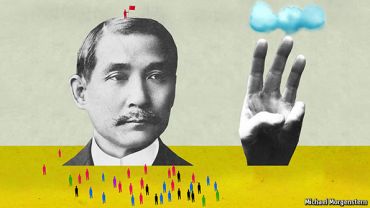
China and Taiwan struggle over Sun Yat-sen’s legacy | The Economist

FOR decades Taiwan’s rulers have paid their respects from afar to Sun Yat-sen, also known as Sun Zhongshan: “father of the nation”, founder of the Kuomintang (KMT) or Nationalist Party, and first president of the Republic of China.

In a ritual called yaoji, they face towards Sun’s mausoleum in Nanjing, 800km (500 miles) to the north-west in China, and offer fruit, burn incense and recite prayers.

Now that links across the Taiwan Strait are better, Sun-worshippers may make the pilgrimage in person. On October 31st it was the turn of the KMT’s chairwoman, Hung Hsiu-chu. But not only do some Taiwanese adore Sun. Museums in his honour also exist in Hong Kong, Macau, Singapore and Penang. He has a memorial park in Hawaii, where the great republican spent his teenage years, and a plaque in London, where he lived in exile from 1896-97. Most striking of all, he is admired by the Chinese Communists, who “liberated” China in 1949 from KMT rule.

In the Communist telling, Sun is the “forerunner of the democratic revolution”. As one visitor to his mausoleum put it this week: just as one sun and one moon hang in the sky, “there is only one father of the country.” There may be more Zhongshan Streets in China’s cities than Liberation Avenues. To mark this month’s anniversary of Sun’s birth 150 years ago, the state is minting a set of commemorative coins, including 300m five-yuan (75-cent) pieces that will go into circulation. It is a signal honour for a non-Communist. The party views Sun as a proto-revolutionary.

He makes an unlikely hero. Sun spent much of his life not in the thick of action but abroad. Half-a-dozen revolts that he helped organise against an ossified Qing dynasty were failures. As for the Wuchang uprising of October 1911, the catalyst for the end of three centuries of Manchu domination, he learnt of it from a Denver newspaper. He was back at the head of China’s first republican government early the following year, but merely as “provisional” president. Lacking the military strength to pull a fractured country together, he said he was the place-warmer for a strongman, Yuan Shikai. The nascent republic soon shattered and Yuan crowned himself emperor. Pressure from Western powers and Japan exacerbated China’s bleak situation. By 1916 Sun was back in exile again, in Japan.

For all that, Sun had brought down a rotten empire. For years he had raised the alarm over China’s direction, denouncing the Manchus and the rapaciousness of external powers. All his life, Sun had strived for a new republican order to turn a stricken China into a modern nation-state.

His ideas were hardly systematic, but he never deviated from the priorities of fostering national unity among Chinese, promoting democracy and improving people’s livelihoods—his “Three Principles of the People”. While railing against foreign depredations, he called for Chinese to embrace Western freedoms and rights (Sun’s messianic drive may have derived from his version of Christianity). His was an astonishingly more cosmopolitan world-view than that displayed by today’s Chinese leaders.Yet the longest-lasting impact of Sun on Chinese political life derives from something different. In the early 1920s he listened to advisers from the Soviet Union, which had won his admiration by renouncing territorial claims in China. He reorganised the KMT along Leninist lines, giving himself almost dictatorial powers (in Leninspeak: “democratic centralism”). The immediate effects were striking: an alliance between the KMT and the young Communist Party and a northward military advance in 1926 under Chiang Kai-shek, Sun’s heir, that toppled the warlords who were then wreaking havoc. Sun had died of liver failure the year before. He did not live to experience the brief national unity that Chiang imposed, nor the parties’ fatal split and descent into bloodshed, nor their struggle over Sun’s mantle.

Follow the Sun

And his legacy today? Consider that among his three principles, the two 20th-century dictators, Mao Zedong in mainland China and Chiang Kai-shek on Taiwan, gave a damn only about the first, national unity, on which, by their standards, they must be judged poorly. Sun’s Leninist party organisation—never one of his hallowed principles—had a far more profound impact on the two autocrats, and still does on China’s rulers today.

In Taiwan dictatorial KMT rule began crumbling a few years after Chiang’s death in 1975. Democratic development since then, including within the KMT, and the growth of a prosperous civil society, seem in line with Sun’s second and third principles relating to democracy and prosperity. But as for the first, a Chinese nationalism: forget it. Sun’s portrait still hangs in schools and government offices, and looks serenely down on the frequent fisticuffs in Taiwan’s parliament. But after resounding defeat in elections early this year, the KMT struggles for relevance on an island that is proud of its separateness from China. If there is any echo of Sun’s idealism, it is in the student “Sunflower Movement”, which wants to keep China at bay. For many Taiwanese, the Republic of China, Taiwan’s official name, is a figleaf for independence; Sun is an old ineffectual ghost. The current president, Tsai Ing-wen of the pro-independence Democratic Progressive Party, performed no yaoji this year.

And China? Democratic centralism still prevails—exemplified by the party’s monopoly on power, Xi Jinping’s autocratic rule and the suppression of dissent. Were Sun to speak from his tomb, he might remind Mr Xi how, under the Communist Party, national unity, real democracy and even broad-based prosperity remain elusive. He might point out, too, that when Sun adopted Leninism it was to advance rather than trump his beloved principles. In his final will, Sun wrote: “The work of the revolution is not done yet.” “Blimey,” he might now say: “Couldn’t you think of trying something different?”

Source: China and Taiwan struggle over Sun Yat-sen’s legacy | The Economist

04/11/2016

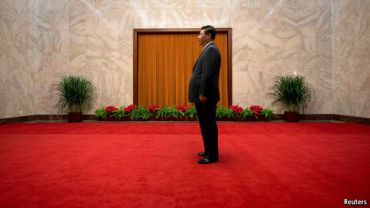
Xi Jinping gets a new title | The Economist

COMMUNIST leaders relish weird and wonderful titles. Kim Jong Il, the late father of North Korea’s current “Great Leader”, was, on special occasions, “Dear Leader who is a perfect incarnation of the appearance that a leader should have” (it doesn’t sound much better in Korean). China’s rulers like a more prosaic, mysterious epithet: hexin, meaning “the core”.

Xi Jinping—China’s president, commander-in-chief, Communist Party boss and so forth—is now also officially “the core”, having been called that in a report issued by the party’s Central Committee after a recent annual meeting.

The term was made up in 1989 by Deng Xiaoping, apparently to give his anointed successor, Jiang Zemin, greater credibility after the bloody suppression of the Tiananmen Square protests. Just as Mao had been the core of the first generation of party leaders and Deng himself of the second, so Mr Jiang was of the third. (Hu Jintao, Mr Xi’s predecessor, was supposedly offered the title of fourth-generation core but modestly turned it down.)

Being core confers no extra powers. Mr Xi has little need of those; he is chairman of everything anyway. Status, though, is what really matters in China (Deng ruled the country for a while with no other title than honorary chairman of the China Bridge Association). And Mr Xi seems to be finding that all his formal power does not convey enough. Early this year, in what looked like a testing of the waters, a succession of provincial party leaders kowtowed verbally to Xi-the-core. But the term soon disappeared from public discourse. Its revival makes it look as if Mr Xi has won a struggle to claim it.

That may augur well for him in his forthcoming battles over the appointment of a new generation of lesser officials (the peel?) at a party congress next year. Mr Xi wants to replace some of the 350-odd members of the central committee with his own people, while keeping as many of his allies as he can. In a sign that he might be able to do that, officials have started dismissing as “folklore” an unwritten rule that members of the Politburo have to retire at 68. The rule is commonly known as “seven up, eight down” (qi shang, ba xia), meaning 67 is fine, 68 is over the hill. Getting rid of it would seem to open the way to the non-retirement of several of Mr Xi’s close allies, notably 68-year-old Wang Qishan, who is in charge of fighting graft. It might even pave the way for Mr Xi’s own refusal to collect his pension when his second (and supposedly final) term as party chief is up in 2022, and he will be 69.

There is another parallel between political language now and in 1989. The recent meeting eschewed the party’s usual practice of tying current events to the triumphs of earlier Communist history and instead set the scene by referring mostly to the congress in 2012, when Mr Xi became leader. Another time when the party ignored history in this way was after the Tiananmen killings, when it wanted to draw a veil over what had just occurred and signal a fresh, dictatorial start. Mr Xi seems to be saying, implicitly, that a new era has begun with him, core among equals.

Source: Xi Jinping gets a new title | The Economist

Law of Unintended Consequences

continuously updated blog about China & India

ChiaHou's Book Reviews

continuously updated blog about China & India

What's wrong with the world; and its economy

continuously updated blog about China & India