Archive for ‘China alert’

03/10/2016

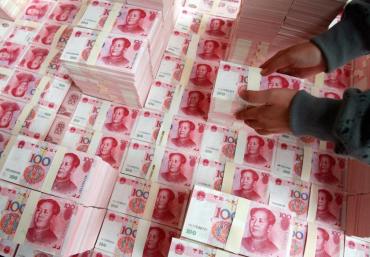
China’s Yuan Just Joined An Elite Club Of IMF Reserve Currencies

China’s yuan joins the International Monetary Fund’s basket of reserve currencies on Saturday in a milestone for the government’s campaign for recognition as a global economic power.

The yuan joins the U.S. dollar, the euro, the yen and British pound in the IMF’s special drawing rights (SDR) basket, which determines currencies that countries can receive as part of IMF loans. It marks the first time a new currency has been added since the euro was launched in 1999.The IMF is adding the yuan, also known as the renminbi, or “people’s money”, on the same day that the Communist Party celebrates the founding of the People’s Republic of China in 1949.

“The inclusion into the SDR is a milestone in the internationalization of the renminbi, and is an affirmation of the success of China’s economic development and results of the reform and opening up of the financial sector,” the People’s Bank of China said in a statement.

China will use this opportunity to further deepen economic reforms and open up the sector to promote global growth, the central bank added.

The IMF announced last year that it would add the yuan to the basket, so actual inclusion is not expected to impact financial markets. But it puts Beijing’s often opaque economic and foreign exchange policy in the international spotlight as some central banks add yuan assets to their official reserves.

Critics argue that the move is largely symbolic and the yuan does not fully meet IMF reserve currency criteria of being freely usable, or widely used to settle trade or widely traded in financial markets. U.S. Republican presidential nominee Donald Trump has said he will formally label China a currency manipulator if he wins November’s election.

China stunned investors by devaluing the currency last year and the yuan has since weakened to near six-year lows, adding to worries about already feeble global growth.

Some China watchers also fear that Beijing’s commitment to further market opening and financial sector reforms will fade after its diplomatic success, despite repeated reassurances from Beijing it will continue with the process.

U.S. Treasury Secretary Jack Lew said on Thursday the yuan was “quite a ways” from true global reserve currency status. The new IMF status recognizes the “enormous” change in China in the last 10 years that had made the yuan more open, but Beijing still had work to do to make its currency and its economy more market-driven, he said. “Being part of the SDR basket at the IMF is quite a ways away from being a global reserve currency,” he said.

Capital Economics said inclusion of the currency in the IMF’s SDR basket will have minimal impact on foreign demand for yuan assets, so “offers little support” for the currency.“

If anything, the risk is that official intervention to keep the renminbi stable ahead of its inclusion will subsequently be paired back, allowing for renewed deprecation,” it said in a research note.

The IMF on Friday fixed the relative amounts of the five currencies in the basket for five years, based on their average exchange rates over the past three months.

Source: China’s Yuan Just Joined An Elite Club Of IMF Reserve Currencies

03/10/2016

Furniture Retailing With Chinese Characteristics – China Real Time Report – WSJ

At the opening of Zaozuo’s first furniture store this month in Beijing, a shopper snoozed on a couch while others clambered onto wall-mounted shelves to take selfies perched in chairs.

Welcome to furniture retailing with Chinese characteristics.Online furniture startup Zaozuo Zaohua Zworks Ltd. opened the outlet in an upscale mall after hitting resistance from customers wary of buying bulky items without so much as a feel of the fabric, let alone a bit of shuteye.

Liu Yusi, a 33-year old human-resource executive living in Beijing, said the showroom is a good idea given that buying large pieces of furniture without a test drive can be a leap of faith, although she was a little disappointed there weren’t any beds on display. “Maybe the store is too small,” Ms. Liu said. “But I think a mattress is something you really need to lay on before you decide to buy.”

Zaozuo has tried to distinguish itself from competitors by letting customers vote on the design and style of furniture items at the prototype stage before they’re mass produced, a strategy it says reduces inventory and cuts cost. This is a Chinese adaptation of business models used by the likes of U.S. website Threadless.com — which conducts online polls of crowd-sourced T-shirt designs before producing winning entries – and by crowd-funding sites that have investors vote on ventures they’re willing to fund.

Zaozuo’s customers vote for the designs they’d like to buy. PHOTO: ZAOZUO, DON ARBOUR/THE WALL STREET JOURNAL

The approach has its skeptics. Guangdong Weiyuhua Furniture Co. says it thinks Zaozuo’s voting is a gimmick and questions whether selling furniture online is sustainable. “It targets a few rich people in cities like Beijing or Shanghai,” said company sales manager Li Songzhi. “Traditional furniture companies like ours have real stores all over China.”

With nearly 700 million online users, Chinese consumers are driving explosive growth in the e-commerce sector, undercutting traditional retailers and leaving new online ventures fighting for an edge. Zaozuo co-founders, Stanford business school graduates Shu Wei and Guan Zishan, say China’s struggling manufacturing sector needs a wakeup call as it battles rising debt and excess capacity.“

The old system is not working very well,” said Ms. Shu. “That was the starting point of our business model.”

One potential problem with the company’s voting system is possible voter fraud, says Travis Wu, China research director with consultancy Forrester Research Inc. “In China, everything is a bit tricky, and lots of people try to game the system,” Mr. Wu said. That could see designers tilt results toward their own models, for example, or allow competitors to steer Zaozuo into producing money-losing items, he said.

Another concern: with Zaozuo opening a showroom, it risks driving up costs and undercutting its advantage over traditional furniture makers. Mr. Guan says users must be registered before voting, the company watches carefully for unusual online activity and the new store is not a major investment.

Zaozuo, which attracted several thousand curious shoppers to its store launch on a recent weekend, sees itself inhabiting a competitive space between expensive designer brands and mass marketers like Sweden’s IKEA, a company that attracts its share of showroom lounge lizards. On any given weekend, entire families can be found snoozing on beds in Ikea’s massive showrooms, luxuriating in the air conditioning and enjoying the inexpensive food.

China’s fragmented furniture industry with around 5,000 large companies and combined revenue of 244.5 billion yuan [$37.3 billion] in 2015, up 16.1% increase from the previous year, is tradition-bound and due for a shakeup, say online companies. Internet furniture companies only command a tiny slice of the market but are growing rapidly. Privately held Zaozuo said sales are increasing by 40% annually although it has yet to break even. MZGF Furniture Studio Co., another online firm, said sales have been expanding by as much as 200% year on year in some months.

Zaozuo, which works with 50 Chinese factories and more than 80 European designers, has attracted $17.5 million in venture funding and hopes to eventually go public. Anna Fang, chief executive of venture capital group Zhen Fund, which has invested $1.3 million in Zaozuo, said prospects for the industry are promising but the startup may need to shorten delivery times, which range from three to 35 days. “Ikea can get furniture to you right away,” she added.At its store opening, Zaozuo said it tried to discourage shoppers from getting too comfortable on its furniture. “The customer might be comfortable, but the image is not that good for other customers who can’t feel the fabrics if someone’s sleeping on it,” said Mr. Guan. “Maybe they do it because they’re tired. Shopping can be very tiring.”

Source: Furniture Retailing With Chinese Characteristics – China Real Time Report – WSJ

30/09/2016

Rich province, poor province | The Economist

EARLY in the summer Xi Jinping, China’s president, toured one of the country’s poorest provinces, Ningxia in the west. “No region or ethnic group can be left behind,” he insisted, echoing an egalitarian view to which the Communist Party claims to be wedded.

In the 1990s, as China’s economy boomed, inland provinces such as Ningxia fell far behind the prosperous coast, but Mr Xi said there had since been a “gradual reversal” of this trend. He failed to mention that this is no longer happening. As China’s economy slows, convergence between rich and poor provinces is stalling. One of the party’s much-vaunted goals for the country’s development, “common prosperity”, is looking far harder to attain.

This matters to Mr Xi (pictured, in Ningxia). In recent years the party’s leaders have placed considerable emphasis on the need to narrow regional income gaps. They say China will be a “moderately prosperous society” by the end of the decade. It will only be partly so if growth fails to pick up again inland. Debate has started to emerge in China about whether the party has been using the right methods to bring prosperity to backward provinces.

China is very unequal. Shanghai, which is counted as a province, is five times wealthier than the poorest one, Gansu, which has a similar-sized population (see map). That is a wider spread than in notoriously unequal Brazil, where the richest state, São Paulo, is four times richer than the poorest, Piauí (these comparisons exclude the special cases of Hong Kong and Brasília).

To iron out living standards, the government has used numerous strategies. They include a “Go West” plan involving the building of roads, railways, pipelines and other investment inland; Mr Xi’s signature “Belt and Road” policy aimed partly at boosting economic ties with Central Asia and South-East Asia and thereby stimulating the economies of provinces adjoining those areas; a twinning arrangement whereby provinces and cities in rich coastal areas dole out aid and advice to inland counterparts; and a project to beef up China’s rustbelt provinces in the north-east bordering Russia and North Korea. The central government also gives extra money to poorer provinces. Ten out of China’s 33 provinces get more than half their budgets from the centre’s coffers. Prosperous Guangdong on the coast gets only 10%.

The number, range and cost of these policies suggest the party sees its legitimacy rooted not only in the creation of wealth but the ability to spread it around. Deng Xiaoping’s economic reforms, launched in the late 1970s, helped seaboard provinces, which were then poorer than inland ones, to catch up by making things and shipping them abroad. (Mao had discouraged investment in coastal areas, fearing they were vulnerable to attack.) In the 1990s the coast pulled ahead. Then, after 2000, the gap began to narrow again as the worldwide commodity boom—a product of China’s rapid growth—increased demand for raw materials produced in the interior (see chart).

That was a blessing for Mr Xi’s predecessor Hu Jintao, who made “rebalancing” a priority after he became party chief in 2002. It also boosted many economists’ optimism about China’s ability to sustain rapid growth. Even if richer provinces were to slow down, they reckoned, the high growth potential of inland regions would compensate for that.

But convergence is ending. GDP growth slowed across the country last year, but especially in poorer regions. Seven inland provinces had nominal growth below 2%, a recession by Chinese standards (in 2014 only one province reported growth below that level). In contrast, the rich provincial-level municipalities of Shanghai, Beijing and Tianjin, plus a clutch of other coastal provinces including Guangdong, grew between 5% and 8%. Though there were exceptions, the rule of thumb in 2015 was that the poorer the region, the slower the growth. Most of the provinces with below-average growth were poor.

Of course, 2015 was just one year. But a longer period confirms the pattern. Of 31 provinces, 21 had an income below 40,000 yuan ($6,200) per person in 2011. Andrew Batson of Gavekal Dragonomics, a research firm, says that of these 21, 13 (almost two-thirds) saw their real GDP growth slow down by more than 4 points between 2011 and 2014. In contrast, only three of the ten richer provinces (those with income per person above the 40,000 yuan mark) slowed that much. In 2007 all of China’s provinces were narrowing their income gap with Shanghai. In 2015 barely a third of them were. In other words, China’s slowdown has been much sharper in poorer areas than richer ones.

There are three reasons why convergence has stalled. The main one is that the commodity boom is over. Both coal and steel prices fell by two-thirds between 2011 and the end of 2015, before recovering somewhat this year. Commodity-producing provinces have been hammered. Gansu produces 90% of the country’s nickel. Inner Mongolia and Shanxi account for half of coal production. In all but four of the 21 inland provinces, mining and metals account for a higher share of GDP than the national average.

Commodity-influenced slowdowns are often made worse by policy mistakes. This is the second reason for the halt in convergence. Inland provinces built a housing boom on the back of the commodity one, creating what seemed at the time like a perpetual-motion machine: high raw-material prices financed construction which increased demand for raw materials. When commodity prices fell, the boom began to look unsustainable.

The pace of inland growth was evident in dizzying levels of investment in physical assets such as buildings and roads. Between 2008 and last year, as a share of provincial GDP, it rose from 48% to 73% in Shanxi, 64% to 78% in Inner Mongolia, and from 54% to an astonishing 104% in Xinjiang. In the country as a whole, investment as a share of GDP rose only slightly in that period, to 43%. In Shanghai it fell.

This would be fine if the investments were productive, but provinces in the west are notorious for waste. In the coal-rich city of Ordos in Inner Mongolia, on the edge of the Gobi desert, a new district was built, designed for 1m people. It stood empty for years, a symbol of ill-planned extravagance (people are at last moving in).

Investment by the government is keeping some places afloat. Tibet, for example, logged 10.6% growth in the first half of this year, thanks to net fiscal transfers from the central government amounting to a stunning 112% of GDP last year. Given the region’s political significance and strategic location, such handouts will continue—Tibet’s planners admit there is no chance of the region getting by without them for the foreseeable future.

Tibet is an extreme example of the third reason why convergence is ending. Despite oodles of aid, both it and other poor provinces cannot compete with rich coastal ones. In theory, poorer places should eventually converge with rich areas because they will attract businesses with their cheaper labour and land. But it turns out that in China (as elsewhere) these advantages are outweighed by the assets of richer places: better skills and education, more reliable legal institutions, and so-called “network effects”—that is, the clustering of similar businesses in one place, which then benefit from the swapping of ideas and people. A recent study by Ryan Monarch, an economist at America’s Federal Reserve Board, showed that American importers of Chinese goods were very reluctant to change suppliers. When they do, they usually switch to another company in the same city. This makes it hard for inland competitors to break into export markets.

There are exceptions. The south-western region of Chongqing has emerged as the world’s largest exporter of laptops. Chengdu, the capital of neighbouring Sichuan province, is becoming a financial hub. But by and large China’s export industry is not migrating inland. In 2002 six big coastal provinces accounted for 80% of manufactured exports. They still do.

This contrast is worrying. Though income gaps did narrow after 2000 and only stopped doing so recently, provinces have not become alike in other respects. Rich ones continue to depend on world markets and foreign investment. Poor provinces increasingly depend on support from the central government.

A divergence of views

Officials bicker about this. Mr Xi asserted the Robin-Hood view in Ningxia that regional gaps matter and that redistribution is needed. “The first to prosper,” he said, “should help the latecomers.” But three months earlier, an anonymous “authoritative person” (widely believed to be Mr Xi’s own adviser, Liu He) took a more relaxed view, telling the party’s mouthpiece, the People’s Daily, that “divergence is a necessity of economic development,” and “the faster divergence happens, the better.”

It is unclear how this difference will be resolved, though the money must surely be on Mr Xi. Economically, though, Mr Liu is right. Regional-aid programmes have had little impact on the narrowing of income gaps. More of them will not stop those gaps widening. Socially, a slowdown in poorer provinces should not be a problem so long as jobs are still being created in richer ones, enabling migrants from inland to find work there and send money home. But politically the end of convergence is a challenge to Mr Xi, who has been trying to appeal to traditionalists in the party who extol Mao as a champion of equality. Wasteful and ineffective measures to achieve it will remain in place.

Source: Rich province, poor province | The Economist

30/09/2016

Glass loos with a view open in China – BBC News

Whatever will the Chinese think of next?

China’s recent obsession with glass tourist attractions has gone round the U-bend with the opening of some see-through treetop public toilets.

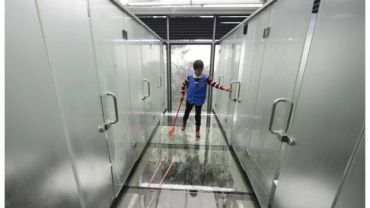
The loos, near Shiyan Lake in southern Hunan province, have fabulous views of both the forest below and other people using the facilities.

Cubicle walls, even those between the men’s and women’s sections, are only separated by lightly frosted glass.

But state media said few visitors dared use the loos on their opening day.

Image copyrightBARCROFT IMAGESImage caption

Shy users of the urinals may take comfort from the privacy barriers between them, though not in the fact they are made of glass

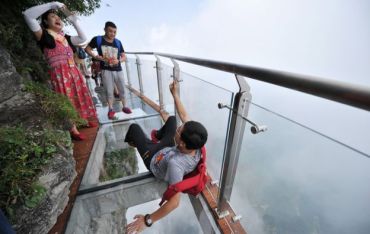
Despite a boom in the construction of glass bridges and walkways in scenic locations in China in recent years – in some cases so popular they had to be closed – these are thought to be the first entirely glass public bathrooms in the country.

However, it not the first time those busting to go have been exposed a little more than they might like by the enthusiasm for glass.

There were reports recently of some male toilets in a university dorm in Hunan which included one very public cubicle.

Image copyrightBARCROFTImage captionUnusually, a head for heights is a requirement for a job as a cleaner there

Image copyrightBARCROFTImage caption Awkward: cubicle walls are only lightly-frosted, even between the men’s and women’s sections

News of the wide-view WCs at Shiyan Lake sparked a range of reactions online.Responding to a Facebook post about it by state television channel CCTV, Ejike Nnadi summed up the feelings of many: “Hell no.”

Others were more taken by the idea. “You’ll be surprised by what you can tolerate when you really, really need to go,” said one post.

Another nodded towards another modern use for restrooms: “I’d be in there ’til my battery hit zero if there was signal in there!”

Image copyrightBARCROFTImage captionThe well-lit lavs are built on a steep hillside

Tina Chen took a dimmer view of all such projects though. “(It) is not about being shy, just again someone had extra money to waste.”

Image copyrightGETTY IMAGESImage caption Unusual glass structures have provided popular photo ops for tourists across China

Awkward or not, it is hoped that these bathrooms for the brave will encourage tourists to visit the countryside around Changsha city and admire the spectacular autumn colours of its forests.

Source: Glass loos with a view open in China – BBC News

29/09/2016

China punishes coal, steel companies for violating pollution, safety rules | Reuters

China’s state planner has punished hundreds of coal and steel companies by forcing them to close or cut output for violating environmental and safety regulations, the latest effort to crack down on the country’s heavily polluting industries.

The National Development and Reform Commission (NDRC) forced two steel companies to shut completely, 29 firms to halt production and another 23 to curb output, it said in a statement on Thursday. The closures and curbs followed a nationwide inspection of more than 1,000 steel makers in the world’s top producer.

Among more than 4,600 coal mines inspected, the NDRC has revoked safety certificates for 28 coal mines and forced another 286 coal mines to halt production, it added.

The planner did not identify or name the companies, or give details on how the companies broke the rules and how long the penalties will be in place.

Beyond the safety and environment rules, the NDRC also listed other infractions such as violations of energy consumption rules or quality standards.

The statement reflects the government’s continued push to force ageing mills and mines to comply with tough new pollution rules by meeting emission standards and installing appropriate monitoring equipment.

China’s unwieldy coal and steel industries are considered two of the biggest sources of pollution in the country.

The government is targeting coal output cuts of 500 million tonnes in the next three to five years.

Source: China punishes coal, steel companies for violating pollution, safety rules | Reuters

29/09/2016

Chinese Tourists Encouraged to Behave Ahead of Mass Vacation – China Real Time Report – WSJ

Urinating on the streets of Hong Kong? Hurling hot water at flight attendants? Stealing wood from Lovers’ Beach in Thailand?

These are the kind of mainland-Chinese tourist antics that the motherland is looking to stub out ahead of the week-long national holiday known as Golden Week, when throngs of citizens travel both domestically and abroad.

To help them do so, the China National Tourism Administration and one of China’s dominant online travel firms, Ctrip.com International, are teaming up to find model tourists to promote travel behavior worthy of emulation—and national recognition.

“Civility of Chinese tourists is an important indicator of a country’s soft power and one of the major ways to export a country’s influence,” the tourism administration’s Vice Chairman Wang Xiaofeng said at an event announcing the campaign.

The two organizations, along with state-run newspaper China Daily, are asking the Chinese public to provide examples of what they think is model traveler decorum. Ctrip will give gifts to exemplary participants, such as free travel products and company souvenirs, said Ctrip senior director of investment relations Zhou Shiwei.

“The campaign is about changing the perception of Chinese travelers,” he said. “We definitely want Chinese travelers to be well-received abroad.

”Examples include pictures of Chinese soccer fans who picked up trash in Seoul, even after the Chinese men’s team lost to South Korea earlier this month, or photos of Chinese tourists patiently waiting in line.Ctrip says the campaign is aiming to publish a compilation of guidelines and pictures suggested by Chinese netizens during Golden Week. Chinese tourists can upload pictures via Chinese social-media network Weibo, and to the China Daily website. It is unclear how the photos will be verified.More than 600 million Chinese are expected to travel abroad in the next five years, as China’s middle class grows and visa restrictions ease in some countries welcoming Chinese spending. Last year, about 120 million Chinese traveled overseas—10% more than in 2014, according to the national tourism administration.

Domestically, tourism generated about $620 billion last year, with more than four billion trips taken.

The campaign, entitled “Good Chinese Tourists,” is an addition to other recent efforts the government has put forth to curb travel misbehavior. Last year, it unveiled new measures that allow authorities to track the bad habits of wayward tourists for up to two years.

The tourism administration also recently published a guidebook on civilized tourism, in which it urges tourists to refrain from spitting and littering—common practices back home—and to take photographs only where permitted. “Do not chase, beat or feed animals,” it adds. “Do not be greedy with complimentary items.

”For traveling abroad, the guide includes recommendations that cutting in line is “shameful wherever you are” and suggests that tourists “not leave footprints on toilet seats.”

Source: Chinese Tourists Encouraged to Behave Ahead of Mass Vacation – China Real Time Report – WSJ

28/09/2016

Warning Sounded Over Chinese Economy – China Real Time Report – WSJ

What a contrast! See pair of articles – this on on China, the other on India, both from WSJ.

Recent stability in the Chinese economy masks deep-seated problems that threaten to rattle global markets in advance of a leadership change next year, according to a survey.

Ignoring these risks is shortsighted, said authors of the China Beige Book International, a quarterly survey that tracks the world’s second-largest economy.Data from the group’s third-quarter survey of 3,100 Chinese firms and 160 bankers point to some potential problems. New growth engines intended to shift the economy away from investment toward consumption-led growth are increasingly wobbly as corporate cash flow is squeezed and Beijing doubles down on traditional engines to stabilize output, the China Beige Book says.

“I’d find it earth-shatteringly surprising if we don’t have a significant problem between now and China’s leadership change” in the fall of 2017 when the 19th Party Congress convenes, said Leland Miller, China Beige Book’s president. “This is not a stable economy. It’s one that twists and turns and happens to end up at the same spot. There are real problems below the surface.”

Growth in China’s service industry, a cornerstone of its planned transition to a new and more sustainable economic model, weakened during the third quarter as financial services, private healthcare, telecommunications, media and other subsectors flagged, the group’s data showed. In retail, the apparel, luxury goods and food sectors slowed, it said, as online retailers continued to cannibalize brick-and-mortar sales.

Despite Beijing’s pledge to reduce excess Industrial capacity and pare debt, China remains heavily dependent on government spending to power traditional debt-fueled growth engines, the group said. Much of the economic momentum during the third quarter came from infrastructure, manufacturing, commodities and real estate and many of these sectors are in danger of losing momentum, it said.

While property sales remained strong in major cities, cash flow in the sector tightened and borrowing increased, a sign that investors should “think about getting off this train sooner rather than later,” the China Beige Book said.

“Deteriorating corporate finances and a rebalancing reversal seem a high price to pay for a quarter’s worth of stability,” the group added.

Economic and monetary authorities didn’t respond to requests for comment.

China roiled global markets last year when stocks plunged and Beijing intervened to prop them up. A few months later, it introduced a new currency system in which the yuan fell against the dollar, fueling concern that this would launch a destabilizing round of currency depreciations among rival trading nations. State spending and easy money policies since then have settled investor nerves.

China is expected to report third-quarter economic growth of around 6.7% next month, the level it posted in both the first and second quarters. Gauges such as industrial production and fixed-asset investment have been surprisingly robust over the past month.The trigger for another potential market jolt in the next few quarters could be the release of particularly weak Chinese service or retail data coinciding with a Federal Reserve interest rate rise or another global event, Mr. Miller said. “Right now, the markets are lulled to sleep,” he said. “People become used to the stable China narrative until they start looking more closely into the data.”

A report released Tuesday by the International Monetary Fund said China can reduce the negative impact on the global economy of its shift to slower but more sustainable growth by ending its use of targets to artificially prop up growth and by communicating its intentions clearly.

Other economists say they expect the Chinese economy to remain relative stable through the once-in-five-year leadership change, which is expected to be in October or November of 2017, as long as Beijing continues stimulating the economy enough to avoid a drop in growth. “I don’t think there’s going to be a crisis next year,” said Julian Evans-Pritchard, an economist with Capital Economics Pte. “But they often take their foot off the pedal too much, then tend to panic again and put it back on, creating a lag.”

The Bank for International Settlements warned last week that mounting leverage raises the risk of a financial crisis in China. The nation’s total debt, led by rising corporate obligations, is on target to reach 253% of gross domestic product by the end of 2016, a doubling over the past eight years, according to credit ratings agency Fitch Ratings Inc.

Third quarter China Beige Book data also pointed to areas of strength. The job market remains strong. The manufacturing outlook improved with new domestic and international factory orders picking up and deflationary pressure on industry ebbing.“It was not a disaster of a quarter,” Mr. Miller said. “But it’s a lot more negative than people think.”

Source: Warning Sounded Over Chinese Economy – China Real Time Report – WSJ

25/09/2016

Culture: Chinese, Indian and Japanese

I’ve just finished watching a short six-part series featuring Joanna Lumley on her trip from near the northern-most tip to the southern-most island of Japan – http://www.itv.com/hub/joanna-lumleys-japan/2a4327a0001. If, like me, you have not been to Japan but are curious about that mysterious far eastern country, then this show is well worth investing six hours of your time.

But the reason I’m raising it here on my blog is that to me it shows in stark contrast the three cultures today: Chinese, Indian and Japanese.

The series illustrate, without a shadow of doubt, that the Japanese have somehow managed to retain most of its old traditions and culture while adopting much of (the best of ) Western culture.The two co-exist happily and without any visible friction.  For example, young girls in traditional kimono are shown visiting the famous cherry blossom festival, alongside Japanese in plain western clothing. Or modern, educated Japanese taking time off to do a multi-temple pilgrimage (see Lumley photo). 

The Chinese, in my opinion, have (certainly in urban areas) disbanded most of their traditional and culture – apart from a few national festivals – and adopted western customs and culture wholesale. Apart from a few speialist travelogue TV series on rural China (http://watchdocumentary.org/watch/wild-china-episode-01-heart-of-the-dragon-video_3a9158d41.html), any TV show on China reveals mainly western modernity.

And finally, my take on Indian culture is that it has not moved far from what has been prevalent over the centuries, apart from a thin veneer of western culture and customs such as car ownership (see India on Wheels – http://www.bbc.co.uk/programmes/b013q5y0) and western clothing or education for the upper class in the English language.

I would really like to hear from you, my blog readers, on this subject, hopefully based on personal experience rather than based on a TV programme!


23/09/2016

Guns and ghee | The Economist

TO MANY Indians, their country’s strategic position looks alarming. Its two biggest neighbours are China and Pakistan. It has fought wars with both, and border issues still fester. Both are nuclear-armed, and are allies with one another to boot. China, a rising superpower with five times India’s GDP, is quietly encroaching on India’s traditional sphere of influence, tying a “string of pearls” of alliances around the subcontinent. Relatively weak but safe behind its nuclear shield, Pakistan harbours Islamist guerrillas who have repeatedly struck Indian targets; regional security wonks have long feared that another such incident might spark a conflagration.

So when four heavily armed infiltrators attacked an Indian army base on September 18th, killing 18 soldiers before being shot dead themselves, jitters inevitably spread. The base nestles in mountains close to the “line of control”, as the border between the Indian and Pakistani-administered parts of the disputed territory of Kashmir is known. Indian officials reflexively blamed Pakistan; politicians and pundits vied in demanding a punchy response. “Every Pakistan post through which infiltration takes place should be reduced to rubble by artillery fire,” blustered a retired brigadier who now mans a think-tank in New Delhi, India’s capital.

Yet despite electoral promises to be tough on Pakistan, the Hindu-nationalist government of Narendra Modi has trodden as softly as its predecessors. On September 21st it summoned Pakistan’s envoy for a wrist-slap, citing evidence that the attackers had indeed slipped across the border, and noting that India has stopped 17 such incursions since the beginning of the year. Much to the chagrin of India’s armchair warriors, such polite reprimands are likely to be the limit of India’s response.

There are good reasons for this. India gains diplomatic stature by behaving more responsibly than Pakistan. It is keenly aware of the danger of nuclear escalation, and of the risks of brinkmanship to its economy. Indian intelligence agencies also understand that they face an unusual adversary in Pakistan: such is its political frailty that any Indian belligerence tends to strengthen exactly the elements in Pakistan’s power structure that are most inimical to India’s own interests.

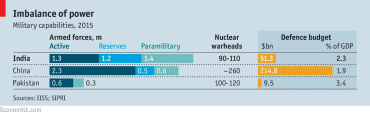
But there is another, less obvious reason for reticence. India is not as strong militarily as the numbers might suggest. Puzzlingly, given how its international ambitions are growing along with its economy, and how alarming its strategic position looks, India has proved strangely unable to build serious military muscle.

India’s armed forces look good on paper. It fields the world’s second-biggest standing army, after China, with long fighting experience in a variety of terrains and situations (see chart).

It has topped the list of global arms importers since 2010, sucking in a formidable array of top-of-the-line weaponry, including Russian warplanes, Israeli missiles, American transport aircraft and French submarines. State-owned Indian firms churn out some impressive gear, too, including fighter jets, cruise missiles and the 40,000-tonne aircraft-carrier under construction in a shipyard in Kochi, in the south of the country.

Yet there are serious chinks in India’s armour. Much of its weaponry is, in fact, outdated or ill maintained. “Our air defence is in a shocking state,” says Ajai Shukla, a commentator on military affairs. “What’s in place is mostly 1970s vintage, and it may take ten years to install the fancy new gear.” On paper, India’s air force is the world’s fourth largest, with around 2,000 aircraft in service. But an internal report seen in 2014 by IHS Jane’s, a defence publication, revealed that only 60% were typically fit to fly. A report earlier this year by a government accounting agency estimated that the “serviceability” of the 45 MiG 29K jets that are the pride of the Indian navy’s air arm ranged between 16% and 38%. They were intended to fly from the carrier currently under construction, which was ordered more than 15 years ago and was meant to have been launched in 2010. According to the government’s auditors the ship, after some 1,150 modifications, now looks unlikely to sail before 2023.

Such delays are far from unusual. India’s army, for instance, has been seeking a new standard assault rifle since 1982; torn between demands for local production and the temptation of fancy imports, and between doctrines calling for heavier firepower or more versatility, it has flip-flopped ever since. India’s air force has spent 16 years perusing fighter aircraft to replace ageing Soviet-era models. By demanding over-ambitious specifications, bargain prices, hard-to-meet local-content quotas and so on, it has left foreign manufacturers “banging heads against the wall”, in the words of one Indian military analyst. Four years ago France appeared to have clinched a deal to sell 126 of its Rafale fighters. The order has since been whittled to 36, but is at least about to be finalised.

India’s military is also scandal-prone. Corruption has been a problem in the past, and observers rightly wonder how guerrillas manage to penetrate heavily guarded bases repeatedly. Lately the Indian public has been treated to legal battles between generals over promotions, loud disputes over pay and orders for officers to lose weight. In July a military transport plane vanished into the Bay of Bengal with 29 people aboard; no trace of it has been found. In August an Australian newspaper leaked extensive technical details of India’s new French submarines.

The deeper problem with India’s military is structural. The three services are each reasonably competent, say security experts; the trouble is that they function as separate fiefdoms. “No service talks to the others, and the civilians in the Ministry of Defence don’t talk to them,” says Mr Shukla. Bizarrely, there are no military men inside the ministry at all. Like India’s other ministries, defence is run by rotating civil servants and political appointees more focused on ballot boxes than ballistics. “They seem to think a general practitioner can perform surgery,” says Abhijit Iyer-Mitra, who has worked as a consultant for the ministry. Despite their growing brawn, India’s armed forces still lack a brain.

Source: Guns and ghee | The Economist

23/09/2016

Shacking up | The Economist

WHEN Da Lin moved in with his girlfriend two years ago, his mother tried to stop them: she feared that their living together unmarried would sully his girlfriend’s reputation and, by association, his too. She will be happy only after they finally marry next year (his family is buying the apartment, hers the car).

That generational clash is replicated in thousands of families across China: cohabitation without marriage was long anathema and officially illegal until 2001. Today it is commonplace.China’s social mores are changing astonishingly quickly. Before 1980 around 1% of couples lived together outside wedlock, but of those who wed between 2010 and 2012, more than 40% had done so, according to data from the 2010 and 2012 China Family Panel Studies, a vast household survey (see chart). Some reckon even that is an underestimate. A recent study by the China Association of Marriage and Family, an official body, found that nearly 60% of those born after 1985 moved in with their partner before tying the knot, which would put the cohabitation rate for young people on a par with that of America.

The number of unmarried couples living together is growing for many of the same reasons it has elsewhere: rising individualism, greater empowerment of women, the deferral of marriage and a decline in traditional taboos on pre-marital sex. Greater wealth helps—more couples can afford to live apart from their parents. Yet Chinese cohabitation has distinctive characteristics. In rich countries, living together is most common among poorer couples, but in China youngsters are more likely to move in together if they are highly educated and live in wealthy cities such as Beijing and Shanghai. Shacking up is seen as a sign of “innovative behaviour”, say Yu Xie of Princeton University and Yu Jia of the Chinese Academy of Social Sciences.

Elsewhere rising cohabitation represents the fraying of marriage: many couples never bother to wed. In China, however, cohabitation is almost always a prelude to marriage—as for Da Lin and his girlfriend—rather than an alternative to it. Marriage is still near-universal, although the skewed sex ratio resulting from China’s one-child policy and a cultural preference for boys has resulted in a surplus of poor rural men who will remain unhappily single. Some highly educated women in cities forgo marriage too.In some Western countries those who live together for an extended period enjoy some of the same legal rights and obligations as married couples. In China cohabitation carries no legal weight. And it is very hard for a child born out of wedlock to acquire a hukou, or residency permit, which provides access to health care, education or other public services.In the 1980s virginity was considered a woman’s chief asset and few couples dared to date openly, let alone live together. Now China is in the midst of a sexual revolution—some 70% of people have sex before marriage, according to a study conducted in 2012. Many young Chinese, however, still have conservative ideas about how their elders should behave: although cohabitation is also on the rise among the elderly, many of them avoid remarrying because their adult children oppose it.

Source: Shacking up | The Economist

Law of Unintended Consequences

continuously updated blog about China & India

ChiaHou's Book Reviews

continuously updated blog about China & India

What's wrong with the world; and its economy

continuously updated blog about China & India