Archive for ‘China alert’

23/09/2016

A glowing future | The Economist

UPON learning (via a terse government statement) that their bustling port city in eastern China had been tipped as the likely site of a plant to recycle used nuclear fuel, residents of Lianyungang took to the streets last month in their thousands. Police, whose warnings against demonstrations were ignored, deployed with riot gear in large numbers but only scuffled with the protesters, who rallied, chanted and waved banners in the city centre for several days. “No one consulted us about this,” says one woman who participated in the protests. “We love our city. We have very little pollution and we don’t want a nuclear-fuel plant anywhere near us. The government says it is totally safe, but how can they be sure? How can we believe them?” she asks.

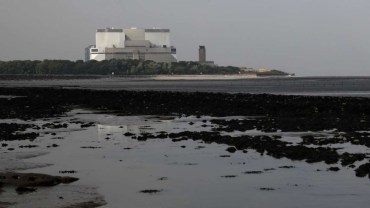
Such scepticism is shared by many in Lianyungang, which already hosts a nuclear-power plant (pictured), and elsewhere in China, where the government plans to expand nuclear power massively. China started its first nuclear plant in 1994. There are now 36 reactors in operation, and another 20 under construction (see map). A further four have been approved, and many more are in the planning stages. Only one new plant has been built in America, in contrast, since 1994; four more are under construction. By 2030 China is projected to get 9% of its power from nuclear, up from 2% in 2012. In absolute terms, its nuclear generation capacity will have increased eightfold over the same period, to 750 billion kilowatt-hours a year, roughly America’s current level.

After disaster struck Japan’s Fukushima nuclear power station in 2011, the Chinese authorities briefly halted this pell-mell rush toward the nuclear future, announcing a moratorium on the construction of new plants, urgent safety checks on existing ones and a prolonged policy review to decide whether nuclear power would remain a part of China’s energy strategy. The following year, however, the government resolved to carry on with its nuclear-energy programme.

The need is clear. Despite slowing economic growth, energy consumption per person is projected to rise dramatically, with no plateau in sight before 2030. Pollution from coal-fired power plants, China’s main source of electricity, causes widespread respiratory disease and many premature deaths each year, a source of persistent public anger. China has also made ambitious promises to reduce greenhouse-gas emissions. If it hopes to meet such targets, it will need to embrace nuclear, “because the only other truly reliable 24/7 source of electric power is coal,” says Zha Daojiong of Peking University.China’s utilities are also keen. The state-owned firms that run all the country’s nuclear plants are thought to earn a good return on their investment (their accounts are too murky to be certain), in part because their official backing allows them to finance new reactors very cheaply, and in part because regulators have fixed power tariffs in a favourable manner. One estimate put the return on nuclear assets between 2002 and 2012 at 7% a year, compared with 3% for coal- and gas-fired plants.

China even harbours ambitions to export its growing expertise in nuclear power. After relying first on Russian designs, and more recently importing American and French ones, China has also developed indigenous nuclear reactors. A recently approved deal with Britain, valued at $23 billion, will see China help finance a French-designed nuclear-power station and possibly build one of its own design later.

But China’s nuclear push has its critics. These include those who live near proposed nuclear facilities. Many, like the protesters in Lianyungang, are happy to have the power they need to run their air-conditioners but want to keep the unpleasant parts of the operation far from their doorsteps. Chinese now has a word for NIMBY: linbi, a fusion of the words for “adjacent” and “shun”. The government has repeatedly backed down in the face of public demonstrations, twice agreeing to relocate a uranium-enrichment plant, for example. It has also put the decision about the reprocessing plant in Lianyungang on hold.

Yet attitudes to nuclear power may be less hostile than in many Western countries. A study published in 2013 found an even split between supporters and opponents of expanding China’s nuclear-power industry. Compared with their counterparts in the rich world, Chinese citizens showed much greater “trust and confidence in the government” as the manager of nuclear policy and operations, the emergency responder in case of accidents and the provider of reliable information about the industry. The lead researcher for that study, He Guizhen of the Chinese Academy of Sciences, says that even protesters like those in Lianyungang are not implacably opposed. “Their message is not really that you can’t build these things no matter what, but that we are concerned about safety, especially after Fukushima, and we demand that you take safety seriously,” she says.

It appears this message is getting through. Early this year the government acknowledged in a white paper that its system for responding to a nuclear accident had “certain inadequacies”. In April officials revealed plans to draft a national nuclear-safety law. In May officials announced 600m yuan ($91m) in funding for six new nuclear-emergency squads, which would be ready for action by 2018. In August—on the same day that protesters marched in Lianyungang—China conducted its first “comprehensive nuclear-security emergency drill”. This week the government said officials must consult locals before settling the location of new nuclear facilities.

Deborah Seligsohn of the University of California, San Diego, says that because China’s nuclear-power industry is centrally run and limited to a handful of companies, authorities are able to keep tight control over safety standards, and that they have not hesitated to slow projects down when seeing signs of strain. Supervision, however, falls to several different agencies and levels of the bureaucracy. The burden of inspecting and managing the growing number of plants, she says, could be better handled by a more independent regulator in charge of its own budget.

In July China Energy News, a newspaper, reported that “quality problems” with domestically manufactured pump-valves were forcing some plants to shut down unexpectedly. (Most plants have since switched to imported valves.) More alarmingly, regulators this month revealed that a radiation-monitoring system at the Daya Bay nuclear-power station, which is within 50km of the huge cities of Shenzhen and Hong Kong, had been turned off inadvertently for three months before anyone noticed. Since no radiation leaked, the government deemed the oversight an event of “no safety significance”—one of several such lapses this year. The residents of Shenzhen and Hong Kong, presumably, would not see it in quite the same way.

Source: A glowing future | The Economist
23/09/2016

India signs deal for 36 French fighter jets to counter China, Pakistan squadrons | Reuters

India signed a deal to buy 36 Rafale fighter jets from France on Friday for around $8.7 billion, the country’s first major acquisition of combat planes in two decades and a boost for Prime Minister Narendra Modi‘s plan to rebuild an ageing fleet.

The air force is down to 33 squadrons, against its requirement of 45 to face both China, with which it has a festering border dispute, and nuclear-armed rival Pakistan.

French Defence Minister Jean-Yves Le Drian signed the agreement with his Indian counterpart, Manohar Parrikar, in New Delhi, ending almost 18 months of wrangling over terms between New Delhi and manufacturer Dassault Aviation.

India’s defence ministry said it would confirm the exact price later on Friday, but a ministry official said it was 7.8 billion euros ($8.7 billion).

Air force officials have warned for years about a major capability gap opening up with China and Pakistan without new state-of-the-art planes, as India’s outdated and largely Russian-made fleet retires and production of a locally made plane was delayed.

India had originally awarded Dassault with an order for 126 Rafales in 2012 after the twin-engine fourth-generation fighter beat rivals in a decade-long selection process, but subsequent talks collapsed.

Modi, who has vowed to modernise India’s armed forces with a $150 billion spending spree, personally intervened in April 2015 to agree on the smaller order of 36 and give the air force a near-term boost as he weighed options for a more fundamental overhaul.

The first ready-to-fly Rafales are expected to arrive by 2019 and India is set to have all 36 within six years.

Dassault Aviation said in a statement it welcomed the contract signing.

($1 = 0.8920 euros)

Source: India signs deal for 36 French fighter jets to counter China, Pakistan squadrons | Reuters

17/09/2016

The plateau, unpacified | The Economist

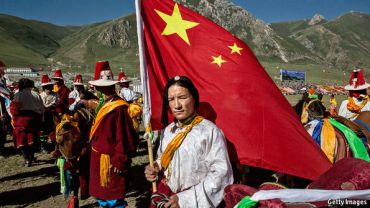
AN ELDERLY woman with long, grey plaits, wearing a traditional Tibetan apron of wool in colourful stripes, has spent her day weaving thread outside her home near the southern end of Qinghai Lake, high on the Tibetan plateau. She is among hundreds of thousands of Tibetan nomads who have been forced by the government in recent years to settle in newly built villages. She now lives in one of them with her extended family and two goats. Every few months one of her sons, a red-robed monk, visits from his monastery, a place so cut off from the world that he has never heard of Donald Trump. Her grandson, a 23-year-old with slick hair and a turquoise rain jacket, is more clued in. He is training to be a motorcycle mechanic in a nearby town. Theirs is a disorienting world of social transformation, sometimes resented, sometimes welcome.Chinese and foreigners alike have long been fascinated by Tibet, romanticising its impoverished vastness as a haven of spirituality and tranquillity. Its brand of Buddhism is alluring to many Chinese—even, it is rumoured, to Peng Liyuan, the wife of China’s president, Xi Jinping. Many Tibetans, however, see their world differently. It has been shattered by China’s campaign to crush separatism and eradicate support for the Dalai Lama, their spiritual leader who fled to India after an uprising in 1959. The economic transformation of the rest of China and its cities’ brash modernity are seductive, but frustratingly elusive.

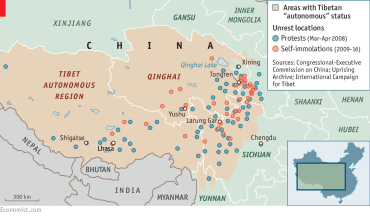
The story of political repression in Tibet is a familiar one. The Dalai Lama accuses China’s government of “cultural genocide”, a fear echoed by a tour guide in Qinghai, one of five provinces across which most of the country’s 6m Tibetans are scattered (the others are Gansu, Sichuan, Yunnan and the Tibet Autonomous Region, or TAR—see map). “We know what happened to the Jews,” he says. “We are fighting for our existence.” Less commonly told is the despair felt by many young Tibetans who feel shut out of China’s boom. They are victims of Tibet’s remote and forbidding topography as well as of racial prejudice and the party’s anti-separatist zeal. They often cannot migrate to coastal factories, and few factories will come to them. Even fluent Mandarin speakers rarely find jobs outside their region.

Yet Tibetans are not cut off from the rapidly evolving culture of the rest of China, where more than 90% of the population is ethnic Han. Mayong Gasong Qiuding, a 26-year-old hotel worker in Yushu in southern Qinghai, listens to Mandarin, Tibetan and Western pop music in tandem. He can rattle off official slogans but can recite only short Tibetan prayers. His greatest wish, he says, is to go to the Maldives to see the sea. Tibetan women in Qinghai use skin-whitening products, following a widespread fashion among their Han counterparts; a teenager roller-skates anticlockwise around a Buddhist stupa, ignoring a cultural taboo. Young nomads frustrate their elders by forsaking locally-made black, yak-hair tents for cheaper, lighter canvas ones produced in far-off factories.

Han migration, encouraged by a splurge of spending on infrastructure, is hastening such change. Although Tibetans still make up 90% of the permanent population of the TAR, its capital Lhasa is now 22% Han, compared with 17% in 2000. Many Tibetans resent the influx. Yet they are far more likely to marry Han Chinese than are members of some of China’s other ethnic groups. Around 10% of Tibetan households have at least one member who is non-Tibetan, according to a census in 2010. That compares with 1% of households among Uighurs, another ethnic minority whose members often chafe at rule by a Han-dominated government.

Core features of Tibetan culture are in flux. Monasteries, which long ago played a central role in Tibetan society, are losing whatever influence China has allowed them to retain. In recent years, some have been shut or ordered to reduce their populations (monks and nuns have often been at the forefront of separatist unrest). In July buildings at Larung Gar in Sichuan, a sprawling centre of Tibetan Buddhist learning, were destroyed and thousands of monks and nuns evicted. Three nuns have reportedly committed suicide since. Of the more than 140 Tibetans who have set fire to themselves since 2011 in protest against Chinese rule, many were spurred to do so by repressive measures at their own monastery or nunnery.

Cloistered life is threatened by social change, too. Families often used to send their second son to a monastery, a good source of schooling. Now all children receive nine years of free education. “The young think there are better things to do,” says a monk at Rongwo monastery in Tongren, a town in Qinghai, who spends his days “praying, teaching [and] cleaning”. New recruits often come from poorly educated rural families.

Mind your language

In the TAR (which is closed to foreign journalists most of the time), the Tibetan language is under particular threat. Even nursery schools often teach entirely in Mandarin. A generation is now graduating from universities there who barely speak Tibetan. Some people have been arrested for continuing to teach in the language. In April last year Gonpo Tenzin, a singer, was sentenced to three-and-a-half years in prison for his album, “No New Year for Tibet”, encouraging Tibetans to preserve their language and culture.

In some areas outside the TAR, however, the government is less hostile to Tibetan. Since the early 2000s, in much of Qinghai, the number of secondary schools that teach in Tibetan has risen, according to research there by Adrian Zenz of the European School of Culture and Theology at Korntal, Germany. The range of degrees taught in Tibetan has expanded too. Unlike elsewhere, someone who has studied mainly in Tibetan can still get a good job in Qinghai. A third of all government roles advertised there between 2011 and 2015 required the language. Despite this, many parents and students chose to be taught in Mandarin anyway, Mr Zenz found. They thought it would improve job prospects.

Karma chameleon

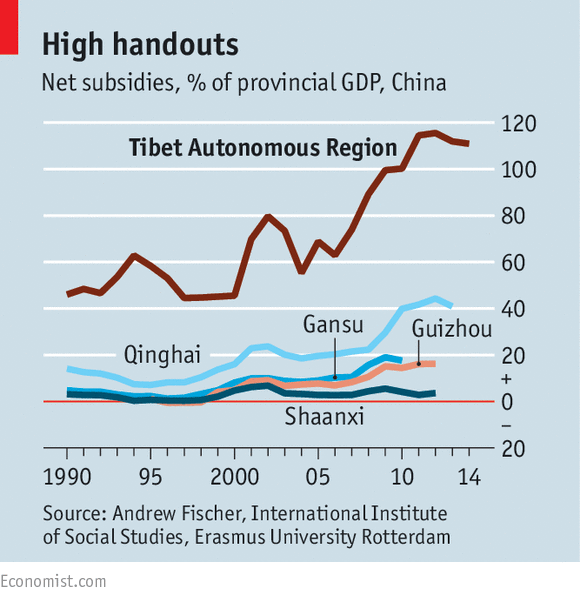
But work can be difficult to get, despite years of huge government aid that has helped to boost growth. Government subsidies for the TAR amounted to 111% of GDP in 2014 (see chart), according to Andrew Fischer of Erasmus University Rotterdam. Eleven airports serve Qinghai and the TAR—they will have three more by 2020. A 156-mile train line from Lhasa (population 560,000) to Shigatse (population 120,000), which was completed in 2014, cost 13.3 billion yuan ($2.16 billion). A second track to Lhasa is being laid from Sichuan, priced at 105 billion yuan.

Better infrastructure has fuelled a tourism boom—domestic visitors to the TAR increased fivefold between 2007 and 2015—but most income flows to travel agents elsewhere. Tourists stay in Han-run hotels and largely eat in non-Tibetan restaurants (KFC opened its first Lhasa branch in March). Tibetan resentment at exclusion from tourism- and construction-related jobs was a big cause of rioting in Lhasa in 2008 that sparked plateau-wide protests. Other big money-spinners—hydropower and the extraction of minerals and timber—are controlled by state-owned firms that employ relatively few Tibetans. The Chinese name for Tibet, Xizang, means “western treasure house”. But Tibetans have little share in its spoils. The rehousing of nomads has helped provide some with building jobs, but has also brought suffering: those relocated sometimes find it harder to make a living from herding.

In most other parts of China, villages have been rapidly emptying as people flock to work in cities. In the country as a whole, the agricultural population dropped from 65% to 48% as a share of the total between 2000 and 2010. On the plateau it fell only slightly, from 87% to 83%. It is hard for Tibetans to migrate to places where there are more opportunities. Police and employers treat them as potential troublemakers. In 2010 only about 1% of Tibetans had settled outside the plateau, says Ma Rong of Peking University. They cannot move abroad either. In 2012 Tibetans in the TAR had to surrender their passports (to prevent them joining the Dalai Lama); in parts of Qinghai officials went house-to-house confiscating them.

Karma chameleon

For university graduates, the prospects are somewhat better. There are few prospects for secure work in private firms on the plateau. But to help them, the government has been on a hiring spree since 2011. Almost all educated Tibetans now work for the state. A government job is a pretty good one: salaries have been rising fast. Few Tibetans see such work as traitorous to their cause or culture. But the government may not be able to keep providing enough jobs for graduates, especially if a slowdown in China’s economy, which is crimping demand for commodities, has a knock-on effect on the plateau.

Many of the problems faced by Tibetans are common in traditional pastoral cultures as they modernise. But those of Tibetans are compounded by repression. They are only likely to increase when the Dalai Lama, now 81, dies. The central government will try to rig the selection of his successor, and no doubt persecute Tibetans who publicly object.

In private, officials say they are playing a waiting game: they expect the “Tibetan problem” to be more easily solved when he is gone. They are deluding themselves. They ignore his impact as a voice of moderation: he does not demand outright independence and he condemns violence. Tibetan culture may be under duress, but adoration of the Dalai Lama shows no sign of diminishing. Poverty, alienation and the loss of a beloved figurehead may prove an incendiary cocktail.

Source: The plateau, unpacified | The Economist

15/09/2016

China Enter Syria on Assad’s Side: Is This A World War?

Conor Boyle's avatarThe Conversation Room

At what point does Syria become a World War?

News has emerged today that China has joined a tripartite alliance with Russia & Iran to prevent the fall of Assad in the up until now secular and relatively stable Damascus. China has its own fears that the chaos of jihadist factions ruling various clusters of Syria, would become birth grounds for instability, may spill over to Russia & even lead to major trouble with separatist movements in China itself.

Questions have been raised as to whether Syria has become  a Third World War. When examining the power dynamics of The United States, Saudi & Israel on one side with China, Russia & Iran on the other, the internationalization of the conflict is of grave concern.

If diplomatic solution was not already an immediate necessity it certainly is even more so now.

For more in depth analysis, read:

http://www.irishtimes.com/news/world/middle-east/china-enters-fray-in-syria-on-bashar-al-assad-s-side-1.2764979

&

View original post

15/09/2016

Censors clamp down on China’s ‘Traingate’ – BBC News

In Britain the leader of the Labour Party, Jeremy Corbyn became embroiled in a very public argument with a rail company about whether or not he was able to get a seat on one of its trains – a controversy that quickly acquired the nickname ‘Traingate’.

Now China is experiencing its own Traingate moment, but in this case the official whose behaviour has come under scrutiny seems to be getting help to minimise discussion of his actions.

Chinese government censors are reportedly censoring mentions of Pan Changjie, the Deputy Commander of the People’s Armed Police Force, who it is claimed used his rank to secure first class seats on a high-speed train.

It’s alleged that Pan compounded the offence by refusing to let a passenger sit in her reserved seat during a journey from Tangshan to Dandong. To make matter worse, Communist Party officials are not allowed to travel first class, and so the incident has enraged some online users.

Anjing_BerBer says Pan refused to get out of her reserved seat

However, most posts that mention Pan appear to have been swiftly taken offline.

The allegations surfaced when a woman with the social media handle ‘Anjing_BerBer’ blogged about her experiences of travelling on the same train as Pan and his colleagues on 6 September.

The woman said she had bought a first class reserved seat. But she described how, when she boarded the train, she found Pan in her seat, surrounded by a group of officials. She asked him to move, but said that he refused, and said warningly, “We’re from the Beijing Armed Police.”

She took her phone out to film him but describes how she was “blocked and threatened by black-clad Special Police“. However, she managed to take a picture of Pan and some of his colleagues playing cards on the train, while she was forced to stand for most of the journey.

The woman’s post with the photo was removed from the social media platform Weibo, a fact she noted in a later post. “My published article was ‘automatically’ deleted. How strange! There might be someone who has a guilty conscience,” she wrote.

“My published article was ‘automatically’ deleted. How strange! There might be someone who has a guilty conscience.”

No media in mainland China have mentioned the alleged incident and a search of Pan’s name on leading search engine Baid brings up news reports only from as recently as August.

Posts on Weibo that mention Pan have been quickly taken offline by government censors. According to censorship-monitoring website Free Weibo, “Pan Changjie” is currently one of the top 10 censored search terms.

Source: Censors clamp down on China’s ‘Traingate’ – BBC News

15/09/2016

Britain approves China-backed Hinkley Point nuclear plant deal after review of scheme | South China Morning Post

The British government said on Thursday it was giving the green light to a controversial new nuclear project at Hinkley Point after Prime Minister Theresa May ordered a review.

“Having thoroughly reviewed the proposals for Hinkley Point C, we will introduce a series of measures to enhance security and will ensure Hinkley cannot change hands without the government’s agreement,” Business Secretary Greg Clark said in a statement.

Beijing calls for British nuclear project financially backed by China to proceed.

“Consequently, we have decided to proceed with the first new nuclear power station for a generation.”

The board of French state-owned power company EDF approved its participation in the project in southwest England on July 28, only for Britain’s new government under May to announce hours later that it wanted to review it.China has a one-third stake in Hinkley Point and analysts have warned that Britain would have risked its relations with the world’s second-largest economy if it cancelled the costly deal.

Source: Britain approves China-backed Hinkley Point nuclear plant deal after review of scheme | South China Morning Post

13/09/2016

China’s Industrial Output, Retail Sales Accelerate in August – China Real Time Report – WSJ

China’s economy strengthened in August, with a slew of data, from factory production to retail sales, beating estimates Tuesday. The improved performance is a fresh sign that stepped-up government spending and strong property sales are helping to stabilize growth in the world’s second-largest economy.

As for the numbers themselves, as reported by the government, industrial output rose 6.3% last month from a year earlier. Investment in buildings and other fixed assets outside rural households climbed a better-than-expected 8.1% year over year in the first eight months of 2016, while retail sales grew 10.6% in August from a year ago.

Economists generally cheered the numbers, but wondered how long the better times would last. Following are excerpts from economists’ views on the latest data, edited for length and style:Better-than-expected data out of China today raise hopes that policymakers’ efforts to reverse the slide in investment growth are seeing some success. Stronger industrial activity last month appears to have been partly driven by a recovery in investment spending, especially in the state sector. The delayed impact of earlier policy easing means that a stronger second half of this year is likely. The latest evidence of a pick-up suggests that recent concerns that policy easing had failed to provide any noticeable boost to the economy were likely somewhat premature.  Julian Evans-Pritchard, Capital EconomicsToday’s data suggest that the downside risk for third quarter GDP is significantly reduced. Investment in manufacturing industry increased only 3% in Jan-Aug, while investment in services picked up to 11.2%, showing economic rebalancing continues to take place. The uptick in industrial output is consistent with the rebound in the August official manufacturing PMI. However, the divergence of PMI performance between large corporates and small- and medium-size enterprises remains a concern.

Louis Lam and David Qu, ANZ ResearchWe expect investment to remain under pressure for the rest of the year because of slower real estate construction and spare capacity in key sectors. But with industrial profits recovering recently, and investment also up in August, the downward pressure should diminish. Meanwhile, export momentum should improve along with global trade, while we expect consumption to hold up. In all, while further stimulus is necessary to reach the government’s GDP growth target of at least 6.5% this year, the outlook has improved slightly after the August data.  Louis Kuijs, Oxford EconomicsChina needs to nurture an initial economic stabilization with continued fiscal support. Today’s data show economic growth seems to have stabilized a little last month, but it is not on a solid footing yet.  Measures such as tax cuts and increased government spending can not only help spur growth but also help restructure the economy by boosting consumption. Fiscal expenditures rose 10% in August from a year earlier, much faster than July’s 0.3% increase.  Liu Xuezhi, Bank of Communication

Source: Economists React: China’s Industrial Output, Retail Sales Accelerate in August – China Real Time Report – WSJ

08/09/2016

A 16-year-old British girl earns £48,000 helping Chinese people name their babies – BBC Newsbeat

Beau Jessup, a British A-level student from Gloucestershire, came up with the idea after a family visit to China.

They were out for a meal with friends when she was asked to give an English name to a newborn baby.

In China it is considered important to have an English name for future study or business with the UK.

‘Special Name’ requires the user to pick five of the 12 personality traits which they most hope their baby will grow into

In China they name their child based on the elements and Beau wanted a similarity between how they pick their Chinese name and how they pick their English name.

And she does this by assigning personality traits to each English name.

They also select the gender of the baby and pay the equivalent of 60p.

The three chosen names are then shared with family and friends on We-Chat, China’s WhatsApp equivalent, to help make the final decision.

Each suggestion is printed on a certificate with its meaning and an example of a famous person with that name.

Beau says that when she was first asked to name her father’s friend’s baby, she was surprised.

“I’m not really qualified or relevant enough in that baby’s life to be the person to give it a name.

“But after hearing of some of the “embarrassing” names, Beau decided she needed to act.

There was someone called Rolex

“There are quite a few examples where people have gotten the names wrong.”

Beau explains that the Chinese are fascinated by western culture but their access to it is restricted by the government in China.There isn’t open access to the internet so they can’t use standard baby naming websites that people may use in the UK.

“Being exposed to luxury items and things like Harry Potter, Disney films and Lord of the Rings means they use those for reference.

“I once heard of someone called Gandalf and another called Cinderella.”

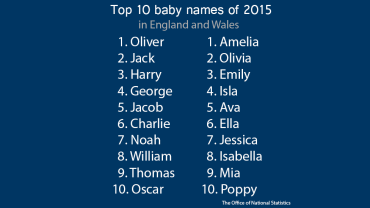
Amelia and Oliver were the most popular baby names in England and Wales in 2015

That’s according to the Office for National Statistics which released the complete set of data last week.

But Beau doesn’t know which names are the most popular on her website, and she’s “happy about that”.

“It is called ‘special name’ and it’s based on individual preference and what they personally want their child to be.”

Beau says it’s quite strange to know she’s named more than 200,000 babies

“It’s nice to be a part of such a happy experience and be a part of those young stages in a baby’s life.”The site’s success has been a pleasant surprise.

“I wanted to do it just to see if an idea could turn into more than just simply an idea.”

And I never expected it to become more than just a small project because I never really considered myself very academic.

“It is obviously a nice surprise, but it is definitely a surprise.”

Source: A 16-year-old British girl earns £48,000 helping Chinese people name their babies – BBC Newsbeat

08/09/2016

Daimler to sell Mercedes-Benz branded all-electric battery cars in China | Reuters

Germany’s Daimler AG plans to sell Mercedes-Benz branded all-electric battery cars in China, its China chief said on Wednesday, as the automaker capitalizes on government initiatives aimed at growing the market for new-energy vehicles (NEVs).

Hubertus Troska said the government’s push, which involves tax breaks and other policy support, helped the number of NEVs sold last year surpass 300,000, making China the world’s biggest market for electric, gasoline-electric and other such vehicles.

The majority of those vehicles were priced under 250,000 yuan ($37,515) and offered mainly by Chinese automakers, Troska said at an analyst and investor conference in Beijing.

Given factors including the government push – which falls under a broader drive to cut oil dependence and air pollution – Daimler is “very confident NEVs will be an important factor of the Chinese market,” Troska said.”Mercedes-Benz is also going to play a role in China in NEVs,” he said, referring to the planned cars.

He also said he sees demand over time shifting toward a “higher segment” of more expensive and capable all-electric battery cars and plug-in hybrids.Troska did not elaborate on the planned cars such as cost, pricing, models or launch dates. But investor relations head Björn Scheib said Daimler plans to show a concept electric car at the Paris Motor Show which opens to the public on Oct. 1.

Daimler currently sells one all-electric battery model in China under its smart brand, and one under the Denza brand it operates with local partner BYD Co Ltd.

Its China line-up also includes plug-in gasoline-electric hybrid versions of the Mercedes-Benz C-class and S-class sedans and GLE crossover sport utility vehicle.

Source: Daimler to sell Mercedes-Benz branded all-electric battery cars in China | Reuters

06/09/2016

Early Look: China’s Economy Likely Perked Up as Summer Wound Down – China Real Time Report – WSJ

After a summer lull, China’s economy is likely to have picked up, if only slightly, in August, according to economists.

The stirring in business activity, while lackluster, points to stabilization in the world’s second-largest economy, a survey of 15 economists by The Wall Street Journal showed. August data numbers to be released in coming days are expected to show that factory output improved marginally and new bank credit picked up, while investment and retail sales slowed, though not by much, the survey said.“We expect the upcoming August data release to show China’s economic activity finding a slightly firmer footing after July’s more-than-expected weakening,” said economists at UBS Securities Asia Ltd.

A surprising rise in a key gauge of manufacturing activity earlier this month buoyed the outlook for many economists.Industrial output, a rough proxy for economic growth, likely grew 6.2% in August from a year earlier, compared with a 6.0% increase in July, the survey showed. Fixed-asset investment outside rural households, a key gauge of construction activity, likely expanded 7.9% for the January-to-August period, slightly slower than an 8.1% increase over the first seven months.

Retail sales likely climbed 10.1% in August, a tick down from July’s 10.2% growth.

Among the other positive signs, the consumer-price index, a main gauge of inflation, moderated, likely rising 1.6% from a year earlier last month and slightly slower than the 1.8% growth in July, the survey found. Meanwhile, the producer-price index, a gauge of factory gate prices, likely dropped 0.9% from a year earlier last month, improving from a 1.7% decline in July and continuing a march out of deflationary territory where it has been for more than four years.

The better performance should give policymakers confidence to stay the course and refrain from interest-rate cuts or other aggressive easing measures, economists said.

At the same time, the faint improvements are largely the result of better performance of large firms that benefit more from policy support, economists said, while growing piles of debt and percolating bubbles in the property market are a looming concern for policymakers.

“At this moment, the key constraint faced by China’s monetary policy is not inflation, but the property market and the financial market,” said economists at Macquarie Capital Ltd.

Chinese banks probably gave out 792.5 billion yuan ($118.69billion) in new credit last month, well above July’s 463.6 billion yuan, the survey of economists showed. The economists mainly attributed the rebound to seasonal patterns, since banks tend to pick up the pace of lending at the end of each quarter.

In July almost all the new credit went to medium- and long-term household loans, predominantly mortgage lending. Lending to corporate borrowers, however, recorded a net drain of 2.6 billion yuan, the first negative growth in 11 years.

Household mortgage loans may have continued to surge in August. Recent data show a jump in housing transactions in many cities, and housing prices continue to rise. Credit demand from the corporate sector likely remained sluggish, though may have improved mildly, economists of Standard Chartered Bank.

Trade also remained anemic. Outbound shipments likely declined 4.0% from a year earlier in August, compared with July’s drop of 4.4%, while imports likely dropped by 5.0%, improving notably from July’s 12.5% dip, the same poll showed. Improvements in imports reflect last year’s low base, likely slightly better industrial production activity, and continued easing of import price deflation, UBS economists noted.

That would bring the country’s trade surplus to $59.40 billion last month, widening from July’s $52.31 billion. A large trade surplus should lend support to the country’s hoard of foreign currencies, which is expected to have dropped only slightly last month. The nation’s total reserves likely fell by about $2 billion last month to $3.199 trillion, the survey showed.

Source: Early Look: China’s Economy Likely Perked Up as Summer Wound Down – China Real Time Report – WSJ

Law of Unintended Consequences

continuously updated blog about China & India

ChiaHou's Book Reviews

continuously updated blog about China & India

What's wrong with the world; and its economy

continuously updated blog about China & India