Archive for ‘China alert’

04/08/2016

Poland in talks with Chinese buyers over LOT airline stake | Reuters

Poland is in talks with potential investors from China over selling a stake in the state airline LOT [LOT.UL], Deputy Prime Minister Mateusz Morawiecki said on Wednesday.

Poland’s euroskeptic, conservative government has been looking to tighten its relations with China since coming to power last year. The two countries pledged deeper co-operation during the visit of China’s leader Xi Jinping to Warsaw in June.”LOT is our national carrier, which we are trying to save no matter the cost. It is deeply in debt,” Morawiecki told state news agency PAP on Wednesday, adding that without a national carrier Poland would become a more peripheral country.

LOT, one of the world’s oldest airlines, has for years struggled to compete against low-cost competitors like Ryanair (RYA.I) and bigger rivals. The state-owned airline was saved from bankruptcy in 2012 thanks to public aid of more than 500 million zlotys ($130 million).

“The previous government has already granted public support for LOT, we cannot grant another and we are looking for an investor,” Morawiecki said.

“According to EU law a carrier from outside the EU cannot take over more than 49 percent of a carrier from the EU, hence we are in talks with potential investors, among others, from China,” he said.Morawiecki also said that usually it is a very long road to finalize such a transaction.

Earlier on Wednesday, a Polish local newspaper reported that Chinese carrier Air China (601111.SS) is interested in buying a 49-percent stake in LOT with a delegation from the Chinese firm expected to arrive in Warsaw over the coming days.

However, a LOT spokesman said he had no knowledge of any plans for a capital tie-up between LOT and Air China.

“I have no knowledge regarding any planned capital co-operation between LOT and Air China,” Adrian Kubicki, LOT spokesman said. “We have commercial co-operation with Air China, which we want to develop, regarding the Warsaw-Beijing route.”

Air China was not immediately available for comment.

Source: Poland in talks with Chinese buyers over LOT airline stake | Reuters

04/08/2016

Rude Chinese banned from going on holiday | The Times & The Sunday Times

“Uncivilised” Chinese tourists who commit such crimes against etiquette as asking foreigners for selfies, throwing nut shells around or defacing historical sites may find themselves stuck at home because their names are on a travellers’ blacklist.

Authorities in China have been cracking down hard on individuals who sully the country’s name abroad by acting rudely or violently, and the national tourism administration introduced a blacklist for the worst offenders last year.

A draft regulation released this week will, if passed, allow government agencies and tour companies to share blacklists and bar trouble-makers from future trips.

As well as travel companies, government organisations such as customs control, quarantine and border protection bodies would potentially be able to access the blacklist and take measures against those on it.

So far the blacklist contains only 19 names. The administration said that behaviour that could lead to a tourist being blacklisted included “damaging public facilities or historical relics, ignoring social customs at tourism destinations and becoming involved with gambling or prostitution”.

The regulation draft, which is in its public comment phase, stated: “Punishments can be imposed by travel agencies or other related agencies or organisations based on the record.

”Some analysts questioned how effective implementation of the rule could be. Liu Simin, of the China Society for Futures Studies research group, said: “If tourism authorities want to restrict blacklisted tourists from travelling overseas, they can do this only through travel agencies. If travellers plan their own trips and skip the agencies, they’re out of reach.

”The introduction of the blacklist came after President Xi told Chinese tourists in 2014 to clean up their act when abroad to help to dispel negative stereotypes about them.

Talking in a light-hearted fashion, he said: “Do not litter water bottles everywhere. Do not damage coral reefs. Eat less instant noodles and more local seafood.

”The year before the president’s comments, Chinese tourists spent more than £14.5 billion on holidays abroad — more than any other country.

Badly behaved Chinese tourists have continued to make headlines since the introduction of the blacklist.

Last week a Chinese woman was arrested for common assault after throwing orange juice at a flight attendant on a flight from Dubai to Hong Kong. She is understood to have been angry because meals for her children had not been prepared by airline staff in advance.

Source: Rude Chinese banned from going on holiday | World | The Times & The Sunday Times

03/08/2016

Road test for homegrown transit elevated bus| Innovation

The transit elevated bus TEB-1 is on road test in Qinhuangdao, North China’s Hebei Province, Aug 2, 2016. China’s home-made transit elevated bus, TEB-1, conducted a road test running Tuesday.

The 22-meter-long, 7.8-meter-wide and 4.8-meter-high TEB-1 can carry up to 300 passengers. The passenger compartment of this futuristic public bus rises far above other vehicles on the road, allowing cars to pass underneath. [

Source: Road test for homegrown transit elevated bus[1]| Innovation

01/08/2016

Didi, Uber said to merge in China in $35 billion deal | Reuters

Ride-hailing firm Uber is to merge its China operations with bigger rival Didi Chuxing, and hold a one-fifth stake in the new business, in a $35 billion deal to end bruising competition between the two, according to a source familiar with the matter.

A deal between the two – which have been spending heavily to gain market share and battling fiercely for passengers – could be announced as early as Monday, said the source, who declined to be identified because the deal is not yet public.

The new entity combines Didi’s most recent valuation of $28 billion and Uber China’s $7 billion valuation for the $35 billion market capitalization. Uber China investors will have a 20 percent stake in the new company, the source said.Uber did not offer any immediate comment. Didi could not be reached for comment.

“It makes huge sense, Uber faces an uphill task in China especially since Didi is multiple times larger by transaction value and city coverage,” said Hong Kong-based Richard Ji, co-founder of All-Stars Investment Ltd, which manages about $900 million and owns Didi stock.

“This will lead to favorable outcomes for both companies. The biggest benefit is cost savings, they no longer have to give out subsidies to drivers and passengers. It will give pricing power as the new entity will become the dominant player. That means profitability will come sooner than later,” he added.

Source: Didi, Uber said to merge in China in $35 billion deal | Reuters

29/07/2016

Disgorging | The Economist

OUTSIDE China, the monster Three Gorges dam across the Yangzi river is one of the most reviled engineering projects ever built. It is blamed for fouling the environment and causing great suffering among the 1.2m people who were relocated to make way for its reservoir. Inside China, officials insist that the dam is an “unsung hero” (in the recent words of the Yangzi’s chief of flood control). But controversy over the project occasionally flares. Amid the country’s worst flooding in years, it is doing so again.
The Communist Party took enormous pride in the completion of the Three Gorges dam a decade ago; officials said it would play a vital role in taming a river which, when it flooded, often claimed hundreds or thousands of lives. Recently, however, censors have permitted a few ripples of complaint to disturb the glassy surface of state-run media. Online critics have asked whether the dam has failed to protect cities from flooding or whether it has caused earthquakes—and have not had their posts deleted. Granting permission to complain may seem surprising. But officials have reason to feel confident. The much-denounced dam seems to be passing its first big test as a flood barrier.

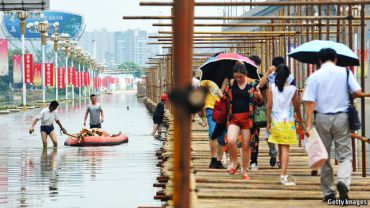
This season has been one of the wettest in China’s recent history, with 150 towns and cities suffering record amounts of rain. The Yangzi basin has been particularly hard hit. In the week to July 6th Wuhan, a giant city downstream from the dam, received 560mm (22 inches) of rain, its biggest ever downpour (residents are pictured on a temporary bridge).

China’s most recent experience of weather like this was in 1998, which was also the last time El Niño, a shift in the weather patterns of the western Pacific, had a big impact on the world’s weather. That summer the Yangzi burst its banks, causing more than 1,300 deaths. So far this year fewer than 200 people have died in the river’s basin.

One big difference is that in 1998 the Three Gorges dam was still under construction (it went into full operation in 2012). By July 24th it had held back about 7.5 billion cubic metres (260 billion cubic feet) of potential floodwater, which would have compounded disasters caused by torrential rain in the middle and lower reaches: some of the heaviest rains have occurred downstream from the dam. It is too soon to declare victory over the floods. The rainy season is only halfway through and more downpours are expected in August. But so far, as a method of flood control, the dam has done more or less what it was supposed to.

That doesn’t necessarily justify the project. One of the most important criticisms of it, by the late Huang Wanli, a hydrologist at Tsinghua University in Beijing, is that so much silt will eventually build up behind the dam that it will have to be taken down, leaving the Yangzi basin worse off than if the barrier had never been built. The region in which the dam stands is also one of the world’s most seismically active. Geologists worry that the weight of water in the sinuous reservoir, 600km (370 miles) from end to end, and the rise and fall of it, is causing more frequent tremors along the fault lines. Even small earthquakes can cause perilous landslides.

Considered purely as a means of flood control, the dam is a mixed blessing. The silt-free water that gushes through it fails to replenish embankments downstream, thus weakening them as flood barriers (several have collapsed this year). Below the dam, the water now runs faster; it has scraped away and lowered the Yangzi’s bed by as much as 11 metres, according to Fan Xiao, a geologist working for Probe International, a Canadian NGO. As a result, nearby wetlands drain into the river, damaging their ability to act as sponges during a flood.In 2000 another academic at Tsinghua, Zhang Guangduo (who had done the environmental feasibility studies for the dam), told the man in charge of building the barrier that “perhaps you know that the flood-control capacity of the Three Gorges Project is smaller than declared by us,” according to leaked documents. Peter Bosshard of International Rivers, an environmental NGO, asks whether it was wise to spend so many billions on one project, rather than strengthen flood-protection measures all along the Yangzi.

That point has been borne out by the many failures of local flood-control measures that have also occurred this year. In July parts of Wuhan’s metro system filled with water. This seems to be the result of bad management or corruption. According to People’s Daily, a party newspaper, only 4 billion yuan ($600m) of the 13 billion yuan allocated to improving drainage in the metro was actually spent. Local media say that one of the people responsible for drainage projects in the city is under arrest for taking huge bribes.

Such problems have been exacerbated by urban expansion. Wuhan used to have more than 100 lakes, but it has lost two-thirds of them to construction sites since 1949. The city’s wetlands have been gobbled up, too. Those that remain are too small to store flood waters. It is a relief that far fewer people have died in floods along the Yangzi this year compared with 1998. But it is no indication of the basin’s broader environmental health.

The Three Gorges dam has a historical parallel. In 1928 a tropical hurricane caused Lake Okeechobee, in central Florida, to flood, drowning 2,500 people in the southern half of the state. Determined that such a thing would never happen again, America’s Army Corps of Engineers over the next few decades drained much of the Everglades, which then covered much of the southern part of the state. No human disaster has recurred but the Everglades is a shadow of its former self and conservationists are battling to save it from destruction. The Yangzi is in danger not only from floods but from its flood controls.

Source: Disgorging | The Economist

29/07/2016

China Steels Its Resolve, But ‘Zombies’ Abound – China Real Time Report – WSJ

China’s steel industry is a test case for the nation’s ability to restructure overbuilt parts of the economy, and so far it’s not going very well.

Seven months into 2016, China has cut just 30% of the 45 million tons of steel capacity it has pledged to pare this year. And a Renmin University study found that more than half of China’s steel companies are “zombies.

”They define zombie firms as companies that have received below-market interest rates for two years running — a sign that they are being artificially propped up by their local governments or other government financing. Essentially, they are dependent on cheap financing to stay alive.Steel firms led the list, with 51.4% zombies in the sector, followed by the property sector, with 44.5% zombies and construction with 31.2%.

Renmin economists said local governments long nurtured sectors such as steel with the central government’s blessing. Now that the pressure is on to scale back, they tend to resist central government calls for cuts, given the impact on jobs, local economic growth and officials’ promotions, economists say.

An indication of that resistance is seen in recent data. Despite calls from Prime Minister Li Keqiang on down to turn off blast furnaces and shutter steel production lines, the industry posted record daily crude steel production in June, driven by easy money policies and a speculation-fueled upturn in the property market — which is itself suffering from overcapacity. Industry Vice Minister Fei Feng told reporters this week he didn’t expect a recent rebound in steel prices to last.

“For the purpose of political performance and maintaining stability, local governments continued to give blood to those zombie firms in various forms that were on the brink of bankruptcy,” the Renmin report said, adding that governments should interfere less in how companies operate and accelerate reform of state companies.

Officials have blamed this year’s slow progress on capacity trim on the lengthy negotiations required to allocate those cuts among China’s 28 provincial governments.

China, which accounts for half of global steel production, remains confident it will fulfill capacity cut targets for 2016, industry Vice Minister Feng told reporters, adding that the reductions so far this year are in line with expectations.

In all, China has vowed to cut up to 150 million tons of extraneous steel production over the next five years. Even that goal targets only 10% of the nation’s excess steel capacity, which is currently around 30%, according to industry analysts. This comes as rising exports fuel tension with overseas companies and labor groups alleging that China is selling steel at prices below its cost of production.

Beijing’s counter argument is a bit of a circular one: The problem isn’t that China is making too much steel, but that global demand is inadequate.

A disproportionate number of steelmakers are state-owned enterprises, a group that accounts for some 55% of China’s corporate debt but only produces 22% of economic output, according to International Monetary Fund data. China’s corporate debt hit approximately 145% of gross domestic product in 2015, up from less than 100% in 2007, according to the International Monetary Fund, a level it characterized as “high by any measure.

”Across all sectors, zombie firms make up 7.5% of the 800,000 industrial companies between 2005 and 2013 that Renmin studied, down from a peak of about 30% in 2000 shortly before China embarked on its last serious reform of the state sector. President Xi Jinping has called for state companies to remain a core part of China’s economy.

As companies age, they are increasingly likely to become zombies. About 30% of firms founded more than three decades ago qualify as zombie firms, according to Renmin’s research, compared with just 3% among firms with less than five years’ history.

Source: China Steels Its Resolve, But ‘Zombies’ Abound – China Real Time Report – WSJ

28/07/2016

With eye on China, India doubles down on container hub ports | Reuters

Indian conglomerate Adani Group has started building the country’s first transshipment port, conceived 25 years ago, and the government will construct another $4-billion facility nearby to create a shipping hub rivalling Chinese facilities in the region.

New Delhi will grant billionaire Gautam Adani 16 billion rupees ($240 million) in so-called “viability gap” funding to help the new port at Vizhinjam in Kerala win business from established hubs elsewhere in Asia.

Once Vizhinjam is operational the central government will start building the port of Enayam in neighbouring Tamil Nadu, said a senior shipping ministry official. Enayam alone will save more than $200 million in costs for Indian companies every year, he said.India’s 7,500-km (4,700-mile) coastline juts into one of the world’s main shipping routes and Prime Minister Narendra Modi wants to capitalise on that proximity by developing ports that can shift freight on to huge vessels capable of carrying up to 18,000 20-foot containers.

By bringing onshore cargo handling now done at entrepots in Sri Lanka, Dubai and Singapore, Modi’s government expects cargo traffic at its ports to jump by two-thirds by 2021 as India ramps up exports of goods including cars and other machinery.

The lack of an Indian domestic transshipment port forces inbound and outbound containers to take a detour to one of those regional hubs before heading to their final destination.

New Delhi expects the new ports to save Indian companies hundreds of millions of dollars in transport costs, as well as ease concerns over the growing strategic clout in South Asia of rival China, which has invested hundreds of millions of dollars in Sri Lankan ports at Colombo and Hambantota.

Adani wants the Vizhinjam port, which an arm of his Adani Group is building at a cost of around $1 billion, to be operational in 2018. The port lies hard by the Gulf-to-Malacca shipping lane that carries almost a third of world sea freight.

“The port can attract a large share of the container transshipment traffic destined for, or originating from, India which is now being diverted primarily through Colombo, Singapore and Dubai,” said an Adani Group executive who declined to be named.

But officials acknowledge that it would be difficult for the new ports to win international clients unless they offered discounts.”A major part of transshipment is happening at nearby ports. We can win some of that business,” said A.S. Suresh Babu, who heads a government agency set up by Kerala to facilitate the construction of Vizhinjam.

“There’s a viability issue in the first few years. Already the Chinese are operating there. So unless you give some discount you can’t attract these ships. So that’s why the government of India has approved the viability gap funding.”

Source: With eye on China, India doubles down on container hub ports | Reuters

27/07/2016

China’s Fosun to sign agreement for $1.4 billion Gland Pharma buy – paper | Reuters

Shanghai Fosun Pharmaceutical (Group) Co (2196.HK) will sign a definitive agreement on Wednesday to buy a controlling stake in India’s Gland Pharma in a $1.4 billion deal, the Economic Times newspaper reported, citing a source with direct knowledge.

In May, Shanghai Fosun had made a non-binding proposal to buy Gland Pharma, which is backed by KKR & Co (KKR.N), to boost its drug manufacturing and research and development capacity.

Fosun did not immediately comment, when contacted by Reuters. Gland Pharma made no immediate comment on the report.

The paper said KKR declined to comment.

Source: China’s Fosun to sign agreement for $1.4 billion Gland Pharma buy – paper | Reuters

25/07/2016

ASEAN breaks deadlock on South China Sea, Beijing thanks Cambodia for support | Reuters

Southeast Asian nations overcame days of deadlock on Monday when the Philippines dropped a request for their joint statement to mention a landmark legal ruling on the South China Sea, officials said, after objections from Cambodia.

China publicly thanked Cambodia for supporting its stance on maritime disputes, a position which threw the regional block’s weekend meeting in the Laos capital of Vientiane into disarray.

Competing claims with China in the vital shipping lane are among the most contentious issues for the Association of Southeast Asian Nations, with its 10 members pulled between their desire to assert their sovereignty while finding common ground and fostering ties with Beijing.

In a ruling by the U.N.-backed Permanent Court of Arbitration on July 12, the Philippines won an emphatic legal victory over China on the dispute.

The Philippines and Vietnam both wanted the ruling, which denied China’s sweeping claims in the strategic seaway that channels more than $5 trillion in global trade each year, and a call to respect international maritime law to feature in the communique.

Backing China’s call for bilateral discussions, Cambodia opposed the wording on the ruling, diplomats said.

Manila agreed to drop the reference to the ruling in the communique, one ASEAN diplomat said on Monday, in an effort to prevent the disagreement leading to the group failing to issue a statement.

The communique referred instead to the need to find peaceful resolutions to disputes in the South China Sea in accordance with international law, including the United Nations’ law of the sea, to which the court ruling referred.

Source: ASEAN breaks deadlock on South China Sea, Beijing thanks Cambodia for support | Reuters

25/07/2016

More Than 100 Chinese Firms on Global Fortune 500, but Not Alibaba – China Real Time Report – WSJ

More than 100 Chinese companies made the Fortune Global 500 list this year, with the U.S. the only country with more names on the list.

China power giant State Grid jumped from seventh place last year to the No. 2 spot, after Wal-Mart Stores Inc., followed by oil giants China National Petroleum Corp. and Sinopec Group, in third and fourth place, respectively.

Dubbed “the world’s most profitable lender,” Industrial & Commercial Bank of China–China’s biggest bank by assets–was No. 15 on the list, up from 18th last year even after a year of nearly flat profit.

Among the 13 Chinese companies that made their debuts on the list were three home builders: China Vanke Co.(356th), Dalian Wanda Group (385th) and Evergrande Real Estate Group (496th), which all benefited from the property-market recovery in China last year after the government loosened restrictions on home purchases.

Ranked at 366th, China’s second-largest online retailer, JD.com Inc., also entered the list for the first time.

One notable absence: China’s perhaps most famous company, e-commerce giant Alibaba Group Holding Ltd., which as an online platform doesn’t have massive revenue, the basis for the list’s rankings.Investors and analysts have focused on a different metric to chart its growth — gross merchandise volume, or the total value of third-party sellers’ transactions on its platforms — because it shows how fast an e-commerce company is growing relative to competitors.

Earlier this year, Alibaba said that transaction volume on its sites hit 3 trillion yuan ($463 billion) in the fiscal year ended in March, which it said meant that by that measure it had overtaken Wal-Mart to become the world’s biggest retail network.

Source: More Than 100 Chinese Firms on Global Fortune 500, but Not Alibaba – China Real Time Report – WSJ

Law of Unintended Consequences

continuously updated blog about China & India

ChiaHou's Book Reviews

continuously updated blog about China & India

What's wrong with the world; and its economy

continuously updated blog about China & India