Archive for ‘China alert’

09/06/2016

‘The greatest palace that ever was’: Chinese archaeologists find evidence of the fabled imperial home of Kublai Khan’s Yuan dynasty | South China Morning Post

For centuries the imperial palace of Kublai Khan’s Yuan dynasty was shrouded in mystery.

After the dynasty collapsed, there were no clues as to where it was and it lived on only in legend through writings such as those of 13th century Venetian merchant Marco Polo.

If Polo is to be believed, the walls of “the greatest palace that ever was” were covered with gold and silver and the main hall was so large that it could easily seat 6,000 people for dinner.

“The palace was made of cane supported by 200 silk cords, which could be taken to pieces and transported easily when the emperor moved,” he wrote in his travel journal.

It was a vision of grandeur but the palace disappeared, seemingly without trace.

The Yuan dynasty lasted for a less than a century, spanning the years from 1279 to 1368, and it is widely believed that the capital of the empire was Beijing.

But in the centuries since, one question has dogged historians and archaeologists in China: just where was the dynasty’s palace?

Now experts at the Palace Museum in Beijing believe that they have some answers, clues they stumbled upon during upgrades to the heritage site’s underground power and fire-extinguishing systems.

According to historical records, the Yuan palace in Beijing was abandoned by its last emperor, Toghon Temür, who was overthrown by rebel troops that established the Ming dynasty in the 14th century.

Some experts believe the palace was razed by Ming soldiers who took over the city, while others insist the buildings were removed by Ming workers on the site of what was to become the Forbidden City.

The foundations for the sprawling Forbidden City were laid in 1406 and construction continued for another 14 years. It was the imperial palace for the Ming rulers and then the Qing dynasty until 1912.

The complex has been built up, layer by layer, but researchers sifting through the sands of archaeological time said last month that they had found evidence that at least part of the Yuan palace was beneath the site.

The researchers from the museum’s Institute of Archaeology said the proof was a 3 metre thick rammed earth and rubble foundation buried beneath the layers of Ming and Qing dynasty construction.

Institute deputy director Wang Guangyao said the foundation unearthed in the central-west part of the palace was in the same style as one uncovered in Zhangjiakou, Hebei province, in the ruins of Zhongdu, one of the four capitals of the Yuan dynasty.

Some of the rubble in the newly discovered Yuan foundation dated back even further to dynasties such as the Liao (907–1125) and the Jin (1115–1234), Wang said.

Wang said a foundation of such size was rare in Yuan buildings and could have been used to support a palatial hall.

At the very least, the find proved that the Yuan palace was built on the same site as the Ming palace, though it was still too early to say these two completely overlapped.

“At least we now know that the palace was not built somewhere else but here,” Wang said.

“From a historical perspective, it gives us evidence that the architectural history runs uninterrupted from the Yuan, to the Ming and Qing dynasties.

”The discovery has also revived debate about the Central Axis of Beijing – a 7.8km strip that runs from Yongding Gate to the Drum and Bell towers and included the Forbidden City, the Temple of Heaven and Zhongnanhai, the Communist Party leadership compound.

Many Chinese believe the axis has been the city’s “sacred backbone” since the Ming dynasty but others argue that it goes back further to the mid-13th century.

Wang said it was still too early to conclude whether the Yuan, Ming and Qing were built along the same axis.

“As archaeologists, we can only define what we have found,” Wang said. “But it gives us a direction for future exploration.”

Wang said it wasn’t easy to excavate in one of the country’s most important cultural sites and more work was still to be done.

Even if we think a certain site is important for an archaeological finding, we can’t just dig the ground up because it is not allowed,” Wang said.“All we can do is to wait and collect as much evidence as we can until sometime later, probably in a generation or two, work is done in those places and we can put all the finds together to see if they are all connected.

”The new discovery would be open to the public soon, Wang said.
Source: ‘The greatest palace that ever was’: Chinese archaeologists find evidence of the fabled imperial home of Kublai Khan’s Yuan dynasty | South China Morning Post

09/06/2016

China leads resistance to India joining nuclear export club | Reuters

China is leading opposition to a push by the United States and other major powers for India to join the main club of countries controlling access to sensitive nuclear technology, diplomats said on Thursday as the group discussed India’s membership bid.

Other countries opposing Indian membership of the Nuclear Suppliers Group (NSG) include New Zealand, Ireland, Turkey, South Africa and Austria, diplomats said.

The 48-nation NSG aims to prevent the proliferation of nuclear weapons by restricting the sale of items that can be used to make those arms.

India already enjoys most of the benefits of membership under a 2008 exemption to NSG rules granted to support its nuclear cooperation deal with Washington, even though India has developed atomic weapons and never signed the nuclear Non-Proliferation Treaty (NPT), the main global arms control pact.

Opponents argue that granting it membership would further undermine efforts to prevent proliferation. It would also infuriate India’s rival Pakistan, which responded to India’s membership bid with one of its own and has the backing of its close ally China.

“By bringing India on board, it’s a slap in the face of the entire non-proliferation regime,” a diplomatic source from one of a handful of countries resisting India’s push said on condition of anonymity.

A decision on Indian membership is not expected before an NSG plenary meeting in Seoul on June 20, but diplomats said Washington had been pressuring hold-outs, and Thursday’s closed-door meeting was a chance to see how strong opposition is.U.S. Secretary of State John Kerry wrote to members asking them “not to block consensus on Indian admission to the NSG” in a letter seen by Reuters and dated Friday.

China, however, showed no sign of backing down from its opposition to India joining unless Pakistan becomes a member. That would be unacceptable to many, given Pakistan’s track record — the father of its nuclear weapons program sold nuclear secrets to countries including North Korea and Iran.

“China, if anything, is hardening (its position),” another diplomat said.

Most of the hold-outs oppose the idea of admitting a non-NPT state such as India and argue that if it is to be admitted, it should be under criteria that apply equally to all states rather than under a “tailor-made” solution for a U.S. ally.

Mexico’s president said on Wednesday his country supports India’s membership bid, but one Vienna-based diplomat said it still opposed the idea of it joining under conditions that did not apply equally to all.

Source: China leads resistance to India joining nuclear export club | Reuters

09/06/2016

India plans expanded missile export drive, with China on its mind | Reuters

India has stepped up efforts to sell an advanced cruise missile system to Vietnam and has at least 15 more markets in its sights, a push experts say reflects concerns in New Delhi about China’s growing military assertiveness.

Selling the supersonic BrahMos missile, made by an Indo-Russian joint venture, would mark a shift for the world’s biggest arms importer, as India seeks to send weapons the other way in order to shore up partners’ defenses and boost revenues.

The government of Prime Minister Narendra Modi has ordered BrahMos Aerospace, which produces the missiles, to accelerate sales to a list of five countries topped by Vietnam, according to a government note viewed by Reuters and previously unreported.

The others are Indonesia, South Africa, Chile and Brazil.The Philippines is at the top of a second list of 11 nations including Malaysia, Thailand and United Arab Emirates, countries which had “expressed interest but need further discussions and analysis”, the undated note added.

A source familiar with the matter would only say the note was issued earlier this year.New Delhi had been sitting on a 2011 request from Hanoi for the BrahMos for fear of angering China, which sees the weapon, reputed to be the world’s fastest cruise missile with a top speed of up to three times the speed of sound, as destabilizing.

Indonesia and the Philippines had also asked for the BrahMos, which has a range of 290 km and can be fired from land, sea and submarine. An air-launched version is under testing.

Source: India plans expanded missile export drive, with China on its mind | Reuters

08/06/2016

In boost to Paris climate pact, India says it aims to join this year | Reuters

India has agreed to work toward joining the Paris Agreement on climate change this year, India and the United States said on Tuesday, giving a jolt of momentum to the international fight to curb global warming.

At a time of heightened tensions in Asia over China’s assertive pursuit of territory, the two countries also pledged to expand military cooperation and outlined principles for cooperation on cyber issues.

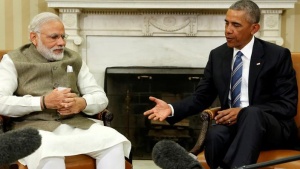
President Barack Obama welcomed Indian Prime Minister Narendra Modi to the White House for their seventh meeting since Modi took office in 2014, underscoring the warm relationship between the leaders and the world’s two largest democracies. Modi is to address the U.S. Congress on Wednesday.

“We discussed how we can, as quickly as possible, bring the Paris Agreement into force,” Obama told reporters. Climate change is a legacy issue for the U.S. president who leaves office in January.

India’s potential entrance into the agreement this year would help accelerate its enactment, perhaps years ahead of schedule. India is the world’s third-largest greenhouse gas emitter after China and the United States.

The two countries also welcomed preparations that could lead to the building of six nuclear reactors in India by U.S.-based Westinghouse, in what would be the culmination of some 10 years of work to resolve civil-nuclear issues.

The joint statement said India and the U.S. Export-Import Bank were working to complete a financing package for the project and that the Nuclear Power Corporation of India and Westinghouse had confirmed engineering and site design work would begin immediately.It said Westinghouse and the Nuclear Power Corporation of India would work toward finalizing the contract by June 2017 – a year later than Westinghouse’s chief executive, Daniel Roderick, said he hoped for in an interview with Reuters in late March.

Modi told an event organized by the U.S. India Business Council that relations between India and the United States were “closer than ever.” He said the planned reactor purchases would mark new era in nuclear and scientific cooperation.Modi’s address to a joint session of Congress will be a significant personal step. Although this has become a tradition for Indian prime ministers, he was once banned from the United States over massacres of Muslims.

More than 1,000 people, mostly Muslims, were killed in sectarian riots in Gujarat in 2002 when Modi had just become the state’s chief minister. Modi has denied any wrongdoing, and India’s Supreme Court in 2010 ruled there was no case.In the joint statement, the United States said it now recognized India as a “Major Defense Partner” and would work on technology sharing “to a level commensurate with that of its closest allies and partners.

“The text of a logistics agreement, which will allow the countries’ militaries to use each other’s land, air and naval bases, would be signed soon, a U.S. official said.

Tensions between the United States and Pakistan as well as regional concerns about China have served as a backdrop to increased security cooperation.Senator John McCain, chairman of the U.S. Senate Armed Services Committee, said the address to Congress was “entirely appropriate” given the new partnership.”

There’s no doubt there are significant tensions and challenges in the region, which argues for closer coordination between our militaries,” he said.While Modi is generally popular with U.S. lawmakers, they criticize what they see as lingering unfriendliness to U.S. firms and a stifling bureaucracy, in spite of Modi’s pro-business image. They also question New Delhi’s record on human rights.Modi got a boost on Tuesday when Amazon Inc AMZN.O Chief Executive Jeff Bezos said his company would invest an additional $3 billion in India, boosting its committed investment in the country to over $5 billion.

Source: In boost to Paris climate pact, India says it aims to join this year | Reuters

03/06/2016

The class ceiling | The Economist

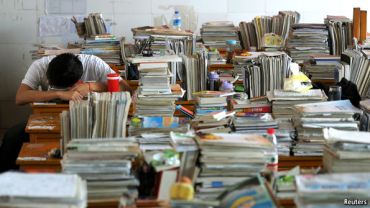
NO CAR may honk nor lorry rumble near secondary schools on the two days next week when students are taking their university entrance exams, known as gaokao. Teenagers have been cramming for years for these tests, which they believe (with justification) will determine their entire future. Yet it is at an earlier stage of education that an individual’s life chances in China are usually mapped out, often in ways that are deeply unfair.

To give more students access to higher education, the government has increased its investment in the sector fivefold since 1997. The number of universities has nearly doubled. In 1998 46% of secondary-school graduates went on to university. Now 88% of them do. About 7m people—roughly one-third of those aged between 18 and 22—now gain entry to some form of higher institution each year.

China’s universities offer more opportunity for social mobility than those in many other countries, says James Lee of Hong Kong University of Science and Technology. But the social backgrounds of those admitted have been changing. Until 1993, more than 40% of students were the children of farmers or factory workers. Now universities are crammed with people from wealthy, urban backgrounds. That is partly because a far bigger share of young people are middle-class. But it is also because rural Chinese face bigger hurdles getting into them than they used to.

The problem lies with inequality of access to senior high schools, which take students for the final three years of their secondary education. Students from rural backgrounds who go to such schools perform as well in the university entrance exams as those from urban areas. But most never get there. Less than 10% of young people in the countryside go to senior high schools compared with 70% of their urban counterparts. The result is that a third of urban youngsters complete tertiary education, compared with only 8% of young rural adults.

One reason is that junior high schools in the countryside are far weaker academically than urban ones. Local governments invest less in them per student than they do in cities. Urban parents tend to be better educated and thus better able to help children with their studies. Rural pupils often suffer from a “poverty of expectations”, says Jean Wei-Jun Yeung of the National University of Singapore: they are not encouraged to think they can succeed, so they do not try to.

Expense is a huge deterrent for many. Governments cover the costs of schooling for the nine years of compulsory education up to the age of around 15. But at senior high schools, families must pay tuition and other expenses; these outlays are among the highest in the world (measured by purchasing-power parity). Many students drop out of junior high school—which is free—because rising wages in low-skilled industrial work make the prospect of staying at school even less attractive. Millions enter the workforce every year who are barely literate or numerate. Poor nutrition is also a handicap. Stanford University’s Rural Education Action Programme has found that a high incidence of anaemia and intestinal worms in rural areas affects educational performance.

Since the 1990s more than 200m people have moved from the countryside to work in cities. Many have left their children behind because of the difficulty of getting them into urban schools: the country’s system of hukou, or household registration, makes it hard for migrant children to enjoy subsidised education in places other than their parents’ birthplace.

But migrant children who do attend schools in cities usually get a worse education than their city-born counterparts. State schools that accept migrant pupils often operate what Pei-chia Lan of National Taiwan University refers to as “apartheid school models”. In these, migrant children are taught separately from urban ones in the same school, and are even kept apart from them in the playground. Since they are forced to take senior high-school exams in the hometown of their hukou, many have little choice but to return to the countryside to attend junior high school.

Source: The class ceiling | The Economist

31/05/2016

China releases new action plan to tackle soil pollution | Reuters

China aims to curb worsening soil pollution by 2020 and stabilize and improve soil quality by 2030, the cabinet said in an action plan published on Tuesday.

The central government will set up a special fund to tackle soil pollution, as well as a separate fund to help upgrade technology and equipment in the heavy metal sector, the cabinet said in a statement on its website (www.gov.cn).

The government will also continue to eliminate outdated heavy metal capacity, the cabinet said.

Last year, the environment minister said 16 percent of China’s soil exceeded state pollution limits. Treatment costs for heavy metal or chemical contamination are high, and China has struggled to attract private funds for soil remediation.

According to Reuters calculations, the cost of making all of China’s contaminated land fit for crops or livestock would be around 5 trillion yuan ($760 billion), based on average industry estimates of the cost of treating one hectare.

Analysts have estimated the soil remediation market could be worth as much as 1 trillion yuan, but authorities have struggled to determine who should pay for rehabilitating contaminated land. Much of the responsibility for the costs now lies with impoverished local governments.

Researchers with Guohai Securities said earlier this year that there are currently 100 key soil remediation projects under way in China with an estimated total cost of 500 billion yuan. With no natural profit motive to encourage private companies to get involved, the clean-up programs have relied mostly on government funding.

China’s five-year plan published in March said the country would give priority to cleaning up contaminated soil used in agriculture. It promised also to strengthen soil pollution monitoring systems and promote new clean-up technologies.

Lawmakers said during the annual session of parliament in March that the country would introduce legislation to help tackle soil pollution by next year.

Companies involved in the sector include Beijing Orient Landscape and Ecology, Tus-Sound Environmental Resources, Beijing Originwater Technology and Guangxi Bossco Environmental Protection Technology.

($1 = 6.5836 Chinese yuan)

Source: China releases new action plan to tackle soil pollution | Reuters

27/05/2016

What Can Be Learned From China’s Monetary Past – China Real Time Report – WSJ

China’s decline as a great power in the 19th century wasn’t the fault of imperialism and opium. It was bad monetary policy, after all.

English: Qing emperor Jiaqing

English: Qing emperor Jiaqing (Photo credit: Wikipedia)

So says Werner Burger, a numismatic historian and Sinologist who has published a detailed history of money in the Qing Dynasty, entitled “Ch’ing Cash.” Mr. Burger has spent his professional life tracking down details of nearly every coin minted in China over three centuries. After three decades of making official requests, it wasn’t until 1996 that Beijing granted him access to the previous century’s imperial mint reports, the modern equivalent to central bank money supply statistics.

His conclusion: The Jiaqing Emperor, By letting the fakes infiltrate the economy, the Jiaqing emperor and his successors allowed the effective exchange rate for standard brass Chinese coins to swell from the official rate of 1000 per unit of silver to as high as 2500. Soldiers wages were effectively halved, giving them little incentive to fight the various battles against Western colonizers.

Mr. Burger refutes the notion that China’s trade with the United Kingdom, which for a time involved China sending silver to the U.K. in exchange for opium, was responsible for the debasement. He said the amount of silver sent abroad didn’t affect the exchange rate, noting a mid-century period of three decades when China actually experienced silver inflows.

Amid such currency instability, “all attempts at economic reforms and progress were bound to fail. China had no chance to catch up with the rest of the world and so lost a whole century to corruption and greedy officials,” says Mr. Burger.

For investors who want to learn from China’s past mistakes, the two volume history will cost a pretty penny: $800.

Source: What Can Be Learned From China’s Monetary Past – China Real Time Report – WSJ

27/05/2016

Foxconn replaces ‘60,000 factory workers with robots’ – BBC News

If manufacturers like Foxconn and high street companies like McDonald’s and, no doubt soon, offices too start replacing humans with robots, where will it all end? Where will all the ‘surplus’ people find jobs and pay.  And, eventually, who will be able to afford the iPhones, the hamburgers and so forth?  Won’t it be self-defeating in the long run for the employers with no customers or, at best, not enough customers to keep all the robots occupied and earning their keep.

“One factory has “reduced employee strength from 110,000 to 50,000 thanks to the introduction of robots”, a government official told the South China Morning Post.

Xu Yulian, head of publicity for the Kunshan region, added: “More companies are likely to follow suit.”

China is investing heavily in a robot workforce.

In a statement to the BBC, Foxconn Technology Group confirmed that it was automating “many of the manufacturing tasks associated with our operations” but denied that it meant long-term job losses.

“We are applying robotics engineering and other innovative manufacturing technologies to replace repetitive tasks previously done by employees, and through training, also enable our employees to focus on higher value-added elements in the manufacturing process, such as research and development, process control and quality control.

“We will continue to harness automation and manpower in our manufacturing operations, and we expect to maintain our significant workforce in China.”

Since September 2014, 505 factories across Dongguan, in the Guangdong province, have invested 4.2bn yuan (£430m) in robots, aiming to replace thousands of workers.

Kunshan, Jiangsu province, is a manufacturing hub for the electronics industry.

Economists have issued dire warnings about how automation will affect the job market, with one report, from consultants Deloitte in partnership with Oxford University, suggesting that 35% of jobs were at risk over the next 20 years.

Former McDonald’s chief executive Ed Rensi recently told the US’s Fox Business programme a minimum-wage increase to $15 an hour would make companies consider robot workers.

“It’s cheaper to buy a $35,000 robotic arm than it is to hire an employee who is inefficient, making $15 an hour bagging French fries,” he said.”

Source: Foxconn replaces ‘60,000 factory workers with robots’ – BBC News

25/05/2016

China to replace direct coal combustion with electricity in new plan | Reuters

China will reduce the amount of coal burned directly in industrial furnaces and residential heating systems in order to tackle a major source of smog, the country’s energy regulator said on Wednesday.

The National Energy Administration (NEA) said in a joint announcement with other government bodies that around 700 million to 800 million tonnes of coal is burned directly in China every year, much of it in the countryside, where access to electricity is limited.

Directly burned coal amounts to about 20 percent of China’s total coal consumption volume, much higher than the 5 percent rate in Europe and the United States.

China will aim to replace direct burning with electricity, including renewable power as well as ultra-low emission coal-fired generators, the NEA said.

China currently relies on coal for around 64 percent of its total primary energy needs and for three-quarters of its total power generation. Emissions from the direct combustion of coal are around five times higher than those from coal-fired power plants, which are subject to strict anti-pollution regulations.

During the 2016-2020 period, China plans to raise electricity’s share of the country’s overall energy mix to 27 percent, up about 1.5 percentage points from now and raising total power consumption by around 450 billion kilowatt-hours a year, the NEA said.

Experts have estimated that China will need an additional 600 GW of coal-fired power capacity over the 2015-2030 period in order to replace direct coal combustion.

Source: China to replace direct coal combustion with electricity in new plan | Reuters

24/05/2016

China’s Middle Class Vents Over Growing List of Grievances – China Real Time Report – WSJ

The death here of a 29-year-old man in police custody—a new father and graduate of a prestigious Chinese university—has exposed growing anxieties in the country’s growing middle class, already shaken by a decelerating economy and a disparate series of high-profile incidents threatening their sense of stability.

As WSJ’s Te-Ping Chen reports:

Other wide-ranging targets of recent social-media attention include a violent string of attacks on doctors by embittered patients and their families, a demand that apartment owners in eastern China pay extra to secure the land on which their apartments were already built, confusing changes in college-entrance standards, and fatal chemical explosions wiping out homes.

Such disruptions have come as reminders that rising incomes or better education don’t automatically shield China’s expanding middle-class ranks from danger, whether physical or economic, in a society where the law can be arbitrarily enforced and justice is sometimes brutal.

“There’s a gap between expectation and reality,” said He Yunfeng, who heads Shanghai Normal University’s Institute of Knowledge and Value Sciences. “These kinds of incidents concentrated together have created a kind of panic.” Some critics have begun joking that the Chinese term for middle class— zhongchanjieji—would be better depicted by the term zhongcanjieji, or the “tragic middle class.”

Source: China’s Middle Class Vents Over Growing List of Grievances – China Real Time Report – WSJ

Law of Unintended Consequences

continuously updated blog about China & India

ChiaHou's Book Reviews

continuously updated blog about China & India

What's wrong with the world; and its economy

continuously updated blog about China & India