Archive for ‘China alert’

14/08/2012

* Surge in Tibetan self-immolations challenges Chinese rule-rights group

Reuters: “As many as five Tibetans set themselves ablaze in China in the past week to protest Chinese rule over Tibet, a U.S. broadcaster said, a surge highlighted by a rights group as a sustained campaign against Beijing’s grip on religious freedom.

Two self-immolations on Monday in the Aba prefecture, a mountainous and mainly ethnic Tibetan part of Sichuan province, were followed by at least one clash between police and ethnic Tibetans that left one protester dead, Radio Free Asia said.

Lungtok, a monk from the restive Kirti monastery in Aba, and Tashi, believed to be a layman, set themselves ablaze on Monday “to highlight their opposition to Chinese rule in Tibetan-populated areas”, Radio Free Asia reported, saying three other Tibetans have died in self-immolations in the past week in China.

Many Tibetans have called for Beijing to allow the return of the Dalai Lama, their self-exiled Buddhist leader. China has branded the self-immolators “terrorists” and criminals and has blamed the Dalai Lama, for inciting them.

Calls to the Aba prefecture office were not answered.

Phelim Kine, senior Asia researcher for New York-based Human Rights Watch, said the frequency of the Tibetan self-immolations is “a reflection of the ever-deepening frustration and despair” that many Tibetans feel about hopes for reform and protection for their culture, religion and language.

“We don’t see any inkling of such changes in the short to medium term, instead we see a hardening of position by the Chinese government,” he said. “This is an unfortunate trend that will continue till we head into the leadership transition.”

Chinese leaders typically clamp down on possible sources of unrest before a once in a decade congress, likely in October, to announce a new leadership team.”

via Surge in Tibetan self-immolations challenges Chinese rule-rights group | Reuters.

Tibet (and Xinjiang) continue to be sore point with China. Religious and ethnic self-determination doesn’t want to go away, despite the efforts by China to improve the social and economic conditions.

See also:

14/08/2012

* Syria crisis: China hosts Assad aide Bouthaina Shaaban

BBC News: “A senior aide to Syria’s President Bashar al-Assad has flown to China for talks on the crisis, officials say.

The Chinese foreign ministry said Bouthaina Shaaban would meet Foreign Minister Yang Jiechi later.

The ministry said it was part of its effort to implement the UN’s six-point peace plan. China has twice vetoed UN resolutions against the Assad regime.

Meanwhile, UN humanitarian chief Valerie Amos has arrived in Syria to assess the flow of emergency aid.

She is expected to ask for more visas for foreign aid workers as the Syrian Arab Red Crescent struggles to distribute food.

The UN says an estimated two million Syrian civilians have now been affected by the crisis and more than one million have fled their homes.

Tens of thousands of people have fled across Syria’s borders into Turkey, Jordan, Lebanon and Iraq amid continuing violence across the country.

In another development, foreign ministers of the Islamic Co-operation Organisation (OIC) have called for Syria to be suspended from the 57-nation bloc at an emergency two-day summit in Mecca, Saudi Arabia, which starts on Tuesday.

Only ministers from Algeria and Iran, which is regarded as Syria’s closest ally, were against the recommendation, reports say.

“We certainly do not agree with the suspension of any OIC member,” Iranian Foreign Minister Ali Akbar Salehi said after a preliminary meeting in the city of Jeddah on Monday.

“We have to look for other ways, means and mechanisms for resolving conflicts and crises,” he said.”

via BBC News – Syria crisis: China hosts Assad aide Bouthaina Shaaban.

Despite the deteriorating situation in Syria, China resolutely sticks to its principle of non-military intervention and its position of not supporting any regime change.

12/08/2012

* Bo Xilai scandal: Gu ‘admits Neil Heywood murder’

BBC News: “Gu Kailai has admitted murdering British businessman Neil Heywood and blamed her actions on a mental breakdown, Chinese state media report.

The state news agency Xinhua said the wife of former top politician Bo Xilai had apologised for what she described as the “tragedy” of Mr Heywood’s death.

She said she would “accept and calmly face any sentence”, the agency added.

Ms Gu was accused of poisoning Mr Heywood with cyanide last November, at her one-day trial on Thursday.

Her aide, Zhang Xiaojun, also admitted his involvement in the murder and said he wanted to apologise to Mr Heywood’s relatives, Xinhua reported in a detailed account of Thursday’s proceedings in court.”

via BBC News – Bo Xilai scandal: Gu ‘admits Neil Heywood murder’.

Incidentally, many Chinese news items use the name Bogu Kailai. That is because of the convention that the wife adopts the husband’s surname  and prefixes her surname with his. See: https://chindia-alert.org/2012/04/05/deciphering-chinese-names/

See also: 

12/08/2012

* Beijing Reasserts Its Claims in South China Sea

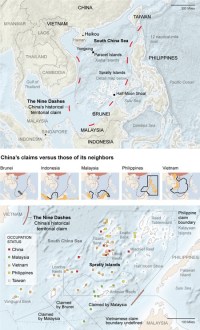
NY Times: “China does not want to control all of the South China Sea, says Wu Shicun, the president of a government-sponsored research institute here devoted to that strategic waterway, whose seabed is believed to be rich in oil and natural gas. It wants only 80 percent.

Mr. Wu is a silver-haired politician with a taste for European oil paintings and fine furniture. He is also an effective, aggressive advocate for Beijing’s longstanding claim over much of the South China Sea in an increasingly fractious dispute with several other countries in the region that is drawing the United States deeper into the conflict.

China recently established a larger army garrison and expanded the size of an ostensible legislature to govern a speck of land, known as Yongxing Island, more than 200 miles southeast of Hainan. The goal of that move, Mr. Wu said, is to allow Beijing to “exercise sovereignty over all land features inside the South China Sea,” including more than 40 islands “now occupied illegally” by Vietnam, the Philippines and Malaysia.

In the past several weeks, China has steadily increased its pressure, sending patrols with bigger ships and issuing persistent warnings in government-controlled newspapers for Washington to stop supporting its Asian friends against China.

The leadership in Beijing appears to have fastened on to the South China Sea as a way of showing its domestic audience that China is now a regional power, able to get its way in an area it has long considered rightfully its own. Some analysts view the stepped-up actions as a diversion from the coming once-a-decade leadership transition, letting the government show strength at a potentially vulnerable moment.

The Obama administration, alarmed at Beijing’s push, contends that the disputes should be settled by negotiation, and that as one of the most important trade corridors in the world, the South China Sea must enjoy freedom of navigation. The State Department, in an unusually strong statement issued this month intended to warn China that it should moderate its behavior, said that Washington believed the claims should be settled “without coercion, without intimidation, without threats and without the use of force.”

Washington was reacting to what it saw as a continuing campaign on the South China Sea after Beijing prevented the Association of Southeast Asian Nations, at its summit meeting in Cambodia in July, from releasing a communiqué outlining a common approach to the South China Sea.

The dispute keeps escalating. On July 31, the 85th anniversary of the founding of the People’s Liberation Army, the Chinese Defense Ministry heralded the occasion by announcing “a regular combat-readiness patrol system” for the waters in the sea under China’s jurisdiction.

The government then said it had launched its newest patrol vessel: a 5,400-ton ship. It was specifically designed to maintain “marine sovereignty,” said People’s Daily, the Communist Party’s leading newspaper.””

via Beijing Reasserts Its Claims in South China Sea – NYTimes.com.

10/08/2012

* China Deal to Acquire U.S. Battery Maker A123 is Just the Beginning

WSJ: “As the script now reads, Wanxiang — China’s largest auto parts maker — plays the role of a clever opportunist in the unfolding tragedy of American competitiveness.

Here is an excerpt from the most recent episode:

A leading American maker of batteries for electric vehicles, A123 Systems, secures hundreds of millions of dollars in grants from Washington D.C and the State of Michigan.

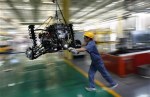
A123 Systems, recently offered a $450 lifeline by China’s Wanxiang Group, makes lithium-ion car batteries at this plant in Michigan.

A123 quickly earns awards for both its innovative culture and its technical advances. But before long, the company encounters business difficulties, faces imminent bankruptcy and scrambles for money.

Wanxiang arrives with fistfuls of cash, takes control of A123 and inherits some of the world’s most advanced battery technology. Wanxiang is further encouraged as policy makers in Beijing promise $10,000 rebates to Chinese electric car buyers. The future is bright.

It is fair to say that Wanxiang, a private company based in Zhejiang, has broken no rules. Wanxiang sees a straight-up business deal in which it pays market price for a cash-starved company that is on the verge of failure.

However, what many American taxpayers see is bad business, a sham. And they sense a deeply troubling pattern for the future: America develops technology – subsidized with generous tax dollars – only to see it purloined, borrowed or, in this case, purchased on the cheap by firms from competing nations.

How can America possibly sustain its culture of innovation when assets are so vulnerable to cherry picking by cash-rich Chinese companies? This issue — not last month’s unemployment rate — should be the central issue as the U.S. tries to decide who will be its president for the next four years.”

via China Deal to Acquire U.S. Battery Maker A123 is Just the Beginning – China Real Time Report – WSJ.

10/08/2012

* China starts construction on 5.8 mln low-income housing units

Xinhua: “China started building 5.8 million low-income housing units in the first seven months of this year, the Ministry of Housing and Urban-Rural Development said Friday.

Construction on 3.6 million affordable homes has been basically completed in the period, the ministry said in a brief statement on its website.

The government vowed to start construction on more than 7 million low-income housing units this year, part of its five-year plan to build 36 million such units by 2015.

The government has stepped up its efforts in the construction of affordable housing in recent years, aiming to cool the country’s runaway property prices.”

via China starts construction on 5.8 mln low-income housing units – Xinhua | English.news.cn.

10/08/2012

Once again, some signs that China is ‘softening’ on contovertial cases. Question is: is it a general policy or only for this year, the year of leadership change?

09/08/2012

* Defects found on 12 rail lines

China Daily: “Seven of the 12 lines have been put into service, including high-speed passenger railways between Wuhan and Guangzhou and between Zhengzhou and Xi’an, according to the document.

The problems were discovered during routine inspections. The construction defects on the seven lines included cracks and leaks on tunnel arches, tilted communications towers and poorly arranged electronic cables, the Chinese news portal eeo.com.cn reported on Tuesday.

Other problems were found on five lines currently under construction, including one linking Lhasa and Xigaze in the Tibet autonomous region, which is an extension of the Qinghai-Tibet railway.

The ministry severely criticized some contractors for building with low-quality materials and not using enough iron bars in reinforced concrete.

Media reports quoted anonymous experts as saying the defects might threaten railway safety.

Cracks on the railway tunnel’s arch could cause concrete chunks to break off when a high-speed train passes, destroying the train’s power supply equipment, they said.

A ministry official who spoke to China Daily on the condition of anonymity confirmed the authenticity of the document, saying it was meant to be circulated inside the ministry and to relevant parties.

He said the ministry is paying great attention to quality issues, and has organized regular inspections on railway construction and operations.”

via Defects found on 12 rail lines |Society |chinadaily.com.cn.

Good news: in the past such information would not have seen the light of day; bad news: too many defects in a key transport and communications system.

See also: 

09/08/2012

* China factory output growth at three-year low, spurs easing hopes

Reuters: “Annual growth in China’s factory output slowed to its weakest in more than three years in July, missing market forecasts and increasing expectations that Beijing will take further policy steps to support an economy that has been sliding for six straight quarters.

Official data released on Thursday also showed China’s annual consumer inflation fell to a 30-month low in July, suggesting that the central bank has ample scope to ease policy again after rate cuts in June and July to keep the economy on track to meet an official 2012 growth target of 7.5 percent.

China’s economy faces powerful headwinds as the euro zone debt crisis and a sluggish U.S. recovery keep global growth at a low ebb, the main factor that pushed China’s new export orders in July into their steepest fall in eight months.

“The government underestimated the pace of slowdown and there needs to be more aggressive stimulating policies,” said Alistair Thornton, an economist at IHS Global Insight in Beijing.

“The government has signaled that it’s taking a more aggressive line on stimulus measures … But it’s yet to feed into the real economy, which is why we are seeing such weak activities data for July.”

Hopes of further easing from China boosted riskier assets, with Asian shares rising to a three-month high and the commodity-sensitive Australian dollar testing a 4-1/2-month peak.

China’s industrial output growth slowed to 9.2 percent year-on-year in July, its weakest since May 2009, down from 9.5 percent in June and below the 9.8 percent forecast in a Reuters poll.

Annual growth in fixed-asset investment, in the likes of real estate, roads and bridges, came in at 20.4 in January-to-July, unchanged from the January-to-June period and just below the 20.5 percent forecast.

Growth of retail sales, the biggest driver of the economy’s expansion in the first quarter, eased to 13.1 percent, short of the forecast of 13.7 percent.”

via China factory output growth at three-year low, spurs easing hopes | Reuters.

09/08/2012

* China inflation rate dips to a 30-month low in July

BBC News: “China’s inflation dipped to a 30-month low in July, giving policymakers a bigger cushion to boost stimulus measures to spur economic growth.

Consumer prices rose by 1.8% in July, from a year earlier. That was down from a 2.2% growth rate in June and a 3% rise in May.

China has been looking to spur domestic consumption amid a slowing global demand for its exports.

China’s economy grew at its slowest pace in three years in second quarter.

The drop in prices of pork and meat and poultry products, which fell by 18.7% and 6.1% from a year earlier respectively, were the key drivers of the slowdown in the rate of inflation.

China’s economy grew at an annual rate of 7.6% in the April to June period, down from an 8.1% expansion in the previous three months.

There are fears that growth in the world’s second-largest economy may slow further in the coming months.

As a result, Beijing has taken various measures to spur growth.”

via BBC News – China inflation rate dips to a 30-month low in July.

Law of Unintended Consequences

continuously updated blog about China & India

ChiaHou's Book Reviews

continuously updated blog about China & India

What's wrong with the world; and its economy

continuously updated blog about China & India