Archive for ‘China alert’

13/02/2019

China, India contribute most to global greenery expansion: NASA data

WASHINGTON, Feb. 12 (Xinhua) — Data from NASA satellites have shown that China and India led the way in greening on land, thanks to ambitious tree-planting programs in China and intensive agriculture in both countries.

The study published in the latest edition in Nature Sustainability on Monday showed that at least 25 percent of the foliage expansion since the early 2000s globally came in China.

The researchers from Boston University found that global green leaf area has increased by 5 percent in the new century, an area equivalent to all of the Amazon rainforest.

“China and India account for one-third of the greening, but contain only nine percent of the planet’s land area covered in vegetation,” said lead author Chen Chi of Boston University.

“That is a surprising finding, considering the general notion of land degradation in populous countries from over-exploitation,” said Chen.

Rama Nemani, a research scientist at NASA’s Ames Research Center and a co-author of the study said: “When the greening of the Earth was first observed, we thought it was due to a warmer, wetter climate and fertilization from the added carbon dioxide in the atmosphere.”

But with data from NASA’s Terra and Aqua satellites, scientists realized that humans are also contributing.

“Humans are incredibly resilient. That’s what we see in the satellite data,” said Nemani.

China’s contribution to the global greening trend comes in large part from its programs to conserve and expand forests, accounting for about 42 percent of the greening contribution, according to the study.

Another 32 percent of the greening change in China, and 82 percent in India, resulted from intensive cultivation of food crops, since the farmland in China and India has not changed much since the early 2000s, while both increased their food production to feed large populations.

However, the researchers rang bells as well. They said that the gain in global greenness did not necessarily offset the loss of natural vegetation in tropical regions like Brazil and Indonesia.

The loss of sustainability and biodiversity in those ecosystems cannot be offset by the simple greenness of the landscape, according to the study.

Source: Xinhua

13/02/2019

Variety of folk activities staged in China to mark lunar new year


#CHINA-FOLK DANCE-PERFORMANCE (CN)

Performers present folk dance at a temple fair in Luquan District of Shijiazhuang, north China’s Hebei Province, Feb. 11, 2019.

Source: Xinhua

13/02/2019

China, UK should handle differences properly, enhance strategic mutual trust: Ambassador

LONDON, Feb. 12 (Xinhua) — China and UK should keep the long-term interests and larger picture in mind, look at each other’s development as opportunities, respect each other’s sovereignty, security and right to development, handle our differences properly and enhance strategic mutual trust, Chinese Ambassador to Britain Liu Xiaoming has said.

The Chinese diplomat made the remarks while attending the Chinese New Year Dinner by the Cities of London and Westminster Conservative Association on Monday night.

“If we compare China-UK relations to a building, it could not stand tall without a solid foundation. This foundation is the mutual confidence between our two countries,” he said.

Recalling that the world economy is under downward pressure, with surging protectionism and unilateralism making things doubly difficult. Against this situation, Liu said it is all the more important that China and the UK advocate free trade, oppose protectionism and promote open cooperation.

“We hope that the UK would continue to provide a fair, transparent and non-discriminatory business environment for Chinese companies. We hope you will make successful Chinese companies such as Huawei feel welcome here in Britain, and convince them that the UK is a trustworthy place to put their money,” said the Chinese ambassador.

Liu said both China and the UK are known for their profound cultural heritage and important contribution to the progress of human civilization.

“I hope that in the new year our two countries will continue to enhance cultural and people-to-people exchanges, and deepen mutual understanding and strengthen friendship.”

The ambassador also hoped that people from all walks of life in both China and UK will join hands to cement the foundation for a solid and magnificent edifice of bilateral relations.

British Prime Minister Theresa May sent a congratulatory message to the event, saying that it is an important moment to recognize the contribution of the Chinese community in London and across the whole of the United Kingdom.

“The Chinese community’s expanding business expertise, scientific inquiry and cultural heritage and traditions are of immense value to our country – not least here in London, where the vibrancy of Chinatown stands as a strong beacon for the Chinese community and a reminder of all that they have contributed to our society,” she said.

Source: Xinhua

12/02/2019

Trade talk hopes and shutdown deal buoy stocks

LONDON (Reuters) – World shares and bond yields rode a renewed surge in risk appetite on Tuesday, as investors were optimistic about U.S.-China trade talks and cheered Washington’s deal to avoid another government shutdown.

Tokyo’s Nikkei set the tone with its best day of the year so far and Europe wasted little time in trying to lift the STOXX 600 back to the two-month high it set last week.

Germany’s DAX jumped more than 1.2 percent, after rising 1 percent on Monday, and Paris and Milan were up 0.8 percent, while London’s FTSE approached a four-month peak despite ongoing Brexit uncertainty.

The dollar hovered at a two-month high and the Australian dollar also gained. The yen and Swiss franc dipped while U.S. Treasury and German bund yields edged up as investors jettisoned safe havens.

“We have had two bits of relatively good news overnight – optimism about the U.S. shutdown not resuming and optimism about a trade deal,” said Societe Generale strategist Kit Juckes.

“Equities are higher, bond yields are a little bit higher, yen and Swiss franc weakest overnight of the major currencies so it’s sort of risk-on rules OK!”

Juckes said he reckoned there was now a 75 percent chance that a ratcheting up of U.S. tariffs on Chinese goods at the start of March will be avoided and a 95 percent chance that another U.S. government shutdown will be dodged.

Those odds got a boost on Monday after U.S. lawmakers reached a tentative deal on border security funding, though aides cautioned that it did not contain the $5.7 billion President Donald Trump wants to build a wall on the Mexican border.

S&P 500 e-mini futures were up nearly 0.5 percent, pointing to a solid start on Wall Street later after a choppy day on Monday.

U.S. and Chinese officials expressed hopes the new round of talks, which began in Beijing on Monday, would bring them closer to easing their months-long trade war.

Beijing and Washington are trying to hammer out a deal before a March 1 deadline, without which U.S. tariffs on $200 billion worth of Chinese imports are scheduled to increase to 25 percent from 10 percent.

“There will be no winner in a trade war. So at some point they will likely strike a deal,” said Mutsumi Kagawa, chief global strategist at Rakuten Securities in Tokyo.

BIG IN JAPAN

MSCI’s broadest index of Asia-Pacific shares outside Japan edged up 0.3 percent.

Shanghai rose 0.35 percent, South Korea’s KOSPI climbed 0.6 percent and Australian shares gained 0.3 percent.

The Nikkei rallied though, shooting up 2.6 percent after closing on Friday at its lowest level since early January. The Tokyo market was closed on Monday.

With the yen backtracking again, shares of exporters such as automakers and machinery makers led the charge. Separately, Deutsche Bank noted it was 20 years since Japan cut interest rates to zero, something now standard in large parts of Europe.

The dollar held firm, having gained for eight straight sessions against a basket of six major currencies until Monday, its longest rally in two years.

Although the Federal Reserve’s dovish turn dented the dollar earlier this month, some analysts noted the U.S. currency still has the highest yield among major peers and that the Fed continues to shrink its balance sheet.

“The dollar is the market’s pet currency at present regardless of whether concerns about the global economy are on the rise,” currency strategists at Commerzbank said in a note.

The dollar popped up to a six-week high of 110.65 yen. In contrast, the euro dropped to as low as $1.1267, its weakest in 2-1/2 months, and last traded at $1.1277.

In commodity markets, oil prices also ticked up as traders weighed support from OPEC-led supply restraint and a slowdown in the global economy.

U.S. crude futures traded at $52.68 per barrel, up 0.5 percent. Brent crude rose 0.6 percent to $61.89 per barrel. Gold was a touch stronger at $1,312 an ounce.

Source: Reuters

12/02/2019

Uighur crackdown: ‘I spent seven days of hell in Chinese camps’

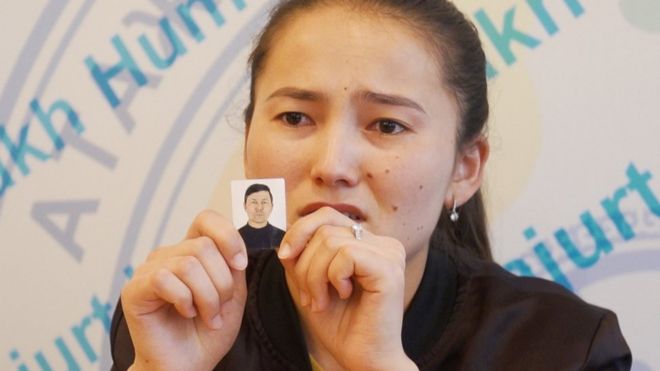
Aibota Serik
Image captionAibota Serik says her father has disappeared into China’s network of detention centres

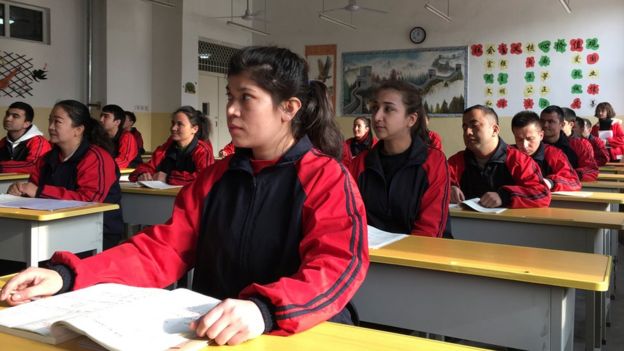
The Chinese government calls them free “vocational training centres”; Aibota Serik, a Chinese Kazakh whose father was sent to one, calls them prisons.

Her father Kudaybergen Serik was a local imam in Tarbagatay (Tacheng) prefecture of China’s western Xinjiang region. In February 2018 the police detained him and Aibota hasn’t heard from her father since then.

“I don’t know why my father was imprisoned. He didn’t violate any laws of China, he was not tried in a court,” she says, clutching a small photo of him, before breaking down in tears.

I met Aibota together with a group of other Chinese Kazakhs in Almaty, Kazakhstan’s largest city. They gathered in a small office to petition the Kazakh government to help secure the release of their relatives who had disappeared in “political re-education camps”.

The UN Committee on the Elimination of Racial Discrimination has heard there are credible reports that around one million people have been detained in internment camps in Xinjiang. Almost all of them are from Muslim minorities such as the Uighurs, Kazakhs and others.

There are more than a million Kazakhs living in China. After the collapse of the Soviet Union, thousands moved to oil-rich Kazakhstan, encouraged by its policy to attract ethnic Kazakhs. Today, these people feel cut off from their relatives who stayed in China.

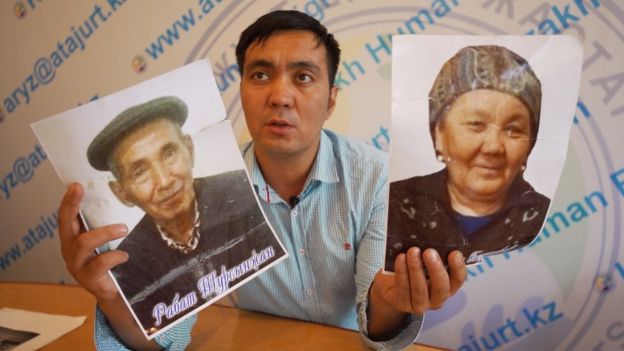
Nurbulat Tursunjan
Image captionNurbulat Tursunjan says the Chinese authorities have confiscated his parents’ passports

Nurbulat Tursunjan uulu, who moved to the Almaty region in 2016, says his elderly parents are unable to leave China and come to Kazakhstan because the authorities took away their passports.

Another petitioner, Bekmurat Nusupkan uulu, says that relatives in China are afraid to talk on the phone or on the popular Chinese messaging app WeChat. And they are right to be afraid, he says.

“My father-in-law visited me in February 2018. From my place, he called his son in China, he asked how he was and so on. Shortly after that his son Baurzhan was detained. He was told that he had received phone calls from Kazakhstan two or three times and was sent to a political camp.”

Human Rights Watch says detainees are held “without any due process rights – neither charged nor put on trial – and have no access to lawyers and family”.

Detention centre in Kashgar, ChinaImage copyrightREUTERS
Image captionChina insists its detention centres, such as this one in the city of Kashgar, are for “vocational training”

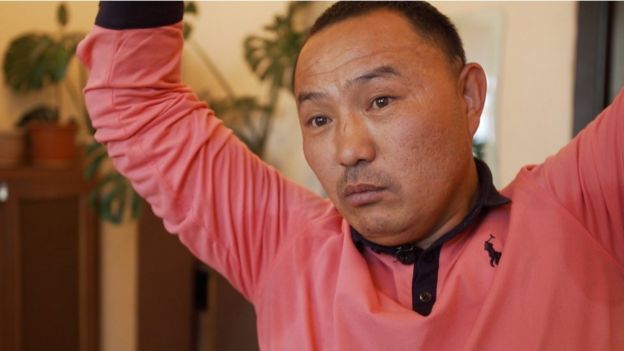
Orynbek Koksybek is an ethnic Kazakh who spent several months in camps.

“I spent seven days of hell there,” he says. “My hands were handcuffed, my legs were tied. They threw me in a pit. I raised both my hands and looked above. At that moment, they poured water. I screamed.

“I don’t remember what happened next. I don’t know how long I was in the pit but it was winter and very cold. They said I was a traitor, that I had dual citizenship, that I had a debt and owned land.”

None of that was true, he says.

A week later Mr Koksybek was taken to a different place where he learnt Chinese songs and language. He was told he would leave if he learnt 3,000 words.

Orynbek Koksybek
Image captionOrynbek Koksybek says he was thrown into a pit

“In Chinese they call it re-education camps to teach people but if they wanted to educate, why do they handcuff people?

“They detain Kazakhs because they’re Muslims. Why imprison them? China’s aim is to turn Kazakhs into Chinese. They want to erase the whole ethnicity,” he says.

It is not possible to independently verify Orynbek Koksybek’s story, but his account is similar to many documented by Human Rights Watch and other activists.

The Chinese embassy in Kazakhstan has not replied to the BBC’s request for comment, but the Chinese authorities have been quoted in state media as saying the camps are “vocational training centres”, which aim to “get rid of an environment that breeds terrorism and religious extremism”.

The Kazakh government says that any restrictions on Chinese citizens in China are their internal matter, and it does not interfere. However, Kazakhstan says it will try to assist any Kazakh citizens who are detained in China.

Source: The BBC

12/02/2019

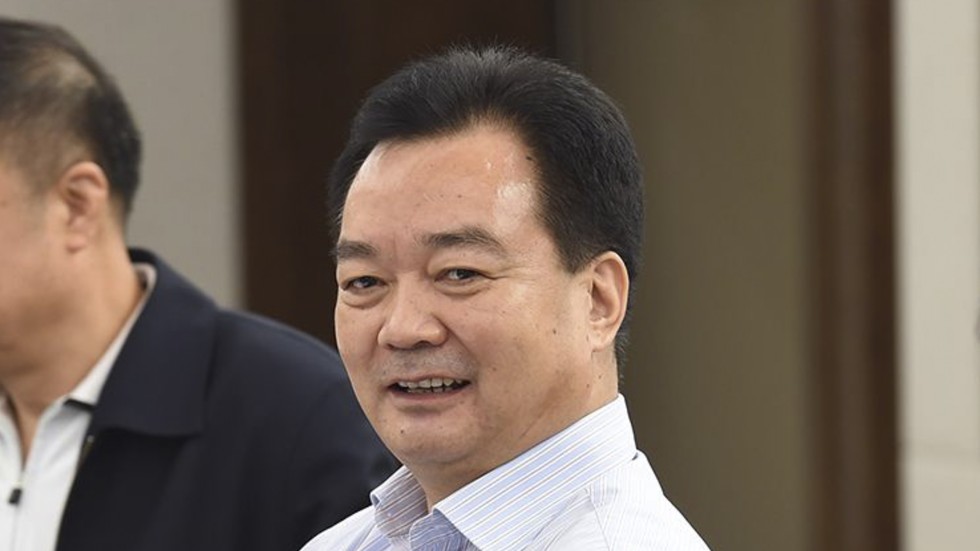
Next stop Xinjiang for one of China’s rising political stars Wang Junzheng

  • Trusted senior cadre tipped for leadership role in implementing Beijing’s ‘stabilising measures’ in the Uygur region
  • His career so far has been a fast track of rotation and promotion
PUBLISHED : Tuesday, 12 February, 2019, 6:33pm
UPDATED : Tuesday, 12 February, 2019, 6:53pm

Beijing has sent a trusted senior cadre – with a track record of versatility and economic development – to join the highest decision-making body of China’s highly sensitive Xinjiang Uygur autonomous region.

Wang Junzheng, 56, has been appointed to Xinjiang’s 14-member Communist Party standing committee, according to an official statement on Monday. His new role was not specified in the two-paragraph announcement.


Analysts said he was expected to assume a leadership role in the party’s regional political and legal affairs commission – a critical body in the implementation of China’s “stabilising measures” in Xinjiang, which include the controversial “re-education camps” where up to 1 million people from the Muslim ethnic minority group are reportedly being held.

In a move that may have paved the way for such a role for Wang, the incumbent head of Xinjiang’s political and legal affairs commission – Zhu Hailun, 61 – was elected deputy head of Xinjiang’s People’s Congress in January. It is standard practice in China for deputy provincial level cadres to step down and take up such positions on reaching 60.

Dr Alfred Wu, an associate professor at Singapore’s Lee Kuan Yew School of Public Policy, said that while there were other vacancies in both Xinjiang’s political and legal affairs commission and its united front work department, Wong’s legal experience made it likely he would take up the role vacated by Zhu.

A source familiar with Wang told the South China Morning Post he was among a group of cadres who had won the trust of President Xi Jinping.

Wang’s career has been on a fast track of rotation and promotion. He reached vice-provincial level when he was only 49 and, five years later, became an alternate member of the Central Committee – the party’s highest organ of power – at the 19th party congress in October 2017.

He moves to Xinjiang from the northeastern province of Jilin, where he was a member of the provincial party standing committee and party chief of Changchun, the provincial capital.

It was not all smooth sailing for Wang in Jilin, where his career was tainted by last year’s Changchun Changsheng vaccine scandal.

National outrage followed the revelation that one of China’s biggest vaccine makers, Changsheng Bio-tech, had systematically forged data in its production of rabies vaccines and had sold ineffective vaccines for diphtheria, whooping cough and tetanus that were given to hundreds of thousands of babies – some as young as three months old.

Heads rolled. Sackings included Jilin vice-governor Jin Yuhui, who had overseen food and drug regulation; Li Jinxiu, a former Jilin food and drug chief; Changchun mayor Liu Changlong; and Bi Jingquan, deputy director of the State Market Regulatory Administration in Beijing.

In a farewell speech published in People’s Daily on Monday, Wang apparently made a veiled reference to the scandal and admitted some shortcomings.

“Because of my constraints, I could have done better on some issues … and have failed to meet the expectations of the Party and people,” he said.

Alfred Wu said the Xinjiang posting showed Wang’s career had not been tainted by the Changchun vaccine scandal.

“Going to Xinjiang is both an opportunity and a challenge for Wang. If he can prove himself in stabilising Xinjiang, he will go further [in his career],” Wu said.

Xinjiang is Wang’s fourth provincial posting. He began his political career in Yunnan, southwestern China, where he spent nearly two decades working with many ethnic minority groups.
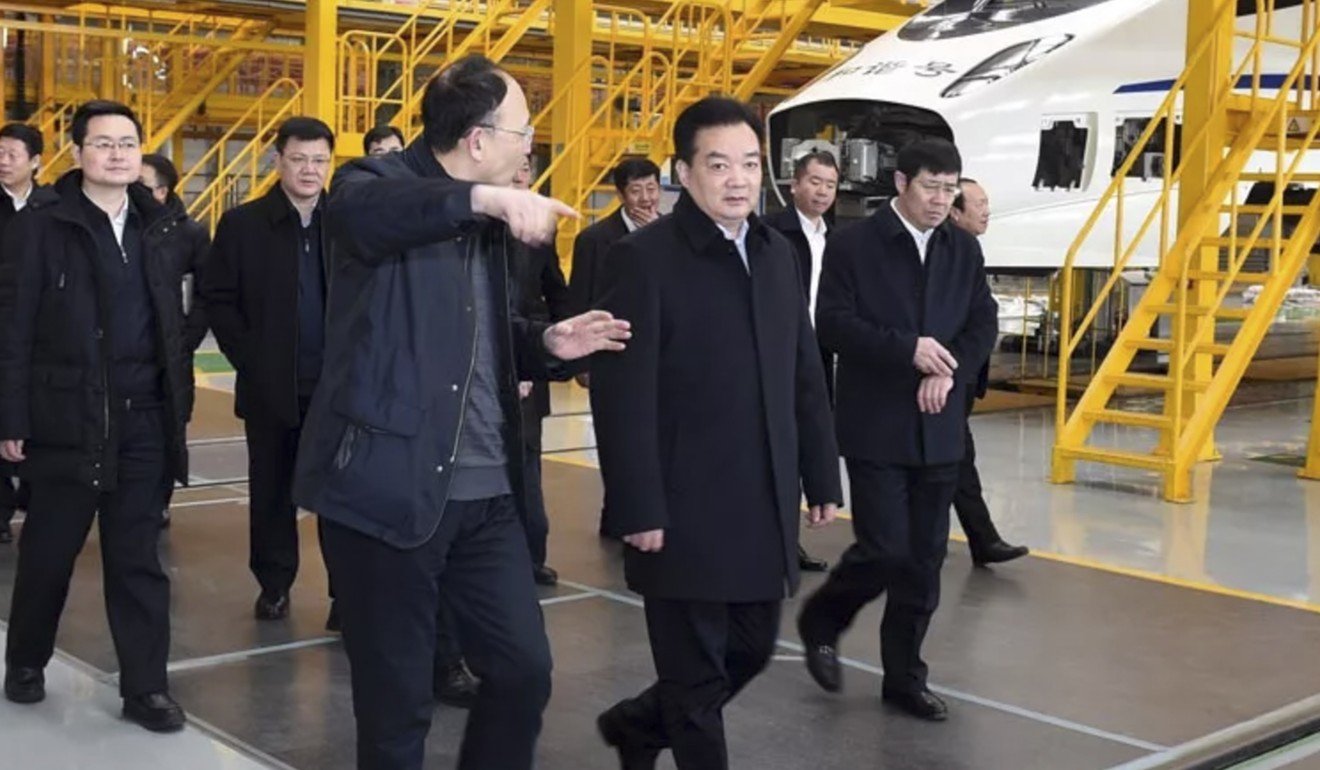
He was the legal chief of Kunming, the provincial capital of Yunnan, from 1988 to 2000 and also served as vice-president of the Yunnan Higher People’s Court from 2005 to 2007.

In 2009 Wang became party chief of Lijiang, a tourist city in Yunnan where the economy thrived under his watch.

“More importantly, he struck a balance between tourism development and environmental conservation and was noticed by the leadership,” a source said.

Wang left Yunnan in 2012 when he was promoted to provincial vice-governor of Hubei in central China. He later became party chief of the city of Xiangyang in Hubei province and was promoted to provincial party standing committee member in 2013.

After three years in Hubei, Wang headed north to Jilin, becoming Changchun party chief in January 2016.

Wang was born in the eastern province of Shandong. He graduated from Shandong University with a bachelor’s degree in socialism studies and a master’s in the same subject from Renmin University in Beijing in the 1980s. He attained his doctorate in management from Tsinghua University in 2006.

Source: SCMP

12/02/2019

China to lift another ten million people out of poverty in 2019

BEIJING, Feb. 11 (Xinhua) — China will continue to work vigorously to reduce poverty and lift no less than ten million people out of poverty in 2019, to lay a solid foundation for winning the battle against poverty, the State Council’s executive meeting chaired by Premier Li Keqiang decided on Monday.

The year 2018 saw China launch its three-year actions in fighting the battle against poverty. Premier Li Keqiang vowed to reduce the poor population by ten million each year in all his government work reports over the past five years. He gave specific instructions on ways to push forward this work and to better manage the poverty alleviation funds.

According to the progress update at the Monday meeting, 13.86 million people were lifted out of poverty in 2018, thanks to the dedicated efforts by local authorities and competent departments in implementing the decisions made by the Communist Party of China Central Committee and the State Council.

Figures from the State Council Leading Group Office of Poverty Alleviation and Development show that the new approach of poverty relief by developing emerging industries in poor areas such as e-commerce, photovoltaics and country tourism has paid off. Infrastructure development in poor areas has been accelerated. Some 208,000 kilometers of rural roads were built or renovated in 2018. New progress was made in upgrading the power grid in poor areas. And 94 percent of the poor villages are now covered by broadband internet services.

“We must strive to meet the poverty alleviation target for this year. Making poverty history by 2020 is the solemn commitment our Party and government have made to the people. We must fulfill this commitment by ensuring full delivery of all related policies and consolidating the progress we have made,” Li said.

It was decided at the meeting that efforts will be intensified this year to help the deeply poor areas. Increase in the poverty alleviation fund under the central government budget will be mainly channeled to these areas. Projects under the 13th Five-Year Plan that help enhance the weak links of poor areas will be prioritized.

The meeting urged to stick to current standard, and the cross-regional pairing arrangements for poverty alleviation will be enhanced. The difficulties poor people face in meeting the five essential needs of food, clothing, compulsory education, basic healthcare and a place to live will be tackled down to every household.

Counties that have emerged from poverty and their populations shall remain eligible for related policy incentives by 2020, the final-stage year in fighting poverty. Records of those who fall back into poverty and the newly discovered poor will be promptly established to provide them support. The meeting urged to cut the poor population by another ten million this year to lay a solid foundation for winning the final battle against poverty.

“We must strictly enforce the poverty criteria involving the five essential needs of food, clothing, compulsory education, basic healthcare and a place to live,” Li said, “Every penny of the poverty alleviation funds must be used effectively and transparently.”

Source: Xinhua

12/02/2019

Chinese investors could help build Kenya into regional manufacturing hub: lobby

NAIROBI, Feb. 11 (Xinhua) — Chinese investors could play an instrumental role in making Kenya a regional manufacturing hub, a Kenyan industry lobby said on Monday.

Mucai Kunyiha, vice chairman of Kenya Association of Manufacturers (KAM), told journalists in Nairobi that local manufacturers have been losing market share in the East and Central Africa due to uncompetitiveness.

“Tapping into Chinese manufacturing technology and finance is one of the strategies that we will pursue to ensure Kenyan products remain marketable both regionally and internationally,” said Kunyiha.

Kunyiha added that Kenyan industrialists are keen to form joint ventures with Chinese manufacturers so as to produce goods for both domestic and international markets.

He noted that some Kenyan manufacturers have already licensed Chinese technology to produce high quality products locally.

He observed that Kenya was once the major source of manufactured goods to the East African Community bloc.

The industrialist revealed that exports especially of manufactured products to Uganda, Tanzania, Rwanda and Burundi have been on a declining trend in the past five years due to competition from low-cost producing nations.

According to the lobby, so far over 300 Chinese factories are operational in the country in diverse fields such as motor bike assembly, ceramics and sanitary towels sectors.

Kunyiha said that the Chinese operations have created thousands of employment opportunities and have also engaged local suppliers which have boosted the economy.

He revealed that Kenyan manufacturers also are seeking to identify niche products that they can sell to the vast Chinese market.

“We can boost our exports to China by focusing on areas we have a comparative advantage such as genuine African jewelry,” he added.

Source: Xinhua

12/02/2019

Chinese envoy calls for improvements on peacekeeping operations

UNITED NATIONS, Feb. 11 (Xinhua) — A Chinese envoy on Monday said that several actions can be taken to improve the UN peacekeeping operations.

Speaking at a plenary meeting of the Special Committee on peacekeeping operations, Wu Haitao, China’s deputy permanent representative to the UN, said that the UN peacekeeping operations are facing new challenges while playing an important role in maintaining international peace and security.

To improve the management of peacekeeping operations, the UN Secretariat should optimize its logistical support mechanisms, strengthen training during deployment, and enhance the capacity to deal with complex situations, said the Chinese envoy.

According to Wu, the Secretariat’s new peace and security architecture and management structure are operational now, and the new structures are expected to be effective on integration of resources, improve service management and operational efficiency.

“More attentions should be paid to the safety of peacekeepers,” he said.

Wu said that security risks and casualties among peacekeepers were on the rise, the Secretariat and the missions should formulate security rules in an integrated manner, strengthen information collection and sharing, ensure that security equipment and measures are in place, and strengthen medical ambulance capacity effectively.

Wu also said that the purposes and principles of the Charter of the United Nations have to be strictly abided by, as well as the basic principles of peacekeeping operations.

“Principles such as sovereign equality, non-interference in internal affairs and peaceful settlement of disputes, should always be observed, ” Wu said, adding that in order to carry out their work smoothly, these are the prerequisite and guarantee for peacekeeping operations to win the trust of the member states.

Wu also highlighted the importance of political settlement, saying that it is the “core element of UN peacekeeping operations.

“Political priorities should permeate all phases of operations. Clear, viable and focused mandates should be made for peacekeeping missions, and continuous adjustments of priorities need to be undertaken at all stages in response to dynamic needs,” said the Chinese envoy.

Source: Xinhua

12/02/2019

China’s largest air carrier serves 2.1 mln passengers in Spring Festival holiday

GUANGZHOU, Feb. 11 (Xinhua) — China Southern Airlines (China Southern), the country’s largest air carrier, has transported more than 2.1 million passengers during the week-long Spring Festival holiday from Feb. 4 to 10, said the airline Monday.

The airline has provided air services to a total of seven million passengers since the start of this year’s Chinese Lunar New Year travel rush on Jan. 21, according to China Southern.

It represented an eight percent increase comparing with the figure over the same period in 2018. Meanwhile, the airline has also seen ten percent increases of passengers on its regional and international routes.

Guangzhou-based China Southern operates a fleet of about 840 airplanes, ranking the first in Asia and third worldwide. It is China’s largest air carrier with the largest passenger volume and air route network.

Traveling by air has become a major trip mode of Chinese thanks to expanding route networks and continuous rising household income.

A total of 12.59 million air passenger trips were made during the week-long holiday, up 10.6 percent from last year’s holiday, said statistics from Civil Aviation Administration of China (CAAC).

China is now the world’s second-largest civil aviation market. It is expected to become the largest by mid-2020s, according to the latest forecasts by the International Air Transport Association (IATA).

Source: Xinhua

Law of Unintended Consequences

continuously updated blog about China & India

ChiaHou's Book Reviews

continuously updated blog about China & India

What's wrong with the world; and its economy

continuously updated blog about China & India