Archive for ‘China alert’

04/02/2019

Cross-border e-commerce pilot zone opens bonded import business to cut price, logistic time

GUANGZHOU, Feb. 3 (Xinhua) — A cross-border e-commerce pilot zone in south China started its first bonded import business on Sunday, a practice believed to benefit businesses in terms of lower logistics cost and provide consumers with cheap and fine products, local officials said.

The comprehensive cross-border e-commerce pilot zone in Zhuhai, Guangdong Province, ushered in the new business hoping to give full play to the proximity of Hong Kong and Macao.

Zhuhai is connected to the Hong Kong airport since the Hong Kong-Zhuhai-Macao Bridge opened to traffic in October last year.

The business model allows e-commerce platforms to purchase a large quantity of goods from overseas according to their market forecasts and consumer demands. The goods will be imported and stored in the special customs-supervised area before being delivered to consumers as personal items.

Such practices enable e-commerce enterprises to buy quality products from around the world at a lower price with less logistic time, according to Lin Xibin, a local commerce official.

The bonded import business program is expected to attract businesses from China’s Hong Kong and Macao, as well as businesses from Portuguese and Spanish speaking countries and regions.

Zhuhai is one of the 22 cities that was identified as a venue for comprehensive cross-border e-commerce pilot zones by the State Council, or China’s cabinet, in July last year.

China’s e-commerce market has developed at a double-digit pace for years. E-commerce transaction totaled 22.69 trillion yuan in the first three quarters of 2018, up 11.2 percent year on year.

Source:Xinhua

04/02/2019

Feature: China’s ambassador delivers Spring Festival wishes to Iraqi visa applicants in Baghdad

IRAQ-BAGHDAD-CHINA-EMBASSY-SPRING FESTIVAL

China’s Ambassador to Iraq Chen Weiqing gives visa to an applicant at the Chinese embassy in Baghdad, Iraq, Feb. 3, 2019. China’s Ambassador to Iraq Chen Weiqing welcomed on Sunday Iraqi visa applicants at the Chinese embassy in Baghdad, ahead of Chinese Spring Festival, saying that China is keen to strengthen ties with Iraq. (Xinhua/Khalil Dawood)

BAGHDAD, Feb. 3 (Xinhua) — China’s Ambassador to Iraq Chen Weiqing welcomed on Sunday Iraqi visa applicants at the Chinese embassy in Baghdad, ahead of Chinese Spring Festival, saying that China is keen to strengthen ties with Iraq.

“Iraq is at a transition point heading to the rebuilding stage. We are keen to strengthen ties between China and Iraq, and at the Chinese embassy, we will facilitate your visa process,” Chen said.

Annually, as the Chinese New Year approaches, embassies of China around the world hold cultural events and ceremonies, but because of the precarious security situation in Iraq, the ambassador had to make a short speech.

“This is the last workday for the embassy before the Spring Festival. Last year, we celebrated the 60th anniversary of the establishment of diplomatic relations with Iraq,” Chen told Xinhua.

“At present, relations between Iraq and China have developed very well, especially after China proposed the Belt and Road Initiative, in which Iraq was among the first Arab nations to join,” Chen added.

The Chinese embassy lies in Baghdad’s upscale neighborhood of al-Arasat, which is a relatively safe area. But like most foreign embassies in Iraq, high security measures are necessary.

Dozens of Iraqi visa applicants, if not hundreds at peak days, flock into the embassy every day, as China has become a favorable destination to many for business or study.

Inside the embassy, a small room was decorated with traditional Chinese red lanterns and paper cuttings, while Chinese landscapes and images of cultural life in China were hanged on the walls.

Two Chinese diplomats and two local employees handled the visa applications. Applicants described the procedures as smooth.

“This is going to be my first visit to China. I am going to study Chinese language at Shandong University, and then I aspire to be a pilot and work in China,” Zeyad Ismael, 23, told Xinhua as he waited in the queue.

“My expectations are high. I have looked for images of Shandong province on the internet and I like it. I expect good opportunities and a beautiful life,” Ismael added.

Last year, the Chinese embassy received close to 20,000 visa applications, most of which were for business reasons.

In recent years, China has become a source for many goods imported to Iraq such as smartphones, electronics and automobiles.

Iraqi English teacher, Muqdad Salih, 38, speaks fluent Chinese as he studied the language in China in 2007. Now, he is on the way to China to work as an English teacher in China’s Jiangxi province.

“Chinese New Year celebrations were beautiful and I was surprised by the atmosphere and friendliness of the Chinese people,” Salih said.

04/02/2019

Senior military official calls for support of strengthening and revitalizing armed forces

BEIJING, Feb. 3 (Xinhua) — A senior military official on Sunday called on media as well as literary and art workers of the military to promote innovation and development in their work, so as to provide solid support for strengthening and revitalizing the armed forces.

Zhang Youxia, a member of the Political Bureau of the Communist Party of China (CPC) Central Committee and vice chairman of the Central Military Commission, made the remarks when he extended Spring Festival greetings at the news media center and the culture and arts center of the People’s Liberation Army (PLA).

The PLA’s news media center is an important publicity front of the Party, and the PLA and has to speak for the Party’s will, said Zhang, stressing adherence to correct political and public opinion direction.

The PLA’s culture and arts center should play an active role in nurturing the fighting spirit and build up a good image of art soldiers in the new era, Zhang said.

Source: Xinhua

03/02/2019

World War One grenade among potatoes at Hong Kong crisp factory

A World War One-era German hand grenade, 2 February 2019Image copyrightGETTY IMAGES
Image captionThe grenade is believed to have been dug up accidentally in France

A World War One-era German hand grenade has been found among a delivery of potatoes shipped from France to a crisp factory in Hong Kong, police say.

The muddy device, which was 3in (8cm) wide, was “in an unstable condition” because it had been discharged but had failed to detonate, officials said.

It was discovered at the Calbee crisp-making factory in the eastern Sai Kung district on Saturday morning.

The bombe de terre was safely detonated on site by bomb disposal officers.

“All the information to date suggests that the grenade was imported from France together with the other potatoes,” Superintendant Wong Ho-hon told reporters.

He added that the device was defused using a “high-pressure water firing technique”.

It is believed to have been dug up accidentally with potatoes planted in a field in France before being exported.

The grenade was likely to have been left behind, dropped by soldiers there during the war, or left there after it was thrown,” Dave Macri, a military historian, told the South China Morning Post.

Last year, thousands of people were forced to evacuate a busy commercial area of Hong Kong while police defused a “severely damaged” World War Two bomb found on a construction site.

It was the second to be found in Hong Kong within the same week.

Source: The BBC

03/02/2019

Chinese boy, 3, has lucky escape after falling onto high-speed train line

  • Youngster was posing for photographs with his mother when he stumbled into the gap between bullet train and platform
PUBLISHED : Sunday, 03 February, 2019, 6:32pm
UPDATED : Sunday, 03 February, 2019, 6:32pm

The youngster was posing in front of a stationary bullet train at Wuchang Railway Station in Wuhan, capital of Hubei province, while his mother was taking photographs and filming him as a souvenir of their ride home for the Lunar New Year holiday, news portal Thepaper.cn reported.

But when she asked him to take a step backwards, the child lost his footing and tumbled into the gap between the platform and the train.

An employee ran to help and after climbing down into the gap managed to lift the boy to safety, the report said.

Apart from being a little shaken, the child was unhurt and he and his family were able to continue on their journey home.

And thanks to the quick thinking of the station worker, the train was not even delayed.

With the Lunar New Year holiday officially set to get under way on Tuesday, hundreds of millions of people across the country have making their way home over recent days. The annual migration, known as chunyun in Chinese, puts a massive strain on the nation’s transport infrastructure.

Over the coming “golden week” – as the holiday is often known – an estimated 400 million trips will be made by train, with that figure rising to 2.99 billion for all trips made by rail, road and air over the 40-day travel period – from January 21 to March 1 – that covers the extended break taken by many migrant workers.

The huge numbers often lead to a spike in accidents and injuries during the holiday travel period.

In 2017 alone, 898 people were killed in railway-related accidents, with most of the fatalities attributed to people being hit by trains while trying to cross the track at non-designated spots, according to official figures.

Source: SCMP

03/02/2019

Xinhua Headlines: Moving China: The Spring Festival train journey now and then

Xinhua Headlines: Moving China: The Spring Festival train journey now and then

This combo photo shows attendants getting ready to work aboard the train K1/6 during the Spring Festival travel rush in Nanjing, east China’s Jiangsu Province in January of 1998 (top, photo taken by Gao Meiji); and bullet train stewards taking part in an etiquette training in Nanjing, east China’s Jiangsu Province, Jan. 17, 2019 (bottom, photo taken by Su Yang). (Xinhua)

BEIJING, Feb. 2 (Xinhua) — Veteran train driver Zhou Li, 54, has driven all four generations of Chinese trains — from steam locomotives to high-speed.

Having spent two-thirds of his Spring Festivals driving a train, this year is Zhou’s 31st Spring Festival travel rush.

The Spring Festival holiday is a frenetic travel period in China when hundreds of millions of Chinese return to their hometowns for family gatherings, to visit relatives and friends or just for a break from city life.

Zhou is one of many Chinese train drivers who have witnessed the fast development of the national railway network in connection with the changes of the world’s biggest travel rush.

Since the founding of the People’s Republic of China 70 years ago, the speed of trains has increased sixfold while the length of the entire railway system has expanded from only slightly more than 20,000 km in 1949 to some 131,000 km by the end of 2018.

Thanks to this enormous train network, the journey home for 413 million Chinese, the number of people who travel via train during the holiday this year, has become faster, more convenient and more high-tech.

According to calculations based on archived reports by the People’s Daily, some 31 million trips were made via train during Spring Festival 1957, which seems like nothing compared to this year’s number.

However, it still exerted a huge pressure on the country’s transport system. The People’s Daily even carried an editorial in 1959 urging short-distance travelers to walk or use bicycle wherever possible, to ease the burden on the public transport system.

Just 10 years ago, standing in carriages filled with passengers and their luggage for a 58-hour trip was ordinary for many. Today, the constantly improving and expanding railway network and the launch of bullet trains means such journeys are less crowded and more enjoyable.

Yu Maosheng, 38, said that he used to wait for several hours when queuing for train tickets, and it used to take him more than 30 hours to return home to Linyi in eastern China’s Shandong Province from Shenzhen in southern China’s Guangdong Province.

Today, the trip between Shenzhen and Linyi has been shortened to 10 hours thanks to high-speed trains.

In September 2017, Fuxing high-speed trains independently developed by China began to run between Beijing and Shanghai. With a speed of 350 kmh, it is the fastest train in commercial service in the world.

Fuxing trains will be running on the railway between Beijing and Zhangjiakou, in northern China’s Hebei Province, when the two cities host the 2022 Winter Olympic Games.

“Efforts are also being made to introduce intelligent railways, which will apply cutting-edge technologies including big data and artificial intelligence,” said Wang Junbiao with the China Academy of Railway Sciences.

Meanwhile, China has developed the world’s largest real-time ticket service website, with nearly 3.5 billion tickets sold annually. New technologies including face scan check-in have been applied in many train stations.

This year, Yu bought his tickets online and said he is looking forward to checking in with facial recognition technology.

For veteran driver Zhou, he can still remember the days he would witness travelers carrying multiple bags while rushing to get on the train and secure enough room for their belongings. With neat and more spacious carriages, that chaos is rarely seen nowadays.

“It all improved very quickly, just like the speed of the train,” he said.

Source: Xinhua

03/02/2019

Feature: Bird guardians’ Spring Festival on the Yellow River wetlands

BEIJING, Feb. 2 (Xinhua) — Unlike the rest of the neighborhood, which is busy decorating their houses with couplets of rhymed wishes for the upcoming Spring Festival, at 11 p.m. Friday, Song Keming, a mild man with a strong build and pleasant features, put on his coat and began his inspection along the vast and extensive wetlands along the Yellow River.

This is his plan for Chinese New Year’s Eve, as it has been for every day and night for the past 20 years.

Enduring temperature below the freezing point, Song tries to curb his coughs caused by chronic bronchitis as he and others patrol along the wetland. It is the winter habitat for tens of thousands of migratory birds, including Asian great bustard (Otis tarda dybowskii, “dabao” in Chinese), a critically endangered species that has been spending winters here for thousands of years.

There are only about 800 specimens of the great bustard’s Asian subspecies left in China, from where it gets the nickname “the giant panda of the birds.” With striped plumage and known to be the heaviest flying terrestrial bird, the Asian subspecies migrates over 10,000 kilometers across Eurasia every year, which is one of the longest migration ranges of any threatened species.

For 20 years, Song has been guarding Changyuan wetland reserve bordering Shandong and Henan provinces in the middle and lower reaches of the Yellow River. The wetlands have been an important wintering home for the bustard and many other wildlife species that form the rich biosphere of the “Mother River of China.”

During the day, Song and other members of the “Green Future” environmental protection association – a non-profit volunteer team founded and led by Song Keming – search along hundreds of miles along the riverbanks to remove poisoned bait placed by poachers and to rescue any surviving wildlife from threats such as deadly toxins, nets or gunshots or properly dispose of dead bodies.

At night, from 11 p.m. till dawn, the volunteers drive along the wetland that stretches 3,000 kilometers from Shaanxi, Hebei, Henan to Shandong provinces, to fend off poachers, who usually come with hunting rifles and hounds, with the help of local public security organs.

Song has been hit by poachers’ vehicles, shot by their rifles and beaten with bricks and fists, but none of these had frightened him enough to cause him to step away from the battlefield.

Every autumn and winter, as migratory birds return from the northern Mongolian Plateau or the Siberian Arctic tundra, poaching happens more often, especially around the Spring Festival holidays. While criminals continue to break the law in an effort to make a fortune, Song and his team are actively trying to make it more and more impossible for these poachers to succeed.

Last year, the “Green Future” team caught four suspected poachers and helped the local police open three criminal cases. The volunteers scattered a dozen poachers from the reserve, including some well-equipped poaching gang members.

In recent years, more and more like-minded local residents have gathered around Song. Now the team has more than 300 volunteers. More and more people, as well as public departments, have been joining the cause to fight hard against poaching.

To Song’s joy, Chinese society is growing in awareness of the importance of species and habitat protection, while those who choose to eat wildlife to show off their wealth have become a rare minority.

Song was delighted to find that China’s building of an ecological civilization as a national strategy and the protection of species have been obtaining positive results.

This winter, a record number of migratory birds flew back to the Changyuan Wetland Reserve, including grey cranes, taiga bean geese, greylags, etc.

“About 180 great bustards have been observed wintering at the reserve, and by spring when they are about to head north, we expect the total number to be around 200,” Song confirmed with Xinhua reporter over the phone on Saturday.

The nicknamed “Bustard Guardian” firmly believes that as long as the Yellow River wetlands are attentively protected to preserve the wintering home for the migratory birds, where wildlife can stay safe from poaching and disturbances and live in peace, the vigorous biodiversity of the mother river will recover.

And the great bustards, a symbol of the king’s diligent peasants recorded as early as in the Book of Songs (1100 to 600 B.C.), can continue to coexist harmoniously with the Chinese nation, Song said.

In order to honor the man’s tireless efforts in protecting the wetlands, Song Keming was named “the most beautiful environmentalist in Henan,” winning the “Green Guardian” award of the Ministry of Ecology and Environment and the “Green Monument” award of the National Forestry and Grassland Administration.

The work of Green Future has received wide acclaim and support from the country and was highly commended by international experts and scholars at the International Conference on Promoting the Protection of Asian Great Bustard held in Ulaanbaatar, Mongolia, in 2017.

However, Song could not let himself rest on the laurels. He told the reporters that there is still a long way to go to protect the great bustard and the Yellow River wetlands. The situation is still urgent and we should not be blindly optimistic, he warned.

The International Committee for the Protection of Birds has included great bustard in the Red Book of Endangered Species. “There are only about 800 left in China. Each one of them that we are losing to poaching is a loss too heavy for the survival of the species!” he said.

The man who humbly refers himself as “just a peasant who doesn’t know how to make great speeches” is determined to continue protecting the wetlands and its biodiversity until he can no longer move.

In the future, Song hopes to help the local villages develop eco-tourism that will not cause harm and disturbance to the wildlife in a way that village folks can benefit from species conservation and ecological restoration. For example, helping poachers become tour guides to show the visitors where to view the most breathtaking landscape or how to identify the most beautiful birds or operate homestays and hostels – anyway that they can make money legitimately, Song suggested.

If wildlife and the health of the wetlands became the attraction for eco-tourism, the local population will voluntarily protect the environment, as proven in precedents worldwide, he said.

“I hope that every ordinary person can start from himself, refuse to eat wildlife, refuse to wear fur, refuse to use drugs containing wild animal components and actively report any suspicious sales of wildlife products to the forest police,” Song said, telling Xinhua that he wishes everyone a happy Chinese New Year.

“Everyone can make his/her share of contribution to protecting endangered species,” Song said.

As for himself, the 54-year-old “bustard guardian” is willing to believe that with the concerted efforts of the entire Chinese society, the future is promising for China’s building of an ecological civilization and the biodiversity conservation and for the Asian great bustard to survive and thrive.

“I look forward to witnessing the Mother River of the Chinese nation regain its vitality as people and nature develop in perfect harmony,” Song said.

Source: Xinhua

02/02/2019

Chinese authorities block access to Australian detained for suspected espionage – lawyers

BEIJING (Reuters) – Two lawyers hired by the wife of an Australian detained in Beijing for suspected espionage said they have been denied access to him by Chinese authorities on the grounds that the detainee did not agree to their appointment.

Yang Hengjun, a 53-year-old Chinese-born writer, was detained in the southern city of Guangzhou while waiting for a transfer to Shanghai last month, after flying in from New York.

He was taken to Beijing, where China has said the city’s State Security Bureau is holding him under “coercive measures”, a euphemism for detention, as he is investigated on suspicion of “endangering state security”.

One of the lawyers, Mo Shaoping, said the state security bureau informed him on Friday that Yang “did not accept lawyers appointed by his family”, but that the bureau rejected his request to verify this with Yang in person.

“The thing we’re most concerned about is whether this is the real wish of Yang Hengjun,” the other lawyer, Shang Baojun, told Reuters, adding that they hoped to glean more information when Australian consular officials are allowed to meet with him next.

China’s Ministry of State Security has no publicly available contact details. The Foreign Ministry did not immediately respond to a faxed request for comment on Saturday, but has previously said that Yang’s rights and interests were being protected in accordance with the law.

Mo previously told Reuters that his client was suspected of “espionage”, and was being held under “residential surveillance at a designated location”.

The special detention measure allows authorities to interrogate suspects for six months without necessarily granting access to legal representation. Rights groups say that the lack of oversight raises concern about abuse by interrogators.

Source: Reuters

02/02/2019

China hails ‘important progress’ in US trade talks

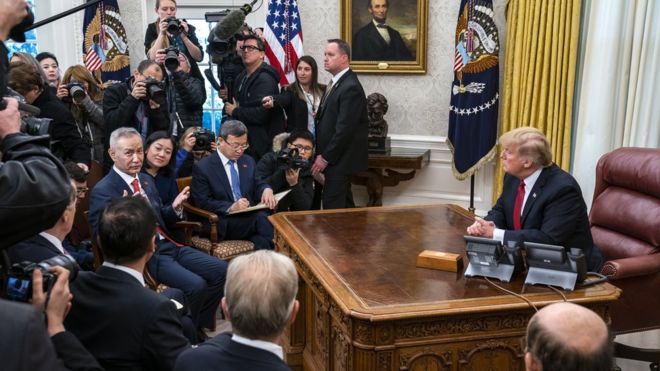
Vice Premier Liu He and President Donald TrumpImage copyrightEPA
Image captionVice Premier Liu He and President Donald Trump talk to the press about trade

China’s trade delegation says it made “important progress” in the latest round of talks with the US, China’s state media reports.

At the end of a two-day meeting in Washington, no deal was reached but China pledged to buy more US soybeans.

US President Donald Trump touted the promise as proof that the two sides were making progress.

They are pushing to reach a deal by 1 March to avert an escalation in tariffs.

At a press conference with Vice Premier Liu He on Thursday, President Trump said he hoped to meet Chinese President Xi Jinping to hash out a final agreement by the looming deadline.

“We have made tremendous progress,” President Trump said.

“That doesn’t mean you’re going to have a deal but there’s a tremendous relationship and a warm feeling.”

China also agreed to increase imports of “US agricultural products, energy products, industrial manufactured goods and service products” during the talks, Xinhua reported.

Is this progress?

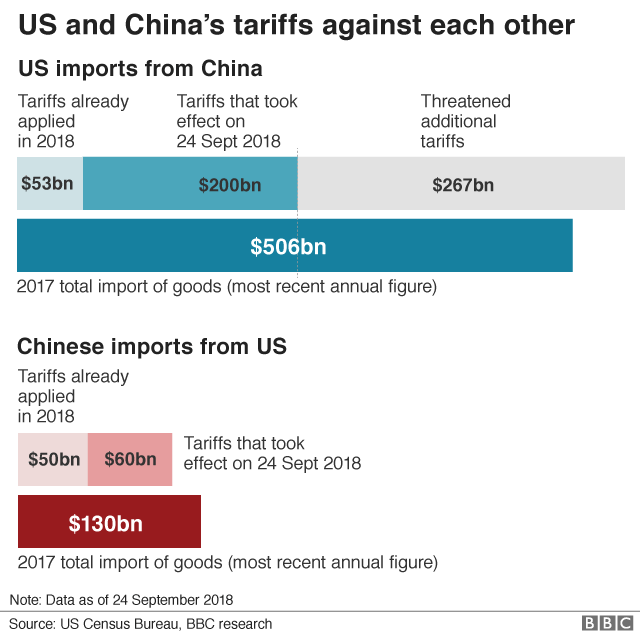
The two sides are racing to come up with a trade deal by 1 March, or the US has said it will increase tariff rates on $200bn (£152bn) worth of Chinese goods from 10% to 25%.

US trade negotiators agreed to visit China for more discussions in mid-February, Chinese state media reported.

In December, the two countries agreed to 90 days of negotiations, in an effort to defuse their escalating trade war, which had led to new tariffs on billions of dollars worth of goods.

US and China's tariffs against each other

Soybean pledge

Shortly after the truce took effect, China – by far the world’s biggest importer of soybeans – bought 1.13 million tonnes of the crop from the US.

The White House said on Thursday the country had agreed to purchase an additional 5 million tonnes of soybeans.

Soybeans have been at the forefront of negotiations as US farmers have suffered from the sudden loss of their largest customer.

The country imported more than 30 million tonnes of soybeans from the US in 2017 – a figure that dropped sharply last year amid the trade war.

Machinery on a US farm spits out soy beans into the back of a truck.Image copyrightGETTY IMAGES

Chinese businesses, meanwhile, have been trying to find new sources to replace crops from the US, which was the country’s second biggest supplier after Brazil in 2017.


Analysis: What China wants

Robin Brant, BBC News, Shanghai

China’s state media has painted these talks as “progress” based on the offer of measures or reforms that China wants to see, or needs.

These are not concessions, but steps that are in line with reform and opening up already planned by President Xi.

What politicians call the retail takeaway – in this case it literally is one – of buying more soybeans from American farmers went down well with President Trump.

That’s the idea. China would probably like a deal with the President Trump. Just the President.

A deal that the lead US negotiator, Trade Representative Robert Lighthizer, will sign off on is likely to involve verifiable, structural changes to the economy.

China is far less likely to concede that.

China would rather simply buy more soybeans and other goods or services to help President Trump fulfil his campaign pledge to deal with the trade imbalance between the two countries.


What happens next?

Mr Lighthizer said he was focused on securing a enforceable deal. He warned that many issues remained unresolved.

The US pressed for changes on intellectual property laws and rules that limit the operations of foreign companies in China, both of which have been key sticking points in negotiations.

The two sides “attached great importance to the issues of intellectual property protection and technology transfer and agreed to further strengthen cooperation”, according to Xinhua.

“We’ve made progress,” Mr Lighthizer said.

“At this point, it’s impossible for me to predict success but we are in a place that, if things work, it could happen.”

Source: The BBC

02/02/2019

Next stop Guam? China shows off its next generation DF-41 and DF-26 ballistic missiles

  • Beijing announces second-strike exercise involving an ICBM capable of hitting any point on the US or Russian mainland
  • State broadcaster releases first ever footage of ‘Guam killer’ DF-26 intermediate-range missile in action
PUBLISHED : Saturday, 02 February, 2019, 7:01pm
UPDATED : Saturday, 02 February, 2019, 7:01pm

China’s ballistic missile technology is advancing rapidly and recent demonstrations of its capabilities leave little doubt that when it comes to military dominance in the Asia-Pacific region, Beijing is keen to send a message to Washington that the United States is not the only player in town.

Last month, the People’s Liberation Army Rocket Force (PLARF) showed off its firepower by running a simulated strike mission using a Dongfeng-41 (DF-41) intercontinental ballistic missile (ICBM) and revealing footage of the improved stability of Dongfeng-26 (DF-26) ballistic missile.

DF-41: China’s ultimate nuclear deterrent

With its capability to deliver a nuclear warhead almost anywhere in the world, the DF-41 is China’s most advanced ICBM and has been the subject of intense speculation by Western analysts for the past decade.

At 16.5 metres (54 feet) it is slightly longer than its predecessor, the DF-31A, and with a range of up to 15,000km (9,320 miles) it not only flies further than either of its main rivals – the United States’ LGM-30 Minuteman (13,000km) and Russia’s RT-2PM2 Topol-M (11,000km) – but is capable of striking any part of the Russian or US mainland.

The fourth-generation missile has a top speed of Mach 25 (25 times the speed of sound) and as a “multiple independently targetable re-entry vehicle” can carry at least 10 warheads, each of which can be aimed at a different target.

The DF-41 can be fired from a silo-based platform or a road- or rail-based mobile launcher. The latter makes it more able to evade attack and in turn increases its value as a deterrent.

Song Zhongping, a missile expert and former officer with the PLA’s Second Artillery Force, said that the recent reports released by state media that Beijing had run a simulation of a second-strike against an “imaginary enemy” from an underground facility, showed the DF-41 was already in service.

A second-strike is a response to a nuclear attack with an equally powerful force.

While the location of the deployment is unknown it is widely thought to have been somewhere in northeast China, close to the Russian border.

DF-26: The ‘Guam killer’

The DF-26 is China’s next generation intermediate-range ballistic missile and takes its nickname from the fact its range – of 3,000km to 5,740km – puts the US island of Guam in the western Pacific and American military bases in Diego Garcia in the Indian Ocean within striking distance.

Operated by the PLARF, the solid-fuel missile system can be carried on a 12-wheeled Taian transporter erector launcher truck. This makes it difficult for US intelligence services to track and counter, either with their sea-based Aegis missile defences or, as on Guam, the long-range THAAD anti-missile interceptors.

Capable of carrying two types of nuclear warheads and many types of conventional ones – with a payload of 1,200kg (2,650lbs) to 1,800kg – the 14-metre-long missile can also be used for anti-ship strikes, such as US aircraft carriers and naval bases in the Asia-Pacific region.

China’s defence ministry confirmed last year that the DF-26 had entered service, and amid growing military tensions with Taiwan and the US, state broadcaster CCTV last month released the first ever footage of a DF-26 launch.

At least one missile was used in an exercise in northwest China and the four finlike flight control surfaces seen around its nose appear to have been designed to improve its stability.

Military analysts said the fins would provide greater stability as the missile neared a moving target, such as an aircraft carrier.

Source: SCMP

Law of Unintended Consequences

continuously updated blog about China & India

ChiaHou's Book Reviews

continuously updated blog about China & India

What's wrong with the world; and its economy

continuously updated blog about China & India