Archive for ‘China alert’

02/02/2019

Economic Watch: Spring Festival shopping going rural amid anti-poverty push

BEIJING, Feb. 1 (Xinhua) — As a time-honored tradition for preparing for Chinese New Year, Spring Festival shopping in cities has become more rustic this year.

Pepper sauce from Guizhou, navel oranges from Jiangxi and beef shank from Anhui are part of the rural specialties Beijing-based IT engineer Zhang Xin bought for the upcoming week-long Spring Festival holiday. They are all products from poor villages.

Zhang bought some of the delicacies from e-commerce platforms, and some from a fair held in his community designed to promote products from rural areas.

The rural specialties sales boom in urban areas is a result of China’s all-out efforts to achieve its goal of lifting its rural population out of poverty by 2020.

Wholesalers, e-commerce companies and supermarkets are encouraged to establish stable and long-term cooperative relationships with impoverished villages to power the country’s poverty eradication campaign, according to a plan released Tuesday by 10 government agencies.

E-COMMERCE PUSH

Social e-commerce giant Pinduoduo showed that orders of rural specialties exceeded 55 million from Jan. 4 to Jan. 24 in its online Spring Festival fair, a record high.

A local pickle product in central China’s Hunan Province developed by the platform’s poverty-reduction program sold 15,800 bottles on the platform the day it was launched. Total sales exceeded 3.3 million yuan (490,500 U.S. dollars) so far, bringing additional income of 3,000 to 5,000 yuan for over 200 rural households.

Other e-commerce players also leverage their platforms to enrich consumers’s shopping choices while boosting sales in poor areas. Alibaba’s Taobao has invited heads of 50 counties across the country to sell their local products via live streaming.

The Spring Festival shopping season is an important opportunity for e-commerce platforms to upgrade their mechanisms in poverty reduction, so that improving sales will ensure farmers a jubilant Chinese New Year, said Pinduoduo cofounder Da Da.

SPROUTING FAIRS

Besides shopping online, rural products are coming to cities with fairs springing up in urban communities, companies and institutions to enable first-hand experience and more direct sales.

A poverty-reduction Spring Festival fair in the capital city of China’s southernmost Hainan Province gathered rural specialties from 11 counties and sold over 10 million yuan of produce in just three days.

Beijing earlier this month set up a longer-term fair to sell over 2,000 products from poor counties in seven provincial regions. The fair will be open all year round.

The State Council has decided to offer incentives for public and private institutions to purchase goods produced in the impoverished regions, while expanding the sales channels of farm produce in the areas.

Product quality in poor areas should be enhanced, with local infrastructure improved so that rural tourism can be developed, according to the guidelines released by the State Council.

Source: Xinhua

02/02/2019

Chinese premier congratulates on 65th anniversary of Icebreaking Mission in China-Britain trade

BEIJING, Feb. 1 (Xinhua) — Chinese Premier Li Keqiang on Thursday sent a congratulatory message to an event commemorating the 65th anniversary of the “Icebreaking Mission” in China-Britain trade held by Britain’s 48 Group Club.

In the message, Li said that over the past more than 60 years, British friends including the 48 Group Club have been actively promoting trade and cultural exchanges between the two countries, facilitating the process of China’s reform and opening-up, and also enhancing bilateral win-win cooperation.

The “icebreakers” spirit not only shows the willingness of the British people to develop friendly cooperation with China, but also demonstrates that the development momentum of human society towards a more open and inclusive future is unstoppable, Li said.

In 1954, Jack Perry, the founder of London Export Corporation, led a group of 48 British businessmen on a historic trade mission to Beijing and helped deliver one of the first modern-day trade links with China.

The 48 men were the precursors of the 48 Group Club. The trip became known as the “Icebreaking Mission,” and the club members were called “icebreakers.”

The Chinese government speaks highly of the efforts made by the 48 Group Club for promoting China-Britain friendship, and looks forward to the “icebreakers” spirit being passed on and carried forward to make new and greater contributions to deepening friendship between the two peoples, Li added.

Li stressed that China is willing to continue to work together with friends from all walks of life in Britain, on a basis of mutual respect and on equal footing, to continuously strengthen bilateral relations and cooperation, jointly safeguard multilateralism and free trade, and promote the development of an open and inclusive world.

Source: Xinhua

02/02/2019

China, Japan hold diplomatic consultation, security dialogue

BEIJING, Feb. 1 (Xinhua) — China and Japan held a regular diplomatic consultation and a security dialogue Friday in Beijing.

During the activities attended by Chinese Vice Foreign Minister Kong Xuanyou and visiting Japanese Senior Deputy Minister for Foreign Affairs Takeo Mori, the two sides agreed that 2019 is a vital year for China-Japan relations to move toward a higher level.

The two countries should grasp the opportunity and implement the consensus reached by their leaders that China and Japan are cooperation partners rather than a threat to each other, and that they should support each other in peaceful development, according to a press release issued after the consultation.

The two sides agreed to plan and prepare for high-level exchanges, make solid progress in trade cooperation and people-to-people exchanges, and properly handle major, sensitive issues.

During the security dialogue, the two sides stressed that they share important responsibilities for safeguarding regional and global peace and stability, and that they should stick to the path of peaceful development.

Both sides agreed to step up dialogue, manage differences, build up trust and strive for a constructive relationship in security.

Source: Xinhua

02/02/2019

China Focus: Xi visits cadres, residents in Beijing ahead of Spring Festival

CHINA-BEIJING-XI JINPING-LUNAR NEW YEAR-VISIT (CN)

Chinese President Xi Jinping, also general secretary of the Communist Party of China Central Committee and chairman of the Central Military Commission, visits residents’ homes in Qianmen area in central Beijing, capital of China, Feb. 1, 2019. President Xi Jinping on Friday visited residents and primary-level officials in Beijing and extended Lunar New Year greetings to Chinese people of all ethnic groups. (Xinhua/Ju Peng)

BEIJING, Feb. 1 (Xinhua) — President Xi Jinping on Friday visited Beijing’s primary-level cadres and residents in downtown neighborhoods ahead of the Spring Festival and extended Lunar New Year greetings to Chinese people of all ethnic groups.

Xi, also general secretary of the Communist Party of China (CPC) Central Committee and chairman of the Central Military Commission, also inspected the preparation work for the Beijing 2022 Olympic and Paralympic Winter Games.

When inspecting the Beijing Municipal Public Security Bureau, Xi stressed the city’s glorious mission and weighty responsibility to safeguard the social stability of the national capital as 2019 marks the 70th anniversary of the founding of the People’s Republic of China.

Xi asked for coordinated efforts to promote work in all fields with resolve to complete the mission.

Touring a “hutong,” or traditional alley, in central Beijing’s Qianmen area, Xi ordered the efforts to protect cultural heritage sites and conserve traditional culture while renovating the city’s old areas.

He called for both improving local residents’ living conditions and protecting historical and cultural deposits, so that history and modernity will perfectly blend. He stressed specific measures to maintain the original features of hutong areas.

Xi dropped into two courtyards along the hutong, inquiring about the living conditions of local residents after the renovation projects in the neighborhood.

“What the CPC pursues is to make the people’s life better,” he told the residents, gladly chatting and making dumplings with them.

Noting close attention from the CPC Central Committee to the renovation of old towns and shanty areas, Xi said that the Party aims to create a more comfortable and better living environment for the people and solve problems they care about most so that they can enjoy modern life even in old hutong areas.

After chatting with residents, Xi went to a property service center to visit staff and community workers.

On the way back, Xi dropped in on a restaurant, chatted with the owner and some customers and wished them good luck.

Xi also called on a nearby express delivery station and visited the deliverymen who were on duty, stressing that priority should be given to solving employment problems and creating more jobs.

At 3:30 p.m., Xi arrived at the Shougang Park in Shijingshan District, the seat of the Beijing Organizing Committee for the 2022 Olympic and Paralympic Winter Games, to learn about the preparation for the Games and the planning and construction of the venues and infrastructure.

Xi stressed the need to stay committed to hosting the Games in a green, sharing, open and clean manner, and to complete all preparation tasks with high standards.

The venue construction must meet the Olympic standards and be completed on time, Xi said.

Stressing that the features of technology, intelligence, greenness and frugality should be highlighted, Xi said advanced technological approaches should be applied, energy-saving and environmental friendly requirements should be strictly enforced, the environment and cultural relics should be well protected, and Chinese styles should be on full display.

Xi visited the office building of the Beijing Organizing Committee, meeting with some of the staff and volunteers there.

Noting that Beijing will become the world’s only host of both the Summer and Winter Olympics, he stressed that China must fulfill the solemn commitments it made to the world.

“Hosting the 2022 Winter Olympics is an important support to the coordinated development of the Beijing-Tianjin-Hebei region,” Xi said, adding that Hebei Province must develop together with Beijing.

During his visit to the national winter sports training center, Xi stressed promoting sportsmanship with Chinese characteristics, boosting coordinated development of mass sports, competitive sports and the sports industry, and speeding up building China into a country strong on sports.

Vice Premier Han Zheng, also a member of the Standing Committee of the Political Bureau of the CPC Central Committee, accompanied Xi on the inspection tour of the preparation work for the Beijing 2022 Olympic and Paralympic Winter Games.

Source: Xinhua

01/02/2019

China’s Xi surprises Beijingers with casual pre-new year visit

BEIJING (Reuters) – Chinese President Xi Jinping dropped in on surprised diners at a small Beijing restaurant and chatted with deliverymen on Friday on an apparently unscripted visit ahead of next week’s Lunar New Year holiday.

Such relaxed interactions between senior politicians and the public are uncommon in a country where even leaders’ birthdays or family backgrounds are often closely held secrets.

Leaders generally use the time around the festival to make carefully choreographed, well pre-arranged inspection trips around the country where they flag important policy initiatives or areas of concern for the year ahead.

Xi last year visited villagers in a poor southwestern part of China, to press home his campaign against poverty.

On Friday, state television showed Xi walking into the restaurant in a southern district of Beijing known for its traditional alleyways and courtyards, asking how much the food was and how long the owners had been in the city.

As diners stood up to take pictures, Xi told them not to stop eating on his account.

“I’m just passing through,” he said.

As he chatted at a separate location with deliverymen, who speed around Beijing delivering packages on motor-bikes, passersby could be seen in the background walking right behind him, or in one case cycling by.

“Are you not able to go home for the Spring Festival?” he asked one of the deliverymen.

Still, Xi was almost certainly accompanied by his security detail throughout, even if they were not directly shown in the television footage.

In another much more obviously scripted part of the day, he visited policemen and made dumplings with residents in a courtyard dwelling.

While Xi has cultivated a man-of-the-people image, and is genuinely popular with many Chinese for his war on corruption, he has only rarely had such relaxed interactions since assuming office six years ago.

In 2014, Xi shocked Beijing residents by visiting courtyard homes and chatting with passersby near a shopping street during one of the city’s notorious smoggy days, drawing praise from social media users for his unusual public diplomacy.

The week-long holiday, starting on the eve of the new year, on Monday, is the most important in the Chinese calendar, when millions of people travel home, many for the only time in the year.

Source: Reuters

01/02/2019

Haidilao: Robots staff China’s top hotpot chain

China’s biggest hotpot restaurant chain by sales, Haidilao, started almost 25 years ago and has already established more than 360 restaurants around the world, including in Japan, the US and Taiwan.

The popular chain has opened Beijing’s first robot-aided hotpot restaurant to much fanfare and is looking to spread the concept across its other outlets if it proves successful.

Source: The BBC

01/02/2019

China hails ‘important progress’ in US trade talks

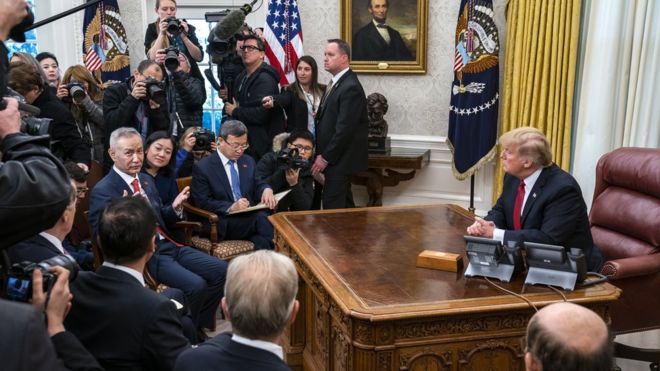
Vice Premier Liu He and President Donald TrumpImage copyrightEPA
Image captionVice Premier Liu He and President Donald Trump talk to the press about trade

China’s trade delegation says it made “important progress” in the latest round of talks with the US, China’s state media reports.

At the end of a two-day meeting in Washington, no deal was reached but China pledged to buy more US soybeans.

US President Donald Trump touted the promise as proof that the two sides were making progress.

They are pushing to reach a deal by 1 March to avert an escalation in tariffs.

At a press conference with Vice Premier Liu He on Thursday, President Trump said he hoped to meet Chinese President Xi Jinping to hash out a final agreement by the looming deadline.

“We have made tremendous progress,” President Trump said.

“That doesn’t mean you’re going to have a deal but there’s a tremendous relationship and a warm feeling.”

China also agreed to increase imports of “US agricultural products, energy products, industrial manufactured goods and service products” during the talks, Xinhua reported.

Is this progress?

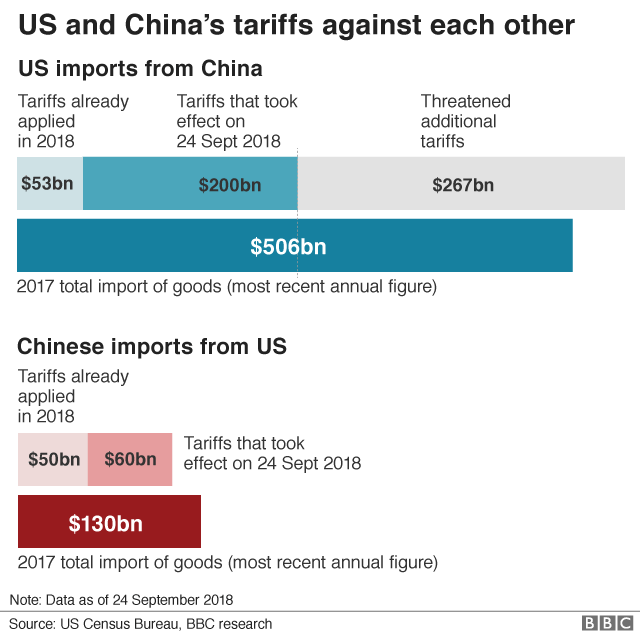
The two sides are racing to come up with a trade deal by 1 March, or the US has said it will increase tariff rates on $200bn (£152bn) worth of Chinese goods from 10% to 25%.

US trade negotiators agreed to visit China for more discussions in mid-February, Chinese state media reported.

In December, the two countries agreed to 90 days of negotiations, in an effort to defuse their escalating trade war, which had led to new tariffs on billions of dollars worth of goods.

US and China's tariffs against each other

Soybean pledge

Shortly after the truce took effect, China – by far the world’s biggest importer of soybeans – bought 1.13 million tonnes of the crop from the US.

The White House said on Thursday the country had agreed to purchase an additional 5 million tonnes of soybeans.

Soybeans have been at the forefront of negotiations as US farmers have suffered from the sudden loss of their largest customer.

The country imported more than 30 million tonnes of soybeans from the US in 2017 – a figure that dropped sharply last year amid the trade war.

Machinery on a US farm spits out soy beans into the back of a truck.Image copyrightGETTY IMAGES

Chinese businesses, meanwhile, have been trying to find new sources to replace crops from the US, which was the country’s second biggest supplier after Brazil in 2017.


Analysis: What China wants

Robin Brant, BBC News, Shanghai

China’s state media has painted these talks as “progress” based on the offer of measures or reforms that China wants to see, or needs.

These are not concessions, but steps that are in line with reform and opening up already planned by President Xi.

What politicians call the retail takeaway – in this case it literally is one – of buying more soybeans from American farmers went down well with President Trump.

That’s the idea. China would probably like a deal with the President Trump. Just the President.

A deal that the lead US negotiator, Trade Representative Robert Lighthizer, will sign off on is likely to involve verifiable, structural changes to the economy.

China is far less likely to concede that.

China would rather simply buy more soybeans and other goods or services to help President Trump fulfil his campaign pledge to deal with the trade imbalance between the two countries.


What happens next?

Mr Lighthizer said he was focused on securing a enforceable deal. He warned that many issues remained unresolved.

The US pressed for changes on intellectual property laws and rules that limit the operations of foreign companies in China, both of which have been key sticking points in negotiations.

The two sides “attached great importance to the issues of intellectual property protection and technology transfer and agreed to further strengthen cooperation”, according to Xinhua.

“We’ve made progress,” Mr Lighthizer said.

“At this point, it’s impossible for me to predict success but we are in a place that, if things work, it could happen.”

Source: The BBC

01/02/2019

Law textbook pulled from shelves in China amid campaign against ‘Western influence’

  • Author Zhang Qianfan rejects suggestion his writing excessively promotes Western ideas as ‘utter nonsense’
  • Authorities have not confirmed they ordered the title to be withdrawn but it comes after government launched sweeping review of teaching materials
PUBLISHED : Friday, 01 February, 2019, 6:40pm
UPDATED : Friday, 01 February, 2019, 6:40pm

The author, Zhang Qianfan, a professor at Peking University known for his advocacy of constitutionalism and judicial reform, dismissed any suggestion his writing excessively promoted Western ideas as “utter nonsense”, and said the academic world should not be politicised.

Since taking office in 2012, President Xi Jinping has tightened the Communist Party’s control over society including the legal system and education.

While authorities have not confirmed they ordered the book withdrawn, and no reason for its disappearance has been given, it comes after the government began a sweeping review of teaching materials.

The Ministry of Education in early January launched a nationwide check on the content of all university constitutional law textbooks, according to posts on the Jiangxi and Zhejiang province education ministry websites.

Universities were told the “fact-finding” sweep was of great importance and they must accurately fill in a chart detailing titles and authors of the books they used, with “no omissions”, according to the ministry’s posts.

The campaign drew criticism from some legal academics, which was amplified by a rumour that the sweep was sparked by an accusation from a professor that certain texts were “promoting Western thinking and agitating for a Western system”.

The education ministry did not respond to a faxed request for comment.

China’s constitution promises freedom of speech, religion and assembly, but it is trumped in practice by legislation and regulations, and it is rarely invoked in legal cases.

The constitution has long been a focus for political reformers, who argue that its status should be elevated within the legal system.

Zhang’s book could not be found on China’s main online bookstores when searched by Reuters on Friday.

Zhang, in an interview published on the WeChat social media platform, rejected any suggestion his texts promoted a “Western” system over alternatives.

“To criticise purely for the sake of it and to shut our nation off to the outside world is closed-minded thinking,” Zhang said.

“Constitutional law, as an academic discipline, should not be politicised,” he said. “Any academic discipline should retain a certain political neutrality.”

“At this time, constitutional law is a ‘sensitive’ topic. As far as I can see there is basically no public discussion. It seems that everyone is scared,” he said.

Zhang’s interview disappeared soon after it was posted, to be replaced by a notice saying the content had broken “relevant laws and regulations”.

Zhang did not respond to an email seeking comment.

Many legal scholars took to social media to voice support for Zhang.

Some posted the foreword from his book, in which he stresses the importance of giving people who have suffered injustices the chance to defend themselves using the constitution.

Some voiced concern that some academics might accuse others of failing to toe the party line.

“The worst part about this incident is that in the current environment, not only are these people not inhibited, but rather they are given a channel, or even rewards,” Zhang Taisu, an associate professor of law at Yale University in the United States, wrote on Weibo, referring to the accusers.

Source: SCMP

01/02/2019

Shanghai adopts law on household garbage sorting

SHANGHAI, Jan. 31 (Xinhua) — Shanghai’s municipal legislature on Thursday adopted a set of regulations on household garbage sorting and recycling, which will become effective on July 1.

In 2018, nearly 26,000 tonnes of house refuse needed to be disposed every day, with the total volume of household garbage surpassing 9 million tonnes.

“The growing demand of garbage disposal has imposed mounting pressure on Shanghai’s sustainable development,” Xiao Guiyu, deputy director of the Standing Committee of the Shanghai Municipal People’s Congress, told the lawmakers.

Shanghai will complete a sophisticated garbage disposal system including efforts in garbage sorting, collecting, transportation and recycling. Efforts will also be carried out in reducing the city’s total volume of house refuse.

The regulations also specify the legal responsibilities of individuals and units concerned, who shall take the responsibilities of sorting garbage according to the categories of recyclable, hazardous, wet, and dry waste.

According to the regulations, units will face fines up to 500,000 yuan (nearly 75,000 U.S. dollars) for violating the waste disposal rules, and individual will be fined 50 to 200 yuan for illegal activities.

In order to reduce the total waste volume, the city will introduce more environmentally-friendly packing materials and promote economical packaging standards against over-packaging.

The regulations also encourage going paperless at work especially in Party and government offices, as well as public institutions. Disposable dishware and chopsticks will also be discouraged in restaurants and during catering services.

Business players who disobey the rules will face fines ranging from 500 yuan to 5,000 yuan, said Ding Wei, a lawmaker in Shanghai.

Over 40 Chinese cities have set up pilot zones to promote garbage sorting and recycling, said Zhang Zhao’an, vice president of Shanghai Academy of Social Science.

Shanghai will also carry out stronger supervision and punishment of illegal activities, said Mayor Ying Yong at a press conference Thursday.

“Everyone should be a part of the campaign of garbage sorting,” Ying said.

Source: Xinhua

01/02/2019

Chinese study on quantum communication wins Newcomb Cleveland Prize

WASHINGTON, Jan. 31 (Xinhua) — A study on quantum communication made by Chinese scientists will receive the 2018 Newcomb Cleveland Prize as it laid the groundwork for ultra-secure communication networks of the future.

The American Association for the Advancement of Science (AAAS) announced Thursday that a team of 34 Chinese physicists led by Pan Jianwei with the University of Science and Technology of China had won the award that will be delivered on Feb. 14.

This is the first time that a Chinese team wins the prize with its home-grown research.

Pan and his Chinese colleagues used a satellite called Quantum Experiments at Space Scale (QUESS) or Micius to send entangled photon pairs through the near-vacuum of space, measuring the quantum keys at receiving stations over 1,200 kilometers apart.

Scientists found that when two entangled particles are separated, one particle can somehow affect the action of the far-off twin instantly, which is what Albert Einstein described as a “spooky action at a distance.”

If researchers are able to maintain entanglement over long distances, an “hack-proof” messaging encryption system could evolve, according to Pan’s study published in the journal Science in June of 2017.

The research shows that a network of satellites could one day form the infrastructure of a quantum internet.

“In principle, methods based on the phenomenon of quantum entanglement represent solutions to the problem of perfectly secure communication,” said Jeremy Berg, editor-in-chief of Science and chair of the Newcomb Cleveland Prize Selection Committee.

“However, many challenges remain in converting these in principle methods into practice,” said Berg. “The Newcomb Cleveland Prize winning paper presents a substantial step in addressing these challenges, demonstrating quantum communication over very long distances.”

Previously, entanglement distribution had only been achieved at a distance up to 100 kilometers due to photon loss in optical fibers or terrestrial free space.

The Newcomb Cleveland Prize, AAAS’ oldest award, has honored the most impactful research paper published in the journal Science since 1923.

Source: Xinhua

Law of Unintended Consequences

continuously updated blog about China & India

ChiaHou's Book Reviews

continuously updated blog about China & India

What's wrong with the world; and its economy

continuously updated blog about China & India