Archive for ‘China alert’

06/01/2019

Chinese scientists succeed in developing clonal seeds from hybrid rice

HANGZHOU, Jan. 5 (Xinhua) — Chinese scientists have succeeded in developing clonal seeds from hybrid rice, said an online paper published in Nature Biotechnology Friday night.

The team, led by Wang Kejian, from the China National Rice Research Institute and the Chinese Academy of Agricultural Sciences, conducted simultaneous genome engineering of meiosis and fertilization genes in developing the clonal seeds.

Usually, beneficial phenotypes are lost in subsequent generations owing to genetic segregation. But with the clonal seeds, the heterosis, or hybrid vigor of the hybrid rice, can be passed on to produce high-yielding crops.

“The success has proved the feasibility of apomixis for hybrid rice, which is significant theoretically. I hope that with their further research, the seeds will be put into production soon,” said Yuan Longping, the “father of hybrid rice.”

Statistics show that China has planted 16 million hectares of hybrid rice, about 57 percent of the total planting area of rice across the country. The annual output of hybrid rice is about 2.5 million tonnes.


Source: XinhuaNet

05/01/2019

China’s Harbin ice festival in pictures

One of the world’s largest ice festivals has opened in north-eastern China, featuring frozen castles, glistening snow sculptures and lots of snowmen.

Ice sculptures are seen at annual ice festival, in the northern city of Harbin, Heilongjiang province, China, on 4 January 2019Image copyrightREUTERS
Image captionThe Harbin International Ice and Snow Sculpture Festival officially opened on Saturday.
Visitors watch fireworks exploding over ice sculptures at the Ice and Snow World during the opening ceremony of the annual Harbin International Ice and Snow Sculpture Festival, in Harbin, Heilongjiang province, China, on 5 January 2019Image copyrightEPA
Image captionIt opened with a fireworks display and a light show.
A child rides a slide of an ice sculpture of the Ice and Snow World during the annual Harbin International Ice and Snow Sculpture Festival, in Harbin, China, on 4 January 2019Image copyrightEPA
Image captionThe festival draws millions of visitors from around the world every year.
People visit ice sculptures illuminated by coloured lights at the Ice and Snow World in Harbin on 4 January 2019Image copyrightEPA
Image captionSome 120,000 cubic metres of ice and 111,000 cubic metres of snow have been used to build the Ice and Snow World.
People visit ice sculptures at the Ice and Snow World during the annual Harbin International Ice and Snow Sculpture Festival, in Harbin, China, on 4 January 2019Image copyrightEPA
Image captionThousands of artists and workers built the displays in a city where temperatures can plunge as low as -35C (-31F).
A couple walk between snowmen on Songhua River that displays 2019 snowmen as a part of annual ice festival, in the northern city of HarbinImage copyrightREUTERS
Image captionThere are 2,019 snowmen on display on the frozen Songhua River.
Participants jump into the freezing water of the Songhua River during a winter swimming competition at the annual Harbin International Ice and Snow Sculpture Festival, in Harbin, Heilongjiang province, China, 05 January 2019. Around 600 winter swimmers took part in the competition.Image copyrightEPA
Image captionThere is even a winter swimming competition – with more than 300 people braving the chilly waters.
People visit ice sculptures illuminated by coloured lights at the Ice and Snow World during the annual Harbin International Ice and Snow Sculpture Festival on 4 January 2019Image copyrightEPA
Image captionThe festival, which first started in the early 1980s, runs until 5 February.

All photographs subject to copyright as marked.

05/01/2019

China’s air force in recruitment drive for J-20 stealth fighter pilots

  • Promotional video encourages young Chinese aged 17 to 20, and those graduating from high school in 2019, to apply
  • With hundreds of new warplanes being commissioned each year, the country’s demand for pilots is huge
PUBLISHED : Saturday, 05 January, 2019, 10:00pm
UPDATED : Saturday, 05 January, 2019, 11:14pm

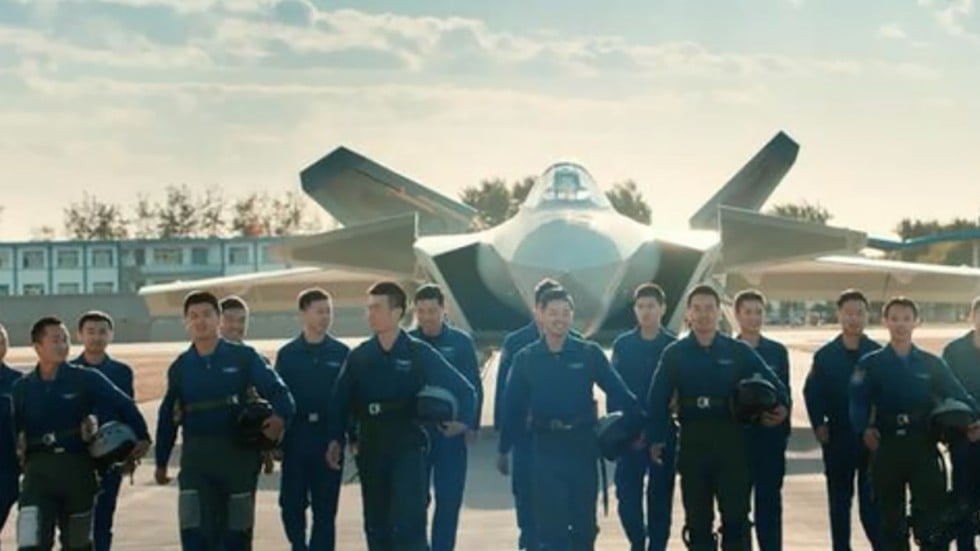
At present, there appear to be at least 18 pilots flying the home-grown stealth fighter jets, according to a promotional video released by the air force this week.

The video is part of a campaign to find new recruits for the People’s Liberation Army Air Force and encourages young Chinese aged 17 to 20, and those graduating from high school in 2019, to apply.

The recruitment drive is under way in 31 of the country’s 33 provinces, and successful candidates will be given the opportunity to study at some of China’s top universities while they are being trained.

As the United States seeks to expand its military presence in the region as part of its Indo-Pacific strategy, China is trying to build up its forces, with a focus on modernising the air force and navy.

And with hundreds of new warplanes – including more than 100 fighter jets – being commissioned each year, China’s demand for pilots is huge.

Last year, the air force recruited its biggest pool of trainees ever, taking on some 1,480 high school graduates.

All pilots must be able to fly different types of planes, but those who receive advanced training to operate China’s newest heavyweight stealth fighter are given the title J-20 pilot.

Among those featured in the air force promotional video is J-20 pilot Bai Long. The 29-year-old has become a popular public face of the PLA Air Force since he flew a J-16 multirole strike fighter during the high-profile military parade marking the PLA’s 90th anniversary in 2017. It was the public debut of China’s fourth-generation fighter jet, which is based on the Russian Sukhoi Su-30.

In an interview last year, Bai said his dream was to be able to “fly China’s most advanced fighter jet” – an ambition he has now officially achieved.

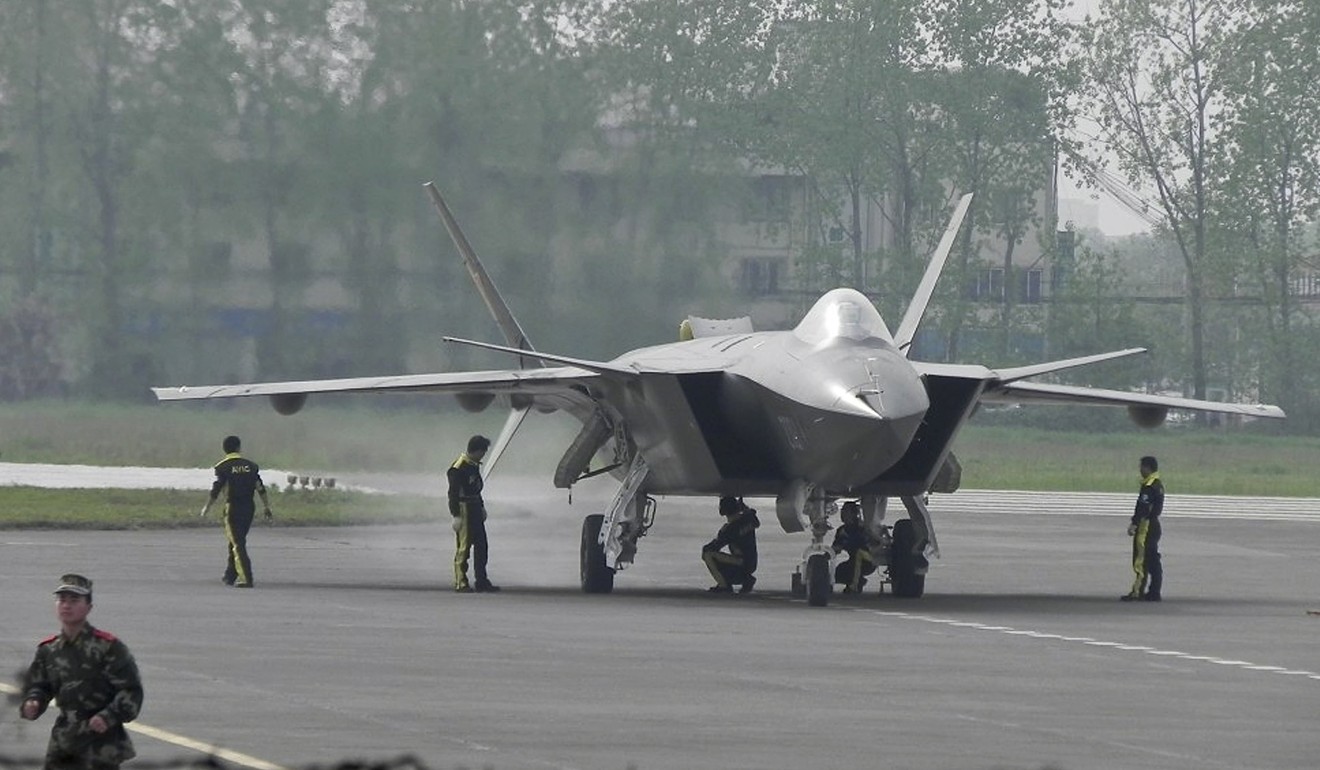
Developed by Chengdu Aerospace Corporation, the J-20 made its maiden flight in 2011 and entered service in 2017. It is the world’s third fifth-generation fighter jet after America’s F-22 and F-35 and is expected to be key to China’s ambition of gaining superiority in the air.

The South China Morning Post reported in September that China had about 20 of the J-20 fighter jets, which analysts said was “far from enough”.

Beijing-based military expert Zhou Chenming said China expected the US to deploy between 200 and 300 F-35s – in addition to the 187 F-22s in operation – in the Asia-Pacific region by 2025.

He said that meant “China needs a similar number of J-20s – or at least 200”.

Meanwhile, the PLA Navy is also searching for trainee pilots, especially for its aircraft carrier-based J-15 fighter jets. By the end of 2016, 25 pilots had qualified to fly the J-15s. That number grew to 40 the following year, and in addition more than two dozen J-15 pilots were being trained.

05/01/2019

China’s population set to peak at 1.44 billion in 2029 – government report

SHANGHAI (Reuters) – China’s population is set to reach a peak of 1.442 billion in 2029 and start a long period of “unstoppable” decline in 2030, government scholars said in a research report published on Friday.

The world’s most populous country must now draw up policies to try to cope with a declining labour force and a rapidly ageing population, according to the summary of the latest edition of the “Green Book of Population and Labor” published by the China Academy of Social Sciences (CASS).

Growth in the working population had now stagnated, the report said, and the rising number of elderly people will have a far-reaching impact on the social and economic development in the country, especially if fertility rates remain low.

“From a theoretical point of view, the long-term population decline, especially when it is accompanied by a continuously ageing population, is bound to cause very unfavourable social and economic consequences,” it said.

China’s population is expected to fall back to 1.36 billion by the middle of the century, it said, which could mean a decline in the workforce of as much as 200 million. If fertility rates remain unchanged, the population could fall to 1.17 billion by 2065, it said.

China decided in 2016 to relax a controversial “one-child policy” aimed at curbing population growth and allow all couples to have two children. However, the country’s birth rate still fell 3.5 percent in 2017 and is expected to have fallen again last year.

China’s “dependency rate” – or the proportion of non-working people, including children and the elderly, in the total population – rose for the first time in more than 30 years in 2011, and is widely predicted to increase further for at least the next few decades.

The proportion of retirees is projected to rise until 2060, the CASS report said, and while the decision to relax “one-child” rules was designed to rebalance China’s age structure, in the short term it will also lead to a greater dependency rate.

According to previous forecasts, China’s elderly population is expected to reach 400 million by the end of 2035, up from around 240 million last year.

05/01/2019

US issues fresh travel warning after China detentions

  • 4 January 2019
Michael Spavor (L) and Michael Kovrig (composite image)Image copyrightAFP
Image captionCanadians Michael Spavor (L) and Michael Kovrig are being detained in China

The US state department has urged Americans to “exercise increased caution” when travelling to China after a spate of high-profile detentions.

Its updated advice says dual US-Chinese nationals are at particular risk from so-called exit bans that prevent them from leaving.

Canada also revealed that 13 Canadians had been detained since 1 December.

On that day, a top Chinese executive was arrested in Canada at the request of US prosecutors.

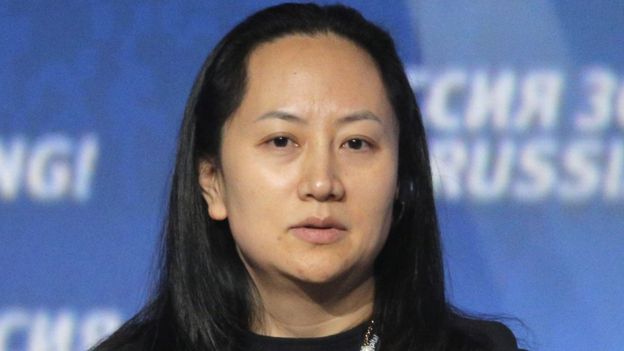
Huawei chief financial officer Meng Wanzhou was detained in Vancouver and faces extradition to the US to face fraud charges, which she denies, that are linked to allegations of avoiding US sanctions on Iran.

China has dismissed the US travel warning as unjustified.

“To be frank, the issuance of such a travel advisory by the US side does not hold water,” foreign ministry spokesman Lu Kang said.

“From January to November 2018, 2.3 million visits to China were made by Americans, which means 70 per 10,000 American people made the trip, a ratio far higher than that of the Chinese visiting the US.

“So, this figure is a testament to China’s safety.”

What is the latest US travel advice?

The new advisory warns that dual US-Chinese nationals are at particular risk from so-called exit bans, which it says can be used to prohibit US citizens from leaving China – in some cases keeping them in the country for years.

The exit bans are also being used to try to lure other individuals back to China, it warns.

It advises citizens travelling to China to use their US passport with a valid China visa. They should ask officials to notify the US embassy immediately if they are detained or arrested.

The state department says that as dual-citizenship is not recognised under Chinese law, “US-Chinese citizens and US citizens of Chinese heritage may be subject to additional scrutiny and harassment”.

The advisory says exit bans are being used to “compel US citizens to participate in Chinese government investigations” and “to aid Chinese authorities in resolving civil disputes in favour of Chinese parties”.

What do we know of the recent detentions?

Three US citizens were accused of committing “economic crimes” and barred from leaving China in November.

Victor and Cynthia Liu, who are the children of a fugitive businessman, and their mother, Sandra Han, have reportedly been detained since June.

The businessman, Liu Changming, is wanted in a $1.4bn (£1bn) fraud case in China and the family has said their detention is an attempt to lure him back to face charges.

Beijing has defended its decision to bar the three US citizens from leaving the country.

A foreign ministry spokesman told reporters that they “all have… valid identity documents as Chinese citizens” and are “suspected of having committed economic crimes”.

On Thursday, Global Affairs Canada revealed that 13 Canadians had been detained in China since 1 December, although eight have since been released.

Meng Wanzhou, chief financial officer of Huawei, 2 October 2014Image copyrightEPA
Image captionMeng Wanzhou, the chief financial officer of Huawei, was arrested in Canada at the request of the US

Among the Canadians who remain detained are former diplomat Michael Kovrig and businessman Michael Spavor.

Canadian teacher Sarah McIver who was reportedly released last week after she was held for “unlawfully working in China”. China and Canada both said the case was different to that of Mr Kovrig and Mr Spavor who stand accused of harming national security.

China insists the detention of both men is not linked to Ms Meng’s arrest, but many analysts believe it was a tit-for-tat action.

On Thursday, China’s prosecutor general said the pair had “violated our country’s laws and regulations” and were being investigated.

05/01/2019

Taiwan President Tsai Ing-wen open to cross-strait talks, but has some demands for Beijing first

  • Leader explains her rejection of Xi Jinping’s proposal to start talks on unification based on ‘one country, two systems’
PUBLISHED : Saturday, 05 January, 2019, 5:00pm
UPDATED : Saturday, 05 January, 2019, 6:13pm

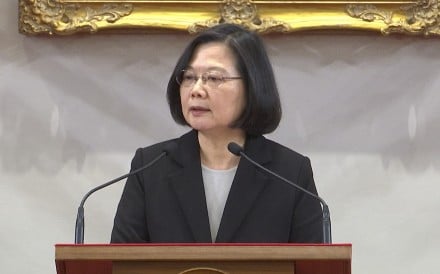
Taiwan’s President Tsai Ing-wen said on Saturday she was open to talks with the mainland if Beijing was willing to promote democracy and renounce the use of force against the self-ruled island.

Tsai’s comments came two days after she rejected Chinese President Xi Jinping’s proposal for the two sides to start talks on unification based on the “one country, two systems” model which applied in Hong Kong.

“As the democratically elected president, I have to defend our democracy, freedom, and way of life,” she told foreign journalists in Taipei to explain her rejection of Xi’s proposal, made in a speech on Wednesday to mark 40 years since the end of military confrontation across the Taiwan Strait.

Tsai said Xi’s statement highlighted two fundamental dangers posed by Beijing to freedom and democracy in Taiwan.

“First, by emphasising ‘one China’ and ‘one country, two systems,’ particularly in the context of the so-called 1992 consensus, China has made clear their political intentions towards Taiwan and their steps for unification.

“This is a major disregard for the fact that the Republic of China, Taiwan does exist, and is in full operation like all other democratic countries,” she said.

“Second, China’s plan to engage in political consultation with the political parties instead of the democratically elected government of Taiwan, is a continuation of its deliberate campaign to undermine and subvert our democratic process and create division in our society.”

The 1992 consensus refers to an understanding that there is only one China, though each side may have its own interpretation of what constitutes “China”.
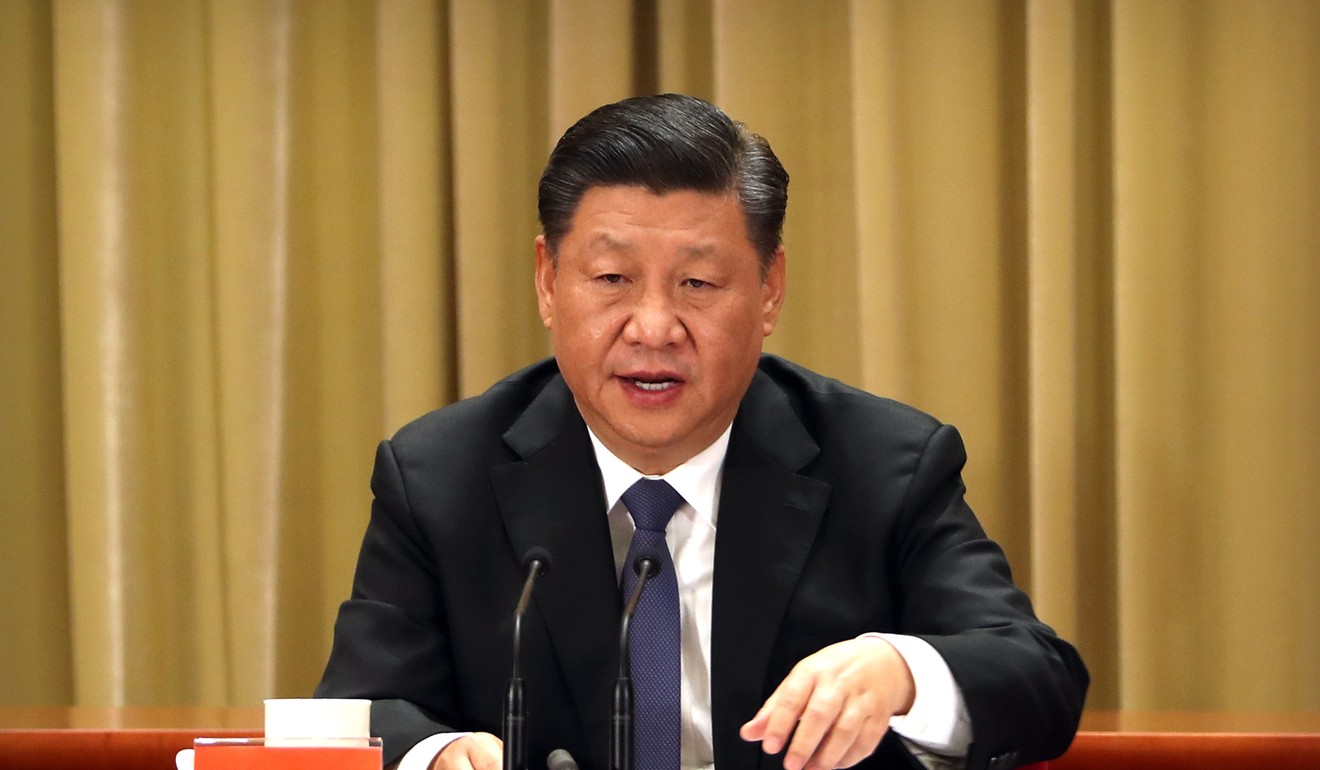
In his speech, Xi rephrased the consensus as an understanding that “the two sides of the Taiwan Strait belong to one China, jointly seeking to achieve cross-strait unification”.

Beijing suspended official talks and exchanges with Taiwan when Tsai was elected president in 2016 and refused to accept the consensus.

Since then Beijing, which considers Taiwan a wayward province awaiting unification by force if necessary, has staged a series of war games to intimidate the island and poached five of Taiwan’s diplomatic allies to try to pressure Tsai into accepting the consensus.

“As a democracy, cross-strait interaction must follow the rules and oversight of the people of Taiwan, and therefore any discussions must be between governments that are representative of the people on both sides,” Tsai said on Saturday.

She identified a lack of mutual trust as the key problem keeping the two sides from consulting on a possible way of dealing with each other.

“The lack of democracy and protection of human rights, as well as the military threats from China are the major reasons [that people here do not trust Beijing],” Tsai said.

This was why majority opinion in Taiwan opposed cross-strait unification, as people there did not want to live in a system without democracy and human rights, she said.

Asked if the Tsai administration would want talks with Beijing, Tsai said her government did not oppose talks, but Beijing must “move towards democracy, protect human rights and renounce the use of force against us”.

“Only when the two sides step up efforts to accumulate adequate trust will the room for [negotiation] be widened and options [for talks] increased,” she said.

Tsai said Taiwan had long adhered to the principle of refraining from provoking Beijing and had done all it could to maintain stability in the region.

On the contrary, she said, Beijing had tried to suppress Taiwan and refused to cooperate with the island, even on health issues like the outbreak of African swine fever which threatened the well-being of the public in Taiwan.

Tsai added that she had also sought international support to defend the self-ruled island’s democracy and way of life, as well as Taiwan’s refusal to accept the one country, two systems approach offered by Xi for unification talks, given Beijing’s snubbing of democracy and human rights.

She asked Beijing to take note of the democratic mindset of Taiwanee.

05/01/2019

Chinese president appoints new ambassadors

BEIJING, Jan. 4 (Xinhua) — Chinese President Xi Jinping has appointed eight new ambassadors in accordance with a decision by the Standing Committee of the National People’s Congress, according to a statement by the national legislature Friday.

Zou Xiaoli has been appointed ambassador to Argentina, replacing Yang Wanming.

Yang Wanming has been appointed ambassador to Brazil, replacing Li Jinzhang.

Hou Yanqi has been appointed ambassador to Nepal, replacing Yu Hong.

Li Minggang has been appointed ambassador to Kuwait, replacing Wang Di.

Li Lingbing has been appointed ambassador to Oman, replacing Yu Fulong.

Li Lianhe has been appointed ambassador to Algeria, replacing Yang Guangyu.

Liu Bin has been appointed ambassador to Tajikistan, replacing Yue Bin.

Wang Shunqing has been appointed ambassador to Slovenia, replacing Ye Hao.

05/01/2019

Xi orders armed forces to enhance combat readiness

CHINA-BEIJING-XI JINPING-CMC-MEETING (CN)

Chinese President Xi Jinping, also general secretary of the Communist Party of China (CPC) Central Committee and chairman of the Central Military Commission (CMC), delivers a speech at a CMC meeting held in Beijing, capital of China, Jan. 4, 2019. (Xinhua/Li Gang)

BEIJING, Jan. 4 (Xinhua) — President Xi Jinping Friday ordered the Chinese armed forces to enhance their combat readiness from a new starting point and open new ground for developing a strong military.

Xi, also general secretary of the Communist Party of China (CPC) Central Committee and chairman of the Central Military Commission (CMC), made the instruction at a CMC meeting held in Beijing.

Hailing the landmark, pioneering and historic military achievements since the 18th CPC National Congress, Xi said the armed forces had resolutely safeguarded national sovereignty, security and development interests and withstood complex situations and severe struggles.

“The world is facing a period of major changes never seen in a century, and China is still in an important period of strategic opportunity for development,” he said, warning that various risks and challenges were on the rise.

The entire armed forces should have a correct understanding of China’s security and development trends, enhance their awareness of danger, crisis and war, and make solid efforts on combat preparations in order to accomplish the tasks assigned by the Party and the people, Xi said.

Regarding combat capability as the only and fundamental criterion, Xi ordered all work, forces and resources to focus on military preparedness and ensure a marked progress in this regard.

Xi stressed the armed forces’ ability to respond quickly and effectively to contingencies, asking them to upgrade commanding capability of joint operations, foster new combat forces, and improve military training under combat conditions.

Party and government departments and agencies at the central and local levels are required to support the defense and military development.

Xu Qiliang, a CMC vice chairman, presided over the meeting, and Zhang Youxia, the other CMC vice chairman, announced the decision to give awards to 10 model units and 20 model individuals. They received awards from leaders, including Xi.

Xi also signed a mobilization order for the training of the armed forces, the CMC’s first order in 2019.

04/01/2019

China slashes banks’ reserve requirements again as economy slow

BEIJING (Reuters) – China’s central bank said on Friday it was cutting the amount of cash that banks must hold as reserves for the fifth time in the past year — freeing up $116 billion for new lending as it tries to reduce the risk of a sharper economic slowdown.

The latest support measures come amid mounting worries about the health of the world’s second-largest economy, which is facing both slowing demand at home and punishing U.S. tariffs on its exported goods.

Global stock markets sold off on Thursday after a warning from tech giant Apple Inc about slowing China sales, while data earlier this week showed the country’s manufacturing activity shrank in December for the first time in over two years.

The cut in banks’ reserve requirement ratios (RRR) is the

first in 2019 by the People’s Bank of China (PBOC) as the economy faces its weakest growth since the global financial crisis and mounting pressure from U.S. tariffs.

Reserve requirement ratios (RRRs) – currently 14.5 percent for large institutions and 12.5 percent for smaller banks – will be lowered by a total of 100 basis points (bps) in two stages, the People’s Bank of China (PBOC) said.

The cuts will be effective Jan. 15 and Jan. 25, and come ahead of the long Lunar New Year celebrations when cash conditions often get tight.

The moves will free up a net 800 billion yuan (£91.8 billion) after banks use some of the 1.5 trillion yuan in liquidity released into the financial system to pay back maturing medium-term loans.

“Policy easing will be stepped up further over coming months,” Capital Economics said in a research note.

“With credit growth still slowing and, typically, a six-month lag before any turnaround in credit affects the economy, worries about the outlook for China will persist for several months yet.”

MORE HELP COMING

Further cuts in the RRR had been widely expected this year, especially after a spate of weak data in recent months showed China’s economy was continuing to lose steam. The size of the move was on the upper end of market expectations, and the net funds released would be the largest amount in the five cuts since last January.

The announcement came just hours after Premier Li Keqiang said China would take further action to bolster the economy, including RRR cuts and more cuts in taxes and fees.

The central bank said China’s economic growth is still within a reasonable range and it will continue to implement a prudent monetary policy, without engaging in massive stimulus.

“We will maintain reasonable and sufficient liquidity, maintain reasonable growth in the scale of money and credit and social financing, stabilise macro-leverage, and seek internal and external balances,” it said.

China’s economic growth is expected to have cooled to around 6.5 percent last year, in line with Beijing’s target but down from 6.9 percent in 2017.

A further deceleration is seen this year, with some analysts forecasting growth will cool to nearly 6 percent, which would mark China’s weakest expansion since 1990.

04/01/2019

What does China want to do on the Moon’s far side?

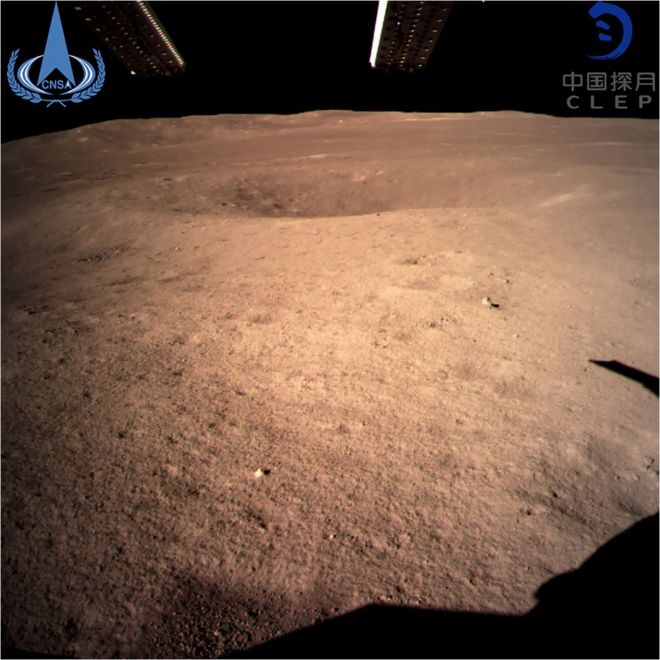
Von Karman craterImage copyrightCNSA/AFP
Image captionThe first close up pictures of the far side of the Moon

What will China’s Chang’e-4 mission learn about the far side of the Moon? Here are a few things the mission is designed to do.

Learn about the Moon’s history

No space mission has ever explored the far side from the surface. As such, it’s the first chance to explore a mysterious region of Earth’s natural satellite.

The “face” that’s never seen from Earth has some key differences to the more familiar “near side”. The far side has a thicker, older crust that is pocked with more craters. There are also very few of the “maria” (dark basaltic “seas” created by lava flows) that are evident on the near side.

Chang’e-4 has reportedly landed at a site known as Von Kármán crater, a 180km depression located in the far side’s southern hemisphere. But Von Kármán lies within a much bigger hole punched in the Moon – the South Pole-Aitken basin.

It’s the oldest, largest and deepest such basin on the Moon and formed when an asteroid – perhaps 500km across, or more – collided with it billions of years ago.

This event was so powerful that it is thought to have ploughed through the Moon’s outer crust layer and through into the zone known as the mantle.

One of the mission’s objectives is to study any exposed material from the mantle present at the landing site. This would provide insights into the internal structure and history of the Moon.

SPA basinImage copyrightNASA
Image captionThe South Pole-Aitken basin was formed by a giant impact billions of years ago

Indeed, data from orbiting spacecraft show that the composition of the basin is different from the surrounding lunar highlands. But exposed mantle material on the surface is just one possibility among several to explain this observation.

The rover will use its panoramic camera to identify interesting locations and its Visible and Near-Infrared Imaging Spectrometer (VNIS) to study minerals in the floor of the crater (as well as of ejecta – rocks thrown out by nearby space impacts).

Additionally, the Lunar Penetrating Radar (LPR) instrument will be able to look into the shallow subsurface of the Moon, down to a depth of about 100m. It could probe the thickness of the lunar regolith – the broken up rocks and dust that make up the surface – and shed light on the structure of the upper lunar crust.

After the huge impact that created the South Pole-Aitken basin, a large amount of melted rock would have filled the depression. The science team wants to use Chang’e-4 to identify and study variations in its composition.

Filling an astronomy gap

The far side of the Moon has long been regarded as an ideal spot for conducting a particular kind of radio astronomy – in the low-frequency band – because it’s shielded from the radio noise of Earth.

There’s a frequency band (below about 10MHz) where radio astronomy observations can’t be conducted from Earth, because of manmade radio interference and other, natural factors.

Chang’e-4’s lander is carrying an instrument called the Low Frequency Spectrometer (LFS) which can make low frequency radio observations. It will be used in concert with a similar experiment on the Queqiao orbiting satellite.

The objectives include making a map of the radio sky at low frequencies and studying the behaviour of the Sun.

Speaking in 2016, Liu Tongjie, from the Chinese space agency (CNSA), said: “Since the far side of the Moon is shielded from electromagnetic interference from the Earth, it’s an ideal place to research the space environment and solar bursts, and the probe can ‘listen’ to the deeper reaches of the cosmos.”

Thus, the mission will fill a gap in astronomical observation, allowing scientists to study cosmic phenomena in a way that has never been possible from our planet.

Radiation on the Moon

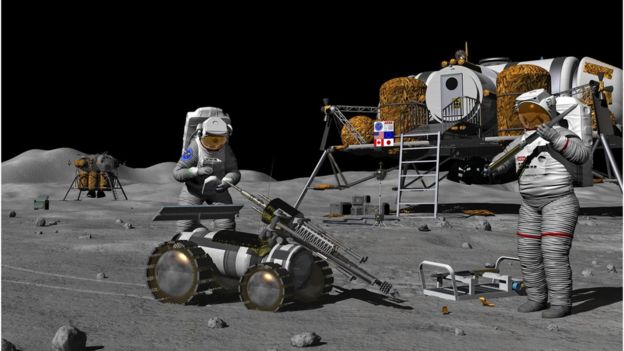
Human exploration of MoonImage copyrightSCIENCE PHOTO LIBRARY
Image captionUnderstanding the radiation environment will be vital for future human exploration

Several space agencies want to land humans on the Moon in the not-too-distant future, and might send astronauts there for longer than we’ve ever stayed before. So understanding the potential risks from radiation are vital.

Earth’s thick atmosphere and strong magnetic field provide adequate shielding against galactic cosmic rays and energetic charged particles travelling from the Sun.

But astronauts on the Moon will be outside this protective bubble and exposed to particles travelling through open space at near the speed of light – with potentially damaging consequences for their health.

The Lunar Lander Neutrons and Dosimetry (LND) experiment, supplied by researchers in Germany, will aim to fill in some gaps in our understanding about the lunar radiation environment.

It will provide dosimetry (measure the ionising radiation dose that could be absorbed by the human body) with a view to future exploration, and contribute to understanding of particles originating from the Sun.

Law of Unintended Consequences

continuously updated blog about China & India

ChiaHou's Book Reviews

continuously updated blog about China & India

What's wrong with the world; and its economy

continuously updated blog about China & India