Archive for ‘China alert’

01/01/2019

Commentary: 40 years on, cooperation still set to define China-U.S. ties

CHINA-U.S.-DIPLOMATIC RELATIONS-40 YEARS

File photo taken on April 15, 1971 shows Chinese table tennis player Yang Ruihua (L) shaking hands with U.S. athlete Dick Miles prior to a friendship match, who had met each other since the 1959 World Table Tennis Championships, in Shanghai, east China. Exactly 40 years ago, Beijing and Washington officially established diplomatic relations, thus ending nearly three decades of isolation, hostility and even confrontation between two big countries with a combined population of over 1 billion, and resetting the course of history and international politics. Just like the “Ping-Pong Diplomacy” that marked a thaw in China-U.S. relations, the establishment of diplomatic ties was another wise and resolute decision made by then Chinese and American leaders with great political courage and far-reaching vision. In the past four decades, their successors have followed their footsteps, guiding the China-U.S. relationship through all complexities and difficulties to maintain a generally steady and smooth development. (Xinhua/Fang Guocai)

by Xinhua writers Zhou Xiaozheng, Xu Feng

BEIJING, Jan. 1 (Xinhua) — Exactly 40 years ago, Beijing and Washington officially established diplomatic relations, thus ending nearly three decades of isolation, hostility and even confrontation between two big countries with a combined population of over 1 billion, and resetting the course of history and international politics.

Just like the “Ping-Pong Diplomacy” that marked a thaw in China-U.S. relations, the establishment of diplomatic ties was another wise and resolute decision made by then Chinese and American leaders with great political courage and far-reaching vision. In the past four decades, their successors have followed their footsteps, guiding the China-U.S. relationship through all complexities and difficulties to maintain a generally steady and smooth development.

“There are a thousand reasons to make the China-U.S. relationship work, and no reason to break it,” Chinese President Xi Jinping said while meeting with his U.S. counterpart, Donald Trump, for the first time, at the Mar-a-Lago estate in the U.S. state of Florida in 2017. Indeed, the China-U.S. relationship is regarded by many as the world’s most important bilateral relationship.

The progress of China-U.S. ties in the past 40 years is nothing but staggering, far exceeding most people’s expectations. Bilateral trade grew from a negligible 2.5 billion U.S. dollars in the late 1970s to over 580 billion dollars in 2017, while the stock of two-way investment rose from practically nil to more than 230 billion dollars.

Even more amazing are the fast-paced changes in people-to-people relations. The Chinese, who once regarded having “overseas relations,” especially families or friends in the United States, as a political and social taboo, are now fervently sending their children — some 200,000 to 300,000 a year — to study in the United States. The Americans have also seen off the so-called “Red Scare” and started to embrace Chinese kung fu, giant pandas and even the learning of the Chinese language as their understanding of the once “mysterious Communist state” deepens.

The Pacific Ocean, which used to serve as a “natural moat” blocking direct transportation between the two countries, is now overflown by more than 300 two-way direct flights each week that carry a total of over 5 million visitors each year.

The 40th anniversary of China-U.S. diplomatic ties comes on the heels of the 40th anniversary of China’s reform and opening-up. The tremendous economic success and social progress China has scored over the past 40 years result primarily from the diligence, creativity and dedication of the Chinese people, but also benefit from the support and assistance from the rest of the world, including the United States.

In return, the rapidly developing China has never stopped merging with the wider world and playing its role as a responsible member of the international community. When the global financial crisis broke out in 2008, China, upholding an all-in-the-same-boat spirit, took swift action and joined the others in a concerted effort to contain the crisis and help bring the hard-hit U.S. and world economy back on track.

Forty years on, cooperation, which might just be one of the many options for China and the United States on Day One of their mended relationship, has turned out to be the best and only correct option. China-U.S. collaboration has not only created immense development opportunities and brought substantial benefits for both countries and both peoples, but also helped reshape the world order, accelerate globalization and improve global governance, thus serving as a major driving force of global peace and prosperity.

Without doubt, the past four decades have not been a smooth ride for China-U.S. relations. Even their economic and trade relations, now reputed as the “ballast stone for bilateral ties,” have experienced twists and turns, from the tough “textile and apparel quota restrictions” and tedious annual reviews of the “Most Favored Nation” status, to the prolonged talks on China’s entry into the World Trade Organization, as well as the ongoing economic and trade frictions. It also seems to be a topic for endless debate in the United States whether China should be seen as a “partner” or a “threat,” and whether the United States should adopt a strategy of “engagement” or “containment.”

As two major countries with different social systems, development paths and historical and cultural backgrounds, it is natural for China and the United States to have disagreements and encounter problems. But such disagreements and problems did not prevent the two countries from normalizing bilateral relations 40 years ago, nor should they be allowed to derail the sound development of bilateral ties today.

Both being great nations with great peoples, China and the United States need not be afraid of any fair, rational and healthy competition, but must be smart enough to avoid a zero-sum game, which harbors a high risk of dragging both nations back into a lose-lose situation of conflicts and confrontation.

At a time when the world is undergoing unprecedentedly profound changes and is fraught with risks and uncertainties, the global community expects even closer collaboration between the two largest economies, so as to help reinforce mankind’s response to numerous common challenges, such as climate change, terrorism, nuclear proliferation, and transnational crimes.

Forty years on, the China-U.S. relationship is once again at a critical point, leaving many on tenterhooks or in a state of speculation. Should the past 40 years be any guide, increasing understanding and win-win cooperation will overcome difficulties and challenges, and cooperation should and will remain at the core of bilateral ties in the long run.

It is all the more comforting and encouraging that both Xi and Trump, in their exchange of congratulatory messages upon the anniversary as well as on multiple other occasions of top-level interaction, vowed to push for more cooperation and further progress of China-U.S. ties.

History has proved that cooperation is the best choice for both sides, Xi said in the message, while Trump said it is his priority to promote cooperative and constructive U.S.-China relations.

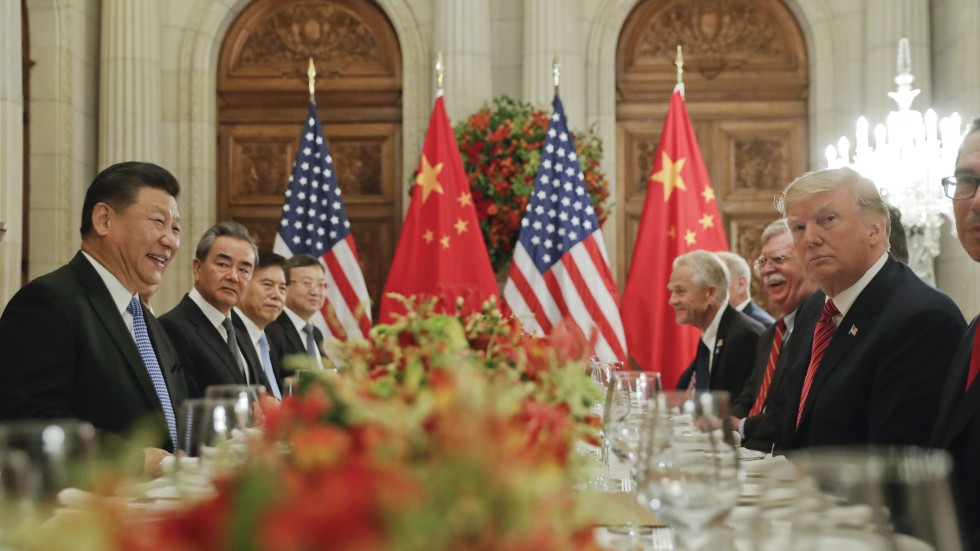
From Mar-a-Lago to Beijing and Buenos Aires, meetings and direct communication between the two heads of state, featuring good personal chemistry and rapport at work, have played an irreplaceable role in navigating bilateral ties through uncharted waters. The world has high hopes for them to succeed.
01/01/2019

Thousands march in Hong Kong against China ‘repression’ after grim 2018

HONG KONG (Reuters) – Thousands of demonstrators marched in Hong Kong on Tuesday to demand full democracy, fundamental rights, and even independence from China in the face of what many see as a marked clampdown by the Communist Party on local freedoms.

Over the past year, countries such as the United States and Britain have expressed concerns about a number of incidents they say have undermined confidence in Hong Kong’s freedoms and autonomy under Chinese rule.

These include the jailing of activists, a ban on a pro-independence political party, the de facto expulsion of a Western journalist and barring democracy activists from contesting local elections.

The New Year’s day march, which organisers said drew 5,800 people, included calls to restart stalled democratic reforms and to fight “political repression” from Beijing.

“Looking back at the year that passed, it was a very bad year … The rule of law in Hong Kong is falling backwards,” said Jimmy Sham, one of the organisers.

The former British colony returned to Chinese rule in 1997 under a “one country, two systems” formula, with the promise of a high degree of autonomy and universal suffrage as an “ultimate aim”.

While authorities have clamped down hard on the city’s fringe, pro-independence movement, that didn’t deter around 100 independence activists from joining the march, holding up banners and chanting for the city to split from China.

China considers Hong Kong to be an inalienable part of its territory, and denounces “separatists” as a threat to national sovereignty, even though the movement has not garnered much popular backing in the city.

“There will be continuous suppression on the Hong Kong independence movement, but the movement will grow stronger and stronger,” said Baggio Leung, an independence leader who said several of his members had been harassed by purported “triads” or gangsters, before the march.

Last year, in an unprecedented move, Hong Kong authorities banned a political group, the Hong Kong National Party, for its pro-independence stance on national security grounds.

A western journalist, Victor Mallet, was also effectively expelled from Hong Kong, soon after he hosted a talk at a press club by the head of the National Party.

Mallet’s visa denial, which the government has so far refused to explain, was criticised by some foreign governments and the American Chamber of Commerce.

Some protesters also carried “wanted” posters of Hong Kong’s top legal official, Theresa Cheng, criticising a decision to drop a corruption investigation into Hong Kong’s former pro-Beijing leader Leung Chun-ying, without a satisfactory explanation.

“I’m afraid the pressure will continue,” said Joseph Cheng, a veteran rights campaigner and retired professor who was raising money for a “justice” fund for activists facing hefty legal fees for several trials.

“We’re going to face a few difficult years, but we must stand firm … Unlike in mainland China, at least we can still protest.”

01/01/2019

An ‘atheist’ empire? Trump aides rally evangelicals in China fight

  • Religious freedom is a growing theme of President Donald Trump’s confrontation with Beijing, and it’s resonating with Christian leaders
PUBLISHED : Tuesday, 01 January, 2019, 5:07pm
UPDATED : Tuesday, 01 January, 2019, 5:07pm

Vice-President Mike Pence infuriated Beijing when he gave a speech in October warning that China had become a dangerous rival to the United States. While he focused on familiar issues such as China’s trade policies and cyber espionage, Pence also denounced the country’s “avowedly atheist Communist Party”.

Citing a crackdown on organised religion in the country, Pence noted that Chinese authorities “are tearing down crosses, burning Bibles and imprisoning believers”.

“For China’s Christians,” Pence said, “these are desperate times.”

Pence’s remarks, which also addressed the repression of Chinese Buddhists and Muslims, illustrated how religious freedom is a growing theme of President Donald Trump’s confrontation with Beijing, which some foreign policy insiders warn could develop into a new cold war.

It is a subject that resonates in the US heartland, some Christian leaders say – parts of which, including rural areas, are disproportionately at risk of fallout from Trump’s trade fight with the Asian giant.

The issue has gained new resonance with Beijing’s arrest this month of a prominent Christian pastor and more than 100 members of his congregation.

The arrests have drawn close coverage from evangelical outlets such as Pat Robertson’s Christian Broadcasting Network (CBN), whose website published an open letter by the jailed pastor, Wang Yi, declaring his “anger and disgust at the persecution of the church by this Communist regime”.

Days after the arrests, Trump’s ambassador for international religious freedom, the former Kansas Republican governor Sam Brownback, decried the crackdown and said that in the weeks since Pence’s speech, religious freedom concerns “have only grown”.

While China’s religious persecution draws less media attention than issues like soybean tariffs and cyber espionage, it is closely tracked by conservative Christian activists and outlets like CBN, where a typical headline recently reported: “Chinese Government Destroys Christian Church, Bills Pastor for Demolition.”

In September, Providence Magazine, which covers US foreign policy from a Christian perspective, wrote that in 2018 China’s religious repression has reached “a sustained intensity not seen since the Cultural Revolution”.

The Trump administration has repeatedly criticised China on such grounds.

In a report on international religious freedom released earlier this year, the State Department noted that throughout China there were reports of “deaths in detention of religious adherents as well as reports the government physically abused, detained, arrested, tortured, sentenced to prison, or harassed adherents of both registered and unregistered religious groups for activities related to their religious beliefs and practices”.

Religious activists note that Pence, Brownback, Secretary of State Mike Pompeo and other top Trump aides are people of faith with genuine concerns about religious freedom. But even they acknowledge the subject happens to be a potent political message for religious conservatives and may help rally them behind Trump’s confrontational China policy.

Some religious leaders even hear an echo of history: cold war-era denunciations of “godless” Soviet communism by past US presidents, notably Ronald Reagan

“In the great heartland of America, where there tend to be higher levels of people who care about faith, reminding people that a regime – whether then the Soviet Union or today’s communist China – rejects God and has an official policy of atheism is helpful in getting them to understand why our government is taking certain actions in the foreign policy area,” said Gary Bauer, a longtime conservative Christian leader whom Trump appointed to the US Commission on International Religious Freedom.

“Evil empire” was the famous label then-president Reagan applied to the Soviet Union in 1983. Less remembered is the fact that Reagan was addressing the National Association of Evangelicals.

Reagan vowed at the time that the Soviets “must be made to understand: … We will never abandon our belief in God”.

Trump himself rarely addresses religious freedom or human rights, and when it comes to China he focuses mainly on Beijing’s trade practices. But his administration – backed by an evangelical base that stood for Trump in 2016 and continues to supporthim enthusiastically – has strongly emphasised international religious freedom.

Earlier this year, for instance, the State Department hosted a first-ever gathering of foreign ministers devoted to the subject. (China was not invited and was targeted in a joint statement signed by a handful of countries, including the US.)

“This administration is putting this in the matrix of all of our policy,” said Tony Perkins, another prominent Christian conservative who serves on the religious freedom commission and is close to the White House. “It’s more than just the throwaway line.”

Pompeo, a former Republican congressman from Kansas, has also assailed Beijing for religious persecution, including at a September speech at the Values Voter Summit in Washington, an event affiliated with the Perkins-led Family Research Council.

During an appearance which some critics called inappropriately political, Pompeo decried “an intense new government crackdown on Christians in China, which includes heinous actions like closing churches, burning Bibles, and ordering followers to sign papers renouncing their faith”.

Like Pence, Pompeo also dwelled on the plight of China’s Muslim population, particularly ethnic Uygurs from the Chinese province of Xinjiang. A State Department official recently testified before lawmakers that up to 2 million Muslims are now confined to special camps in China.

“Their religious beliefs are decimated,” Pompeo told Values Voter Summit attendees.

The Chinese government, which often casts Uygur Muslims as potential terrorists, says the camps are designed to teach vocational and life skills. But the State Department official, Scott Busby, said the goal appears to be “forcing detainees to renounce Islam and embrace the Chinese Communist Party”.

While evangelical groups active in Washington tend to focus primarily on the persecution of Christians in China and elsewhere, some make sure to point out that they care about religious freedom for all faith groups, including Muslims. In a past interview with POLITICO, Brownback stressed that he also wants to protect people’s right to have “no religion at all”.

The Trump administration may unveil a set of human rights-related sanctions targeting officials in a range of countries in the coming weeks. Some China observers are hopeful the list will include Chen Quanguo, a top Communist Party official said to have orchestrated the anti-Muslim crackdown and to have had a role in repressing Tibetan Buddhists.

“It’s a critical moment,” said Bob Fu, a US-based pastor and founder of ChinaAid, a group that advocates for religious freedom in China.

Brownback did not offer comment for this story, and a spokesman for Pompeo did not immediately respond to a request for comment. A White House spokesperson said of Pence that “religious freedom throughout the world is a top priority for the vice-president and the administration as a whole”.

Bauer predicted that evangelicals and other voters in the US heartland will continue to support Trump even if he expands his trade war with China. The administration, cognizant of the potential pain for its supporters, has taken some steps to cushion the blow, such as offering farming subsidies.

By retaliating against particular US industries, such as soybean farmers, China is trying to pressure the administration. “I think China will fail in this effort and support for the Trump-Pence policies will remain strong,” Bauer said.

When it comes to pleasing the religious right, the Trump administration has been willing to make some dicey moves.

This past summer, to the shock of the foreign policy establishment, Trump imposed economic sanctions on two Cabinet officials in Turkey – an important US ally and fellow Nato member – due to the questionable imprisonment of an American pastor, Andrew Brunson.

Brunson, whose cause was championed by evangelicals, was eventually freed and the sanctions lifted.

How far the administration will push Beijing on religious freedom could come down to the president himself and what China is willing to do to assuage his concerns on trade.

Trump, after all, has been willing to drop talk of human rights issues when it seems he’s making progress on other fronts – that’s what has happened in his dealings with North Korea.

The Chinese in particular are highly sensitive to their global image, and, like the Soviet Union, China cannot be ignored.

“If this tariff business gets really bad and the economy goes down, I wouldn’t be surprised if [Trump officials] ramp up the ‘evil empire’ language,” said a Senate Democratic aide. “It inoculates them from their base.”

But “if you start using the ‘evil empire’ language”, the aide added, “it’s harder to make up and kiss and be friends.”

01/01/2019

Xi, Trump exchange congratulations over 40th anniversary of China-U.S. diplomatic ties

BEIJING, Jan. 1 (Xinhua) — Chinese President Xi Jinping and U.S. President Donald Trump on Tuesday exchanged congratulations on the 40th anniversary of the establishment of China-U.S. diplomatic relations.

In his congratulatory message, Xi said China-U.S. relations have experienced ups and downs and made historic progress over the past 40 years, bringing huge benefits to the two peoples and contributing greatly to world peace, stability and prosperity.

History has proved that cooperation is the best choice for both sides, Xi said.

Currently, China-U.S. relations are in an important stage, he noted.

“I attach great importance to the development of China-U.S. relations and am willing to work with President Trump to summarize the experience of the development of China-U.S. relations and implement the consensus we have reached in a joint effort to advance China-U.S. relations featuring coordination, cooperation and stability so as to better benefit the two peoples as well as the people of the rest of the world,” Xi said.

For his part, Trump said Jan. 1, 2019 marks the 40th anniversary of the establishment of U.S.-China diplomatic relations.

Great progress has been made in the development of bilateral ties over the past years, he noted.

Trump said it is his priority to promote cooperative and constructive U.S.-China relations, adding that his solid friendship with President Xi has laid a firm foundation for the great achievements of the two countries in coming years.

31/12/2018

Surprise, war and miscalculations, China’s turbulent economy in 2018 had it all and more

  • The world’s second largest economy started the year with the strong intentions to improve the quality of growth but ended it hoping for a better 2019
  • The trade war with the United States, the government’s deleveraging campaign to reduce debt and an unhappy private sector all played their part
PUBLISHED : Monday, 31 December, 2018, 6:33pm
UPDATED : Monday, 31 December, 2018, 6:33pm

If there is a single Chinese word to describe China’s economy in 2018, there may be no better one than gang, which translates to dispute and leverage.

Beijing started the year with the strong intentions to improve the quality of growth, vowing to reduce deeply troubling risks in the financial system and to control rampant pollution.

But in reality it was disputes – either between China and the United States, or with the Chinese private economy and state-owned enterprises – that dominated the headlines.

The world’s second-biggest economy is expected to achieve the government’s growth target of “around 6.5 per cent” this year, but the deviation from its original policy intentions, a mixed result of misjudgment, excess pride and uncontrollable external factors, have turned out to be very costly.

Unprecedented trade war

The Chinese government’s strategy of making major purchases of US products managed to prevent the US China-bashing from damaging bilateral ties in the first year of Donald Trump’s term as US president which began in January 2017, but that strategy was no longer effective in 2018.

Beijing’s tough retaliatory stance in the face of the first US tariffs starting in July did nothing to deter more American taxes.

And by the end of September, Washington had imposed tariffs on half of the Chinese exports to the US and threatened to sanction the rest if an acceptable trade deal was not agreed by March 1.

“We were relatively slow to foresee [the US actions] … and underestimated [the Trump administration’s] determination. Also, policy support was not well prepared,” said Qu Fengjie, director of the external economy research institute under the National Development and Reform Commission.

The US’ liberal use of decade-old trade law to justify its protectionist trade moves, the surprise arrest of Huawei chief financial officer Sabrina Wanzhou Meng on the same day that Chinese President Xi Jinping and Trump met in Argentina, the hard-hitting speech by US Vice-President Mike Pence at the Hudson Institute in early October, and US charges in December that China had engaged in a prolonged campaign of cybertheft for commercial advantage, all helped fan speculation that the world’s two largest economies had entered into a prolonged “economic cold war”.

“It’s not simply economic friction, but a turning point of bilateral ties and a strategic adjustment of the US,” warned Li Wei, an associate professor of international relations at Renmin University of China.

Despite the 90-day truce agreed on December 1, there remains a huge question whether a bilateral trade deal can be reached at any point, creating great uncertainty that is increasingly haunting the national economy.

The data suggests a further slowing of Chinese growth in the fourth quarter from the 6.5 per cent posted in the third quarter, with some suggesting a drop below 6 per cent in the first half of next year.

China’s lowest first-quarter growth rate was 6.4 per cent in 2009, meaning a drop below 6 per cent would represent a record low since the National Bureau of Statistics started publishing quarterly figures in 1992.

The government’s deleveraging campaign to cut excess debt and risky borrowing – one of the three major tasks laid out at the start of the year by the top leadership – sought to tackle the risk from the huge, and often hidden, debt accumulated in a decade of economic stimulus since the 2008 global financial crisis.

Risk from the deleveraging campaign

The country’s debt-to-gross domestic product (GDP) ratio stood at 253 per cent of GDP at end of June, one of the highest rates in the world.

Beijing slashed its fiscal deficit ratio for the first time in six years, while a clampdown on shadow banking rippled to capital-thirsty private firms, local government controlled financing vehicles and public-partnership projects.

“Its impact on the economy has exceeded expectation upon a variety factors, most notably the trade war, a shadow banking curb and environmental protection,” Bank of Communications senior researcher Liu Xuezhi said.

“Particular, infrastructure investment has registered a free fall.”

The infrastructure investment growth, a major government tool in previous rounds of economic stabilisation, plunged to 7.3 per cent in the first half of this year, compared to 21.1 per cent a year earlier.

And despite the offsetting measures that started in July, the slowdown continued, with January-November growth of only 3.7 per cent.

Li Yang, a senior researcher at the Chinese Academy of Social Sciences and a former policy adviser of the People’s Bank of China (PBOC), said the deleveraging campaign was meant to avoid a financial crisis rather than exacerbate an economic slowdown.

“If it progresses too quickly – rather than having a controlled timing and pace in coordination with other policies – it could artificially create a Minsky moment or even Lehman Brothers moment,” he said.

Minsky and Lehman Brothers moments refer to the sudden collapse of a financial market or institutions, usually triggered by debt, currency or other issues.

The first is named after economist Hyman Minsky, while the second refers to the collapse of the US investment bank Lehman Brothers 10 years ago that rocked global stock markets and led to the biggest financial crash since the Great Depression.

A year ago, former PBOC governor Zhou Xiaochuan warned that China must stay alert for a Minsky moment.

After the first US tariffs were imposed on Chinese products in July, Beijing’s policymakers continued the deleveraging campaign even though they shifted the policy direction to economic stabilisation.

At the Central Economic Work Conference in December, the top leadership vowed to carry on “structural deleveraging”, paving the way for a bigger economic stimulus.

“It will become a long-term policy goal” rather than an immediate priority, Li said.

Structural deleveraging means structural changes among different sectors. For instance, the government can have higher leverage, but corporate leverage should be lowered, therefore the overall debt-to-GDP ratio will be kept roughly stable.

Private economy outcry

Private firms, the major victims of both financial deleveraging and the trade war, have been hit the hardest by the economic slowdown.

A total of 33 firms for the first time registered bond defaults by November 5, 28 of which were private firms, according to Everbright Securities, compared to only nine private firms in 2017.

In addition, dozens of private owners of listed firms risked losing their controlling stakes when the value of the shares they pledged to banks as collateral for loans fell with the rest of the stock market.

As well as the decade-old problems of lack of access to credit and high fundraising costs, the governments support of state-owned enterprises to become bigger and stronger and feelings of those who wanted to eliminate private ownership turned out to be the last straw.

The desperate voices of entrepreneurs, which increased ahead of the celebration of the 40th anniversary of the reform and opening up policy, forced top leaders to emphasis the government’s support for the private sector, including the introduction of new credit and tax policies to help small businesses.

Xi also rolled up his sleeves at a high-profile symposium at the start of November.

“Some argue that the private economy has completed its mission and will fade out. All these statements are completely wrong and do not conform to the party’s policies,” he told dozens of private sector representatives.

Lu Feng, a professor of economics at Peking University, said the arguments of those advocating elimination of private ownership were not well formulated.

“However, they do expose some inconsistency between our ideology and the reform and opening up reality,” he said in December.

Lu said further reforms were needed to lower institutional costs and address the obstacles that businesses faced every day.

“Market access for private firms have been talked about for years, but many old problems remain unsolved,” he said.

31/12/2018

Xinhua Headlines: China, EU on path of expanding cooperation in outer space

Source: Xinhua| 2018-12-30 14:58:41|Editor: Yamei
Xinhua Headlines: China, EU on path of expanding cooperation in outer space

People visit the booth of China Aerospace Science and Technology Corporation during the 69th International Astronautical Congress in Bremen, Germany on Oct. 1, 2018. (Xinhua/Lian Zhen)

by Xinhua writer Zhang Yirong

BERLIN, Dec. 30 (Xinhua) — China’s Chang’e-4 lunar probe was launched earlier this month, and it is expected to make the first-ever soft landing on the far side of the moon.

During the mission, China has cooperated with four other countries, three of which are from Europe, an epitome of the increasing space cooperation between China and the European Union (EU) in recent years.

CHANG’E-4 TO THE MOON

The Chang’e-4 mission will be a key step in revealing the mysterious far side of the moon, most of which remains unknown.

Germany’s scientific payload is a “Lunar Lander Neutron and Dosimetry” instrument, developed by Kiel University, which aims to measure radiation on the moon, mainly for future manned missions there, also the water content beneath the landing unit, said Robert Wimmer-Schweingruber, who is leading the research team.

Karl Bergquist, the European Space Agency’s (ESA) administrator for the International Relations Department, called the Chang’e-4 mission scientifically and technologically “very impressive,” because “no one has ever done it, this mission will therefore advance our knowledge of the moon.”

He also called the lunar mission “the first step towards future explorations farther afield.”

Stressing the difficulties of landing on the far side due to spacecraft controlling and signal relay, Wimmer-Schweingruber said that “the satellite is already in place. We’re orbiting the moon right now. It has worked well.”

Earlier, China has already launched a relay satellite “Queqiao,” tasked with transmitting signals between Chang’e-4 and ground control.

Scientific tasks for Chang’e-4 also include low-frequency radio astronomical observation, surveying the terrain and landforms, as well as detecting the mineral composition and shallow lunar surface structure, according to the China National Space Administration (CNSA).

COOPERATION OPPORTUNITIES

Wimmer-Schweingruber said he’s been working with his Chinese counterparts for nearly two decades, and praised China for its increasing cooperation with international partners.

Apart from Chang’e-4, China has offered and promised multiple opportunities for space cooperation with the EU and beyond recently.

At the International Astronautical Congress held this October in the German city of Bremen, Zhang Kejian, deputy minister of the Ministry of Industry and Information Technology of China, stressed China’s willingness to cooperate with other countries within the space program.

Zhang, who is also the head of the CNSA, noted that Chang’e-6, China’s second sample return lunar mission, will provide 10 kg of payloads on the orbiter and lander for international partners.

China also announced in Vienna this May that all member states of the United Nations (UN) are welcome to cooperate with China to jointly utilize its future China Space Station (CSS).

“The CSS belongs not only to China, but also to the world,” said Shi Zhongjun, China’s ambassador to the UN and other international organizations in Vienna.

The CSS, expected to be launched by 2019 and operational by 2022, will be the world’s first space station that is developed by a developing country and open for cooperation with all UN member states.

Jan Woerner, director general of the ESA, told Xinhua that the ESA welcomes more cooperation with China’s space program, and several European astronauts are now learning Chinese in preparation.

China and the EU signed an agreement in 2015 concerning cooperation in a manned space program, stipulating that the period from 2015 to 2017 was the stage of technological exchanges, and the two sides taking part in each other’s astronaut training programs.

Matthias Maurer, an ESA astronaut of German nationality, told Xinhua that he had studied Chinese for over six years.

After participating in a sea survival training program in waters off the coast of Yantai in east China’s Shandong Province, organized by the Astronaut Center of China in 2017, Maurer hopes to work with astronauts from China and other countries at the CSS.

WIN-WIN RESULTS

China’s achievements and openness in outer space explorations have been welcomed worldwide and are believed to produce win-win results.

China’s opening its CSS will reinforce international cooperation for the peaceful use of outer space, said Simonetta Di Pippo, director of the UN Office for Outer Space Affairs.

“China is currently the first contributor to our activities in terms of voluntary contributions. This is quite important. It’s a sign of the strong interest of China in collaborating with us, opening up to the entire world the possibility of utilizing your facilities,” said Di Pippo, who hoped to see more cooperation projects in the future.

Maurer viewed the cooperation between China and the EU as win-win. He said China has a lot of advantages such as its own rockets, capsules and a space station.

Europe, on the other hand, has abundant experience in long-duration missions in space “which can be brought into our cooperation to make it develop more efficiently,” Maurer said.

Wimmer-Schweingruber spoke highly of China’s openness, saying “to compensate the weakness of one country with the strength of another, that’s how we work scientifically.”

After collaborating on satellites that monitor earthquakes and their effects, “we now hope to collaborate more intensively on their new space station, that could offer us important flight opportunities for our astronauts, but also for the development of experiments and innovative technologies,” said Piero Benvenuti, commissioner of the Italian Space Agency.

Woerner said the ESA is also discussing using the Chinese manned spacecraft Shenzhou to send European astronauts into space in the future. “Although it is not on the agenda, it’s a possibility,” he said.

“We have worked with the Chinese side for over 25 years. For us Europeans, the exploration of the universe as well as major space science missions are domains in which we collaborate with all space powers: the United States, Russia, China and Japan,” Bergquist said.

“What’s important is to advance our knowledge, and if we can do it together, it’s preferable for everyone,” Bergquist added.

30/12/2018

China’s Supreme Court to take on intellectual property case

BEIJING (Reuters) – Intellectual property rights cases can from next month be taken to China’s Supreme Court, the government said on Saturday, as the country seeks to strengthen protections in the face of complaints from the United States about the issue.

China and the United States are currently in talks to resolve a trade dispute, in which both countries have put tariffs on imports of each other’s products.

The United States, along with the European Union, have long complained about poor enforcement of intellectual property rights in China, and this has been a key complaint of the Trump administration, along with forced technology transfers and a yawning trade gap.

Beijing in response has been seeking to show that it is serious about addressing U.S. concerns.

Deputy chief justice Luo Dongchuan told a news conference that from Jan. 1 the Supreme Court would begin handling appeals on intellectual property rights cases, whereas previously only provincial-level high courts would handle them.

“Setting up a Supreme Court intellectual property rights court is an important decision by the Communist Party, is a major step to strengthen the legal protection of intellectual property rights and will have a major impact at home and abroad.”

Luo did not directly answer a question about how the United States should view the move and what it said about China’s efforts to protect intellectual property, saying that such protection was a “basic national policy”.

“China is already the world’s second largest economy, and in the future China’s development will rely on innovation. The protection of innovation needs there to be legal protection for intellectual property rights.”

30/12/2018

Trade wars cost U.S., China billions of dollars each in 2018

CHICAGO (Reuters) – The U.S.-China trade war resulted in billions of dollars of losses for both sides in 2018, hitting industries including autos, technology – and above all, agriculture.

Broad pain from trade tariffs outlined by several economists shows that, while specialized industries including U.S. soybean crushing benefited from the dispute, it had an overall detrimental impact on both of the world’s two largest economies.

The losses may give U.S. President Donald Trump and his Chinese counterpart, Xi Jinping, motivation to resolve their trade differences before a March 2 deadline, although talks between the economic superpowers could still devolve.

The U.S. and Chinese economies each lose about $2.9 billion annually due to Beijing’s tariffs on soybeans, corn, wheat and sorghum alone, said Purdue University agricultural economist Wally Tyner.

Disrupted agricultural trade hurt both sides particularly hard because China is the world’s biggest soybean importer and last year relied on the United States for $12 billion worth of the oilseed.

China has mostly been buying soy from Brazil since imposing a 25 percent tariff on American soybeans in July in retaliation for U.S. tariffs on Chinese goods. The surge in demand pushed Brazilian soy premiums to a record over U.S. soy futures in Chicago, in an example of the trade war reducing sales for U.S. exporters and raising costs for Chinese importers.

“It’s something that’s crying for a resolution,” Tyner said. “It’s a lose-lose for both the United States and China.”

Total U.S. agricultural export shipments to China for the first 10 months of 2018 fell by 42 percent from a year earlier to about $8.3 billion, according to the U.S. Department of Agriculture.

The most actively traded soybean futures contract averaged $8.75 per bushel from July to December 2018, down from an average of $9.76 during the same period a year earlier.

As of Dec. 28, futures in the last month of the year were averaging $8.95-1/2 a bushel. That was down from $9.61-3/4 for all of December last year.

To compensate suffering farmers, the U.S. government has allocated about $11 billion to direct payments and buying agricultural goods for government food programs, after consulting economists, including Tyner.

In North Dakota, which exports crops to China through ports in the Pacific Northwest, soy farmers face at least $280 million in losses because of Beijing’s tariffs, said Mark Watne, president of the North Dakota Farmers Union.

“You could almost put another $100 million on top of this because all commodity prices are down and that affects North Dakota farmers indirectly,” Watne said.

FILE PHOTO: Shipping containers are seen at a port in Shanghai, China July 10, 2018. REUTERS/Aly Song

China’s tariffs improved margins for U.S. soy crushers such as Archer Daniels Midland Co (ADM.N) by leaving plentiful supplies of cheap soybeans on the domestic market.

Chinese soybean mills, on the other hand, front-loaded soy purchases ahead of the tariffs. This led to an oversupply that reduced Chinese processing margins and led factories this summer to make the biggest cuts in years to the production of soymeal used to feed livestock.

China resumed purchases of U.S. soybeans in early December following a trade truce agreed to by leaders from the two countries during G20 summit in Argentina. But Beijing kept its 25 percent tariffs on the oilseed from America, which effectively curbed commercial Chinese buying.

“With the tariffs, the beans can’t go into the commercial system,” said a manager at a major Chinese feed producer, speaking on condition of anonymity. “The buying will have a very limited impact on the market.”

China also suffered as products such as phone batteries were hit by U.S. tariffs, and customers began looking to buy from other countries.

A study commissioned by the Consumer Technology Association showed U.S. tariffs on imported Chinese products cost the technology industry an additional $1 billion per month.

The conflict also squeezed U.S. retail, manufacturing and construction companies that had to pay more for metal and other goods.

“Input price pressures remained elevated in part due to tariffs, particularly in manufacturing and construction, and firms were struggling to pass these higher costs onto customers,” the Dallas Federal Reserve said.

The Big Three Detroit automakers – General Motors, Ford and Fiat Chrysler Automobiles – have each said higher tariff costs will result in a hit to profits of about $1 billion this year.

The pain is ongoing, economists say: Ford and Fiat expect a similar hit in 2019.

30/12/2018

China’s rich saddle up as horse riding enjoys a boom

  • Rising incomes prompt growing numbers to take up the sport, pushing country to second place behind US for number of riders
PUBLISHED : Sunday, 30 December, 2018, 5:37pm
UPDATED : Sunday, 30 December, 2018, 5:37pm

Leather riding boots are neatly lined up on a carpet, a picture shows bloodthirsty hounds on a fox hunt and a fountain spews water from the mouths of stone horses.

It may have the trappings of upper-class Britain, but this is in fact suburban Shanghai and the County Down Club, the self-styled first exclusive membership club in China for horsemanship and fox-hunting.

The club, which takes its name from a county in Northern Ireland, was founded three years ago and owner Steven Sun says equestrian sport “has developed rapidly in China during the past five to 10 years”.

“I think it’s a change in awareness,” said the 32-year-old, whose interest in horses was triggered while studying in Britain.

Rising numbers of Chinese are taking up sports such as horse riding as the country’s growing economy – now the second biggest after the United States – gives people more disposable income to pursue leisure activities.

County Down has a dozen horses and Sun wants it to be at the forefront of promoting equestrian sports in China.

The club, which also features an indoor swimming pool, gym and sparkling white piano, is just as much about networking as it is about horse riding, Sun says.

County Down has about 80 members and annual membership is 58,000 yuan (US$8,400), but prospective newcomers will need more than just deep pockets.

“We hope our members have good qualities and manners or are highly educated elites,” said Sun, in polo shirt and riding trousers.

“That can ensure communication between our members will be at the same level.

“One of the benefits is that our members can meet using this platform and push each other forward.”

Sun says he has forged links outside China, too, taking members on fox hunts with European nobility. He also has four racing horses in France.

Zoe Quin recently founded WonderHorse, which provides products and services relating to horses.

The industry is “booming” for two main reasons, said Shanghai-based Quin.

“Chinese parents consider horse riding an elite education to make their kids more outstanding in this highly competitive Chinese society,” said Quin, formerly chief representative in China for LeCheval, which promotes the French horse industry.

“As for adults, they can extend their participation in equestrian sports beyond riding into broader aspects such as ownership, investment, travel, leisure and social activities.

“More than a sport, it is a new experience for Chinese.”

The governmental Chinese Equestrian Association declined to give numbers, but according to the respected Horsemanship magazine’s annual report, there were 1,802 equestrian clubs in China to July 2018.

That is double the number in 2016, with the majority in northern and eastern China, notably Beijing and Shanghai, according to the magazine’s findings.

With the Chinese government stating in 2014 that equestrian sports were to be “strongly supported”, the trend looks set to continue.

Underlining the point, in January 2018, French President Emmanuel Macron arrived in China bearing the gift of a French Republican Guard horse for his Chinese counterpart Xi Jinping.

However, Horsemanship identified areas of concern, primarily the lack of media coverage and a shortage of experts such as trainers and veterinary surgeons.

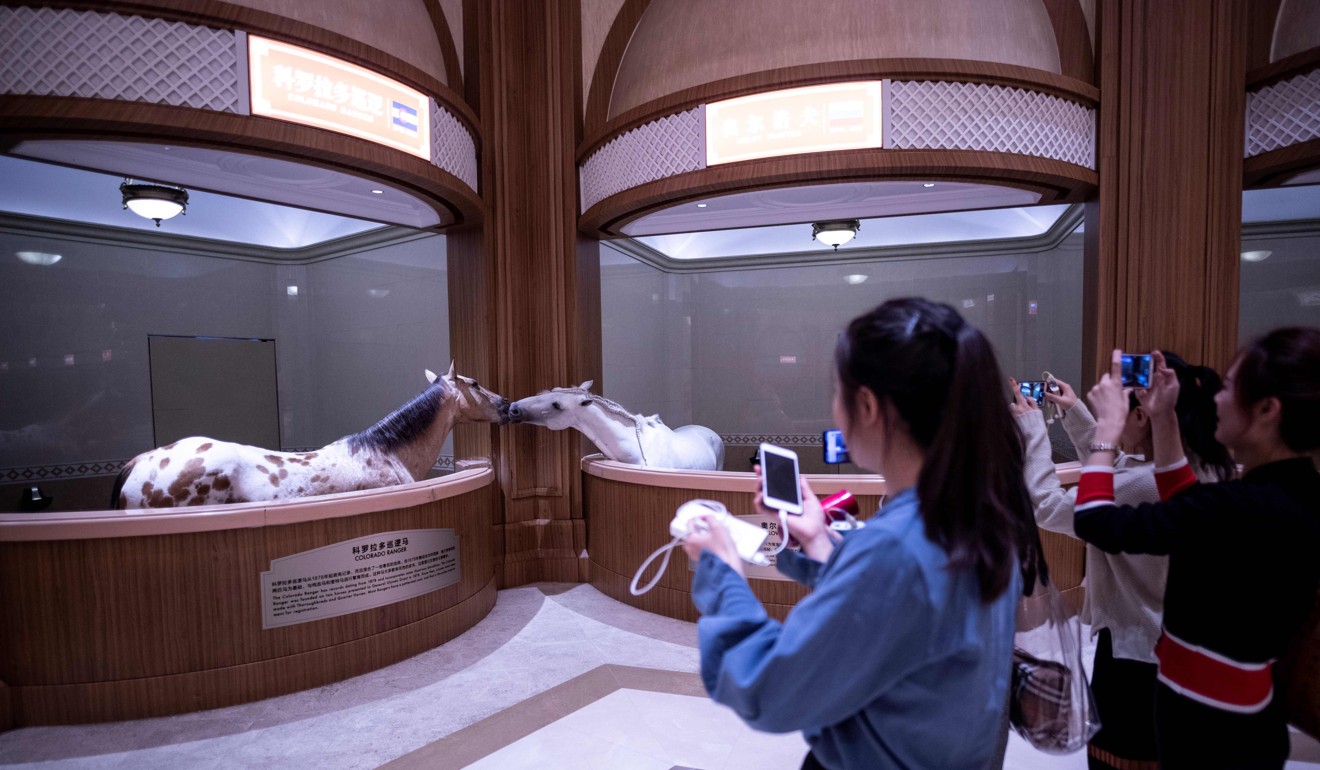
A two-hour drive from Shanghai is the horse-themed “Pegasus Water Town” complete with hotels, art gallery, a mall with Venice-style gondolas, an equestrian club and “Horse Culture Museum”.

There are more than 400 horses of dozens of breeds imported from around the world and visitors form long queues for horse-drawn carriage tours of the resort in Jiangsu, the province west of Shanghai.

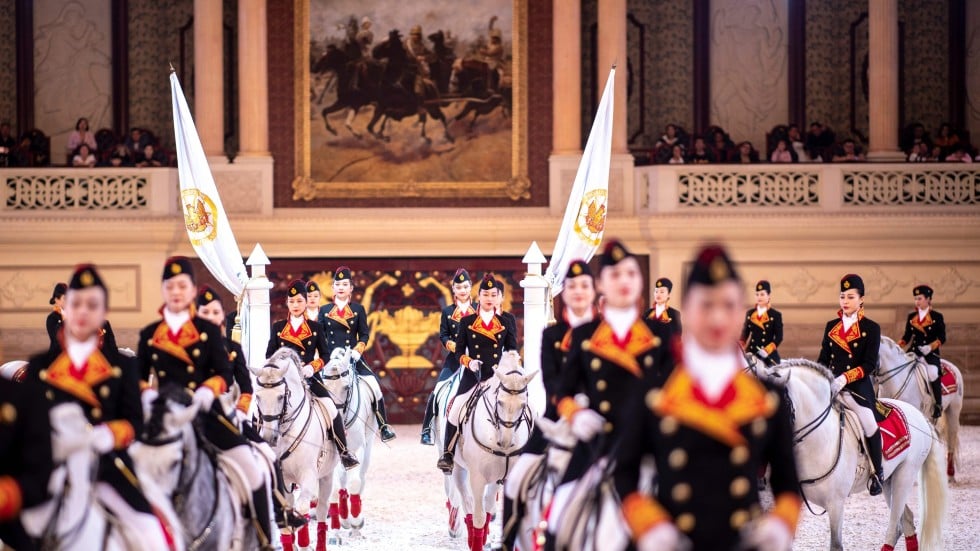
Once a week, pristine horses are paraded and perform crowd-pleasing tricks in an opulent arena designed in what the official website calls “Austro-Hungarian Empire style”.

A giant portrait of Napoleon on horseback overlooks the performance.

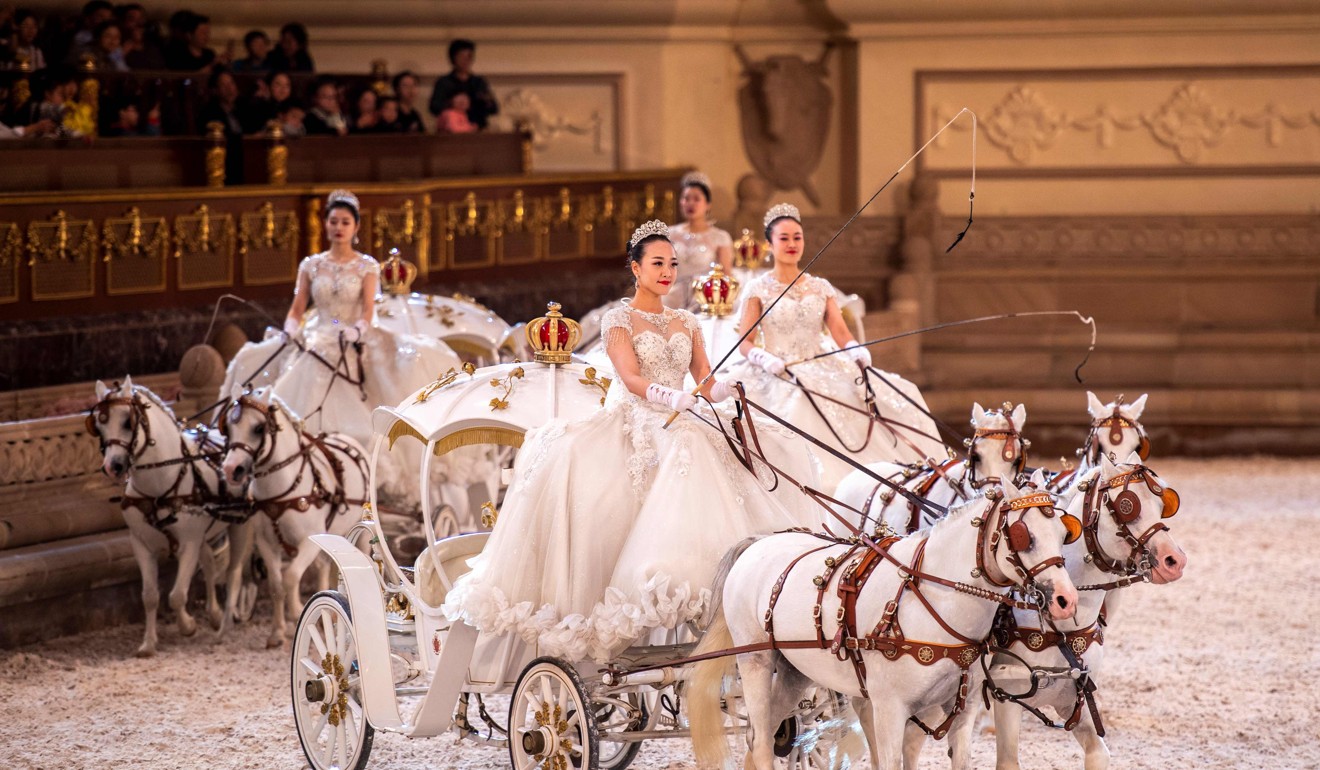
At one point in the show, women horse riders in white gowns and sparkling tiaras convey white carriages that would not look out of place at a British royal wedding.

It is all a far cry from 40 years ago, when China’s ruling Communist Party launched wide-ranging reforms that lifted hundreds of millions of people out of poverty.

“Forty years ago China was very poor, there was no possibility of doing such a high-end sport,” said Shen Houfeng, general manager of Heilan International Equestrian Club, one of the jewels of the resort.

“But you see 40 years after reform and opening, China has seen big changes. It’s gone from a country people didn’t pay attention to, to one that everyone cares about.”

30/12/2018

Xi, Trump have telephone conversation, agree to implement consensus in Argentina meeting

BEIJING, Dec. 30 (Xinhua) — Chinese President Xi Jinping and U.S. President Donald Trump on Saturday held a telephone conversation, expressing their willingness to push for implementation of their agreements reached during the G-20 summit in Argentina.

Trump wished Xi and the Chinese people a happy new year, saying that the U.S.-China relations are very important and closely followed by the whole world.

He said he values the great relations with Xi, adding that he is pleased to see the teams of both countries are working hard to implement the important consensus reached between him and Xi during their meeting in Argentina.

Trump said relevant talks and coordination are producing positive progress. He hopes results will be reached to the benefit of both U.S. and Chinese peoples as well as people of all nations.

Xi, for his part, extended best wishes to Trump and the U.S. people upon the arrival of the new year.

Xi said both he and Trump hope to push for a stable progress of the China-U.S. relations, adding that the bilateral ties are now in a vital stage.

The Chinese president said he and Trump had a very successful meeting early this month and reached important consensus in Argentina.

The teams from both countries have since been actively working to implement such consensus, he said, expressing hopes that both teams can meet each other halfway and reach an agreement beneficial to both countries and the world as early as possible.

Xi said next year marks the 40th anniversary of the establishment of diplomatic ties between the United States and China, adding that China attaches great importance to the development of bilateral relations and appreciates the willingness of the U.S. side to develop cooperative and constructive bilateral relations.

China is willing to work with the United States to summarize the experience of 40 years of the development of China-U.S. relations, and strengthen exchanges and cooperation in fields of economy and trade, military, law enforcement, anti-drug operations, local issues and culture, Xi said.

Xi added that China is also willing to work with the United States to maintain communication and coordination on major international and regional issues, respect each other’s important interests, promote China-U.S. relations based on coordination, cooperation and stability, and let the development of bilateral relations better benefit the two peoples and people around the world.

The two heads of state also exchanged views on international and regional issues of common concern such as the situation on the Korean Peninsula. Xi reiterated that China encourages and supports further talks between the United States and the Democratic People’s Republic of Korea, and hopes for positive results.

Law of Unintended Consequences

continuously updated blog about China & India

ChiaHou's Book Reviews

continuously updated blog about China & India

What's wrong with the world; and its economy

continuously updated blog about China & India