Archive for ‘China alert’

28/12/2018

China hails Maldivian FM’s remarks on BRI

BEIJING, Dec. 28 (Xinhua) — A Chinese Foreign Ministry spokesperson on Friday applauded the Maldivian Foreign Minister Abdulla Shahid’s remarks that the Maldives will continue to work with China under the framework of the Belt and Road Initiative (BRI).

Shahid on Thursday said in an interview that the Maldivian new government will continue with the projects initiated in the Maldives under the China-proposed BRI.

Spokesperson Hua Chunying told a press briefing that Shahid’s remarks showcased the willingness of the Maldivian new government to develop bilateral ties.

Hua said China and the Maldives have promoted cooperation on the construction of bridges, airports, housing and other projects related to people’s livelihoods based on mutual respect and equal treatment, which has played a positive role in promoting the economic transformation and upgrading of the Maldives and improving people’s living conditions.

The China-Maldives Friendship Bridge, which opened to traffic in August, has not only facilitated the interconnection of infrastructure in the Maldives but also brought tangible benefits and improved lives of local people, said the spokesperson.

China is ready to work with the Maldivian new government to consolidate traditional friendship, better dovetail development strategies, further bilateral pragmatic cooperation and push forward mutual beneficial and win-win cooperation under the framework of the BRI, so as to constantly enrich the China-Maldives Future-Oriented All-round Friendly and Cooperative Partnership, Hua said.

28/12/2018

Third prototype of China’s C919 jet completes first test flight

BEIJING (Reuters) – A third prototype of China’s home-built C919 narrowbody passenger jet completed its first test flight on Friday, its manufacturer said, in another step forward in the nation’s push to become a global civil aerospace player.

The C919, which will compete with Boeing Co’s (BA.N) 737 and the Airbus SE (AIR.PA) A320, is widely regarded as a symbol of China’s civil aerospace ambition and President Xi Jinping’s policy of upgrading manufacturing capabilities.

In a statement on its official microblog, Commercial Aircraft Corp of China Ltd (COMAC) [CMAFC.UL] said the plane landed safely at Shanghai Pudong International Airport at 12:45 p.m. (0445 GMT), having flown for 1 hour and 38 minutes.

The jet will next fly to the city of Xian in central China for more test flights with a focus on aircraft flutter and airspeed calibration, the company said.

The second prototype of the C919 jet conducted its first flight in December 2017, seven months after the maiden flight of the first C919.

COMAC said it is assembling a further three prototypes, and that all six will be scheduled to conduct flight tests next year.

The C919 has dozens of customers that have placed orders and commitments for 815 jets.

COMAC is aiming to obtain certification for the plane from Chinese regulators by the end of 2020, as well as Europe’s aviation safety regulator, which agreed in April to start the certification process.

28/12/2018

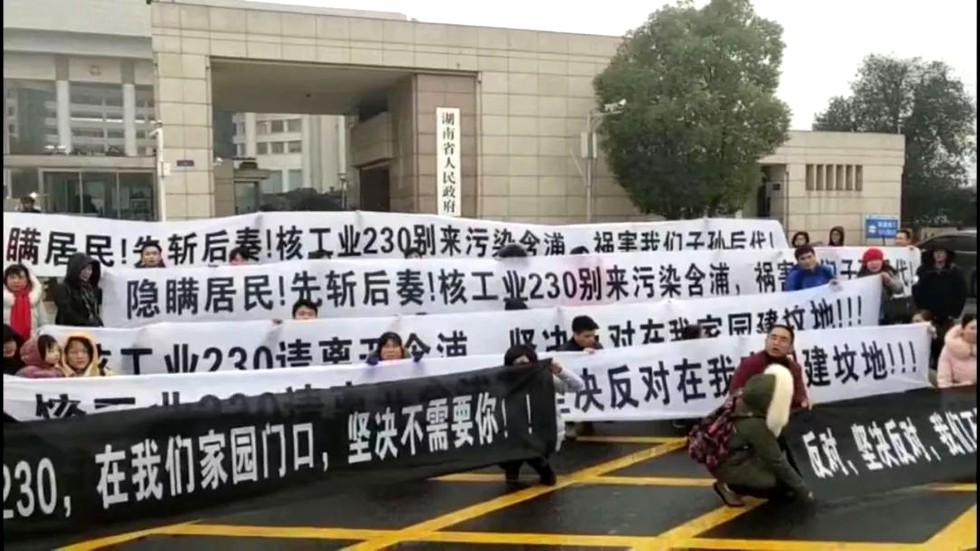
Chinese city residents protest over plans for nuclear research plant

  • Local suspicions over Changsha plant heightened by failure to officially announce the plans until one day before public consultation process was due to end
PUBLISHED : Friday, 28 December, 2018, 7:40pm
UPDATED : Friday, 28 December, 2018, 7:40pm

The protesters fear that radioactive materials used at the planned facility in Changsha, the capital of Hunan province, will pose a health risk.

The institute behind the project did not officially release their plans on Tuesday – after work had began on the site and one day before the public consultation period was supposed to end.

An environmental impact assessment into the project said Number 230 Research Institute, a branch of the China National Nuclear Corporation, had acquired a space of over 20,000 square metres near a densely populated area to expand its offices and laboratories at the site, which will be dedicated to the geological exploration of uranium.

Although the facility is not intended to handle refined uranium, and scientists say that unprocessed material does not emit harmful levels of radiation, residents have expressed concerns about the possible health risks and have called for building work to be halted.

Their concerns were heightened by the failure to carry out an assessment of the radiological hazards and the decision to announce the plans a day before the consultation period was due to end.

Wu Xiaosha, one of the protesters, said people were also angry that the project is already being built without approval.

“The environmental impact assessment report lied about the population in the area – it said there are only 40,000 people in the area, but actually it’s nearly 250,000,” said Wu.

Yang Wenqiang, an official from the Changsha Urban Rural Planning Bureau, refused to comment on the matter, saying the government was holding an emergency meeting and will release a statement later.

In a public letter issued on Thursday, Luo Zheng, deputy head of the Xueshi subdistrict, said he had no idea what the project was planning to do and had asked the institute to explain its population estimate – a question it has not yet answered.

“As for what does this institute does and why should it be built here, I am very curious too,” said Luo.

He said he would visit related institutions to see how they operate and how they evaluate the risks.

Environmental concerns have fuelled a growing number of protests in China in recent years as public awareness of the possible health risks increases.

The Chinese Academy of Social Sciences reported that half of protests with more than 10,000 participants between 2001 and 2013 were sparked by concerns about pollution.

28/12/2018

Slow cooker: China gives final approval to imports of rice from US after inspection procedures put in place

  • US producers can now sell into world’s largest rice market after phytosanitary standards and procedures set out in 2017 agreement are reached
PUBLISHED : Friday, 28 December, 2018, 7:53pm
UPDATED : Friday, 28 December, 2018, 7:53pm

China has given final clearance for US imports into the world’s largest rice market, as the trade dispute between the world’s two largest economies is on hold for talks and concessions.

American rice was cleared for import from Thursday, Chinese customs officials announced.

“According to the relevant Chinese laws and the conditions set out in the agreed phytosanitary protocol, the US is permitted to export rice to China,” the agency said.

https://multimedia.scmp.com/widgets/china/tradewar-countdown/China agreed to open its rice market to US producers after a deal was struck in 2017. It did not take effect straight away as inspection procedures had to be put in place.

The customs announcement is the latest step for Beijing towards opening its markets since Chinese President Xi Jinping and his American counterpart Donald Trump met on December 1 and agreed to a 90-day period to work towards a trade deal. Part of that agreement was that China would buy more US agricultural produce.

China has since then bought more than 1.5 million tonnes of soybeans and resumed buying liquefied gas.The US keeps a long list of complaints against China on intellectual property, forced technology transfers and industrial subsidies. Trump said China used “unfair trade practices”, which led to a trade deficit that he promised to cut.

Negotiations on opening China’s rice market to the US started more than a decade ago. China’s demands for rice surged after it joined the World Trade Organisation in 2001, but a lack of plant health protocols stalled imports, trade group USA Rice said.

China imported about 5 million tons of rice in 2016, according to data from the US Department of Agriculture.

Meanwhile, the US exports 3 million to 4 million tons of rice per year, according to the UN Food and Agriculture organisation.

US rice products will face competition in China, where Vietnam and Thailand are major rice exporters.

28/12/2018

China’s type 15 lightweight tank commissioned

BEIJING, Dec. 27 (Xinhua) — A new type of tank, the type 15 lightweight tank, has been commissioned by China’s army, a military spokesperson said Thursday.

Wu Qian, a spokesperson for the Ministry of National Defense, made the remarks at a regular press conference.

The spokesperson also revealed that in 2018, China has conducted nearly 40 joint drills and training sessions with over 30 countries, deepening friendship and mutual trust with other militaries.

Such operations have been carried out with more in-depth exchanges, greater focus on real combat conditions and improved systems, Wu said.

Regarding preparation for the 7th International Military Sports Council Military World Games, Wu said a total of 10,049 people from 93 countries, including 9,122 competitors and officials, 389 referees and 172 media staff, had signed up for the event scheduled for October 2019 in Wuhan, capital of central China’s Hubei Province.

In a review of China’s naval escort missions, the spokesperson said that over the past 10 years, China has sent 31 fleets and over 26,000 officers and soldiers, escorting more than 6,600 Chinese and foreign ships and successfully rescuing or aiding over 70 ships.

The fleets also carried out other missions, such as the evacuation of Chinese nationals from war zones, the search for the missing flight MH370 and supplying fresh water to Maldives, the spokesperson said.

28/12/2018

China’s BeiDou officially goes global

BEIJING, Dec. 27 (Xinhua) — China on Thursday announced that the primary system of BeiDou-3 has been established and started to provide global services, meaning its home-grown BeiDou Navigation Satellite System (BDS) officially went global.

The BDS has been performing well in the Asia-Pacific region and it goes global with cutting-edge technology and high-quality service.

“The BDS is very popular in Indonesia,” said Marianto Yang, an agent selling satellite navigation equipment in Indonesia, adding that the system offers services superior to similar equipment.

In November 2017, BeiDou-3, the latest generation of the BDS, started its satellite constellation, which was completed this November.

Xie Jun, deputy chief designer of the system, said the goal of the design of BeiDou-3 is to provide services with comparable accuracy to those of the third generation of the Global Positioning System owned by the United States and European Galileo system.

The new progress of BeiDou-3 offers an alternative to the world.

“We have seen great potential in the BeiDou system,” said Sabira Khatun, a professor who specializes in electronics engineering at Universiti Malaysia Pahang, emphasizing that the system has brought opportunities for academic cooperation on navigation between the two countries.

The BDS was created in a spirit of openness and cooperation. Before BeiDou-3 started its global service, services provided by BeiDou-2 had been applied in over 70 countries and regions, from land planning and supervision of river transport in Myanmar to urban modernization and smart tourism in Brunei.

In recent years, the BDS’s pace of globalization has been quickening. At the sixth ministerial meeting of the China-Arab States Cooperation Forum in 2014, the application of the BDS in Arab countries has been discussed.

In May 2015, China and Russia signed the BeiDou-Glonass system compatibility and interoperability cooperation agreement. In April 2018, the China-Arab States BDS/GNSS Center, the first overseas center for China’s indigenous BDS, was officially inaugurated in Tunisia.

“Cooperation on the BDS is of special significance for the Belt and Road construction,” said Mohamed Ben Amor, secretary general of the Tunisia-based Arab Information and Communication Technology Organization, an Arab governmental organization under the Arab League.

“The next step of the China-Arab cooperation is to achieve further connectivity and both sides can apply the BDS to promote regional technological and economic development,” Amor added.

Shen Jun, deputy director of the International Cooperation Center of the China Satellite Navigation Office, said the China-Russia Commission on Important Strategic Satellite Navigation Cooperation has been established to continuously coordinate and promote bilateral cooperation in satellite navigation.

Cooperative projects between China and Russia include the development of chips for satellite navigation applications and autonomous vehicles in agriculture, Shen added.

This year has seen an intensive launch of BeiDou satellites. By around 2020, when the BeiDou system completes its global network, it will have more than 30 satellites.

All countries around the world, especially developing ones, will enjoy free positioning and navigation services provided by the BDS, which “not only is the progress of the global satellite navigation system, but also benefits the development of production and transportation in these countries,” said Amor.

(Xinhua reporters Yang Jun in Beijing, Liang Hui in Jakarta, Lin Hao in Kuala Lumpur, Ma Di and Huang Ling in Tunis, and Luan Hai in Moscow also contributed to the story.)

28/12/2018

China to work with Russia to prepare for high-level contact next year

28/12/2018

Big data, AI help manage traffic in east China city

JINAN, Dec. 27 (Xinhua) — Chinese ride-hailing giant DiDi Chuxing has partnered with traffic police and Shandong University in the city of Jinan to use big data and artificial intelligence to ease traffic.

An intelligent traffic management system named JTBrain was officially launched Wednesday, equipping the capital of east China’s Shandong Province with a self-adaptive traffic-light control system.

The system can serve as a decision-making platform to increase traffic efficiency, according to Liu Xianghong, chief scientist of DiDi Chuxing’s intelligent transport department.

JTBrain was designed to “learn and evolve” by modeling core algorithms and realize real-time control under different traffic conditions, according to Zou Nan, director of Transportation Study Center of Shandong University.

Zou added that the brain-like system, which now covers 36 streets and 450 crossroads, uses AI, big data and cloud-computing to search for optimal traffic solutions.

“JTBrain makes decisions by crunching data gathered from video footage on streets, and provides live recommendations through mobile phone apps and outdoor LED screens,” said Li Yong, deputy director of the Intelligent Traffic System Office of Jinan Traffic Police.

In tests lasting over six-months, JTBrain helped cut the average morning and evening commute time by 10.7 percent and 10.9 percent, respectively, according to local traffic police.

21/12/2018

Crude refusal: China shuns U.S. oil despite trade war truce

SINGAPORE (Reuters) – China, the world’s top oil importer, is set to start 2019 buying little or no crude from the United States despite a three-month truce in a trade scrap between the two nations, with relatively high freight costs and political uncertainty choking demand.

That muted appetite means the United States, which became the world’s top oil producer this year as its shale output hit record levels, will continue to hold only a sliver of China’s market even as a wave of new refining capacity starts up there.

It also suggests that China is unlikely to use crude purchases to help plug a widening trade gap with the United States, which remains a core source of tensions between the world’s top two economies.

The U.S. trade deficit with Beijing hit a record $43 billion in October as its firms stockpiled inventory from China to avoid higher tariffs that may kick in next year.

“Chinese companies have little incentive to buy U.S. crude due to the wide availability of crude supplies today from Iran and Russia,” said Seng Yick Tee, an analyst at Beijing-based consultancy SIA Energy.

“Even though the trade tension between China and the U.S. had been defused recently, the executives from the national oil companies hesitate to procure U.S. crude unless they are told to do so.”

China stopped U.S. oil imports in October and November after the trade war intensified. It resumed some imports in December, but purchased just 1 million barrels, a minute portion of the more than 300 million barrels of total imports, Refinitiv data showed.

Chinese refineries that used to purchase U.S. oil regularly said they had not resumed buying due to uncertainty over the outlook for trade relations between Washington and Beijing, as well as rising freight costs and poor profit-margins for refining in the region.

Costs for shipping U.S. crude to Asia on a supertanker are triple those for Middle eastern oil, data on Refinitiv Eikon showed.

(GRAPHIC: China’s appetite for U.S. crude muted by high freight costs, competitive Mid East supplies – tmsnrt.rs/2GyFnJI)

A senior official with a state oil refinery said his plant had stopped buying U.S. oil from October and had not booked any cargoes for delivery in the first quarter.

“Because of the great policy uncertainty earlier on, plants have actually readjusted back to using alternatives to U.S. oil … they just widened our supply options,” he said.

He added that his plant had shifted to replacements such as North Sea Forties crude, Australian condensate and oil from Russia.

“Maybe teapots will take some cargoes, but the volume will be very limited,” said a second Chinese oil executive, referring to independent refiners. The sources declined to be named because of company policy.

A sharp souring in Asian benchmark refining margins has also curbed overall demand for crude in recent months, sources said.

(GRAPHIC: Singapore refining margins slump 50 pct in 3 ths amid demand growth concerns – tmsnrt.rs/2RhnHXv)

Despite the impasse on U.S. crude purchases, China’s crude imports could top a record 45 million tonnes (10.6 million barrels per day) in December from all regions, said Refinitiv senior oil analyst Mark Tay.

Russia is set to remain the biggest supplier at 7 million tonnes in December, with Saudi Arabia second at 5.7-6.7 million tonnes, he said.

China’s Iranian oil imports are set to rebound in December after two state-owned refiners began using the nation’s waiver from U.S. sanctions on Tehran.

21/12/2018

US charges ‘China government hackers’

  • 20 December 2018
FBI wanted posterImage copyrightFBI

The US justice department has indicted two Chinese men accused of hacking into the computer networks of companies and government agencies in Western countries.

The pair are allegedly part of a “hacking group” known as Advanced Persistent Threat 10, affiliated with China’s main intelligence service.

They have not been arrested.

The US and UK have accused China of violating an agreement relating to commercial espionage.

Zhu Hua and Zhang Shilong worked for a company called Huaying Haitai and in association with the Chinese Ministry of State Security, the US court filing says.

The Federal Bureau of Investigation (FBI) said that from at least 2006 until 2018, the two extensively hacked into computer systems with the aim of stealing intellectual property and confidential business and technological information from:

  • at least 45 commercial and defence technology companies in at least 12 US states
  • managed service providers (MSPs) and their government and commercial clients in at least 12 countries, including the UK, Brazil, Canada, Finland, France, Germany, India, Japan, Sweden, Switzerland, and the UAE, as well as the US
  • US government agencies

The FBI said they had also hacked into US Navy computer systems and stolen the personal information of more than 100,000 personnel.

FBI director Christopher Wray said the two men were at present “beyond US jurisdiction”.

‘Economic aggression’

Announcing the unsealing of the indictments, US Deputy Attorney General Rod Rosenstein said China had violated a 2015 agreement under which it had pledged to not engage in commercial cyber-spying.

Image captionUS Deputy Attorney General Rod Rosenstein: “We want China to cease its illegal cyber activities”

Mr Rosenstein said his department’s move had been co-ordinated with US allies in Europe and Asia to rebuff “China’s economic aggression”.

He added: “We want China to cease its illegal cyber activities.”

The UK government said it was joining allies in holding the Chinese government responsible for a global campaign targeting commercial secrets.

UK Foreign Secretary Jeremy Hunt said: “This campaign is one of the most significant and widespread cyber intrusions against the UK and allies uncovered to date, targeting trade secrets and economies around the world.

“These activities must stop. They go against the commitments made to the UK in 2015, and, as part of the G20, not to conduct or support cyber-enabled theft of intellectual property or trade secrets.”

Australia and New Zealand said they too held China responsible for the global hacking campaign and joined their “like-minded partners” in condemning the activity.


‘Chinese hackers return’

By Gordon Corera, security correspondent

This is the latest salvo in Washington’s attempt to pressure Beijing on a range of issues, with economic espionage one of the most high-profile.

US and UK officials are reluctant to name the companies that have been hit but they say the economic damage has been significant.

The hackers, officials say, work under the direction of China’s Ministry of State Security – one of the country’s intelligence organisations.

“It is organised more like a corporation than a gang,” one UK official says, adding that British intelligence has the highest level of confidence in their assessment of who was responsible.

The UK and US believe China is breaking a 2015 agreement not to steal commercial data to help its companies. There was a dip in activity after the deal was signed (which followed a period of pressure by Washington, including the indictment of Chinese military hackers and the threat of sanctions).

But US and UK sources both say that recently they have seen Chinese hackers return, now operating more stealthily, whereas in the past they were easier to spot.

Where the US has been vocal in recent months, this is the first time the UK has spoken out – perhaps because it has been concerned about risking trade ties and getting pulled into the Trump administration’s broader confrontation with Beijing.

UK officials say they have raised the matter privately a number of times with Beijing over the last two years, including during the prime minister’s visit earlier this year, and officials are keen to stress that they think the relationship with China is strong enough to allow them to address these issues without causing wider problems.

Law of Unintended Consequences

continuously updated blog about China & India

ChiaHou's Book Reviews

continuously updated blog about China & India

What's wrong with the world; and its economy

continuously updated blog about China & India