Archive for ‘India alert’

22/03/2019

Guns and tourists: Aboard the unlikely India-Pakistan ‘friendship bus’

NEW DELHI (Reuters) – One Friday morning before dawn, a half-empty Volvo coach slipped out of New Delhi’s Ambedkar bus terminal under armed guard, the sirens of a police convoy wailing.

Carrying a mixture of Indian and Pakistani tourists, the bus, emblazoned with the flags of both countries and the phrase ‘Sada-e-Sarhad’ (Call of the Frontier), is one of the few remaining transport links between the nuclear-armed neighbors, who clashed last month over the disputed Kashmir region in a conflict that alarmed world powers.

But as Reuters found on a return trip on what is also known as the ‘dosti (friendship) bus’, that runs daily except Sundays between Delhi and the Pakistani city of Lahore, it is a powerful symbol of hope for better relations between the rivals, who despite their political differences share strong linguistic, cultural and family ties.

After breakfast at a government-run restaurant on the highway where police seal off the grounds, passengers from both countries watch a Bollywood film on board, starring one of India’s many Muslim actors.

“Salman Khan is a Muslim, he is one of us,” said Hilal Ahmad Mir, 36, a Kashmiri apple farmer and father of four.

The journey from his home in the south Kashmir valley to Pakistan’s capital Islamabad to visit his brother Hamid, should be less than 300 km (200 miles) by the most direct route, across the contested border known as the Line of Control.

But with the ongoing conflict making that route effectively impossible, he is forced to take a lengthy detour via Delhi and Lahore, before eventually reaching Islamabad two days later.

Still, he is upbeat.

“Pakistan makes it easy for Kashmiris to get a visa,” he said. “In some ways, Pakistan and India have a very good relationship. We have had a lot of damage. We want friendship, not guns.”

SEPARATED AT BIRTH

India and Pakistan have thousands of years of shared history. Delhi and Lahore’s sandstone forts and grand mosques were all constructed by the Mughal empire, and both countries were later part of British colonial India.

When Britain gave up control of the Indian subcontinent in 1947, it hastily partitioned it into Hindu-majority India and Islamic Pakistan. Hundreds of thousands died in ethnic bloodshed and millions more became refugees.

Relations between the two countries have been strained ever since. They have fought three wars, two of them over the Muslim-majority Kashmir region that both claim in full but rule in part. Last month, they clashed over a suicide attack on an Indian paramilitary convoy in Kashmir by Pakistani militants.

In an attempt to maintain close links to Indian-administered Kashmir, Pakistan often approves visas for the Muslim-majority population on the same day.

For the vast majority of people in both countries, however, arranging a visa to visit to the other side is a bureaucratic process that often takes as long as three months, according to half a dozen of the bus’s passengers.

“My family is divided: my wife’s side is in India, my side in Pakistan,” said Shoaib Mohammed, a banker from Karachi returning after a month in Delhi. “The visa process takes at least 45 days and is often extended.”

Though the bus, inaugurated in 1999 by India’s then-prime minister Atal Bihari Vajpayee, has been briefly suspended over the years, it ran uninterrupted through the last major clash between the two countries that erupted weeks after the launch.

Neither has it been canceled over the tensions of the last month, although passenger numbers dropped into the single digits, officials said, a testimony to the huge police operation to protect it.

Several armed police are always on board – one of whom on this trip snores on the back seat, rifle on his lap. Dozens more block off roads in Delhi and other major towns, while a convoy ahead clears traffic.

But even without policing costs, the bus loses money, according to a senior Pakistani diplomat based in New Delhi familiar with the bus’s operations.

“Commercially, the bus is a failure,” he said. “But relations between the two countries are so bad at the moment neither side can afford to cancel it.”

INTO THE SUNSET

After lunch in another deserted and heavily guarded highway restaurant, the bus passes through Wagah-Attari, one of the few active border crossings between India and Pakistan. It is best known for an elaborate dusk ceremony where high-kicking guards from both countries perform a choreographed routine at a purpose-built stadium that straddles the border.

Most days, just 100 people cross in either direction, Indian and Pakistani border officials said. Both times Reuters crossed the border, the process took close to three hours, and the terminal was deserted with no other travelers in sight apart from those on the bus.

Mir, from Kashmir, is held by Indian border officials for 40 minutes for questioning.

“Kashmiris are dangerous,” he laughed, as he returned to the bus.

Shortly before the dusk ceremony begins, the bus drives across the border through the stadium, where hundreds of spectators from both countries roar their approval.

Passengers then pass through near-identical Pakistani immigration checks.

On board, spirits are high as the bus begins its last lap to the center of Lahore, about 20 km (12 miles) away.

“We have been visiting for the last 40 years and this time there were no problems for me as a normal visitor,” Mohammed said, of his visit to Delhi when tensions were at their peak.

“I didn’t feel any anger against Pakistanis. Nothing.”

Source: Reuters
22/03/2019

Oppn has insulted armed forces, Indians won’t forgive: PM Modi after Pitroda’s IAF remarks

The remarks by Pitroda come on a day when the Pakistan High Commission in Delhi is hosting the reception for the Pakistan National Day, the invite to which has been declined by India.

SNS Web | New Delhi | 

Lashing out heavily at the Congress after Sam Pitroda’s remarks on the IAF strike, Prime Minister Narendra Modi on Friday said the most trusted advisor and guide of Rahul Gandhi has kickstarted the Pakistan National Day celebrations on behalf of the Congress, ironically by demeaning Indian armed forces.

The PM said the Opposition has insulted the country’s armed forces time and again.

Sparking a massive controversy, Gandhi’s close confidant and Chairman of Indian Overseas Congress Sam Pitroda earlier in the day made shocking remarks on the IAF strike questioning the death toll in Balakot after the Indian Air Force dropped bombs on JeM camps in a pre-dawn attack on February 26.

Questioning the strike impact, Pitroda asked, “I would like to know more as I have read in New York Times and other newspapers, what did we really attack, we really killed 300 people?”

“If you say 300 people were killed, we all need to know that; all Indians need to know that. Then comes the global media which says nobody was killed. I look bad as an Indian citizen,” he added.

Referring to the 26/11 Mumbai terror attacks that killed 166 people, Sam Pitroda further said, “Eight people come and do something, you don’t jump on an entire nation. It is naive to assume that just because some people came here and attacked, every citizen of that nation is to be blamed. I don’t believe in that way”.

He also said that “attacks happen all the time, it also happened in Mumbai”, adding that the government could have then reacted and just sent fighter planes, but that is not the right approach”.

The Indian Overseas Congress chief further said that it was not the right approach by the Government to send Indian fighters to deal with issues like terror attacks.

Taking a dig at the Congress, PM Modi reacted saying the “loyal courtier of Congress’ royal dynasty admits what the nation already knew – that the Congress was unwilling to respond to forces of terror”.

“This is a New India – we will answer terrorists in a language they understand and with interest,” PM Modi.

The Prime Minister further appealed to the citizens of the country to question the Opposition leaders on their statements and let them know that the 130 crore Indians will not forgive or forget the Opposition for their antics.Union Minister Smriti Irani too hit back at the Congress saying “now the nation knows why Rahul Gandhi’s UPA chose not to respond with full might post the Mumbai terror attacks”, adding that “Congress sympathies with Pakistan stands exposed”.

The remarks by Pitroda come on a day when the Pakistan High Commission in Delhi is hosting the reception for the Pakistan National Day, the invite to which has been declined by the Government citing the presence of Hurriyat leaders.

Many Congress leaders have demanded proof of the retaliatory assault and casualties in the aftermath of the Pulwama terror attack that left over 44 CRPF men dead on February 14.

Following the Pulwama attack, India carried out “non-military pre-emptive” airstrikes targeting the JeM training camp in Balakot in Pakistan’s restive Khyber Pakhtunkhwa province, about 80-km from the Line of Control (LoC) early on February 26.

Hours after the pre-dawn offensive, Government sources had claimed that over 300 terrorists were killed.

The sparring between the government and the opposition intensified after BJP chief Amit Shah claimed that “more than 250” terrorists were killed in the operation, even when the government was yet to give out an official count of the terrorists killed.

Source: The Statesman
21/03/2019

India election 2019: Will fast broadband reach all villages?

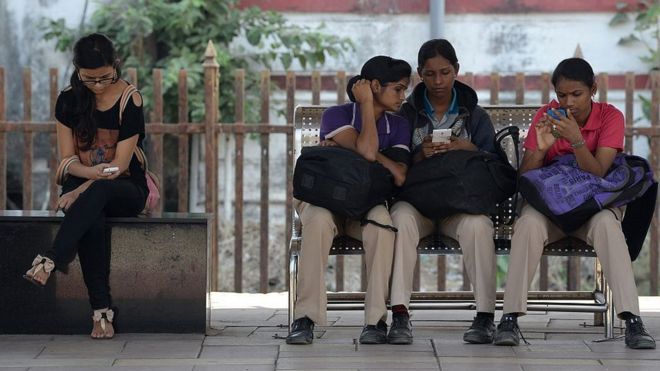
Indian women check their mobile phones at a free Wi-Fi zone in Mumbai in February 2016Image copyrightGETTY IMAGES

India’s Prime Minister Narendra Modi wants to connect more than a billion Indians to the internet – and his BJP government is counting on a project taking cheap high-speed broadband to rural areas to achieve this.

The project, to build a nationwide optical fibre network, was launched in 2014 and is the flagship scheme of the government’s Digital India programme.

In the run-up to the Indian election, which gets under way on 11 April, BBC Reality Check is examining claims and pledges made by the main political parties.

So has the project been a success?

Presentational grey line

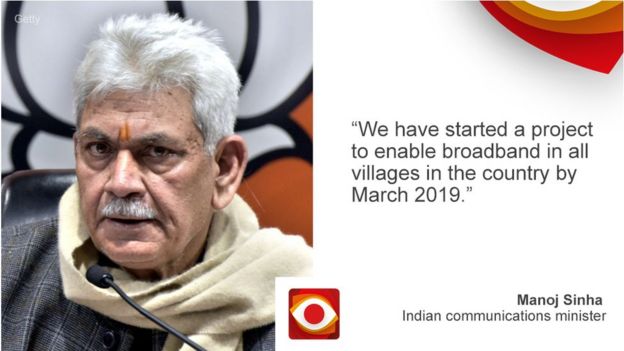
Pledge: Indian Communications Minister Manoj Sinha promised to provide every village in the country with high speed broadband and that this would be achieved by March 2019.

Verdict: The project to set up digital infrastructure in rural India has made substantial headway but has so far achieved less than 50% of its intended target.

Quote card for Indian minister of state (communications) Manoj Sinha
Presentational grey line

An ambitious plan

India has the second highest number of internet users in the world but the penetration is quite low for its size and population.

The BharatNet scheme aims to connect more than 600,000 villages in India with a minimum broadband speed of 100Mbps.

It would enable local service providers to offer internet access to the local population, primarily through mobile phones and other portable devices.

India’s telecom regulator says there were 560 million internet connections in India in September last year.

India’s broadband users

Source:

But the pace of internet adoption is lower in rural areas, where most Indians live.

What’s been achieved so far?

The government’s overall target is to connect 250,000 village councils covering more than 600,000 individual villages across the country.

The work of laying cables and installing equipment to connect 100,000 of them was finally completed in December 2017 after significant delays.

This milestone was hailed a success but there were also critical voices, especially from government opponents about whether the cables were actually operational.

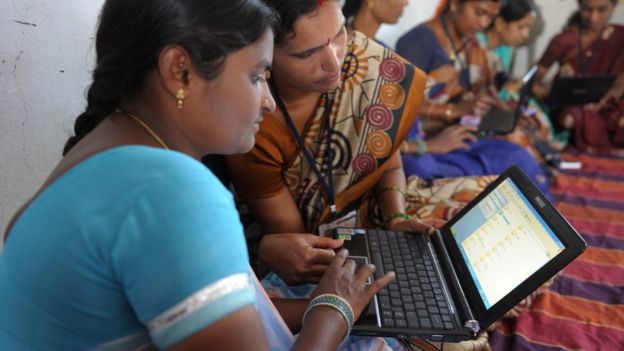
Indian villagers from a self-help group with laptops in Bibinagar village outskirts of Hyderabad on 7 March 2013Image copyrightGETTY IMAGES

The next phase, to connect the remaining councils by March 2019, has been under way for a year now.

In total, as of the end of January this year, official data shows optical fibre cables have been laid in 123,489 village councils – and equipment installed in 116,876 of them.

There is also a plan to install wi-fi hotspots in more than 100,000 council areas – but as of January these were operational in only 12,500 of them.

Old plan, new name

It has been an ambition of successive governments to connect all India to the internet but plans have hit many roadblocks.

BharatNet was first conceived in 2011 by the then Congress government as the National Optical Fibre Network but did not make much headway in its pilot phase.

A parliamentary committee said the project had been affected by “inadequate planning and design” from 2011 to 2014.

When the BJP came to power in 2014, it took over the project and has pushed ahead with national broadband coverage.

And in January last year, the government said it would complete the work ahead of the stipulated deadline of March 2019.

Has the deadline been met?

There was impressive progress made in 2016 and 2017 but since then the pace has slowed.

In January this year, the agency executing BharatNet said 116,411 village councils were “service ready”.

This means that provisions for ready-to-use connectivity have been made.

Status of BharatNet project

Source: Bharat Broadband Network Limited

But not all “service ready” village councils have proper connections, says Osama Manzar, from the non-governmental Digital Empowerment Foundation (DEF).

DEF found that only 50 of 269 “service ready” councils inspected across 13 states in 2018 had the required device and internet connection set-up.

And only 31 of them had “functional”, but slow, internet connections.

Mr Manzar notes that this is problematic considering “the public welfare distribution and the financial sectors rely heavily on digital infrastructure today”.

Another report, citing an internal official memo, said most of the councils had non-functioning networks or faulty equipment.

Next steps

BharatNet has faced also difficulties with electricity supply, theft, low-quality cables and poorly maintained equipment.

And these delays come as India aims to provide broadband in all households and move to 5G networks by 2022.

An official source defended BharatNet as a large-scale infrastructure project tackling difficult sites and not a service scheme, saying it was natural to see delays between set-up and use.

Source: The BBC

20/03/2019

India election 2019: Are three times more roads being built?

Quote card of PM Modi

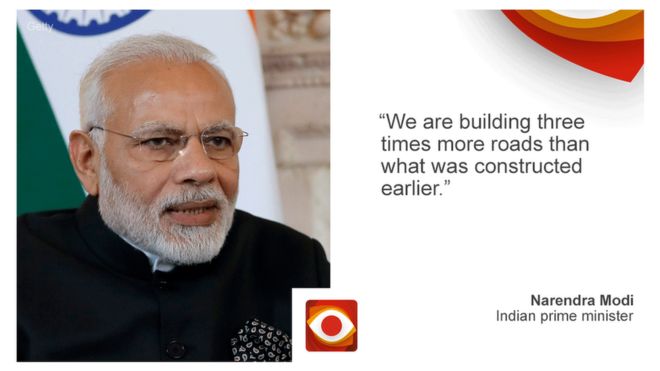
In April 2018, India’s Prime Minister, Narendra Modi, said his government was building more roads than ever.

“Today, the volume of work that is being done every day is three times what was done previously,” he said.

India has one of the largest road networks in the world, covering a total of 5.5 million km (3.4 million miles).

In the run-up to the Indian election, which gets under way on 11 April, BBC Reality Check is examining claims and pledges made by the main political parties.

Presentational grey line

Claim: The current government says it is building three times as many roads in India, compared with previous governments.

Verdict: Road-building has gone up significantly under this government, although not as much as Mr Modi has claimed.

Presentational grey line
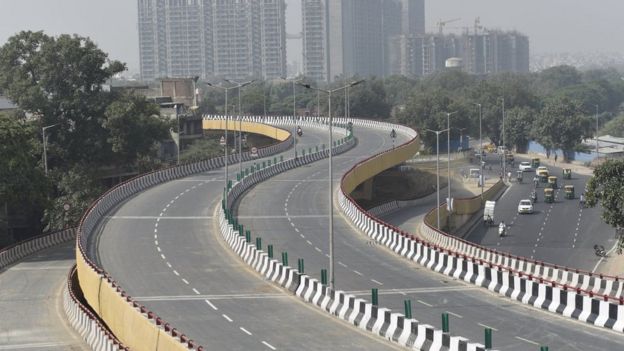
New highway near DelhiImage copyrightGETTY IMAGES
Image captionA recently opened stretch of highway in Delhi

Road infrastructure in India is divided into three categories:

  • national highways
  • state highways
  • rural roads

At independence in 1947 the total length of national highways in India – the main routes that cross the country – was around 21,000km.

By 2018, it had gone up to almost 130,000km.

National highways are funded and constructed by the government, in Delhi, and state highways by state governments across India.

Rural roads come under the Ministry of Rural Development, in Delhi.

Presentational grey line

Construction rate rises

Official government data for the past decade shows the total length of highways built each year increased sharply after 2014, when the BJP came to power.

In its last year in office, in 2013-14, the previous Congress-led government built 4,260km of national highway.

In 2017-18, the current BJP government built a total of 9,829km of highway – more than double but not as much as three times the 2013-14 figure.

National highways in India

In a December 2018 review, the Ministry of Road Transport and Highways said more than 300 government highway projects would be completed by the end of 2019.

The present government has also set aside increasing amounts in the budget each financial year for developing national highways.

Budget allocated to highways

The Highways and Transport Minister, Nitin Gadkari, has said roads and highways are “a country’s assets”

Rural road building

Plans for extending roads in rural areas are not new – in fact, they date back to a previous BJP-led government in 2000.

India rural roadImage copyrightGETTY IMAGES
Image captionThe BJP claimed that construction of rural roads reached an all-time high in 2016-2017

In May last year, the current BJP government said more than 47,000km of rural roads had been constructed in the financial year 2016-17.

“Construction of rural roads reached an all-time high in 2016-17, under the Modi government,” it said.

However, official data for the past decade shows that 2009-10 saw an even higher length of rural roads built – 60,117km.

And this was when a Congress-led government was in power.

Rural roads built in India

Sine the BJP came to power, the budget for rural roads has increased every financial year – to expand the network to less accessible areas.

And the World Bank, which has been helping finance rural road building since 2004, said, in a report issued in December 2018, that progress had been “highly satisfactory”.

Source: The BBC

20/03/2019

From farms to slums, Indian women on sharp end of jobs crisis

CHINCHOLI, India (Reuters) – A few years ago, in this sweltering corner of western India, the horizon was dotted with hunched, barefoot women swinging sickles all day to cut wheat for the spring harvest.

Now, a giant green harvester clears an entire half-acre field within minutes, allowing farmers to save money and quickly sell the wheat, typically used to make Indian flat breads.

Chhaya Kharade, 36, and other women doing lighter farm work were gradually replaced by the machines that now crisscross wheat, sugar cane and onion fields surrounding Chincholi, a village 190 km (120 miles) east of India’s financial hub of Mumbai.

“I should be busy now, as the wheat harvesting is going on. But there is hardly any work for me. Almost all farmers are using machines,” Kharade said in her spartan two-room house.

Indian women, especially those working in precarious informal sectors, are at the sharp end of what economists and opposition politicians describe as a jobs crisis in India. According to the private Centre for Monitoring Indian Economy (CMIE), 90 percent of around 10 million jobs lost last year were held by women.

Several unemployed women interviewed by Reuters said they had soured on Prime Minister Narendra Modi, a Hindu nationalist who swept to power in 2014 vowing to turn India into an economic powerhouse but has struggled to create jobs.

While Modi remains the favourite in general elections that kick off next month, insufficient employment – despite India’s roughly 7 percent economic growth rate – is a major voter worry.

“Modi’s government has not done anything to create employment in this region. We would like to vote for a party that will set up factories and create jobs,” said Mumtaj Mulani, a 40-year-old woman who was plucking weeds from a pearl millet field in the area. She said she usually struggles to find work due to the spread of machines.

The dwindling female labour participation rate could have far-reaching implications for India’s economic development and the progress of women’s rights in the often deeply conservative country.

“When nearly fifty percent of the labour force is unable to live up to its potential, India is foregoing significant growth, investment, and productivity gains,” said Milan Vaishnav, director of the South Asia programme at the Carnegie Endowment.

“The social costs, while less tangible, are nevertheless acute,” Vaishnav added, noting research suggests women’s economic empowerment reduces inequality and ensures women have a greater voice in society.

Measuring the problem is tricky, and Modi’s government has delayed the release of controversial jobs data. [L3N2121QE]


Private estimates are gloomier. CMIE puts the figure at just 10.7 percent between May and August 2018.

For an interactive graphic on India’s female labour force participation rate, click tmsnrt.rs/2FbrbDK

DOUBLE WHAMMY: NOTE BAN AND GST

To be sure, the loss of jobs to machines is a global issue, but Indian women have a more limited range of alternative work than their male counterparts. And in family-focused India, women across economic lines often quit work after getting married or having children.

Also, as some families’ earnings rise, more women can afford to become caregivers.

Still, when compared to nations with similar income levels, India’s female labour participation rate is “a distinct outlier,” according to Vaishnav.

Economists say Modi’s two signature economic policies – a ban on high-value banknotes in 2016 and the implementation of a national sales tax rate (GST) in 2017 – have hurt women more than men because they are more likely to be employed in vulnerable, informal workplaces.

Demonetisation thrust the informal, cash-based economy into turmoil. A year later, many small businesses went under, unable to deal with GST’s complexities or rate increases.

“If there are fewer jobs available, who will move out? The women will move out, because they get lower wages. The men will go compete for the few jobs,” said CMIE’s CEO Mahesh Vyas.

In Dharavi, a Mumbai slum that is one of Asia’s largest, 33 year-old Farzana Begum has struggled to provide for her five children since the workshop she stitched buttons for shut shop in the wake of GST.

“I have stopped all extra spending on clothes and good food,” said Begum. “If you ask anyone in Dharavi, everyone has seen a fall in income, lost their jobs or seen factories close after GST.”

Her dismay was echoed on the other side of the country, in a village near the eastern city of Kolkata, where Nuren Nesa’s earnings from embroidering saris fell from 700 rupees a week to 300 after demonetisation. Following GST, work ground to a halt and her embroidery machine is gathering dust.

“Modi’s note ban and GST measures have destroyed our source of income,” said Nesa, 41, who withdrew her son from university because tuition fees grew out of reach.

“I will vote for the leader who will help us out with proper work and income,” she added.

As the battle for women’s votes heats up, Modi has pointed to programmes to provide toilets and subsidised cooking gas cylinders as evidence his administration cares for women. This month, the main opposition party, Congress, vowed to reserve a third of federal government jobs for women if elected.

HARD WORK TO HIRE WOMEN?

Some business owners say they receive few applications from women.

“We do not find too many women in the segment we service, even though we would like to hire more women because they are more sincere, there is less attrition and they can multi-task,” said Vineet Pandey, who owns Mumbai-based housekeeping firms Kaarya Facilities & Services and Hecqo.com.

Indian women sometimes do not take jobs far from home due to fears for their safety.

Call centres or factories run by multinationals often attract women workers by providing transport after late shifts, but working at many other jobs entails commutes on packed trains and buses through India’s teeming and cities.

One businessman who employees roughly 1,000 men at his chemical factory in southern India, says hiring women would mean providing separate bathrooms and transport at night.
He argues bypassing men would also stoke tensions in India, where economic transformations and an influx of technology are testing the social fabric.
“In the rural areas, it is a more patriarchal society, if we give jobs to women and not men, there will be complaints from men,” said the businessman, who asked to remain anonymous.
“It is to maintain harmony.”
In any case, it is a moot point for now. His plant, struggling with high costs of power and transport, is not hiring.
Source: Reuters
20/03/2019

Mayawati says she won’t contest Lok Sabha elections

Mayawati said it was better for the party, people and the country that she does not contest the Lok Sabha elections at this stage.

INDIA Updated: Mar 20, 2019 13:30 IST

HT Correspondent
HT Correspondent
New Delhi
Mayawati,BSP,Bahujan Samaj Party
Bahujan Samaj Party chief Mayawati at the party office in Lucknow.(ANI)

Bahujan Samaj Party chief Mayawati on Wednesday ruled herself out of the 2019 Lok Sabha race to allow her to focus on getting the largest share of seats for her alliance with the Samajwadi Party in Uttar Pradesh and beyond.

Mayawati said it was better for the party, people and the country that she does not contest the Lok Sabha general elections at this stage. “I am confident and sure that my party workers will accept this decision,” she told news agency ANI.

The BSP chief said that she would, if required, contest the Lok Sabha election at a later stage.

Last week, Mayawati had indicated to party leaders that she will not contest the Lok Sabha polls and will instead focus on the BSP’s campaign. She will start the BSP’s national campaign from the Odisha capital Bhubaneswar on April 2, a party leader had said.

In 2014, the BSP had contested 503 Lok Sabha seats but won none with a countrywide vote share of 5%. In Uttar Pradesh, she will hold the first joint rally with her alliance partners, the Samajwadi Party and Rashtriya Lok Dal, in Deoband on April 7.

The BSP is contesting the Lok Sabha election in alliance with the Samajwadi Party. BSP chief Mayawati and SP president Akhilesh Yadav announced their electoral arrangement in January for 80 Lok Sabha seats in Uttar Pradesh.

The BSP is the senior partner in the alliance contesting 38 Lok Sabha seats. The SP is contesting 37 seats, according to the seat sharing arrangement. The Rashtriya Lok Dal (RLD) is the third constituent of the grand-alliance. The RLD has got three Lok Sabha seats.

Source: Hindustan Times
20/03/2019

Lok Sabha polls 2019: National Conference, Congress enter pre-poll alliance in Jammu-Kashmir

The two parties kept three of the six Lok Sabha seats in Jammu-Kashmir for “friendly contest” between them.

Statesman News Service | Jammu | 

The Congress and National Conference (NC) on Wednesday sealed a partial pre-poll alliance for the upcoming Lok Sabha elections wherein the two parties kept three of the six Lok Sabha seats in Jammu-Kashmir for a “friendly contest” between them.

Both parties will contest the Jammu, Udhampur and Srinagar seats in alliance, while there will be “friendly contest” for Anantnag, Baramulla and Ladakh seats.

The NC has left both seats of Jammu division – Jammu and Udhampur – for the Congress.

NC chief, Farooq Abdullah, will re-contest from the Srinagar Lok Sabha seat and the Congress will not field any candidate against him.

The two parties reached the alliance only after Congress leaders Ghulam Nabi Azad and Ambika Soni dashed to Srinagar early this morning from New Delhi to hold deliberations with Abdullah.

The NC had earlier announced candidature of BR Kundal, a former chief secretary of the state, who recently deserted the Congress and joined the NC.

The two parties failed to reach any understanding for the Anantnag seat in South Kashmir where the PCC chief GA Mir was seeking the Congress ticket.

The NC had spared the seat for Mir during the by-polls but the election did not take place due to security reasons. Farooq Abdullah had won the Srinagar seat during the by-election.

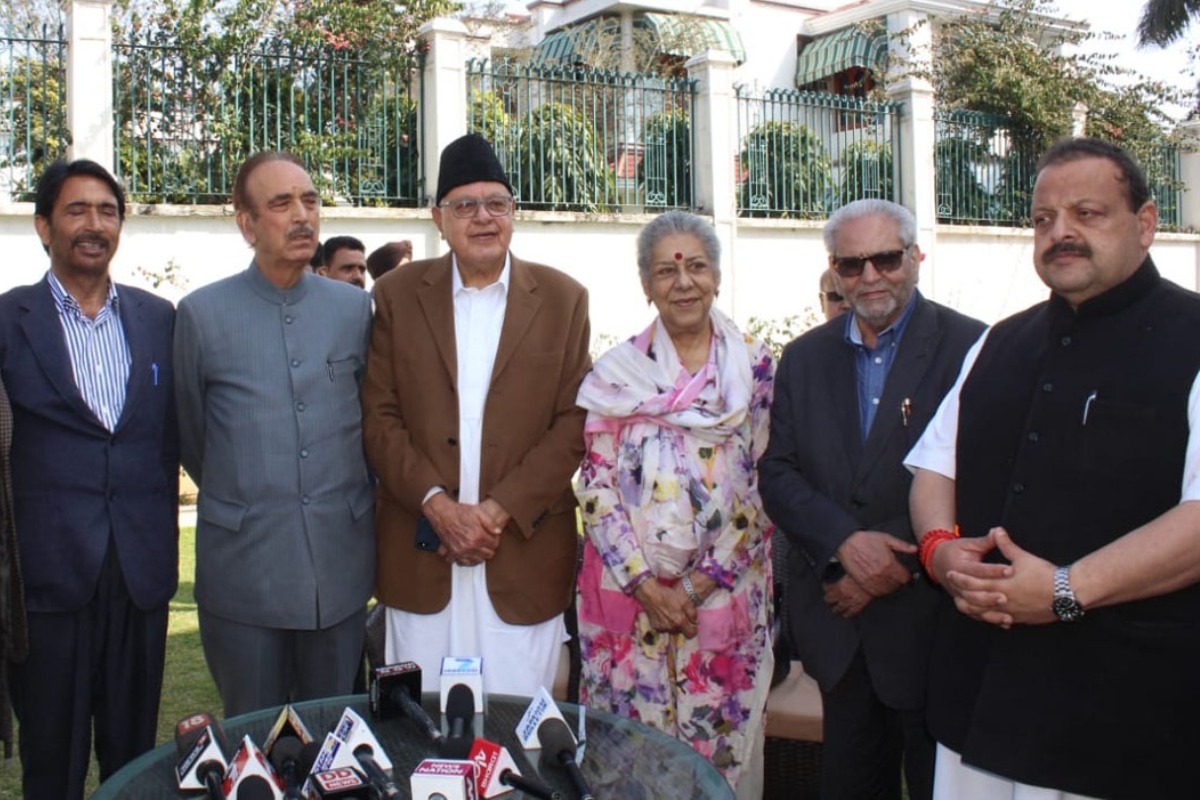
The announcement about the alliance was made jointly by Farooq Abdullah, Ghulam Nabi Azad and Ambika Soni after a closed door meeting at Abdullah’s residence.

Azad said that the alliance has been reached in the national interest, to strengthen secular forces in Jammu and Kashmir as the state faces threat from Pakistan.

Abdullah said the Congress will contest from Jammu and Udhampur Lok Sabha seats.

“I will contest from Srinagar and there will be a friendly contest between National Conference and Congress in Anantnag and Baramulla parliamentary constituencies. We are also discussing the Ladakh seat,” said Farooq Abdullah.

Azad said that friendly contest means that there will be no cut-throat contest between the parties on Anantnag and Baramulla seats.

“Live and let live. This is the best decision taken in national interest. If either the Congress or National Conference wins, it is a win-win situation for both,” he said.

Azad said the Congress-NC alliance will ensure there is no division of secular votes and the BJP doesn’t get to benefit. He added that all Congress leaders will also campaign for Abdullah, who will be contesting from the Srinagar Parliamentary seat.

The NC has already announced Mohammad Akbar Lone, a former Speaker, as the party’s candidate for the Baramulla seat.

Earlier, there were speculations that the pre-poll alliance between NC and Congress had hit a dead-end after former announced its candidate for the Anantnag Parliamentary constituency. Anantnag Lok Sabha seat has been a bone of contention between the NC and Congress.

Omar Abdullah, National Conference vice-president, had set a precondition to contest on all three seats in Kashmir for any alliance to take place.

In exchange, NC was willing to support Congress in the two seats in Jammu and one in Ladakh. However, Congress had insisted on contesting from four seats – two from the Jammu region and one each from Ladakh and Anantnag.

On Tuesday, Peoples Democratic Party (PDP) chief and former Chief Minister Mehbooba Mufti dismissed reports of an alliance with the Congress stating that the party is preparing to contest all the six Lok Sabha seats in Jammu and Kashmir. Mehbooba Mufti is expected to finalise the party’s candidates for the Lok Sabha seats within a day or two.

Source: The Statesman
19/03/2019

Mukesh Ambani: India’s richest man helps his brother avoid jail

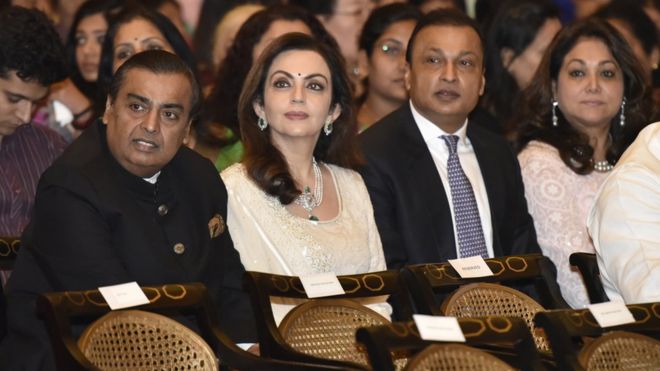
Chairman, Managing Director of Reliance Industries Limited Mukesh Ambani, his wife Nita Ambani, brother and Chairman of Reliance Group Anil Ambani and his wife Tina Ambani during the Padma Awards Investiture ceremony at Rashtrapati Bhawan on March 28, 2016 in New Delhi, IndiaImage copyrightGETTY IMAGES
Image caption: Mukesh Ambani, left, sits next to his wife Nita Ambani, and Anil Ambani on the right

India’s richest man Mukesh Ambani has paid a debt payment owed by his brother, saving him from spending time in prison.

Anil Ambani faced a prison sentence after a deal between his firm Reliance Communications (RCom) and telecoms giant Ericsson collapsed.

That left his firm owing Ericsson 5.5bn rupees ($80m; £60m), which it failed to pay by a court deadline.

The move marks a new twist a long-running feud between the brothers.

RCom failed to comply with an India Supreme Court order to pay Ericsson the money by 15 December last year.

The court found him guilty of contempt, giving him another four weeks to pay or go to prison.

On Monday, RCom said the debt had been paid.

“My sincere and heartfelt thanks to my respected elder brother, Mukesh, and (his wife) Nita, for standing by me during these trying times, and demonstrating the importance of staying true to our strong family values by extending this timely support,” Anil Ambani said.

The two brothers have long had an acrimonious relationship, fighting over their father’s businesses after he died in 2002 without a will.

The Reliance empire was divided between the two brothers in 2005 after a bitter seven-month feud.

The brothers have fought bruising court battles in the past over natural gas interests.

Mukesh Ambani is worth more than $54bn, according to Bloomberg.

His firm Reliance Industries, whose activities span from oil to telecommunications, is among India’s most valuable companies.

By contrast, Anil Ambani has an estimated net worth of around $300m, Bloomberg said.

The Ambani family made headlines last year with the lavish wedding of Mukesh Ambani’s daughter, Isha Ambani, which featured a performance from US singer Beyoncé

19/03/2019

School buses, patients held up by Indian roadblocks on main Kashmir highway

SRINAGAR (Reuters) – Military roadblocks on Kashmir’s main highway are delaying ambulances carrying patients and leading to confrontations with motorists that occasionally turn physical, residents and medical staff say, as India’s crackdown on separatists in the region causes major disruption to daily life.

Tensions in Kashmir, a mountainous region claimed by both India and Pakistan, have been elevated since a suicide car bomb attack killed 40 Indian paramilitary police in the region on Feb. 14.

The nuclear-armed neighbours, who have fought two wars over the territory, which is divided between them, both launched airstrikes last months, forcing world powers to urge calm.

Tensions between the two countries have temporarily eased. But India has kept up pressure on militant groups on its side of the contested border, boosting its military presence there and arresting hundreds of alleged separatists. Hundreds of thousands of Indian troops patrol the valley, and motorists say security around military convoys has increased delays.

“The school buses were stopped even today,” Var said. “It is harassment. We can’t run schools like this.”

CHEST PAIN

Irfan Ahmad, 45, a resident of Awantipora in South Kashmir, said it took him three hours to take his mother, Sajja Begum, for treatment at a hospital in Srinagar on March 11, a journey that usually takes an hour.

“She was crying with chest pain but who listened, there were long queues everywhere we were stopped”, he said.

Mohammad Yusuf, an ambulance driver who frequently ferries critical patients from nearby Qazigund to hospitals in Srinagar, said commuting on the highway has become increasingly difficult.

“We are stopped (in) five to six places on the way,” he said. “It takes four hours to take patients from Qazigund to Srinagar and normally it hardly takes 70-80 minutes.”

Waqar Ahmad, a doctor at North Kashmir’s main Baramulla hospital, said he faced similar delays making him late for work shifts.

“Every few kilometres we are stopped by troops on the highway,” he said. “They are very aggressive and they don’t listen to us. We feel insecure. Earlier, they would nicely talk to you and now they are abusive. We are stopped in at least five to six places in a 60-kilometre journey. It is a routine now and we feel dejected.”

The hospital’s medical superintendent, Syed Masood, said most of its doctors were now late for work.

“It affects the functioning of the hospital which caters to lakhs (hundreds of thousands) of people,” he said.

SCHOOLS HIT

A rail line intended to link mountainous North Kashmir to the winter capital of Jammu is more than a decade behind schedule.

That means the highway – India’s longest that begins in Srinagar and terminates at the country’s southern tip – is a vital lifeline to Indian-administered Kashmir, a Muslim-majority region where many residents say they feel cut off from the rest of Hindu-majority India.

Some residents also allege that troops have damaged cars during roadblocks.

Khursheed Ahmad, a 23-year-old from South Kashmir, said he was hit by troops carrying batons and had one of his car windows broken at a traffic stop on March 8.

“I was on the way to Srinagar and was stopped by troops, it took me a little while to apply the breaks and two men swooped on me,” he said. “They beat me with batons and smashed one of the window panes.”
Lt General KJS Dhillon, one of India’s top military commanders in the region, denied troops had harassed or assaulted motorists.
“The point about harassment and all, it is not true, it is propaganda,” he said. “I appeal to my civilian friends to please cooperate with the security forces for one and a half minutes.”
Source: Reuters
19/03/2019

Govt asks banks to save Jet Airways, avoid bankruptcy: Report

The government has also nudged its 49 percent-owned National Investment and Infrastructure Fund (NIIF)— created to invest in stalled and new infrastructure projects — to buy a stake in Jet, a separate government source said.

BUSINESS Updated: Mar 19, 2019 15:53 IST

Reuters
Reuters
New Delhi
Jet Airways,Jet bankruptcy,Naresh Goyal
Saddled with more than 1 billion dollars of debt, Jet is struggling to stay aloft.(REUTERS)

The government has asked state-run banks to rescue privately held Jet Airways without pushing it into bankruptcy, as Prime Minister Narendra Modi seeks to avert thousands of job losses weeks before a general election, two people within the administration told Reuters.

The finance ministry has in the past year sought regular updates from the banks, led by State Bank of India (SBI), on Jet’s financial health, the people said. In recent months, the banks have provided weekly updates about a revival plan and also sought government advice, the people added.

“Top officials at the finance ministry seek regular updates on the issue,” said an official at one of Jet’s lenders, who did not want to be identified as discussions are private.

Details of the discussion between the finance ministry and bankers on bailing out Jet have not been previously reported.

New Delhi has urged state-run banks to convert debt into equity and take a stake in Jet in a rare move in India to use taxpayer money to save a struggling private-sector company from bankruptcy. The two people plus one more source, however, said this would be “transitory” and lenders could sell the stakes once Jet revives.

Also read:Civil aviation minister Suresh Prabhu calls emergency meeting on Jet Airways crisis

The government has also nudged its 49 percent-owned National Investment and Infrastructure Fund (NIIF) – created to invest in stalled and new infrastructure projects – to buy a stake in Jet, a separate government source said.

Saddled with more than 1 billion dollars of debt, Jet is struggling to stay aloft. It has delayed payments to banks, suppliers, employees and aircraft lessors – some of which have begun terminating lease deals.

The world’s biggest democracy is gearing up for an election next month and its booming aviation sector, which employs close to a million people, has been one of the job-creation success stories that Modi can point to as he seeks a second term.

It is crucial for India that Jet revives as the fall of its second-largest airline could have “disastrous consequences for the investment climate” in the sector, a top government official told Reuters.

The official is concerned that if Jet collapses it could drive up airfare in a fast-growing market, wiping out efforts to bring low-cost air travel to India’s hinterland.

A chaotic end could also make it more difficult for the government to sell a stake in Air India, at least in the short run. Last year, it failed to sell part of its stake in the indebted carrier which currently relies on taxpayer money.

If the government’s plan for Jet succeeds, then state-run banks including SBI and Punjab National Bank (PNB) as well as NIIF would together own at least a third of the airline until they find a new buyer.

Currently, Abu Dhabi’s Etihad Airways is Jet’s largest shareholder with a 24 percent stake.

India’s finance ministry, SBI, PNB and Jet Airways did not respond to requests for comment.

KINGFISHER’S COLLAPSE

Most companies in Jet’s financial condition would be placed by creditors into India’s new bankruptcy process, two bankers said. However, memories of the chaos sparked by Kingfisher Airlines’ demise in 2012 have prompted the government to seek a more sober road to rescue, they said.

Kingfisher’s bankruptcy caused job losses, lessors lost millions of dollars and banks took massive writedowns.

Putting what is essentially a services provider like Jet through the bankruptcy process would diminish its value because it owns no major assets, unlike a manufacturing company, as most of its planes are leased, said another government official.

Also read: Jet Airways delays interest payments, grounds 4 more planes

If it is pushed into bankruptcy and lessors start pulling even more planes out of service, there would be nothing left for any potential investors, the official said. Already 41 planes have been grounded by lessors in the past three months, leading to flight cancellations.

While on the surface Jet’s future still hangs in the balance with its main shareholder Etihad at loggerheads over the final terms of any deal, behind-the-scenes support from the government means there is likely to be a bailout.

But there are no easy options, one of the sources said, adding that the lenders do not have the expertise to run an airline so they have to decide what to do once they convert their debt into equity.

New Delhi is also backing a proposal for Jet’s founder and Chairman Naresh Goyal to step down if it means saving the airline, another official said. “Saving Jet is not equivalent to saving Goyal,” the official said.

RISING AIRFARE

Jet, with its fleet of 119 planes, once controlled a sixth of India’s domestic aviation market. The 25-year-old airline is also one of only two full-service carriers that flies to international destinations. The other is Air India.

The government ideally wants four to six major airlines to ensure fares are competitive and passengers have greater choice, according to the top government source.

Also read: Not paid salaries for months, Jet Airways pilots seek govt help

India plans to build 100 new airports costing about $60 billion which would need a steady stream of flights to sustain them, and that is possible only if there are enough airlines, a separate official said.

“The investment in these airports will solely depend on operators willing to have regular flights at affordable prices and one operator going bankrupt does not help,” he said.

Law of Unintended Consequences

continuously updated blog about China & India

ChiaHou's Book Reviews

continuously updated blog about China & India

What's wrong with the world; and its economy

continuously updated blog about China & India