Archive for ‘India alert’

31/05/2012

* Myanmar can be link between India, China: Indian PM

Times of India: “Looking to quell speculation about India and China taking their rivalry to gas-rich Myanmar, PM Manmohan Singh said the country was perfectly placed to play the role of an economic bridge between China and India. While Indian officials have often described Myanmar as India’s gateway to Aseancountries, this is the first time Myanmar has been spoken about by the government as a link between India and China.

English: Manmohan Singh, current prime ministe...

English: Manmohan Singh, current prime minister of India. (Photo credit: Wikipedia)

While China alone accounts for more than 70% of investments into Myanmar, India stands at the 13th position in terms of its investments into the country. Despite its attempts to play a larger economic role there, India continues to be looked upon as a Johnny-come-lately whose infrastructure projects, including the ambitious Kaladan multimodal transport facility, have hardly taken off. On the other hand, Beijing is even building a gas pipeline from Myanmar to China.”

via Myanmar can be link between India, China: PM – The Times of India.

29/05/2012

* India PM Manmohan Singh in historic Burma visit

BBC News: “Manmohan Singh has held talks with Burmese President Thein Sein as he makes the first official visit to Burma by an Indian prime minister since 1987. The two sides signed 12 agreements to strengthen trade and diplomatic ties. During his three-day trip, Mr Singh will meet opposition leader Aung San Suu Kyi, whose mother once served as Burma’s ambassador to India.

The two nations share a 1,600km (1,000 mile) border, but relations have often been uneasy. On Monday, they signed agreements on border area development, air services, cultural exchanges, a $500m credit line between India’s Export-Import Bank and Myanmar [Burma] Foreign Trade bank, and establishment of a joint trade and investment forum, the BBC’s Sanjoy Majumder reports from the Burmese capital, Nay Pyi Taw.

Delhi cold-shouldered Burma’s military rulers during the 1990s, infuriating the generals by openly supporting Ms Suu Kyi. But Mr Singh, who arrived in the Burmese capital on Sunday, has overseen a dramatic turnaround in Delhi’s policy, and hosted former ruler Than Shwe on a state visit in 2010. Earlier, on his arrival in Burma, Mr Singh said: “I am coming here after 25 years when the last prime minister of India visited here. We have centuries-old ties of religion, culture and civilisation with the people of Myanmar. He had earlier said he wanted “stronger trade and investment links, development of border areas, improving connectivity between our two countries and building capacity and human resources”.”

via BBC News – India PM Manmohan Singh in historic Burma visit.

27/05/2012

* State of Paradox

NY Times: ““‘India’ and ‘change’ were once virtual antonyms: old India hands returned again and again in large part because the subcontinent was so dependably different from the West,” Geoffery C. Ward writes in The Sunday Review section of The New York Times. “But since 1991, when a financial crisis forced India’s government to devalue the rupee, lower import barriers and relax controls on private investment, things have nearly reversed themselves.”

“As the journalist Akash Kapur demonstrates in his lucid, balanced new book, ‘India Becoming,’ his homeland now seems almost synonymous with change,” Mr. Ward writes. Mr. Kapur is especially qualified to “assess the contrasts and contradictions all that change has brought,” he writes. “The son of an American mother and an Indian father, he was raised on the outskirts of Auroville, a utopian international community in the southern state of Tamil Nadu.”

via State of Paradox – NYTimes.com.

See also: How close will India be in 25 years?

24/05/2012

* Who Cares if the Rupee Keeps Falling?

NY Times: “As the Indian rupee continues to fall in global markets, many respected analysts contend that the weakening currency signals the failure of the economic policies of the Indian government.

In an op-ed column last weekend in The Business Standard, a leading business daily in India, Shankar Acharya said: “The real cause of the rupee’s weakness is the relentless deterioration in our economic policies in recent years. A falling rupee is simply a symptom of the underlying disease: unsound economic policies.” Mr. Acharya was part of the team that helped design the original economic reforms of 1991 and is a former chief economic adviser to the Indian government so his words should be taken seriously.

In a similar vein, in a recent op-ed column in The Wall Street Journal, Eswar Prasad wrote: “The falling Indian rupee, which Monday closed at an all-time low relative to the dollar, is a perfect metaphor for the free fall India’s economy seems to be in.” He went on to lay the blame squarely on the government’s failure to pursue necessary economic reforms, contending that the “real message” of the depreciating currency is that “India’s policy making has lost its way.” Mr. Prasad is a professor at Cornell and a former senior official of the International Monetary Fund, and his voice too must be given heed.

With all due respect to these eminent economists and others in the media who have been opining in a similar fashion, the charge that the rupee’s misfortune principally reflects the government’s policy failures cannot be decisively established on the basis of the evidence at hand. If the Indian government was in the dock, and Anglo-American rules of evidence were applied, the verdict would have to be “not guilty,” or, at best, “not proved,” if Scottish rules were used instead.

The rupee’s downward trajectory, if it were drawn on paper, could best be seen as a Rorschach test of analysts’ hopes and expectations. There is no doubt that the current Indian government has failed to deliver on much-needed “second generation” reforms, as many observers, including myself here in India Ink, have noted. This fact – driven by the reality that good economics is often bad politics in a democracy, as I argued late last year in an op-ed column in the Business Standard – is surely regrettable.”

via Who Cares if the Rupee Keeps Falling? – NYTimes.com.

Author: Vivek Dehejia is an economics professor at Carleton University in Ottawa, Canada, and a writer and commentator on India. You can follow him on Twitter @vdehejia.

Related articles

24/05/2012

* The High Price India Pays to Maintain the Status Quo

NY Times ““It is useful to be suspicious of alliterations,” Manu Joseph writes in The International Herald Tribune. “They are often too good to make complete sense: ‘digital divide,’ ‘Swinging ’60s.’” “But it is hard to resist their contagion, and it is not surprising that the most popular diagnosis in India of the nation’s alarming economic plunge is ‘policy paralysis’ — the hypothesis that the central government led by the Indian National Congress is too incompetent to pass crucial legislation,” Mr. Joseph writes.

The government has denied that it is paralyzed. It has conveyed that, considering its circumstances, it has been at once savvy and humane. What the government has been unable to say is that it knows what must be done but cannot control its enormous welfare spending or take tough long-term economic measures because it does not want to infuriate the what might be termed the Greeks among the Indians — the rural voters. Unlike the actual Greeks, whose fiscal ways have exasperated some of their European Union partners, they cannot be kicked out of the union. In a way, they are the union.”

via The High Price India Pays to Maintain the Status Quo – NYTimes.com.

19/05/2012

* The world turned upside down: how workers are moving from PIIGS to BRICS

The Times: “The eurozone was dreamland for the formerly impoverished fringe of southern Europe. To share the same currency as the powerful Germans and French was a sure sign that the bad times — of dusty villages emptied of menfolk — were over. They bought German cars, borrowed money to build villas and said farewell to centuries of emigration.

BRICS counties. BRICS - Brazil, Russia, India,...

BRICS counties. BRICS – Brazil, Russia, India, People’s Republic of China, South Africa. Português: As Potências regionais. (Photo credit: Wikipedia)

Now, as dreamland turns to nightmare, young Portuguese, Spaniards and Greeks are on the move again, travelling in search of work and security to countries they had previously treated with contempt or indifference. People from the PIIGS — Portugal, Ireland, Italy, Greece and Spain — are heading for the BRICs — Brazil, India and China but not Russia — as the global turmoil creates a new trend: reverse migration.

The movement of peoples began in earnest at the outset of the financial crisis three years ago, as the strong-growth cultures became a magnet not only for European adventurers but for well-educated native-born emigrants returning home. The rapid unravelling of the PIIGS has, however, made this an act of desperation for many. Across the globe millions of people are on the move as who is rich, who is poor, who is up, who is down is defined anew. Remarkably, at least 10,000 Portuguese have left for Angola. …Angola was a Portuguese colony for three hundred years, a supplier of slaves to the mercantile class in the 17th century. Today it is Africa’s second-largest oil producer and while not exactly a BRIC — two thirds of its population live on £1.30 a day — it has an energy that has drained from its former colonial master.

Brazil has become a natural destination for the Portuguese — and the Spanish. In Madrid, a website, Pepas y Pepes, has been set up to guide would-be emigrants. Even its name is a sad echo, adapted from a famous Spanish film called ¡Vente a Alemania, Pepe! — Come to Germany, Pepe! — which was inspired by the exodus after the Spanish Civil War. … A Barcelona businessman, Jordi Camps, has set up a travel company in China, China a la Carta. “Here you can smell growth,” he says. “It is sad to hear the news from Spain.”

There are two trends unfolding in the world. The first is that many hundreds of thousands who emigrated from what was once called the developing world to Europe and the United States are now being drawn back by the resurgent economies of their homelands. … Nowadays it is an eerily quiet place with giant razor-wired pens all empty of Mexican illegals. Instead, as the US economy wobbles uncertainly, Mexicans are heading home for work. For the first time since the Great Depression more Mexicans are leaving the US than entering it — and most of them are finding jobs.

There is huge reverse migration, too, by overseas Chinese and Indians. Almost 135,000 Chinese students returned home in 2009-10 after finishing their education abroad, an increase of 24.7 per cent. Zhang Peizhuo, a 45-year-old chemical researcher who stayed in Britain for 12 years after graduating there, has now gone back to China, in part because of government incentives. “Huge growth potential and increasing government subsidies have made returning home to start a business an attractive option for many overseas Chinese,” he said.

According to the recruitment company Kelly Services India, as many as 300,000 Indian professionals are expected to return to their homeland in the next four years: “Hype or reality, people do believe that the BRICs are the future and that there are a lot more job opportunities in India than elsewhere.” …

via The world turned upside down: how workers are moving from PIIGS to BRICS | The Times.

See also: https://chindia-alert.org/economic-factors/

19/05/2012

* IIT-JEE topper watched movie on exam eve

The Hindu: “A total number of 479,651 candidates appeared for both papers of the exam on April 8.

Delhi-based Arpit Agrawal, who came as all-India number one in IIT-JEE on Friday, revealed some of the secrets of his success to The Hindu. “I watched a movie the day before my exam,” he said.  “I was definitely lucky that it was on TV. It was loaded with so many emotions [that all the tension of the exam was driven from my mind].”

A student of Modern Vidya Niketan in Faridabad, Arpit says he does not believe that topping the exams comes down to the number of hours of preparation. “Everyone require different hours to prepare. The best way is to revise what you learn on the same day.” …

A total number of 479,651 candidates appeared for both papers of the exam, which was conducted on April 8. Of the total, 24,112 have secured ranks in various categories and 17,462 shortlisted for counselling for admission to 9,647 seats in the 15 IITs, IT-BHU, Varanasi, and Indian School of Mines-Dhanbad. …

This year, 150,431 girls appeared in both papers of IIT-JEE, out of which 2,886 secured ranks and the first 1,908 were shortlisted for counselling.”

via The Hindu : Education : IIT-JEE topper watched movie on exam eve.

15/05/2012

* No storage space for bumper harvest, warns food ministry

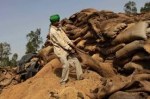
Times of India: “Food Corporation of India FCI has warned that unless the government can distribute 750 lakh tonnes of food grain, there will be no storage space for the bumper harvest being currently procured, the food ministry told Rajya Sabha on Monday.

The crisis of plenty has been engaging the government for a while as it is under pressure to distribute food grain to the poor or intervene in some manner to cool inflation and the FCI alarm provides the clearest indication of the scale of the problem.”

via No storage space for bumper harvest, warns food ministry – The Times of India.

This problem is not new and once again the inability of the Indian government to anticipate and solve a recurring problem makes it hard to believe what some economists say that India will overtake China in economic terms in the latter half of this century.

Related posts: 

07/05/2012

* U.S. agrees to treat West Bengal as partner for investment: Mamata

Trinamool Congress chief Mamata Banerjee atten...

Trinamool Congress chief Mamata Banerjee September 7, 2008. (Photo credit: Wikipedia)

The Hindu: “The U.S. has agreed to treat West Bengal as a partner state for investment in the changed political situation, Chief Minister Mamata Banerjee said in Kolkata on Monday.

“As per partner state, they will invest in West Bengal which was not taking place due to the political situation in the past,” Ms. Banerjee told reporters after a 52-minute meeting with U.S. Secretary of State Hillary Clinton. She also said that the issue of FDI in retail did not come up during the meeting. She said that the areas identified for U.S. investment were IT, software sector, manufacturing, deep sea port, tourism, health care and education. “They will give full support for economic and business development,” Mr. Banerjee said, adding that Chief Secretary Samar Ghosh and U.S. Ambassador Nancy Powell would coordinate and monitor the progress.”

via The Hindu : News / National : U.S. agrees to treat West Bengal as partner for investment: Mamata.

07/05/2012

* Never Mind Europe. Worry About India

Countries of Modern Indian subcontinent

Countries of Modern Indian subcontinent (Photo credit: Wikipedia)

New York Times: ““The economic slowdown in India is one of the world’s biggest economic stories,” even though it has not commanded much attention in the United States, Tyler Cowen writes in The New York Times.

“What is disturbing is that much of the decline in the growth rate is distributed unevenly, with the greatest burden falling on the poor,” he writes. “If the slower rate continues or worsens, many millions of Indians, for another generation, will fail to rise above extreme penury and want. The problems of the euro zone are a pittance by comparison.”

China commands more attention, but Scott B. Sumner, the Bentley College economist, has pointed out it is India that is likely to end up as the world’s largest economy by the next century. China’s population is likely to peak relatively soon while India’s will continue to grow, so under even modestly optimistic projections the Indian economy will be No. 1 in terms of total size. India also is a potential force for energizing the economies of Bangladesh, Nepal and, perhaps someday, Pakistan and Myanmar. The losses from a poorer India go far beyond the country’s borders; furthermore, the wealthier India becomes, the stronger the allure of democracy in the region.”

via Never Mind Europe. Worry About India. – NYTimes.com.

Law of Unintended Consequences

continuously updated blog about China & India

ChiaHou's Book Reviews

continuously updated blog about China & India

What's wrong with the world; and its economy

continuously updated blog about China & India