Chindia Alert: You’ll be Living in their World Very Soon
aims to alert you to the threats and opportunities that China and India present. China and India require serious attention; case of ‘hidden dragon and crouching tiger’.
Without this attention, governments, businesses and, indeed, individuals may find themselves at a great disadvantage sooner rather than later.
The POSTs (front webpages) are mainly 'cuttings' from reliable sources, updated continuously.
The PAGEs (see Tabs, above) attempt to make the information more meaningful by putting some structure to the information we have researched and assembled since 2006.
Mudasir Ahmed Khan alias ‘Mohd Bhai’, the mastermind of the 14 February Pulwama terror attack, was killed in an encounter earlier today in South Kashmir.
Mudasir was a Jaish-e-Mohammed (JeM) terrorist and the one who arranged the vehicle and the explosives for Adil Ahmed Dar, the suicide bomber who attacked a CRPF convoy killing 44 troopers.
He was among three terrorists killed in Tral in south Kashmir’s Pulwama district by security forces an overnight encounter, which began after the terrorists opened fire during a cordon and search operation in Pinglish area.
Police said that among the three terrorists neutralised at Pinglish in Tral, two were locals and one was Pakistani national.
Bodies of all three terrorists are charred beyond recognition and police have sought assistance of their family members for DNA test to establish their identity.
Mobile phone record indicates that Mudasir was in constant touch with Adil after providing the van to him.
Mudasir was a 23-year-old resident of Mir Mohalla of Tral in Pulwama. The son of a labourer, Mudasir was an electrician with a graduate degree.
He joined the JeM sometime in 2017 as an overground worker and was later drawn into the terror outfit by Noor Mohammed Tantrey, alias ‘Noor Trali’, who is believed to have helped the terror group’s revival in the Kashmir Valley.
Mudasir disappeared from his home on 14 January 2018 following the killing of Tantray in December 2017. The same month, his role came under lens in the Lethpora attack on a CRPF camp that left five personnel dead.
Officials believe that Mudasir was also involved in the terror strike at the army camp in Sunjawan in February 2018, in which six personnel and a civilian were killed.
The National Investigation Agency (NIA), which is probing the 14 February terror attack, had carried out searches at Mudasir’s residence on 27 February.
Authorities are also looking for another JeM operative, identified as Sajjad Bhat, a resident of Bijbehara in south Kashmir, who was one who bought the vehicle used in the attack on the CRPF convoy.
Image copyrightGETTY IMAGESImage captionAn Indian man watches the news broadcasting images of the released Indian pilot
As tensions between India and Pakistan escalated following a deadly suicide attack last month, there was another battle being played out on the airwaves. Television stations in both countries were accused of sensationalism and partiality. But how far did they take it? The BBC’s Rajini Vaidyanathan in Delhi and Secunder Kermani in Islamabad take a look.
It was drama that was almost made for television.
The relationship between India and Pakistan – tense at the best of times – came to a head on 26 February when India announced it had launched airstrikes on militant camps in Pakistan’s Balakot region as “retaliation” for a suicide attack that had killed 40 troops in Indian-administered Kashmir almost two weeks earlier.
A day later, on 27 February, Pakistan shot down an Indian jet fighter and captured its pilot.
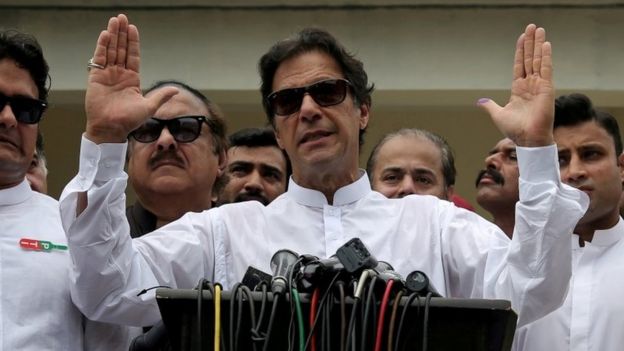
Abhinandan Varthaman was freed as a “peace gesture”, and Pakistan PM Imran Khan warned that neither country could afford a miscalculation, with a nuclear arsenal on each side.
Suddenly people were hooked, India’s TV journalists included.
Image copyrightAFPImage captionIndian PM Narendra Modi is accused of exploiting India-Pakistan hostilities for political gain
So were they more patriots than journalists?
Rajini Vaidyanathan: Indian television networks showed no restraint when it came to their breathless coverage of the story. Rolling news was at fever pitch.
The coverage often fell into jingoism and nationalism, with headlines such as “Pakistan teaches India a lesson”, “Dastardly Pakistan”, and “Stay Calm and Back India” prominently displayed on screens.
Some reporters and commentators called for India to use missiles and strike back. One reporter in south India hosted an entire segment dressed in combat fatigues, holding a toy gun.
And while I was reporting on the return of the Indian pilot at the international border between the two countries in the northern city of Amritsar, I saw a woman getting an Indian flag painted on her cheek. “I’m a journalist too,” she said, as she smiled at me in slight embarrassment.
Print journalist Salil Tripathi wrote a scathing critique of the way reporters in both India and Pakistan covered the events, arguing they had lost all sense of impartiality and perspective. “Not one of the fulminating television-news anchors exhibited the criticality demanded of their profession,” she said.
Media captionIndia and Pakistan’s ‘war-mongering’ media
Secunder Kermani: Shortly after shooting down at least one Indian plane last week, the Pakistani military held a press conference.
As it ended, the journalists there began chanting “Pakistan Zindabad” (Long Live Pakistan). It wasn’t the only example of “journalistic patriotism” during the recent crisis.
Two anchors from private channel 92 News donned military uniforms as they presented the news – though other Pakistani journalists criticised their decision.
But on the whole, while Indian TV presenters angrily demanded military action, journalists in Pakistan were more restrained, with many mocking what they called the “war mongering and hysteria” across the border.
In response to Indian media reports about farmers refusing to export tomatoes to Pakistan anymore for instance, one popular presenter tweeted about a “Tomatical strike” – a reference to Indian claims they carried out a “surgical strike” in 2016 during another period of conflict between the countries.
Media analyst Adnan Rehmat noted that while the Pakistani media did play a “peace monger as opposed to a warmonger” role, in doing so, it was following the lead of Pakistani officials who warned against the risks of escalation, which “served as a cue for the media.”
What were they reporting?
Rajini Vaidyanathan: As TV networks furiously broadcast bulletins from makeshift “war rooms” complete with virtual reality missiles, questions were raised not just about the reporters but what they were reporting.
Indian channels were quick to swallow the government version of events, rather than question or challenge it, said Shailaja Bajpai, media editor at The Print. “The media has stopped asking any kind of legitimate questions, by and large,” she said. “There’s no pretence of objectiveness.”
In recent years in fact, a handful of commentators have complained about the lack of critical questioning in the Indian media.
Image copyrightAFPImage captionIndians celebrated news of the strikes
“For some in the Indian press corps the very thought of challenging the ‘official version’ of events is the equivalent of being anti-national”, said Ms Bajpai. “We know there have been intelligence lapses but nobody is questioning that.”
Senior defence and science reporter Pallava Bagla agreed. “The first casualty in a war is always factual information. Sometimes nationalistic fervour can make facts fade away,” he said.
This critique isn’t unique to India, or even this period in time. During the 2003 Iraq war, western journalists embedded with their country’s militaries were also, on many occasions, simply reporting the official narrative.
Secunder Kermani: In Pakistan, both media and public reacted with scepticism to Indian claims about the damage caused by the airstrikes in Balakot, which India claimed killed a large number of Jaish-e-Mohammad (JeM) militants in a training camp.
Hamid Mir, one of the most influential TV anchors in the country travelled to the area and proclaimed, “We haven’t seen any such (militant) infrastructure… we haven’t seen any bodies, any funerals.”
“Actually,” he paused, “We have found one body… this crow.” The camera panned down to a dead crow, while Mr Mir asked viewers if the crow “looks like a terrorist or not?”
There seems to be no evidence to substantiate Indian claims that a militant training camp was hit, but other journalists working for international outlets, including the BBC, found evidence of a madrassa, linked to JeM, near the site.
Image copyrightPLANET LABS INC./HANDOUT VIA REUTERSImage captionThe satellite image shows a close-up of a madrassa near Balakot in Pakistan’s Khyber Paktunkhwa
A photo of a signpost giving directions to the madrassa even surfaced on social media. It described the madrassa as being “under the supervision of Masood Azhar”. Mr Azhar is the founder of JeM.
The signpost’s existence was confirmed by a BBC reporter and Al Jazeera, though by the time Reuters visited it had apparently been removed. Despite this, the madrassa and its links received little to no coverage in the Pakistani press.
Media analyst Adnan Rehmat told the BBC that “there was no emphasis on investigating independently or thoroughly enough” the status of the madrassa.
In Pakistan, reporting on alleged links between the intelligence services and militant groups is often seen as a “red line”. Journalists fear for their physical safety, whilst editors know their newspapers or TV channels could face severe pressure if they publish anything that could be construed as “anti-state”.
Who did it better: Khan or Modi?
Rajini Vaidyanathan: With a general election due in a few months, PM Narendra Modi continued with his campaign schedule, mentioning the crisis in some of his stump speeches. But he never directly addressed the ongoing tensions through an address to the nation or a press conference.
This was not a surprise. Mr Modi rarely holds news conference or gives interviews to the media. When news of the suicide attack broke, Mr Modi was criticised for continuing with a photo shoot.
Image copyrightAFPImage captionImran Khan was praised for his measured approach
The leader of the main opposition Congress party, Rahul Gandhi, dubbed him a “Prime Time Minister” claiming the PM had carried on filming for three hours. PM Modi has also been accused of managing his military response as a way to court votes.
At a campaign rally in his home state of Gujarat he seemed unflustered by his critics, quipping “they’re busy with strikes on Modi, and Modi is launching strikes on terror.”
Secunder Kermani: Imran Khan won praise even from many of his critics in Pakistan, for his measured approach to the conflict. In two appearances on state TV, and one in parliament, he appeared firm, but also called for dialogue with India.
His stance helped set the comparatively more measured tone for Pakistani media coverage.
Officials in Islamabad, buoyed by Mr Khan’s decision to release the captured Indian pilot, have portrayed themselves as the more responsible side, which made overtures for peace.
On Twitter, a hashtag calling for Mr Khan to be awarded a Nobel Peace Prize was trending for a while. But his lack of specific references to JeM, mean internationally there is likely to be scepticism, at least initially, about his claims that Pakistan will no longer tolerate militant groups targeting India.
NEW DELHI (Reuters) – India’s election commission issued a notice asking political parties not to use images of the country’s armed forces in their campaign posters and other advertising during its upcoming general election.
The notice followed pictures posted to social media recently showing the ruling Bharatiya Janata Party used images in their campaign posters of a captured Indian Air Force pilot recently returned by Pakistan after a clash with India over the disputed Kashmir territory.
The Election Commission said in a notice on its website on Saturday that political parties must refrain from using photographs of defence personnel in advertisements or their election campaign propaganda as the armed forces are “apolitical and neutral stakeholders in a modern democracy.”
The commission cited a 2013 order that said photographs of defence personnel should not be used “in any manner in advertisement/propaganda/campaigning or in any another other manner in connections with elections by political parties and candidates.”
It called for “strict compliance” with the order.
The pilot, Abhinandan Varthaman, was shot down on Feb. 27 by Pakistani aircraft during clashes between the two nuclear-armed powers that began after a terror attack last month in Kashmir that killed 40 Indian paramilitary police.
India blamed Pakistan for the attack and harbouring the militants that claimed responsibility for the attack. Pakistan denies the charges.
India later attacked a site inside Pakistan it claimed was a militant training camp. That triggered aerial clashes that led to Varthaman’s capture. Pakistan released him last week as a peace gesture.
Indian Prime Minister Narendra Modi hailed his release and claimed the clashes with Pakistan were an Indian victory. Nationalistic passions in India have risen since the terror attack.
Recent social media posts showed a campaign poster on a billboard in Indian capital of New Delhi with Varthaman’s face alongside Modi’s, along with the words: “If Modi is in power, it is possible! NaMo again 2019!” NaMo is an acronym for Modi.
Later on Sunday, the Election Commission is due to announce the polling schedule for the upcoming general election, which will be the world’s biggest democratic exercise.
Prime Minister Narendra Modi on Sunday praised the Central Industrial Security Force (CISF) for playing a major role in ensuring the security of the country’s national assets.
SNS Web | New Delhi | March 10, 2019 2:18 pm
Prime Minister Narendra Modi on Sunday praised the Central Industrial Security Force (CISF) for playing a major role in ensuring the security of the country’s national assets.
At the 50th Raising Day ceremony of the central armed police force, the PM pointed at the threat from Pakistan.
“Enough is enough,” he said, while referring to the terror attacks in Pulwama and Uri, adding, “We cannot keep suffering till eternity.”
The PM said that protecting nation is a challenging thing because of the hostile neighbour.
“Your achievement is important because when neighbour is hostile, incapable to fight war, conspiracies to hit the nation internally find a safe haven there, and terrorism shows its face in different forms then protecting the nation becomes challenging,” said the PM.
He acknowledged that providing security to establishments where lakhs of people come daily is a task that is incomparable to any.
“The task of providing security to an establishment where over 30 lakh people come daily and every face is different is far more than security to a VIP,” he said at the golden jubilee ceremony in Indirapuram in Uttar Pradesh’s Ghaziabad.
The PM added that there was a need to spread awareness among the public regarding the security aspect.
“There is a need to educate the citizens because if they do not cooperate then the task of CISF becomes even more difficult,” he said.
Recalling the services of the CISF in the rescue efforts following the Kerala floods, the PM said that the force has given an invaluable contribution in tackling natural calamities and humanitarian crises in India and abroad.
“Your contribution in natural calamities is praiseworthy. You saved the lives of thousands in the recent Kerala floods,” he said, adding, “CISF has also played its role whenever humanity has come under threat in the world.”
Before addressing the CISF personnel, the PM laid a wreath at the Martyr’s Memorial.
He also reviewed the parade of the CISF and presented the Police and Fire Service Medals for distinguished and meritorious services.
The event was attended by Minister of State for External Affairs VK Singh, Ministers of State for Home Affairs Kiren Rijiju and Hansraj Gangaram Ahir.
Raised in 1969, the CISF has currently over 1.5 lakh personnel who provide security to vital installations of the country, including 61 airports, seaports, Delhi Metro and various state-owned industries.
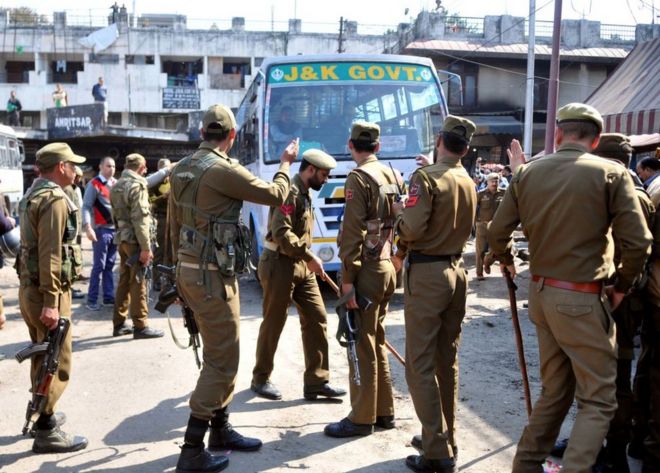
Image copyrightGETTY IMAGESImage captionThe blast occurred at a busy bus station in Jammu city
Indian police have arrested an alleged member of the Hizbul Mujahideen militant group after a grenade attack killed at least two people and injured more than 30 others.
The attack took place on Thursday in a bus station in the Indian-administered state of Jammu and Kashmir.
Last month a suicide attack against security forces triggered cross-border air strikes between India and Pakistan.
Hizbul Mujahideen has said it was not behind Thursday’s attack.
But police told BBC Urdu that the accused, Yasir Javed Bhat, had confessed. He is a Kashmiri and reported to be in his 20s.
“He revealed that he was tasked with throwing the grenade by Farooq Ahmed Bhat, a district commander of Hizbul Mujahideen in Kulgam district,” inspector general Manish Kumar Sinha said.
Mr Sinha added that they were gathering more intelligence on Yasir.
Hizbul Mujahideen was formed in 1989 when an armed insurgency against Indian rule first broke out in the valley. It was the largest Kashmiri militant group through the 1990s and is considered to be pro-Pakistani.
India has blamed Pakistan for supporting militancy in the region – a charge Islamabad denies.
Image copyrightREUTERSImage captionPakistan PM Imran Khan said Pakistan was not behind the suicide attack in February
This has long been a source of tension between the nuclear-armed neighbours as groups based in Pakistan have carried out deadly attacks on Indian soil. The suicide attack last month killed more than 40 central reserve policemen in Indian-administered Kashmir.
Tensions between the two sides escalated quickly. India carried out air strikes against what it said was a militant camp based in Pakistan and the latter retaliated with air raids of its own.
An Indian fighter jet was shot down in Pakistan-administered Kashmir and the pilot was captured. Two days later, Pakistan handed over the pilot to Indian officials establishing a fragile truce.
NEW DELHI (Reuters) – India said on Saturday Pakistan had “plenty to hide” by preventing journalists from accessing the site of an air strike by Indian fighter jets inside Pakistan.
Citing “security concerns”, Pakistani security officials on Thursday barred a Reuters team from climbing a hill in northeastern Pakistan to the site of a madrasa, or religious school, and a group of surrounding buildings that was targeted by Indian warplanes last week.
“The fact that Pakistan has now refused access to journalists from visiting the site means that they have plenty to hide,” Indian foreign ministry spokesman Raveesh Kumar told reporters.
He reiterated the government’s stand that India’s air strikes were “successful and achieved the desired objectives”, after being asked about a Reuters report that said high-resolution satellite images reviewed by Reuters showed that the madrasa appeared to be still standing.
NEW DELHI (Reuters) – Indian cricketers wore army camouflage-style caps in a match with Australia on Friday in solidarity with Indian paramilitary police killed in a militant attack by a Pakistan-based group and in an unusually strong display of patriotic fervour in sport.
The suicide bombing last month killed 40 in Indian-controlled Kashmir, a region also claimed by Pakistan. The attack prompted India to launch an air strike inside Pakistan, which responded with an aerial attack the next day.
The Board of Control for Cricket in India (BCCI) has in recent days tried unsuccessfully to isolate Pakistan in the cricketing world. The International Cricket Council rejected India’s calls to boycott games against Pakistan, whose prime minister is former cricketing hero Imran Khan.
But there are still calls within India for the national team to pull out of a World Cup match against Pakistan in June in England.
The idea to sport the olive-and-black caps bearing the BCCI’s logo came from former Indian cricket captain and current player Mahendra Singh Dhoni, one of the game’s biggest stars and an honorary lieutenant colonel with the Indian army.
“It’s a special cap,” Indian captain Virat Kohli said before the third in a five-match one-day series with Australia. “This is to pay respect to the martyrs … and their families.”
He said all the players would donate their fees from the match to a national defence fund to help out the families of defence personnel who die on duty. Kohli also urged all Indians to contribute to the fund.
The BCCI posted a clip on Twitter of commentators for the match also wearing the caps, signing off the tweet with “#JaiHind”, or “Hail India”.
The board has scrapped the opening ceremony for the Indian Premier League Twenty20 tournament, which begins on March 23, and will donate the money saved to the families of those who died in the bomb attack.
Cricket historian Boria Majumdar said he could not remember seeing any Indian cricket team in the past making such a gesture, which he called a “peaceful political stand”.
“(Indian cricket) teams have expressed solidarity in the past but not this kind of public display of that solidarity,” Majumdar told Reuters.
“Sport has always been meshed with politics and people have often used it to make very strong points. This is yet another one. This is a peaceful way of expressing solidarity in a manner which I don’t see problematic at all.”
But Pakistani lawyer Abdullah Nizamani said on Twitter the BCCI and international cricket board should keep “sports away from petty politics”. Some Pakistanis even asked on social media if Indian cricketers would turn up for the World Cup match with Pakistan in military fatigues.
Nuclear-armed neighbours India and Pakistan have fought two of their three wars since independence over Kashmir, which both sides claim in full but rule in part.
The plane was on a routine training sortie and hence was unarmed.(Mint/ Representative Image)
A MiG-21 fighter jet of the Indian Air Force crashed in Rajasthan’s Bikaner on Friday. The plane crashed after it reportedly suffered a bird hit.
The plane had taken off from Nal near Bikaner. The pilot is said to have ejected safely.
Bikaner SP Pradeep Mohan Sharma said the MIG aircraft crashed in Shobhasar ki Dhani, 12 km from Bikaner city, news agency PTI reported.
Sharma said police teams have rushed the spot to cordon off the area. No loss of life has been reported.
A statement by the IAF said that the MiG-21 had taken off from the Indian Air Force’s Nal airbase in Rajasthan and that it was on a routine mission.
The IAF statement said, “Today afternoon a MiG-21 aircraft on a routine mission crashed after getting airborne from Nal near Bikaner. Initial inputs indicate the likely cause as bird hit after take off. Pilot of the aircraft ejected safely. A CoI [Court of Inquiry] will investigate the cause of the accident.”
In recent times, the IAF has witnessed a series of crashes involving fighter jets and choppers.
On February 1, a Mirage 2000 fighter jet had crashed during a routine testing flight. Both the pilots in the jet had died after their safety equipment gave way. The pilots were on an “acceptance sortie” of the Mirage 2000 trainer aircraft after it was overhauled by the Bengaluru-based Hindustan Aeronautics Limited (HAL).
Barely a fortnight later, two Surya Kiran Hawks were involved in a collision that led to the death of one pilot. The crash had taken place barely days before the 12 edition of Aero India.
On February 12, a MiG-27 fighter jet had crashed at the Pokhran firing range after taking off from the Jaisalmer air base. The jet was on a training mission. The pilot managed to eject safely from the jet before it crashed.
More recently, on February 27, a Mi17 helicopter of the Indian Air Force had crashed at Budgam in Kashmir. All six IAF personnel on board the chopper were killed. A civilian was also killed in the crash.
The MiG-21 fighter jet has been in the news recently after Wing Commander Abhinandan Varthaman, who was flying a similar aircraft shot down a Pakistani F-16 before crashing in Pakistan.
The MiG-21 is a supersonic jet fighter and interceptor aircraft, designed by the Mikoyan-Gurevich Design Bureau in the erstwhile Soviet Union.
Prime Minister Narendra Modi on Friday condemned in strong words the attack on a group of Kashmiri merchants in Lucknow by a group of right-wing men, assuring that those behind the attack will be dealt with sternly by the Uttar Pradesh government.
SNS Web | New Delhi | March 8, 2019 4:48 p
Prime Minister Narendra Modi on Friday condemned in strong words the attack on a group of Kashmiri merchants in Lucknow by a group of right-wing men, assuring that those behind the attack will be dealt with sternly by the Uttar Pradesh government.
Addressing a rally in Kanpur, located 80 kilometres from Lucknow, the PM said, “Desh mein ekta ka vatavaran banaye rakhna bahut ahem hai. Lucknow mein kuch sirphire logo ne hamare Kashmiri bhaiyon ke sath jo harkatein ki thi uss par UP sarkar ne turanth karwayi ki (There is an environment of unity across the country. (But) Some crazy people in Lucknow attacked our Kashmiri brothers. The UP government has taken prompt action on them),” he said.
“I will also urge other state governments to take strict action whenever wherever they try to do such an act,” PM Modi added.
On 6 March, two Kashmiri street vendors were attacked by a group of men from a fringe right-wing group on a busy road in the Uttar Pradesh capital.
In a video shot by one of the accused, the men clad in saffron shirts were seen with sticks in their hands and thrashing the vendors. The men were heard saying that they were assaulting the vendors because they were from Kashmir. The vendors were rescued after several locals intervened.
As the video of the incident went viral on social media, the BJP and the state government came in for severe criticism from across the political spectrum.
The police arrested a man identified as Bajrang Sonkar. An FIR has been registered against unidentified men.
Union Home Minister Rajnath Singh, too, condemned the incident and requested chief ministers of all the states to protect and love Kashmiri students.
“I want to convey a message to the entire country. I heard of a few incidents against Kashmiri children. Kashmiris are, were and will remain our people,” Rajnath Singh said.
Earlier on February 20, two Kashmiri shawl vendors claimed they were beaten up and called “stone pelters” by unidentified men on a train, forcing them to cut short their business trip to Rohtak.
The incidents come amid reports of some Kashmiri people claiming they were being targeted in many parts of the country in the aftermath of the February 14 terror attack on a CRPF convoy in Pulwama that left over 44 personnel dead.
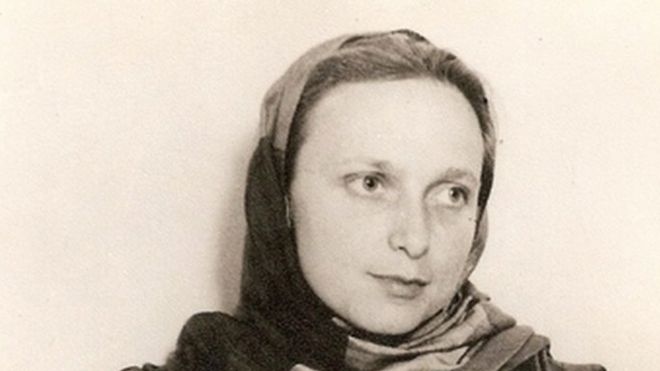
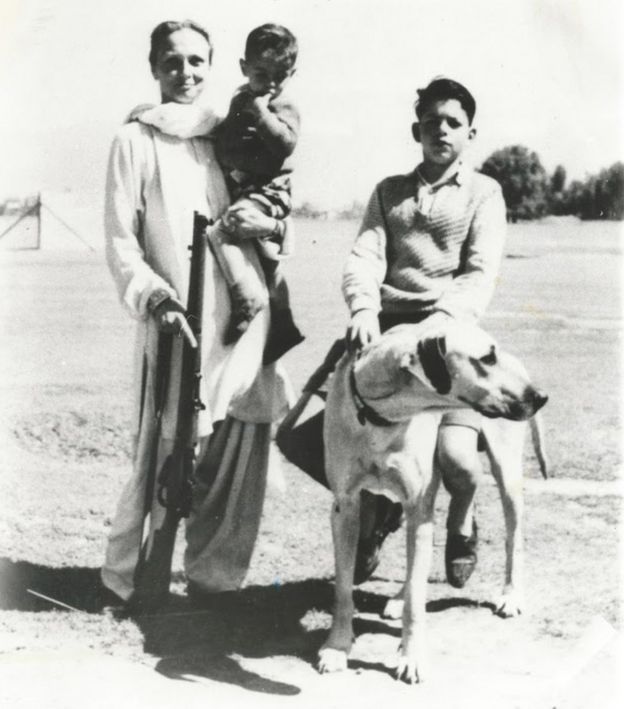
Freda Bedi lived an unusual life. Born in a small town in England, she moved to India for love and ended up joining the independence movement. Her biographer, Andrew Whitehead, writes about her remarkable story.
“There are things deeper than labels and colour and prejudice, and love is one of them.”
These were the words of Freda Bedi, an English woman who overcame prejudice to marry an Indian Sikh and went on to challenge Indian notions about the role of a woman and a wife.
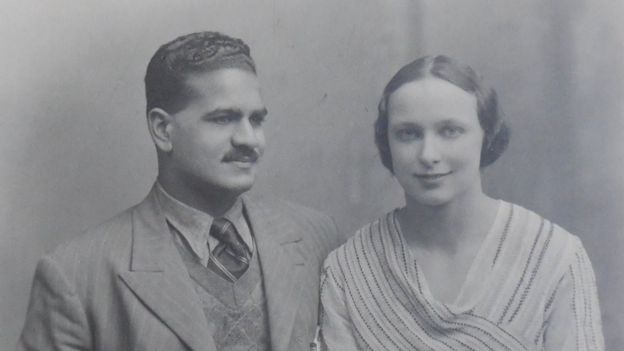
Freda and her boyfriend, Baba Pyare Lal Bedi (his friends called him BPL), met at Oxford where both were students.
This was the early 1930s and romances across the racial divide were rare – almost as rare as a girl from Freda’s background securing a spot at a top university. She was born, quite literally, above the shop in the city of Derby in England’s East Midlands, where her father ran a jewellery and watch repair business.
Freda could barely remember her father. He enlisted during the First World War and served in the Machine Gun Corps, where casualties were so high it was known as the “suicide club”. He died in northern France when his daughter was just seven years old. “This death shadowed my whole childhood,” she recalled – it shaped her political loyalties and prompted her lifelong spiritual quest.
Her years at Oxford were “the opening of the gates of the world”, as Freda once put it. She was part of “the Depression generation” – those who were students at a time of global crisis, mass unemployment and the rise of fascism.
She made firm friends at her college with young women who were rebellious by nature, and went with them to meetings of the Labour Club and the communist October Club.
Image captionFreda and BPL met as students at Oxford University
Driven by curiosity and by sympathy with those struggling against the Empire, she also went along to the weekly meetings of the Oxford Majlis, where radicals among the university’s small number of Indian students asserted their country’s case for nationhood. BPL Bedi, a handsome and cheerful Punjabi, was a regular there. A friendship developed into intellectual collaboration and, within months, Freda and BPL were a couple.
In the early 1930s, women’s colleges at Oxford were obsessed with sex or rather with preventing it. If a male student came to have tea in a female student’s room, a chaperone had to be present, the door left wide open and the bed had to be taken into the corridor. Freda’s college did its best to derail her relationship – she was disciplined for visiting BPL without a chaperone in what she was convinced was a case of racial discrimination.
But she was fortunate in her student friends. Barbara Castle, who later became a commanding British woman politician of her era, was thrilled when Freda confided that she intended to marry her boyfriend. “Well, thank goodness”, Barbara exclaimed. “Now at least you won’t become a suburban housewife!” Freda’s mother didn’t see things that way though. Her family were sternly disapproving, until BPL made a visit to Derby and managed to charm them.
Freda commented that the engagement caused “a minor sensation” in Oxford. That was an understatement. She believed she was the first Oxford woman undergraduate to marry an Indian fellow student. Some didn’t hide their disapproval. The registrar who conducted the marriage ceremony pointedly refused to shake hands with the couple.
From the moment she married, Freda regarded herself as Indian and often wore Indian-style clothes. A year later, husband and wife and their four-month old baby, Ranga, set off by boat from Trieste, Italy, on the two-week journey to the western Indian city of Bombay (now Mumbai). “The nightmare was to get milk for myself to drink because I was feeding the baby”, Freda recalled. “And I remember the millions of cockroaches that used to come out at night in the ship’s kitchens – I used to go in and attempt to get milk.”
The couple had already been marked out by the British authorities as revolutionaries and potential trouble makers because of their student activism. When they disembarked in Bombay, their bags and cases were inspected for seven hours to check for left-wing propaganda. “Even Ranga’s little napkin was taken off and searched,” recalled Freda, “because they thought I might be carrying messages in it”.
The key test of Freda’s marriage was still to come – the first meeting with her Indian mother-in-law, a widow and matriarch known in the family as Bhabooji. From Bombay, the Bedis travelled non-stop for a couple of days to reach the small Punjabi city of Kapurthala, arriving at the family home close to midnight. Freda was wearing a white cotton sari – “not the ideal travelling dress, and nursing Ranga had not improved it”.
BPL bowed to touch his mother’s feet in the traditional expression of respect. “I copied him, feeling a little awkward,” Freda said, “but all my shyness disappeared when she smiled at us both with tears in her eyes, and embraced us and the child as if she could not hold us close enough.”
Although Freda was determined to fit in with her Indian extended family, her lifestyle was anything but conventional. BPL’s political stand extended to rejecting any share in his family’s wealth. They made their home in Lahore, one of the largest cities in Punjab, in a cluster of thatched huts without power or running water, keeping hens and a buffalo. It can’t have been the sort of life Freda had expected – nor would she have been used to the idea of sharing the household with her mother-in-law.
“Nowhere had I seen a white woman trying to be a typical Indian daughter-in-law”, commented Som Anand, a frequent visitor to the Bedis’ huts. “It surprised me to see Mrs Bedi coming to Bhabooji’s hut in the morning to touch her feet. In household matters she respected the old mother’s inhibitions. Her mother-in-law was an equally large hearted person; despite all her conservatism she had accepted a Christian into the family without a murmur.”
Image captionFreda and BPL moved to Kashmir after 1947 and remained politically active
When World War Two broke out, both BPL and Freda were outraged that India was being dragged into supporting the British war effort. BPL was detained in a desert prison camp to stop him sabotaging military recruitment in Punjab. Freda decided to make her own stand against her motherland.
She volunteered as a satyagrahi, a seeker of truth, and was among those chosen by Indian independence leader Mahatma Gandhi to defy emergency wartime powers. She travelled to her husband’s home village of Dera Baba Nanak and announced that she would “break the law by asking the people not to support the military effort until India became democratic”. The authorities didn’t know how to respond to a white woman staging such a protest – they hurriedly sent an English police inspector to the village, deeming it inappropriate for an Indian policeman to arrest an Englishwoman.
Freda was brought before a visiting magistrate that same morning – she has left her own account of the trial:
It was finished in 15 minutes. The man on the other side of the table was quite young still, and looked as though he had been to Oxford. His face was red.
“I find this as unpleasant as you do,” he murmured.
“Don’t worry. I don’t find it unpleasant at all.”
“Do you want the privileges granted to an Englishwoman?”
“Treat me as an Indian woman and I shall be quite content.”
She was sentenced to six months in jail, which was fairly standard, and also to hard labour, which she regarded as vindictive.
That turned out to be no more onerous than supervising the prison gardens, where women imprisoned for criminal rather than political offences – many were locked up for killing their abusive husbands – did most of the work.
“It was my destiny to go to India,” Freda asserted. It was her destiny too to make history as an English woman who went willingly to jail in support of India’s demand for freedom.
The Bedis’ political prominence persisted after independence, when they moved to Kashmir – Freda joined a left-wing women’s militia and worked with the radical nationalists who gained power there. In the 1950s, her life changed utterly when, during a UN assignment in Burma, she encountered Buddhism for the first time and became an enthusiastic convert.
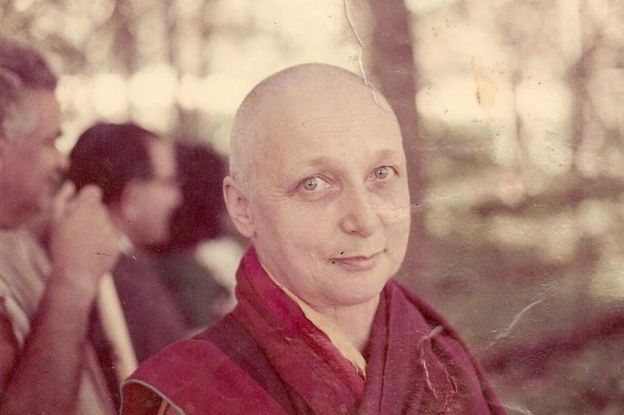
Image captionFreda became a Buddhist nun in the 1950s
When thousands of Tibetans fled across the Himalayas in 1959 to escape Chinese oppression, Freda devoted herself to helping these “brave and wonderful” refugees. She became steeped in Tibetan spirituality. And once she felt that she had fulfilled her role as a mother (the film star Kabir Bedi is one of her three surviving children), she broke convention again by taking vows as a Tibetan Buddhist nun. In her sixties, she travelled relentlessly to spread the word about Buddhist teachings but never returned to live in the West.
“India is my womanhood and my wife-hood,” she once declared. “I too am ‘dust that England bore, shaped and made aware’. Yet I am living in an Indian way, with Indian clothes, with an Indian husband and child on Indian soil, and I cannot feel even the least barrier or difference in essentials between myself and the new country I have adopted.”
Throughout her life, Freda was determined not to be constrained by barriers of race, religion, nation or gender. She delighted in challenging convention and confounding expectations – that is what makes her story so beguiling.





 CHINDIA ALERT: You'll be living in their world, very soon
India and Pakistan: How the war was fought in TV studios
As tensions between India and Pakistan escalated following a deadly suicide attack last month, there was another battle being played out on the airwaves. Television stations in both countries were accused of sensationalism and partiality. But how far did they take it? The BBC’s Rajini Vaidyanathan in Delhi and Secunder Kermani in Islamabad take a look.
It was drama that was almost made for television.
The relationship between India and Pakistan – tense at the best of times – came to a head on 26 February when India announced it had launched airstrikes on militant camps in Pakistan’s Balakot region as “retaliation” for a suicide attack that had killed 40 troops in Indian-administered Kashmir almost two weeks earlier.
A day later, on 27 February, Pakistan shot down an Indian jet fighter and captured its pilot.
Abhinandan Varthaman was freed as a “peace gesture”, and Pakistan PM Imran Khan warned that neither country could afford a miscalculation, with a nuclear arsenal on each side.
Suddenly people were hooked, India’s TV journalists included.
So were they more patriots than journalists?
Rajini Vaidyanathan: Indian television networks showed no restraint when it came to their breathless coverage of the story. Rolling news was at fever pitch.
The coverage often fell into jingoism and nationalism, with headlines such as “Pakistan teaches India a lesson”, “Dastardly Pakistan”, and “Stay Calm and Back India” prominently displayed on screens.
Some reporters and commentators called for India to use missiles and strike back. One reporter in south India hosted an entire segment dressed in combat fatigues, holding a toy gun.
And while I was reporting on the return of the Indian pilot at the international border between the two countries in the northern city of Amritsar, I saw a woman getting an Indian flag painted on her cheek. “I’m a journalist too,” she said, as she smiled at me in slight embarrassment.
Print journalist Salil Tripathi wrote a scathing critique of the way reporters in both India and Pakistan covered the events, arguing they had lost all sense of impartiality and perspective. “Not one of the fulminating television-news anchors exhibited the criticality demanded of their profession,” she said.
Secunder Kermani: Shortly after shooting down at least one Indian plane last week, the Pakistani military held a press conference.
As it ended, the journalists there began chanting “Pakistan Zindabad” (Long Live Pakistan). It wasn’t the only example of “journalistic patriotism” during the recent crisis.
Two anchors from private channel 92 News donned military uniforms as they presented the news – though other Pakistani journalists criticised their decision.
But on the whole, while Indian TV presenters angrily demanded military action, journalists in Pakistan were more restrained, with many mocking what they called the “war mongering and hysteria” across the border.
In response to Indian media reports about farmers refusing to export tomatoes to Pakistan anymore for instance, one popular presenter tweeted about a “Tomatical strike” – a reference to Indian claims they carried out a “surgical strike” in 2016 during another period of conflict between the countries.
Media analyst Adnan Rehmat noted that while the Pakistani media did play a “peace monger as opposed to a warmonger” role, in doing so, it was following the lead of Pakistani officials who warned against the risks of escalation, which “served as a cue for the media.”
What were they reporting?
Rajini Vaidyanathan: As TV networks furiously broadcast bulletins from makeshift “war rooms” complete with virtual reality missiles, questions were raised not just about the reporters but what they were reporting.
Indian channels were quick to swallow the government version of events, rather than question or challenge it, said Shailaja Bajpai, media editor at The Print. “The media has stopped asking any kind of legitimate questions, by and large,” she said. “There’s no pretence of objectiveness.”
In recent years in fact, a handful of commentators have complained about the lack of critical questioning in the Indian media.
“For some in the Indian press corps the very thought of challenging the ‘official version’ of events is the equivalent of being anti-national”, said Ms Bajpai. “We know there have been intelligence lapses but nobody is questioning that.”
Senior defence and science reporter Pallava Bagla agreed. “The first casualty in a war is always factual information. Sometimes nationalistic fervour can make facts fade away,” he said.
This critique isn’t unique to India, or even this period in time. During the 2003 Iraq war, western journalists embedded with their country’s militaries were also, on many occasions, simply reporting the official narrative.
Secunder Kermani: In Pakistan, both media and public reacted with scepticism to Indian claims about the damage caused by the airstrikes in Balakot, which India claimed killed a large number of Jaish-e-Mohammad (JeM) militants in a training camp.
Hamid Mir, one of the most influential TV anchors in the country travelled to the area and proclaimed, “We haven’t seen any such (militant) infrastructure… we haven’t seen any bodies, any funerals.”
“Actually,” he paused, “We have found one body… this crow.” The camera panned down to a dead crow, while Mr Mir asked viewers if the crow “looks like a terrorist or not?”
There seems to be no evidence to substantiate Indian claims that a militant training camp was hit, but other journalists working for international outlets, including the BBC, found evidence of a madrassa, linked to JeM, near the site.
A photo of a signpost giving directions to the madrassa even surfaced on social media. It described the madrassa as being “under the supervision of Masood Azhar”. Mr Azhar is the founder of JeM.
The signpost’s existence was confirmed by a BBC reporter and Al Jazeera, though by the time Reuters visited it had apparently been removed. Despite this, the madrassa and its links received little to no coverage in the Pakistani press.
Media analyst Adnan Rehmat told the BBC that “there was no emphasis on investigating independently or thoroughly enough” the status of the madrassa.
In Pakistan, reporting on alleged links between the intelligence services and militant groups is often seen as a “red line”. Journalists fear for their physical safety, whilst editors know their newspapers or TV channels could face severe pressure if they publish anything that could be construed as “anti-state”.
Who did it better: Khan or Modi?
Rajini Vaidyanathan: With a general election due in a few months, PM Narendra Modi continued with his campaign schedule, mentioning the crisis in some of his stump speeches. But he never directly addressed the ongoing tensions through an address to the nation or a press conference.
This was not a surprise. Mr Modi rarely holds news conference or gives interviews to the media. When news of the suicide attack broke, Mr Modi was criticised for continuing with a photo shoot.
The leader of the main opposition Congress party, Rahul Gandhi, dubbed him a “Prime Time Minister” claiming the PM had carried on filming for three hours. PM Modi has also been accused of managing his military response as a way to court votes.
At a campaign rally in his home state of Gujarat he seemed unflustered by his critics, quipping “they’re busy with strikes on Modi, and Modi is launching strikes on terror.”
Secunder Kermani: Imran Khan won praise even from many of his critics in Pakistan, for his measured approach to the conflict. In two appearances on state TV, and one in parliament, he appeared firm, but also called for dialogue with India.
His stance helped set the comparatively more measured tone for Pakistani media coverage.
Officials in Islamabad, buoyed by Mr Khan’s decision to release the captured Indian pilot, have portrayed themselves as the more responsible side, which made overtures for peace.
On Twitter, a hashtag calling for Mr Khan to be awarded a Nobel Peace Prize was trending for a while. But his lack of specific references to JeM, mean internationally there is likely to be scepticism, at least initially, about his claims that Pakistan will no longer tolerate militant groups targeting India.
Source: The BBC
Posted in Adnan Rehmat, airstrikes, airwaves, Al Jazeera, Balakot, BBC, BBC reporter, campaign schedule, casualty, combat fatigues, commentators, congress party, critical questioning, Dastardly Pakistan, Delhi, escalation, factual information, fought, general election, Hamid Mir, hashtag, Imran Khan, India alert, Indian jet fighter, international border, Islamabad, Islamist militant groups, Jaish-e-Mohammad (JeM), JeM, jingoism and nationalism, Journalist, Kashmir, madrassa, Masood Azhar, Media analyst, media editor, militant camps, militants, missiles, nationalistic fervour, Nobel Peace Prize, Pakistan, Pakistani, Pakistani military, Pallava Bagla, pilot, PM Narendra Modi, press, press conference, Prime Time Minister, rahul gandhi, Rajini Vaidyanathan, red line, retaliation, Reuters, Salil Tripathi, Secunder Kermani, Senior defence and science reporter, sensationalism and partiality, Shailaja Bajpai, signpost's, suicide attack, Surgical strike, The Print, Tomatical strike, toy gun, training camp, TV anchors, TV journalists, TV studios, Twitter, Uncategorized, war, war mongering and hysteria, warmonger, Wg Cdr Abhinandan Varthaman | Leave a Comment »