Archive for ‘India alert’

07/02/2019

India man to sue parents for giving birth to him

Mr Samuel says he remembers first having anti-natalist thoughts when he was five.

“I was a normal kid. One day I was very frustrated and I didn’t want to go to school but my parents kept asking me to go. So I asked them: ‘Why did you have me?’ And my dad had no answer. I think if he’d been able to answer, maybe I wouldn’t have thought this way.”

As the idea grew and took shape in his mind, he decided to tell his parents about it. He says his mum reacted “very well” and dad too “is warming up” to the idea.

Image from Nihilanand Facebook page saying you owe your parents nothingImage copyrightNIHILANAND

“Mum said she wished she had met me before I was born and that if she did, she definitely wouldn’t have had me,” he says laughing and adds that she does see reason in his argument.

“She told me that she was quite young when she had me and that she didn’t know she had another option. But that’s what I’m trying to say – everyone has the option.”

In her statement, his mother also said it was unfair to focus on a “sliver of what he believes in”.

“His belief in anti-natalism, his concern for the burden on Earth’s resources due to needless life, his sensitivity toward the pain experienced unwittingly by children while growing up and so much more has been ruefully forgotten.

“I’m very happy that my son has grown up into a fearless, independent-thinking young man. He is sure to find his path to happiness.”

Mr Samuel says his decision to take his parents to court is only based on his belief that the world would be a much better place without human beings in it.

So six months ago, one day at breakfast, he told his mother that he was planning to sue her. “She said that’s fine, but don’t expect me to go easy on you. I will destroy you in court.” Mr Samuel is now looking for a lawyer to take up his case, but so far he’s not had much success.

“I know it’s going to be thrown out because no judge would hear it. But I do want to file a case because I want to make a point.”

His Facebook posts have also attracted a lot of responses, “some positive, but mostly negative” with some even advising him to “go kill yourself”. He has also had worried mums asking him what would happen if their children see his posts.

“Some argue logically, some are offended and some are offensive. To those abusing me, let them abuse me. But I also hear from many who say they support me but can’t say this publicly for whatever reasons. I ask them to come out and speak up,” he says.

His critics also say that he’s doing this to get some publicity.

“I’m not really doing this for publicity,” he says, “but I do want the idea to go public. This simple idea that it’s okay to not have a child.”

I ask him if he is unhappy being born.

“I wish I was not born. But it’s not that I’m unhappy in my life. My life is good, but I’d rather not be here. You know it’s like there’s a nice room, but I don’t want to be in that room,” he explains.

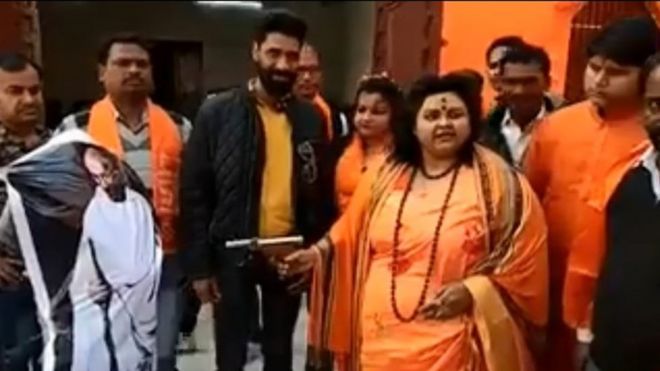
Source: The BBCPooja Pandey, leader of the Hindu Mahasabha, shooting at an effigy of Gandhi with an air pistol

07/02/2019

As good as gold for some brides in India as election nears

NEW DELHI (Reuters) – An India state will give gold worth about $530 to every bride from a poor family, the latest budget giveaway ahead of a general election that must be held by May.

The northeastern state of Assam is run by Prime Minister Narendra Modi’s Hindu nationalist Bharatiya Janata Party (BJP), which is facing a battle for re-election because of low farm incomes and a lack of jobs that have turned off some of those who backed it in the last polls, in 2014.

The federal government announced cash handouts to farmers and tax cuts for the lower middle class last week.

On Thursday, the Reserve Bank of India (RBI) cut interest rates for the first time since 2017, in line with a government demand as it attempts to stimulate the economy.

The opposition Congress party has also been forgiving farmers’ loans and announcing it would provide the unemployed with cash handouts in some of the states it controls.

But handing out gold to brides is new.

The tea-growing state’s finance minister, Himanta Biswa Sarma, allocated 3 billion rupees ($42 million) for the next fiscal year, from April 1, for the gold programme.

That would buy 875 kg of gold, enough for about 80,000 brides.

“A customary ritual which has been part of Assamese society for centuries is to gift a set of gold ornaments to one’s daughter as a blessing as she leaves her father’s home to start a new life,” Sarma said in his budget speech on Wednesday.

He said the programme should stop families falling into debt to pay for daughters’ weddings.

“I feel that it’s my solemn responsibility to stand with those fathers who cannot afford to gift a set of gold ornaments,” he said.

The Assam government would buy the gold from the RBI and give it to the beneficiaries directly, Sarma told Reuters on Thursday.

The programme would be limited to two women from each family with an income of less than 500,000 rupees (£5,422) a year. Each bride would get a “tola”, or 11.66 grams, of gold.

Indian brides traditionally get gold, which helps make the country the world’s second-biggest buyer of the metal after China. The World Gold Council expects India to consume 750-850 tonnes of gold this year.

The Assam government hasn’t stopped at gold.

Sarma said the state would also give electric bikes to girls who score at least 60 percent in school-leaving exams, for getting to places of higher studies.

He rejected opposition accusations he was making “fake promises” to win votes.

Political parties and candidates find different ways to give presents to voters.

In the past, gifts have included electric fans, laptops, pressure cookers and televisions.

Under the election law, the gift-giving has to stop once an election date is set.

Source: Reuters

06/02/2019

Hindu right-winger arrested for re-enacting Gandhi assassination

Pooja Pandey, leader of the Hindu Mahasabha, shooting at an effigy of Gandhi with an air pistolImage copyrightSCREENGRAB
Image captionPooja Pandey, leader of the Hindu Mahasabha, shooting an effigy of Gandhi with an air pistol

A leader of a fringe Hindu right-wing group in India has been arrested after a video of her shooting an effigy of Mahatma Gandhi went viral.

The Hindu Mahasabha had organised an event to “celebrate” the 71st anniversary of Gandhi’s assassination.

In the video, Pooja Pandey shoots the effigy with an air pistol after garlanding a picture of Nathuram Godse, who shot the independence leader.

Gandhi has long been seen as too moderate by some right-wing Hindus.

Police had been seeking Ms Pandey’s arrest since the video, believed to have been released by her group, emerged last week.

Two police teams were deployed to track her and her husband, who also features prominently in the footage.

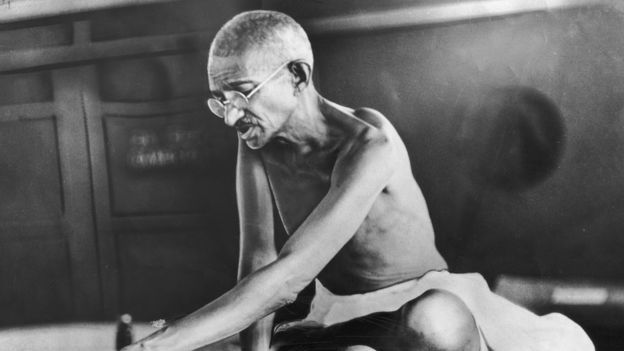
Circa 1935: Indian spiritual and political leader Mahatma Gandhi (1869 - 1948)Image copyrightGETTY IMAGES
Image captionNathuram Godse shot Mahatma Gandhi on 30 January 1948

They had already made several other arrests in connection with the video which was shot on 30 January – the day Gandhi was killed.

“We arrested nine people within a week and are searching for two more suspects in the case,” police officer Neeraj Jadaun told the BBC.

Godse, who shot Gandhi in the chest three times at point-blank range on 30 January 1948, was an activist with nationalist right-wing groups, including the Hindu Mahasabha.

Hindu hardliners in India accuse Gandhi of having betrayed Hindus by being too pro-Muslim, and even for the division of India and the bloodshed that marked Partition, which saw India and Pakistan created after independence from Britain in 1947.

This is not the first time the controversial fringe group has tried to glorify Godse and celebrate Gandhi’s assassination.

In 2015, the group announced plans to install statues of Godse across six districts in the southern state of Karnataka, sparking protests across the state.

Source: The BBC

06/02/2019

Stray cows add to Modi’s farmer woes as Indian election looms

KAKRIPUR/MAHABAN, India (Reuters) – As night fell on the bucolic northern Indian hamlet of Mahaban, Gopi Chand Yadav gathered blankets and a flashlight to spend the night sitting on a wooden platform in his field. His task: to use bamboo sticks to ward off stray cattle from intruding and eating a maturing mustard crop.

Like Yadav, many thousands of farmers stay awake to guard their farms over a cold winter or face losing their crops to the cattle – a double whammy for growers already reeling from a plunge in Indian crop prices.

While stray cows ambling around towns and villages have always been a feature of life in rural India, farmers say their number has increased sharply in recent years to the extent that they have become a menace, and blame the policies of Prime Minister Narendra Modi’s Hindu nationalist government.

Protecting cows – considered sacred to Hindus – was one of the measures meant to shore up support in the heavily populated, Hindi-speaking belt across northern India that has been a heartland of the ruling Bharatiya Janata Party’s (BJP). Instead, it is creating a backlash, even among Hindu farmers.

“We already had enough problems and now the government has created one more,” said octogenarian farmer Baburao Saini from Kakripur village, about 85 kilometres (50 miles) from New Delhi. “For the first time, we’ve been forced to stay in the fields to protect our crops.”

More than 50 farmers Reuters spoke to in Mahaban and nine other villages in Uttar Pradesh state said they would think twice before voting for Modi’s BJP in the next general election, due by May. The cattle issue and low farm prices are major reasons behind their disillusionment with a party that most say they voted for in the last election in 2014.

Modi swept Uttar Pradesh at that poll, winning 73 of 80 seats in India’s most populous state, with rural voters swayed by a promise of higher crop prices, and as Hindu farmers supported the BJP amid tensions with the minority Muslim community.

COW PROTECTION

Modi is trying hard to claw back support among India’s 263 million farmers and their many millions of dependents after the BJP lost power in December to the opposition Congress in three big northern states where agriculture is a mainstay.

Indian farmers keep cows to produce milk, cheese and butter, but to harm or kill a cow, especially for food, is considered taboo by most Hindus.

Most states in India have long outlawed cow slaughter, but after coming to power in 2014 the BJP ratcheted up its distaste for trade in cattle, launching a crackdown on unlicensed abattoirs in Uttar Pradesh and on cattle smuggling nationwide.

At the same time, a wave of attacks on trucks carrying cattle by Hindu vigilante groups has scared away traders, most of whom are Muslims, bringing to a halt the trade even in bullocks, which are not considered sacred. Rising sales of tractors and increasing mechanisation mean that more animals are redundant for use in farming.

The farmers Reuters spoke to said they revered cows as most devout Hindus would, but a sudden halt in the trade of cattle had hit the rural economy. In their view, the government should come up with more cow shelters and let cattle traders deal in other animals without fear of attack.

“The government has only enforced the laws by closing down unlicensed abattoirs and cracking down on cattle smuggling,” said BJP spokesman Gopal Krishna Agarwal, who added that he runs a cow shelter of 1,300 cattle. “We’re not trying to hurt either any community or the rural economy.”

CROP TRAMPLED

Fodder prices have gone up by more than a third in the past year and most farmers cannot afford to keep cows after they stop producing milk, said farmer Rajesh Pahalwan as he smoked a hookah pipe in the village of Manoharpur. Six farmers sitting with him mainly nodded in agreement.

In India, the world’s biggest milk producer, about 3 million cattle become unproductive every year. In the past, Hindu farmers would sell unproductive cows to Muslim traders and about 2 million of these would end up smuggled to Bangladesh for meat and leather. But that trade has now been throttled by the government crackdown, trade and industry officials say.

That has led to many unproductive cattle being abandoned, farmers said, but governments – both state and federal – have failed to construct new shelters, leaving rising numbers of stray cattle that are feeding on crops, or even garbage.

“The government clearly did not think of alternatives before putting these curbs in place,” said farmer Deepak Chaudhary, who grows wheat on the outskirts of Mathura, considered to be the birthplace of the Hindu God Krishna. “As Hindus, we treat cows as sacred but these unwarranted measures have upended the economics of farming.”

The government did provide some relief in its interim budget last week as it announced a cow welfare programme costing 7.50 billion rupees (80.79 million pounds) in the year beginning April.

But there are hardly any “adequate measures to rehabilitate” cattle, said Fauzan Alvi, vice-president of the All India Meat and Livestock Exporters Association.

“Forget about cows, we cannot sell even a single animal to even our relatives thanks to cow vigilante groups which are aided and abetted by the BJP,” said the wheat farmer Chaudhary.

Modi has in the past condemned violence by cow vigilantes, but critics and opposition politicians say some of the right-wing Hindu groups involved have links to his party, a charge the BJP denies.

Nearly 85 percent of India’s farmers own less than 2 hectares (5 acres) of land, so even a relatively small area damaged has a big impact on their livelihood.

Only two weeks ago, some cattle ravaged an acre of wheat grown by farmer Chandra Pal in the Mathura district of Uttar Pradesh.

“My investment went down the drain after some stray cattle trampled and ate up the crop,” he said.

Many farmers in Uttar Pradesh are now using barbed wire to stop animals from entering their farms, but that is expensive.

“We have been at the receiving end of anti-farmer policies of the government and the problem of stray cattle is just another blow to us,” said farmer Amar Chand, from Maholi village who voted for Modi in 2014. “Unlike the previous general election, farmers are not solidly behind Modi, who’s on shaky ground this time round.”

Source: Reuters

06/02/2019

Robert Vadra reaches Enforcement Directorate office for questioning, wife Priyanka drops him off

This is the first time Robert Vadra is appearing before any probe central agency in connection with allegations of dubious financial dealings and comes days after Priyanka Gandhi was formally inducted into the Congress party.

INDIA Updated: Feb 06, 2019 16:31 IST

HT Correspondent
HT Correspondent
Hindustan Times, New Delhi
Robert vadra,Priyanka Gandhi vadra,Rahul Gandhi
Robert Vadra was dropped off at the ED office by his wife Priyanka Gandhi Vadra. (HT PHOTO/Burhaan Kinu)

Robert Vadra, brother-in-law of Congress president Rahul Gandhi, reached the Enforcement Directorate office in Delhi on Thursday after the agency summoned him in a money laundering case. Robert Vadra was dropped off at the office by his wife and Priyanka Gandhi Vadra.

This is the first time Robert Vadra is appearing before any probe central agency in connection with allegations of dubious financial dealings and comes days after Priyanka Gandhi was formally inducted into the Congress party. She has been tasked with reviving the party in eastern Uttar Pradesh.

Robert Vadra arrived at the ED’s office located in central Delhi’s Jamnagar House at 3.45 pm. He has been told to cooperate with the ED investigation by a Delhi court that he had approached for anticipatory bail.

The case relates to allegations of money laundering in the purchase of a London-based property at 12, Bryanston Square. Robert Vadra has denied the allegations on several occasions in the past, called termed them a political witch hunt and accused the BJP-led national coalition of attempting to distract attention from its failures.

Read more:‘Tomorrow it can be PM Modi’: Congress leader on ED summons to Robert Vadra

The Enforcement Directorate had told the court that it has received information about various new properties in London which belongs to Vadra, including two houses of five and four million each, six other flats and more properties.

The ED had carried out raids in this case in December last year and questioned Robert Vadra’s aide Manoj Arora, an employee of a firm linked to Vadra, Skylight Hospitality LLP.

Vadra has also been directed by the Rajasthan High Court to appear before the ED on February 12 in connection with another money laundering case being probed by the agency.

Read more: Priyanka Gandhi gets room next to brother Rahul Gandhi at Congress headquarters

First Published: Feb 06, 2019 16:00 IST

Source: Hindustan Times

06/02/2019

Respect Sabarimala verdict, want SC order allowing women of all ages to stay: Dewasom Board

A five-judge Constitution Bench headed by the then Chief Justice Misra had on September 28 last year junked the age-old tradition of the Lord Ayyappa temple by a majority verdict of 4:1.

SNS Web | New Delhi | 

In a complete turnaround from its earlier stand that women aged between 10 and 50 should not be allowed inside the Sabarimala temple, the Travancore Dewasom Board, on Tuesday opposed the review and told the Supreme Court that it wants the verdict allowing women of all ages to stay.

“Everyone is entitled to enter the temple. Any practice has to be dominant with the view of equality,” the board said adding “We have to move and transform the society to include women in all walks of life”.

“We have taken a decision to respect the judgement,” the board added.

It is an essential part of the Hindu religion to allow women to enter the temple, the temple board said.

Following the temple board’s U-turn in the matter, Justice Justice Indu Malhotra said, “There is a complete change of stand by the Travancore Dewasom Board”.

Justice Indu Malhotra had presented a dissenting opinion on the Supreme Court’s September verdict saying, “the court should not interfere in matters of faith”.

Advocate Indira Jaising arguing for women rights said that “purification ceremony being held affirms that menstruating women are considered polluted”.

“Social boycott going on against the women who entered the temple,” she added.

She further asserted that women should be allowed to enter the temple which is set to open on February 12.

The apex court has reserved its verdict on the matter.

Several organisations including the Nair Service Society and the Thantri of the Sabarimala temple had earlier in the day advanced arguments before the bench and sought reconsideration of the verdict.

Senior advocate K Parasaran appearing for the Nair Service Society told the court that “the exclusionary practice in Sabarimala is based on the character of the deity”.

The petitioners also argued that “Sabarimala custom cannot be equated to untouchability. It is only a religious custom”.

Abhishek Manu Singhvi appearing for ex-Chairman of the Devaswom Board argued before the court that “untouchability will not be applicable as it is not a caste or religion-based exclusion. There is no exclusion of men and women, but only exclusion for a class of women.”

The Supreme Court, in its September judgement, had said the practice is akin to untouchability.

Read | Supreme Court scraps Sabarimala temple ban on entry of women

Senior Advocate Nafade argued that “religion was a matter of faith and only community can decide the custom, not the court”.

“As long as the community decides not to change the practice, the Supreme Court cannot intervene,” he said.

The Chief Justice also allowed 90 minutes to those supporting the Supreme Court verdict.

Jaideep Gupta, arguing for the Kerala state said that there was no need to review the verdict.

Opposing the review, the government said there was also a consensus of judges on three issues – First, that Sabarimala is not a denominational temple, second, that a person’s right to worship in a temple is taken away for a major part of her life, and third, that the rule violated the act governing the temples itself.

The government further submitted that only if it is a denominational temple, the question of essential practice arises.

“Jagannath temple is unique in its practice and yet this court has held it’s not a denominational temple… similarly Kashi Vishwanath and Tirupati have been said not to be denominational,” it said.

The 65 petitions including 56 review petitions and four fresh writ petitions are being heard by a Constitution bench comprising Chief Justice Ranjan Gogoi and Justices RF Nariman, AM Khanwilkar, DY Chandrachud and Indu Malhotra.

The petitions were earlier scheduled to be heard on January 22 but were postponed since Justice Indu Malhotra went on medical leave.

On November 13, in a rare instance, the Supreme Court decided to go for open court hearing of the petitions seeking a recall of its order permitting women of all age groups to pray at the Sabarimala temple.

Read | SC agrees to reconsider Sabarimala temple verdict in open court on Jan 22

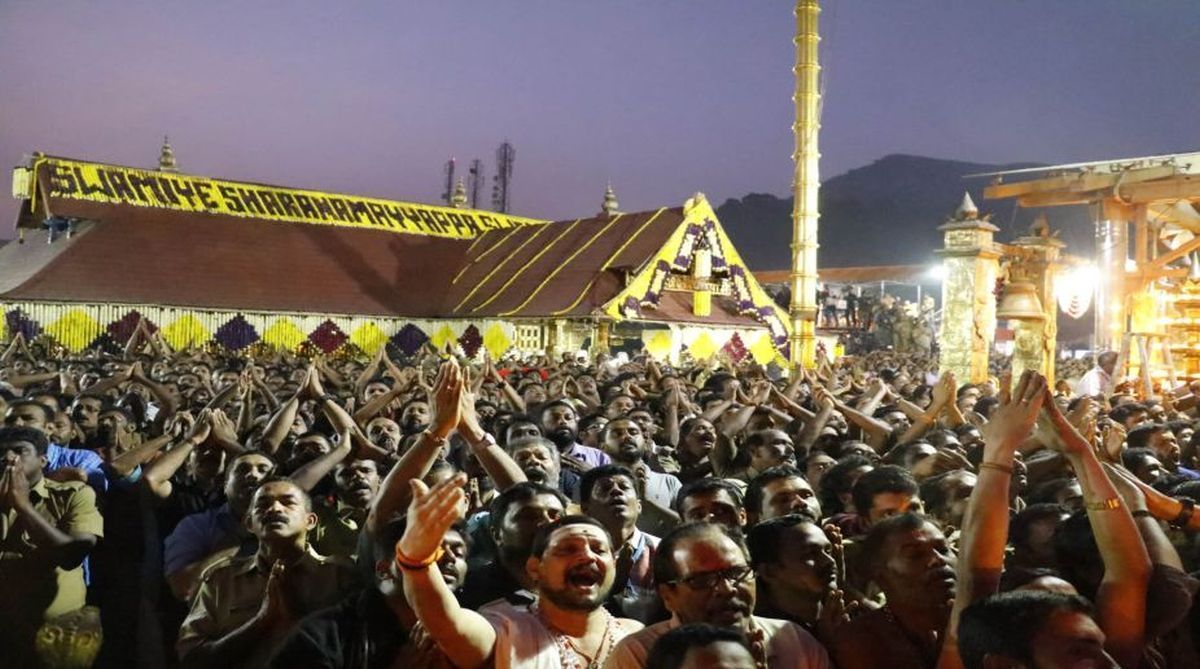
The Lord Ayyappa temple has since then witnessed massive protests by various devotee groups and Hindu outfits against the Pinarayi Vijayan government’s decision to implement the apex court order without going for any review petition.

Only two women — Bindu and Kanakadurga — managed to enter the temple in the wee hours of January 2 with tight police security.

Though many attempts were made by some young women, to enter the temple of the ‘Naishtik Brahmachari’, the eternally celibate deity, the devotees backed by priests stood their ground, saying they would not allow the tradition to be breached.

The temple remains open only for 127 days in a year.

A five-judge Constitution Bench headed by the then Chief Justice Misra had on September 28 last year junked the age-old tradition of the Lord Ayyappa temple by a majority verdict of 4:1.

“Right to worship is given to all devotees and there can be no discrimination on the basis of gender,” former chief justice Dipak Misra had observed.

Source: The Statesman
05/02/2019

Why ‘India’s FBI’ agents are clashing with police

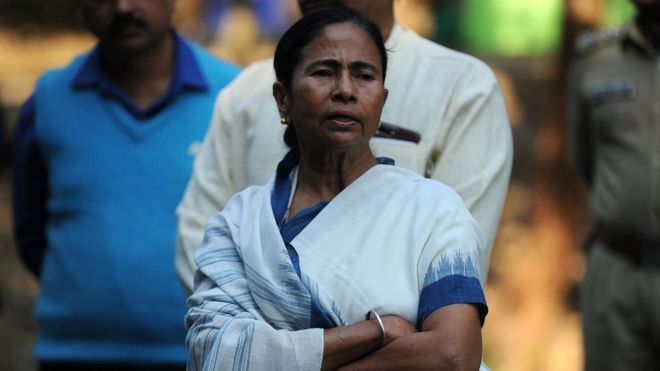
Mamata BanerjeeImage copyrightGETTY IMAGES
Image captionMamata Banerjee is a rare firebrand woman leader who commands mass support

Imagine state policemen in the US detaining FBI agents investigating a case on state territory.

Then imagine the governor of the state starting a public protest against the FBI and the president for carrying out what she calls an act of vendetta against her government.

Now imagine federal forces being deployed to protect their offices in the state, fearing attacks by supporters of the governor.

This possibly sounds like a plot from a dystopian political novel. But it is what is happening in India.

A group of detectives belonging to India’s federal investigation agency, the CBI, arrived at the well-secured home of the commissioner of police of Kolkata (formerly known as Calcutta) in West Bengal state on Sunday evening. They said they wanted to question Rajeev Kumar in connection with a ponzi scandal. (The multi-million dollar scam, involving businessmen, politicians, journalists and film producers, defrauded a large number of small investors.)

But Mr Kumar refused to meet the detectives. Instead his forces detained the agents – who are recruited from the police forces themselves – and took them away to a police station. They were freed after a few hours, and returned without being able to question Mr Kumar.

Mr Kumar had led the early local investigation into the scandal, before the case was taken over by the CBI under the supervision of the Supreme Court. The federal agency, say reports, unsuccessfully tried to question Mr Kumar half-a-dozen times in the past in connection with some evidence he had purportedly collected in the case. The agency believes that he is “hiding” something.

The ponzi scandal, involving at least two small investment companies, came to light in 2013 under the watch of the leader of West Bengal state. In India’s male-dominated politics, Mamata Banerjee is a rare firebrand woman leader who commands mass support. She took power in 2011, ending 34 years of communist rule in the state. (The following year, she was named one of Time magazine’s 100 most influential people in the world.) The feisty Ms Banerjee has ruled West Bengal ever since.

Central Bureau of InvestigationImage copyrightAFP
Image captionThe Central Bureau of Investigation is India’s top investigation agency

Ms Banerjee has a testy relationship with the federal government, run by Prime Minister Narendra Modi’s Bharatiya Janata Party (BJP). This is, in part, because Mr Modi’s party is trying to make inroads into Bengal, using its usual mix of development promises and sectarian rhetoric.

Source: The BBC

05/02/2019

UK approves tycoon Mallya’s extradition to India

(Reuters) – The British government has signed an order to extradite Indian liquor and aviation tycoon Vijay Mallya, the UK’s Home Office said in a statement on Monday.

The order follows a London court’s ruling in December that Mallya, who moved to Britain in March 2016, be extradited to India to face fraud charges.

“After the decision was handed down on December 10, 2018 by the Westminster Magistrates Court, I stated my intention to appeal. I could not initiate the appeal process before a decision by the Home Secretary. Now I will initiate the appeal process,” Mallya tweeted late on Monday.

A court set up under the country’s anti-money laundering laws last month declared Mallya a “fugitive economic offender”, paving the way for the Indian government to seize his assets, according to Reuters partner ANI.

Mallya, the co-owner of the Formula One motor racing team Force India which went into administration in July, has denied any wrongdoing and says the case against him is politically motivated.

Prime Minister Narendra Modi’s government had cleared “one more step to get Mallya extradited,” Finance Minister Arun Jaitley wrote on Twitter.

“While we welcome the UK Government’s decision in the matter, we await the early completion of the legal process for his extradition,” a government source said on Monday.

The Times of India reported news of the UK government’s order to extradite Mallya earlier on Monday.

Source: Reuters

05/02/2019

Supreme Court pans Centre on Assam’s citizen register, says trying to destroy process

The Supreme Court’s observation came on the home ministry’s plea for withdrawal of 167 companies of combined armed forces for two weeks from Assam as they will be deployed for elections.

New Delhi, HT Correspondent

Villagers gather to check their documents at a NRC help centre for people whose names were not featured in the final draft in Kamrup district of Assam.(AFP)

The Supreme Court on Tuesday pulled up the Centre over the National Register of Citizens (NRC) in Assam saying that the Union home ministry comes up with different stories to destroy the process.

The top court’s observation came on the home ministry’s plea for withdrawal of 167 companies of combined armed forces for two weeks from Assam as they will be deployed for elections. Rejecting the plea, a bench headed by Chief Justice Ranjan Gogoi said the Centre is not cooperating and it seems the entire effort of the home ministry is to destroy the NRC process.

The government sought the suspension of the NRC exercise to which the court said “it is too much to ask for both.” The Supreme Court bench said elections and NRC can go on simultaneously. The court told the government that if it wanted the citizen register process to go on there were “1001 ways to do so”.

The SC asked the Election Commission to consider exempting certain state officers from election duty to ensure that the NRC process is not hampered

Over 4 million of the 32.9 million in Assam were left out of the NRC draft, released on July 30 last year. The Centre and the Assam government insisted that register is still a draft and that there is adequate recourse available to those not included.

The Supreme Court had extended the last date to file claims and objections on inclusion of names in the draft NRC from December 15 to December 31, 2018.

The Supreme Court had initially given the Assam government a deadline of December 15 to register the remaining people. The court had also allowed those left out of the draft NRC to use five more documents to prove their citizenship and be included in the final NRC. This, the state government, had claimed was putting additional burden on authorities to make the process of inclusion fool-proof.

The NRC, which was first prepared for Assam in 1951, is being updated at the insistence of the Supreme Court, although it has been a longstanding demand of most political organisations in the state. The register is aimed at distinguishing the state’s citizens from illegal immigrants, mostly from Bangladesh. The first draft of the updated NRC, released on December 3, 2017 listed 19 million people.

Source: Hindustan Times

05/02/2019

Denied permission to land chopper, Yogi Adityanath heads to Bengal rally site by road

Earlier in the day, West Bengal Chief Minister Mamata Banerjee lashed out at Yogi Adityanath asking him to take care of Uttar Pradesh first.

SNS Web | New Delhi | 

Amid simmering tensions between the BJP and the Trinamool Congress with the West Bengal government denying permission to Yogi Adityanath’s chopper to land in the state, the Uttar Pradesh Chief Minister touched down in Jharkhand’s Bokaro on Tuesday and is headed to West Bengal’s Purulia by road to address a public rally there.

No permission has been granted to Yogi’s rally with the paperwork still not in order. However, the BJP is confident of conducting the event.

Earlier in the day, West Bengal Chief Minister Mamata Banerjee lashed out at the BJP poster boy asking him to take care of Uttar Pradesh first.

Referring to the rising number of fake encounters and cop killings in Uttar Pradesh, Mamata said, “So many people have been killed, even police were murdered, so many people were lynched; he himself will lose if he contests elections. He doesn’t have a place to stand in UP, that’s why he is roaming around in Bengal”.

Earlier on Sunday, Yogi’s chopper was not allowed to land in the state to let him address two scheduled rallies.

Adityanath addressed the rallies there telephonically and lashed out at the “anti-people” Trinamool Congress (TMC) government in the state, saying the days of Chief Minister Mamata Banerjee’s rule are “numbered”.

The UP chief minister and state BJP president Dilip Ghosh were scheduled to address “Ganatantra Bacaho Rallies” at Balurghat in South Dinajpur district and Raiganj in North Dinajpur district.

Though the BJP had been allowed to organise the rallies, the district administration denied permission for Adityanath’s chopper to land at both the places, party leaders said.

Following the denial of permission to land his chopper, Adityanath decided not to attend either of the rallies and instead addressed them telephonically.

Addressing both the rallies through an audio link, the Uttar Pradesh chief minister said, “The TMC government didn’t allow me to come and meet you all. That is why I had to resort to the Digital India of Modi Ji to address you.”

Lashing out at the Mamata Banerjee government, the UP chief minister said, “This TMC government is anti-people and anti-democratic and has compromised with the national security.”

Alleging that the Banerjee government had tried to stop Durga Puja in West Bengal to pursue its appeasement policy, Adityanath urged BJP workers to fight vigorously and ensure that the party forms the next government in the state.

The BJP has complained to the Election Commission that the Mamata Banerjee government, instead of following democratic processes, was setting hurdles for every programme of the party in the state.

Earlier, permission was denied for BJP chief Amit Shah’s chopper landing in Malda.

Source: The Statesman
Law of Unintended Consequences

continuously updated blog about China & India

ChiaHou's Book Reviews

continuously updated blog about China & India

What's wrong with the world; and its economy

continuously updated blog about China & India