Archive for ‘India alert’

01/02/2019

2019 Budget Summary: Middle class gets tax relief, farmers get cash support in election budget

2019 Budget Summary: Finance minister Piyush Goyal announced relief in income tax and proposed a Rs 75,000-crore fund for assured income of around 12 crore farmers.

BUDGET Updated: Feb 01, 2019 16:40 IST

HT Correspondent
HT Correspondent
Hindustan Times, New Delhi
Budget 2019,Piyush Goyal,Income Tax
Finance Minister Piyush Goyal during his budget speech in the Lok Sabha on Friday.(Photo: Twitter/@ANI)

Finance Minister Piyush Goyal rolled out the government’s last budget ahead of this year’s national elections, announcing no tax on income up to Rs 5 lakh, a Rs 75,000 crore assured income scheme for small farmers and a mega pension scheme for workers in the unorganised sector. The initiatives are designed to woo the middle class, address farm distress and boost private investment in an effort to shore up the political base of ruling BJP-led national coalition that has been accused by the opposition of not delivering on its promises to the poor.

“India is solidly back on track and marching towards growth and prosperity,” Piyush Goyal said early in his budget speech, asserting that the government had succeeded in “we have broken the back of back-breaking inflation”.

He said the Narendra Modi government’s success in controlling inflation had put more money in the hands of people. “Inflation is a hidden and unfair tax, from 10.1 per cent during 2009-14,” he said.

Goyal announced exemption from tax on income of up to Rs 5 lakh per annum, which goes up to Rs 6.5 lakh if the individual tax payers invest Rs 1.5 lakh in provident fund and prescribed equities. He also proposed to increase the standard deduction from the existing Rs 40,000 to Rs 50,000. The proposal will benefit 3 crore middle class tax payers.

The TDS (tax deduction at source) threshold on interest from bank, post office deposits has been raised from Rs 10,000 to Rs 40,000. The finance minister further proposed to increase the TDS threshold on rental income from Rs 1.8 lakh to Rs 2.4 lakh.

The BJP-led ruling National Democratic Alliance (NDA) is facing discontent over depressed farm incomes and doubts over whether his policies are creating enough jobs. The interim budget allocates Rs 600 billion for a rural jobs programme and Rs 190 billion for building of roads in the rural areas.

Goyal said Rs 6,000 per year assured income support will be given to small and marginal farmers having less than two hectares of land. He announced a new fund, ‘Pradhan Mantri Kisan Samman Nidhi’ for disbursement of cash to “vulnerable farmers”.

Around 12 crore farmers will receive Rs 6,000 per annum under the PM Kisan scheme. The money will be transferred into bank accounts of farmers in three equal instalments. The finance minister said Rs 20,000 crore have been provided for current fiscal, 2018-19 under PM Kisan scheme.

The government proposed to set up a national commission, the Rashtriya Kamdhenu Aayog with the initial capital of Rs 500 crore for the welfare of cows. “Happy to announce setting up of Rashtriya Kamdhenu Aayog. Government will never step back from protection of the Gau Mata,” said Goyal.

The government unveiled a mega pension scheme for the unorganised sector workers with an aim to benefit 10 crore people. Goyal said the beneficiaries will get assured monthly pension of Rs 3,000 after reaching the age of 60 years.

“We are launching Pradhan Mantri Shram Yogi Mandhan today. The scheme will provide assured monthly pension of Rs 3,000, with contribution of 100 rupees per month, for workers in unorganised sector after 60 years of age,” Goyal said.

The fiscal deficit would be 3.4 per cent of gross domestic product (GDP), slightly higher than the targeted 3.3 percent, said Goyal, who presented the budget as Union minister Arun Jaitley is undergoing medical treatment in the United States.

Goyal told the Lok Sabha that direct tax collections increased from Rs 6.38 lakh crore in year 2013-14 to almost Rs 12 lakh crore this year with a growth of 80 per cent in tax base. The number of income tax returns filed increased from 3.79 crore to 6.85 crore over the same period, he said.

On job creation, the finance minister said, “EPFO shows two crore accounts in two years. This shows formalisation of the economy. When there is such a high growth, jobs are created.” The government is facing sharp criticism from the opposition over a ‘leaked report’ claiming that unemployment rate is at a 45-year high.

The interim budget is likely to be followed by a full one in July after the Lok Sabha elections. The interim budget projected the economic growth for the fiscal year 2019-20 to be around 7.5 per cent.

Source: Hindustan Times
01/02/2019

Interim Budget 2019: Income tax limit raised, no tax for people earning up to Rs 5 lakh per annum

Under the existing tax rates, individuals earning up to Rs 2.5 lakh are not required to pay any taxes whereas those earning between Rs 2.5 lakh to Rs 5 lakh are taxed at 10 per cent.

SNS Web | New Delhi | 

With an eye on the upcoming Lok Sabha elections, the Union government in its Interim Budget 2019-20 announced a full rebate for individuals with annual income up to Rs 5 lakh in a move that will benefit an estimated 3 crore tax-paying citizens.

In an announcement that will have an impact on the livelihoods of millions of Indians who fall in the lower middle-class bracket, Union Finance Minister Piyush Goyal said, “Individual tax payers having taxable annual income up to Rs 5 lakhs will get full tax rebate.”

“And therefore,” Goyal continued, “[they] will not be required to pay any tax.”

Under the existing tax rates, individuals earning up to Rs 2.5 lakh are not required to pay any taxes whereas those earning between Rs 2.5 lakh to Rs 5 lakh are taxed at 10 per cent.

The decision was welcomed by loud chants of “Modi-Modi” from the ruling party section in the lower house of Parliament as well as alliance MPs who sounded their approval with a 3-minute long thumping of the desks. Prime Minister Narendra Modi, too, joined the chorus.

In a Budget which was, expectedly, heavy on the populist side, Goyal said that both tax collection and tax base have shown significant increase in the last 4.5 years due to the major reforms undertaken by the government.

“We have made progress towards achieving a moderate taxation high compliance regime,” he said, adding, “Some benefits from tax reforms should go to middle class tax payers.”

Goyal further announced that even those having gross income of up to Rs 6.5 lakh may not be required to pay any income tax “if they make investments in provident funds, specified savings, insurance, etc.”

“With additional deductions persons having even higher incomes will not have to pay any tax,” he said.

“This will provide tax benefit of Rs 18,500 crore rupees to an estimated three crore middle class tax payers comprising self-employed, small business, small traders, salary earners, pensioners and senior citizens,” Goyal said amid continued cheers from the ruling party lawmakers.

“For salaried persons, standard deduction is being raised from current Rs 40,000 to Rs 50,000,” Goyal announced.

“I propose to exempt levy of income tax on notional rent on a second self-occupied house,” he said, adding that this move will benefit those who have to maintain families at two locations on account of their jobs, children’s education and care of parents.

Goyal also raised the TDS threshold on interest earned on bank and post office deposits from Rs 10,000 to Rs 40,000 to benefit the unemployed women and pensioners who keep money in banks.

The TDS threshold on deduction of tax on rent was also increased from Rs 1.8 lakh to Rs 2.4 lakh.

The benefit of rollover of capital gains under section 54 of Income Tax Act, Goyal announced, will be increased from investment in 1 residential house to 2 residential houses for a taxpayer having capital gains up to Rs 2 crores.

Before making the announcements, Goyal said that convention dictates that the main tax proposals are presented in regular Budget but “small tax payers need certainty in their minds and therefore proposals for such class of persons should not wait”.

He said that the existing tax rates will continue for FY 19-20.

Goyal also thanked taxpayers for their contribution to nation building and for providing better quality of life for the marginalised communities by paying taxes which fund the various schemes of the government.

Source: The Statesman
31/01/2019

India job data spells trouble for Narendra Modi

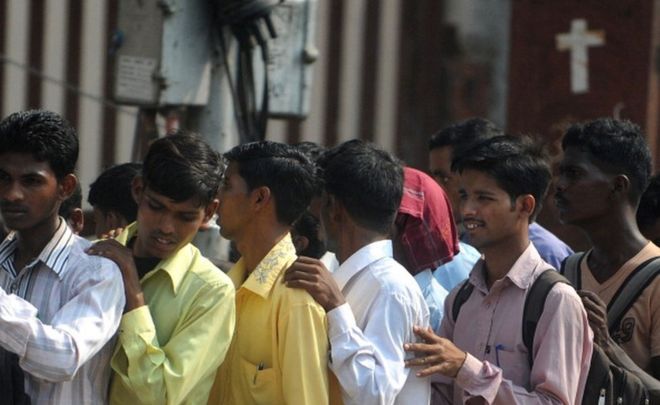
Indian youth queue at a jobs fair in Mumbai on October 12, 2011.Image copyrightGETTY IMAGES
Image captionOne out of every five young people is out of work

India’s unemployment rate is the highest it has been since the 1970s, according to a government jobs report.

Economist Vivek Kaul explains what this means and why it matters to Prime Minister Narendra Modi’s government, which is accused of withholding the findings months before the general election.

What does the report say?

It says that India has a jobs problem.

The country’s unemployment rate – 6.1% – is the highest it has been since 1972-73, the earliest year for which comparable data is available. This is according to the latest employment survey, which was exclusively accessed by The Business Standard newspaper, after the government had allegedly refused to release it.

On its own, an unemployment rate of 6.1% may not sound too dire, until you consider that in 2011-12, it was just 2.2%. And it’s particularly high among people between 15 and 29 years – in urban India, 18.7% of men and 27.2% of women in this age group are looking for jobs, while in rural India, its 17.4% and 13.6% respectively.

How significance is it?

Over the years, the story of India’s economic growth has been sold on the basis of its massive and young workforce – people under the age of 35 make up 65% of the population. The idea was that 10 to 12 million young people would enter the workforce every year. As they start earning and spending, growth would accelerate and this would pull millions more out of poverty.

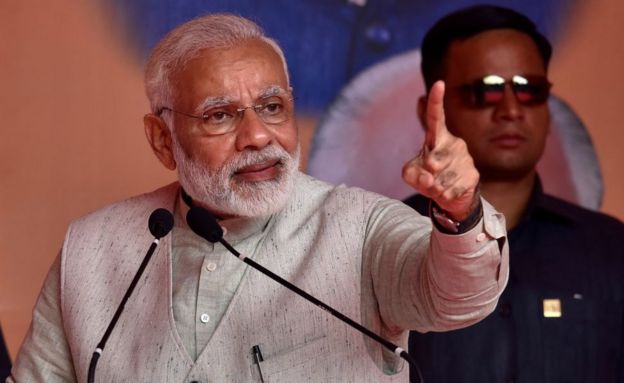
Prime Minister Narendra Modi addressing BJP party workers during a public meeting on October 29, 2017 in Bengaluru.Image copyrightGETTY IMAGES
Image captionMany see the upcoming election as a referendum on Mr Modi

But, as the survey shows, the unemployment rate among young people is very high. Nearly one in every five is unable to find a job. India’s so-called demographic dividend is nowhere in sight.

This timing of this finding – just months ahead of a general election – makes it all the more significant. The report was approved by India’s national statistics commission. Two of its members resigned earlier this week, citing the government’s alleged refusal to release the report as one of the reasons.

Job creation was a key promise during Mr Modi’s election campaign in 2013.

In early January, the Centre for Monitoring Indian Economy, a private institution, had raised the alarm, saying the number of unemployed people has been rising steadily and had reached 11 million by the end of December 2018.

Who is to blame – the government or the economy?

It is a little bit of both.

The Indian economy and the bureaucratic machinery that supports it do not encourage entrepreneurship and job creation – there is a lot of red tape and crucial reforms are still pending. One cannot lay all the blame on Mr Modi, who has been in power for just five years. The problem is older and deeper.

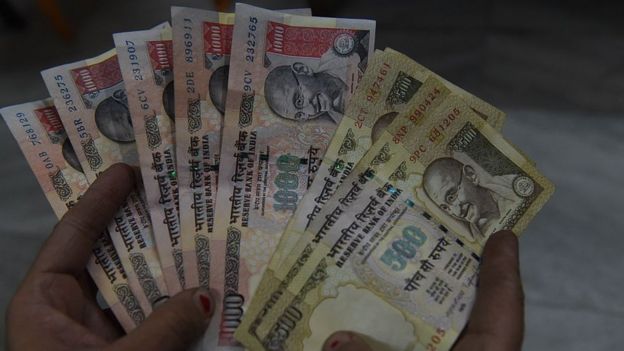
An Indian resident holds 500 and 1000 rupee notes.Image copyrightGETTY IMAGES
Image captionThe surprise cancellation of 500 and 1000 rupee notes hurt the economy

But Mr Modi had promised “minimum government and maximum governance”, which translates to efficiency and growth and failed to deliver on this. His government also did two things that badly hurt the economy.

In 2016, his government cancelled all 500 ($8; £6) and 1,000 rupee notes, which accounted for 86% of the currency in circulation. This was supposed to be a crackdown on illegal cash but India’s central bank subsequently said most of that money made its way back into the banking system.

Demonetisation, as it is known, adversely affected large parts of India’s economy and particularly the informal sector which relied heavily on cash transactions. Agriculture also suffered as farmers largely pay in and get paid in cash. Several small business shut down and those that managed to survive cut jobs. In such situations, young people are more likely to get fired.

Then in July 2017, the government implemented the Goods and Services Tax (GST), a sweeping new single tax code that replaced numerous central and state levies. But it crippled small businesses, partly because it was shoddily designed and implemented. This has also delayed job recovery, suggesting that employment could increase next year.

The data for this survey was collected between July 2017 and June 2018. It is the first survey of jobs since demonetisation and the new tax code.

Is there a problem with the data?

When opposition parties had expressed concern over rising unemployment in the past few years, Mr Modi had often dismissed the criticisms saying “no-one has accurate data on jobs” and calling the figures they quoted “propaganda”.

Mr Modi was referring to India’s large informal economy, which accounts for nearly three-fourths of the country’s jobs. But any meaningful employment survey would have to capture this demographic. The periodic labour force survey collects data from large as well as small enterprises across India – it, therefore, takes into account the informal sector.

31/01/2019

Bank of India, Maharashtra to come off central bank watchlist – source

NEW DELHI (Reuters) – Bank of India and Bank of Maharashtra will be dropped from the Reserve Bank of India’s prompt corrective action plan (PCA) for state-owned banks with high levels of bad debt and inadequate capital, a source told Reuters on Thursday.

The move follows improvements in their asset quality and capital ratios and a ruling by the RBI on Thursday, said the source, who asked not to be identified as the discussions are private.

The RBI’s board for financial supervision chaired by new governor Shaktikanta Das took the decision at its meeting on Thursday after reviewing the latest quarterly performance of all 11 banks on the PCA list, the source said.

Bank of India shares rose as much as 5 percent after the news before ending 3.65 percent higher. Bank of Maharashtra rose as much as 5.6 percent before ending up 3.2 percent.

A third lender may also be removed from the list pending the outcome of a technical clarification from the bank, the source added.

The RBI did not respond to an email seeking comment.

The 11 state-owned lenders on the RBI’s list are barred from issuing fresh big-ticket loans or expanding operations and their financial performance is given close scrutiny.

There are 21 listed state-run banks in India that provide about two-third of the total loans. With nearly half of them under a PCA plan and the rest cautious due to a record $150 billion in bad debt, the government has been keen the curbs be relaxed to boost their ability to lend.

Bank of India’s net non-performing assets fell to 5.87 percent in the October-December quarter from 7.64 percent in July-September. Its capital adequacy ratio improved to 12.47 percent from 10.93 percent.

Bank of Maharashtra’s net non-performing assets fell to 5.91 percent from 10.61 percent while its capital adequacy improved to 11.05 percent from 9.87 percent.

The government increased its planned capital infusion into state banks by 410 billion rupees ($5.76 billion) to 1.76 trillion rupees in the current fiscal year ending March.

Source: Reuters

31/01/2019

‘Discuss only non-contentious bills’: Opposition tells PM Narendra Modi at all-party meet

Senior Congress leader Ghulam Nabi Azad said that the Opposition had asked the government to take up only those bills that were not controversial in Parliament during the Budget session.

INDIA Updated: Jan 31, 2019 17:58 IST

HT Correspondent
HT Correspondent
Hindustan Times, New Delhi
PM Narendra Modi,all-party meet,budget session
The Opposition parties have conveyed to the prime minister during an all party meeting held in New Delhi to not present any controversial bills in Parliament during the Budget session, a day before the interim budget is presented before Parliament.(PTI)

The Opposition parties have asked Prime Minister Narendra Modi to not present any controversial bills in Parliament during the Budget session. This was conveyed to the prime minister during an all party meeting held in New Delhi a day before the interim budget is presented before Parliament.

Senior Congress leader Ghulam Nabi Azad said that the Opposition had asked the government to take up only those bills that were not controversial in Parliament during the Budget session.

“We should take up only those bills which are not controversial… on which there is total unanimity,” the Leader of Opposition in Rajya Sabha said.

Azad said it would be difficult for Parliament to function if the government pushes for contentious bills.

The TMC leaders said that once the President’s address and budget discussions got over, there would only be a few hours left for discussion. They said that the issue of jobs and famer distress should be discussed during that time.

They questioned why the government had listed as many as 48 bills to be discussed in just 240 minutes. “Why has Government listed 48 Bills in 240 minutes? Only 5 minutes per Bill!,” they said.

They also said that the TMC would raise the issue of misuse of the CBI. “CBI is being misused against political opponents. This will be raised strongly by us and other Opposition parties,” Derek O’Brien said.

Source: Hindustan Times

31/01/2019

Hours after extradition, AgustaWestland co-accused Rajiv Saxena sent to 4-day ED remand

Dubai-based businessman Rajiv Saxena and corporate lobbyist Deepak Talwar were deported to India from United Arab Emirates (UAE) in the early hours of Thursday.

SNS Web | New Delhi | 

Delhi’s Patiala House Court on Thursday granted the Enforcement Directorate a four-day custodial remand of AgustaWestland VVIP chopper case co-accused Rajiv Saxena.

The probe agency had sought an eight-day remand of the Dubai-based businessman, with the ED counsel DP Singh saying that the agency was aware of Saxena’s health and medical condition and that every possible need will be taken care of.

Accused Rajiv Saxena’s counsel Geeta Luthra had argued before the court that the businessman was brought to India in an illegal manner and therefore the remand request had automatically become incorrect.

After successful extradition of Christian Michel James in December 2018 in the Rs 3,600-crore AgustaWestland chopper deal case, co-accused Rajiv Saxena and corporate lobbyist Deepak Talwar were deported to India from United Arab Emirates (UAE) in the early hours of Thursday.

Hours after extradition, the ED had started the interrogation of the duo.

The extradition comes as a major boost to the Indian agencies investigating corruption angles in two separate cases involving Saxena and Talwar.

While Rajeev Shamsher Bahadur Saxena was wanted in the AgustaWestland money laundering case, Deepak Talwar was wanted by the Enforcement Directorate and the Central Bureau of Investigation for alleged misuse of over Rs 90 crore taken through the foreign funding route.

A two-member team of the Enforcement Directorate, headed by an Inspector General rank officer and officials of Ministry of External Affairs and Research and Analysis Wing (R&AW), accompanied the two accused to Delhi from Dubai in the aircraft that landed at the Indira Gandhi International (IGI) Airport in Delhi around 2.30 am, an IANS report said.

The two were placed under arrest by the ED after completion of the immigration process and medical examination. They will be produced before a court later on Thursday, said officials.

Both Saxena and Talwar were picked by Dubai authorities on Wednesday “in assistance” to a request made by Indian agencies, PTI reported.

Talwar faces charges of criminal conspiracy, forgery and various sections of the FCRA for allegedly diverting foreign funds to the tune of Rs 90.72 crore meant for ambulances and other articles received by his NGO from Europe’s leading missile manufacturing company. The agencies are also probing his role in some aviation deals he struck during the UPA regime.

Besides ED and CBI cases, Talwar also has a tax evasion case filed against him by the Income Tax department.

The ED had summoned Rajiv Saxena multiple times in the case and had arrested his wife Shivani Saxena from the Chennai airport in July 2017. She is now out on bail.

According to the ED case, Saxena, his wife and their two Dubai-based firms — Ms UHY Saxena, Dubai and Ms Matrix Holdings — routed “the proceeds of crime and further layered and integrated into buying the immovable properties/shares among others”.

The ED had said that its probe found that “Agusta Westland International Ltd, UK paid an amount of Euro 58 million as kickbacks through Gordian Services Sarl, Tunisia and IDS Sarl, Tunisia”.

It also said these companies “further syphoned off the said money/ proceeds of crime in the name of consultancy contracts to Interstellar Technologies Ltd, Mauritius, and others which were further transferred to UHY Saxena, Dubai and Matrix Holdings Ltd. Dubai and others”.

The ED had named Rajeev Saxena in its chargesheet and got a non-bailable warrant issued against him.

On January 1, 2014, India scrapped the contract with AgustaWestland, the British subsidiary of Finmeccanica, for supplying 12 AW-101 VVIP choppers to the India Air Force over an alleged breach of contractual obligations and charges of Rs 423-crore kickbacks paid by the firm to secure the deal.

(With agency inputs)

30/01/2019

Election worries muddy waters for bond investors in India

MUMBAI (Reuters) – Doubts over how India will vote in a coming election and fears that the government will overspend persuading people to extend its mandate is keeping investors wary of buying bonds despite the lure of low inflation and possible interest rate cuts.

“There is obviously increasing uncertainty going into the general election and that is making investors generally a bit more cautious,” said Leong Lin-Jing, investment manager at Aberdeen Standard Investments in Singapore.

On Friday, the Hindu Nationalist government of Prime Minister Narendra Modi will unveil an interim budget that is expected to be full of goodies for rural and urban middle class voters.

Direct cash transfers to farmers, interest-free loans and income tax cuts might help the ruling Bharatiya Janata Party’s chances in a general election that must be held by May.

But pre-election largesse won’t reassure investors wanting more commitment to fiscal consolidation.

Investors have generally liked Modi’s pro-business stance, and his government’s earlier fiscal conservatism. And the size of the BJP’s parliamentary majority at the last election bred confidence in Modi’s ability to deliver on policies.

But the BJP’s defeat in state polls last month, and recent opinion polls that show it could be forced to form a coalition with partners who could make it harder to press forward with economic reforms and revert to fiscal prudence.

“It is really about having a stable leadership,” said Mitul Kotecha, senior emerging market strategist at TD Securities in Singapore.

“If there is no clear mandate at the elections then implementation of reforms could take a hit and prompt foreign capital outflows from India’s bond and equity markets.” And if the opposition Congress Party were to form the next coalition government it could adopt populist measures even more worrying for investors.

Earlier this week, Congress announced plans for a universal basic income scheme to support 300 million poor, which some analysts reckon would cost around 1 trillion Indian rupees ($14 billion)annually, and also potentially ignite inflation.

“The universal basic income scheme or any such fiscal largesse can lead to higher wages and therefore higher core inflation,” Maneesh Dangi, head of fixed income at Aditya Birla Sun Life, one of India’s largest mutual funds.

(Graphic: Foreign flows into Asian bonds-monthly – tmsnrt.rs/2SS8ZDO)

The fears of fiscal slippage have already pushed benchmark 10-year bond yields up about 30 basis points during the past six weeks, and some analysts expect them to rise further.

That gloominess comes despite hopes of a more dovish stance on interest rates from the Reserve Bank of India following the appointment last month of a new governor. Dangi, who manages around $22.5 billion of debt assets, believes the bond market should be even more bearish, as it is probably over-optimistic over chances for an early RBI rate cut.

“In our view the market is overextending its bullishness that there will be a rate cut in February,” he said.

Worried about underpriced risks posed by fiscal slippage and the RBI proving to be more hesitant reducing rates, Aditya Birla Sun Life has significantly cut holdings of long-tenure bonds and switched to tenures of one to two years.

Aberdeen has also cut its exposure to Indian debt paper during the past couple of weeks.

The uncertainties have prompted some investors to sharply reduce their duration of debt holdings while many are switching to Indonesia, Malaysia, Philippines and Thailand.

India saw a sustained sell-off by foreigners who have sold $736 million of Indian debt so far in January on top $5.9 billion sold in 2018. In contrast, foreigners bought 7.09 trillion rupiah ($501.95 million) of debt in Indonesia this month after having pumped in 57 trillion rupiah ($4.05 billion) in 2018.

For all the near term uncertainty, foreign investors remain bullish on India in the long term given its stable macro-economic outlook and attractive returns.

“There is a bit of hesitancy ahead of elections about raising exposure to India, but we are constructive on India in the medium to longer term,” said Kotecha.

($1 = 14,125.0000 rupiah)

Source: Reuters

30/01/2019

After 2 statistics panel members quit, Govt clarifies on jobs report, revised GDP data

Regarding the announcement of the back-series data, the ministry said the NSC had itself urged it to finalise and release it.

SNS Web | New Delhi | 

A day after two independent members of the National Statistical Commission resigned over a disagreement with the Government, the Ministry of Statistics and Programme Implementation issued a clarification stating that “no concerns were expressed by the members in any of the meetings of the Commission in the last few months”.

NSC acting chairperson PC Mohanan and another member JV Meenakshi quit on Monday expressing concerns on the functioning of the panel including the release of the labour force survey results and the Back Series of GDP.

“I have resigned from NSC. We thought that the commission is not very effective nowadays and we also thought that we are not able to discharge the commission’s responsibility,” Mohanan told PTI.

“We have resigned from the NSC. Over the months, we have been feeling that we were not been taken seriously and being sidelined by the government. Recent decisions of the NSC were not being implemented,” Mohanan was quoted as saying by media reports.

Source: The Statesman

29/01/2019

Is Rahul Gandhi’s minimum income guarantee for India’s poor viable?

India's poorImage copyrightAFP
Image captionMillions of Indians remain vulnerable to income shocks

India’s opposition Congress Party has promised to guarantee a minimum income for the country’s poor if it wins the upcoming summer elections.

So will this scheme be a game-changer and bolster the fortunes of the Congress party? (There are rumours that the BJP is primed to announce a similar scheme soon) Or does it risk becoming a handout, fuelled by populism, mired in confusion and blighted by misallocation?

The details of the minimum income plan will be only revealed in the party manifesto, which is due soon.

To be sure, this is not is an Universal Basic Income, where the idea is that everyone gets a fixed income from the state without any conditions, even if they start full or part-time work. (Last April, Finland decided not to expand a two-year limited pilot in paying 2,000 randomly chosen people a basic income, which had drawn much international interest.)

The Congress’s scheme essentially promises a basic income support for India’s poorest households after fixing an income eligibility threshold. It is also likely to be progressive in nature: if the household is entitled to, say 50,000 rupees ($700; £534) a year, and it already earns 30,000 rupees, it will receive 20,000 rupees as income support. So the poorer the family, the more income support it will get.

Abhijit Vinayak Banerjee, a professor of economics at MIT, told me that there is “a lot of sympathy for the minimum income guarantee in purely ethical terms”. But, he says, there will be a lot of challenges in implementing it in a vast and complex country like India.

India's poorImage copyrightAFP
Image captionThe gap between the rich and poor has widened in India

For one, what happens to India’s massive rural employment guarantee programme? The Mahatma Gandhi National Rural Employment Guarantee Scheme (MNREGA) also promises a minimum income to every rural household by providing at least 100 days of guaranteed wage employment in a financial year. Will the new scheme also count income from the rural programme? What happens if someone stops going for rural work?

More generally, who will be too rich to become a beneficiary? If a resident simply stops working and therefore becomes poorer, should the person be eligible for the scheme? More pointedly, who should become eligible for the money, and based on what data? (There are various estimates on the exact number of poor in India, and the counts have been embroiled in controversy.)

“Our research suggests this is where the poor often lose out and the less poor make hay, partly – but probably not mostly – because of corruption, but also because the less poor are better at figuring out how to make claims,” says Prof Banerjee.

Then there’s the problem of what economists call the “moral hazard” – undue risks that people could take if they don’t have to bear the consequences of it.

‘Lack of incentive’

Welfare schemes, many economists believe, can end up trapping people in poverty. One criticism of guaranteed income support is that it reduces the incentive to work – generations of families stay on welfare in the US because there’s no incentive to come out of it.

Economist Vivek Dehejia wonders whether something similar could happen with this scheme. “If you fix a household income eligibility threshold of 10,000 rupees a month to be eligible for income support, what incentive do you have rise above it,” he says.

There are also questions about where India will find the money to support such a scheme – we are talking about hundreds of millions of eligible families who will have to be paid.

India already has more than 900 federally funded schemes – like cheap food, fertiliser subsidies, rural jobs guarantee, crop insurance, student scholarships – accounting for about 5% of the GDP by budgetary allocation. Many of these schemes are marred by leakage, wastage, exclusion of the eligible, and even fraud.

Economists wonder whether the vast amount of money required for the new income scheme will come from pruning subsidies and existing welfare schemes, which are always politically difficult.

“A lot thinking and working has gone into the income scheme,” Praveen Chakravarty, head of the data analytics department of the Congress party, told me. “It is fiscally doable without drastic reduction of existing welfare schemes”.

India's poorImage copyrightAFP
Image captionGuaranteed basic income is intended to pull more people out of poverty

So the plan is to apparently find money for it through expenditure reduction (trimming wasteful government expenditure?) and “new revenue streams” (new taxes?). Both are going to be daunting tasks.

Vivek Dehejia says the scheme would make financial sense if it subsumes other welfare schemes and subsidies. Otherwise, he says, it will “become another handout, and will not help fix India’s poorly sorted out welfare architecture”.

Clearly, the scheme, inspired in part by the Brazil’s Bolsa Familia or Family Grant to lift people out of poverty will also reignite the debate over cash transfers to the poorest, who, some believe, often do not have enough fiscal knowledge and information to handle money. However. the Indian scheme will be unique because Bolsa Familia is a conditional transfer of money

Test for the state

Supporters of cash transfers say they reduce poverty, give the poor the choice to spend as they think best, targets better, and acts as a buffer against shocks. It also improves financial inclusion, and by helping the poor to consume more, boosts the GDP. Other economists, most notably Nobel laureate Amartya Sen, believe that people in a market driven economy will spend more on private education and healthcare if the state gives them a minimum income.

Any which way, handing out guaranteed income in a vast and complex country in India will remain a formidable challenge, irrespective of the government in the power. It will be a test for the Indian state.

29/01/2019

Exclusive: Walmart’s Flipkart warns of major ‘customer disruption’ if new India rules not delayed

NEW DELHI (Reuters) – Walmart Inc’s online retailer Flipkart has told the Indian government the company faces the risk of “significant customer disruption” if the implementation of new curbs for e-commerce is not delayed by six months, a source told Reuters.

India’s new foreign investment restrictions will, from Feb. 1, bar e-commerce companies from selling products from firms in which they have an equity interest and also ban them from reaching deals with sellers to only sell on one platform.

In a letter to India’s industries department earlier this month, Flipkart Chief Executive Kalyan Krishnamurthy said the rules required the company to assess “all elements” of its business operations, according to a person privy to the communication.

“Redesigning numerous elements of our technology systems to ensure that we can validate and evidence our compliance, in such a compressed period of time, has caused us to divert significant resources,” Krishnamurthy wrote in the letter. The new curbs were only announced on Dec. 26.

He also said the regulations could cause “significant customer disruption” if the deadline for compliance wasn’t extended. He asked for a six-month delay.

The contents of Flipkart’s letter have not been previously reported. Flipkart declined to comment.

Indian officials have said the government is unlikely to change the policy’s implementation date. The industries department declined to comment for this article.

The policy move has jolted Walmart, which last year invested $16 billion in Flipkart in its biggest ever deal, and Amazon, which has committed $5.5 billion in India investments.

Industry sources have said the new policy would raise compliance costs and force Amazon and Flipkart to review their business arrangements in the country.

Flipkart and Amazon have both started working on approaching thousands of sellers on their platforms to ensure the companies comply with the regulations, three sources aware of the matter said, even as they seek a deadline extension.

For Flipkart, the process would take five-to-six months, said one of the sources, who told Reuters: “the company is right now focusing on working with sellers (for compliance), all rest is on the back burner”.

UNFAIR MARKETPLACE?

India’s small traders had complained that large e-commerce companies used their control over inventory from their affiliates to create an unfair marketplace that allowed them to offer deep discounts on some products. Such arrangements would be barred under the new policy.

Amazon told Reuters last week it had written to the Indian government to seek an extension of four months. With more than 400,000 sellers and “hundreds of thousands of transactions” daily, Amazon said it needed the time to understand the policy.

Flipkart, in its letter, said the group has more than 80,000 employees and contractors and the number of shipments and packages which move daily were between 500,000 and 600,000.

The new policy “imposes several new conditions, which we believe could potentially have undesirable impacts on the continued growth of e-commerce in India”, Krishnamurthy wrote.

The company added that it wanted to work with the federal government to promote “pro-growth policies” which can help develop the e-commerce sector. Before the policy change, Morgan Stanley estimated India’s e-commerce market would grow 30 percent a year to $200 billion in the 10 years up to 2027.

The U.S. government has been concerned and earlier this month told Indian officials to protect Walmart and Amazon’s investments in the country, citing “good relations” between the two countries, Reuters reported on Thursday.

Source: Reuters

Law of Unintended Consequences

continuously updated blog about China & India

ChiaHou's Book Reviews

continuously updated blog about China & India

What's wrong with the world; and its economy

continuously updated blog about China & India