Chindia Alert: You’ll be Living in their World Very Soon
aims to alert you to the threats and opportunities that China and India present. China and India require serious attention; case of ‘hidden dragon and crouching tiger’.
Without this attention, governments, businesses and, indeed, individuals may find themselves at a great disadvantage sooner rather than later.
The POSTs (front webpages) are mainly 'cuttings' from reliable sources, updated continuously.
The PAGEs (see Tabs, above) attempt to make the information more meaningful by putting some structure to the information we have researched and assembled since 2006.
A whip had been issued by the BJP on Wednesday as well, directing its MPs to be present in Lok Sabha on Thursday, when the Triple Talaq Bill was tabled in the Lower House.
Both the BJP as well as the Congress have issued whips to their MPs to be present in Parliament on December 31.(PTI)
Both the BJP as well as the Congress have issued whips to their MPs to be present in Parliament on December 31.
While the BJP whip went out to its Rajya Sabha MPs, the Congress issued a three-line whip to its Rajya Sabha and Lok Sabha MPs asking them to be present in Parliament on Monday, ANI reported.
A whip had been issued by the BJP on Wednesday as well, directing its MPs to be present in Lok Sabha on Thursday, when the Triple Talaq Bill was tabled in the Lower House.
The Triple Talaq bill is listed in the Rajya Sabha’s legislative agenda for Monday.
It was passed in the Lok Sabha with 245 voting in favour and 11 opposing it amid a walkout by the Opposition parties.
The Congress has said that it will not allow the passage of the proposed bill in its current form. The BJP is in a minority in the Upper House and is likely to face difficulties in getting the bill passed.
Union law minister Ravi Shankar Prasad will table the bill in the Rajya Sabha on Monday.
The opposition has demanded that the bill be sent to a joint select panel for review before it is passed by Parliament.
The bill was passed in Lok Sabha on Thursday after the government rejected the Opposition’s contention that it was aimd at targeting a particular community.
Prasad had said there should be no politics on the bill, and had stressed that it was not against any particular community.
The PM said Swacchh Bharat mission is a success adding that more than 3 lakh people gathered to participate in a cleanliness drive.
SNS Web | New Delhi | December 30, 2018 2:05 pm
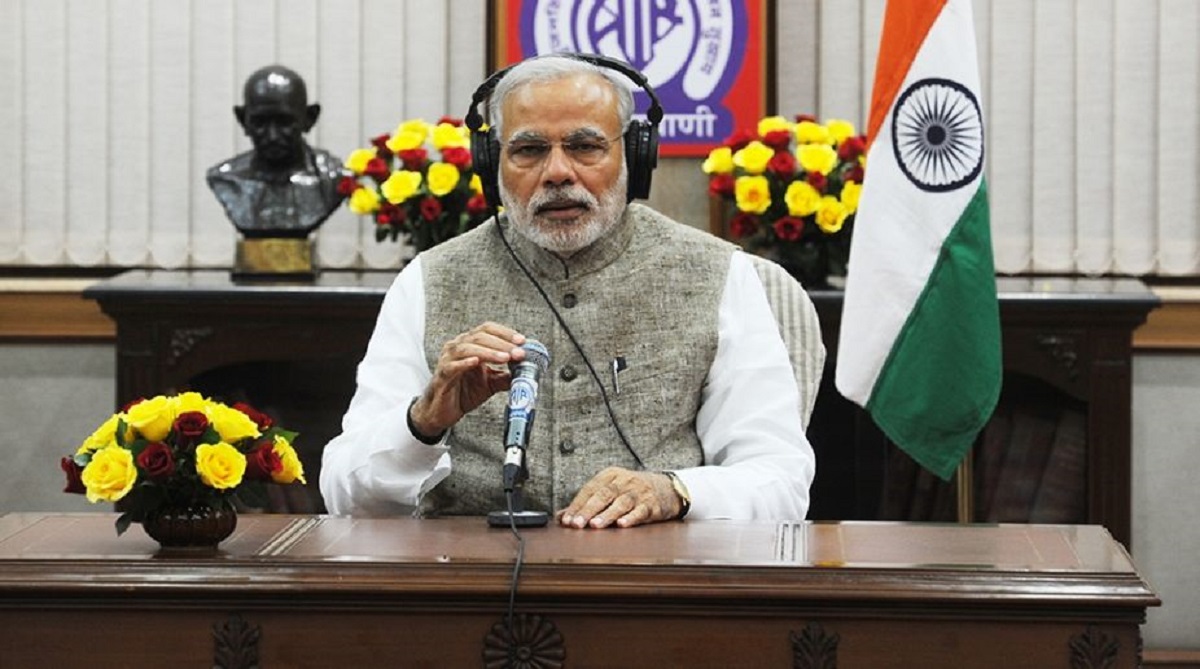
It was the 51st edition of his monthly address. (Photo: PIB)
Delivering his last Mann Ki Baat of 2018 on Sunday, Prime Minister Narendra Modi on Sunday said the achievements of his government in 2018 will fill everyone with glory.
He expressed hope that the journey towards the path of development will continue into 2019 as well.
It was the 51st edition of his monthly address.
Modi highlighted the achievements of the year in various sectors like economy, social sector, and sports among others saying it could happen because of the collective efforts of the people.
“Whether it is one’s own life or the life of the nation, we are advised to look back, and look ahead too… so that we can learn lessons from our mistakes and get the confidence to move ahead. You all must be thinking how do we remember 2018? The year 2018 would fill everyone with glory,” said Modi.
Talking about the accomplishments of his government in 2018, he said, “Year 2018 saw launching of world’s biggest health insurance scheme ‘Ayushman Bharat’; in honour of Sardar Vallabhbhai Patel, India witnessed the unveiling of the tallest statue in the world, ‘Statue of Unity’; electricity reached each and every village of the country; the ease of doing business in India improved notably; on the 75th anniversary of Azad Hind government, a tricolour was unfurled at Delhi’s Red Fort for the first time, and the highest United Nations Environment Award ‘Champions of the Earth’ was conferred upon India.”
The PM said Swacchh Bharat mission is a success adding that more than 3 lakh people gathered to participate in a cleanliness drive.
He also praised the achievements of Indian sportspersons, especially in Asian Games and Para Asian Games where India won many medals. He also mentioned the Indian cricket team and its outstanding performances in the recent games.
He spoke about the opening of India’s first multi-modal terminal on the Ganga river in Varanasi and Sikkim’s first airport.
“I hope this trail of success will continue in 2019 also,” he said.
He also wished the people for a host of upcoming festivals in the month of January, such as Makar Sakranti, Pongal, and Lohri.
A Uttar Pradesh police constable was killed and some others injured as crowd of people waiting for local party leader in Uttar Pradesh’s Ghazipur district went out of control and started to pelt stones. The incident was not connected to Prime Minister Modi’s rally earlier in the eastern district.
Visuals of the violence and stone pelting in Uttar Pradesh’s Ghazipur district in which a police constable was killed. (ANI/Twitter)
A police constable was killed and some other people injured in mob violence by Nishad Party workers in Uttar Pradesh’s Ghazipur district, barely 15 kilometres from the venue of Prime Minister Narendra Modi’s rally on Saturday. The rioters also pelted stones on vehicles of local BJP leaders and workers returning from the rally.
Police have arrested 13 people and detained 10 others for interrogation.
Taking serious note of the incident, chief minister Yogi Adityanath, who himself was present in the rally, directed the district magistrate and superintendent of police to take strict action against the unruly elements and make immediate arrests. He condoled the death and announced Rs 40 lakh and an extraordinary pension for the constable’s wife, Rs 10 lakh for his parents, and a job for one of his dependents.
#WATCH One constable dead & two locals from the area injured in stone pelting allegedly by Nishad Party workers near Atwa Mor police station in Naunera area, earlier today. #Ghazipur
UP director general of police OP Singh said the incident had no connection with the PM’s rally and the violence was a result of Nishad Party workers’ protest for release of their four workers arrested for blocking the road earlier in the morning. He said constable Vats was fatally hit by a stone on the head when the police force was trying to disperse the mob.
Police constable Surendra Vats, who was killed in mob violence in Uttar Pradesh’s Ghazipur district as he was returning from duty at Prime Minister Narendra Modi’s rally there earlier in the day. (HT)
Additional director general, Varanasi zone PV Ramasastry had been rushed to the spot with extra police force while inspector general , Varanasi range, Vijay Singh Meena was already camping in Ghazipur to examine the situation and ensure immediate arrest of the rioters
Meena said the incident happened at the Atwa turning under Nonhara police station when the protestors suddenly turned violent at around 5.30 pm.
He said the Nishad Party workers had blocked the road in the morning over some demand related to reservation, but they were immediately dispersed and four arrested for causing nuisance. However, later around 60-70 party workers, including a group of women, again gathered at the Atwa turning demanding immediate release of the arrested people.
He said the deceased constable was posted at Karimudeen police station of Ghazipur and was returning after his duty in the PM’s rally. Another sub-inspector accompanying him on motorcycle was also hit but remained unhurt as he was wearing a helmet. He said some other police personnel and passers-by were also injured in the incident.
Police were identifying people involved in inciting the mob through video footage, Meena added.
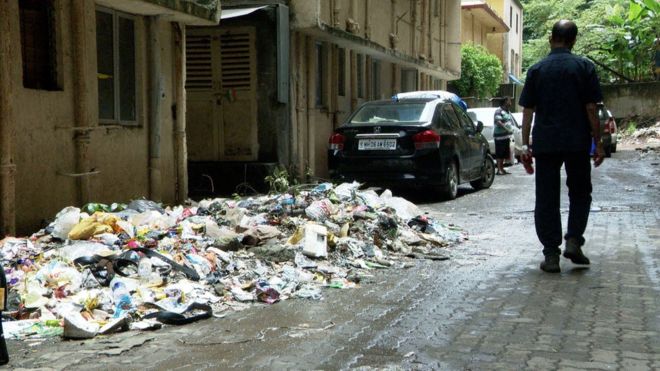
Image captionPiles of garbage are a common sight in Mahul
Tens of thousands of people are fighting to leave Mahul, a heavily industrialised neighbourhood in the western Indian city of Mumbai, saying the toxic pollution there is adversely impacting their health. BBC Marathi’s Mayuresh Konnur and Janhavee Moole report on the residents’ battle to be relocated.
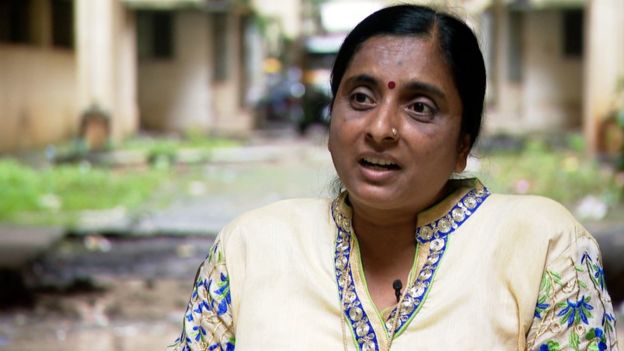
Anita Dhole, 38, was forced to move to a “transit camp” set up by the civic authorities in Mahul in May 2017 after the illegal slum she was living in was demolished. Since then, she says, she has been suffering.
“I have breathing trouble and high blood pressure, and the pollution has also affected my eyesight,” she says.
Hers was one of more than 5,000 families – estimated to be between 30,000 and 50,000 people – that lost their homes in the demolition drive and were offered temporary housing in Mahul. They were told they would be given homes in another Mumbai suburb later but, residents say, Mahul is not fit for living, even for a short time.
Image captionMs Dhole has been living here since May 2017
A former fishing village, it’s now close to oil and petroleum refineries, chemical factories and fertiliser plants.
A report in 2013 by the King Edward Memorial Hospital said that around 67% of people living in Mahul complained of breathlessness several times a month and around 84% of them complained of eye-irritation. In 2015, India’s environment court National Green Tribunal said there was “a perceptible threat to [the] health of residents” in Mahul because of the “prevailing air quality in the area”.
But local municipal authorities say three different surveys by the Maharashtra Pollution Control Board show “that the pollution levels in Mahul are not different from other areas of Mumbai”.
Yet residents blame breathing issues, asthma, skin diseases, tuberculosis and blood pressure-related problems on poor local conditions.
Ms Dhole says her parents fell so sick in Mahul that they soon left for their village.
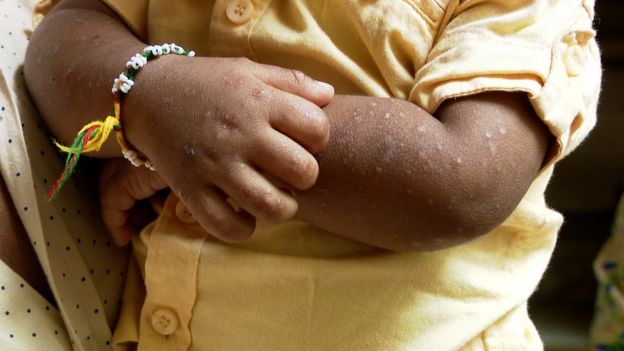
Image captionSkin infections are common among residents
Shamdas Salve, who also moved to Mahul last year, says his two-year-old son has had a persistent skin infection for the past five months.
“He doesn’t sleep the whole night and keeps scratching. I’ve consulted several skin specialists and changed his medication but he has had no relief. He cries and keeps scratching. He now has marks on his face too.”
His words are echoed by many of his neighbours – 10-year-old Sahil suffers from TB and so does 17-month-old Anshul Tusambad; Maya Goswami, 55, struggles with asthma; and 18-year-old Kavita Subramanyan has low BP and breathing problems.
Besides pollution, residents say they have no access to clean water and sewage facilities and that electricity supply is far from regular. There are also no hospitals or schools nearby. The area is poorly connected with other parts of the city and, as a result, many women have been forced to quit their jobs and stay home.
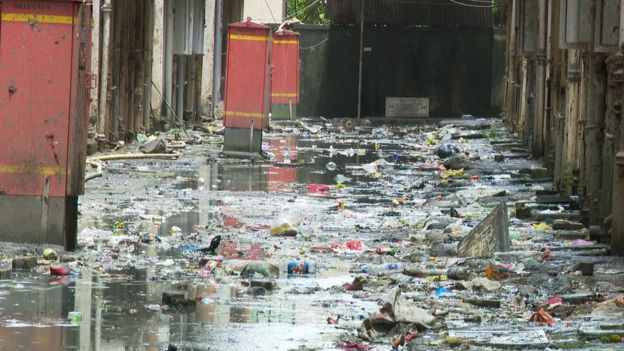
Image captionOverflowing sewage in Mahul’s transit camp
The transit camp where Ms Dhole lives is actually a block of apartments that goes by the official name of Eversmile layout.
It has dozens of buildings and each is home to 300 congested one-room apartments. The complex is filthy – sewage pipes are broken, gutters are overflowing; electric wires are dangling everywhere; the air is stuffy, mosquitoes abound and rats scurry past us as we walk around the neighbourhood.
Most of these low-cost homes are meant for families who have been relocated because of demolition of unauthorised slums.
Every year, tens of thousands migrate from rural India to Mumbai in search of livelihood and most end up living in illegal shanty towns that often encroach on roads or other city infrastructure.
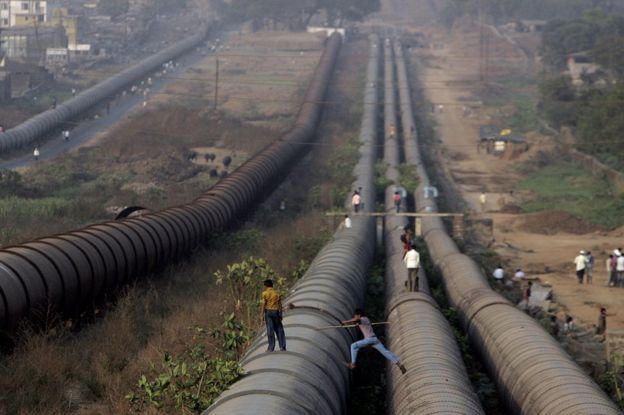
Image copyrightGETTY IMAGESImage captionThousands were relocated to build the Tansa water pipeline
Most of those who were relocated to Mahul, including Ms Dhole, used to live in a slum along the Tansa pipeline – the 160km (99 miles) long water pipeline that runs through Mumbai, carrying water from Lake Tansa. It’s a major source of water for the city.
Just over half of the pipeline is overground and, over the years, unauthorised houses came up alongside it and, in some places, on top of it.
In 2006, a petition was filed in the high court in Mumbai asking the court to order the government to relocate those living in the slums to “ensure that the water, which is used by the citizens of Mumbai, is safe, and that these pipelines do not become a target for persons to attack the citizens of Mumbai”.
Read more stories about pollution and the environment:
In 2009, the court ruled that there must be a 10-metre gap between the pipeline and the nearest home, which meant that thousands of families had to move out. Their homes were subsequently demolished and they were told to relocate to Mahul.
Many initially refused because of the pollution, but were forced to move as the demolitions continued.
In August, the court said the civic authorities could not force people to move to Mahul and that they must find alternative housing for them or pay rent for those families that did move out.
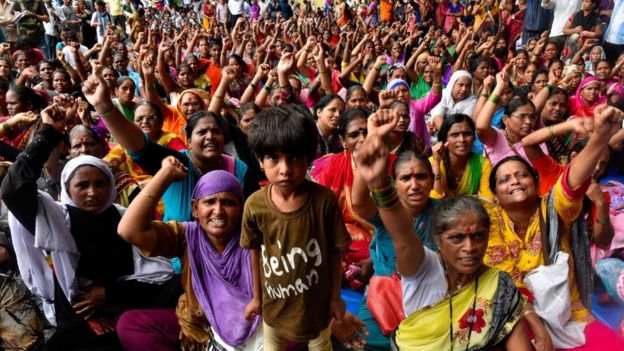
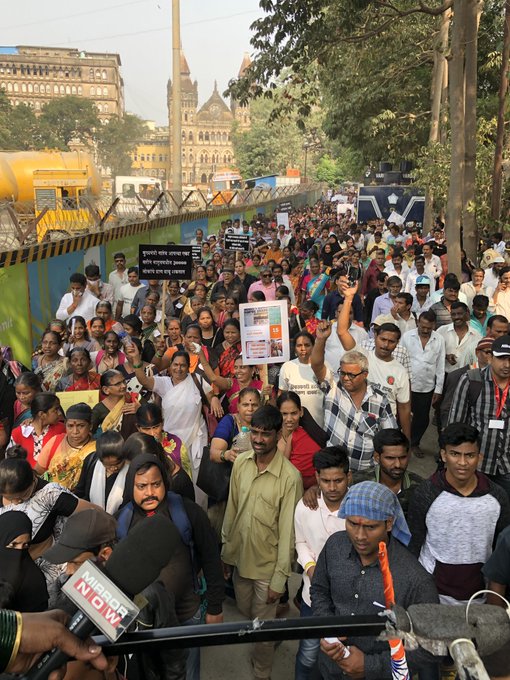
Image copyrightGETTY IMAGESImage captionResidents have been protesting for months to be moved elsewhere
The protests have intensified in the past two months with many residents of Mahul’s transit camp demonstrating at the site where their homes once stood.
They have also launched a campaign on social media with the hashtag and Twitter handle MumbaisToxicHell – demanding that they are relocated again, this time to a safer and healthier environment.
Residents of Mahul protesting on the streets yet again demanding relocation from the Maha state government. Now even IIT Bombay’s report says the area is not fit to stay. What are you now waiting for? #mumbaistoxichell#wakeupgovt#residentspleadforbetterlife#mirrornow
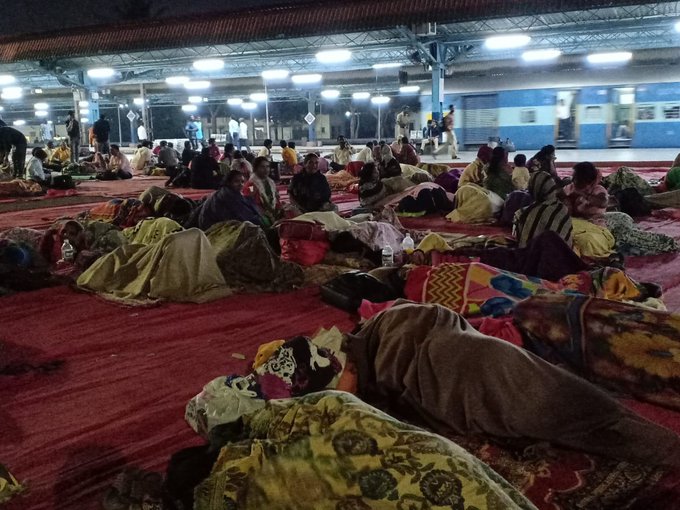
Residents of Mahul are compelled to sleep under the sky to save their lives from toxic atmosphere of Mahul. They are camping outside their homes since 50 days to save their lives.#MumbaisToxicHell
The initial rescue operation to help the miners had to be stopped as the pumps were not adequate to flush out large volumes of water. The state government then sough Centre’s help and high-powered pumps and a team was dispatched from Odisha.
An Indian Navy team has reached the mine in Meghalaya’s East Jaintia Hills where 15 people have been trapped since December 13 but will begin their operations on Sunday morning. (HT Photo)
After delays and hiccups, two teams of rescuers—one comprising divers from Indian Navy and another from the Odisha fire services—reached the flooded coal mine in Meghalaya on Saturday where 15 miners are trapped since December 13.
But except conducting recce at the site located at Khloo Ryngksan in East Jaintia Hills district and attempts to set up the high-powered pumps needed to flush out water nothing much happened during the day. Actual work on the ground will begin early on Sunday morning.
National Disaster Response Force (NDRF) Assistant Commandant Santosh Kumar Singh, who is overseeing operations at the rat hole coal mine. said a three member team of the Indian Navy visited the site.”They did a recce of the spot, spent 30 minutes inside the main pit. They also held a meeting with us and are likely to start operation tomorrow. Now that they are here we will assist them,” he said.
The water levels inside the mine remains unchanged, he said.
A team of Odisha fire and emergency services, who finally reached the spot, tried to install their high-powered pumps. “They may be operational by tomorrow,” Singh said.
“Pumps and other machinery are being installed at the site. Everyone is working overtime with extreme dedication and zeal as our mission is to save lives. That is our top priority,” East Jaiñtia Hills district police chief Silvester Nongtnger told Hindustan Times.
He aid that after all the gear has been installed and put into place on Saturday night, rescue operations will begin on Sunday morning. “We will start right from the first hour itself.”
The initial rescue operation to help the miners started on December 14 once the NDRF and SDRF teams arrived. On December 17, a team of Directorate General of Mine Safety along with Coal India officials arrived and suggested 100 HP submersible pumps be used. The district administration wrote to the state government seeking immediate help from Coal India on December 20. However, it was only on December 26 that Coal India received a request from state government for assistance.
The rescue operation launched by the state government had to be stopped as the pumps were not adequate to flush out large volumes of water. The state government then sough Centre’s help and high-powered pumps and a team was dispatched from Odisha.
The team reached Guwahati on Friday morning around 11:30 am, but due to lack of transport provided by Meghalaya they had to wait till 5:45 pm to start their 220 km journey to the mine.
“Initially we were told that we would be travelling by trucks. Then the plan was changed and it was decided that dumpers would be used to shift the equipment to the accident site,” said Sukant Sethi, Chief Fire Officer (Odisha), who is leading the team.
“By the time we reached a primary school (located 25 km from the mine) where we were supposed to spend the night it was 2 am on Saturday. There was no person from Meghalaya government’s side who helped us with basic needs,” Sethi said.
Despite the problems faced by them, the team was keen to reach the spot soon to help the trapped miners. They finally reached around 1 pm on Saturday
Another aspect of seemingly lukewarm response by the government has emerged. Tata Trusts had offered to lend two pumps which it had airlifted from London to augment rescue efforts during the Kerala floods to Meghalaya but till date, there has been no response from the government.
Efforts to reach Peter W Ingty, additional chief secretary in-charge revenue and disaster management by Hindustan Times proved futile as he did not respond to calls.
Prime Minister Narendra Modi accused the Congress governments in Madhya Pradesh, Rajasthan and Karnataka of making hollow promises to the people before elections for political gains.
SNS Web | New Delhi | December 29, 2018 4:27 pm
Prime Minister Narendra Modi addresses at the foundation stone laying ceremony of Medical College in Ghazipur, Uttar Pradesh on Dec 29, 2018. (Photo: IANS/PIB)
Prime Minister Narendra Modi accused the Congress governments in Madhya Pradesh, Rajasthan and Karnataka of making hollow promises to the people before elections for political gains.
In a public meeting in Ghazipur in eastern Uttar Pradesh, the PM said that the alliance government in Karnataka led by Congress and Janata Dal (Secular) had promised to waive off loans of lakhs of farmers but has only done so for 800.
“They gave the lollipop of a farm loan waiver, votes were stolen but so far only… the loans of 800 farmers have been waived off,” Modi said while exhorting people to understand “such games”.
“Long queues for urea, fertilizers can be seen in Madhya Pradesh and Rajasthan. Black-marketeers are now back on the field,” the PM said hitting out at the Congress governments in the two states.
He also said that the Congress, when it was in the Centre, had similarly made false promises.
“Congress had promised waiver of Rs 6 lakh crore loans of farmers. The waiver was of just Rs 60 thousand crore. And the CAG report revealed that of the persons whose ‘loans’ were waived, 35 lakh people were not farmers, they had no loans and neither were they eligible for waivers,” the PM said.
Asking the gathering to be wary of Congress’ promises, the PM said that the grand old party was trying to fool the people with such announcements.
“These people are trying to lure you by short-term benefit announcements and promises but all this will not help,” he said, adding, “Announcements made for instant benefits won’t be successful in the long run.”
Modi, who was in Ghazipur to lay the foundation stone of a medical college, said that people of the region will immensely benefit from the medical college.
“The medical college will not only provide Ghazipur with advanced medical facilities but also produce new and meritorious doctors,” he said, adding, “When this college is ready, the district hospital in Ghazipur will become a 300-bed facility.”
At the event, the PM also released a commemorative postal stamp in honour of Maharaja Suheldev in the presence of Uttar Pradesh Governor Ram Naik, Chief Minister Yogi Adityanath.
Praising the 11th century ruler semi-legendary king, the PM said that Maharaj Suheldev is among those bravehearts who struggled for the honour of India.
“Remembering Maharaja Suheldev, from whom every deprived and oppressed draws inspiration, strengthens the ‘Sabka Saath, Sabka Vikas’ mantra,” he said underlining the political significance of the king in today’s times.
The PM said that unlike the previous governments, his government is showing respect to every brave son and daughter of the country.
Ironically, the Suheldev Bharatiya Samaj Party (SBSP), an NDA ally, decided to stay away from all the events attended by the PM Saturday.
The SBSP, which has four legislators in the 403-member state assembly, announced that it will “boycott” Prime Minister’s programmes. The party claims that the name of its chief, state Minister for Backward Classes Welfare Om Prakash Rajbhar, has been “deliberately omitted from the invitation card”.
Rajbhar has been a bitter critic of the BJP government in the state and the Centre over a host of issues.
SBSP was not the only ally to boycott the PM’s events. The powerful Apna Dal, too, stayed away to protest the “arrogant attitude” of the BJP leaders in the state.
Ashish Patel, the state unit chief of Apna Dal, charged the BJP leaders of “insulting leaders and the weaker sections of the society”.
He also announced that till the matter between the two allies was not settled, Apna Dal will not attend any government programmes and demanded Modi’s intervention in sorting out the matter.
The Apna Dal has two Lok Sabha MPs, including MoS Health and Family Welfare Anupriya Patel, and 9 seats in the UP Assembly.
HIVARGAON/MUJAHIDPUR, India (Reuters) – A spike in the price of onions has led to the ouster of governments in Indian elections in the past. Now, prices of the staple have collapsed, and many impoverished farmers are saying they will make Prime Minister Narendra Modi pay in next year’s general election.
Steep drops in recent weeks in the prices of onions and potatoes, both staple foods for India’s 1.3 billion people, have badly hit the rural economy in large states.
In interviews with dozens of farmers last week, Reuters reporters found resentment welling against Modi’s Hindu nationalist Bharatiya Janata Party (BJP) for not helping support incomes in the countryside, where a majority of the population lives.
“Whatever they do in the coming months, I will vote against the BJP. I won’t repeat the 2014 mistake,” said Madhukar Nagare, an onion grower from Nashik in Maharashtra state, referring to his backing the BJP at the last general election.
In the 1998 state elections, a sharp spike in onion prices led to the fall of the BJP government in the capital New Delhi.
In the 1980 general election, sky-high onion prices helped former Prime Minister Indira Gandhi dislodge a coalition government that had included politicians who later formed the BJP.
In recent weeks, loss-stricken farmers have staged protests, blocked highways and dumped onions on the road after prices plunged to as low as one rupee (1.4 U.S. cents) per kg for a crop that costs about 8 rupees a kg to produce.
But because of large cuts taken by middlemen, consumers have not benefited from the low prices.
In Maharashtra, the top onion producing state, farm prices have fallen 83 percent, dragged down by surplus supplies from the previous season’s crop and lower export orders from the Middle East and Southeast Asia.
And in India’s most populous state of Uttar Pradesh, which was crucial in Modi’s election win in 2014, there is a similar problem with low potato prices.
Maharashtra and Uttar Pradesh are both dominated by rural voters and together send 128 lawmakers to the 545-member lower house of parliament. It means that big losses in these two states could either see Modi lose the next election which is due by May or his party be forced to form a coalition government. Farmers say shortcomings in a government crop support programme, and weak overseas demand have combined to produce the current glut of onions. And as prices have plunged, fertiliser and crop nutrient costs have risen, thanks in part to a weak rupee.
Perhaps most important of all, the BJP came into office in 2014 determined to shift away from subsidies. That may have been fine when crop prices were relatively high but as they crashed it has exposed the party in farm areas.
The prime minister’s office did not respond to a request for comment on this story.
NOT “GOOD DAYS”
Many farmers blame Modi for not fixing a price protection programme which barely covers 7 percent of India’s 263 million farmers, leaving most growers at the mercy of middlemen.
They also criticize him for not setting up more food processing and cold storage facilities, which would allow them to store their crops without having to sell immediately after the harvest.
“Expecting good days, as promised by Modi, we voted for the BJP, but now we are going through the worst phase,” onion farmer Madhav Pawase said, pointing to his rotting crop stocked in a temporary shed in Hivargaon village, about 230 km (140 miles) northeast of Mumbai, India’s financial hub.
“I’ve spent more than 80,000 rupees to produce 15 tonnes of onions from my two acres of land, but I won’t recover more than 3,000 rupees at the current market price,” he said.
Some farmers have decided to let onions rot in the field, saying that harvesting and transporting the produce to wholesale markets would only add to their losses.
A farmer sits on a tractor trolley after auctioning his onions at Lasalgaon market in Nashik in the western state of Maharashtra, India, December 19, 2018. REUTERS/Rajendra Jadhav
The BJP was defeated by the opposition Congress party in three major states in local elections this month because of rural anger, and Modi’s government is under pressure to come up with measures to placate farmers.
Congress wrote off farmers’ loans in the three states which it won and has demanded the federal government do the same across the country.
Although the BJP has so far not commented on the issue of farm loan waivers, Rajiv Kumar, the head of government think-tank NITI Aayog, has said that writing off debt is not the solution for the problems of the farm sector.
Syed Zafar Islam, a spokesman for the BJP, said the government had initiated a number of steps to help farmers get remunerative prices, including a project to electronically provide farmers with real-time market prices and help them directly sell to buyers, eliminating middlemen.
“It’s an ongoing process and the results will not just start reflecting in four years,” he said.
In a sign that the Modi administration is beginning to take the crisis seriously, the government on Friday doubled export incentives for onion farmers to 10 percent.
The move will result in better prices for onions in the domestic market, the government said in a statement.
Home still a distant dream for Indonesia’s tsunami survivors
POTATO PRICES
In Mujahidpur village of Uttar Pradesh, India’s biggest potato growing state, farmers lamented that prices have dropped by 86 percent to 2,500 rupees a tonne.
“I lost my entire investment of 100,000 rupees to grow potatoes on one hectare,” said Gopi Chand, 55, sitting next to bright yellow mustard fields.
He said he and some other farmers in the area had dumped potatoes in favour of growing mustard.
Farmers in the two states also complained of rising operating costs.
Prices of crop nutrient diammonium phosphate, popularly called DAP, have gone up by 400 rupees to 1,450 rupees for a bag of 50 kg, said Babloo Singh in Mujahidpur village. DAP rates have gone up because of higher overseas prices and India’s weaker currency.
“Higher input costs and record low potato prices have left us in deep debt,” said Singh. “The situation would have been different had there been more cold storage facilities and food processing plants in our state.”
The crash in vegetable prices hasn’t helped consumers either thanks to the chain of middlemen.
In Lasalgaon, the country’s largest onion trading hub, most farmers are selling their produce at 2 rupees a kg. But consumers in Mumbai are still shelling out 20 rupees. Between Lasalgaon and Mumbai, a distance of 220 km (135 miles), traders say onions pass through at least four layers of middlemen, adding a hefty margin at every stage.
India’s assistance to Bhutan’s 12th plan, which runs from 2018 to 2023, would conform to its needs and priorities.
Statesman News Service | New Delhi | December 28, 2018 7:44 pm
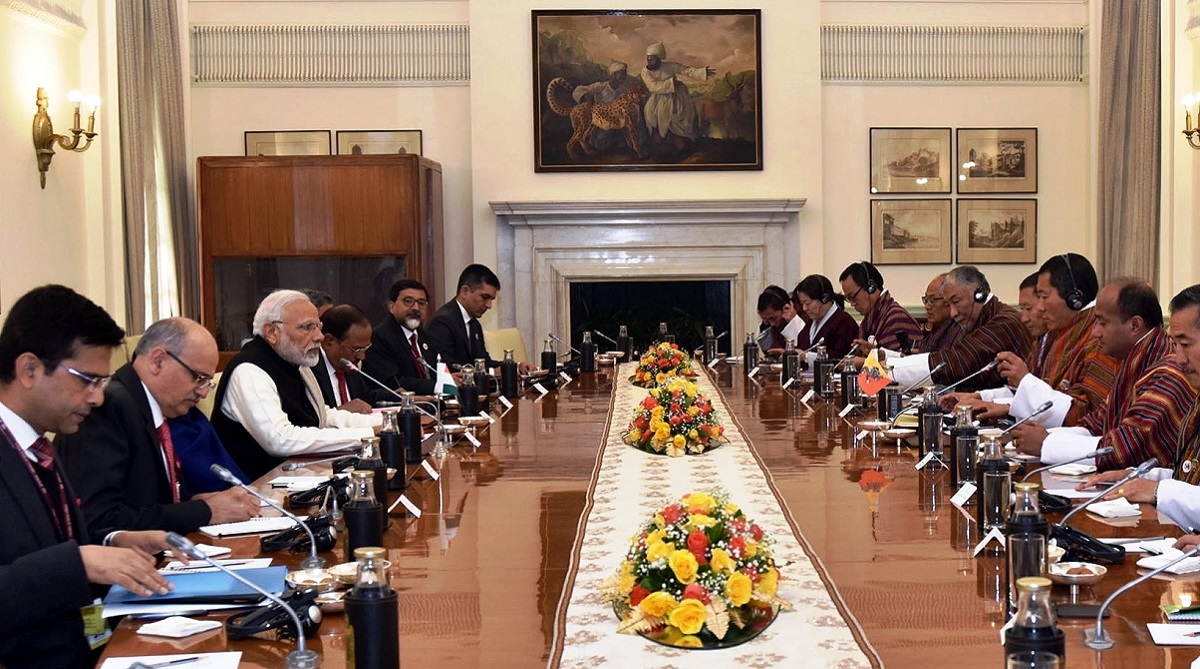
Prime Minister Narendra Modi and Bhutan Prime Minister Dr. Lotay Tshering, during delegation level talks at Hyderabad House, in New Delhi on December 28, 2018. (Photo: IANS/PIB)
Prime Minister Narendra Modi on Friday announced that India would contribute Rs 4,500 crore to Bhutan’s 12th five-year plan as the two countries decided to enhance cooperation in hydro-power and other key sectors.
India’s assistance to Bhutan’s 12th plan, which runs from 2018 to 2023, would conform to its needs and priorities, Modi said at a joint media interaction with his Bhutanese counterpart Lotay Tshering after wide-ranging talks between the two leaders.
Tshering is on his maiden overseas visit after assuming the office in November, reflecting the importance his government attaches to ties with India. Bhutan had solidly backed India during its military stand-off with China at Doklam in June last year.
Noting that the collaboration in hydro projects has been an important part in the long history of cooperation between India and Bhutan, Modi said work on the Mangghe-Descchu project was going to be completed soon. The tariff of this project has also been agreed upon between the two sides. Work on other projects was also making satisfactory progress, he added.
Modi said he was happy to learn that the Bhutan Government has decided to launch RuPay Cards soon and expressed confidence that this would lead to strengthening people-to-people relations. He said he had assured the Bhutanese leader that India would, as always, play the role of a trusted partner and friend in the development of Bhutan.
On his part, Tshering noted that Prime Minister Modi was the first head of government to congratulate him on his electoral victory. He also thanked India for its continued support to his country’s developmental needs.
He said the purpose of his visit was to take India-Bhutan relations to much greater heights. India and Bhutan were celebrating the golden jubilee of bilateral ties and it should be their endeavour to score a century, double century, and triple century in taking this relationship forward.
He was hopeful that India would come to the rescue of Bhutanese businessmen who had been affected due to the introduction of the Goods and Services Tax (GST) in India.
Earlier in the day, Tshering was accorded a ceremonial welcome at Rashtrapati Bhavan. External Affairs Minister Sushma Swaraj also called on the Bhutanese PM.
Flights of Dutch carrier KLM, Taiwan’s Eva Air and the US-based National Airlines were involved in the incident, an official said. The incident happened in the Delhi Flight Information Region (FIR).
In a rare incident, three planes of three foreign airlines, carrying hundreds of passengers, came perilously close in the Delhi flight information region and collisions were averted after multiple auto generated warnings and intervention from ATC, an official said Friday.(Reuters/Representative Image)
In a rare incident, three planes of three foreign airlines, carrying hundreds of passengers, came perilously close in the Delhi flight information region and collisions were averted after multiple auto generated warnings and intervention from ATC, an official said Friday.
The Aircraft Accident Investigation Bureau (AAIB) has started a probe into the incident, which happened on December 23.
Flights of Dutch carrier KLM, Taiwan’s Eva Air and the US-based National Airlines were involved in the incident, the official said.
The incident happened in the Delhi Flight Information Region (FIR).
An FIR refers to a specified airspace where flight information and alerting services are provided. Generally, an FIR can be land and sea territory as well as any international airspace as defined under global norms.
According to the official, at the time of the incident, National Airlines’ flight NCR 840 was on its way to Hong Kong from Bagram in Afghanistan while the KLM Flight KLM 875 was heading to Bangkok from Amsterdam. The Eva Air flight EVA 061 was flying to Vienna from Bangkok, the official said. “First it was NCR 840, which was flying at flight level 310 (31,000 ft) and EVA 061 at flight level 320 (32,000 ft) which breached mandatory separation. The pilots of both the aircraft were alerted by the onboard TCAS warning system,” the official said.
Around the same time, the KLM flight was at 33,000 ft, he added.
Following the TCAS (Traffic Collision Avoidance System) warning, the pilot of NCR 840 sought to climb to 35,000 feet but was told to remain at that current level till the time it gets a go-ahead. “However, when the air traffic controller (ATC) observed it climbing, it was immediately asked to take a left turn. In the meantime, EVA also continued climbing at flight level 330, a level at which KLM was already flying, and at this time, another TCAS warning went off, alerting the pilots to steer the aircraft to a safer distance,” the official said.
As the NCR 840 again descended to flight level 330, it came across the EVA flight , triggering another TCAS alarm, the official said.
Image copyrightGETTY IMAGESImage captionMaking pornographic material or sharing it is illegal in India
A troubling trend of rape videos going viral in India has led many to believe that smartphones and easy access to violent porn, coupled with a lack of sex education, could fuel sexual violence. The BBC’s Divya Arya reports.
Earlier this year, a video showing a group of teenage boys trying to rip the clothes off a young woman was shared extensively on WhatsApp in India.
In it, she is urging them to stop, using the term “bhaiyya” (Hindi for brother) but they are jeering, laughing, clearly enjoying themselves.
As the video went viral, police were able to establish that it was filmed in a village in the northern state of Bihar. The accused teenagers were arrested.
The arrests caused anxiety in their village in Jehanabad, a four-hour drive from the state capital Patna, where village elders blamed the entire incident on smartphones.
Making pornographic material or sharing it is illegal in India.
But even as it becomes easier to access pornography thanks to cheap data and smartphones, there is concern that this isn’t being accompanied by any meaningful understanding of sex and relationships.
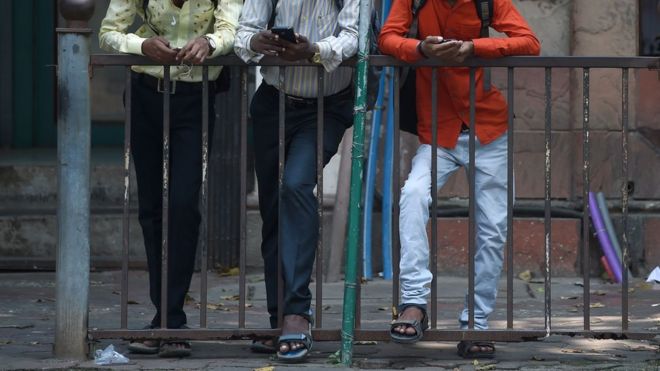
Local boys in the village freely admitted to the BBC that they watched videos of molestation and rape. One 16-year-old said he had seen more than 25 such videos, adding that his friends often shared them on their smartphones.
“Most boys in my class watch these videos together or sometimes by themselves,” another boy said. “It feels fine because everyone does it.”
Experts say this kind of introduction to sex is typical for many Indian men.
Image copyrightGETTY IMAGESImage captionWhatsApp is the medium often used to share such videos
“We have not grown up being given sex education or having normal adult conversations about these things,” says filmmaker and writer Paromita Vohra. She runs the website Agents of Ishq (Romance), which encourages open discussions about sex.
“When people only watch violent sexual content, it is very desensitising because they start believing that violence is the only way to get pleasure and that female consent is unimportant.”
India has 400 million smartphone users, and more than half of them use WhatsApp, which is the medium often used to share such videos.
In a statement to the BBC, WhatsApp said: “These horrendous rape videos and child pornography have no place on our platform. That’s why we’ve made it easy to report problems like these so we can take appropriate action, including banning accounts. We also respond to valid legal requests from law enforcement in India to help them investigate crimes.”
Porn ban
Concerned after a case in which some young men gang-raped a schoolgirl after allegedly watching porn on their mobile phones, a court in the northern state of Uttarakhand asked the federal government to reinstate a 2015 ban imposed by the Supreme Court on websites hosting violent pornography.
It had been revoked almost instantly due to widespread protest.
The ban only applies to some 800 websites that contain violent or abusive videos. This does not seem to have had much impact though.
Within days of being blocked, one of the largest pornography websites had already set up a mirror site with a different URL for its Indian market.
Many believe it is the lack of sex education that is fuelling the appetite for violent and misogynistic videos. Often, there is no deeper understanding of what a sexual relationship or experience should be for both men and women.
This is something the government tried to change in 2009, when it began its Adolescent Education Programme (AEP). It sought to address changes in adolescence and dispel myths about gender, sexuality, sexually transmitted diseases and drug abuse.
But implementing the programme remains a challenge. At an all-girls school in Jehanabad for instance, the principal had never heard of it.
Image copyrightGETTY IMAGESImage captionMany say it is the lack of sex education that is behind the proliferation of violent videos
Huge market
Sunita Krishnan, the founder of Prajwala, an organisation in the southern city of Hyderabad that deals with issues of sexual violence and trafficking says these violent videos reinforce the old belief that a woman’s choice is insignificant and she has no agency.
Ms Krishnan, a rape survivor herself, has also received such videos and has been campaigning to check their spread. In fact, the 2015 Supreme Court ban on porn sites was a result of her efforts.
Even though she has managed to get a few of these videos taken down, she says it can be near impossible to completely erase something from the internet.
Ranjeet Ranjan, who is one of only three women amongst Bihar’s 40 MPs, says the lack of concern about such videos is alarming.
“No-one really cares. If people had even a little respect for these girls, they would have gone to the police station instead of sharing such videos,” she said.
Ms Ranjan is also concerned by what she sees as “a competition” to make such videos.
“If these continue to circulate and we have no sex education, then it will embolden the thinking that a woman should be treated as an object, a source of entertainment.”