Chindia Alert: You’ll be Living in their World Very Soon
aims to alert you to the threats and opportunities that China and India present. China and India require serious attention; case of ‘hidden dragon and crouching tiger’.
Without this attention, governments, businesses and, indeed, individuals may find themselves at a great disadvantage sooner rather than later.
The POSTs (front webpages) are mainly 'cuttings' from reliable sources, updated continuously.
The PAGEs (see Tabs, above) attempt to make the information more meaningful by putting some structure to the information we have researched and assembled since 2006.
Li Zhanshu (R), chairman of China’s National People’s Congress (NPC) Standing Committee, holds talks with Maya Fernandez Allende, president of the Chilean Chamber of Deputies, in Beijing, capital of China, Jan. 25, 2019. (Xinhua/Liu Weibing)
BEIJING, Jan. 25 (Xinhua) — China’s top legislator Li Zhanshu held talks with Maya Fernandez Allende, president of the Chilean Chamber of Deputies, in Beijing Friday.
Hailing the traditional friendship between the two countries, Li, chairman of China’s National People’s Congress (NPC) Standing Committee, said the precious experience of bilateral friendship should be passed down and carried forward.
“We are glad to see that China-Chile relations have been upgraded to a comprehensive strategic partnership and have yield cooperative results in various fields,” said Li, adding that those achievements were derived from “sincere treatment, mutual respect and trust, complementary advantages, mutually beneficial and win-win results” between the two countries.
China-Chile relations will embrace new opportunities in the next two years, said the top legislator, calling on the two sides to enhance friendly cooperation in various fields and promote comprehensive strategic partnership for continued development featuring exchanges of two heads of state and jointly building the Belt and Road.
“China stands ready to work with Chile and countries around the world to build a community of a shared future featuring equality, mutual benefit and common development, but not targeting or excluding any third party,” he said.
On enhancing cooperation between the two legislative bodies, Li called on the NPC and the National Congress of Chile to continue to give full play to the political communication committee, expand experience exchanges on legislation, supervision and governance, guarantee the joint construction of the Belt and Road and expansion of economic and trade cooperation in compliance with rule of law, optimize the business environment, and promote cultural and people-to-people exchanges and cooperation between the two countries.
Fernandez said the National Congress of Chile stands ready to work with the NPC of China to continue to give full play to communication mechanism and platform, explore cooperation potential, facilitate people-to-people exchanges, and constantly enrich the connotation of bilateral relations. She said Chile will, as always, adhere to the one-China policy.
The bill attempts to grant citizenship to immigrants who are not Muslim.
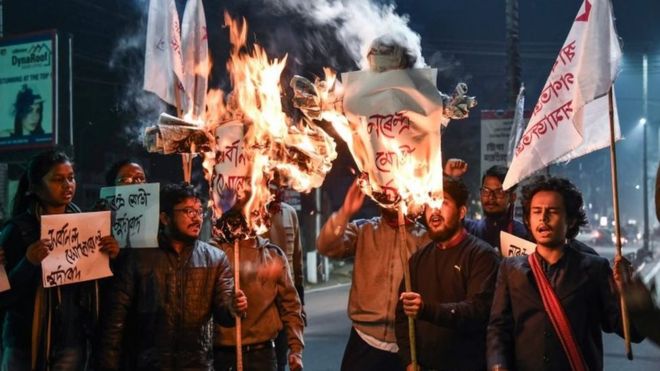
Students, activists, politicians and celebrities have all joined the protests against India’s ruling party.
What does the bill say?
The Citizenship (Amendment) bill seeks to provide citizenship to non-Muslim migrants from Pakistan, Bangladesh and Afghanistan.
Supporters of the bill defend it by saying that Muslims have been excluded as the bill offers Indian nationality only to religious minorities fleeing persecution in neighbouring countries.
It comes months after the publication of the National Register of Citizens (NRC) – a list of people who can prove they came to the state by 24 March 1971, a day before neighbouring Bangladesh became an independent country. Around 3.62 million of those left off the register have submitted claims for inclusion again.
Media captionLiving in limbo: Assam’s four million unwanted
India said the process was needed to identify illegal Bangladeshi migrants.
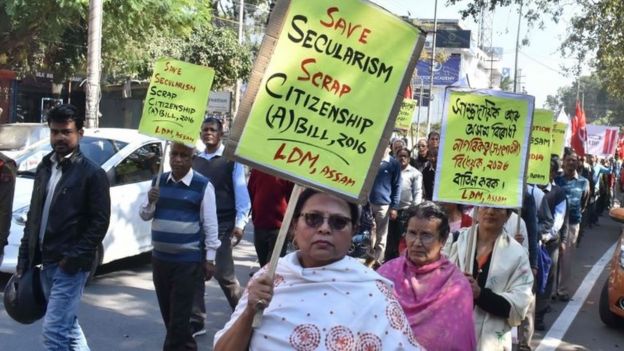
Thousands of students have joined writers, artists and activists in regular protests against the bill, fearing that tens of thousands of Bengali Hindu migrants who were not included in the NRC may still get citizenship to stay on in the state.
How bad are the protests?
Offices of the Bharatiya Janata Party (BJP), which runs both the federal government and Assam’s state government, have been burnt down by angry mobs in many places.
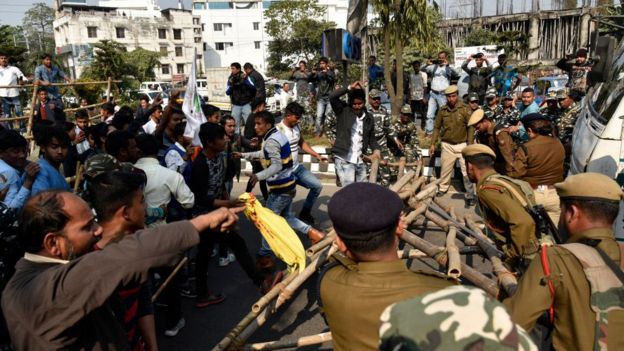
Protesters have also frequently surrounded the state secretariat in the capital, Guwahati, demanding the shelving of the amendment.
Some supporters of Assamese peasant leader Akhil Gogoi even staged a nude protest in the national capital, Delhi, earlier this month.
“The movement against the bill has gained momentum across the north-east and if it is not withdrawn, the situation in the region may turn volatile,” Sammujal Bhattacharyya of the All Assam Students Union (Aasu), which is leading the protests against the bill in Assam, told the BBC.
He said it was an attempt to provide citizenship “by backdoor” to illegal non-Muslim migrants who were excluded from the NRC.
Image copyrightGETTY IMAGESImage captionAssam has seen vocal protests against the bill
In the early 1980s, Aasu was behind the anti-migrant protests in Assam that paralysed the state and degenerated into rioting that led to more than 3,000 deaths.
The agitation ended in 1985 after March 1971 was agreed as the cut-off date to determine citizenship.
Why is the BJP determined to get the bill through?
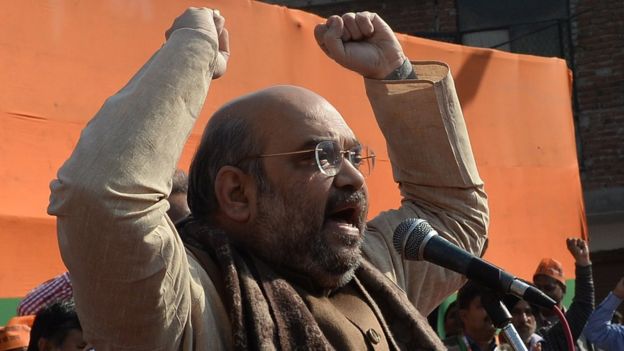
Despite the protests, BJP president Amit Shah has insisted that the government is determined to pass the bill.
“Hindus from these countries have nothing to fear, they will all get Indian citizenship,” Mr Shah told a rally in West Bengal state this week. Analysts say it’s an obvious attempt to win over Bengali Hindus to the BJP’s cause.
The Bengali Hindus are in a majority in the states of West Bengal and Tripura, with substantial numbers in Assam. The three states together will account for 58 seats in upcoming general elections.
Image copyrightGETTY IMAGESImage caption BJP president Amit Shah has said the government is committed to pass the bill
But while the BJP may seek to win many of these seats to offset possible losses in north India, it risks losing the support of the ethnic Assamese, who voted for the party in the 2016 state elections.
Assam Chief Minister Sarbananda Sonowal, himself a former Aasu leader, is on the defensive, requesting students not to join the agitation which, he says, is fuelled by “misinformation”.
“Nobody will automatically get citizenship if the amendment is passed into law. The government will closely examine all applications and reject those that are not tenable,” he said this week.
What are the other reactions to the bill?
India’s main opposition Congress party opposes the bill on the grounds that determining citizenship on the basis of religion goes against the spirit of the constitution.
Regional parties who have joined hands with the BJP to form governments in Assam and the neighbouring states of Meghalaya, Nagaland and Mizoram have threatened to renege on their alliances because they all oppose the bill.
Image copyrightAFPImage caption Demands to scrap the bill have been growing louder
“Anyone who came to Assam after March 1971 is a foreigner, an illegal migrant. We don’t care if he or she is Hindu or Muslim. Religion is not the issue here, it is a question of protecting indigenous people from being swamped by foreigners in their own land,” university student Mitali Baruah told the BBC as she marched to a protest rally.
That has been the dominant sentiment with most of the indigenous communities – a migrant is unwelcome, regardless of religion.
“The BJP has failed to understand the pulse of the region, because they see everything through the prism of religion,” said analyst Samir Purkayastha.
NEW DELHI (Reuters) – A Hindu nationalist group close to Prime Minister Narendra Modi’s party has urged him to resist pressure from the United States and not defer new regulations for the e-commerce sector, according to a letter seen by Reuters.
The economic wing of the group, Rashtriya Swayamsevak Sangh (RSS), which is the fountainhead of the ruling party, has written to Modi saying that changing the policy implementation date, under pressure from Washington, will hurt 130 million small Indian entrepreneurs.
“There is no need to buckle under these pressures. India must continue to chart the way best for itself and the entrepreneurs,” the Swadeshi Jagran Manch said in its letter, which was reviewed by Reuters.
The new rules, to be implemented from Feb. 1, will deal a blow to Walmart Inc and Amazon.com’s ambitions in the country. They mandate that e-commerce companies will not be allowed to sell products from firms in which they have an equity interest.
Reuters reported on Thursday the United States government had told Indian officials the new rules will hinder the investment plans of the two companies.
The rules, which will force the companies to change their business structures and raise operational costs, have sparked an extensive lobbying effort from both Amazon and Walmart, which last year invested $16 billion in Indian e-commerce company Flipkart.
Both Amazon and Walmart have sought an extension of the Feb. 1 deadline, but government sources have said that was unlikely to happen as Modi needs millions of traders by his side in an upcoming national election due by May.
On Friday, the Confederation of All India Traders, which has supported tougher scrutiny of large e-commerce players, said “the entire trading community will vote against the government if they extend the deadline”.
The e-commerce spat is the latest in a number of disputes over trade and investment relations between India and the United States.
Walmart spokesman Greg Hitt told Reuters this week the company had “engaged the (United States) administration on this issue”.
The RSS has long advocated self-reliance and opposed the opening up of the Indian economy to foreign players.
Small Indian retailers have alleged that e-commerce companies use their control over inventory from their affiliates to create an unfair marketplace that allows them to sell some products at lower prices, which hurts the businesses of brick-and-mortar retailers. Such arrangements would be barred under the new policy.
In front-page advertisements in newspapers last week, Walmart-owned Flipkart highlighted how the platform had helped transform local struggling businesses selling badminton racquets and sarees, a traditional dress.
Parliament earlier this month passed a Constitution amendment bill providing for 10 per cent reservation in government jobs and education for economically weaker sections in the general category.
SNS Web | New Delhi | January 25, 2019 12:01 pm
The Supreme Court on Friday refused to stay the implementation of 10 per cent reservation in jobs and education to the economically weaker section of general category.
However, a bench headed by Chief Justice of India Ranjan Gogoi said the court will examine the validity of the ‘EWS’ quota.
The top court also issued a notice to the Centre on pleas challenging the constitutional amendment that gives 10 per cent reservation for the economically weaker section of the general category.
The Government will respond to the Supreme Court on the matter in four weeks.
The judges will hear a batch of petitions challenging the decision, which takes the total quotas beyond the 50 per cent cap set by the Supreme Court.
Parliament earlier this month passed a Constitution amendment bill providing for 10 per cent reservation in government jobs and education for economically weaker sections in the general category.
The proposed quota would be over and above the 50 per cent reservation already available to SC/ST and other backward castes.
The major castes to benefit from the proposed law are Brahmins, Rajputs (Thakurs), Jats, Marathas, Bhumihars, several trading castes, Kapusand Kammas among other upper castes.
Influential castes such as Marathas, Kapus, Jats and Patidars have hit the streets in the past few years, seeking reservation benefits.
BJP chief Amit Shah described the bill as a “gift” to youths from poor families and said it is a lesson for political parties doing appeasement politics for years.
The Congress said it supported the bill but doubted the government’s intentions as it was merely a “gimmick” aimed at political gains in upcoming elections.
HONG KONG (Reuters) – A senior Alibaba executive slammed the United States’ treatment of China’s Huawei Technologies [HWT.UL] as “extremely unfair”, saying measures by the country to curb the firm’s access to their markets was “very politically motivated”.
Joe Tsai, the e-commerce giant’s executive vice-chairman, also sharply criticised what he called an attempt by the U.S. government to curb China’s rise via a trade war.
He struck an optimistic note about China’s economy, saying it remained fundamentally strong despite a slowdown, and added that stimulus such as tax cuts needed to be imposed to prop it up even as it battles U.S. efforts to dent its businesses.
U.S. President Donald Trump’s administration has not only slapped crippling tariffs on Chinese imports, it has also stepped up scrutiny of Chinese investments in the country and torpedoed many deals citing national security concerns.
Huawei, the world’s biggest network equipment maker, has been caught up in the crosshairs, with the United States alleging its products could be used by Beijing for espionage.
SPONSORED
Huawei has repeatedly denied the allegation.
“I think what the American government and together with the Five Eyes Alliance – what they’re trying to do with Huawei – is a bit unfair, there’s definitely a political agenda behind it,” Tsai said at a Reuters BreakingViews event in Hong Kong.
The United States and its allies, Australia and New Zealand, have restricted Huawei’s access to their markers, while Canada and the United Kingdom are reviewing whether to curb access.
Last month, Meng Wanzhou, Huawei’s finance chief, was arrested in Canada, sparking a diplomatic row between Canada and China. She faces extradition to the United States.
Tsai, a Canadian passport holder, said he hoped the relationship between Canada and China would improve.
“I love Canadians, they’re great,” Tsai joked when asked about Meng’s arrest, calling it a politically charged question.
“ANTI-CHINA PROBLEM”
Relations between Washington and Beijing have deteriorated rapidly amid a tit-for-tat escalation in tariffs that has roiled financial markets and raised fears over the impact on global supply chains and investment plans.
“President Trump may have started it focussing on the trade deficit itself … but over the course of the last nine months it was blown into a bigger anti-China problem,” Tsai said, adding the trade war has spurred anti-China sentiment.
“It worries everybody.”
Alibaba has been previously critical of the trade war as well, with founder Jack Ma calling the spat the “most stupid thing in the world.”
U.S., China ‘miles and miles’ from trade deal – Ross
The company, which promised in 2017 to create a million U.S. jobs, backed out last year, blaming the trade war.
Tsai said U.S. regulators had made it very difficult for Alibaba to make investments in the country, adding that the company would look at other parts of the world for investment.
Just last year, a U.S. government panel rejected a bid by Ant Financial, which Ma owns together with Alibaba executives, to buy U.S. money transfer company MoneyGram International Inc on national security concerns.
Among the most high-profile Chinese deals to be scuttled under the Trump administration, the $1.2 billion deal’s failure was a major blow for Ma, who was looking to expand Ant’s footprint amid fierce competition back home from rival Tencent Holdings Ltd’s WeChat.
CHINA OPTIMISM
Brushing aside the pains of the trade war, Tsai said people were over worried about China’s economy. Chinese consumers are still fundamentally very strong and consumption in China is going to grow over the next 5-10 years, he said.
Comments from Tsai come at a time when China’s economic growth has slowed to its weakest pace in nearly three decades amid faltering domestic demand and bruising U.S. tariffs.
Growth is expected to ease further this year.
Tsai said Alibaba will continue to invest aggressively despite the uncertain business environment.
Asia’s second most valuable public company has been investing heavily in offline retail and rural e-commerce to win new customers as China’s urban market shows signs of saturation.
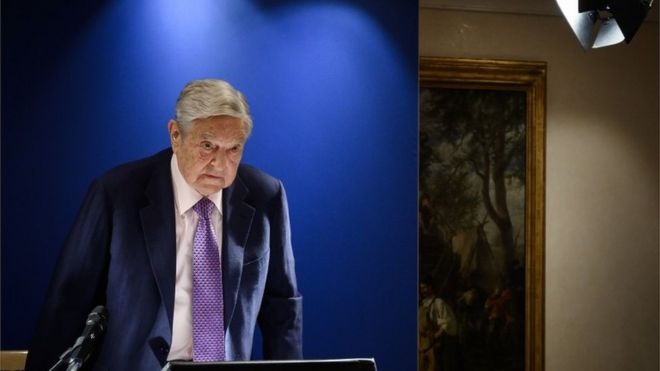
The billionaire philanthropist George Soros has used his annual speech at the World Economic Forum, in Davos, to launch a scathing attack on China and its president Xi Jinping.
Mr Soros warned that artificial intelligence and machine learning could be used to entrench totalitarian control in the country.
He said this scenario presented an “unprecedented danger”.
But he said the Chinese people were his “main source of hope”.
“China is not the only authoritarian regime in the world but it is the wealthiest, strongest and technologically most advanced,” he said, noting concerns too about Vladimir Putin’s Russia.
‘Security risk’
“This makes Xi Jinping the most dangerous opponent of open societies,” he said.
Mr Soros, a prominent donor to the Democratic Party in the US, also criticised the Trump administration’s stance towards China.
“Instead of waging a trade war with practically the whole world, the US should focus on China,” he said.
He urged Washington to crack down on Chinese technology companies such as Huawei and ZTE, which he said present an “unacceptable security risk for the rest of the world”.
More broadly, Mr Soros cautioned that repressive regimes could utilise technology to control their citizens, in what he called “a mortal threat to open societies”.
Image copyrightGETTY IMAGESImage caption \\
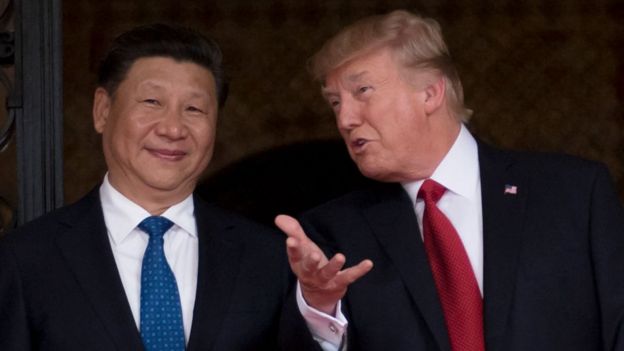
Both Xi Jinping and Donald Trump have been criticised by Mr Soros
The 88-year-old Hungarian-born Jewish businessman, who survived Nazi occupation by forging identity documents, became infamous for his involvement in the devaluation of the British pound, known as Black Wednesday.
But it is his philanthropic and political activities that have made him a divisive figure in the US, Europe and beyond.
Bribes
He has spent billions of his own money funding human rights projects and liberal democratic ventures around the world, and has become a frequent target for criticism by right-wing groups due to his support for liberal causes.
Much of the criticism aimed at him has been criticised as having anti-Semitic undertones.
Last year, a suspect package was found in a post box at his home in New York.
Mr Soros used his Davos speech last year to lambast tech giants such as Facebook, and what he considered to be their corrosive effect on democratic systems.
But this year, he directed his wrath towards Beijing, and particularly its controversial “Belt and Road” investment plan, which pays for road, rail and sea links to boost trade with countries around the world.
“It was designed to promote the interests of China, not the interests of the recipient countries,” he said.
“Its ambitious infrastructure projects were mainly financed by loans, not by grants, and foreign officials were often bribed to accept them.”
Downtown Changchun in China’s northeastern Jilin province was rocked by a series of explosions on Friday afternoon.
The Changchun fire department confirmed it received a call at about 3.13pm saying a car had exploded in the basement of a Wanda Shopping Plaza building.
Three minutes later, another blast erupted in a room on the 30th floor of the same building.
One person was found dead and another injured at the scene.
The police are treating the explosions as a “criminal case”.
Earlier, the municipal government confirmed a blast on the 30th floor and said one person had been found dead so far.
A witness dining at a restaurant in the plaza on Hongqi Street said people were asked to evacuate the buildings immediately, Beijing Youth Daily reported. Firefighters are clearing the area for investigation.
“There must have been more than 20 explosions. The shopping mall asked people over the public address system to leave right away, and we ran for our lives,” the woman, identified only by her family name Zhang, was quoted as saying.
She said she saw sparks around her as she ran out.
A video clip circulating online, which the South China Morning Post cannot independently verify, showed a bright beam of light accompanied by a bang from a room in a higher floor of the Wanda building, and another explosion and heavy smoke on the ground, with people running for safety.
BEIJING, Jan. 24 (Xinhua) — A reception was held Thursday for ethnic groups in Beijing ahead of the Spring Festival, the Chinese New Year.
Bater, vice chairman of the National Committee of the Chinese People’s Political Consultative Conference (CPPCC) and an ethnic Mongolian, delivered a speech at the event, which was presided over by Cao Jianmin, vice chairman of the National People’s Congress (NPC) Standing Committee.
While guaranteeing China’s national unification and ethnic unity, Bater said it is imperative to foster a strong sense of community for the Chinese nation, increase exchange and communication among people of ethnic groups and further efforts to lift areas inhabited by ethnic minorities out of poverty and help build them into moderately prosperous regions, in order to make new contribution to realizing Chinese Dream of national rejuvenation.
The event was jointly held by the United Front Work Department of the Communist Party of China, the ethnic affairs committee of the NPC, the National Ethnic Affairs Commission, the ethnic and religious affairs committee of the CPPCC National Committee and the Beijing municipal government.
The Chinese Lunar New Year falls on Feb. 5 this year. And the public holiday in association with it lasts from Feb. 4 to 10.
BEIJING, Jan. 24 (Xinhua) — Xu Qiliang, vice chairman of the Central Military Commission, said on Thursday that China and Australia should further strengthen their strategic communication and exchanges between the two militaries at all levels.
Xu made the remarks when meeting with visiting Australian Minister for Defense Christopher Pyne.
The mutually beneficial cooperation between China and Australia has promoted their respective development and benefited the two peoples, said Xu.
Xu noted that the two sides should respect each other, rationally view each other’s strategic intentions and strive to draw on each other’s strengths for mutual benefit and win-win results, so as to broaden the path of mutual cooperation.
Pyne said Australia attaches great importance to developing its relations with China and would like to strengthen pragmatic exchanges and cooperation with China in various fields to bring more benefits to the two peoples.
China’s State Councilor and Defense Minister Wei Fenghe also met Pyne on the day and told him that China and Australia are important countries in the Asia-Pacific region. To develop a healthy, stable and sustainable Sino-Australian relationship is in the fundamental interests of the two peoples and conducive to peace, stability and prosperity in the region.
Pyne said Australia appreciates China’s important role in international and regional affairs and is ready to work with China to develop stronger, friendly and dynamic relations between the two countries and militaries.
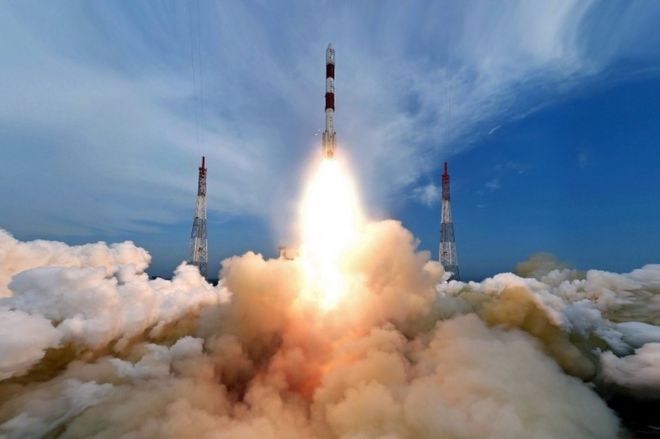
Image copyrightEPAImage captionThe rocket carrying the satellite will be launched from Sriharikota in southern India
India is due to launch what it says is the world’s lightest satellite ever to be put into orbit.
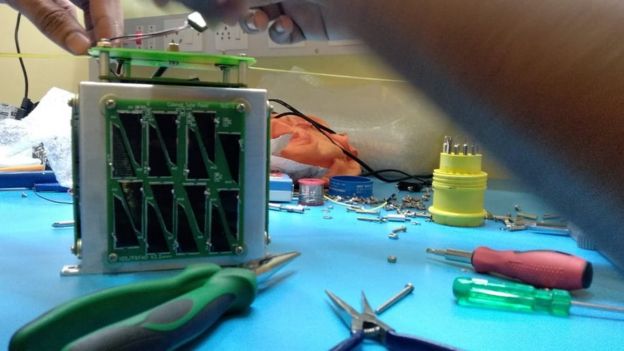
Weighing only 1.26kg (2.6lb), the Kalamsat-V2 has been made by students belonging to a space education firm.
It will help ham radio operators and “inspire schoolchildren to become the scientists and engineers of the future”, India’s space agency says.
The Indian Space Research Organisation (Isro) will launch the satellite from its Sriharikota space centre.
Isro chief K Sivan has claimed that “Kalamsat is the lightest satellite to be ever built and launched into orbit”.
It is equipped to serve as a communications satellite for ham radio transmission, a form of wireless communication used by amateurs for non-commercial activities.
An even lighter satellite, weighing 64 grams and built by the same group of students, was launched on a four-hour mission for a sub-orbital flight from a Nasa facility in the US in June 2017. Sub-orbital spaceflights technically enter space, but don’t get into orbit.
Kalamsat-V2 was made by students belonging to Space Kidz India, a Chennai-based space education firm. So far nine satellites made by Indian students have found a place on space rockets.
In a first, the Indian space agency is also going to reuse a stage of the rocket that will be used to launch the satellite.
Traditionally, rockets are expendable. Their various segments are discarded during an ascent. Fuel is also removed.
They end up as space debris – there are millions of discarded pieces of metal and other materials orbiting the Earth, ranging from defunct satellites to old rocket segments to accidentally dropped astronaut tools. Collisions can cause a great deal of damage, and generate even more pieces of debris.
Image captionWeighing only 1.26kg (2.6lb), the Kalamsat-V2 has been made by students belonging to a space education firm
The satellite is being launched by Isro’s reliable Indian Polar Satellite Launch Vehicle (PSLV) – a four-stage rocket that on this launch weighs about 260 tonnes.
Its first three segments usually drop back to Earth; its fourth and final stage uses liquid propellants, and can be stopped and restarted several times to get a spacecraft into just the right orbit.
The fourth stage can take the the satellite in Thursday’s launch to a height of 277km (172 miles) above earth.
But Isro is giving new capability to the last stage so that it can remain active in space for up to a year.
“Why waste such a valuable resource? We decided to convert [the fourth stage] into an experimental orbital platform to conduct small experiments in space,” says Mr Sivan. The PSLV rocket costs upwards of $28m (£21m).
The experimental orbital platform will help researchers carry out experiments in a near zero-gravity environment.
Innovative move
So in this mission, the last stage of the rocket will be “moved to a higher circular orbit” from where the Kalamsat-V2 is expected to beam down its signals.
“This is the first time Isro is conducting such an experiment to reclaim a dead rocket stage and to keep it alive,” Mr Sivan said.
In this new approach, researchers can simply bring in their payloads or experiments which will then be plugged into the equipment bay especially made in the spent rocket.
Isro is the not the first space agency to try this “waste to wealth innovation”.
Jean Yves-LeGall, president of the Centre National d’Etudes Spatiales (CNES), the French space agency, says they have used it “but did not find it a cost effective way to conduct experiments in space”.






COMMENTS: 4