Archive for ‘Chindia Alert’

01/01/2019

Xi congratulates Cuban leaders on 60th anniversary of revolution victory

BEIJING, Jan. 1 (Xinhua) — Chinese President Xi Jinping on Tuesday warmly congratulated Raul Castro, first secretary of the Central Committee of the Communist Party of Cuba, and Miguel Diaz-Canel, president of the Council of State and the Council of Ministers of Cuba, on the 60th anniversary of Cuba’s revolution victory on behalf of the Communist Party of China (CPC) and the Chinese government and people.

In his congratulatory message to Raul Castro, Xi, who is also general secretary of the CPC Central Committee, said under the strong leadership of the Communist Party of Cuba over the past 60 years, the Cuban government and people have made great achievements with hard work in the cause of socialist construction, which are highly appreciated and congratulated by the CPC and the Chinese government and people.

The relations between the two parties and two countries have stood the test of international vicissitudes and achieved fruitful results, making the two sides good friends, good comrades and good brothers, Xi noted.

Xi said he attaches great importance to the development of the China-Cuba friendship and is willing to work together with Raul Castro to lead bilateral relations to keep marching forward.

In his congratulatory message to Diaz-Canel, Xi said that the Communist Party of Cuba and its people are endeavoring to update and improve the nation’s socialist system, which will guarantee new developments in Cuba’s socialist cause.

Xi mentioned Diaz-Canel’s historic visit to China around a month ago, during which the two leaders proposed a blueprint for bilateral ties in the new era, adding that he is willing to join hands with Diaz-Canel for continuous development of China-Cuba relations.

Chinese Premier Li Keqiang also sent a congratulatory message to Diaz-Canel on Tuesday, saying Cuba has enjoyed flourishing national developments and will usher in a brighter future.

The two countries have always understood and supported each other, pushing bilateral relations for an all-round and in-depth development, said the premier.

Li also voiced hope that with the joint efforts from both sides, their traditional friendship will continue to bear fruits.

01/01/2019

Commentary: 40 years on, cooperation still set to define China-U.S. ties

CHINA-U.S.-DIPLOMATIC RELATIONS-40 YEARS

File photo taken on April 15, 1971 shows Chinese table tennis player Yang Ruihua (L) shaking hands with U.S. athlete Dick Miles prior to a friendship match, who had met each other since the 1959 World Table Tennis Championships, in Shanghai, east China. Exactly 40 years ago, Beijing and Washington officially established diplomatic relations, thus ending nearly three decades of isolation, hostility and even confrontation between two big countries with a combined population of over 1 billion, and resetting the course of history and international politics. Just like the “Ping-Pong Diplomacy” that marked a thaw in China-U.S. relations, the establishment of diplomatic ties was another wise and resolute decision made by then Chinese and American leaders with great political courage and far-reaching vision. In the past four decades, their successors have followed their footsteps, guiding the China-U.S. relationship through all complexities and difficulties to maintain a generally steady and smooth development. (Xinhua/Fang Guocai)

by Xinhua writers Zhou Xiaozheng, Xu Feng

BEIJING, Jan. 1 (Xinhua) — Exactly 40 years ago, Beijing and Washington officially established diplomatic relations, thus ending nearly three decades of isolation, hostility and even confrontation between two big countries with a combined population of over 1 billion, and resetting the course of history and international politics.

Just like the “Ping-Pong Diplomacy” that marked a thaw in China-U.S. relations, the establishment of diplomatic ties was another wise and resolute decision made by then Chinese and American leaders with great political courage and far-reaching vision. In the past four decades, their successors have followed their footsteps, guiding the China-U.S. relationship through all complexities and difficulties to maintain a generally steady and smooth development.

“There are a thousand reasons to make the China-U.S. relationship work, and no reason to break it,” Chinese President Xi Jinping said while meeting with his U.S. counterpart, Donald Trump, for the first time, at the Mar-a-Lago estate in the U.S. state of Florida in 2017. Indeed, the China-U.S. relationship is regarded by many as the world’s most important bilateral relationship.

The progress of China-U.S. ties in the past 40 years is nothing but staggering, far exceeding most people’s expectations. Bilateral trade grew from a negligible 2.5 billion U.S. dollars in the late 1970s to over 580 billion dollars in 2017, while the stock of two-way investment rose from practically nil to more than 230 billion dollars.

Even more amazing are the fast-paced changes in people-to-people relations. The Chinese, who once regarded having “overseas relations,” especially families or friends in the United States, as a political and social taboo, are now fervently sending their children — some 200,000 to 300,000 a year — to study in the United States. The Americans have also seen off the so-called “Red Scare” and started to embrace Chinese kung fu, giant pandas and even the learning of the Chinese language as their understanding of the once “mysterious Communist state” deepens.

The Pacific Ocean, which used to serve as a “natural moat” blocking direct transportation between the two countries, is now overflown by more than 300 two-way direct flights each week that carry a total of over 5 million visitors each year.

The 40th anniversary of China-U.S. diplomatic ties comes on the heels of the 40th anniversary of China’s reform and opening-up. The tremendous economic success and social progress China has scored over the past 40 years result primarily from the diligence, creativity and dedication of the Chinese people, but also benefit from the support and assistance from the rest of the world, including the United States.

In return, the rapidly developing China has never stopped merging with the wider world and playing its role as a responsible member of the international community. When the global financial crisis broke out in 2008, China, upholding an all-in-the-same-boat spirit, took swift action and joined the others in a concerted effort to contain the crisis and help bring the hard-hit U.S. and world economy back on track.

Forty years on, cooperation, which might just be one of the many options for China and the United States on Day One of their mended relationship, has turned out to be the best and only correct option. China-U.S. collaboration has not only created immense development opportunities and brought substantial benefits for both countries and both peoples, but also helped reshape the world order, accelerate globalization and improve global governance, thus serving as a major driving force of global peace and prosperity.

Without doubt, the past four decades have not been a smooth ride for China-U.S. relations. Even their economic and trade relations, now reputed as the “ballast stone for bilateral ties,” have experienced twists and turns, from the tough “textile and apparel quota restrictions” and tedious annual reviews of the “Most Favored Nation” status, to the prolonged talks on China’s entry into the World Trade Organization, as well as the ongoing economic and trade frictions. It also seems to be a topic for endless debate in the United States whether China should be seen as a “partner” or a “threat,” and whether the United States should adopt a strategy of “engagement” or “containment.”

As two major countries with different social systems, development paths and historical and cultural backgrounds, it is natural for China and the United States to have disagreements and encounter problems. But such disagreements and problems did not prevent the two countries from normalizing bilateral relations 40 years ago, nor should they be allowed to derail the sound development of bilateral ties today.

Both being great nations with great peoples, China and the United States need not be afraid of any fair, rational and healthy competition, but must be smart enough to avoid a zero-sum game, which harbors a high risk of dragging both nations back into a lose-lose situation of conflicts and confrontation.

At a time when the world is undergoing unprecedentedly profound changes and is fraught with risks and uncertainties, the global community expects even closer collaboration between the two largest economies, so as to help reinforce mankind’s response to numerous common challenges, such as climate change, terrorism, nuclear proliferation, and transnational crimes.

Forty years on, the China-U.S. relationship is once again at a critical point, leaving many on tenterhooks or in a state of speculation. Should the past 40 years be any guide, increasing understanding and win-win cooperation will overcome difficulties and challenges, and cooperation should and will remain at the core of bilateral ties in the long run.

It is all the more comforting and encouraging that both Xi and Trump, in their exchange of congratulatory messages upon the anniversary as well as on multiple other occasions of top-level interaction, vowed to push for more cooperation and further progress of China-U.S. ties.

History has proved that cooperation is the best choice for both sides, Xi said in the message, while Trump said it is his priority to promote cooperative and constructive U.S.-China relations.

From Mar-a-Lago to Beijing and Buenos Aires, meetings and direct communication between the two heads of state, featuring good personal chemistry and rapport at work, have played an irreplaceable role in navigating bilateral ties through uncharted waters. The world has high hopes for them to succeed.

01/01/2019

The Indian woman who makes ‘fake food’ for a living

You can look at it and you can even touch it – but you definitely can’t eat it!

Shilpa Mitha’s creations of classic Indian dishes made with clay went viral on Instagram, prompting her to quit her job and pursue her hobby of making food miniatures.

You can look at it and you can even touch it – but you definitely can’t eat it!

Shilpa Mitha’s creations of classic Indian dishes made with clay went viral on Instagram, prompting her to quit her job and pursue her hobby of making food miniatures.

01/01/2019

As temperatures fall, air quality worsens in Indian capital

NEW DELHI (Reuters) – Pollution levels spiked last week in New Delhi, India’s teeming capital of more than 20 million people, climbing to nearly 12 times the recommended level and exacerbating a public health crisis.

Senior government officials said the main reasons for the surge in the amount of toxic smog trapped over New Delhi were unusually cold air, including fog, and slow wind speeds.

Click here for an interactive Reuters graphic tmsnrt.rs/2GORiU9 on the link between Delhi’s pollution and falling temperatures and wind speeds.

The World Health Organization said this year India was home to the world’s 14 most polluted cities. New Delhi was ranked the sixth most polluted.

In the city on Sunday, levels of PM 2.5, the amount of tiny particulate matter under 2.5 micrograms found in every cubic meter of air, were at 415, well above “hazardous” levels, as defined by the U.S. Environmental Protection Agency. The agency says any level above 35 can be unhealthy.

Pollution levels were exacerbated because of fumes from vehicles, pollutants from coal-fired power plants and industries, as well as smoke from fires being burned to keep people warm.

In October and November, crop residue burning in the neighboring states of Haryana and Punjab also contributed to air pollution.

In India, air pollution claimed 1.24 million lives in 2017, or 12.5 percent of total deaths, according to a study published in Lancet Planetary Health this month.

01/01/2019

Surgical strikes was a ‘big risk’ but was more concerned about soldiers’ safety: PM Modi

This was the message of Prime Minister Narendra Modi to the Indian Army Special Forces’ commandos who went across the Line of Control (LoC) on September 28, 2016 to carry out surgical strikes at terrorist camps in Pakistan-occupied-Kashmir.

INDIA Updated: Jan 01, 2019 17:24 IST

Surgical strikes,Prime Minister Narendra Modi interview,India news
Prime Minister Narendra Modi(PTI file photo)

“Come back before sunrise, irrespective of the success or failure of the mission”.

This was the message of Prime Minister Narendra Modi to the Indian Army Special Forces’ commandos who went across the Line of Control (LoC) on September 28, 2016 to carry out surgical strikes at terrorist camps in Pakistan-occupied-Kashmir.

Modi, while revealing details of the military action for the first time, told ANI in an interview that the date of the attack was changed twice, keeping in mind the safety and security of the troops.

The strikes were carried out days after terrorists attacked an Army camp in Uri in Kashmir, killing 20 soldiers.

The Prime Minister said the surgical strikes were planned as there was a “rage” building up within him as well as the Army after soldiers were burnt alive in the terror attack in Uri.

“I gave clear orders that whether you get success or failure, don’t think about that but come back before sunrise. Don’t fall for the lure and prolong it (the operation),” he said, turning a bit emotional while discussing that operation.

Emphasising that he was determined to see that none of the soldiers died in the operation, he said he had told them that they must return before sunrise even if they fail.

The Prime Minister revealed that he was keeping tab of the risky operation throughout the night and was getting live information.

“I knew it was a big risk. I never care about any political risk to me. The biggest consideration for me was the safety of our soldiers,” he said.

He said he didn’t want any harm to come to the commandos who were “willing to sacrifice their lives on our word.”

The Prime Minister disclosed that the commandos for the operation were chosen carefully and then imparted special training. Whatever equipment was required, it was arranged for them, he said.

He said he was “anxious” throughout the time the soldiers were on the other side of the LoC and the moments became “extremely difficult” when the information flow stopped for about an hour in the morning.

“In the morning, information flow stopped, for an hour. My anxiety increased. Even one hour after sunrise. That time was extremely difficult for me… Then came the information that they have not reached back yet but two-three units have reached the safe zone, so don’t worry. But I said I won’t be fine till the last man returns,” Modi said.

On politicisation of the surgical strikes, the Prime Minister said it was not done by the government but by opposition parties, which “raised questions” over the military action and cited the Pakistani version to “lend weight to their doubts”.

The Prime Minister said that even before the country was informed about the strikes, Pakistan was told about it.

“An Army officer apprised the nation (India) of the operation. That information was given to Pakistan as well… But it is unfortunate for the country that the same day (of the surgical strike), leaders of some parties raised doubts over the surgical strikes,” Modi said.

“It was necessary for Pakistan to speak like this (to deny), to keep their morale intact. But what Pakistan was saying, was being said here too. To lend weight to their views, they were citing Pakistani version. Politicisation started from that point,” he added.

Delhi CM and AAP supremo Arvind Kejriwal in a series of tweets post surgical strikes raised doubts over the veracity of the Government’s claims. Kejriwal said that Pakistan had invited foreign journalists to view their side of the border to ascertain claims of a surgical strike. “BJP I believe you. But international media publishing Pak propaganda that no strike took place. Lets expose Pak propaganda,” tweeted Arvind Kejriwal on October 4th, 2016.

PM Modi added that the opposition leaders were speaking “rubbish” and “those who raised doubts over the Army action, were wrong and such politicisation should not have happened”.

Modi said lauding the valour of soldiers from all operations including the 1962 war with China was the duty of the government and citizens.

“If we don’t hail the valour of those who stake their lives for the country, then who will? So praising the Army should not be considered as politicisation,” he said.

The Prime Minister was asked whether the objectives of the surgical strikes were met, considering that cross-LoC attacks still continue in Kashmir.

In response, he said he would not like to discuss the issue in open domain.

But then he went on to add, “Ek ladai se Pakistan sudhar jayega, yeh sochne mein bahut badi galti hogi. Pakistan ko sudarne mein abhi aur samay lagega (It will be a big mistake to think that Pakistan will start behaving after one fight. It will take a long time for Pakistan to start behaving).

Talking about the Uri attack, Modi said, “That incident made me restless and there was rage within me. I had gone to Kerala and made a mention of this. Because I could not stop myself.

Modi said that while talking to the Army, he realised that they wanted justice for their martyred soldiers and the government gave them the “free hand” to plan and execute the surgical strikes.

Special training was imparted to the commandos and secrecy was maintained.

“The topography and obstacles were kept in consideration… It was a learning experience for me as well,” Modi said.

In September 2016, terrorists of Pakistan-based Jaish-e-Mohammed entered the Army camp in Uri near the Line of Control and killed 20 soldiers in the attack.

In retaliation, the Indian Army troops including the commandos from various units of the Para (Special Forces) units deployed in Jammu and Kashmir carried out raids across the border on multiple targets.

All these targets were launch pads for terrorists for infiltrating into Jammu and Kashmir for carrying out attacks against military and civilian targets.

Though the security forces are not sure about the exact number of casualties on the Pakistan side but based on post-operation intercepts and movements, it is believed that it had suffered around 50 casualties including its regular Army soldiers who were deployed for protecting the terror camps.

From the Indian side, only one soldier had suffered injury due to a personnel mine explosion while returning from the operation.

RAM TEMPLE

PM Modi suggested that the judicial process was being slowed down because Congress lawyers were creating “obstacles” in the Supreme Court.

“We have said in our BJP manifesto that a solution would be found to this issue under the ambit of the Constitution,” the Prime Minister said about the Ram temple matter when asked whether the Ram Mandir issue had been relegated as merely an emotive issue for the BJP.

The BJP, as articulated in its manifesto, wants building of a majestic Ram temple in Ayodhya. Recently, there has been a renewed pitch within the party as well as by its sister organisations in the Sangh Parivar for expediting the process of construction of the temple.

The Sangh Parivar organisations have expressed unhappiness over the delay in resolving the matter and there are demands for promulgating an Ordinance, similar to the one issued on Triple Talaq, to facilitate construction of a temple.

The demand for Ordinance has been articulated even by BJP’s ally the Shiv Sena.

Asked whether the government could consider issuing an Ordinance on Ram temple, the Prime Minister pointed out that the matter is before the Supreme Court and possibly in the final stages.

“Let the judicial process be over. After the judicial process is over, whatever will be our responsibility as the government, we are ready to make all efforts,” he added.

The matter is slated to be heard by the Supreme Court on January 4.

01/01/2019

Thousands march in Hong Kong against China ‘repression’ after grim 2018

HONG KONG (Reuters) – Thousands of demonstrators marched in Hong Kong on Tuesday to demand full democracy, fundamental rights, and even independence from China in the face of what many see as a marked clampdown by the Communist Party on local freedoms.

Over the past year, countries such as the United States and Britain have expressed concerns about a number of incidents they say have undermined confidence in Hong Kong’s freedoms and autonomy under Chinese rule.

These include the jailing of activists, a ban on a pro-independence political party, the de facto expulsion of a Western journalist and barring democracy activists from contesting local elections.

The New Year’s day march, which organisers said drew 5,800 people, included calls to restart stalled democratic reforms and to fight “political repression” from Beijing.

“Looking back at the year that passed, it was a very bad year … The rule of law in Hong Kong is falling backwards,” said Jimmy Sham, one of the organisers.

The former British colony returned to Chinese rule in 1997 under a “one country, two systems” formula, with the promise of a high degree of autonomy and universal suffrage as an “ultimate aim”.

While authorities have clamped down hard on the city’s fringe, pro-independence movement, that didn’t deter around 100 independence activists from joining the march, holding up banners and chanting for the city to split from China.

China considers Hong Kong to be an inalienable part of its territory, and denounces “separatists” as a threat to national sovereignty, even though the movement has not garnered much popular backing in the city.

“There will be continuous suppression on the Hong Kong independence movement, but the movement will grow stronger and stronger,” said Baggio Leung, an independence leader who said several of his members had been harassed by purported “triads” or gangsters, before the march.

Last year, in an unprecedented move, Hong Kong authorities banned a political group, the Hong Kong National Party, for its pro-independence stance on national security grounds.

A western journalist, Victor Mallet, was also effectively expelled from Hong Kong, soon after he hosted a talk at a press club by the head of the National Party.

Mallet’s visa denial, which the government has so far refused to explain, was criticised by some foreign governments and the American Chamber of Commerce.

Some protesters also carried “wanted” posters of Hong Kong’s top legal official, Theresa Cheng, criticising a decision to drop a corruption investigation into Hong Kong’s former pro-Beijing leader Leung Chun-ying, without a satisfactory explanation.

“I’m afraid the pressure will continue,” said Joseph Cheng, a veteran rights campaigner and retired professor who was raising money for a “justice” fund for activists facing hefty legal fees for several trials.

“We’re going to face a few difficult years, but we must stand firm … Unlike in mainland China, at least we can still protest.”

01/01/2019

An ‘atheist’ empire? Trump aides rally evangelicals in China fight

  • Religious freedom is a growing theme of President Donald Trump’s confrontation with Beijing, and it’s resonating with Christian leaders
PUBLISHED : Tuesday, 01 January, 2019, 5:07pm
UPDATED : Tuesday, 01 January, 2019, 5:07pm

Vice-President Mike Pence infuriated Beijing when he gave a speech in October warning that China had become a dangerous rival to the United States. While he focused on familiar issues such as China’s trade policies and cyber espionage, Pence also denounced the country’s “avowedly atheist Communist Party”.

Citing a crackdown on organised religion in the country, Pence noted that Chinese authorities “are tearing down crosses, burning Bibles and imprisoning believers”.

“For China’s Christians,” Pence said, “these are desperate times.”

Pence’s remarks, which also addressed the repression of Chinese Buddhists and Muslims, illustrated how religious freedom is a growing theme of President Donald Trump’s confrontation with Beijing, which some foreign policy insiders warn could develop into a new cold war.

It is a subject that resonates in the US heartland, some Christian leaders say – parts of which, including rural areas, are disproportionately at risk of fallout from Trump’s trade fight with the Asian giant.

The issue has gained new resonance with Beijing’s arrest this month of a prominent Christian pastor and more than 100 members of his congregation.

The arrests have drawn close coverage from evangelical outlets such as Pat Robertson’s Christian Broadcasting Network (CBN), whose website published an open letter by the jailed pastor, Wang Yi, declaring his “anger and disgust at the persecution of the church by this Communist regime”.

Days after the arrests, Trump’s ambassador for international religious freedom, the former Kansas Republican governor Sam Brownback, decried the crackdown and said that in the weeks since Pence’s speech, religious freedom concerns “have only grown”.

While China’s religious persecution draws less media attention than issues like soybean tariffs and cyber espionage, it is closely tracked by conservative Christian activists and outlets like CBN, where a typical headline recently reported: “Chinese Government Destroys Christian Church, Bills Pastor for Demolition.”

In September, Providence Magazine, which covers US foreign policy from a Christian perspective, wrote that in 2018 China’s religious repression has reached “a sustained intensity not seen since the Cultural Revolution”.

The Trump administration has repeatedly criticised China on such grounds.

In a report on international religious freedom released earlier this year, the State Department noted that throughout China there were reports of “deaths in detention of religious adherents as well as reports the government physically abused, detained, arrested, tortured, sentenced to prison, or harassed adherents of both registered and unregistered religious groups for activities related to their religious beliefs and practices”.

Religious activists note that Pence, Brownback, Secretary of State Mike Pompeo and other top Trump aides are people of faith with genuine concerns about religious freedom. But even they acknowledge the subject happens to be a potent political message for religious conservatives and may help rally them behind Trump’s confrontational China policy.

Some religious leaders even hear an echo of history: cold war-era denunciations of “godless” Soviet communism by past US presidents, notably Ronald Reagan

“In the great heartland of America, where there tend to be higher levels of people who care about faith, reminding people that a regime – whether then the Soviet Union or today’s communist China – rejects God and has an official policy of atheism is helpful in getting them to understand why our government is taking certain actions in the foreign policy area,” said Gary Bauer, a longtime conservative Christian leader whom Trump appointed to the US Commission on International Religious Freedom.

“Evil empire” was the famous label then-president Reagan applied to the Soviet Union in 1983. Less remembered is the fact that Reagan was addressing the National Association of Evangelicals.

Reagan vowed at the time that the Soviets “must be made to understand: … We will never abandon our belief in God”.

Trump himself rarely addresses religious freedom or human rights, and when it comes to China he focuses mainly on Beijing’s trade practices. But his administration – backed by an evangelical base that stood for Trump in 2016 and continues to supporthim enthusiastically – has strongly emphasised international religious freedom.

Earlier this year, for instance, the State Department hosted a first-ever gathering of foreign ministers devoted to the subject. (China was not invited and was targeted in a joint statement signed by a handful of countries, including the US.)

“This administration is putting this in the matrix of all of our policy,” said Tony Perkins, another prominent Christian conservative who serves on the religious freedom commission and is close to the White House. “It’s more than just the throwaway line.”

Pompeo, a former Republican congressman from Kansas, has also assailed Beijing for religious persecution, including at a September speech at the Values Voter Summit in Washington, an event affiliated with the Perkins-led Family Research Council.

During an appearance which some critics called inappropriately political, Pompeo decried “an intense new government crackdown on Christians in China, which includes heinous actions like closing churches, burning Bibles, and ordering followers to sign papers renouncing their faith”.

Like Pence, Pompeo also dwelled on the plight of China’s Muslim population, particularly ethnic Uygurs from the Chinese province of Xinjiang. A State Department official recently testified before lawmakers that up to 2 million Muslims are now confined to special camps in China.

“Their religious beliefs are decimated,” Pompeo told Values Voter Summit attendees.

The Chinese government, which often casts Uygur Muslims as potential terrorists, says the camps are designed to teach vocational and life skills. But the State Department official, Scott Busby, said the goal appears to be “forcing detainees to renounce Islam and embrace the Chinese Communist Party”.

While evangelical groups active in Washington tend to focus primarily on the persecution of Christians in China and elsewhere, some make sure to point out that they care about religious freedom for all faith groups, including Muslims. In a past interview with POLITICO, Brownback stressed that he also wants to protect people’s right to have “no religion at all”.

The Trump administration may unveil a set of human rights-related sanctions targeting officials in a range of countries in the coming weeks. Some China observers are hopeful the list will include Chen Quanguo, a top Communist Party official said to have orchestrated the anti-Muslim crackdown and to have had a role in repressing Tibetan Buddhists.

“It’s a critical moment,” said Bob Fu, a US-based pastor and founder of ChinaAid, a group that advocates for religious freedom in China.

Brownback did not offer comment for this story, and a spokesman for Pompeo did not immediately respond to a request for comment. A White House spokesperson said of Pence that “religious freedom throughout the world is a top priority for the vice-president and the administration as a whole”.

Bauer predicted that evangelicals and other voters in the US heartland will continue to support Trump even if he expands his trade war with China. The administration, cognizant of the potential pain for its supporters, has taken some steps to cushion the blow, such as offering farming subsidies.

By retaliating against particular US industries, such as soybean farmers, China is trying to pressure the administration. “I think China will fail in this effort and support for the Trump-Pence policies will remain strong,” Bauer said.

When it comes to pleasing the religious right, the Trump administration has been willing to make some dicey moves.

This past summer, to the shock of the foreign policy establishment, Trump imposed economic sanctions on two Cabinet officials in Turkey – an important US ally and fellow Nato member – due to the questionable imprisonment of an American pastor, Andrew Brunson.

Brunson, whose cause was championed by evangelicals, was eventually freed and the sanctions lifted.

How far the administration will push Beijing on religious freedom could come down to the president himself and what China is willing to do to assuage his concerns on trade.

Trump, after all, has been willing to drop talk of human rights issues when it seems he’s making progress on other fronts – that’s what has happened in his dealings with North Korea.

The Chinese in particular are highly sensitive to their global image, and, like the Soviet Union, China cannot be ignored.

“If this tariff business gets really bad and the economy goes down, I wouldn’t be surprised if [Trump officials] ramp up the ‘evil empire’ language,” said a Senate Democratic aide. “It inoculates them from their base.”

But “if you start using the ‘evil empire’ language”, the aide added, “it’s harder to make up and kiss and be friends.”

01/01/2019

Xi, Trump exchange congratulations over 40th anniversary of China-U.S. diplomatic ties

BEIJING, Jan. 1 (Xinhua) — Chinese President Xi Jinping and U.S. President Donald Trump on Tuesday exchanged congratulations on the 40th anniversary of the establishment of China-U.S. diplomatic relations.

In his congratulatory message, Xi said China-U.S. relations have experienced ups and downs and made historic progress over the past 40 years, bringing huge benefits to the two peoples and contributing greatly to world peace, stability and prosperity.

History has proved that cooperation is the best choice for both sides, Xi said.

Currently, China-U.S. relations are in an important stage, he noted.

“I attach great importance to the development of China-U.S. relations and am willing to work with President Trump to summarize the experience of the development of China-U.S. relations and implement the consensus we have reached in a joint effort to advance China-U.S. relations featuring coordination, cooperation and stability so as to better benefit the two peoples as well as the people of the rest of the world,” Xi said.

For his part, Trump said Jan. 1, 2019 marks the 40th anniversary of the establishment of U.S.-China diplomatic relations.

Great progress has been made in the development of bilateral ties over the past years, he noted.

Trump said it is his priority to promote cooperative and constructive U.S.-China relations, adding that his solid friendship with President Xi has laid a firm foundation for the great achievements of the two countries in coming years.

31/12/2018

Why legalising gay sex in India is not a Western idea


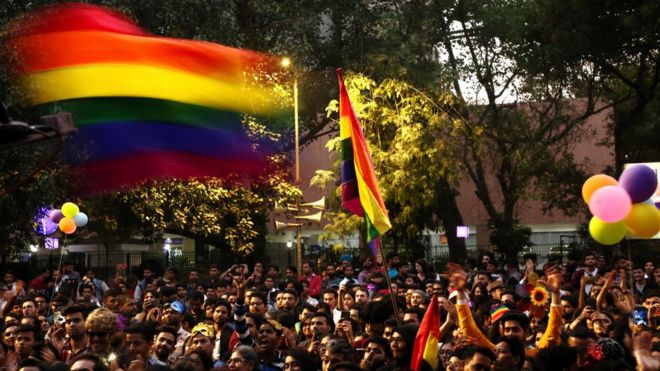
Members and supporters of the lesbian, gay, bisexual, transgender (LGBT) community take part in Delhi's Queer Pride Parade from Barakhamba Road to Parliament Street, on November 25, 2018 in New Delhi, IndiaImage copyrightGETTY IMAGES
Image captionIndia’s Supreme Court made gay sex legal in September 2018

The decriminalisation of gay sex was arguably the biggest news story of 2018 in India.

So, it wasn’t surprising when it became a hotly debated topic at one of the year-end parties I recently attended in Delhi.

The common consensus was that the Supreme Court’s decision to strike down a colonial-era law has pushed the country towards adopting Western ideals of liberalism in India.

“We are on par with countries like the UK, France and other European nations where homosexuality is legal,” one of my friends excitedly announced.

“We are now like the West when it comes to our attitudes toward LGBT people.”

Similar discussions have been taking place on social media where many agree with this view.

But is it true?

India’s historians and mythology experts have differing views.

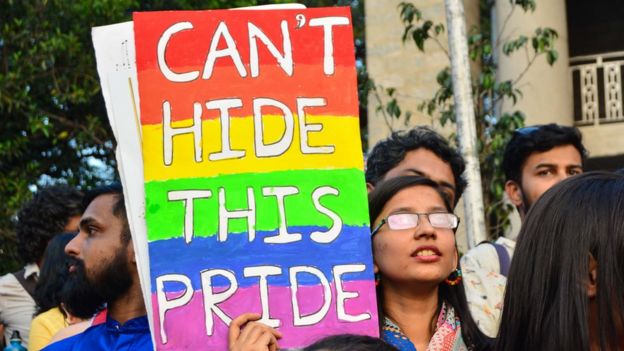
A protester seen holding a placard saying can't hide this pride during the protest.Image copyrightGETTY IMAGES
Image captionMost Indian cities witnessed celebrations after the ruling

Noted historian Harbans Mukhia says one has to know India’s history to understand why the British made gay sex illegal.

“The British brought their own rules to India, including the Section 377 which banned homosexuality and made it a criminal act. This law was enforced by them but it didn’t conform with India’s attitude toward homosexuality. It was more to do with their Christian belief systems,” he says.

He adds that the court’s decision has taken India back to its roots.

Other experts also believe that India had a more open attitude to homosexuality before the Raj and there is ample evidence of it in medieval history and mythology.

Historian Rana Safvi says “love was celebrated in India in every form”.

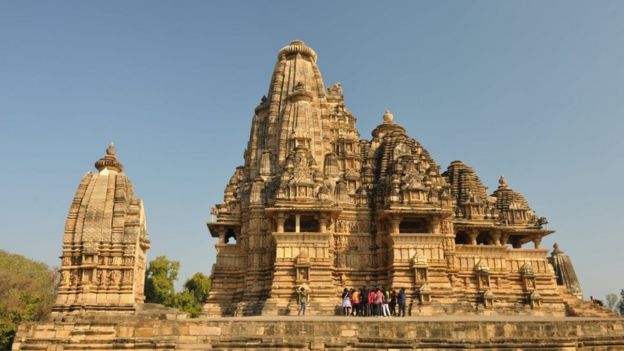
“Whether ancient or medieval India, fluid sexuality was present in the society. One can see the depictions of homosexuality in the temples of Khajuraho and Mughal chronicles,” she says.

The most vivid example of this can be seen in Khajuraho town of the central state of Madhya Pradesh.

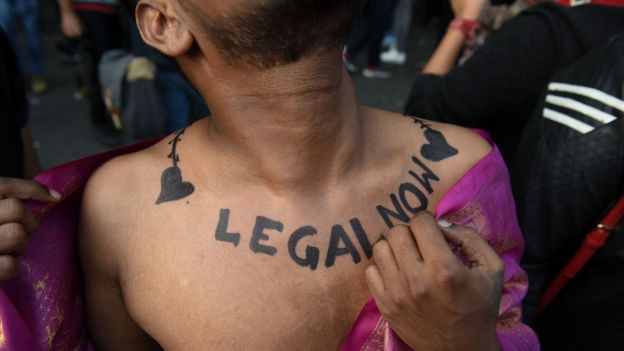
Member and supporter of the lesbian, gay, bisexual, transgender and queer (LGBTQ) community flaunts his body art at New Delhi's Queer Pride Parade in IndiaImage copyrightGETTY IMAGES
Image captionThe fight to decriminalise gay sex took decades of legal fight

The temple complex was built between 950 and 1050 by the Chandela dynasty. The erotic sculptures in the temple vividly depict homosexuality. Similar temple art can also be seen in the 13th-Century Sun Temple in Konark in the eastern state of Orissa, and Buddhist monastic caves at Ajanta and Ellora in the western state of Maharashtra.

Mythologist Devdutt Patnaik has often explained the presence and acceptance of homosexuality in Hinduism.

“The term homosexuality and the laws prohibiting ‘unnatural’ sex were imposed across the world through imperial might. Though they exerted a powerful influence on subsequent attitudes, they were neither universal nor timeless. They were – it must be kept in mind – products of minds that were deeply influenced by the ‘sex is sin’ stance of the Christian Bible,” he writes in an article on his website.

“With typical colonial condescension, European definitions, laws, theories and attitudes totally disregarded how similar sexual activity was perceived in other cultures.”

He believes that criminalisation of homosexuality was entirely a foreign concept.

“An overview of temple imagery, sacred narratives and religious scriptures does suggest that homosexual activities – in some form – did exist in ancient India. Though not part of the mainstream, its existence was acknowledged but not approved,” he writes.

Khajuraho temples are a popular tourist destinationImage copyrightGETTY IMAGES
Image captionKhajuraho temples are a popular tourist destination

Prof Mukhia says books and scriptures from medieval times also suggest that homosexuality was not looked down upon.

“There was some disproval for homosexuality but LGBT people were not ostracised. The society was tolerant towards them and nobody was hounded for being a homosexual.

“Alauddin Khalji’s son, Mubarak, was known to be in a relationship with one of the noble men in his court,” he adds. Khalji ruled the Delhi sultanate between 1296 and 1316.

Babur, who founded the Mughal dynasty which ruled most of what is now India and Pakistan in the 16th and 17th Centuries, also wrote about his love for men.

“He wrote, without any sense of embarrassment, that he was in love with a boy named Baburi. There was no disapproval about his writing during his time or even after that,” Prof Mukhia adds.

Historians also believe that India’s conservative outlook about homosexuality started with the British Raj and became stronger after independence.

Prof Mukhia adds that the Section 377 remained in place event after India’s independence in 1947 largely because of “our ignorance of history and politicians’ apathy”.

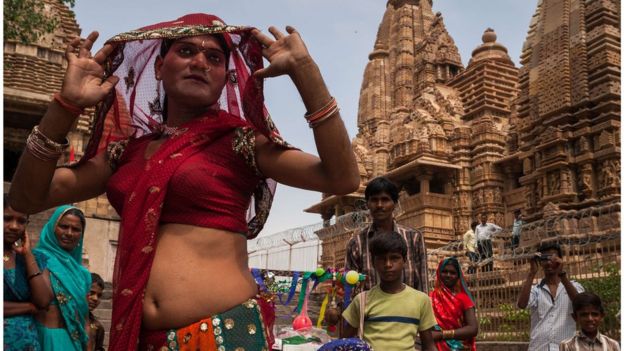
A group of hijras dancing in front of Khajuraho temples in Madhya Pradesh, India.Image copyrightGETTY IMAGES
Image captionLGBTQ community wants India to become more liberal

Keshav Suri, the owner of a hotel chain and a prominent LGBT rights activist, believes that young people need to be educated about the country’s LGBT history.

“I wasn’t taught in school about Khajuraho and the presence of LGBT characters in our mythology. That has to change. Transgender people were considered gods and goddesses. They were great poets, artists and even administrators in medieval times,” he says.

He adds that young people need to know that we were a much open and tolerant society in the past.

Prof Mukhia agrees.

“In 2018, we recovered what we had lost during colonial times – a more open attitude toward the LGBT community.”

31/12/2018

India university official urges students to kill instead of complaining

NEW DELHI (Reuters) – A top official at a Indian state-run university urged his students to “murder” fellow students if confronted instead of complaining to him, amid a wave of violence being reported from across the state where the school is based.

“If you’re a student of this University, never come crying to me,” said Raja Ram Yadav, vice-chancellor of Purvanchal University, in a speech, video from Reuters partner ANI showed.

Adding: “If you ever get into a fight, beat them, if possible murder them, we’ll take care of it later.”

Yadav was speaking on Friday at a college event in Ghazipur in Uttar Pradesh, India’s most populous state. In the same city a police officer was stoned to death during violent protests on Saturday, though there is no indication of a link with Yadav’s remarks.

Uttar Pradesh is notorious for communal tensions and crime, and has been plagued by incidents of mob violence in recent weeks.

A senior police officer and another man were killed in another incident of violence earlier this month after local residents protested because they say they had seen some people slaughtering a cow, an animal sacred in Hindu culture. That was in Uttar Pradesh’s Bulandshahr district.

Law of Unintended Consequences

continuously updated blog about China & India

ChiaHou's Book Reviews

continuously updated blog about China & India

What's wrong with the world; and its economy

continuously updated blog about China & India