Chindia Alert: You’ll be Living in their World Very Soon
aims to alert you to the threats and opportunities that China and India present. China and India require serious attention; case of ‘hidden dragon and crouching tiger’.
Without this attention, governments, businesses and, indeed, individuals may find themselves at a great disadvantage sooner rather than later.
The POSTs (front webpages) are mainly 'cuttings' from reliable sources, updated continuously.
The PAGEs (see Tabs, above) attempt to make the information more meaningful by putting some structure to the information we have researched and assembled since 2006.
MONTREAL (Reuters) – A Canadian citizen who was detained in China this month has returned to Canada after being released from custody, a Canadian government spokesman said on Friday.
The spokesman did not specify when the Canadian was released or returned to Canada. Earlier in the day, broadcaster CBC identified the citizen as Canadian teacher Sarah McIver.
China’s Foreign Ministry said this month that McIver was undergoing “administrative punishment” for working illegally.
McIver was the third Canadian to be detained by China following the Dec. 1 arrest in Vancouver of Meng Wanzhou, chief financial officer of the Chinese telecommunications giant Huawei Technologies Co Ltd., but a Canadian official said there was no reason to believe that the woman’s detention was linked to the earlier arrests.
Foreign Minister Chrystia Freeland did not mention the woman in calling for the release of the other two Canadians last week.
China’s Foreign Ministry said in a statement sent to Reuters that it was aware of reports she had been released, and referred further questions to the “relevant authority”. It did not elaborate.
On Saturday, a Chinese court is hearing an appeal in the case of a Canadian citizen held on drugs charges, that could further test the tense relations between the two countries.
The high court in the city of Dalian in the northeastern province of Liaoning will hear the appeal of Robert Lloyd Schellenberg from 2 p.m. (0600 GMT), it said in a statement this week.
A Dalian government news portal said Schellenberg was a Canadian and that this was an appeal hearing after he was found by an earlier ruling to have smuggled “an enormous amount of drugs” into China.
Canada’s government said this week it had been following the case for several years and providing consular assistance, but could provide no other details, citing privacy concerns.
Drugs offences are usually punished severely in China.
China executed a Briton caught smuggling heroin in 2009, prompting a British outcry over what it said was the lack of any mental health assessment.
Image copyrightIQIYIImage captionThe Story of Yanxi Palace revolves around its female protagonist, Wei Yingluo
It has love but also hatred, intrigue, revenge, poisoning rivals and even killing babies.
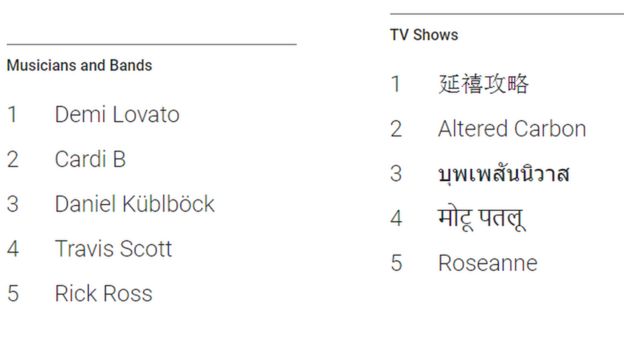
The Chinese drama Story of Yanxi Palace is the most Googled TV show of 2018 globally, despite Google being largely blocked in the country.
The search engine’s analytics suggested that the top interest in the drama has come from Asian regions like Singapore, Malaysia, Brunei and Hong Kong, but its popularity in mainland China has been overwhelming as well.
The series has been streamed more than 15 billion times on iQiyi, China’s Netflix-like site where the show premiered in July before it reached domestic TV channels and more than 70 markets abroad. It was the most watched online drama in China for 39 consecutive days over the summer.
The 70-episode Story of Yanxi Palace fictionalised the power struggles among the concubines of Emperor Qianlong in the 1700s.
The protagonist, a smart girl with a humble background, manages to rise through the ranks among the harem and wins both love and respect from the emperor.
Image copyrightGOOGLEImage captionThe Chinese title of Yanxi Palace appears as the most Googled TV show of 2018
Its theme may be likened to a Cinderella tale or Netflix’s The Crown that chronicles the reign of Queen Elizabeth II. But its own uniqueness has made it the undisputed entertainment sensation of the year.
Here’s how it took over China and its neighbouring regions.
It catches up with a trend of feminist shows
The heroine of the show, Wei Yingluo, is unlike most traditional Chinese female characters who are taught to be tolerant, submissive and fragile.
Inspired by the actual real-life consort of Emperor Qianlong, the story follows Yingluo as a woman of Chinese Han ethnicity in the Qing dynasty – the last imperial dynasty in China ruled by the Manchurian ethnicity that suppressed the Han people.
But her intelligence, determination and appropriate ferocity meant she was eventually granted her the title of imperial noble consort, the highest possible position for a Han person at that time.
Yingluo’s most famous line from the show goes like this : “I, Wei Yingluo, am naturally hot-tempered and not to be pushed around. Whoever keeps talking [nonsense], I have all kinds of methods to go against her.”
Image copyrightIQIYIImage captionWei Yingluo started off as a servant in the palace but slowly worked her way up
The woman she is based on – Xiaoyichun – was posthumously given the title of empress, making her the only Han empress during the Manchu-reigned dynasty.
The show comes as the latest example of how feminist-themed soap operas have captured Chinese audiences.
Other shows like The Legend of Zhenhuan – another imperial rising-up-the-ranks story bought by Netflix – and The Empress of China, that tells the story of the only female emperor in Chinese history, have also taken off in China.
It didn’t face much censorship
Before the show aired on TV screens, it was shown online.
The co-producer and initial distributor of the series, iQiyi, is one of China’s most popular online video platforms – helping the show gain large traffic and, more importantly, easier regulatory scrutiny for its debut.
In China, the National Radio and Television Administration oversees all content on radio and television. A TV project has to obtain the go-ahead from it even before shooting starts.
When video sites emerged a few years ago, they could publish anything as long as they thought it was within the regulator’s rules.
In 2016, an online series featuring gay love went viral but was taken off in the middle of the streaming season. A year later, a a ban on homosexual content was issued.
Online video platforms can’t broadcast shows at will but the censorship they go through is much lighter than TV channels, which are mostly owned by the government.
Low-cost cast, high-quality production
No actor in the show is very famous, except for one Hong Kong actress, Charmaine Sheh, who was willing to play a supporting role.
Gong Yu, founder and CEO of iQiyi, said the company had “deliberately cast lesser known actors… rejecting recent trends in the Chinese industry that put too much emphasis of the celebrity appeal of actors in their productions”.
It came at an essential time when Chinese celebrities’ high income and ambiguous tax practices had caught the attention of the authorities.
Total spending on the show’s cast didn’t even reach one tenth of the total production cost, according to Chinese magazine Portrait citing series producer Yu Zheng, who added that the rest of the money was mainly spent on things like costume and make-up.
Image copyrightIQIYIImage captionThe detailed costumes and intricate sets won over audiences
The well-built sets, elaborate costumes, make-up and attention to detail have won viewers’ love.
For example, concubines in the show wear three earrings on each side, as was the tradition of Manchu women at that time.
So if you’ve never heard of Yanxi Palace, you could try Googling it – you wouldn’t be the first.
US President Donald Trump’s surprise decision to withdraw US forces from Syria will leave China’s intended investment into the country’s reconstruction in uncertainty, analysts said, adding that the move might also suggest a stronger strategic focus by Washington on the Indo-Pacific region to put pressure on Beijing.
Experts said it remains unclear when the troop withdrawals will be completed but the departure is likely to prolong instability in Syria and delay its reconstruction.
“Trump is restarting the game and all parties there will make their own moves. China is watching closely how changes in the Middle East would affect its own interests there,” said Wu Xinbo, director of the Centre for American Studies at Fudan University in Shanghai.
China has kept its distance from the Syria conflict but is interested in promoting its economic presence in the war-torn country under the “Belt and Road Initiative”, according to Wang Jian, a Middle East expert at the Chinese Academy of Social Sciences in Beijing.
“Chinese companies and investment cannot hurry now,” he said, adding that security would be a major concern with the withdrawal of US troops.
“If the security situation worsens, it will affect China’s intended economic cooperation in the region. Security risks may also spill over to other countries such as Turkey, Saudi Arabia and the UAE where China has extensive economic interests.
Although China is the world’s biggest oil importing country and heavily relies on energy imports from the Middle East, it does not have a military presence in the region.
Chinese businesses used to invest in and trade with Syria before the civil war broke out in 2011. Bilateral trade between China and Syria amounted to US$2.4 billion that year. Almost all Chinese companies have since pulled out or suspended operations there.
But should the situation stabilise, Chinese companies will return and Beijing is keenly interested in reconstruction. Analysts said the belt and road plan emphasises trade and infrastructure construction, and that both will be urgently needed when reconstruction begins. According to United Nations estimates, the seven-year military conflict has wiped out nearly US$400 billion worth of assets in Syria.
Analysts said also that Chinese businesses were likely to be welcome in a post-war Syria as they have been in Iraq. In a recent interview with Xinhua, Wafiqa Hosni, Syria’s state minister for investment affairs, said the Assad government considered China, which has taken a stance similar to that of Russia at the UN Security Council concerning Syrian issues, a “friendly country”.
China, meanwhile, has already taken steps to establish an early foothold in the Syrian market. Last year, it convened its first “Syria Reconstruction Projects Fair” in Beijing, putting forward a US$2 billion plan to build an industrial estate in the country that could accommodate as many as 150 companies.
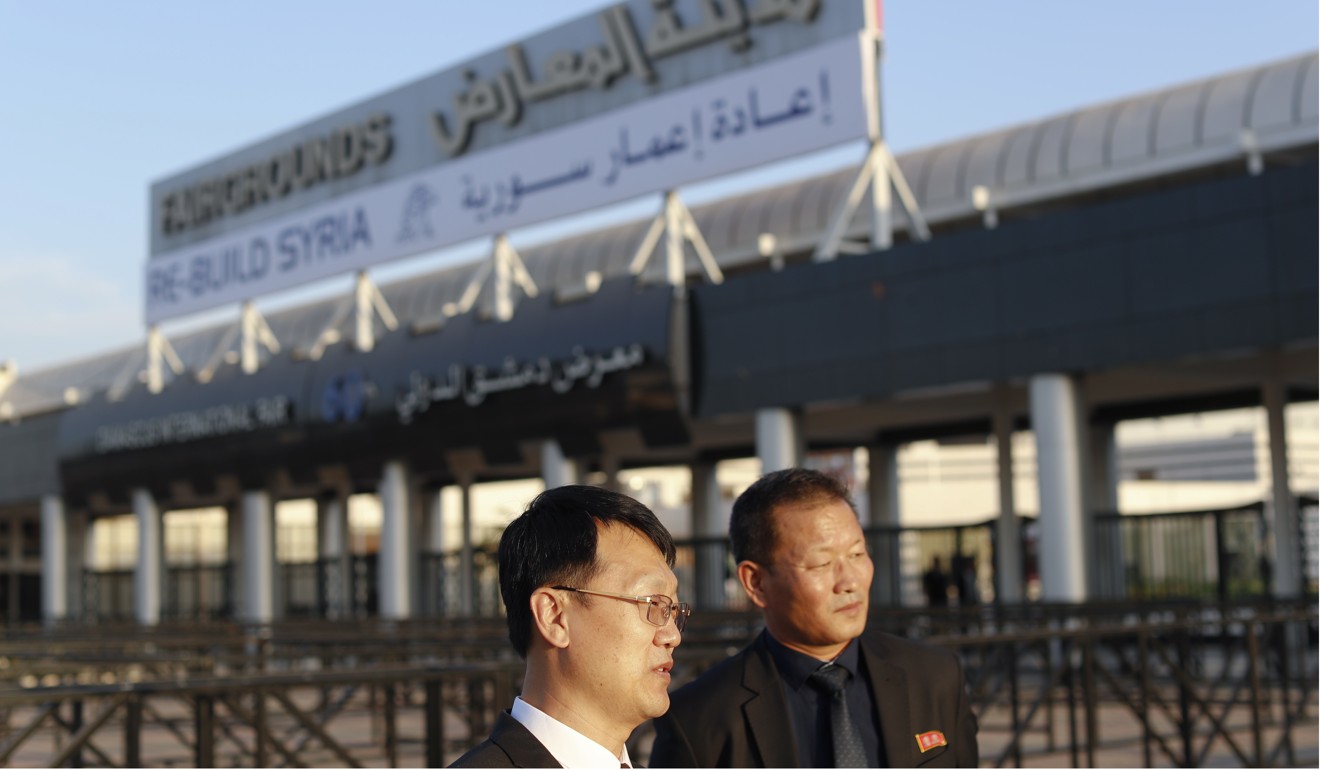
in September, China sent a delegation of 200 companies to the 60th Damascus International Fair, most of which are state-owned enterprises looking to tap in Syria and build a working relationship in its reconstruction process.
John Lee, a professor at the University of Sydney in Australia and a senior fellow at the Hudson Institute in Washington, said the troop withdrawal may also signal a rethinking of Washington’s Indo-Pacific policies.
“It represents a shift in strategic thinking [in the US] that the Middle East is becoming less important to America as more attention is being directed towards the Indo-Pacific,” he said.
“The US already views China as its primary and long-term challenge. This is brought out in the National Security Strategy, National Defence Strategy and in the speech by Vice-President Mike Pence.”
The US military’s Pacific Command has been renamed Indo-Pacific Command, and plans to upgrade equipment and weapons systems and enhance exercises with its regional allies. More specifically, it has increased patrols in the South China Sea to challenge China’s territorial claims.
In the past two years, the US navy has carried out eight freedom of navigation operations near the China’s controlled islands in the South China Sea.
However, Wu from Fudan University believes the use of US military forces in the Indo-Pacific will be limited. Their purpose, he said, was mainly to maintain a presence and profile of the US in the region for its allies and to pressure China.
“It’s unlikely that the US will take China’s South China Sea islands by force or force China to give up its ‘Maritime Silk Road’ plans,” he said, referring to Beijing’s strategy to boost infrastructure connectivity throughout Southeast Asia, Oceania and East African countries.
“I am not convinced the US will actually use military means in this region.”
BEIJING, Dec. 28 (Xinhua) — A Chinese Foreign Ministry spokesperson on Friday applauded the Maldivian Foreign Minister Abdulla Shahid’s remarks that the Maldives will continue to work with China under the framework of the Belt and Road Initiative (BRI).
Shahid on Thursday said in an interview that the Maldivian new government will continue with the projects initiated in the Maldives under the China-proposed BRI.
Spokesperson Hua Chunying told a press briefing that Shahid’s remarks showcased the willingness of the Maldivian new government to develop bilateral ties.
Hua said China and the Maldives have promoted cooperation on the construction of bridges, airports, housing and other projects related to people’s livelihoods based on mutual respect and equal treatment, which has played a positive role in promoting the economic transformation and upgrading of the Maldives and improving people’s living conditions.
The China-Maldives Friendship Bridge, which opened to traffic in August, has not only facilitated the interconnection of infrastructure in the Maldives but also brought tangible benefits and improved lives of local people, said the spokesperson.
China is ready to work with the Maldivian new government to consolidate traditional friendship, better dovetail development strategies, further bilateral pragmatic cooperation and push forward mutual beneficial and win-win cooperation under the framework of the BRI, so as to constantly enrich the China-Maldives Future-Oriented All-round Friendly and Cooperative Partnership, Hua said.
HIVARGAON/MUJAHIDPUR, India (Reuters) – A spike in the price of onions has led to the ouster of governments in Indian elections in the past. Now, prices of the staple have collapsed, and many impoverished farmers are saying they will make Prime Minister Narendra Modi pay in next year’s general election.
Steep drops in recent weeks in the prices of onions and potatoes, both staple foods for India’s 1.3 billion people, have badly hit the rural economy in large states.
In interviews with dozens of farmers last week, Reuters reporters found resentment welling against Modi’s Hindu nationalist Bharatiya Janata Party (BJP) for not helping support incomes in the countryside, where a majority of the population lives.
“Whatever they do in the coming months, I will vote against the BJP. I won’t repeat the 2014 mistake,” said Madhukar Nagare, an onion grower from Nashik in Maharashtra state, referring to his backing the BJP at the last general election.
In the 1998 state elections, a sharp spike in onion prices led to the fall of the BJP government in the capital New Delhi.
In the 1980 general election, sky-high onion prices helped former Prime Minister Indira Gandhi dislodge a coalition government that had included politicians who later formed the BJP.
In recent weeks, loss-stricken farmers have staged protests, blocked highways and dumped onions on the road after prices plunged to as low as one rupee (1.4 U.S. cents) per kg for a crop that costs about 8 rupees a kg to produce.
But because of large cuts taken by middlemen, consumers have not benefited from the low prices.
In Maharashtra, the top onion producing state, farm prices have fallen 83 percent, dragged down by surplus supplies from the previous season’s crop and lower export orders from the Middle East and Southeast Asia.
And in India’s most populous state of Uttar Pradesh, which was crucial in Modi’s election win in 2014, there is a similar problem with low potato prices.
Maharashtra and Uttar Pradesh are both dominated by rural voters and together send 128 lawmakers to the 545-member lower house of parliament. It means that big losses in these two states could either see Modi lose the next election which is due by May or his party be forced to form a coalition government. Farmers say shortcomings in a government crop support programme, and weak overseas demand have combined to produce the current glut of onions. And as prices have plunged, fertiliser and crop nutrient costs have risen, thanks in part to a weak rupee.
Perhaps most important of all, the BJP came into office in 2014 determined to shift away from subsidies. That may have been fine when crop prices were relatively high but as they crashed it has exposed the party in farm areas.
The prime minister’s office did not respond to a request for comment on this story.
NOT “GOOD DAYS”
Many farmers blame Modi for not fixing a price protection programme which barely covers 7 percent of India’s 263 million farmers, leaving most growers at the mercy of middlemen.
They also criticize him for not setting up more food processing and cold storage facilities, which would allow them to store their crops without having to sell immediately after the harvest.
“Expecting good days, as promised by Modi, we voted for the BJP, but now we are going through the worst phase,” onion farmer Madhav Pawase said, pointing to his rotting crop stocked in a temporary shed in Hivargaon village, about 230 km (140 miles) northeast of Mumbai, India’s financial hub.
“I’ve spent more than 80,000 rupees to produce 15 tonnes of onions from my two acres of land, but I won’t recover more than 3,000 rupees at the current market price,” he said.
Some farmers have decided to let onions rot in the field, saying that harvesting and transporting the produce to wholesale markets would only add to their losses.
A farmer sits on a tractor trolley after auctioning his onions at Lasalgaon market in Nashik in the western state of Maharashtra, India, December 19, 2018. REUTERS/Rajendra Jadhav
The BJP was defeated by the opposition Congress party in three major states in local elections this month because of rural anger, and Modi’s government is under pressure to come up with measures to placate farmers.
Congress wrote off farmers’ loans in the three states which it won and has demanded the federal government do the same across the country.
Although the BJP has so far not commented on the issue of farm loan waivers, Rajiv Kumar, the head of government think-tank NITI Aayog, has said that writing off debt is not the solution for the problems of the farm sector.
Syed Zafar Islam, a spokesman for the BJP, said the government had initiated a number of steps to help farmers get remunerative prices, including a project to electronically provide farmers with real-time market prices and help them directly sell to buyers, eliminating middlemen.
“It’s an ongoing process and the results will not just start reflecting in four years,” he said.
In a sign that the Modi administration is beginning to take the crisis seriously, the government on Friday doubled export incentives for onion farmers to 10 percent.
The move will result in better prices for onions in the domestic market, the government said in a statement.
Home still a distant dream for Indonesia’s tsunami survivors
POTATO PRICES
In Mujahidpur village of Uttar Pradesh, India’s biggest potato growing state, farmers lamented that prices have dropped by 86 percent to 2,500 rupees a tonne.
“I lost my entire investment of 100,000 rupees to grow potatoes on one hectare,” said Gopi Chand, 55, sitting next to bright yellow mustard fields.
He said he and some other farmers in the area had dumped potatoes in favour of growing mustard.
Farmers in the two states also complained of rising operating costs.
Prices of crop nutrient diammonium phosphate, popularly called DAP, have gone up by 400 rupees to 1,450 rupees for a bag of 50 kg, said Babloo Singh in Mujahidpur village. DAP rates have gone up because of higher overseas prices and India’s weaker currency.
“Higher input costs and record low potato prices have left us in deep debt,” said Singh. “The situation would have been different had there been more cold storage facilities and food processing plants in our state.”
The crash in vegetable prices hasn’t helped consumers either thanks to the chain of middlemen.
In Lasalgaon, the country’s largest onion trading hub, most farmers are selling their produce at 2 rupees a kg. But consumers in Mumbai are still shelling out 20 rupees. Between Lasalgaon and Mumbai, a distance of 220 km (135 miles), traders say onions pass through at least four layers of middlemen, adding a hefty margin at every stage.
India’s assistance to Bhutan’s 12th plan, which runs from 2018 to 2023, would conform to its needs and priorities.
Statesman News Service | New Delhi | December 28, 2018 7:44 pm
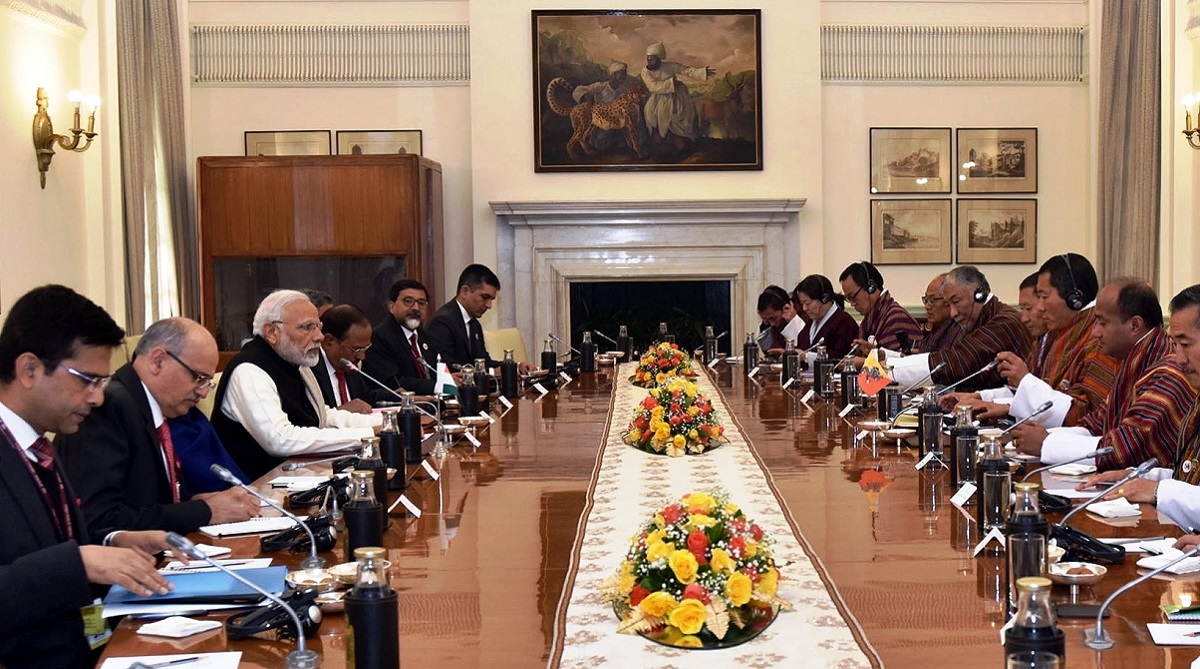
Prime Minister Narendra Modi and Bhutan Prime Minister Dr. Lotay Tshering, during delegation level talks at Hyderabad House, in New Delhi on December 28, 2018. (Photo: IANS/PIB)
Prime Minister Narendra Modi on Friday announced that India would contribute Rs 4,500 crore to Bhutan’s 12th five-year plan as the two countries decided to enhance cooperation in hydro-power and other key sectors.
India’s assistance to Bhutan’s 12th plan, which runs from 2018 to 2023, would conform to its needs and priorities, Modi said at a joint media interaction with his Bhutanese counterpart Lotay Tshering after wide-ranging talks between the two leaders.
Tshering is on his maiden overseas visit after assuming the office in November, reflecting the importance his government attaches to ties with India. Bhutan had solidly backed India during its military stand-off with China at Doklam in June last year.
Noting that the collaboration in hydro projects has been an important part in the long history of cooperation between India and Bhutan, Modi said work on the Mangghe-Descchu project was going to be completed soon. The tariff of this project has also been agreed upon between the two sides. Work on other projects was also making satisfactory progress, he added.
Modi said he was happy to learn that the Bhutan Government has decided to launch RuPay Cards soon and expressed confidence that this would lead to strengthening people-to-people relations. He said he had assured the Bhutanese leader that India would, as always, play the role of a trusted partner and friend in the development of Bhutan.
On his part, Tshering noted that Prime Minister Modi was the first head of government to congratulate him on his electoral victory. He also thanked India for its continued support to his country’s developmental needs.
He said the purpose of his visit was to take India-Bhutan relations to much greater heights. India and Bhutan were celebrating the golden jubilee of bilateral ties and it should be their endeavour to score a century, double century, and triple century in taking this relationship forward.
He was hopeful that India would come to the rescue of Bhutanese businessmen who had been affected due to the introduction of the Goods and Services Tax (GST) in India.
Earlier in the day, Tshering was accorded a ceremonial welcome at Rashtrapati Bhavan. External Affairs Minister Sushma Swaraj also called on the Bhutanese PM.
Flights of Dutch carrier KLM, Taiwan’s Eva Air and the US-based National Airlines were involved in the incident, an official said. The incident happened in the Delhi Flight Information Region (FIR).
In a rare incident, three planes of three foreign airlines, carrying hundreds of passengers, came perilously close in the Delhi flight information region and collisions were averted after multiple auto generated warnings and intervention from ATC, an official said Friday.(Reuters/Representative Image)
In a rare incident, three planes of three foreign airlines, carrying hundreds of passengers, came perilously close in the Delhi flight information region and collisions were averted after multiple auto generated warnings and intervention from ATC, an official said Friday.
The Aircraft Accident Investigation Bureau (AAIB) has started a probe into the incident, which happened on December 23.
Flights of Dutch carrier KLM, Taiwan’s Eva Air and the US-based National Airlines were involved in the incident, the official said.
The incident happened in the Delhi Flight Information Region (FIR).
An FIR refers to a specified airspace where flight information and alerting services are provided. Generally, an FIR can be land and sea territory as well as any international airspace as defined under global norms.
According to the official, at the time of the incident, National Airlines’ flight NCR 840 was on its way to Hong Kong from Bagram in Afghanistan while the KLM Flight KLM 875 was heading to Bangkok from Amsterdam. The Eva Air flight EVA 061 was flying to Vienna from Bangkok, the official said. “First it was NCR 840, which was flying at flight level 310 (31,000 ft) and EVA 061 at flight level 320 (32,000 ft) which breached mandatory separation. The pilots of both the aircraft were alerted by the onboard TCAS warning system,” the official said.
Around the same time, the KLM flight was at 33,000 ft, he added.
Following the TCAS (Traffic Collision Avoidance System) warning, the pilot of NCR 840 sought to climb to 35,000 feet but was told to remain at that current level till the time it gets a go-ahead. “However, when the air traffic controller (ATC) observed it climbing, it was immediately asked to take a left turn. In the meantime, EVA also continued climbing at flight level 330, a level at which KLM was already flying, and at this time, another TCAS warning went off, alerting the pilots to steer the aircraft to a safer distance,” the official said.
As the NCR 840 again descended to flight level 330, it came across the EVA flight , triggering another TCAS alarm, the official said.
Image copyrightGETTY IMAGESImage captionMaking pornographic material or sharing it is illegal in India
A troubling trend of rape videos going viral in India has led many to believe that smartphones and easy access to violent porn, coupled with a lack of sex education, could fuel sexual violence. The BBC’s Divya Arya reports.
Earlier this year, a video showing a group of teenage boys trying to rip the clothes off a young woman was shared extensively on WhatsApp in India.
In it, she is urging them to stop, using the term “bhaiyya” (Hindi for brother) but they are jeering, laughing, clearly enjoying themselves.
As the video went viral, police were able to establish that it was filmed in a village in the northern state of Bihar. The accused teenagers were arrested.
The arrests caused anxiety in their village in Jehanabad, a four-hour drive from the state capital Patna, where village elders blamed the entire incident on smartphones.
Making pornographic material or sharing it is illegal in India.
But even as it becomes easier to access pornography thanks to cheap data and smartphones, there is concern that this isn’t being accompanied by any meaningful understanding of sex and relationships.
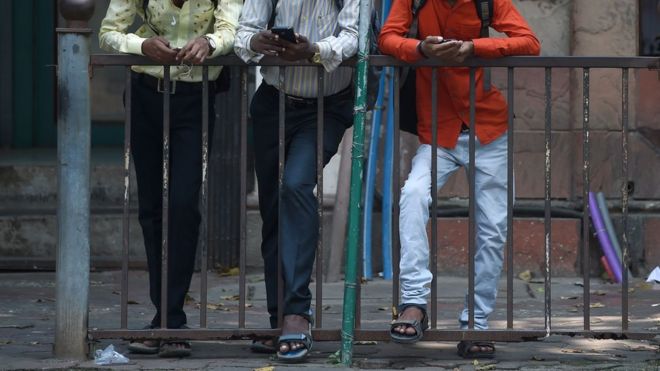
Local boys in the village freely admitted to the BBC that they watched videos of molestation and rape. One 16-year-old said he had seen more than 25 such videos, adding that his friends often shared them on their smartphones.
“Most boys in my class watch these videos together or sometimes by themselves,” another boy said. “It feels fine because everyone does it.”
Experts say this kind of introduction to sex is typical for many Indian men.
Image copyrightGETTY IMAGESImage captionWhatsApp is the medium often used to share such videos
“We have not grown up being given sex education or having normal adult conversations about these things,” says filmmaker and writer Paromita Vohra. She runs the website Agents of Ishq (Romance), which encourages open discussions about sex.
“When people only watch violent sexual content, it is very desensitising because they start believing that violence is the only way to get pleasure and that female consent is unimportant.”
India has 400 million smartphone users, and more than half of them use WhatsApp, which is the medium often used to share such videos.
In a statement to the BBC, WhatsApp said: “These horrendous rape videos and child pornography have no place on our platform. That’s why we’ve made it easy to report problems like these so we can take appropriate action, including banning accounts. We also respond to valid legal requests from law enforcement in India to help them investigate crimes.”
Porn ban
Concerned after a case in which some young men gang-raped a schoolgirl after allegedly watching porn on their mobile phones, a court in the northern state of Uttarakhand asked the federal government to reinstate a 2015 ban imposed by the Supreme Court on websites hosting violent pornography.
It had been revoked almost instantly due to widespread protest.
The ban only applies to some 800 websites that contain violent or abusive videos. This does not seem to have had much impact though.
Within days of being blocked, one of the largest pornography websites had already set up a mirror site with a different URL for its Indian market.
Many believe it is the lack of sex education that is fuelling the appetite for violent and misogynistic videos. Often, there is no deeper understanding of what a sexual relationship or experience should be for both men and women.
This is something the government tried to change in 2009, when it began its Adolescent Education Programme (AEP). It sought to address changes in adolescence and dispel myths about gender, sexuality, sexually transmitted diseases and drug abuse.
But implementing the programme remains a challenge. At an all-girls school in Jehanabad for instance, the principal had never heard of it.
Image copyrightGETTY IMAGESImage captionMany say it is the lack of sex education that is behind the proliferation of violent videos
Huge market
Sunita Krishnan, the founder of Prajwala, an organisation in the southern city of Hyderabad that deals with issues of sexual violence and trafficking says these violent videos reinforce the old belief that a woman’s choice is insignificant and she has no agency.
Ms Krishnan, a rape survivor herself, has also received such videos and has been campaigning to check their spread. In fact, the 2015 Supreme Court ban on porn sites was a result of her efforts.
Even though she has managed to get a few of these videos taken down, she says it can be near impossible to completely erase something from the internet.
Ranjeet Ranjan, who is one of only three women amongst Bihar’s 40 MPs, says the lack of concern about such videos is alarming.
“No-one really cares. If people had even a little respect for these girls, they would have gone to the police station instead of sharing such videos,” she said.
Ms Ranjan is also concerned by what she sees as “a competition” to make such videos.
“If these continue to circulate and we have no sex education, then it will embolden the thinking that a woman should be treated as an object, a source of entertainment.”
NEW DELHI (Reuters) – India’s new curbs on e-commerce companies may not be enough to win over small store owners and traders in next year’s general election, with the key voting bloc still seething over what it sees as broken promises by Prime Minister Narendra Modi.
From Feb. 1, e-commerce firms such as Amazon.com and Walmart-owned Flipkart Group will not be able to sell products from companies in which they have an equity interest or form exclusive agreements with sellers.
Intended to prevent predatory pricing and deep discounting, the curbs follow intense lobbying by India’s many millions of small shopkeepers and the middlemen who serve them, particularly after Walmart this year spent $16 billion to acquire Flipkart.
The sector, which includes an estimated 25 million small store owners, largely supported Modi in the 2014 general election. While seeing the new rules as a step in the right direction, many small businesses feel too much damage has been done after Modi went back on promises that he would not allow the entry of foreign companies into the domestic retail sector.
“We clapped and voted for Modi believing in his promises. But what have we got is just a slap on our face,” said Pankaj Revri, president of a furniture market association in central Delhi.
The curbs, announced on Wednesday, surprised foreign e-commerce firms as little had been done by the government despite over three years of lobbying by domestic retailers.
Modi’s Hindu nationalist Bharatiya Janata Party is widely viewed as panicking after losing five state elections this month. The government, which must hold a general election by May, is also expected to come up with new support programs for farmers as their opposition grows due to low crop prices.
An opinion poll by TV channel ABP News this week predicted Modi’s party could fall short of a majority if the opposition forms an effective alliance in the national election.
EARNINGS HALVED
B.C. Bhartia, president of the Confederation of All India Traders, said some small businesses had seen earnings more than halve in the last few years as they struggle to compete with low prices offered by the American-controlled behemoths.
“The last minute policy change is too little and too late,” he said.
In particular, retailers and traders believe Modi turned a blind eye to what they say was the use of policy loopholes by major e-commerce companies to offer heavy discounts that allowed them to seize market share for goods such as electronic items.
Asked about those accusations, Amazon India said in a statement that it had always operated “in compliance with the laws of the land” and that had more than 400,000 small and medium businesses on its marketplace.
Flipkart declined to comment on the specific allegations.
Small Indian businesses have also been bruised by other Modi policies, including a sudden ban on the use of high-value currency notes in late 2016 and the launch of a national sales tax in 2017, both of which raised compliance costs.
Bhartia said if the government was serious about the concerns of small traders, it should prosecute violators of trade rules and appoint an independent regulator to curb malpractice.
FILE PHOTO: The logo of Flipkart is seen on the company’s office in Bengaluru, India, May 9, 2018. REUTERS/Abhishek N. Chinnappa
A government official told reporters on Thursday the administration could consider demands for a regulator in its new e-commerce policy, expected to be released in the coming months.
A September report by PricewaterhouseCoopers estimated online commerce in India would grow 25 percent a year for next five years, hitting $100 billion a year by 2022.
The new curbs could harm those growth prospects and discourage some foreign investors, said investment consultants.
“Sentiment is definitely hurt,” said Harminder Sahni of retail consultant Wazir Advisors, adding that the policy suggested online retail business should only be done by Indians.
Amazon said in its statement it was evaluating the new guidelines to engage as necessary with the government so it could remain true to its vision of “transforming how India buys and sells and generating significant direct and indirect employment.”
Flipkart said the advent of e-commerce had created hundreds of thousands of jobs and “the industry was set to be a major growth driver for the Indian economy and create millions of jobs in the future.”
Exclusive: Foxconn to make iPhones in India-source
“It is important that a broad market-driven framework through the right consultative process be put in place in order to drive the industry forward,” it added.
The government boasts of attracting nearly $223 billion foreign investment in the last four years, compared with about $152 billion in the previous four years.











COMMENTS: 6