Archive for ‘Chindia Alert’

03/12/2018

Trump says China agreed to reduce tariffs on US car imports

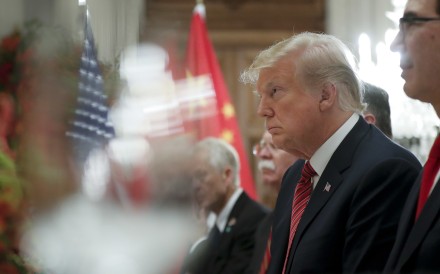
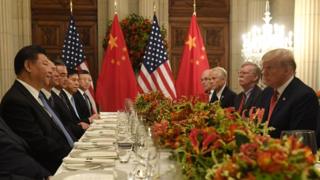
US President Donald Trump, US Secretary of the Treasury Steven Mnuchin and members of their delegation hold a dinner meeting with China's President Xi Jinping and Chinese government representatives, at the end of the G20 Leaders' Summit in Buenos Aires, on December 01, 2018. -Image copyrightGETTY IMAGES

Beijing will “reduce and remove” the 40% tariffs it places on US cars imported into China, US President Donald Trump has said.

China has not commented on President Trump’s announcement, which he made on Twitter without providing details.

The move, if confirmed, would be welcomed by a car industry unsettled by the escalating US-China trade war.

President Trump and Xi Jinping have now agreed to a temporary truce in the bitter dispute.

Over dinner at the G20 summit, they agreed to not increase tariffs for 90 daysto allow for talks.

Failure to strike a deal would have seen tariffs on $200bn worth of Chinese goods rise from 10% to 25% at the start of next year, and would have opened the way for tariffs on additional Chinese goods.

On Monday, China’s foreign ministry said the presidents of China and the US had instructed their economic teams to work towards removing all tariffs following the G20 meeting,

But it didn’t say if that was a plan with specifics or something that was merely desirable.

Asian markets rallied after news of the trade war truce. In China, Hong Kong’s Hang Seng index climbed 2.5% and the Shanghai Composite index jumped 2.6%. Japan’s Nikkei 225 index rose 1%.

The gains spread to Europe, with the UK’s FTSE 100 index, the Cac 40 in France and Germany’s Dax index all up by about 2% in early trade.

The trade war has seen the US and China hit each other with escalating tariffs in an attempt to make their domestically made goods more competitive.

The US says its tariff policy is a response to China’s “unfair” trade practices and accuses it of intellectual property theft.

Since July, the US has hit China with tariffs on $250bn (£195.9bn) worth of goods. China has retaliated with duties on some $110bn of US goods over the same period.

As part of this, the US imposed a 25% tariff on Chinese cars, on top of the 2.5% already in place.

In July, China, which is the world’s largest market for cars, imposed a 40% tariff on US vehicle imports. The rate is much higher than the 15% it places on other trading partners and forced many carmakers to raise prices.

In his tweet, President Trump said Beijing had “agreed to reduce and remove tariffs on cars coming into China from the US”.

He did not provide a new level for the Chinese tariffs, and Beijing did not immediately confirm the statement.

What was agreed at the G20?

In a statement, the White House said US tariffs on Chinese goods would remain unchanged for 90 days, but added: “If at the end of this period of time, the parties are unable to reach an agreement, the 10 percent tariffs will be raised to 25 percent.”

Image captionThe US manufactures cars for export to China, the world’s largest car market

The US said China agreed to “purchase a not yet agreed upon, but very substantial, amount of agricultural, energy, industrial, and other products from the United States to reduce the trade imbalance between our two countries”.

Both sides also pledged to “immediately begin negotiations on structural changes with respect to forced technology transfer, intellectual property protection, non-tariff barriers, cyber intrusions and cyber theft”, according to the White House.

Chinese Foreign Minister Wang Yi told reporters after the talks that “the principal agreement has effectively prevented further expansion of economic friction between the two countries”.

Are tariffs still in place?

Yes. The truce prevents raising tariffs as planned on $200bn worth of Chinese goods.

But it does not remove tariffs that apply to a total of $250bn of Chinese goods targeted since July.

The truce also does not affect the existing duties China has imposed on $110bn of US goods in a tit for tat retaliation.

Will this resolve the dispute?

While the result of the G20 meeting was better than expected, it is unclear how the two countries will manage to resolve their underlying differences.

“There should be no wishful thinking that the truce would end the trade war between the world’s two largest economies,” DBS strategist Philip Wee wrote in a research note.

He said it “remains to be seen if real progress could be achieved during this narrow window to resolve the contentious issues, not just on trade, but also intellectual property”.

Louis Kuijs, head of Asia economics at Oxford Economics, said while the agreement itself was “positive” the next steps remained unclear.

“Whether we will see further de-escalation or whether it is temporary reprieve continues to be very much up to a political decision in Washington DC – that will continue to make this uncertain,” Louis Kuijs, head of Asia economics at Oxford Economics said.

02/12/2018

India and US to participate in 12-day joint air force exercise

The aim of the exercise is to provide operational exposure and undertake a mutual exchange of best practices towards enhancing operational capability.

ADVERTISEMENT
Cope India 2018

Cope India is bilateral joint exercise held between the Indian Air Force and the US Air Force held in India. (Photo: IAF)

HIGHLIGHTS

  • Exercise to be held from December 3-14
  • Will be held at 2 air force bases in West Bengal
  • Approximately 200 US airmen will be arriving in India for exercise

The air forces of the United States and India are participating in a 12-day joint exercise called ‘Cope India 2018’ at two air force stations in West Bengal. Cope India 2018 is the fourth edition in the series of bilateral joint exercises held between the Indian Air Force and the US Air Force, which is conducted in India.

For the first time, the exercise is being planned at two air force bases, Kalaikunda and Panagarh from December 3-14. The Cope India exercise is being held after a gap of eight years, with the last one having taken place in 2010.

The USAF is participating with 12 XF15C/D fighter plane and 3 XC-130 planes. The IAF is participating with the Su-30 MKI, Jaguar, Mirage 2000, C-130J & AWACS aircraft.

The exercise showcases efforts and commitment of the two nations to a free and open Indo-Pacific region, a communique from the US Consulate said. “Exercise CI18 is a long-standing bilateral US Pacific Air Forces (PACAF)-sponsored Field Training Exercise (FTX), conducted with the Indian Air Force (IAF), focused on enhancing US-Indian mutual cooperation and building on existing capabilities, aircrew tactics and force employment,” the communique said.

Approximately 200 US airmen with 15 aircraft from the 18th Wing, Kadena Air Base, Japan and 182nd Airlift Wing, will be taking part in the exercise alongside their IAF counterparts.

The aim of the exercise is to provide operational exposure and undertake a mutual exchange of best practices towards enhancing operational capability. First held in 2004, the exercise has evolved to incorporate subject matter expert exchanges, air mobility training, airdrop training and large-force exercises, in addition to fighter-training exercises.

02/12/2018

Why do billions of people still lack basic sanitation?

  • 23 November 2018
Community leader NasimaImage copyrightWSUP
Image captionDhaka, Bangladesh: Community leader Nasima shows off her village’s new community toilet

Hi-tech loos that use little or no water and can recycle waste products safely and sustainably promise to give billions of people around the world access to much-needed sanitation. So why do so many still lack this basic amenity?

About 2.3 billion people still lack basic toilets, according to the World Health Organization (WHO). And 4.5 billion don’t have safely managed sanitation, with waste disposed in a way that won’t contaminate drinking water.

Each year contaminated water kills half a million children under five through diarrhoeal diseases, the WHO says.

So many inventors, entrepreneurs and research institutions around the world have been working on hi-tech loos that can function without the need for expensive mains sewerage systems.

Image captionMillions of people live next to unsanitary open sewers with potentially fatal consequences

One approach is taking chloride from urine, turning it into chlorine with electricity, and using that as a disinfectant, says Dr Brian Hawkins, a research scientist in nanomaterials at Duke University, North Carolina.

Activated charcoal can remove organic material and nano-membranes replace the need for septic tanks, he says.

A solar-powered toilet using this approach, developed at Duke and nearby universities, is being tested at a cotton mill in Coimbatore, India and a township in South Africa.

Currently, it can handle about 15 users a day.

New membrane technology means toilets can “get clean water out of human waste, which is pretty cool”, says Dr Alison Parker, a lecturer at Cranfield University in Bedford.

But power is needed to push waste through the membranes. So the challenge is making a self-contained loo that doesn’t need external electricity.

Image captionCranfield University’s clever loo can produce clean water from human waste

Her lab’s Nano Membrane Toilet works by “relying on the energy we can get from human waste, burning faeces, and the person lifting the lid and closing it again – so that’s not a huge amount of energy to work with,” she says.

But reverse electrodialysis, from putting faeces components on one side of the membrane and urine on the other, “gives us a little extra energy”, she says, and is “just enough to give it the boost to do what we need”.

Heating urine before it goes through the membrane to be closer to the vapour state makes it more efficient, too, says Dr Parker.

More Technology of Business

She says her lab’s waterless flush toilet is “basically ready and could be commercialised straight away”.

A challenge now is making them feasible for rural areas – the membranes need cleaning every three months, which is more easily achieved in cities.

Reducing costs

While there is lots of innovation going on, the key challenge is making sanitation affordable, says Jack Sim, World Toilet Day founder.

He remembers growing up in Singapore in the 1950s and 60s and having to use his village’s communal outhouse. It was a “very traumatic” experience, he says, involving buckets and lots of green flies.

Moving to public housing with a flushable loo was “like a miracle”, he recalls.

Image captionWorld Toilet Day founder Jack Sim (r) meets Indian Prime Minister Narendra Modi

He believes people on low incomes need to be convinced to “sacrifice something else and build a toilet first”.

But many promising products are now stuck in the “valley of death”, says Duke University’s Dr Hawkins.

This is the space between developing a successful prototype and “getting to a locked-down product you can scale up, mass produce, and find a market share”.

The aim is to get the operating expenses of clean toilets down to five cents (3.8p) per person per day, he says.

And Neil Jeffery, chief executive of Water & Sanitation for the Urban Poor, a non-profit organisation focusing on African and Indian cities, points out that it’s “not just about the toilets – it’s about how you collect waste safely, transport it, treat it, and how it’s then used”.

Most African cities only have 10-15% of households connected to mains sewerage, he says, with many urban settlements sharing pit latrines instead.

When these fill up, a lorry needs to take their contents to a treatment plant.

Image captionCrane Engineering’s waste treatment trucks will be trialled in 2019

But this can be a costly two- or three-hour drive, says Mark Hassman, project manager for the Mobile Septage Treatment System at Crane Engineering in Wisconsin.

He says the amount of waste that trucks actually bring to treatment plants is “less than 5% [of the total] in some cities”.

Instead, they dump it in ditches, mix it with rubbish and burn it, or “plop it in a ditch, and if it’s rainy season, it goes downstream”.

Mr Hassman has been leading a team designing trucks that can process 70-80% of the waste on site. So instead of emptying two pits, “they can now maybe do eight in one drive, and that hopefully reduces the cost and enables people to afford clean pit emptying,” he says.

He says the trucks are “fairly close” to producing potable water.

The trucks will have trial runs in Africa in 2019, and his company is “looking to get these units out there” commercially in 2020.

The crucial requirement is to create a market that enables companies to make a profit from loos that are also affordable for poorer households, he says.

Image captionSpecial treatment trucks can turn human waste into clean water

Lack of sanitation also has an economic impact.

The Bill & Melinda Gates Foundation, which has been running its Reinvent the Toilet Challenge since 2011, says “more than $200bn (£155bn) is lost due to healthcare costs and decreased income and productivity” as a result of poor sanitation.

This is one of the reasons why Indian Prime Minister Narendra Modi has committed $20bn to build 111 million latrines by 2019 – “the biggest toilet building project in the history of mankind”, says Mr Sim.

The goal of sanitation for all may still be “some years” away. “But I can see this problem being solved in the next decade,” he says.

Not a day too soon for the billions still suffering.

02/12/2018

Kartarpur corridor: A road to peace between India and Pakistan?

  • 29 November 2018
Gurcharan Singh
Image captionGurcharan Singh welcomes the opportunity to unite Indians and Pakistanis

Seventy-five-year-old Gurcharan Singh was just a child during Partition in 1947, when his family left their home in the city of Sialkot, in modern day Pakistan, to head to India.

Now on a visit to the Sikh temple in the Pakistani village of Kartarpur, he was delighted that the two countries had agreed to construct a corridor allowing visa-free access to pilgrims from India.

“Since Pakistan was created our community has wanted this,” he told the BBC. “Two families,­ Indians and Pakistanis,­ are meeting again.”

The Gurdwara Darbar Sahib Kartarpur is one of the holiest places in Sikhism. It’s believed to have been built on the site where Guru Nanak, the founder of the religion, died in the 16th Century.

Image captionThe Gurdwara Darbar Sahib Kartarpur, close to the Pakistan-Indian border, is one of the holiest sites in Sikhism

The temple is located around 4km (2.5 miles) from the border with India, but tensions between the neighbouring countries have meant Sikh pilgrims have often found it difficult to visit. Some have had to be content with viewing it through binoculars from India.

The “Kartarpur corridor” will however lead from the Indian border straight to the gurdwara, with the sides fenced off.

The move has been welcomed enthusiastically by the Sikh community, and also represents a rare instance of co-operation between the two countries, which have fought three wars against each other since independence.

Image captionThe ceremony was attended by Sikh children

Relations between India and Pakistan remain strained, but at a ceremony formally starting construction work on the pathway on the Pakistani side of the border, the country’s Prime Minister Imran Khan said: “We will only progress when we free ourselves from the chains of the past”.

A number of Indian politicians were amongst those attending.

Pakistani Foreign Minister Shah Mahmood Qureshi told the BBC the Kartarpur project would help improve the countries’ relationship.

“The more people meet, the more they realise how much in common we have, and what we are missing by not resolving our outstanding issues.” he said.

Formal talks between India and Pakistan have stalled since an attack in 2016, which Indian authorities blamed on Pakistani-backed militants. Pakistan denied the claim.

Prime Minister Khan directly addressed the commonly held view that Pakistan’s powerful military and intelligence services don’t want peace with India, whilst civilian governments generally do.

“My political party, the rest of our political parties, our army, all our institutions are all on one page. We want to move forward,” he said.

Image captionPakistani PM Imran Khan spoke of his hope that the two neighbours can one day be friends

However India’s Foreign Minister, Sushma Swaraj, said the initiative did not mean “bilateral dialogue will start”, adding: “Terror and talks cannot go together. The moment Pakistan stops terrorist activities in India, bilateral dialogue can start.”

Pakistan denies supporting militants targeting Indian forces in Kashmir and in return accuses India of supporting separatist movements within Pakistan.

Following his election victory this summer, Mr Khan announced that for every “one step” India takes on improving relations, Pakistan would take “two”. However, a planned meeting between the countries’ foreign ministers on the sidelines of the United Nations General Assembly in September was cancelled by Indian officials, amidst anger over stamps issued by Pakistan commemorating what they termed Indian atrocities in Kashmir.

Analyst Michael Kugelman, from the Wilson Centre, told the BBC the Kartarpur border crossing was a “significant” development but it would be wrong to suggest that the next step was a peace process.

“It’s a confidence building measure but at the end of the day India and Pakistan are still at loggerheads”.

Image captionSikhs will be celebrating a landmark birthday of their founder next year

Many observers have also predicted that substantial progress on dialogue between the neighbours would have to wait at least until after elections are held in India, next April or May.

Mr Kugelman said: “It’s politically risky for the Indian government, particularly for a Hindu nationalist government like the current one, to extend an olive branch to Pakistan during the height of campaign season.”

The Kartarpur corridor is due to become operational next year, in time for celebrations of the 550th anniversary of the birth of Guru Nanak.

02/12/2018

India farmers: Tens of thousands march against agrarian crisis

  • 30 November 2018
Farmers protesting in DelhiImage copyrightGETTY IMAGES
Image captionThe farmers are marching to highlight the agrarian crisis

Tens of thousands of Indian farmers have marched to the parliament in the capital, Delhi, to highlight the deepening agrarian crisis.

They arrived on Thursday from across the country and held a rally demanding better crop prices, drought relief and loan waivers.

Indian agriculture has been blighted by a depleting water table and declining productivity for decades.

This is the fourth such farmers’ protest in the past year.

Farmers make up important voting bloc in the country and, analysts say, given the scale of the protests, their discontentment could hurt the ruling Bharatiya Janata Party (BJP) in next year’s general election.

“We voted for the BJP but anti-farmer policies of the government have hit us hard,” Lakhan Pal Singh, one of the farmers participating in the march, told Reuters news agency.

One of their chief demands is a special parliamentary session to discuss solutions to the agrarian crisis, including a full loan waiver and higher crop prices.

Half of India’s population works on farms, but farming contributes only 15% to the country’s GDP.

Image captionThe farmers, including women, have come from different parts of India

In most states, governments have been less than swift in paying the farmers more for their crops – the federal government sets the price for produce and procures crops from farmers to incentivise production and ensure income support.

Indian farmers also struggle with debt owed to banks and money lenders. And crop failures trigger farm suicides with alarming frequency. At least 300,000 farmers have killed themselves since 1995.

Daughters, wives and other family members of farmers who took their own lives over crop failure or mounting debt are also participating in the protest – with some of them carrying photographs of their loved ones.

Read more about India’s farming crisis

The march has been organised by an umbrella group of farmers’ organisations from different parts of the country. Many of the protesters are also members of the farmers’ wing of the Communist Party of India (Marxist).

They have been arriving in Delhi since Thursday night. They gathered at a huge public ground that is often used for political rallies and spent the night in tents there. They started matching towards the parliament on Friday morning even as thousands of policemen were deployed for security.

Sangita Bhoir, a woman farmer from the western state of Maharashtra, had protested in Mumbai city a few months ago. Now, she is in Delhi.

Image captionFamilies of farmers who have killed themselves also participated in the protest

“In Mumbai, we had blisters in our feet [from walking]. They [the government] had promised that they would fulfil our demands in three months, but they never did,” she told BBC Marathi.

Several young doctors and medical students have also joined the farmers to show support and to provide them with medical aid, if necessary.

Many others – including lawyers, artists and teachers – are bringing drinking water and food, as well as publicising the protest on social media.

Image captionThis is the fourth such farmers’ protest in the past one year

“Due to social media, there has been an increased awareness about farmers’ issues in Delhi,” says Monami Basu, a Delhi University professor who is also participating in the march.

“I wanted to be a part of this march to show solidarity with the agitating farmers.”

The protest in Delhi is the latest by farmers in recent years. In March, tens of thousands of farmers from the western state of Maharashtra had walked 160km (100 miles) to Mumbai city in support of similar demands.

And last year, drought-hit farmers from the southern state of Tamil Nadu brandished human skulls and held live mice in their mouths to draw attention to their plight.

02/12/2018

China and the Logistics of Everything

China’s densely populated cities are making it easier for companies to deliver everything from food takeout to large appliances quickly and at cheaper rates than other parts of the world. China boasts 156 cities with over 1 million people, compared with just 10 in the United States. This density has enabled Chinese companies to build an elaborate supply chain network that ships more than 140 million parcels a day and makes China the world’s largest eCommerce market, according to Ronald Keung of Goldman Sachs Research. Keung notes that the nation’s online retail segment  is projected to reach $2 trillion by 2020.


The strong logistics supply chain is currently the key driver of much higher online penetration in China that will lead the rest of the world.

– Ronald Keung

02/12/2018

The US-China trade war: from first shots to a truce

  • Washington has agreed to hold off on new tariffs but the core conflicts have yet to be resolved
PUBLISHED : Sunday, 02 December, 2018, 5:44pm
UPDATED : Sunday, 02 December, 2018, 5:44pm
Sarah Zheng

<a class="scmp-icon-cross" onclick="popoverClose(this);"></a><h3 class="popover-title"></h3>

” data-original-title=””> 

1SHARE

Related Articles

China and the United States agreed to a 90-day ceasefire on new tariffs in their trade war at the G20 summit in Buenos Aires, allowing a reprieve after months of threats and stalled talks.

The decision for the US to hold off on planned tariff increases on US$200 billion in Chinese goods from 10 to 25 per cent on January 1 came over a grilled steak dinner in Argentina, the first face-to-face meeting between US President Donald Trump and his Chinese counterpart Xi Jinping since the start of the conflict.

Here is a look back at how it all began.

The first shots

The truce comes almost a year after the two countries began sparring over trade. Trump first slapped 30 per cent tariffs on solar panels and washing machines in February, prompting a complaint to the World Trade Organisation from Beijing. Then in March, the Trump administration imposed steel and aluminium tariffs across the board, including on China, which the Chinese government responded to with tariffs on 128 US products such as wine, fruit, and pork.

But the trade war began in earnest in July with the US levying its first round of punitive tariffs, triggered by an investigation under Section 301 of the Trade Act into Chinese trade and intellectual property practices.

Washington’s duties on US$34 billion in Chinese products was quickly matched by Beijing. The US imposed tariffs on another US$16 billion in August – again matched by China – and then US$200 billion in September. Beijing responded to the third round by targeting US$60 billion in US goods.

Beijing’s US$110 billion total targeted industries that analysts said were aimed at Trump’s political base, including a particularly stinging 25 per cent duty on American soybeans.

While business leaders in both countries called for a resolution, a series of trade talks – including low-level discussions in Washington in late August – failed to yield a breakthrough.

After the Chinese side reportedly cancelled scheduled talks in September, US officials signalled that they would not return to the negotiating table without a concrete proposal from Beijing.

Then just before the G20 summit, Chinese Vice-Premier Liu He, Xi’s top economic aide, called off a planned meeting in Washington at the last minute and pinned everything on talks in Buenos Aires.

Just how bad has it been?

The trade war cast a long shadow over the Asia-Pacific Economic Cooperation forum in Papua New Guinea in November, resulting in the leaders failing for the first time to issue a joint communique. And as the China-US conflict has rolled on, it has spilled over into a broader strategic concern, one some analysts have described as the start of a new cold war.

In October, US Vice-President Mike Pence slammed Beijing not only for unfair trade practices, but for militarisation of the energy-rich South China Sea, domestic repression including massive state imprisonment of ethnic Uygurs in Xinjiang, and expanded global influence through “debt diplomacy”. Without offering evidence, Trump also accused China of meddling in US elections ahead of the November midterms.

As tensions escalated, Washington tightened export restrictions on strategic industries, sanctioned a key department of the Chinese military for purchases from Russia, and increased visa scrutiny for Chinese academics in the US.

Meanwhile, American companies in China have reported increased scrutiny from regulators and delayed approvals for licences.

What’s next?

Xi and Trump initially appeared to hit things off with reciprocal lavish state visits in Mar-a-Lago in Florida and Beijing, but their apparent honeymoon was short-lived. A 100-day plan that outlined ways for China to open its economy failed to address the Trump administration’s fundamental concerns.

Those concerns include US complaints about Chinese intellectual property theft and industrial subsidies, centred on Beijing’s state-backed “Made in China 2025” initiative, a programme to turn China into a leader in a range of advanced technologies.

Despite the ceasefire, analysts are sceptical that a deal can be reached on the wide range of prickly trade issues. Only days before the G20 summit, Trump told The Wall Street Journal that it was “highly unlikely” he would delay the January 1 tariff increases, insisting that the brunt of the existing tariffs were being borne by China.

He also said the US was ready to levy tariffs on the remaining US$267 billion in Chinese imports, including consumer goods such as Apple products.

The White House is insisting on structural reforms to China’s economy, beyond window-dressing measures to close the trade imbalance, but Xi is unlikely to make major concessions given the inevitable domestic political backlash, analysts say.

“Both sides got the time out they wanted, to recalibrate their strategies and figur

e out what to do next,” Patrick Chovanec, managing director and chief strategist at Silvercrest Asset Management, said on Twitter.

“But the underlying issues – some due to China’s protectionist ideology, some due to Trump’s – remain unresolved.”

01/12/2018

Chinese scientists discover spider species nurses young with milk

BEIJING, Nov. 30 (Xinhua) — Chinese scientists have discovered a species of spiders that can produce milk and care for their young, providing a new take on the understanding of invertebrate animals’ maternal care.

The study, published online Thursday on the U.S. journal Science, was conducted by researchers from the Chinese Academy of Sciences (CAS).

The findings focus on Toxeus Magnus, a species of jumping spider native to southeastern Asia, which lives in nests and looks like ants.

According to the study, spider mothers in their laboratory-based nests were found to feed a milk-like substance to their spiderlings and continue to care for them as they matured.

During the first 20 days, the spider babies were found to first drink droplets of spider milk left on the surface of the nest and then suck directly from their mother’s abdomen area.

Compared with cow’s milk, spider milk has nearly four times the protein but less fat and sugar.

From about day 20 to day 40, the young spiders were able to leave the nest to hunt food, but they were still allowed to drink milk from their mothers.

The most intriguing part starts after 40 days when the spiders reach sexual maturity. Only daughters were allowed to stay with their mother in the nest, while the sons were attacked by the females and not allowed to return home.

In the study, maternal care and milk provisioning appeared to work together to ensure the long-term survival of young spiders.

Of the 187 spiderlings observed in 19 different nests, the survival rate was 76 percent for spiders that received both. Separated from the mother at day 20, the survival rate of the spiderlings dropped to 50 percent.

Previous studies show that maternal care, which continues after the offspring reach maturity, only exist among some long-lived advanced social vertebrates like humans and elephants.

Chen Zhanqi, lead author of the study from Xishuangbanna Tropical Botanical Garden, CAS, told Xinhua the findings demonstrate that mammal-like provisioning and parental care for sexually mature offspring also evolved in invertebrates.

He noted that the new findings encourage researchers to reevaluate this “parenting style” among animals, especially in invertebrates. Invertebrates make up over 95 percent of Earth’s species.

Nicole Royle, a senior lecturer in the behavioral ecology of Exeter University in Britain, said it is the most comprehensive study that proves long-term maternal care also exists in invertebrates.

“It will help researchers gain a better understanding of the evolution process of milk provisioning and parental care for sexually mature offspring across the animal kingdom,” he said.

01/12/2018

Boeing delivers 2,000th airplane to China

U.S.-SEATTLE-CHINA-BOEING AIRPLANE-2000TH

Rick Anderson (L, front), Boeing vice president of Northeast Asia sales, and Che Shanglun (R, front), chairman of Xiamen Airlines, attend the signing ceremony during the delivering of the 2,000th Boeing airplane to China in Seattle, the United States on Nov. 30, 2018. Top U.S. aircraft manufacturer Boeing Company on Friday delivered its 2,000th airplane to China, which is a milestone for the U.S. aircraft maker in the world’s largest commercial aviation market. (Xinhua/Wu Xiaoling)

SAN FRANCISCO, Nov. 30 (Xinhua) — Top U.S. aircraft manufacturer Boeing Company on Friday delivered its 2,000th airplane to China, which is a milestone for the U.S. aircraft maker in the world’s largest commercial aviation market.

The aircraft, a Boeing 737 MAX, is the eighth of the same model that Boeing has delivered to Xiamen Airlines, a fast growing carrier that operates the largest all-Boeing fleet in China with more than 200 jets.

“Our long-standing industrial relationship in this market has been mutually beneficial, fueling significant growth in Boeing’s business, the U.S. economy, and the Chinese aviation industry,” said Ihssane Mounir, senior vice president of Commercial Sales and Marketing at Boeing.

Che Shanglun, chairman of Xiamen Airlines, said his company has steadily grown in the past 34 years, doubling its fleet size over the past five years and achieving profits for 31 years in a row.

“Throughout that time, Boeing has been a valued partner in our growth and expansion by providing safe and reliable airplanes,” he said.

Xiamen Airlines is one of Boeing’s more than 30 commercial customers in China. Boeing-made jets comprise more than half of the over 3,000 jetliners flying in the Asian country.

Boeing delivered its first 1,000 airplanes to Chinese airlines over four decades, but the next 1,000 Boeing jets have been delivered over the past five years.

The next 20 years will witness China’s commercial fleet more than doubled, and Boeing predicts China, the world’s second largest economy, will need 7,690 new airplanes valued at 1.2 trillion U.S. dollars by 2038.

The commercial services market in China will be driven by a growing demand of 1.5 trillion dollars over the next two decades, accounting for 17 percent of the world total, Boeing said.

01/12/2018

Xi urges G20 to steer world economy responsibly

ARGENTINA-BUENOS AIRES-XI JINPING-G20-SUMMIT-SPEECH

The 13th summit of the Group of 20 (G20) is held in Buenos Aires, Argentina, Nov. 30, 2018. Chinese President Xi Jinping delivered a speech titled “Look Beyond the Horizon and Steer the World Economy in the Right Direction” at the first session of the summit. (Xinhua/Li Tao)

BUENOS AIRES, Nov. 30 (Xinhua) — Chinese President Xi Jinping on Friday urged the Group of 20 (G20) to stick to openness, partnership, innovation and inclusiveness and steer world economy responsibly.

Xi made the remarks while addressing the 13th G20 summit in the Argentine capital of Buenos Aires.

He warned the G20 leaders of accelerated accumulation of risks in global economy and pledged that China will firmly push forward a new round of reform and opening-up, with increased efforts in intellectual property rights (IPR) protection and more imports.

Noting that it has been 10 years since the global financial crisis broke out and the first G20 summit was convened, the Chinese president said the global economy today, while maintaining growth on the whole, is still not free from the underlying impacts of the crisis.

Old growth drivers are yet to be replaced by new ones, while various risks are rapidly building up, he said, adding that the world economy is facing another historical choice.

“We G20 members must closely follow the underlying historical trend so as to chart the course for the future. In mankind’s relentless quest for development and progress, the trend toward openness and integration among countries is unstoppable despite ups and downs in the global economy,” Xi said.

Greater coordination and complementarity among countries meet the need of productivity growth and will also shape the future of relations of production, he said.

In this process, countries are increasingly becoming a community with shared interests, shared responsibilities and a shared future, Xi said, stressing that win-win cooperation is the only choice going forward.

“Facing various challenges, we must have a stronger sense of urgency, be rational in approach and look beyond the horizon. We must fulfill our responsibility and steer the global economy in the right direction,” he told the G20 leaders.

Noting that the G20 was born out of the international community’s need to maintain stable growth of the global economy, Xi said the group has braced difficulties together, navigated the global economy out of recession and brought it back to the track of recovery and growth over the past decade.

“Ten years later, let us work with the same courage and strategic vision and ensure that the global economy grows on the right track,” he said, putting forward a four-point proposal to the summit.

Firstly, Xi called on G20 members to stay committed to openness and cooperation and uphold the multilateral trading system.

“We should firmly uphold free trade and the rules-based multilateral trading system,” he said.

China supports necessary reform of the World Trade Organization, and believes that it is critical to uphold the WTO’s core values and fundamental principles such as openness, inclusiveness and non-discrimination and ensure the development interests and policy space of developing countries, according to the Chinese president.

During the process, all sides need to conduct extensive consultation to achieve gradual progress, he said.

Secondly, Xi urged the G20 to forge strong partnership and step up macro-policy coordination.

All participating sides should employ the three tools of fiscal and monetary policies and structural reform in a holistic way to ensure strong, balanced, sustainable and inclusive growth of the global economy, Xi said.

Developed economies, when adopting monetary and fiscal policies, should give more consideration to and work to minimize the impact such policies may exert on emerging markets and developing economies, he said.

The international monetary system should become more diversified, and the global financial safety net should continue to be strengthened, he added.

Thirdly, the G20 should stay committed to innovation and create new momentum for growth, Xi said.

He called on the group to encourage innovation and leverage the role of the digital economy in growing the real economy.

“We need to watch out for risks and challenges brought by the application of new technologies, and strengthen the legal and regulatory framework,” Xi said, adding that more efforts are needed to boost education and vocational training.

“We should give priority to achieving development through fully tapping our innovation potential. At the same time, we also need to keep our doors open and encourage the spread of new technologies and knowledge so that innovation will benefit more countries and peoples,” said the Chinese president.

To better adapt to and guide technological innovation, Xi proposed that the G20 carry out an in-depth study on the application and impact of new technologies on a priority basis to explore new thinking and new ways of cooperation in this area.

Fourthly, Xi urged the G20 to stay committed to win-win cooperation to promote inclusive global development.

“We need to continue to follow a people-centered development philosophy and endeavor to deliver a sense of fulfillment, happiness and security to our people,” Xi said.

He encouraged the G20 members to continue to prioritize development in global macro-policy coordination, implement in real earnest the 2030 Agenda for Sustainable Development and give strong support to work in this area within the UN framework.

Calling on the group to protect the development interests and space of developing countries, Xi said the G20 should also continue to support Africa’s development by helping Africa with its infrastructure and connectivity building and new industrialization.

Noting that this year marks the 40th anniversary of China’s reform and opening-up, Xi recalled that during the past 40 years, with the support of the international community, the Chinese people have forged ahead with perseverance and made historic achievements in development.

China owes its progress to reform and opening-up, and will continue to advance on this path, Xi told the G20 leaders, pledging to continue to deepen market-oriented reform, protect property rights and IPR, encourage fair competition and do more to expand imports.

China will continue to improve its business environment, and hopes that all countries will work together for a free, open, inclusive and orderly international economic environment, Xi said.

The Chinese president arrived in Buenos Aires on Thursday night to attend the G20 summit and pay a state visit to Argentina.

Argentina is the second stop of Xi’s Europe and Latin America trip from Nov. 27 to Dec. 5, which had taken him to Spain and also includes state visits to Panama and Portugal.

Law of Unintended Consequences

continuously updated blog about China & India

ChiaHou's Book Reviews

continuously updated blog about China & India

What's wrong with the world; and its economy

continuously updated blog about China & India