Archive for ‘Chindia Alert’

23/02/2016

‘Weird’ new buildings banned in Chinese cities| Society

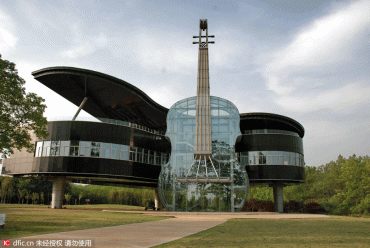
Cities will not be allowed to build more “oversized, xenocentric, weird” buildings devoid of cultural tradition in the future, according to a new directive from the central government.

The State Council, or the cabinet, and the Communist Party of China Central Committee issued the directive on Sunday. It says buildings should be “suitable, economic, green and pleasing to the eye.”

Cities have built some unusually shaped buildings to create memorable skylines in recent years, but many have drawn criticism. Here is one of sixteen very weird buildings in China!'Weird' new buildings banned in Chinese cities

See the other fifteen at:

Source: ‘Weird’ new buildings banned in Chinese cities[12]| Society

23/02/2016

Angry victims heckle Haryana CM after Jat riots kill 19 | Reuters

A political ally of Prime Minister Narendra Modi was shouted down on Tuesday by a crowd angered by rioting in Haryana that destroyed businesses, paralysed transport and cut water supplies to metropolitan Delhi.

Photo

The chief minister of Haryana, Manohar Lal Khattar was heckled by local people in the town of Rohtak after they objected to his comments promising that they would receive compensation.

More than a week of unrest involving the Jat rural caste has challenged the authority of Modi, who was elected in 2014 with the largest majority in three decades but has publicly ignored the outburst of anger over a lack of jobs.

Although Jat leaders reached a deal late on Monday to end more than a week of protests that killed 19 people and injured 170, anger was still boiling among the victims whose livelihoods had been ruined.

Live TV pictures showed Khattar giving up his attempt to address angry people on the street. After retreating indoors to give an impromptu news conference, he repeated his promise of compensation only to be shouted down again.

Soon after Modi won national power, Khattar led his nationalist Bharatiya Janata Party to power in Haryana, a state of 25 million people, for the first time.

TRAIL OF DESTRUCTION

There was a trail of destruction through the town, one of several to be hit by Jat agitation to demand more government jobs and college places, with one Hyundai dealership gutted. Traders who staged an earlier sit-down protest said they had lost everything.

“I had two showrooms on the road; both were first looted and then set on fire. I have nothing left now,” Anil Kumar told Reuters Television.

Kumar appealed to Modi and to chief minister Khattar for compensation: “Are we not humans? Don’t our votes count? Why did they not have any mercy on us? Don’t we pay our taxes?”

Modi has remained silent through the worst social unrest of his 20 months in office. A senior government official said he would give a statement in due course to parliament, which convened for its budget session on Tuesday.

Finance Minister Arun Jaitley next week presents his annual budget. He is expected to announce big hikes in public sector pay that would make it hard to free up funds for investment without borrowing more money.

Thousands of troops were deployed to quell the protests, which flared on Monday near Sonipat when a freight train was torched and, according to reports, police shot dead three protesters. Jats also attacked buses in neighbouring Rajasthan.

Disruption has been huge, with at least 850 trains cancelled, 500 factories closed and business losses estimated at as much as $5 billion by one regional lobby group. India’s largest car maker, Maruti Suzuki, shut two factories at the weekend because its supply of components was disrupted.

The army on Monday retook control of a canal that supplies three-fifths of the water to Delhi, a metropolis with a population of over 20 million. A key sluice gate was reopened, but protesters sought to cut the water supply at another place.

“The canal was damaged by protesters and repair work will have to be done,” Delhi’s Water Resources Minister Kapil Mishra said. “The water crisis will continue for a few more days.”

Source: Angry victims heckle Haryana CM after Jat riots kill 19 | Reuters

21/02/2016

Xi takes nuclear option in bid to rule for life | The Sunday Times

Very worrying, if true.

CHINA is moving towards one-man rule as the state media step up demands for personal loyalty to President Xi Jinping, a departure from the Communist party’s collective leadership of recent decades.

Xi Jinping appears to be building a personality cult around him as Mao did

Last week the party’s flagship newspaper issued a call for Xi to have the power to “remake the political landscape of China”. The article, supposedly written by one of a literary group, was put out on a social media account run by the People’s Daily. It said all communists must be loyal to Xi and “line up with the leadership”.

The campaign to enshrine Xi as the infallible “core” of authority is worrying many inside the political elite and coincides with China exerting its military muscle and possibly preparing to change its nuclear weapons strategy.

The People’s Liberation Army (PLA) has just stationed surface-to-air missiles on a disputed island in the South China Sea. The Chinese expansion comes as Barack Obama rallies Asian nations to support free navigation in the strategic waterway. The prospect of one man dominating the party, the state and the army in China could be the most challenging test in the next American president’s in-tray.

Xi’s grand plans include a total reorganisation of the Chinese military command structure that has included an internal debate about its nuclear weapons. Xi recently formed a dedicated PLA rocket force to control the nuclear ballistic missile arsenal. A report for the Union of Concerned Scientists, a US-based group, says China may be considering placing its nuclear forces on alert, which means that, like America and Britain, its weapons would be ready to fire on command.

That would be a shift of position for a nation that affirms it will not be the first to use nuclear weapons in any conflict. China has already started an ambitious programme to upgrade its older missiles with multiple warheads like those of other nuclear powers.

Rising military budgets show that despite the slower Chinese economy and big flows of capital out of the country, Xi is seizing any initiative to turn nationalism to his advantage. A source who grew up in the party’s privileged residential compounds in Beijing said the moves harked back to an earlier era: “There is a fear among the families, the long-time party members for generations, that this guy wants to make himself into another Chairman Mao and rule for life.”

It is clear that, like Mao, Xi, 62, is using articles and essays in the state media, often penned by pseudonymous authors or published in the provinces, to intimidate his enemies and promote himself.

Last week a social media platform controlled by the Beijing Daily, the voice of the capital’s municipal committee, launched a striking attack on a party faction opposed to Xi, the Communist Youth League. Officials connected to the league were “ambitious aristocrats whose self-serving attitude did no good to the party and led to scandals”, it sneered.

Targeting the league — whose members include the prime minister, Li Keqiang, and the former president, Hu Jintao — is a signal that Xi has broken with the consensus set after the unrest of 1989 that the party’s factions do not attack one another in public. In the past, a league connection meant a fast-track to promotion for young high-flyers. Now it seems to be a liability.

A study by the Central Commission for Discipline Inspection — the party watchdog unleashed by Xi against rivals accused of corruption — has criticised the “mentality” of league members. The commission’s propaganda publication, the China Discipline Inspection Paper, warned against “those who form their own circles inside the party” and referred to fallen officials as “gangs”.

This Mao-era language singled out the “petroleum gang” under the purged security chief, Zhou Yongkang, whose cronies dominated the Chinese oil industry, and the “secretary gang” around Ling Jihua, a close aide to Hu and a former league stalwart. Ling is already under arrest on corruption and bribery charges.

Defining people as members of “gangs” or “cliques” is a classic tactic of communist infighting and a prelude to destroying them.

Chilled by the signals from the top, half the provincial party chiefs in the country this month pledged allegiance to Xi as “the core”.

The term represents a significant change from the language used about Xi’s predecessors, Hu and Jiang Zemin, who were referred to as being only “at the core” of a collective leadership. The last strongman in China, Deng Xiaoping, exercised his power behind the scenes and scorned a cult of personality.”

Source: Xi takes nuclear option in bid to rule for life | The Sunday Times

20/02/2016

A slow awakening | The Economist

AROUND 270m people have left China’s countryside to work in urban areas, many of them entrusting their children to the care of a lone parent, grandparents, relatives or other guardians.

By 2010 there were 61m of these “left-behind children”, according to the All-China Women’s Federation. In a directive released on February 14th, the government has at last shown that it recognises the problems caused by the splintering of so many families. The document acknowledges that there has been a “strong reaction” from the public to the plight of affected children. It describes improving their lot as “urgent”.

That is clearly right. There have been numerous stories in recent years revealing the horrors some of these children endure. Last year four siblings left alone in the south-western province of Guizhou apparently committed suicide by drinking pesticide. Numerous sex-abuse cases involving left-behind children have come to light.

The new proposals look sensible enough: minors may not be abandoned entirely; local institutions such as schools and hospitals must do more to notify the authorities of cases of abuse or neglect; social workers should monitor the welfare of left-behind children. Sadly, however, the government’s suggested remedies will achieve little. They largely replicate recent laws and policies designed to protect children (not just left-behind ones), which have been almost universally unenforced. It is already illegal to allow minors to live alone, for example. There is no indication that the new recommendations will be made law or implemented any more rigorously.

The new scheme mentions the importance of giving migrants urban hukou, or household-registration certificates, which are needed to gain access to public services such as education and health care. Most migrants leave their children in the countryside because they do not have such papers. In December the government announced plans to make it easier for migrants to gain urban hukou privileges. But few casual labourers are likely to fulfil the still-onerous conditions that must be met to qualify.

A study published last year by researchers at Stanford University found that among more than 140,000 children assessed in areas such as education, health and nutrition, left-behind ones performed as well as or better than those living in the countryside with both parents. But both kinds of children lagged far behind those who grow up in cities.

Source: A slow awakening | The Economist

20/02/2016

Leaders of Nepal and India mend fences after friction | Reuters

The leaders of Nepal and India have overcome mutual misgivings, India’s foreign secretary said on Saturday, after talks to ease tensions over Nepal’s recently-adopted constitution.

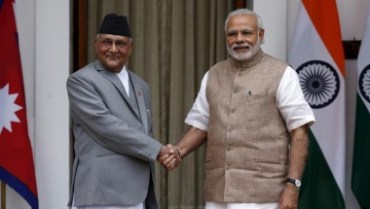
Nepal's Prime Minister Khadga Prasad Sharma Oli (L) shakes hands with his Indian counterpart Narendra Modi during a photo opportunity ahead of their meeting at Hyderabad House in New Delhi, India, February 20, 2016. REUTERS/Adnan Abidi

Prime Minister K.P. Oli visited New Delhi for talks with his Indian counterpart Narendra Modi after a months-long freeze in relations triggered by the grievances of plains dwellers in southern Nepal who have close historical ties to India.

Nepal, which moved from absolute to constitutional monarchy in 1990, made changes to its constitution to ensure greater participation of the Madhesi community in parliament.

But community leaders said the amendments failed to address their central fear that provincial borders would be redrawn in a way that would divide them.

“Our prime minister appreciated the progress made towards consolidation of constitutional democracy in Nepal,” Indian Foreign Secretary Subrahmanyan Jaishankar told a news briefing.

Source: Leaders of Nepal and India mend fences after friction | Reuters

20/02/2016

Pathankot Attack: Pakistan Begins Formal Police Investigation – India Real Time – WSJ

Pakistan has launched a formal police investigation into the alleged involvement of Pakistan-based militants in a deadly attack on an Indian air force base last month, senior government and police officials said Friday.

Six heavily-armed militants attacked the Pathankot air force base on Jan. 2, sparking a battle with Indian forces that lasted more than 40 hours, killed seven Indian security personnel and threatened to dismantle a tentative improvement in relations between Islamabad and New Delhi.

India suspected Pakistan-based Jaish-e-Mohammad, a U.S.-designated foreign terrorist group, was behind the Pathankot attack, and demanded Pakistan take action against the perpetrators.

Source: Pathankot Attack: Pakistan Begins Formal Police Investigation – India Real Time – WSJ

18/02/2016

Apple Pay takes on China’s internet kings in mobile payments | Reuters

Apple Inc launched its mobile payment system in China on Thursday in a bid to convince the hundreds of millions of users of the country’s entrenched, dominant services to switch.

Photo

“We think China could be our largest Apple Pay market,” Jennifer Bailey, vice president of Apple Pay, told Reuters in an interview in Beijing.

In an early boost, China’s biggest lender, Industrial and Commercial Bank of China Ltd (ICBC), was among the banks that said earlier this week that customers would be able to use Apple Pay from Thursday.

However, Apple Pay has not had an easy ride so far in China, the fifth country to get the service. Even in its U.S. home market, Apple has faced skeptical retailers in its effort to develop a new revenue stream.

China is not likely to prove any easier to crack.

“People switch applications for significantly better experiences, it (Apple) has to deliver not just a little bit more secure, or a little bit easier to use,” said Mark Natkin, founder of Marbridge Consulting.

Greater China is Apple’s second-largest market by revenue, and the world’s biggest smartphone market. By the end of 2015, 358 million people, more than the U.S. population, had already taken to buying goods and services by mobile phone, according to the China Internet Network Information Center.

The vast majority are using payment services from China’s two biggest Internet companies that have existed for years.

Social networking and gaming firm Tencent Holdings Ltd operates WeChat Payment, and e-commerce company Alibaba Group Holding Ltd, through its Internet finance affiliate Ant Financial Services Group, runs Alipay.

“With 100 percent saturation of local payment systems, no one in China is clamoring for Apple Pay,” said one retailer who declined to be named for fear of harming business prospects. “Today, everyone has a local payment option on their phone, so Apple Pay is a solution in need of a problem.”

Source: Apple Pay takes on China’s internet kings in mobile payments | Reuters

18/02/2016

Is India’s Freedom 251, a $4 Smartphone, Too Good to Be True? – India Real Time – WSJ

A little-known Indian company has announced grand plans to sell millions of made-in-India smartphones for less than $4 a piece, despite the fact that it has only been in the smartphone business for five months and has yet to build a factory.

Ringing Bells Pvt. started taking orders for its Freedom 251 phone on Thursday for 251 rupees ($3.67) each, or less than the price of a McDonald’s Big Mac in the U.S. The company has promised to deliver the phones by June 30–after it builds two manufacturing plants.

Social media lit up with discussion about the device–which the company says will have a four-inch display, 3.2-megapixel camera and 8 gigabytes of storage–after ads for the phone with the tagline “dreams will come true,” appeared in newspapers. Ringing Bells said its phones will have apps that help farmers check soil conditions and fishermen get weather reports.

The company’s website crashed Thursday and it stopped accepting orders for the device as it worked to upgrade its servers, the website said.

At a launch event in a public park Wednesday, thousands turned out to see company President Ashok Chadha unveil a poster-sized image of a phone under a shower of pyrotechnics and confetti. It was an impressive turnout considering only days earlier almost no one had even heard of him, his company or its phone.

Phones given to journalists to try looked as if the branding from another manufacturer had been covered up with white-out on the phone’s front. Indian flag stickers covered the rear. The phones used an Android operating system.

Mr. Chadha said the phone he was sharing was a “beta device.”

Ringing Bells said it would spend 5 billion rupees, or about $73 million, to build the factories. Mr. Chadha said the money will come from the family of Mohit Goel, one of the founders and directors of the company. Mr. Goel’s family owns a farming business, Mr. Chadha said. Attempts to reach Mr. Goel were unsuccessful.

Analysts said they couldn’t see how Ringing Bells could ever make money selling phones for $4.

If Ringing Bells follows through with its plans, the difficulties of setting up manufacturing operations in India could mean it runs into delays that could cause it to miss its June deadline, a spokeswoman for another Indian phone manufacturer said. She said setting up a new factory often takes up to a year.

The company aims produce hundreds of thousands of phones a month and take around 30% of the smartphone market within a year, Mr. Chadha said. Over 100 million smartphones were shipped by manufacturers to retailers in India last year, according to International Data Corp., a research company.

Despite the low price, Mr. Chadha said the company expects to make money on the phones. He said that making the phone using components imported from China would cost about 2,500 rupees per phone. India doesn’t make many components used in phones and other phone sellers in the country import their phones and components from elsewhere.

But Mr. Chadha said he expected to reduce costs through through “economies of scale,” tax breaks for local manufacturing, and other cost-cutting measures. “We are technocrats and have some understanding of international economics,” he said.

Ringing Bells says it will offer a smartphone with a 4-inch display, 3.2 megapixel camera and 8 gigabytes of memory for less than $4. The $33 smartphones powered by Mozilla Corp.’s Firefox operating system have a 3.5 inch display, 2 megapixel camera and 256 megabytes of storage.

Source: Is India’s Freedom 251, a $4 Smartphone, Too Good to Be True? – India Real Time – WSJ

17/02/2016

Free Speech in China Gets an Unlikely State-Media Backer – China Real Time Report – WSJ

China’s ruling Communist Party is cracking down on internal criticism, and the editor of one of the country’s most nationalist tabloids isn’t going to take it anymore.

In a post on his Weibo microblog over the weekend, Hu Xijin, editor in chief of the Global Times, called on Chinese authorities to show greater tolerance for dissenting opinions.

“China should open up more channels for criticism and suggestions and encourage constructive criticism,” Mr. Hu wrote on Sunday. “There also should be a certain amount of tolerance for unconstructive criticism.”

While allowing greater freedom of speech can lead to some problems, it brings greater benefits, he wrote, adding that recent Chinese history since the beginning of Communist rule in 1949 shows that freedom of speech “is inseparably linked to the vitality of society.”

“As for the problems it causes, the state has ample capacity to respond,” Mr. Hu wrote, without elaborating.

The message had received more than 2,000 comments and 1,500 “likes” as of Wednesday afternoon, on par with some of Mr. Hu’s other recent posts.

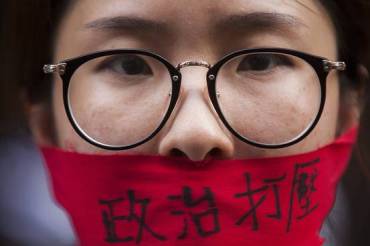
The posting comes as the Communist Party is doubling down on its efforts to stifle dissent among cadres. The sacking last November of Zhao Xinyu, an editor at a state-run newspaper, drew attention to a new tool in the party’s repertoire: the punishment of members for “groundlessly commenting” on official policies.

Introduced in a set of party rules last October, the prohibition against speaking out on national policies – known in Chinese as 妄议中央, wangyi zhongyang – is likely to have a chilling effect on political discussion within China, experts say.

It wasn’t clear whether Mr. Hu’s posting was in reaction to the new regulation – although some of the comments on his post indicated that the issue is on Chinese Internet users’ minds. “Aren’t you afraid of [being fired for] groundlessly commenting on official policies?” one user wrote.

Source: Free Speech in China Gets an Unlikely State-Media Backer – China Real Time Report – WSJ

16/02/2016

First train from China to Iran stimulates Silk Road revival – Xinhua | English.news.cn

First cargo train from China to Iran arrived in Tehran on Monday, indicating a milestone in reviving the “Silk Road,” which has opened a new chapter of win-win cooperation between China and Iran.

English: the Silk Road in Central Asia

English: the Silk Road in Central Asia (Photo credit: Wikipedia)

silk road

The train, also referred to as Silk Road train, has passed through Kazakhstan and Turkmenistan to Iran, travelling a distance of 10,399 kilometers. It had left Yiwu city in east China’s Zhejiang Province on January 28.

This train was carrying dozens of cargo containers, according to the deputy of Iran’s Road and Urbanism Minister, Mohsen Pour-Aqaei, who made a welcome speech after the arrival of the cargo train at Tehran Train Station on Monday.

As known to all, ancient Silk Road trade route had served as an important bridge for East-West trade and brought a close link between the Chinese and Persian civilizations.

The “Belt and Road” initiative was raised by Chinese President Xi Jinping in 2013, which refers to the New Silk Road Economic Belt, linking China with Europe through Central and Western Asia, and the 21st Century Maritime Silk Road, connecting China with Southeast Asian countries, Africa and Europe.

“To revive the Silk Road Economic Belt, the launch of the train is an important move, since about 700 kilometers of trip has been done per day,” said Pour-Aqaei, who was present at the welcome ceremony of the train in Tehran’s Railway Station.

“Compared to the sea voyage of the cargo ships from China’s Shanghai city to Iran’s Bandar Abbas port city, the travel time of the train was 30 days shorter,” he said.

Pour-Aqaei, also the Managing Director of Iran’s Railway Company, added that according to the plan, there would be one such a trip from China to Iran every month.

The travel of cargo train from China to Iran is part of a Chinese initiative to revive the ancient Silk Road used by the traders to commute between Europe and East Asia.

Tehran will not be the final destination of these kinds of trains from China, the Iranian deputy minister said, adding that in the future, the train will reach Europe.

This will benefit Iran as the transit course for the cargo trains from the east Asia to Europe, he said.

Chinese ambassador to Iran Pang Sen told Xinhua that as one of the cooperation projects after Chinese President Xi Jinping’s state visit to Iran, the cargo train is playing a important role to promote construction of the “Belt and Road” initiative.

Meanwhile, the railway line from Yiwu to Tehran provides the two countries an express and efficient cargo trade transportation method, Pang said, adding that the countries along the railway line will furthur upgrade rail technology with the aim to make its transportation ability faster and better.

Source: First train from China to Iran stimulates Silk Road revival – Xinhua | English.news.cn

Law of Unintended Consequences

continuously updated blog about China & India

ChiaHou's Book Reviews

continuously updated blog about China & India

What's wrong with the world; and its economy

continuously updated blog about China & India