Archive for ‘Chindia Alert’

19/10/2014

China Wastes 35 Million Metric Tons of Grain a Year—Enough to Feed 200 Million – Businessweek

Chinese officials like to point out that their country has less than 10 percent of the world’s arable land but has to feed a fifth of the world’s population. So you would think that China obsessively ensures there is no wastage in its agriculture sector. You would be wrong.

A farmer harvests rice in Xizhou county, China

Every year China wastes at least 35 million metric tons of grain through subpar storage, during transportation by truck, rail, and boat, and through excessive processing, said a Chinese official earlier this week. “The losses can feed 200 million people for a year, which is shameful,” said Chen Yuzhong, an official with the State Administration of Grain, reported China Daily today.

In particular, 27.5 million tons is lost through improper storage and transportation, while another 7.5 million tons is destroyed during processing, he said. Excessive processing that leads to waste happens as companies polish rice two or three times, according to Wang Lirong, a quality engineer in the State Administration of Grain.

via China Wastes 35 Million Metric Tons of Grain a Year—Enough to Feed 200 Million – Businessweek.

19/10/2014

Made in Vietnam Looks Better and Better for Chinese Shirt Maker – Businessweek

In May, a long-simmering territorial dispute between China and Vietnam turned particularly hot. With Chinese and Vietnamese ships confronting one another in the South China Sea (known in Vietnam as the Eastern Sea), Vietnamese protesters furious with China went on a rampage at home. They attacked companies with Chinese workers or Chinese names, including businesses that were owned not by mainlanders but by companies from Taiwan or other places in Asia.

A TAL Apparel employee at the company’s factory in Hong Kong

Despite worries that the anti-Chinese violence would hurt Vietnam’s ability to attract investment dollars from overseas, the unrest hasn’t dissuaded a major Hong Kong-based manufacturer from making Vietnam its top focus for growth. TAL Group is one of the world’s biggest producers of menswear, selling shirts to brands such as Brooks Brothers, L.L.Bean, Eddie Bauer, and Burberry (BRBY:LN). One out of every six dress shirts sold in the U.S. comes from a TAL Group factory, the company says. Today, Vietnam accounts for only 12 percent to 15 percent of its production, but in two years that percentage should grow to 25 percent, according to TAL Chief Executive Officer Roger Lee.

The company’s commitment to Vietnam isn’t limited just to making garments. TAL is also investing in a new business to make textiles in the country. “We believe in Vietnam,” Lee says.

via Made in Vietnam Looks Better and Better for Chinese Shirt Maker – Businessweek.

19/10/2014

Jayaram Jayalalithaa Granted Bail – India Real Time – WSJ

India’s Supreme Court Friday granted bail to Jayaram Jayalalithaa, the influential leader of one of India’s biggest regional parties, as she appeals her conviction nearly three weeks after she was sentenced to four years in jail for corruption.

In September, a court in Bangalore found Ms. Jayalalithaa and three of her aides guilty of having accumulated wealth beyond their known sources of income.

On Friday, the Supreme Court granted her “conditional bail on grounds that she is unwell and needs to rest at home,” her party’s spokesman Aspire K. Swaminathan told The Wall Street Journal in an interview.

After a case that lasted close to two decades, Ms. Jayalalithaa had to step down immediately from her position as chief minister of the southern state of Tamil Nadu after the September verdict. Her party – the All India Anna Dravida Munnetra Kazhagam– quickly named O. Paneerselvam as her successor as chief minister, she remains the leader of the party and has been in jail in Bangalore since Sept. 27.

Ms. Jayalalithaa denied wrongdoing and appealed for bail in the Karnataka High Court earlier this month on health grounds. But the court rejected her bail plea saying there was no reason to suspend her conviction.

Subramanian Swamy, a petitioner in the case against Ms. Jayalalithaa and a leader in Prime Minister Narendra Modi’s Bharatiya Janata Party said the top court has asked Ms. Jayalalithaa to submit her appeal within two months in the Karnataka High Court, “failing which her bail would be cancelled.”

via Jayaram Jayalalithaa Granted Bail – India Real Time – WSJ.

19/10/2014

China, Vietnam pledge to ‘address and control’ maritime disputes | Reuters

China and Vietnam have agreed to “address and control” maritime disputes, state media said on Friday, as differences over the potentially energy-rich South China Sea have roiled relations between the two countries and other neighbors.

Chinese coastguard ships give chase to Vietnamese coastguard vessels (not pictured) after they came within 10 nautical miles of the Haiyang Shiyou 981, known in Vietnam as HD-981, oil rig in the South China Sea July 15, 2014. REUTERS/Martin Petty

Ties between the Communist countries sank to a three-decade low this year after China deployed a $1 billion-oil rig to the disputed waters which straddle key shipping lanes.

Vietnam claims the portion of the sea as its exclusive economic zone, and the rig’s deployment sparked a wave of violent protests in Vietnam.

The two countries should “properly address and control maritime differences” to create favorable conditions for bilateral cooperation, Chinese Premier Li Keqiang told Vietnamese Prime Minister Nguyen Tan Dung on Thursday on the sidelines of the Asia-Europe Meeting (ASEM) in Milan.

“Thanks to efforts from both sides, China-Vietnam relations have ridden out the recent rough patch and gradually recovered,” the official Xinhua news agency cited Li as saying.

Xinhua said Dung agreed and endorsed boosting “cooperation in infrastructure, finance and maritime exploration”.

The comments were a reiteration of earlier pledges by leaders from the two countries.

China’s Defense Minister Chang Wanquan held talks with his Vietnamese counterpart, Phung Quang Thanh, on Friday in Beijing, Xinhua reported, during which both sides agreed to “gradually resume” military ties.

The two leaders vowed that the countries’ militaries would “play a positive role in properly dealing with their maritime disputes and safeguarding a peaceful and stable situation”, the news agency said.

China claims almost the entire South China Sea, believed to be rich in deposits of oil and gas resources. Brunei, Malaysia, the Philippines, Taiwan and Vietnam also have claims in the waters where $5 trillion of ship-borne goods pass every year.

Alarmed by China’s military rise and growing assertiveness, Vietnam has broadened its military relationships in recent years, most notably with Cold War-era patron Russia but also with the United States.

Beijing has told Washington to stay out of disputes over the South China Sea and let countries in the region resolve the issue themselves.

via China, Vietnam pledge to ‘address and control’ maritime disputes | Reuters.

19/10/2014

After border row, India, China plan counter-terror drills to build trust | Reuters

India, which under Prime Minister Narendra Modi has struck an assertive national security posture, also agreed to China’s request to move next month’s exercises away from the border with Pakistan with which China shares a close relationship.

The manoeuvres will come just weeks after thousands of Indian and Chinese soldiers confronted each other on their de facto border in the western Himalayas, accusing each other of building roads and observations posts in disputed territory.

“The exercises are a confidence-building measure, it is in everyone’s interest,” Jayadeva Ranade, the China specialist on India’s National Security Advisory Board, told Reuters.

“It doesn’t mean anyone is conceding anything.”

The row in the Chumar sector of the Ladakh region erupted just as China’s President Xi Jinping was visiting New Delhi for his first summit with Modi since the Indian leader’s election in May. The leaders of the Asian giants aim to ramp up commercial ties.

India sees the anti-terrorism collaboration with China as a way to highlight the threat they both face from Islamist militants in Pakistan.

It had arranged for the Chinese to practise mock assaults in Bhatinda, about 110 km (70 miles) from the Pakistan border.

via After border row, India, China plan counter-terror drills to build trust | Reuters.

19/10/2014

A pocket guide to doing business in China | McKinsey & Company

A pocket guide to doing business in China

McKinsey director Gordon Orr goes behind the trends shaping the world’s second-largest economy to explain what companies must do to operate effectively.

October 2014 | byGordon Orr

China, a $10 trillion economy growing at 7 percent annually, is a never-before-seen force reshaping our global economy. Over the past 30 years, the Chinese government has at times opened the door wide for foreign companies to participate in its domestic economic growth. At other times, it has kept the door firmly closed. While some global leaders, such as automotive original-equipment manufacturers, have turned China into their single largest source of profits, others, especially in the service sectors, have been challenged to capture a meaningful share of revenue or profits.

This article summarizes some of the trends shaping the next phase of China’s economic growth, which industries might benefit the most, and what could potentially go wrong. It also lays out what I believe it takes to build a successful, large-scale, and profitable business in China today as a foreign company.

via A pocket guide to doing business in China | McKinsey & Company.

04/10/2014

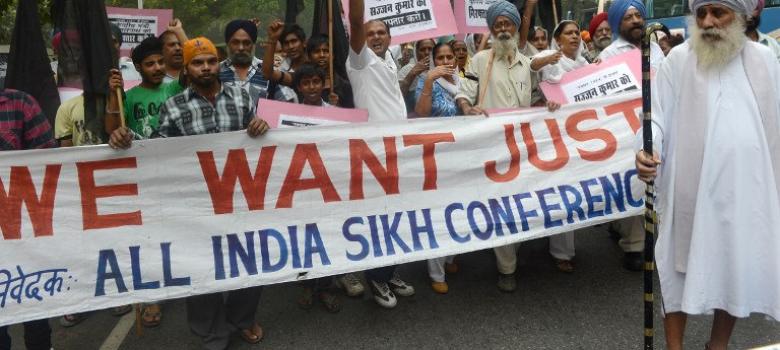
1984 anti-Sikh riots were an organised massacre, says ‘Caravan’ article

Avtar Singh Gill, the former petroleum secretary, alleged that Rajiv Gandhi aide Arun Nehru had sanctioned the violence.

Did disparate groups of rioters act spontaneously during the anti-Sikh riots of 1984, or was the violence orchestrated at the behest of the top leadership of the Congress? This question has dogged Congress governments since Delhi’s Sikh comunity was devastated by one the bloodiest bouts of communal carnage after Independence. The Congress has long maintained that the violence was an unplanned response to the assassination of Prime Minister Indira Gandhi by two Sikh bodyguards on October 31, 1984. The riots continued until November 3.

Now, a recent statement by a senior government official of the time has added credence to the allegation that the violence was indeed orchestrated, and that the clearance came from the top. Avtar Singh Gill, the former petroleum secretary, has told Caravan magazine that Arun Nehru, a cousin and confidant of Rajiv Gandhi, had given clearance for Sikhs to be attacked and killed in Delhi.

In an article by the magazine’s political editor Hartosh Singh Bal in the latest issue, Gill is quoted as saying that on November 1, 1984, “Lalit Suri of Lalit Hotels, who used to come and see me often, dropped by. He was the errand boy for Rajiv Gandhi, and since he often needed some work done, he was close to me. He came to me in the ministry and said, ‘Clearance has been given by Arun Nehru for the killings in Delhi and the killings have started.  The strategy is to catch Sikh youth, fling a tyre over their heads, douse them with kerosene and set them on fire. This will calm the anger of the Hindus.”

Gurudwara lists

Gill is also quoted as saying that Suri “told me that I should be careful even though my name is not in the voters’ list, the Delhi Gurdwara voters’ list. ‘They [the rioters] have been provided this list. This will last for three days. It has started today, it will end on the third [of November].’”

Gill’s revelations also appear to put to rest the long-term speculation about Arun Nehru’s role in the violence. “That Arun Nehru had a role in the violence has long been widely rumoured, but Gill’s statement marks the first time a senior government official has put the accusation on record,” writes Bal. “His story offers the first coherent explanation for the nature of the violence in Delhi,”

Gill and Nehru

Gill’s revelations have greater significance because he was often consulted by Arun Nehru on Punjab and Sikh issues. “As one of the few Sikhs in a senior position in the government – even though I was clean shaven, he [Nehru] wanted to know my views,” the former petroleum secretary is quoted as saying.

Gill’s also explains – again for the first time – how rioters could easily identify Sikh houses. Lawyer HS Phoolka, who is leading the legal battle to secure justice for the victims of the 1984 riots, is quoted in the article saying “the ease with which Sikh houses were identified would make sense if Gurdwara voters’ lists were available”.

Gurdwara voter lists contain the names of people eligible to vote in the elections to the Delhi Sikh Gurdwara Management Committee. That these lists were already available to “people in the higher ranks” is made clear by another contention Phoolka makes in this article.

via 1984 anti-Sikh riots were an organised massacre, says ‘Caravan’ article.

04/10/2014

Meet the Hong Kong teenager who’s standing up to the Chinese Communist Party

Joshua Wong Chi-fu is Hong Kong’s most prominent pro-democracy student leader.

Political movements often conjure images of passionate university-goers championing progressive views they learned on campus. But the long, storied history of Hong Kong’s student-led political movements is taking a different turn: The most prominent student leader of the territory’s pro-democracy protests is only 17 years old.

Sporting heavy black glasses and a bowl cut, Joshua Wong Chi-fung doesn’t exactly cut a menacing figure. But his activism against what many in Hong Kong perceive to be the Chinese Communist Party’s encroachment onto their freedoms has already attracted Beijing’s attention. Mainland authorities call him an “extremist.” A party document on national security identifies Wong by name as a threat to internal stability. Pro-Beijing newspapers in Hong Kong, meanwhile, accuse him of working for the US Central Intelligence Agency to infiltrate Hong Kong schools. (Wong denies the charges.)

Joshua Wong’s fight against ‘brainwashing’

Wong got his start in 2011, when he and fellow students founded a group called “Scholarism,” which they thought was catchier than the direct translation of the Chinese, meaning “scholarly trends.” Wong and Scholarism rose to prominence in 2012, when the Hong Kong government tried to roll out Communist Party-approved “patriotic” education in Hong Kong’s public schools, to replace civics classes. The curriculum included textbooks like one titled “The China Model,” which characterised China’s Communist Party as “progressive, selfless and united,” and criticized multi-party systems like Hong Kong’s while avoiding major (unflattering) events – notably, the Great Leap Forward, the Cultural Revolution and the Tiananmen Square massacres of 1989 – reports the New York Times (paywall).

One Hong Kong journalist likened the move to a Trojan horse that dissolved Hong Kong’s identity; Wong called it “brainwashing,” an attempt to require students to “develop an emotional attachment to China,” as he put it in this video by the South China Morning Post (paywall). In Sep. 2012, Wong and Scholarism mobilized more than 120,000 people to demonstrate (paywall) against the education programme, including a slew of students who went on hunger strike. Within days, the Hong Kong government scrapped the plan for mandatory implementation.

Wong’s next battle: ‘universal suffrage’

But Wong and Scholarism knew that as long as Hong Kong lacks representative government, both the education issue and the Chinese government’s failed 2003 attempt to impose US Patriot Act-style rules on Hong Kong would eventually resurface. So they began researching the controversy that’s now galvanising the Umbrella Revolution: universal suffrage.

This issue is really confusing – and, as even Wong admits, “really boring.” The background goes something like this: Hong Kong is governed by what’s called the Basic Law, which legal scholars from the then-British colony and the mainland wrote up prior to the 1997 handover. The law promises Hong Kong a “high degree of autonomy” until 2047 (after which, it is assumed, it will merge with the People’s Republic of China for good). It also indicates, although vaguely, that the ultimate objective is for the chief executive and the congress to be elected by universal suffrage by Hong Kong’s seven million people.

That’s not how it is at the moment. Hong Kong’s chief executive is currently chosen by an “election committee” made up of 1,193 members selected to represent “functional constituencies,” such as business and labor groups. Beijing controls who is on the committee, and, in turn, whom the committee elects; the committee also decides who runs. Ultimately, since the Chinese government still has to officially “appoint” the chosen candidate, it has veto power over the chief executive.

In 2007, the National People’s Congress, China’s legislature, promised that by 2017, Hong Kong’s chief executive “may be implemented by the method of universal suffrage.” Some in Hong Kong read that to mean by 2017, they’d have fully democratic elections. But the NPC, evidently, had something else in mind: that each and every Hong Kong citizen would be allowed to vote – but only for one of three candidates selected by the (Communist Party-picked) “electoral committee.”

via Meet the Hong Kong teenager who’s standing up to the Chinese Communist Party.

03/10/2014

China Focus: Nation rises after 65 years of development – Xinhua | English.news.cn

One need look no further than China’s railways to see the enormous development of the country since its foundation on Oct. 1, 1949.

At the 65th anniversary of that formative moment, every Chinese citizen has access to a modern train service. In 1949, the nation’s railways extended only 22,000 km, with half the track in poor condition.

In comparison, the mileage had expanded to 100,000 km by 2013. More than 10,000 km was high-speed infrastructure, and another 12,000 km was under construction at that time.

This modernization is transforming the lives of Chinese people. For Tsering Dekyi, for example, his wish to send his children from their remote home to far-off schools for a better education is no longer a wild dream.

“I heard that the trains are very fast and safe. It takes only two hours from here to Lhasa. I really hope that my three kids will be able to attend schools in Lhasa or inland cities by train in the future,” Tsering Dekyi said from Xigaze City, some 200 km west of Lhasa in southwest China’s Tibet.

This is possible after an extension of the Qinghai-Tibet Railway was put into operation in August, linking Xigaze and Lhasa like never before.

Via the Qinghai-Tibet Railway, launched in 2006 as the world’s highest plateau rail track, Xigaze locals can even travel further off to major cities like Beijing and Shanghai.

Train track mileage is not the only data that makes clear the positive changes in China since 1949. In 2010, China overtook Japan to become the world’s second-largest economy. China is the world’s top goods trader. The nation also ranks third in global investment…

Meanwhile, the 2014 APEC Economic Leaders’ Meeting will come to Beijing in November, with leaders gathering in the Chinese capital to discuss important economic issues for the Asia-Pacific region. China will take center stage once more.

Behind the huge economic achievements made especially since the reform and opening-up policy was introduced in 1978, the nation has made huge, unprecedented strides in providing basic education and welfare for its population of 1.3 billion, the world’s largest.

Sixty-five years ago, a shocking 80 percent of the population were illiterate, but by 2008, free nine-year compulsory education programs were fully implemented across the country. This year, 7.27 million university students will graduate, marking a historical high.

Nutritious meals are being provided to students from poor families with billions of yuan budgeted each year by the government.

About 32.29 million rural students have benefited from the 46.23 billion yuan (7.52 billion U.S. dollars) in subsidies the central government has allocated since 2011, when it launched the nutrition improvement program. Also, more than 10 million university students have completed their studies after being granted student loans under programs adopted since 1999.

The 660 million people that China has lifted out of poverty since 1981account for more than 70 percent of the world’s total.

Meanwhile, the Chinese government has worked hard to provide basic healthcare for its people, with over 95 percent of the population covered by different sorts of healthcare programs by 2011.

However, there remain problems among the achievements, and they must be dealt with increasingly urgently. The issues include restraints on future development from the environment and resources, wide gaps between the wealthy and the poor, industrial overcapacity and imbalanced regional development.

Meanwhile, the Chinese economy must also brave challenges imposed from an economic slowdown after a boom over the past decade, as employment and structural control are key agendas for the government.

In order to cope, the Chinese leadership has showed political courage in pushing comprehensive reforms, including fighting corruption. Overhauls of administrative management, fiscal and financial systems are steadily being carried out as well.

There is no doubting the truth of Chinese President Xi Jinping‘s assertion that today’s China is nearer to its great goal of rejuvenation than at any period in history.

via China Focus: Nation rises after 65 years of development – Xinhua | English.news.cn.

03/10/2014

Hong Kong protests: No exit | The Economist

IT IS a challenge unlike anything Chinese leaders have seen since Tiananmen Square in 1989; a city roiled by days of unauthorised protests led by students demanding democracy. On October 1st, the 65th anniversary of Communist rule in China, anti-government demonstrations in Hong Kong, which had begun nine days earlier with class boycotts, swelled to include well over 100,000 people. Protesters, conveniently armed with the umbrellas that have become their rallying symbol, endured downpours of rain to jeer the territory’s leader, Leung Chun-ying, as he presided over the raising of the national flag. A few raised their middle fingers towards it.

The “umbrella revolution”, as the movement has been dubbed, is the nightmare Communist Party leaders in Beijing have long feared from Hong Kong and the “one country, two systems” arrangement it has enjoyed since its handover from Britain in 1997. It is the first large-scale student-led protest for democracy to erupt in any Chinese city since 1989. And it presents unusual challenges. The authorities in Hong Kong are reined in by a legal system bequeathed by the British; they cannot, as officials commonly do in mainland China, handle unrest with a combination of astute bargaining, thuggish violence, ruthless treatment of ringleaders and tight controls over media and the internet. Xi Jinping, China’s president, is constrained by a desire to keep Hong Kong stable and prosperous: a botched response could badly damage one of the world’s wealthiest economies and China’s image.

But if the protests continue far beyond the public holiday on October 1st and 2nd, leaders in Beijing will doubtless become impatient for tougher action. On October 1st the party’s newspaper, the People’s Daily, called on Hong Kong residents to support “resolute” action by the police against the demonstrators, who it said would “reap what they have sown”. The party does not want Hong Kong’s protests to fan dissent elsewhere. Chinese censors on the mainland have been working hard to make sure they do not (see article). So too have China’s police, who have rounded up dozens of activists on the mainland for expressing sympathy with the protests. Some tour groups have reportedly been denied permits to go to Hong Kong on their usual shopping extravaganzas. Despite the party’s efforts, however, news of Hong Kong’s defiance is spreading in China.

The protesters’ main demand is that the people of Hong Kong be allowed to vote for any candidate of their choosing in elections for the post of chief executive in 2017 (the first in which citizens would have such a vote). Mr Xi has made clear he does not want any Western-style democracy within China’s borders. The current election plan, which China proposed on August 31st, calls for candidates to be screened by a committee stacked with party supporters.

Several protest movements have converged to challenge this. Until recently the best-known was Occupy Central with Love and Peace, which is modelled on Occupy Wall Street and named after an important business district in the heart of Hong Kong. But even Occupy Central’s leaders, who teach at local universities, wondered whether they could muster meaningful numbers. Then came the students, both from universities and schools, thousands of whom began boycotting classes on September 22nd. On the evening of September 26th the police inflamed their passions by arresting Joshua Wong, the 17-year-old leader of a movement called Scholarism, which two years ago led successful protests against an effort to introduce party-backed “patriotic” teaching in schools. Mr Wong was released on September 28th, but in the early hours of that day Benny Tai, one of the leaders of Occupy Central, announced that its protest, which had been scheduled for October 1st, would begin immediately.

via Hong Kong protests: No exit | The Economist.

Law of Unintended Consequences

continuously updated blog about China & India

ChiaHou's Book Reviews

continuously updated blog about China & India

What's wrong with the world; and its economy

continuously updated blog about China & India