Archive for ‘Chindia Alert’

13/08/2014

Chinese medical workers arrive in Sierra Leone’s Freetown to battle Ebola – Xinhua | English.news.cn

A team of three Chinese medical workers arrived in Sierra Leone’s capital Freetown on late Tuesday to help the country fight against the deadliest-ever Ebola virus which has claimed over 1,000 lives in west African countries.

Chinese disease control experts arrive in Sierra Leone

The first batch of three medical workers arrived in Guinea on Monday and another three medical staff are expected to carry out anti-Ebola work in Liberia soon, medical sources told Xinhua.

China announced on Sunday it would send three expert teams and medical supplies to Guinea, Liberia and Sierra Leone to assist in the prevention and control of the Ebola virus, with each medical team composed of one epidemiologist and two specialists in disinfection and protection.

China announced on Sunday that it would provide relief worth 30 million yuan (4.9 million U.S. dollars) to the three countries. It was the second round of Ebola relief from China so far.

via Chinese medical workers arrive in Sierra Leone’s Freetown to battle Ebola – Xinhua | English.news.cn.

13/08/2014

Beijing cuts coal use by 7 percent in first half of year – China – Chinadaily.com.cn

Beijing cut coal consumption by 7 percent in the first half of 2014 as part of its efforts to tackle smog, the city’s environmental protection bureau said.

Beijing cuts coal use by 7 percent in first half of year

Beijing is at the front line of a “war on pollution” declared by the central government earlier this year in a bid to head off public unrest about the growing environmental costs of economic development.

The city has already started to close or relocate hundreds of factories and industrial plants.

The coal-fired power generators at Beijing’s Gaojing Thermal Power Plant are decommissioned on July 23. Provided to China Daily

It will also raise vehicle fuel standards and is mulling the introduction of a congestion charge.

To reduce coal consumption, it is in the process of shutting down all of its aging coal-fired power plants and replacing them with cleaner natural gas-fired capacity or with power delivered via the grid.

Based on last year’s coal consumption level of 19 million metric tons, the 7 percent cut would amount to around 1.33 million tons per year.

Beijing has said previously that it plans to reduce total coal use by 2.6 million tons in 2014, and aims to slash consumption to less than 10 million tons per year by 2017.

The Beijing environmental bureau said the city had cut sulfur dioxide emissions by 5.4 percent over the first six months of the year.

It also took 176,000 substandard vehicles off the road.

Previous data issued by the Ministry of Environmental Protection showed that concentrations of hazardous airborne particles known as PM2.5 stood at 91.6 micrograms per cubic meter in Beijing in the first half of the year, down 11.2 percent year-on-year but still more than twice the recommended national limit of 35 mcg.

Much of the pollution that hits Beijing drifts in from the surrounding province of Hebei, a major industrial region that is home to seven of China’s 10 most polluted cities.

Under new plans to integrate Beijing with Hebei and the port city of Tianjin, the region will be treated as a “single entity” with unified industrial and emission standards.

Hebei said last week that it had cut coal consumption by 7.53 million tons in the first half of 2014, amounting to just over half of its target of 15 million tons for the year.

The province agreed last year to cut coal use by 40 million tons by 2017, and it is also planning to shed at least 60 million tons of excess steel capacity over the same period.

via Beijing cuts coal use by 7 percent in first half of year – China – Chinadaily.com.cn.

13/08/2014

China Demands that Japan Return the Plundered Honglujing Stele – Businessweek

Islands. Airspace. Antiquities. Until now, China has concentrated its attention on the first two as it fights against Japan for dominance in East Asia. In focusing on the wrongs done by Imperial Japan before and during World War II, China’s government has escalated its claims to uninhabited islands in the East China Sea controlled by Japan and has designated airspace in the area as its own.

The Honglujing Stele is housed in Tokyo's Imperial Palace, home to Japan's Emperor Akihito

The dispute has had humorous moments, such as the time officials invoked Voldemort.  The conflict has potential to become far more dangerous, though, with ships and planes from both sides provoking one another. On Tuesday, for instance, Chinese Coast Guard vessels patrolled near the islands, called the Senkaku by Japan and Diaoyu by China.

China’s foreign ministry voiced “strong dissatisfaction and resolute opposition” last week to a white paper published by Japanese Prime Minister Shinzo Abe’s government that had expressed concern over China’s behavior in the East China Sea and South China Sea. Over the weekend, China’s defense ministry followed with a statement accusing Japan of looking for excuses to re-militarize.

China has plenty of ways to poke its neighbor. Determined to leave no grievance unaired, China has opened a fresh front in its battle against Japan: A group has  demanded the return of a 1,300-year-old relic that Japanese soldiers whisked away from China’s northeast a century ago.  The Honglujing Stele, three meters wide, 1.8 meters tall, and two meters thick, dates back to the Tang Dynasty and now belongs to Japan’s Emperor, according to the official Xinhua news agency.

A group called the China Federation of Demanding Compensation from Japan is now demanding that the Emperor give it back. Stolen items such as the Honglujing Stele “have done great damage to Sino-Japanese ties,” Wang Jinsi, the federation official in charge of recovering cultural relics, told Xinhua. “They should be returned to their rightful owner.”

That may be, but Wang’s group has chosen an interesting time to make its point. As Xinhua points out, Japanese troops went on a rampage in the mainland in the 50 years between China’s defeat in the First Sino-Japanese War and the end of the Second World War, with Japan stealing some 3.6 million relics. Only now is the Chinese group calling on the imperial family to return one of them.

via China Demands that Japan Return the Plundered Honglujing Stele – Businessweek.

13/08/2014

China Names U.S. as the Top Destination for ‘Economic Fugitives’ – Businessweek

China’s wealthy elite is fleeing the country for a better quality of life—better education, better air, and greater personal security. China’s Ministry of Public Security has just added a further potential reason: fleeing the police.

“The U.S. has become the top destination for Chinese [economic] fugitives,” Liao Jinrong, a ministry official told state-run China Daily on Monday. According to the English-language newspaper, “More than 150 economic fugitives from China, most of whom are corrupt officials or face allegations of corruption, remain at large in the United States.”

While this is a rather incredible admission, the intent of the article—no doubt placed by China’s propaganda authorities—seems to be to make the case for an extradition treaty between the U.S. and China. “We face practical difficulties in getting fugitives who fled to the US back to face trial due to the lack of an extradition treaty and the complex and lengthy legal procedures,” Liao told the paper.

via China Names U.S. as the Top Destination for ‘Economic Fugitives’ – Businessweek.

13/08/2014

India Wants to Find the Saraswati River and Bring It Back to Life – India Real Time – WSJ

ndia’s new government says it plans to find and possibly bring back to life a long-lost river mentioned in sacred Hindu texts.

In answer to a question in Parliament Tuesday, Uma Bharti, the water resources and river development minister said India wants to “detect and revive,” the Saraswati River, described in Vedic texts.

“There are enough scientific evidences on the presence of the river Saraswati in some parts of the country through which it flowed about five to six thousand years ago,” she said on the floor of the lower house of Parliament. “Saraswati is not a myth.”

Geologists have known for more than 100 years about ancient river beds passing through northern India that could be the Saraswati, said the Times of India. But reviving the river by bringing any underground water to the surface is “an impossible task,” Umesh Chaube, professor emeritus of water resource development and hydrology at IIT –Roorkee told the Hindustan Times.

Critics were quick to suggest it would be a waste of government money and a potential wild goose chase aimed at strengthening the ruling Bharatiya Janata Party’s ties to its Hindu nationalist supporters.

A BJP spokesman did not respond to a request for the party response on Wednesday morning.

It wouldn’t be the first time that scientists have had to follow the hunches of politicians. Last year a team of government archaeologists had to excavate the ruins of an old palace in the state of Uttar Pradesh, after a famed Hindu holy man declared that there was 1,000 tons of gold buried under it. No gold was found.

via India Wants to Find the Saraswati River and Bring It Back to Life – India Real Time – WSJ.

13/08/2014

Class divide puts English to the test in India’s civil services

Indian students in recent weeks have protested the use of English in the country’s difficult civil service examinations. The students, usually from Hindi-speaking regions of India, say that the exams reflect a class divide: if you speak and write English well, you are seen as part of the educated, urban elite. If you do not, it’s because you are one of the disadvantaged, usually from smaller towns or villages.

English is a tricky subject in India. A language imposed by colonists who exploited the people and resources of the land for centuries, it also was the one language that people seeking independence from the British could use to speak to one another. It remains one of two official languages across India, though many people do not speak it well or at all. I spoke to some of the civil service aspirants who have complained about the language requirement and the structure of the exams, and learned about the role that they hope the exam will play in their lives.

Ashutosh Sharma is a 25-year-old psychology graduate from Basti district of Uttar Pradesh, who has been camping in Delhi’s Mukherjee Nagar neighbourhood for the past two years, hoping that he will crack the examination one day.

“The entire protest is presented as a language issue. It’s much more than that. It’s about how a group of elite people in the country want to govern the things. How they cannot digest that a villager, who doesn’t match their lavish lifestyle, rises to the ranks on the basis of his knowledge and hard work,” he said.

Ashutosh said he comes from a village, and is better acquainted with the problems the country faces in these places. “When I was in the village primary school, I remember that the teacher would hardly come to take classes. There was no accountability. As a district magistrate, I would know better how the problem can be fixed and I can deal with the problem regardless of whether I speak English or not.”

via India Insight.

13/08/2014

Chennai, home of Indian coffee, scoffs as Starbucks enters the market

When Starbucks opened its first coffeehouse in Chennai last month, its 50th in India, many people wondered why the chain had waited so long to come to the city. Was it because it was summoning up courage to enter the land of filter coffee?

The US chain, which has entered India in partnership with the Tata group, opened its first outlet in Mumbai in October 2012. But it took two years for Starbucks to come to Chennai, where it opened its first outlet in the Velachary area on July 10. It plans to open a second outlet soon, in the Alwarpet locality.

Chennai is famous for its ubiquitous filter coffee, a potent brew made in a cylindrical metal device with two compartments separated by a fine filter that allows water to percolate through a bed of coffee powder. The decoction that drips through into the bottom compartment is then mixed with milk and sugar to produce the famous Chennai filter coffee.

For now, youngsters are thronging the new Starbucks outlet, but filter coffee, brewed in most Chennai homes and available in low-cost eateries around the city, might yet prove to be formidable competition.

Starbucks’ representatives did not reply to specific queries about the chain’s prospects in Chennai. But because Starbucks is not a pioneer, it will not have to create a market for its style of coffeehouse: another chain has already done that.

Indeed, the first battle for coffee in Chennai took place a good 15 years ago, when the city got its first Western-style coffee house with Café Coffee Day‘s first outlet in Nungambakkam in 1999. Since then, the chain has grown to 74 cafés, becoming the largest in the city.

Starbucks, therefore, not only has another competitor in Café Coffee Day but also a fellow-traveller, albeit one that got an early start.

via Scroll.in – News. Politics. Culture..

13/08/2014

Rising inflation, weak industrial output dampen hopes of economic turnaround in India

New economic data casts dark clouds over economic revival

The Consumer Price Index increased from 7.46%  in June to 7.96% in July, according to data released by the government on Tuesday. The CPI measures the change in market price levels for a representative basket of goods and services purchased by households. Meanwhile, overall factory output has decelerated by 1.8% in June to 3.4% due to a sharp decrease in the manufacturing activity.

via Scroll.in – News. Politics. Culture..

10/08/2014

Modi has realised that India needs to be a regional power before it can be a global one

One of the many pet projects of those inclined more to the right has been turning the dream of “Akhand Bharat“, or Undivided India, into a reality. The Rashtriya Swayamsevak Sangh’s education saffroniser-in-chief, Dinanath Batra, has even written about the subject in his book Tejomay Bharat, which will now be stocked in Gujarat school libraries. “Undivided India is the truth, divided India is a lie,” Batra writes, referring to a vision of the nation that begins as far west as Afghanistan and goes all the way till Burma, including everything in between. “Division of India is unnatural and it can be united again,” Batra suggests.
Of course, no one in the government has spoken of Akhand Bharat and Prime Minister Narendra Modi has never clearly explained his understanding of the concept. There is no indication that the government intends to implement any policy that aims to reinstate this fanciful notion of what India once was and there is no reason to believe there will be.

But the concept could be a rubric by which to understand the Modi government’s approach to foreign policy, particularly in the neighbourhood. From the very get-go Modi announced his intention to reinvigorate ties with India’s neighbours by inviting to his swearing-in ceremony each of the leaders from the South Asian Association for Regional Cooperation — the primary multilateral forum for subcontinental nations.

Just two-and-a-half-months in, the PM has visited two of India’s neighbours, his foreign minister has visited four, and India is set to become part of multilateral organisations that will give it many more opportunities to project itself as a regional powerhouse. This is Akhand Bharat 2.0.

Regional power

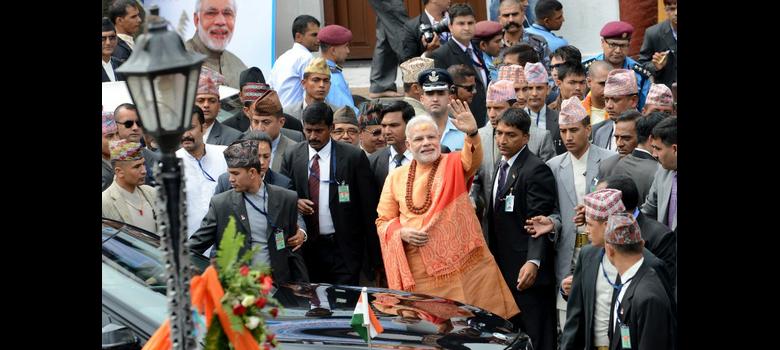
Foreign minister Sushma Swaraj is currently in Myanmar, the fourth neighbourhood country that she has visited in the last three months. But it was the trip made by Modi to Nepal that really sent a statement, since it was the first visit by an Indian prime minister to the country in 17 years. He received an enthusiastic reception.

“All governments that come to power in India feel that we must improve our relationship with the neighbourhood,” said Kanwal Sibal, a former foreign secretary. “But the difference is that, whereas in the past it remained at the level of rhetoric, in this case they are translating it into concrete initiatives. The fact that an Indian PM visited Nepal after 17 years is a testimony to the fact that, despite our professed position about needing a secure neighbourhood, we have actually neglected it… that is changing.”

That message was sent at the very beginning with the invitations handed out to each of the SAARC leaders for Modi’s swearing-in, all of which were accepted — with the exception of Bangladesh’s Sheikh Hasina, but only because she was on another diplomatic visit at the time. The sight of all the leaders in front of Rashtrapati Bhavan, and Modi dedicating his first day in office to bilateral talks with them, sent a very clear signal. The PM made his first foreign visit to Bhutan, a country deeply connected to India but not particularly important in terms of foreign policy.

“It shows that they understand that unless India is a dominant regional power, we can hardly be an extra-regional power or a world power,” said Manoj Joshi, a distinguished fellow at the Observer Research Foundation. “They seem to definitely be working on this understanding, especially because we are facing stiff competition from the Chinese when it comes to projecting power in the neighbourhood.”

Leading South Asia

It’s not just symbolism and rhetoric either. Modi’s visits to Bhutan and Nepal have been accompanied by important agreements, such as a $1 billion line of credit to Kathmandu, as well as the promise of further talks. Discussions with Bangladesh have also indicated progress on key stumbling blocks between the two nations. Modi has also spoken of using the SAARC framework to further cooperation in the neighbourhood. His suggestion of a SAARC space satellite, for example, while criticised by some as a gimmick, certainly sent a message that he is looking beyond the potential disputes towards projects that would allow the countries to work together.

“He has staked his leadership of the region, and this is important,” Sibal said. “There is a gesture to friendship in the neighbourhood, but he has also put across the message that India is leading the region. India is not going to neglect its neighbourhood, and it will take the lead in creating synergies that can benefit all.”

via Scroll.in – News. Politics. Culture..

09/08/2014

China’s Shale-Gas Production Target Cut in Half by Top Official – Businessweek

Tapping China’s vast shale-gas reserves has proved more difficult than government planners in Beijing once hoped. In 2012, China’s National Energy Administration projected that, by 2020, from 60 billion to 80 billion cubic meters (bcm) of domestic shale gas would be pumped annually. Earlier this week the country’s energy chief, Wu Xinxiong, slashed the goal in half, to 30 billion bcm by 2020.

A shale well at Fuling, owned by Sinopec, China's largest oil refiner, in Chongqing, southwest China on April 21

According to the U.S. Energy Information Administration, China’s holds the world’s largest reserves of theoretically recoverable shale gas. But much of it is locked in mountainous regions in western China.

While China’s leaders—concerned about steeply rising energy demand accompanying rapid urbanization—dearly want to emulate the U.S.’s shale-gas boom, it turns out Americans have several practical advantages. For starters, the U.S. shale-gas revolution kicked off in fairly accessible regions: the flatlands of Texas, North Dakota, and Pennsylvania.

So far, explorations in China have identified only one clearly promising shale play: Fuling shale gas field, near the western megalopolis of Chongqing. Sinopec, which controls the Fuling field, projects that its annual shale gas production will reach 5 bcm by 2015 and 10 bcm by 2017. (China trivia fact: Fuling was also the site of River Town, well-known journalist Peter Hessler’s first book chronicling his years as a Peace Corps volunteer in the then-small city on the Yangtze.)

With no other comparable sites yet identified, it’s not clear where the other 20 bcm may come from. While Sinopec is currently at the forefront of China’s shale-gas development, two foreign companies, Royal Dutch Shell (RDSA:LN) and Hess (HES), have secured production-sharing contracts for other potential sites.

via China’s Shale-Gas Production Target Cut in Half by Top Official – Businessweek.

Law of Unintended Consequences

continuously updated blog about China & India

ChiaHou's Book Reviews

continuously updated blog about China & India

What's wrong with the world; and its economy

continuously updated blog about China & India