Archive for ‘Chindia Alert’

09/08/2014

China provinces on track to meet 2015 energy targets: NDRC | Reuters

Most of China’s provinces are ahead of schedule or on track to meet 2015 energy savings targets, the government said on Friday, with Beijing and Shanghai among the frontrunners as the world’s No.2 economy seeks to reduce its impact on the environment.

Smoke rises from chimneys of a thermal power plant near Shanghai March 26, 2014.  REUTERS/Carlos Barria

China has pledged to reduce its energy intensity – the amount of energy it uses to add a dollar to its gross domestic product (GDP) – to 16 percent below 2010 levels by 2015.

Beijing’s intention in setting the targets was to slow emissions of climate-changing greenhouse gases and cut expensive fuel imports, but they have won new relevance with the pollution crisis that has enveloped the nation the past two years.

via China provinces on track to meet 2015 energy targets: NDRC | Reuters.

09/08/2014

China builds friendship railway to link Pakistan | The Times

In a park outside Islamabad, fountains tinkle beneath the huge glass façade of the new Pakistan-China Friendship Centre. “Pakistan China friendship is as high as the Himalayas, as deep as the ocean and sweet as honey,” declares a hoarding above an escalator, which grinds to a halt intermittently due to the country’s chronic power shortages.

Nanga Parbat mountain

Next month, China’s President Xi Jinping will arrive here to finalise plans to turn this gushing propaganda into reality by building a 1,800km railway that would, for the first time, directly link Beijing to Islamabad via its eastern province of Xinjiang. Stretching to Pakistan’s biggest city of Karachi, and beyond to a Chinese-built deep-sea port at Gwadar on the Gulf of Oman, the railway would bore through some of the world’s highest peaks in the Karakoram sub-range of the Himalayas.

“China has a new focus on this region,” beams Senator Mushahid Hussain Sayed, the chairman of the Pakistan China Institute, who says the railway will be a “game changer” and the most ambitious part of a Chinese plan to reboot the area’s troubled economy and open up its own western flank to development. After years of war and terrorism, Pakistan has suffered an exodus of foreign cash and expertise, but with Beijing now splashing out $32 billion on more than 120 projects in Pakistan over the next seven years, the number of Chinese living and working in the country has leapt to from 3,000 in 2008 to nearly 15,000.

Chinese workers are dredging Karachi’s port complex, and building a giant hydroelectric dam at Bunji on the Indus River, a highway linking Lahore to Karachi, and nuclear and coal-fired power stations, solar power plants and ports.

With Pakistan’s reputation for violence, terrorism and corruption, some westerners are privately raising their eyebrows at the scale of China’s spending spree. However, for China’s former ambassador to India and Pakistan, Zhou Gang, the attractions are clear. “It will promote the economic development of all Asian countries,” he said, pointing out that to reach the Gulf of Oman from Shanghai, Chinese goods must currently travel 15,858km by ship through the Strait of Malacca. A railway, road or pipeline through Pakistan would slash that journey to 4,712km.

Despite the hype, however, tensions exist. India disapproves of the railway, which would run through territory it claims as its own. China also frets about the safety of its citizens in Pakistan, several of whom have been killed. One Pakistani official warned: “If they can’t sort out the terrorism and security then it won’t happen.”

via China builds friendship railway to link Pakistan | The Times.

08/08/2014

Nation to donate $4.9 million for Ebola assistance – China – Chinadaily.com.cn

The Chinese government announced on Thursday it will provide 30 million yuan ($4.86 million) in humanitarian aid to four Ebola-ravaged countries in West Africa to help contain the outbreak.

English: Biosafety level 4 hazmat suit: resear...

English: Biosafety level 4 hazmat suit: researcher is working with the Ebola virus (Photo credit: Wikipedia)

The Ebola virus has been blamed for at least 932 deaths in four western African countries-Guinea, Liberia, Nigeria and Sierra Leone-with 1,711 reported cases, according to The Associated Press.

China’s National Health and Family Planning Commission said on Thursday that no Ebola cases have been reported in China. Song Shuli, the commission’s spokeswoman, said a series of preventive measures have been taken to stop the virus from entering the country.

The commission said it is communicating with the World Health Organization to better monitor and anticipate the spread of the virus.

It has also ordered border control authorities to intensify their checks of inbound travelers, Song said at a news conference on Thursday.

She dismissed an online rumor that a person in Shanghai died of Ebola virus. She also said “the possibility of the virus coming to China remains slim right now” in response to news reports in late July of a Hong Kong woman who showed symptoms suggestive of the Ebola virus after a visit to Kenya. She later tested negative for the disease.

Local medical institutions must report any confirmed or suspected Ebola cases directly to the commission within two hours, said Song, who added that the public should learn more about the disease to protect themselves.

via Nation to donate $4.9 million for Ebola assistance – China – Chinadaily.com.cn.

08/08/2014

In China, Wastewater Irrigates Parks and Spreads Bacteria – Businessweek

In theory, recycling water in China’s parched cities, including Beijing, makes ecological sense. But when wastewater is inadequately treated before being used to water urban parks—or redirected through scenic downtown canals—it can become an environmental health hazard.

Something Is Scary in the Water That Irrigates Many Chinese Parks

Six researchers in Beijing and Xiamen working for the Chinese Academy of Sciences recently decided to compare conditions in city parks watered with fresh water vs. recycled water. Their findings, reported in a July 24 article in the journal Environmental Science & Technology, may make you squirm.

Conventional wastewater treatment plants are designed to remove solids, organic matter, and nutrients from water, but they aren’t properly equipped to treat the kinds of waste that may be found in used water from hospitals and pharmaceutical facilities. In particular, most wastewater plants in China don’t remove traces of antibiotics and may even become “reservoirs” for them, as the researchers put it.

Even treated wastewater can therefore become a vector for spreading antibiotics, as well as “antibiotic resistant genes”—chance genetic mutations that make bacteria resistant to drugs. The researchers found that urban parks in China doused with recycled water contained dangerously elevated levels of antibiotic resistant genes, with quantities from 100 times to 8,655 times greater than in other parks.

An April 30 report from the World Health Organization sounded the alarm about growing antibiotic resistance worldwide: “This serious threat is no longer a prediction for the future, it is happening right now in every region of the world. … Antibiotic resistance–when bacteria change so antibiotics no longer work in people who need them to treat infections–is now a major threat to public health.”

Apparently lousy sewage systems and some irrigated parks in China, and likely elsewhere, are helping to accelerate the threat. China’s situation is particularly risky because of a culture of rampant overprescription of antibiotics, which the government is trying hard to bring under control.

via In China, Wastewater Irrigates Parks and Spreads Bacteria – Businessweek.

08/08/2014

Rats On Planes — A Distressingly Common Problem – India Real Time – WSJ

After a rat was discovered aboard an Air India Ltd. plane at the Delhi airport, a spokesman for the country’s state-owned flag carrier said rodent stowaways are a “rare occurrence.”

If only that were true. In fact, rats and other pests often find their way onto jetliners in India and around the world.

With thousands of flights each day handling large quantities of food for passengers as well as baggage, rodents and insects sometimes manage to hitch a ride on food catering trucks or luggage trollies to get inside planes despite hygiene checks.

“We get requests to fumigate four or five planes each month,” said an official of India’s state-run Central Warehousing Corp., which offers pest-control services to airlines, ports, railways, shipping companies and government offices in India.

The official, who declined to be named, said Central Warehousing offers two types of pest treatment to airlines. The most common is spraying pesticides inside aircraft cabins to keep out mosquitoes, cockroaches and other insects.

“The second is fumigation and it is done only when a rat or rat droppings are spotted inside an aircraft,” he said.

Fumigating an aircraft isn’t easy. The plane needs to be isolated, sealed and then pumped full of lethal gas. After about six hours, the aircraft is ventilated to clear the toxic fumes.

The official said the fumigation procedure was carried out on the Air India Airbus A321 that had rodent issues this week. The official said he wasn’t sure whether there was one or more rats inside the plane.

An Air India official had said there was only one rat inside the Airbus A321 jet when it landed at New Delhi on a flight from the eastern metropolis of Kolkata. He denied a Times of India report that said there were “scores” of rats inside the plane.

Pests afflict all airlines. A pest-control company in Southeast Asia said his company has helped clear rats out of planes belonging to two Asian airlines. But airline companies like to keep such matters quiet, and often ask exterminators to sign confidentiality agreements, he said.

The Central Warehousing official said the company’s pest control business for Indian carriers suffered a setback after Kingfisher Airlines stopped flying in 2012 but is now optimistic that business will rebound as new airlines like AirAsia India Pvt.  and Tata SIA Airlines Ltd. set up base in the country.

via Rats On Planes — A Distressingly Common Problem – India Real Time – WSJ.

08/08/2014

Bordeaux in Beijing? China Hopes to Build Must-See Destination For Wine Lovers – China Real Time Report – WSJ

Beijing may be better known for its pollution than its bucolic charms. But that isn’t stopping the government from trying to develop a rural region northwest of the city into a Napa Valley-style attraction.

Last month, the government hosted the 11th International Conference on Grapevine Breeding and Genetics in Beijing’s Yanqing county, a five-day affair involving wine tasting competitions and networking among grape breeders and geneticists from around the world.

In addition to hosting such a conference, the government also recently finished the construction of a so-called “International Grape Exhibition Garden,” which will consist of vineyards that they hope will attract an increasingly wine-loving public.

“We want to build our own Bordeaux in China,” said Pang Rongnian, the International Grape Exhibition Garden’s deputy director. He declined to comment on how much the government has invested in the garden’s creation.

The garden is home to 750,000 square meters of vineyards, along with a 2,500 square-meter greenhouse that will help nurture more than 1,000 kinds of grapes from more than 40 countries.

According to Vinexpo, which hosts regular wine and spirits exhibitions, China consumes more wine than any other country in the world. Last year,  China consumed more than 1.9 billion bottles of red wine in 2013, up 136% compared to 2008.

Also last year, auction house Christie’s set up the world’s first estate agency for wealthy Chinese to buy vineyards.

via Bordeaux in Beijing? China Hopes to Build Must-See Destination For Wine Lovers – China Real Time Report – WSJ.

07/08/2014

Rahul Gandhi Wakes Up to New Role as Rebel Leader – India Real Time – WSJ

There’s nothing particularly newsworthy about boisterous Indian lawmakers blocking debate on the floor of Parliament when they don’t get their way, unless one of the lawmakers is the usually-reticent Rahul Gandhi.

The typically uninvolved Parliamentary back-bencher and Congress party vice president made the front pages of Indian newspapers Thursday after he and others mobbed the desk of the lower house of Parliament’s speaker, demanding to be heard.

“Rip Van Winkle Rahul Finally Rises Out of Slumber,” read an Economic Times headline paired with a recent photograph of Mr. Gandhi nodding off during a parliamentary session.

Mr. Gandhi, who is part of a diminished Congress camp of 44 representatives in the 545-member Lok Sabha, also made a rare statement to reporters outside Parliament complaining that opposition parties were not being allowed to speak. He accused speaker Sumitra Mahajan of bias after she shot down a proposal to discuss recent communal violence.

“There is a mood in Parliament that only one man’s voice counts,” Mr. Gandhi said in an apparent reference to Prime Minister Narendra Modi.

On the campaign trail a few months ago, Mr. Gandhi had said a Modi-led government would polarize Indians and trigger religious unrest.

Mr. Gandhi’s outburst was described as “surprisingly belligerent” in the Times of India that also carried a front-page story about what they called his “new-found combativeness.”

The fourth-generation scion’s occasional public outbursts are closely covered by the national media. In October when he called an executive order by his own party’s government “complete nonsense,” his tantrum was reported, discussed and debated for days.

On Wednesday, television news channels questioned what may have prompted a reaction from a leader who in his decade-long career in Parliament has rarely engaged in debate or taken the lead on policy issues.

The governing Bharatiya Janata Party offered one theory.

Finance Minister Arun Jaitley said Mr. Gandhi’s show of aggression was a result of internal rumblings – a “palace coup” – in the beleaguered Congress that is struggling to bounce back after its worst ever electoral defeat in national elections.

The party’s dynastic leadership by president Sonia Gandhi and her son, Rahul, must be struggling and Mr. Gandhi’s actions Wednesday were an attempt “to show they are also capable of aggression,” Mr. Jaitley said.

Congress spokesman Randeep Singh Surjewala said there “wasn’t an iota of doubt or question” within his party on the Gandhis’ leadership. Some “disgruntled elements hankering for immediate power” had abandoned the Congress after the electoral defeat, Mr. Surjewala said, but added that his party had weathered numerous challenges in the past and, like before, would emerge stronger.

He said the Modi-led government couldn’t run away from a discussion on religious violence by making personal attacks against Congress or its leaders.

via Rahul Gandhi Wakes Up to New Role as Rebel Leader – India Real Time – WSJ.

07/08/2014

After China Factory Explosion, Workers Petition for More Rights – China Real Time Report – WSJ

A deadly fire at a garment factory in New York City more than a century ago set the stage for widespread support a for labor movement in the U.S. that led to sweeping reforms of workplace-safety laws.

Now, some activists are hoping that a recent blast in eastern China that killed at least 75 workers and left 180 other injured can do the same here. Chinese labor-right activists are putting together a petition for the country’s legislators, which they say they hope might help to reshape the labor-rights landscape of the world’s largest manufacturing center.

The letter, circulating on Chinese social media, calls on unions to give workers the right to inspect work-safety conditions and to carry out collective bargaining with employers regarding labor-safety standards. It also calls for local governments to step up their supervision of work safety and for employers to respect workers’ rights.

The 1911 Triangle Shirtwaist fire, which claimed the lives of 146 mostly female immigrant garment workers in New York—a garment-manufacturing hub at the time— inspired the U.S. workers to defend their rights. After decades of suffering, Chinese workers’ rights are still neglected, said the letter, signed by 15 labor-rights institutions and nearly 1,600 workers as of Thursday morning.

“China does have work-safety laws, but local governments don’t implement them strictly so some companies don’t take the codes seriously,” Beijing-based labor-rights researcher Wang Jiangsong said.

Mr. Wang, a professor at the China Institute of Industrial Relations, has been promoting the petition on his personal Weibo account.

“Under the current system, workers have no means to voice their concerns. That’s the root problem.” Mr. Wang said by phone.

China’s unions are controlled by the government, and recent efforts by workers to establish independent worker unions have been foiled by local governments, workers and activists have said.

An official investigation showed the most recent incident, which happened at a company that supplies parts for cars from General Motors Co. and other auto makers in Kunshan, Jiangsu province, was caused by an excess of dust that exploded after exposure to a heat.

The town’s local fire department said there was a fire alert from the factory two months before the explosion, which they said the workers extinguished before the fire engine arrived, the Beijing News reported on Monday.

Xinhua News Agency on Monday cited China’s official work-safety agency as saying inadequate supervision by local authorities was partly responsible for the blast.

The local government in Suzhou, which governs Kunshan, has suspended operations at 214 factories to evaluate safety risks, Xinhua said on Wednesday.

The explosion in Kunshan, which caught nationwide attention, is the most deadly among a series of similar accidents in China in recent years.

In April, a blast also caused by excessive dusk levels in the neighboring city of Nantong, led to eight deaths. Two years ago, aluminum dust caused a blast at a factory in the export hub of Wenzhou, in Zhejiang province, claiming 13 workers’ lives and injuring 15, Xinhua reported.

“Excess levels of dusk is very common in Zhejiang, and it’s very dangerous for workers,” said Huang Caigen, founder of Zhejiang-based nonprofit Xiaoxiaoyu Labour Services, which provides work-safety training and legal assistance.

Mr. Huang said inspectors from local governments normally have close relationships with their town’s employers, meaning factories can often easily pass local work-safety inspections via their “public relations” efforts.

Although Mr. Huang admits that the most recent petition might bring about immediate change, he remains optimistic that persistence will eventually pay off.

“Maybe this time won’t result in anything, but if we keep on trying… I think we could make some difference.”

via After China Factory Explosion, Workers Petition for More Rights – China Real Time Report – WSJ.

07/08/2014

China suspends work at hundreds of factories after deadly blast | Reuters

China has suspended work at more than 200 factories in an eastern province for safety checks as part of a nationwide review following an explosion at an auto parts plant that killed 75 people, government officials and state media said.

Family members cry at a caring centre for relatives of victims of a factory explosion, in Kunshan, Jiangsu province August 3, 2014.REUTERS/Stringer

Officials have been ordered to shut all aluminium and magnesium factories – and others that generate metal dust – for safety violations, the Jiangsu provincial government said in a statement late on Wednesday. Some 214 factories in Suzhou and 54 factories in Kunshan have been shut and will not reopen until they obtain government approval.

It was not immediately clear how long that would take.

Provinces such as Shaanxi, Tianjin and Sichuan, as well as the Guangxi special administrative region, have also stepped up safety checks. The crackdown comes after a blast at Kunshan Zhongrong Metal Products Co Ltd on Saturday, China’s worst industrial accident in a year.

State media has reported that investigators’ preliminary findings show that Kunshan Zhongrong bears the main responsibility for the blast in Jiangsu, which also injured 185 people when a flame was lit in a dust-filled room.

An hour’s drive from Shanghai, Kunshan Zhongrong polishes wheel hubs for automakers including General Motors Co.

“The suspended factories were found to suffer the same safety risk of dust pollution,” the official Xinhua news agency said on Wednesday, citing the government in Suzhou, which includes the satellite city Kunshan.

Xinhua did not give further details on the factories or what they produced. Jiangsu and Zhejiang provinces are known for their alloy wheel makers, with Jiangsu home to four of China’s top 10 exporters, according to the Automobile Association.

Many alloy wheel makers in Jiangsu have poor safety practices, the official China Securities Journal said.

Earlier this week, President Xi Jinping demanded a full inquiry into what happened at Kunshan Zhongrong and that those responsible be punished. China’s State Council Work Safety Commission ordered nationwide inspections and a safety campaign targeting factories that process aluminium, magnesium, coal, wood, paper, tobacco, cotton and plastic, Xinhua said.

Xinhua also said authorities would draw up comprehensive regulations for dust control at factories.

Police took at least two Kunshan Zhongrong representatives into custody earlier this week, Xinhua reported.

via China suspends work at hundreds of factories after deadly blast | Reuters.

07/08/2014

The BJP’s real opposition turns out to be a far-Left-far-Right combination

When the final results of the general election were tallied up, it was hard not to marvel at the sheer size of the Bharatiya Janata Party’s victory and the unprecedented defeated delivered to the Indian National Congress. With the BJP emerging not just as the single largest party but also the first since 1984 to cross the halfway mark by itself and the Congress not even having enough seats to automatically be given the Leader of the Opposition post, there were genuine concerns about unbridled majoritarianism. Where would the opposition to the BJP come from?

Since the Congress continues to occupy the muddled middle and has pinned all its hopes on  Rajya Sabha numbers, where it has more seats than the BJP, the answer actually turns out to be an unusual combination of players both to the right and the left of the BJP. From labour law reform to the introduction of further foreign direct investment in insurance, it is BJP-affiliated organisations making common cause with pro-labour and Leftist outfits that have caused the most headaches for the new government.

With the Left and Right managing to converge on swadeshi issues, those who fall more in the pro-market camp within the BJP — many of whom were seen as the intellectual leaders of the campaign that brought Prime Minister Narendra Modi to power — are starting to get disconcerted with  government’s actions.

FDI in insurance

This appears to be the new government’s first big legislative battle, as the opposition parties have attempted to use their superior numbers in the Rajya Sabha to stand in the way of an attempt to increase the foreign direct investment cap in insurance from 26% to 49%. The government can resort to a joint sitting of the houses to bulldoze its legislation through the Parliament, but it is the reaction from trade unions and state insurance companies that has got the BJP concerned.

Crucially, the Bharatiya Mazdoor Sangh, the BJP-affiliated organisation that counts itself as the largest centrally organised trade union in the country, has joined forces with an array of other labour organisations as well as employees of state insurance corporations in threatening to strike if the cap is raised. The communist parties have always been staunch opponents of additional foreign investment. They have now come together with outfits like the BMS to prevent a move that finance minister Arun Jaitley has said is crucial to help reinvigorate economic activity.

Genetically modified crops

Shortly after representatives of the Swadeshi Jagran Manch and the Bharatiya Kisan Sangh met with environment minister Prakash Javadekar, he announced that the government was putting field trials of the genetically modified crops on hold. The news prompted loud howls from many who believe GM crops are important for Indian agriculture to take its next step forward. But it was welcomed by both the Sangh Parivar organisations that had met Javadekar as well as by many on the Left who have sought to halt GM crops for years now.

Swadeshi education

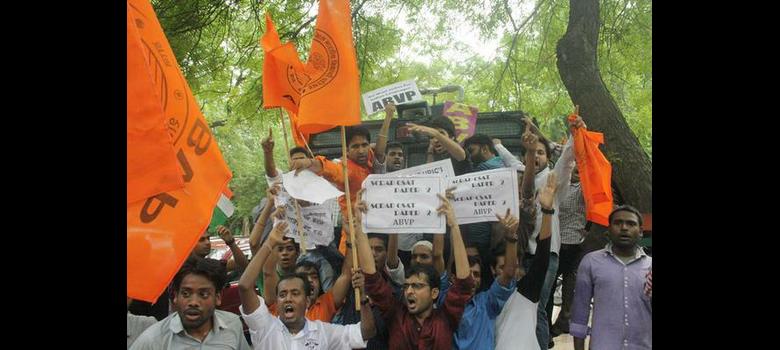
The Akhil Bharatiya Vidya Parishad, the BJP’s Youth Wing, sensed during last year’s Delhi University Student Union elections that opposition to the new Four Year Undergraduate Programme could be a key plank in remaining popular on campus. Incidentally, the FYUP had been opposed by the more left-wing organisations on campus from the very get-go, so the ABVP joined up with them to call for a roll-back of the four-year programme. The agitation quickly became a national issue, and eventually the FYUP was rolled back.

This ABVP-Left combine has now re-emerged in the agitation against the Union Public Service Commission’s Common Scholastic Aptitude Test, which is being fought on grounds that it is biased towards urban students. Yet again, the combined forces have managed to extract a concession from the government — despite opposition from the more reformist sections of the BJP.

Labour law reforms

Trade unions from across the country are meeting this week to try and decide how to approach the issue of labour law reforms, after the Rajasthan government last month passed legislation that made it easier for companies to retrench employees. These unions include both those on the Left, including the Communist Party of India (Marxist)-backed Centre of Indian Trade Unions  as well as the BJP-affiliated Bharatiya Mazdoor Sangh. Any decision to strike or launch a nationwide campaign by these groups could have a significant impact on a government that has insisted it is working primarily for the poor.

Foreign relations

The Modi government’s decision to vote against Israel at a United Nations forum shocked many supporters, who believe that India must be stand with Tel Aviv and remain steadfast against Islamic terrorism. It came as a pleasant surprise to those on the Left, however, who have always pushed India to speak up for those who live under Israeli occupation in Gaza and the West Bank.

The foreign relations convergence of the Left and Right was given a bigger boost after the Modi government decided to stand in the way of the World Trade Organisation’s Bali Package. Although the two factions here are unlikely to work together in pressuring the government to make decisions, particularly in the neighbourhood, the pressure to keep India relatively insulated from the West is likely to gain purchase from both sides.

via Scroll.in – News. Politics. Culture..

Law of Unintended Consequences

continuously updated blog about China & India

ChiaHou's Book Reviews

continuously updated blog about China & India

What's wrong with the world; and its economy

continuously updated blog about China & India