Archive for ‘Chindia Alert’

05/04/2019

Decade on from failed Chinese well-digging project, poor farmers wait for water

  • Poverty busting project in northern China was meant to increase cultivation of green vegetables
  • Instead, more than 100 inadequate wells have been abandoned
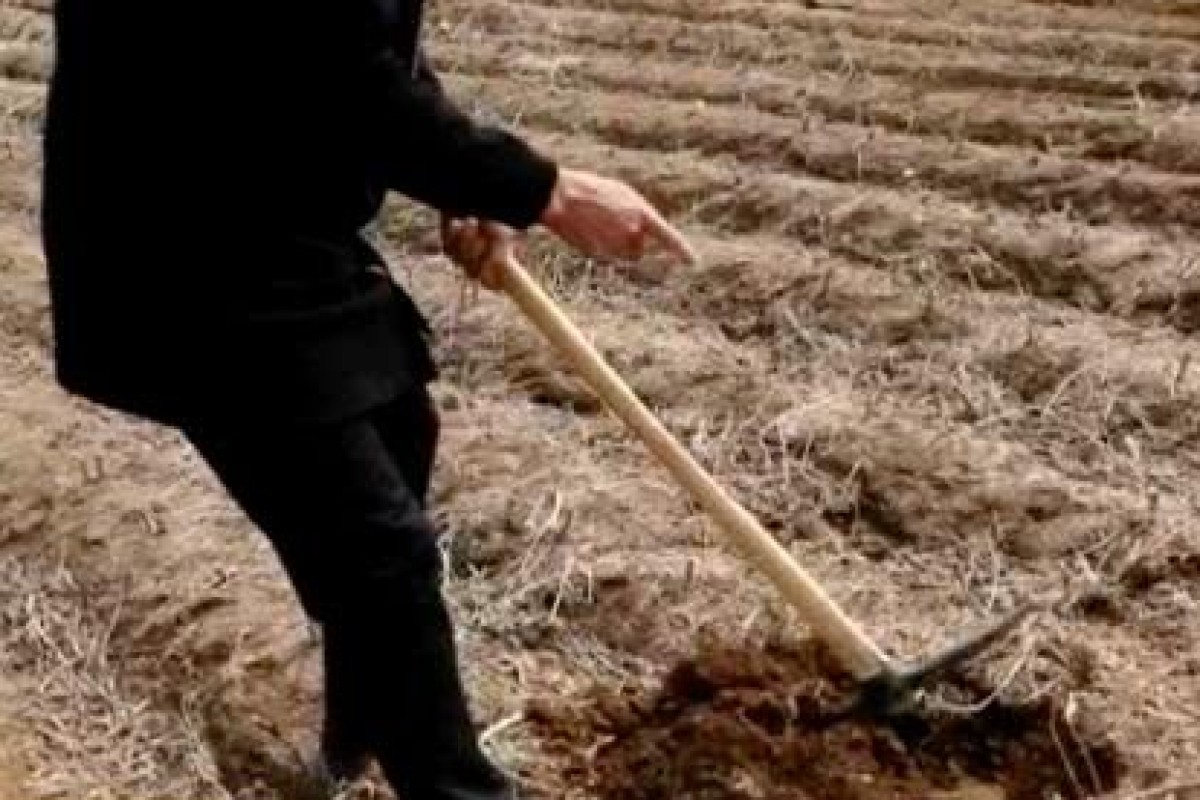
More than 100 wells dug by a local government in northern China have been abandoned and covered over because they failed to produce any water. Photo: Weibo
More than 100 wells dug by a local government in northern China have been abandoned and covered over because they failed to produce any water.
Built in 2000, the wells were part of a poverty alleviation programme in Xiuyan county, Liaoning province, looking to spur cultivation of green vegetables, CCTV’s Half-hour Economy programme reported on Thursday.
The problem was first exposed in 2015 by the same programme, and most of the wells have now been filled in to prevent people from tripping into or over them.
“This well does not have any water, it’s just for show. All of the ones here are like that,” Li Guoyi, a county resident told CCTV.
One of the abandoned wells dug as part of a poverty busting programme in China’s northern Liaoning province. Photo: Weibo

Li’s farmland is next to one of the abandoned wells. He said he cannot grow as many square metres of vegetables as he would like as they require more water.

Instead, he cultivates hardy crops that fetch lower prices, like potatoes and corn. He has had to buy a pump and transport water from a source 200 metres away for irrigation, according to the report.

“I still hope we can have working wells,” Li, 71, said. “If I can live for another 10 years and make 18,000 yuan (US$2,680) a year, I can reduce my children’s burden a lot.”

A villager who helped dig the wells said the project had failed to follow protocols that would have produced wells fit for irrigation.

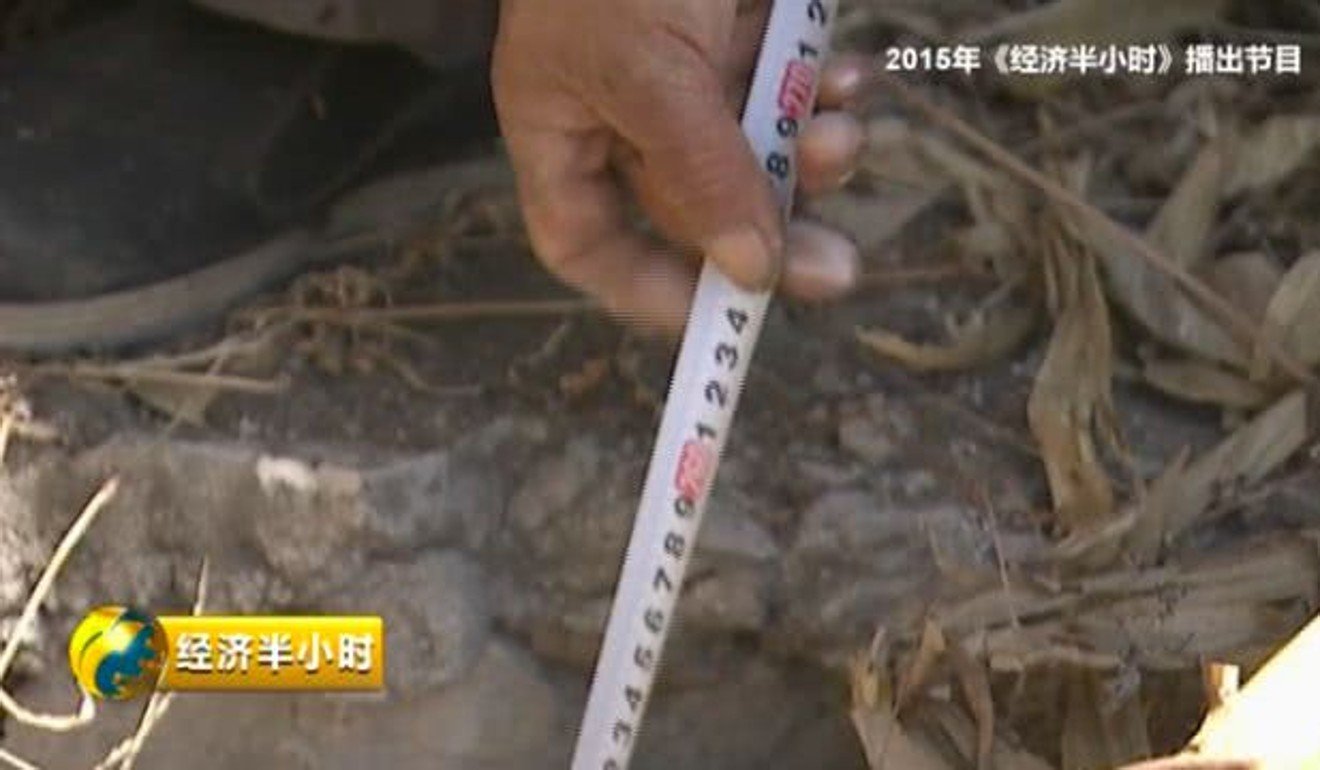
Dong Ensheng, who also wrote a 2015 report into the failed project, said the wells were only required to be dug to a depth where water was visible. In addition, some of the wells had openings as small as 40cm in diameter – not even big enough to fit a water pump.

A 2015 report found some of the wells had openings too small to fit a water pump. Photo: Weibo

In his report Dong said the wells fell way below established standards. “At the very least, they should be able to sustain several hours of water pumping. The well we dug was pumped dry in minutes,” he wrote.

When confronted with the issue of the failed wells this year, county officials refused to take responsibility and declined to provide records of the 2015 investigation, launched in response to the previous exposé, according to CCTV.

“This happened more than 10 years ago. You want to follow up on this now, you won’t be able to find it,” Wei Tianhui, the deputy director of Xiuyan county’s economy bureau, was quoted as saying.

“The staff has changed a lot. The structure of the county government has changed a lot. Where do we start looking?”

The programme drew angry reactions from internet users on China’s Twitter-like Weibo, who criticised the local government.

“They just keep passing the ball, thinking it’s not my fault so why should I bear the responsibility?” a user from Shandong province, eastern China, wrote. “Are these the civil servants of the new era? These are the so-called civil servants in service of the people?”

Source: SCMP

05/04/2019

US and China edge closer to ‘epic’ trade deal, says Trump

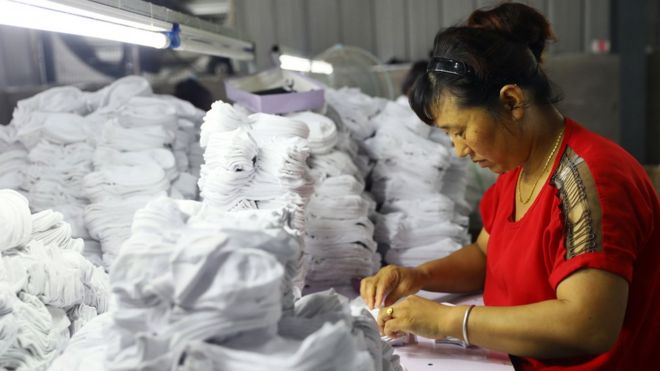
A woman works on socks that will be exported to the US at a factory in Huaibei in China's eastern Anhui province on August 7, 2018Image copyrightGETTY IMAGES

President Donald Trump says the US has found agreement on some of the toughest points in trade talks with China.

He said a deal could come in the next four weeks, but added some sticking points remained.

The Chinese echoed the optimism, with President Xi Jinping touting substantial progress, according to the Chinese state news agency Xinhua.

The US and China have been in talks since December trying to end a trade war that is hurting the global economy.

Mr Trump said the US and China had agreed on “a lot of the most difficult points” but that “we have some ways to go”.

He was speaking from the White House, before a meeting with Chinese Vice Premier Liu He.

The US president said if there was a deal, he would hold a summit with President Xi.

“This is an epic deal, historic – if it happens,” said Mr Trump.

“This is the Grand Daddy of them all and we’ll see if it happens. It’s got a very good chance of happening.”

Sticking points in negotiations in recent weeks have included how fast to roll back tariffs and how a deal would be enforced.

Mr Trump suggested at the press conference that some of these persisted.

He said it would be tough for the US to allow trade to continue with China in the same way as in the past, if a deal did not materialise.

‘Conflicting signals’

The world’s two largest economies imposed tariffs on billions of dollars worth of one another’s goods over the past year.

Negotiations between them have continued since a trade truce was agreed in December, but have at times been rocky.

The BBC’s China correspondent Robin Brant said that both sides were – yet again – giving conflicting signals.

Mr Liu said the US and China had reached a new consensus on important issues like the text of the economic and trade agreement, Xinhua reported.

While that echoed Mr Trump’s comments, US Trade Representative Robert Lighthizer sounded more cautious. He said there were still some major issues left in trade talks, according to reports.

Mr Brant said there was clearly still significant distance between the two sides on the crucial issue of enforcement.

What’s being discussed?

The US accuses China of stealing intellectual property from American firms, forcing them to transfer technology to China.

Washington wants Beijing to make changes to its economic policies, which it says unfairly favour domestic companies through subsidies and other support, and wants China to buy more US goods to rein in a lofty trade deficit.

China accuses the US of launching the largest trade war in economic history, and is unlikely to embrace broader structural changes to its economy.

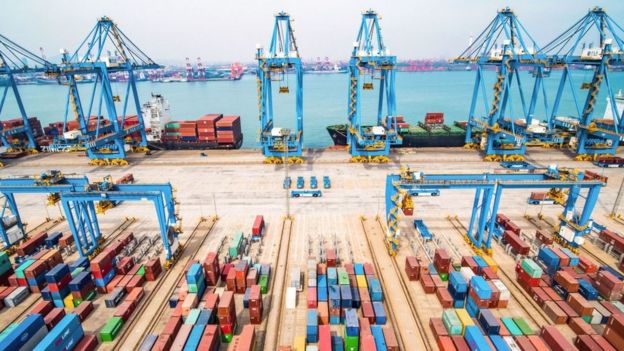
An aerial view of a port in Qingdao in China's eastern Shandong province on March 8, 2019Image copyrightGETTY IMAGES

What’s at stake?

Failure to achieve a deal may see the US more than double the 10% tariffs on $200bn (£153bn) of Chinese goods and impose fresh tariffs.

Mr Trump has in the past threatened to tax all Chinese goods going into the US.

The US has already imposed tariffs on $250bn worth of Chinese goods, and China has retaliated with duties on $110bn of US products.

The damaging trade war has already cast a shadow over global trade and the world economy.

Source: The BBC

05/04/2019

U.S. count shows no Pakistan F-16s shot down in Indian battle – report

NEW DELHI (Reuters) – Pakistan’s F-16 combat jets have all been accounted for, U.S.-based Foreign Policy magazine said, citing U.S. officials, contradicting an Indian air force assessment that it had shot down one of the jets in February.

India and Pakistan engaged in an aerial battle over the disputed region of Kashmir a day after Indian jets crossed over into Pakistan to attack a suspected camp of anti-India militants.

An Indian jet was brought down during the fight and its pilot captured when he ejected on the Pakistani side of the border. India said it, too, had shot down a Pakistani aircraft and the air force displayed pieces of a missile that it said had been fired by a Pakistani F-16 before it went down.

Foreign Policy said in a report published on Thursday two U.S. defence officials with direct knowledge of the matter said U.S. personnel had done a count of Pakistan’s F-16s and found none missing.

The F-16s are made by Lockheed Martin and, under an end-user agreement, the United States required the host country to allow for regular inspections to ensure they were accounted for and protected, Foreign Policy said.

Details of the India-Pakistan air engagement have not been provided by either side. If the U.S. report turns out to be true, it would be a further blow to Prime Minister Narendra Modi’s claim that India had taught Pakistan a lesson.

The success of Indian air strikes on a camp of the Jaish-e-Mohammed militant group in northwestern Pakistan has also been thrown into doubt after satellite images showed little sign of damage.

High-resolution satellite images reviewed by Reuters last month showed that a religious school run by Jaish appeared to be still standing days after India claimed its warplanes had hit the Islamist group’s training camp on the site and killed a large number of militants.

Modi’s ruling Bharatiya Janata Party, heading into a tight election next week, is campaigning on a platform of tough national security, especially with regard to arch foe Pakistan. New Delhi blames Pakistan for stoking a 30-year revolt in Muslim-majority Kashmir but Islamabad denies any involvement.

Foreign Policy said Pakistan had invited U.S. officials to physically count the F-16 planes after the incident. Some of the aircraft were not immediately available for inspection due to the conflict, so it took U.S. personnel several weeks to account for all of the jets, one of the officials was quoted as saying.
The count had now been completed and all aircraft “were present and accounted for”, the official was quoted as saying.
India has separately asked the United States for its view on whether the use of the F-16s by Pakistan was a violation of the end-user agreement.
Source: Reuters
04/04/2019

China to keep increasing assistance to needy people

BEIJING, April 3 (Xinhua) — The Chinese government will not reduce financial assistance to needy people but keep it increasing, said Minister of Civil Affairs Huang Shuxian at a national civil affairs conference that closed Wednesday.

The priority in the near future is to increase the civil affairs service at the primary level and increase personnel at county, township and village levels, Huang said at the two-day meeting.

China has allocated more than 840 billion yuan (about 125 billion U.S. dollars) from the central budget for minimum living allowances, medical aid and financial assistance to people in special difficulties, and for emergency aid from 2013 to 2018, according the ministry.

The standard minimum living allowance in urban areas increased by 9.2 percent annually from 2013 to 2018, and 14.7 percent for rural areas.

Source: Xinhua

04/04/2019

China Focus: Premier Li’s Europe visit to inject impetus to China-EU ties

BEIJING, April 3 (Xinhua) — Chinese Premier Li Keqiang’s upcoming visit to Europe will intensify cooperation between China and European countries and provide new impetus to the China-EU comprehensive strategic partnership, a Foreign Ministry official said Wednesday.

Li’s visit, scheduled for April 8 to 12, will take him to Brussels for the 21st China-EU leaders’ meeting, and Croatia for an official visit and the eighth leaders’ meeting of China and Central and Eastern European countries (CEEC), Vice Foreign Minister Wang Chao said at a press briefing.

This is the first overseas trip to be made by Li this year as well as another significant high-level exchange between China and Europe after Chinese President Xi Jinping’s successful state visits to Italy, Monaco and France in March, demonstrating the importance that China attaches to its relations with Europe, Wang noted.

A SIGNIFICANT MEETING FOR CHINA AND EUROPE

“The China-EU leaders’ meeting, a high-level platform for strategic communication between the two sides, has played a leading role in deepening China-EU relations and promoting dialogue and cooperation,” Wang said.

He stressed that this year’s meeting, the fifth co-chaired by Premier Li, European Council President Donald Tusk and European Commission President Jean-Claude Juncker, will be the last China-EU leaders’ meeting during the tenure of the current EU institutions, thus bearing transitional significance.

China and the EU are enjoying sound development of ties, close high-level connections, deepening cooperation and robust people-to-people exchanges, he added.

“We share broad common interests in deepening win-win practical cooperation, common positions on upholding multilateralism and free trade, and common goals in improving global governance and maintaining world peace and stability.”

Leaders of the two sides will exchange views on bilateral ties and major international and regional issues of common concerns, and witness the signing of cooperation documents on energy, competition policies and other areas, Wang said.

“We believe that this meeting will inject new impetus to the China-EU comprehensive strategic partnership, take our dialogue and cooperation across the board to a new level, and strengthen the stability, reciprocity and strategic significance of our relations,” Wang said.

A BOOST FOR 16+1 COOPERATION

Wang Chao said China-CEEC cooperation (16+1 cooperation) was a beneficial mechanism of regional cooperation between China and Central and Eastern European (CEE) countries, and has provided a platform for China and CEE countries to deepen traditional friendship and enhance mutually beneficial cooperation.

Initiated in 2012, the 16+1 cooperation has gained broad support and active participation from 16 CEE countries, and has built up an all-round and multi-tiered cooperation framework, said Wang, adding that the 16+1 cooperation has played a positive role in promoting trade and expanding pragmatic cooperation across-the-board between China and other countries.

This year marks the 70th anniversary of the founding of the People’s Republic of China. Some CEE countries also established diplomatic relations with China 70 years ago.

Wang said this year’s meeting, to be held in Croatian city Dubrovnik, was of important significance to the promotion of the steady, long term development of 16+1 cooperation as well as China-Europe relations.

Noting the theme of this year’s meeting of building new bridges of openness, innovation and partnership, Wang said leaders attending the meeting would review new progress of 16+1 cooperation, have insightful discussions on key future work directions, and announce a series of new measures on pragmatic cooperation.

China hopes that the 16+1 cooperation will become a bridge of openness, innovation and partnership through enhancing exchanges and cooperation of mutual benefit and win-win results, he said.

According to the vice minister, outcome documents charting 16+1 cooperation will be released after the meeting and related parties will ink cooperation agreements on infrastructure construction, trade, finance, education, quality inspection, personnel exchanges, and mutual recognition of driving licenses.

China believes this year’s meeting will inject new impetus to relations between China and the CEE countries and the development of the China-Europe comprehensive strategic partnership, he said.

CHINESE PREMIER’S FIRST VISIT TO CROATIA

“Li’s visit will be the first ever by a Chinese premier to Croatia since the establishment of diplomatic ties. Therefore, it is significant in consolidating traditional friendship and advancing our comprehensive cooperative partnership as well as China-EU relations,” Wang Chao said.

Hailing Croatia as an important member of CEE countries and a key stop on the ancient Silk Road, Wang said relations between China and Croatia had been growing rapidly with the development of the Belt and Road Initiative and 16+1 cooperation.

In addition to close top-level exchanges, fruitful cooperation in trade, investment and infrastructure construction, and ever-deepening friendship between the two peoples, China-Croatia relations face a broad space for future development, he added.

During Li’s visit, the two sides will issue a joint statement summarizing any important consensus reached by their leaders and mapping out future cooperation. The prime ministers of the two countries will witness the signing of government cooperation documents and commercial contracts covering multiple sectors.

China hopes the visit will help synergize both countries’ development strategies, enhance mutual understanding and political trust, deepen cooperation and bring bilateral ties to a higher level, Wang said.

04/04/2019

Chinese vice premier meets IPPF Director General

CHINA-BEIJING-SUN CHUNLAN-IPPF-MEETING (CN)

Chinese Vice Premier Sun Chunlan(R) meets with Alvaro Bermejo, director-general of the International Planned Parenthood Federation (IPPF), in Beijing, capital of China, April 3, 2019. (Xinhua/Rao Aimin)

BEIJING, April 3 (Xinhua) — Chinese Vice Premier Sun Chunlan met with Alvaro Bermejo, director-general of the International Planned Parenthood Federation (IPPF), on Wednesday.

Sun spoke highly of the good relationship between China and the IPPF, and expressed a willingness to deepen cooperation with the federation in such areas as family planning, reproductive health, and aging populations in developing countries.

Bermejo said he appreciates China’s achievements in family planning, and the federation is willing to consolidate cooperation with China, participate in the Belt and Road Initiative, and support China’s bigger role in global population development.

Source: Xinhua

04/04/2019

Manila accuses Beijing of violating its sovereignty as South China Sea dispute rages on

  • Philippines’ foreign ministry weighs in on controversy over presence of Chinese fleet near contested Thitu Island
  • Manila has ‘consistently manifested its … objections or concerns over illegal, tension-raising or coercive activities’, statement says
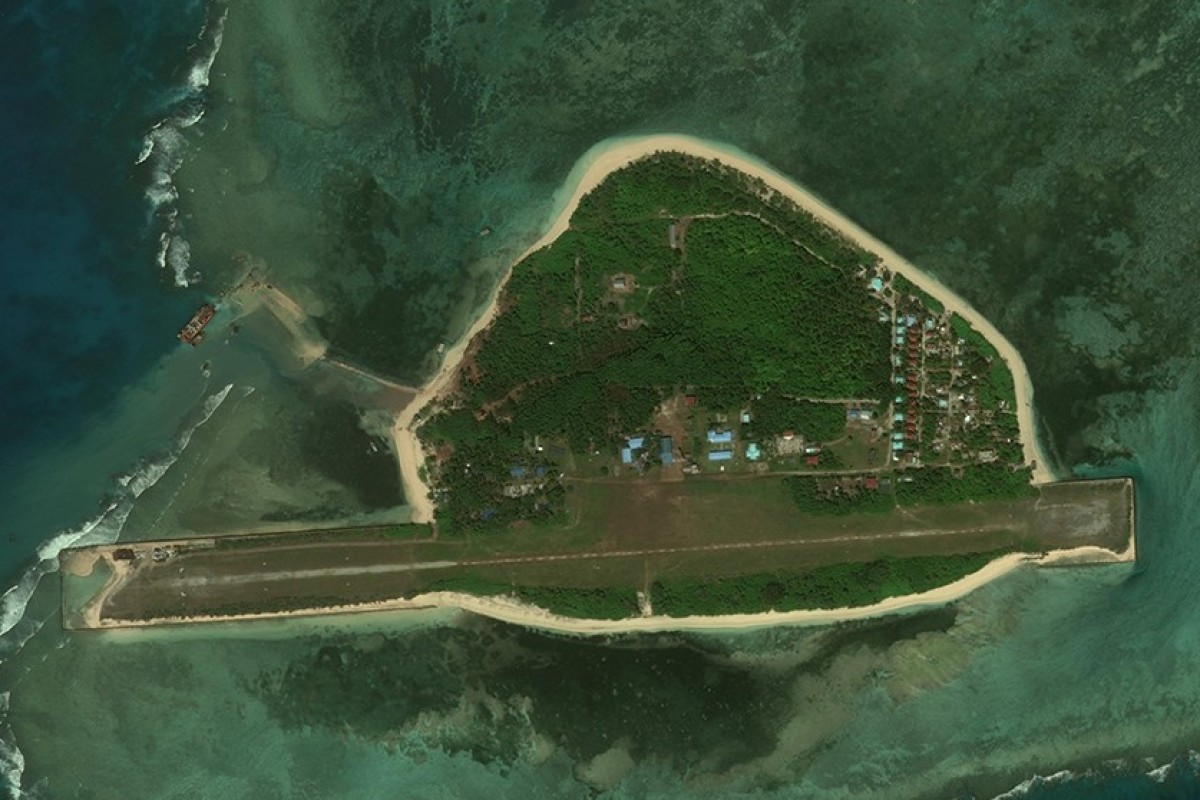
The Philippines is angry about the presence of a Chinese fleet close to Thitu Island in the South China Sea. Photo: AMTI
The Philippines’ foreign ministry on Thursday accused Beijing of violating its sovereignty and jurisdiction by allowing hundreds of vessels to sail close to an island claimed by Manila in the South China Sea.
The statement came just three days after Philippine Defence Minister Delfin Lorenzana
described China’s growing presence in the disputed waters as “very concerning”, saying on a trip to Washington that it was encroaching on the Philippines’ exclusive economic zone.
The conflict relates to the presence of up to 
200 Chinese vessels near Thitu Island

, which Manila calls Pag-asa, in the disputed Spratly Islands.

The Department of Foreign Affairs in Manila said the Philippines “has consistently manifested its position on Pag-asa … and its objections or concerns over illegal, tension-raising or coercive activities, through diplomatic actions … and in meetings with the Chinese side”.
The statement said Thitu is part of the Kalayaan island group – the local name for the Spratlys – and an integral part of the Philippines, over which it has sovereignty and jurisdiction.

“The presence of Chinese vessels near and around Pag-asa and other maritime features in the KIG is illegal,” it said.

US, Philippines in talks on rocket system to deter Beijing

“Such actions when not repudiated by the Chinese government are deemed to have been adopted by it,” it said. “The presence of Chinese vessels within the KIG, whether military, fishing or other such will thus continue to be the subject of appropriate action by the Philippines”.

The foreign ministry said earlier it had filed a diplomatic protest about the presence of more than 200 Chinese vessels near Thitu between January and March.

Satellite images captured in February by the Asia Maritime Transparency Initiative under the Washington-based Centre for Strategic and International Studies show almost 100 Chinese ships apparently hampering Philippine construction work on Thitu.

The fleet, dispatched from the nearby Subi Reef, includes naval and coastguard vessels, as well as dozens of fishing boats.

Manila was planning to upgrade its military facilities on Thitu, including the construction of an airstrip, but the project was suspended because of the Chinese interference.

The defence chiefs of the US and the Philippines reaffirmed their security alliance on Monday in Washington. As well as agreeing to boost cooperation, the US promised to increase its support for Manila’s military modernisation – a move seen as a response to Beijing’s increasingly assertive posturing in the South China Sea.

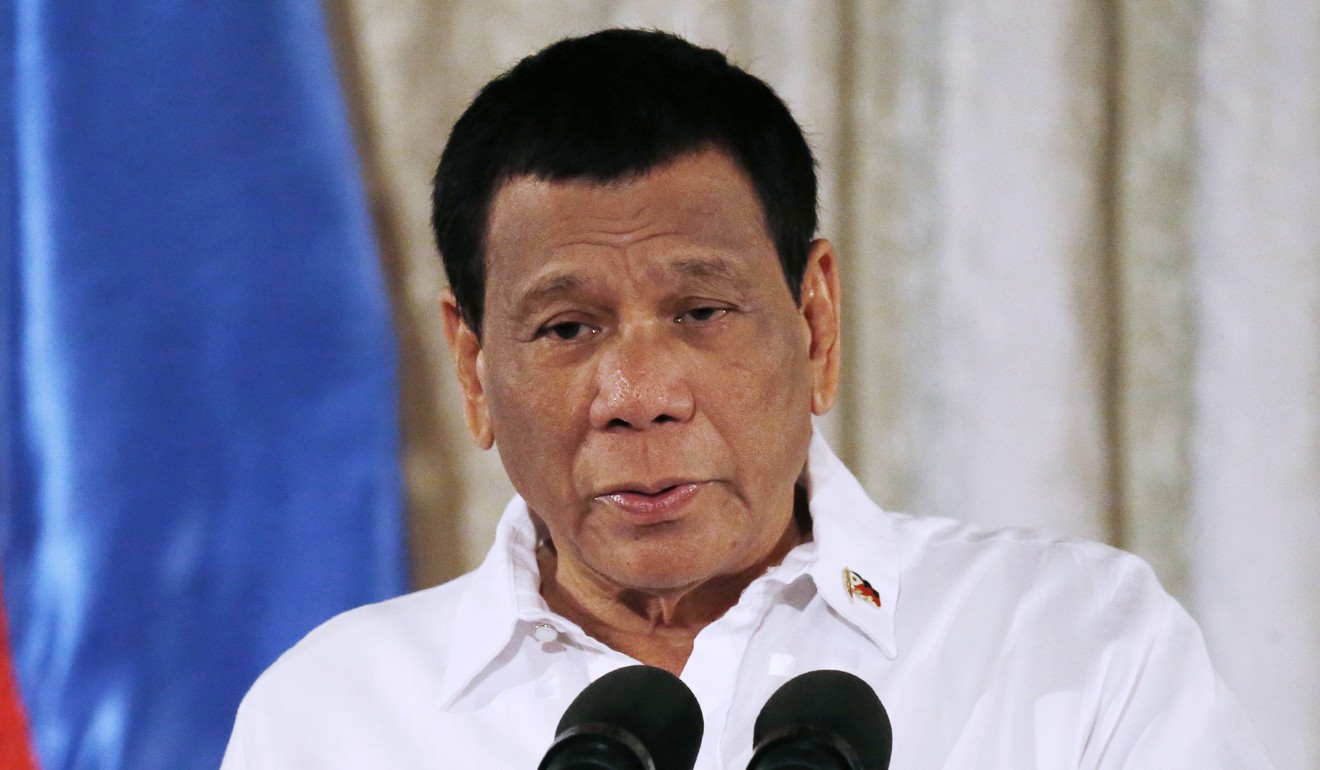
Philippine President Rodrigo Duterte says he will not confront China over the South China Sea dispute as doing so would end in war. Photo: AP
Despite the statements from his ministries,

Philippine President Rodrigo Duterte

said on Wednesday that Beijing wanted to be friends with Manila and that he would not confront China over their competing claims in the South China Sea because it would end in war.

The foreign affairs department in Manila also sought to sound a positive note in its statement, saying the maritime dispute was not the “sum total” of Philippines-China relations, and should not exclude mutually beneficial cooperation in other fields.
US more likely than Philippines to end up in ‘shooting war’
A day after the two nations wrapped up their latest meeting on the South China Sea, Chinese foreign ministry spokesman Geng Shuang said on Thursday the two sides had reaffirmed their differences but would continue to seek a resolution.
“China looks forward to working with the Philippines to make active efforts to safeguard the overall interests of China-Philippines cooperation and peace and stability in the South China Sea,” he said.
Hong Kong-based military expert Song Zhongping said the presence of the Chinese vessels near Thitu was a clear statement of Beijing’s intent.

“Beijing believes Thitu Island is Chinese territory, so any work there should be done by China, not the Philippines,” he said.

It also wanted to stop Manila “opening the door to dangerous people” he said, referring to the Southeast Asian nation’s announcement about allowing the US access to five more of its military bases.

Source: SCMP

02/04/2019

Xi calls for closer cultural exchanges between China, Pacific island countries

BEIJING, April 1 (Xinhua) — Chinese President Xi Jinping on Monday extended congratulations on the launch ceremony of the 2019 Year of Tourism for China and Pacific Island Countries, calling for closer cultural and personnel exchanges.

In a congratulatory message to the event, which was held in Apia, capital of Samoa, Xi noted that China and Pacific island countries have a time-honored tradition of friendly exchanges.

They are good friends who treat each other with sincerity and mutual respect, good partners who work together to pursue common development and win-win cooperation, and good brothers who understand and learn from each other, said the president, adding that they set a model for all countries treating each other as equals regardless of their sizes.

Xi recalled that in November last year, he held a collective meeting with leaders of Pacific island countries in Papua New Guinea (PNG), and they agreed to elevate their countries’ relations to a comprehensive strategic partnership featuring mutual respect and common development, opening a new chapter in the interaction between China and Pacific island countries.

The Chinese president emphasized that the tourism year is an important consensus he reached with leaders of Pacific island countries in their PNG meeting.

Xi expressed the hope that the two sides seize the opportunity to expand cultural and personnel exchanges, boost practical cooperation, deepen mutual understanding, and consolidate the public support for their comprehensive strategic partnership, so as to bring more benefits to the peoples of both China and the Pacific island countries.

Source: Xinhua

02/04/2019

China’s new relay satellite to help video calls possible with space station

BEIJING, April 1 (Xinhua) — A new relay satellite launched late Sunday night will allow videos calls to be made between China’s future space station and the ground and provide data transmission and control services for various spacecraft.

The Tianlian II-01 satellite was sent to an orbit at an altitude of 36,000 km by a Long March-3B carrier rocket from the Xichang Satellite Launch Center in southwest China’s Sichuan Province at 11:51 p.m. Beijing Time on Sunday.

The satellite, developed by the China Academy of Space Technology (CAST) under the China Aerospace Science and Technology Corporation, will provide data transmission services for satellites operating on medium- and low-Earth orbit and monitoring and control support for the launch of spacecraft.

“The Tianlian II-01 ushered in the construction of a new generation of the relay satellite system for China,” said Zhang Peng, commander in chief of the research team of the satellite from CAST.

From 2008 to 2016, China launched four relay satellites to form the Tianlian I system, making China the second country in the world to establish a relay satellite system which is able to cover the whole world. The system can provide global real-time information transmission.

As the first satellite of China’s second-generation relay satellite system, Tianlian II-1 is compatible with the Tianlian I system, but its transmission speed and volume and coverage area have been greatly improved, according to Zhang.

Source: Xinhua

02/04/2019

Chinese president meets The Elders delegation

CHINA-BEIJING-XI JINPING-THE ELDERS-DELEGATION-MEETING (CN)

Chinese President Xi Jinping meets with The Elders delegation, led by its chair, former president of Ireland Mary Robinson, in the Great Hall of the People in Beijing, capital of China, April 1, 2019. (Xinhua/Rao Aimin)

BEIJING, April 1 (Xinhua) — President Xi Jinping on Monday met with The Elders delegation, led by its chair, former president of Ireland Mary Robinson, in the Great Hall of the People.

During their meeting, Xi said the world today was facing unprecedented changes, while the prospect of international cooperation, as well as solutions to global challenges and the future of human society were being thought on by more and more insightful people.

“We advocate cultivating the awareness of a community with a shared future for humanity, and better building and caring our common home planet,” Xi said, adding that every country bore a responsibility for the future of mankind.

China is a major developing country, but it never evades its due international responsibilities. China seeks cooperation with win-win results and helps developing countries realize common progress during its own development process, he said.

He said China had always pursued a right approach to justice and interests by putting justice before interests, and given selfless help to African countries when it was still very poor.

The Belt and Road Initiative proposed by China is “for mutual benefit and win-win cooperation with all the countries,” Xi said.

At present, many countries have felt pressure and worries from the impact of unilateralism, but the voice of the international community in support of multilateralism has remained the dominant force.

It is important to ensure that existing multilateral processes do not stall and what has been achieved is not reversed, Xi said, reiterating China’s commitment in maintaining international nuclear non-proliferation regime and strengthening international cooperation on climate change and other multilateral agendas.

“China always holds an open attitude towards the reform of multilateral institutions,” Xi said, stressing that the reform should be discussed by all the relevant countries and accommodate the legitimate concerns of all parties in accordance with universally recognized rules, serving the common interests of majority countries.

China-proposed Belt and Road Initiative is a major contribution to multilateralism and international cooperation, Xi stressed, adding that China and other participating countries have upheld the principle of consultation and collaboration for shared benefits in the past five years and created many new modes of cooperation.

Xi stressed that major countries should shoulder special responsibilities as the relations between major countries concern global strategic stability.

China has been committed to promoting coordination between major countries and looked forward to harmony among major countries, with no conflict or confrontation but mutual respect and win-win cooperation, Xi said.

Calling China-U.S. ties one of the most important bilateral ties in the world, Xi said he hoped the United States could meet China halfway, manage differences and expand cooperation and jointly promote China-U.S. relations based on coordination, cooperation and stability so as to provide more stable and expectable factors to the world.

This year marks the 70th anniversary of the founding of the People’s Republic of China (PRC). Xi said it was Chinese people’s choice to adhere to the leadership of the Communist Party of China (CPC).

The CPC has led the Chinese people in tireless struggle and scored remarkable achievements in many areas, said Xi, adding that China had kept improving its development path and made unremitting efforts towards the “two centennial goals.”

“China running its own affairs well is in itself a contribution to the world,” President Xi said.

Mary Robinson, chair of The Elders and former president of Ireland, Ban Ki-moon, co-deputy chair, former Secretary-General of the United Nations and chairman of the Boao Forum for Asia, as well as former President of Mexico Ernesto Zedillo also spoke on behalf of The Elders.

They congratulated on the 70th anniversary of the founding of the PRC and the success China had achieved in economic and social development, and spoke highly of the country’s efforts made in environmental protection, poverty eradication and the work on ethnic minorities.

China has played a responsible and constructive role at a crucial moment when multilateralism is faced with challenges, they said, adding that China had always adhered to the purposes and principles of the UN Charter and taken part in the cause of peace and development in Africa.

Saying that Xi’s speeches on international occasions had sent positive messages, they called on countries to uphold the multilateral system with the United Nations at its core and enhance multilateral cooperation in areas of international and regional stability and climate change.

The Elders, initiated by former South African President Nelson Mandela in 2007, is an international non-governmental organization consisting of former leaders of countries and important international organizations. Its goal is to promote the resolution of conflict via dialogue and work on solutions for global problems such as poverty and disease.

Earlier Monday, Yang Jiechi, a member of the Political Bureau of the Central Committee of the Communist Party of China and director of the Office of the Foreign Affairs Commission of the CPC Central Committee, also met the delegation.

Source: Xinhua

Law of Unintended Consequences

continuously updated blog about China & India

ChiaHou's Book Reviews

continuously updated blog about China & India

What's wrong with the world; and its economy

continuously updated blog about China & India