Archive for ‘Chindia Alert’

28/01/2019

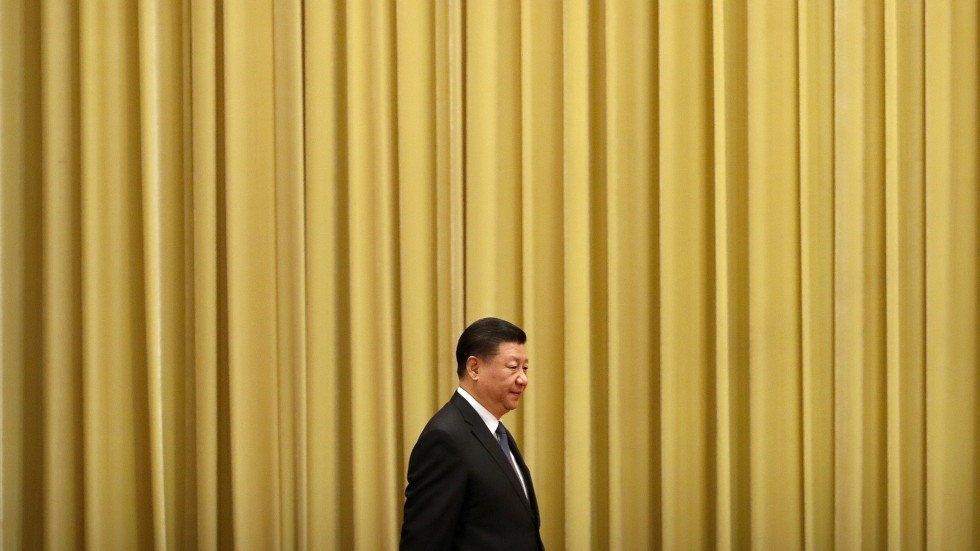
President Xi Jinping visit to Macau confirmed as security chief issues stern warning against illegal activities threatening China’s security

  • Chinese leader’s visit to celebrate 20th anniversary of former colony’s reunification
  • Security services meanwhile are focused on anniversaries of Tiananmen Square and Falun Gong crack downs
PUBLISHED : Monday, 28 January, 2019, 9:35pm
UPDATED : Monday, 28 January, 2019, 9:35pm
Li Chunsheng, head of the Guangdong Provincial Public Security Department, also disclosed that a communication centre for police forces in the Greater Bay Area would be set up in an islet called Qi’ao in Zhuhai by October, which would handle the security details and operational command for Xi’s trip.

Speaking at a meeting in Guangzhou, where dozens of officials from the city of Maoming discussed the annual report delivered by the provincial governor Ma Xingrui, Li gave a stern warning on a series of threats to China’s political security in 2019, indirectly citing a number of anniversaries, including that for the crackdown on the pro-democracy movement in Beijing’s Tiananmen Square in 1989.

“In October, a Greater Bay Area police communication centre will be set up in Zhuhai,” Li said. “[Xi] will come and join the celebrations for the 20th anniversary in Macau, where he will deliver an important speech.”

Li was speaking hours after Ma Xingrui, Guangdong’s No 1 official, also said the province would team up with Hong Kong and Macau this year on building joint laboratories to study cutting-edge technologies needed by local industries.Ma said the province had chosen the development of the Greater Bay Area – a plan to create an international innovation and technology hub in partnership with Hong Kong and Macau – as its top priority for 2019.

Yet such a centre, and the cross-border collaboration of police forces, were not the top priority for him and his peers in 2019, according to Li, who has been overseeing public security in Guangdong for six year.

“We must resolutely defend the country’s political security,” Li said. “Among all types of security, the political security is the most prominent and its two essential parts are the security of our socialist system and the security of the Chinese Communist Party’s regime.”

Li said to defend the security of the party that centres around Xi, and to defend the socialist path were the top priority for public security authorities in 2019, which he described as “a politically significant year”.

“It’s the 70th anniversary of the establishment of the People’s Republic of China, it’s the 20th anniversary of Macau’s handover, and of course, it’s the anniversary of a series of incidents, which took place 20, 30 and 10 years ago,” Li said, without naming the specific incidents.

“The hostile forces inside China have long marked this year as an important time to implement their plan – which is a vain attempt – to overthrow our system.”

Other than the Tiananmen crackdown in 1989, in April 1999, thousands of members of the Falun Gong spiritual group gathered outside the Communist Party’s headquarters in Beijing to protest against violent treatment by the police, which prompted former president Jiang Zemin to outlaw the group and punish its believers.

Li said Guangdong’s provincial party chief Li Xi had recently organised a special meeting and rolled out eight operation plans to strike “illegal activities that will jeopardise political security”, including strengthening control over universities, the social sciences sector, and the internet.

When asked by the Post on the sidelines of the meeting if Guangdong police would more severely crack down on people who tried to get rid of the internet blockage in mainland China, Li said the police would be targeting the “hostile forces” and “illegal activities that will threaten our system, society and public security”.

“It’s not contradicting the integration [with Hong Kong and Macau],” Li said.

Source: SCMP

28/01/2019

Political advisors call for enhanced protection of intellectual property rights

BEIJING, Jan. 28 (Xinhua) — China’s political advisors on Monday called for more efforts to enhance the protection of intellectual property rights (IPR) and put forward their suggestions at a bi-weekly consultation session presided over by top political advisor Wang Yang.

Wang, a member of the Standing Committee of the Political Bureau of the Communist Party of China Central Committee and chairman of the National Committee of the Chinese People’s Political Consultative Conference, said a better understanding of IPR in its creation, protection and application on the Internet was needed to better enforce protection measures.

A total of 18 political advisors and experts, including Zhou Qunfei, founder of touchscreen maker Lens Technology and Pony Ma, founder and CEO of Tencent, raised suggestions on IPR protection, legal guarantees and corporate responsibilities while another 180 left suggestions on a mobile application platform.

The political advisors spoke of the need to strengthen IPR protection as a discipline in the university, set up a talent pool and build a professional and international IPR protection team.

They also proposed to put more efforts in the publicity and education work of IPR protection and improve people’s IPR protection awareness.

Source: Xinhua

28/01/2019

Chinese envoy calls for more flexible approach in investment treaty talks with EU

BRUSSELS, Jan. 28 (Xinhua) — China and the European Union (EU) could take a more flexible approach by setting phase-based targets in Bilateral Investment Treaty (BIT) negotiations and have some early harvests which would be followed by more to come, the Chinese envoy to the EU has said.

Zhang Ming, head of the Chinese mission to the EU, made the remarks in a recent interview with the Financial Times, according to an edited transcript of the interview provided by the mission on Sunday night.

“The BIT talks is a priority in China-EU relations. Both sides have put in a great deal of effort. Both sides are pushing the talks in good faith,” Zhang said.

Last year, the two sides exchanged the market access offers, which marked big progress and brought the talks into a new phase, he said.

“This year, we hope to make further progress. To conclude the agreement requires both sides to work together in the same spirit. This is a process of making compromise. We hope that our European friends can work together with us,” Zhang said.

“Usually, the negotiating parties tend to set an ultimate goal. Reaching the goal takes quite some time,” he said, proposing that the two sides could set phase-based targets and have some early harvests.

China is now the EU’s second-biggest trading partner while the EU is China’s biggest trading partner.

The two sides launched negotiations for a BIT in 2013 with the aim of providing investors on both sides with predictable, long-term access to each other’s markets, and protecting investors and investments.

Source: Xinhua

28/01/2019

China-ASEAN trade growth provides opportunities for Malaysia exporters: business association

KUALA LUMPUR, Jan. 28 (Xinhua) — The growing trade between China and the Association of Southeast Asian Nations (ASEAN) is providing Malaysian exporters with an opportunity to tap into the massive Chinese market, a Malaysia-based business association for China and ASEAN said on Monday.

Lim Gait Tong, president of the China-ASEAN Business Association (CABA), said that ASEAN’s trade with China has recorded higher growth rate than that with the European Union and the United States.

“So, this is an opportunity and the growth trend provides great potential for Malaysian exporters,” he was quoted as saying by state news agency Bernama.

CABA is a business promotion group which coordinates communication between chambers of commerce, industrial associations, trade institutions and enterprises within China and ASEAN, under the framework of China-ASEAN Free Trade Area.

“There was a good exchange of views on important economic and trade issues between China and ASEAN,” he said.

Spurce: Xinhua

28/01/2019

China eyes development of tourism industry

CHINA-TOURISM INDUSTRY-DEVELOPMENT(CN)

Aerial photo taken on Nov. 17, 2018 shows the snow scenery of the Mount Huashan scenic area in northwest China’s Shaanxi Province. The Chinese government has laid down key measures to improve the quality of tourism services amid efforts to promote the high-quality development of the industry. Targeting key problems affecting travel, a guideline issued by the Ministry of Culture and Tourism listed seven priority areas for quality enhancement, including scenic zones, accommodation, online and brick-and-mortar travel agencies, tour guides and tourism administration. The guideline calls on government agencies to strengthen supervision, market participants to fulfill their responsibility, industry associations to play a better role in coordination and the introduction of industry standards, and practitioners to improve their professional skills. The government aims to make tourism services “an important representative of China’s services” by 2020, with the tourism market and consumption environment improved, and market order well-regulated. (Xinhua/Tao Ming)

BEIJING, Jan. 28 (Xinhua) — The Chinese government has laid down key measures to improve the quality of tourism services amid efforts to promote the high-quality development of the industry.

Targeting key problems affecting travel, a guideline issued by the Ministry of Culture and Tourism listed seven priority areas for quality enhancement, including scenic zones, accommodation, online and brick-and-mortar travel agencies, tour guides and tourism administration.

The guideline calls on government agencies to strengthen supervision, market participants to fulfill their responsibility, industry associations to play a better role in coordination and the introduction of industry standards, and practitioners to improve their professional skills.

The government aims to make tourism services “an important representative of China’s services” by 2020, with the tourism market and consumption environment improved, and market order well-regulated.

With the approaching of the Spring Festival, which falls on Feb. 5 this year, the ministry also reminded outbound tourists to raise awareness of safety and “abide by the norms of civilized behavior.”

Source: Xinhua

28/01/2019

China Focus: A healthier Shanghai economy a bliss to the world

SHANGHAI, Jan. 27 (Xinhua) — China’s eastern metropolis of Shanghai pledges to further open up its door to let the world share the benefits of its high-quality growth.

While delivering the government work report at the annual session of the municipal legislature, Shanghai mayor Ying Yong promised that the city will strengthen its efforts in reform and opening up, while pursuing high-quality growth in the year 2019.

Shanghai recorded an overall economic growth of 6.6 percent last year, with its GDP per capita exceeding 20,000 U.S. dollars. The city expects to attain a growth rate of 6 percent to 6.5 percent this year.

HEALTHIER ECONOMY

Experts said the GDP per capita is an important indicator of a region’s economic wellbeing. The fact that it has exceeded 20,000 U.S. dollars means that Shanghai’s growth has reached a higher level.

Quan Heng, deputy head of the Shanghai Academy of Social Sciences, said as China aims to build itself into a moderately prosperous society by 2020, the growth of GDP per capita is a key measurement.

Quan added that besides per capita GDP, other factors such as economic structure, efficiency and technological innovation are also important indicators of development.

According to the government work report, Shanghai has seen the structure, quality and efficiency of its economy continuing to improve last year. The added value of the tertiary sector accounted for 69.9 percent of the GDP. Total research and development expenditures accounted for 4 percent of the city’s GDP.

The city has been boosting its real economy, with the industrial investment increasing by 17.7 percent in 2018, the greatest growth rate the city has seen during the past decade. It recorded around a 10 percent growth rate in the output of emerging industries including new energy cars, high-end medical equipment, integrated circuits and biomedicine.

The city vows to further promote high-quality growth this year. It will deepen supply-side structural reform and advance the construction of a modern industrial system featuring modern services, strategic emerging industries and advanced manufacturing.

The city will further boost its science and innovation sector and fortify its function as an international financial, trade and shipping center.

Meanwhile, Shanghai will further upgrade the real economy and come up with supporting policies for industries including integrated circuits, artificial intelligence and biomedicine.

The city will push ahead with industrial innovation projects such as intelligent connected vehicles, and it expects to see the mass production of 14 nanometer-integrated circuits this year.

OPENING-UP MEASURES

Development of the Shanghai free trade zone (FTZ) is expecting new momentum, as a new section will be built this year. Policies and systems will also be adopted in alignment with international norms to upgrade the FTZ, said Mayor Ying.

A science and technology innovation board will be set up with a pilot registration system for listed companies in the Shanghai Stock Exchange, said the report.

The city will further improve the private investment environment. In an effort to ease enterprises’ access to market and financing, the city vows to put into good use the bailout fund worth 10 billion yuan (1.48 billion U.S. dollars) for listed companies.

It will channel 10 billion yuan of credit and secured loans to high-quality small and medium private companies.

It will also gradually increase the size of policy-based financing guarantee funds for medium, small and micro enterprises to 10 billion yuan.

At the same time, Shanghai is actively participating in the integrated development of the Yangtze River Delta region.

This year, the city will cooperate with its partners in constructing programs in infrastructure, scientific innovation, industrial collaboration, environment and market systems, the mayor said.

Cooperation mechanisms will be further improved in public services such as pension service, medical and health services, human resources and social welfare.

THE SECOND IMPORT EXPO

Shanghai is determined to successfully host the second China International Import Expo (CIIE) this year, according to the mayor.

The city will normalize the expo’s pilot mode of bonded display and trade, having it occur on a regular basis.

As the world’s first import-themed national-level expo, the first CIIE was held in Shanghai from Nov. 5-10 in 2018 and concluded with deals worth about 57.83 billion U.S. dollars. The expo attracted 3,617 foreign exhibitors and more than 400,000 buyers from home and abroad.

Ying said the city plans to open wider for foreign investment and foreign firms, amplifying the expo’s spillover effects.

According to the CIIE bureau, more than 500 companies from more than 40 countries and regions have confirmed participation in the 2019 CIIE. Among them, there are over 70 Fortune Global 500 firms and leading enterprises in various industries.

Source: Xinhua

28/01/2019

Xi and his wife meet senior DPRK official, watch art performance

CHINA-BEIJING-XI JINPING-DPRK-ART TROUPE (CN)

Xi Jinping (C), general secretary of the Communist Party of China (CPC) Central Committee and Chinese president, and his wife Peng Liyuan meet with Ri Su Yong, a member of the Political Bureau of the Workers’ Party of Korea (WPK) Central Committee, vice-chairman of the WPK Central Committee and director of the party’s International Department, who led an art troupe from the Democratic People’s Republic of Korea (DPRK), in Beijing, capital of China, Jan. 27, 2019. (Xinhua/Xie Huanchi)

BEIJING, Jan. 27 (Xinhua) — Xi Jinping, general secretary of the Communist Party of China (CPC) Central Committee and Chinese president, and his wife Peng Liyuan on Sunday met with Ri Su Yong, a senior official from the Democratic People’s Republic of Korea (DPRK), and watched a performance by DPRK artists.

Ri, a member of the Political Bureau of the Workers’ Party of Korea (WPK) Central Committee, vice-chairman of the WPK Central Committee and director of the party’s International Department, is leading an art troupe to visit China.

This visit, as an important cultural exchange activity for implementing the consensus reached by the two sides, as well as a significant event in celebration of the 70th anniversary of the establishment of China-DPRK diplomatic relationship, will be a great success to cement friendship between the two peoples, Xi said.

Ri extended to Xi and his wife Peng Liyuan warm greetings and good wishes from Kim Jong Un, chairman of the WPK and chairman of the State Affairs Commission of the DPRK, and his wife Ri Sol Ju.

Xi asked Ri to convey the cordial greetings and good wishes to Kim and his wife.

Xi said he and Kim had reached important consensus on the development of China-DPRK party-to-party and state-to-state relations in the new era during their four meetings since 2018.

China stands ready to work with the DPRK to implement the important consensus reached by the two sides, so as to better benefit the two peoples and contribute to world peace, stability, development and prosperity, Xi said.

Art and cultural exchange is an important, unique and traditional component in bilateral ties, Xi said, calling for joint efforts in implementing the consensus on strengthening art and cultural exchanges and cooperation, so as to consolidate the foundation of good will of the people, carry forward traditional friendship, and promote the development of respective socialist cultures.

Ri expressed gratitude to Xi and his wife for watching the performance.

This visit and art performance represented Kim’s deep feelings to Xi and the DPRK people’s profound friendship with the Chinese people, Ri said.

The DPRK side will earnestly implement the important consensus reached by Kim and Xi, strengthen friendly cooperation and contribute to writing a new chapter in DPRK-China friendship, Ri added.

The performance featured famous and popular songs in both the DPRK and China.

The visit of the DPRK art troupe is at the invitation of the International Department of the CPC Central Committee.

Source: Xinhua

28/01/2019

China powers up renewable energy but some wind farms still struggle to plug into grid

  • Renewables account for more than 38 per cent of overall capacity as country tries to wean itself off coal
PUBLISHED : Monday, 28 January, 2019, 7:01pm
UPDATED : Monday, 28 January, 2019, 7:01pm

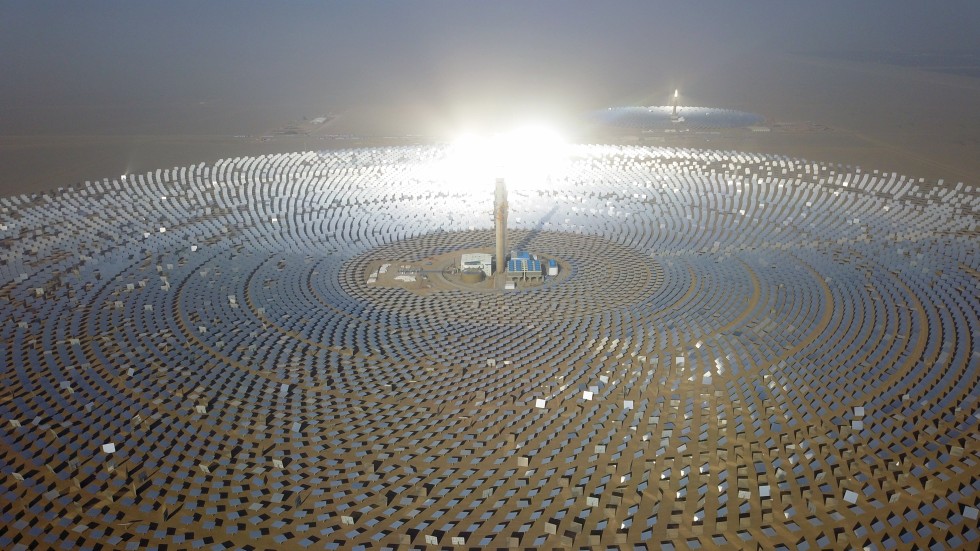
China has been aggressively promoting renewable power as part of an “energy revolution” aimed at easing its dependence on coal, a major source of pollution and climate-warming greenhouse gas emissions.

Total capacity – including hydro and biomass as well as solar and wind – rose to 728 gigawatts (GW) by the end of last year, the National Energy Administration (NEA) said.

That amounted to 38.3 per cent of China’s total installed power capacity, up 1.7 percentage points on the year and around 7 percentage points higher than at the end of 2015.

China hooked up another 20.59GW of new wind power capacity to its grid in 2018, the NEA said. New solar capacity reached 44.3GW, slightly higher than a figure given by an industry association earlier this month, but still down compared to 2017 following a decision to slash subsidies.

China also completed another 8.54GW of hydropower capacity, mostly in the nation’s southwest, bringing total hydropower to 352GW by the year’s end

China has tried to change the “rhythm” of renewable power construction to give grid operators time to raise transmission capacity and ensure clean electricity generation is not wasted.

Li Chuangjun, deputy head of the NEA’s new energy section, said overall rates of waste in the wind power sector had fallen to 7 per cent last year, down 5 percentage points on the year.

The major wind generation regions of Xinjiang and Gansu in the far northwest, however, still failed to get around a fifth of potential wind power onto the grid over the period.

China’s “energy revolution” has also involved the installation of new emissions control technology at its coal-fired power plants, still the dominant form of energy in China.

Around 810GW, or 80 per cent, of China’s coal-fired capacity was employing “ultra-low emission” technology by the end of 2018, according to the transcript of a speech by Environment Minister Li Ganjie published on Monday.

But despite China’s efforts to cut coal consumption and promote renewable power domestically, it has been criticised for backing new coal-fired projects overseas that use obsolete equipment no longer permitted at home.

Source: SCMP

28/01/2019

Wang Quanzhang: China jails leading human rights lawyer

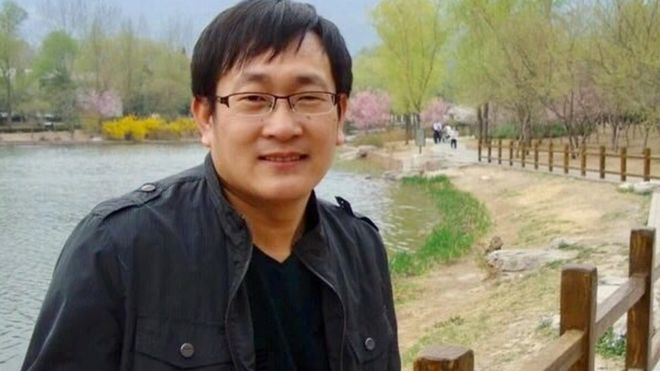
Wang QuanzhangImage copyrightFAMILY
Image captionWang Quanzhang went missing in a 2015 crackdown

China has sentenced prominent human rights lawyer Wang Quanzhang to four and a half years in prison for state subversion.

Wang, 42, had defended political campaigners and victims of land seizures, as well as followers of the banned spiritual Falun Gong movement.

He was one of several lawyers and activists arrested in a 2015 crackdown, and the last to go on trial.

China has intensified its prosecution of rights lawyers in recent years.

Mr Wang was “found guilty of subverting state power, sentenced to four years and six months in prison, and deprived of political rights for five years,” the court in Tianjin said.

The trial had been conducted behind closed doors with journalists and foreign diplomats barred from entering the courthouse.

Reuters news agency reports that Wang fired his state-appointed lawyer during the proceedings.

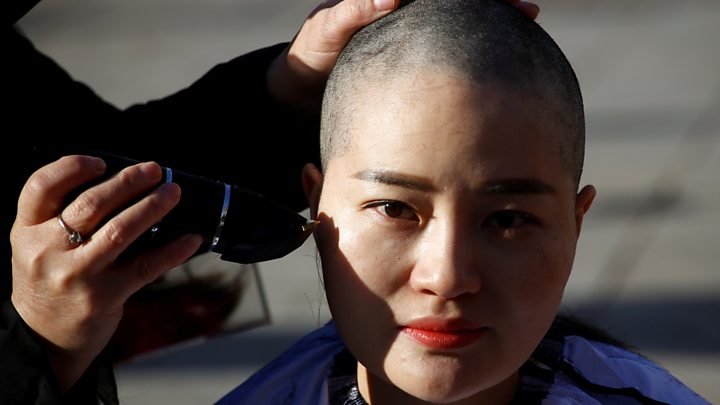
Wang’s wife, Li Wenzu, was also banned from attending and confined to her home in Beijing. A tireless champion of his case, she has shaved her head in protest against his detention and files near-weekly petitions to China’s highest court.

Media captionWang’s wife and her friends shave their heads to protest against his detention

In April, police intercepted Ms Li after she began a 100km (62 mile) march calling for her husband’s release. She was forcibly returned to Beijing and placed under temporary house arrest with her five-year-old son.

After the verdict Ms Li tweeted: “Wang Quanqi is not guilty, the public prosecution law is guilty!”

Presentational grey line

‘A chilling message’

John Sudworth, BBC News, Beijing

Wang Quanzhang had disappeared so completely into a legal black hole, that for much of the past three and half years, his family did not know if he was alive or dead.

He was denied family visits and denied the right to appoint his own lawyer.

Perhaps he’d been seriously injured, those who knew him wondered. Or perhaps, against all the odds, he was somehow managing to hold out – refusing the pressure, and perhaps the torture too, and refusing to confess.

Other lawyers caught up in the same 2015 crackdown, have since been processed, convicted and sentenced.

Whatever the reason for the delay in Mr Wang’s case – his brief one-day trial was finally held behind closed doors over Christmas – he has been found guilty for much the same reason; his attempts to use the letter of the Chinese law to hold the authorities to account in their own Communist Party-run courts.

As the Party has been making clear in recent years, it sees concepts such as constitutionalism and an independent judicial system as dangerous Western ideals.

Mr Wang’s fate is likely intended to reinforce that chilling message.

Presentational grey line

Michael Caster, researcher and author of The People’s Republic of the Disappeared, told the BBC that Wang’s case was “emblematic of Xi Jinping’s assault on the human rights and legal community”.

“The rights defence and broader civil society community in China is rightly outraged. For some time now they have rallied around Wang Quanzhang and his wife Li Wenzu as symbolic of both abuse and resistance under Xi Jinping,” he said after the sentencing.

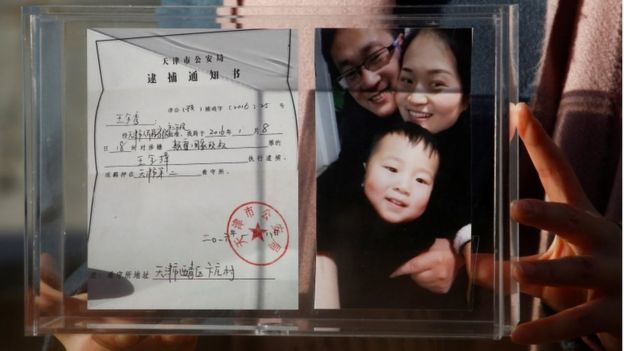
Li Wenzu, the wife of prominent Chinese rights lawyer Wang Quanzhang, holds a box with a family picture and her husband's detention notice, before shaving her head in protest in Beijing, ChinaImage copyrightREUTERS
Image captionLi Wenzu holds a family picture, and her husband’s detention notice

Mr Caster said that “the UN Working Group on Arbitrary Detention has found that Wang’s detention is arbitrary, which means that under international law he should never have faced a trial in the first place, and so obviously should never have faced any length of sentence”.

Rights groups have condemned the trial with Amnesty International calling it a “sham” and the verdict “a gross injustice”.

“It’s outrageous that Wang Quanzhang is being punished for peacefully standing up for human rights in China,” Amnesty China researcher Doriane Lau said in a statement.

China’s crackdown on lawyers, known as the “709” crackdown because it began on 9 July, has been seen by activists as a sign of a growing intolerance of dissent under President Xi Jinping.

More than 200 people were detained in that sweep, with many given jail terms, suspended sentences or house arrest.

Source: The BBC

28/01/2019

UK shares lower after downbeat China data; Ocado rallies

(Reuters) – Britain’s FTSE 100 opened lower on Monday, taking direction from the wider market where worries over slowdown in China muted a cheer from reopening of the U.S. government after weeks of shutdown, while Ocado rallied on a report of a tie-up with M&S.

The blue-chip index dipped 0.4 percent, while the FTSE 250 index was 0.1 percent lower as at 0911 GMT.

Sector heavyweights Shell and BP shed 1 percent each as oil prices fell on signs that output may rise further with U.S. companies adding rigs for the first time this year. [O/R]

Overnight, Asian shares have rallied on relief after Washington moved to temporarily end the longest U.S. government shutdown in history. But adding caution was data from China that showed earnings at its industrial firms shrank again in December.

That rekindled tensions among investors who are already rattled by repeated signs of a slowdown in the world’s No.2 economy amid its ongoing trade dispute with the United States.

Investors were also bracing for a series of votes in parliament on Tuesday that will aim to break a Brexit deadlock. With just two months before Britain is due to leave the EU, there are still no signs of a divorce deal that would get through government.

“At the start of a stacked week … the FTSE suffered the kind of muted, negative open that has become routine in the last few sessions,” Spreadex analyst Connor Campbell wrote.

A Guardian report that Ocado has held talks with Marks & Spencer over the launch of a food delivery service helped shares in the online grocer jump 6 percent to its highest since September.

M&S also added 2 percent, hitting levels not seen since late November.

Airline Flybe jumped 23.5 percent after confirming that its largest shareholder had urged the company to remove its Chairman and investigate its cut-price sale to a consortium that included Richard Branson’s Virgin Atlantic, Stobart, Cyrus Capital.

In other news-driven moves, Petra Diamonds slumped more than 8 percent as lower diamond prices at its flagship Cullinan mine overshadowed an increase in half-year revenue.

Mining shares rose 1.5 percent as Chinese iron ore prices jumped after a deadly incident at top producer Vale over the weekend.

Source: Reuters

Law of Unintended Consequences

continuously updated blog about China & India

ChiaHou's Book Reviews

continuously updated blog about China & India

What's wrong with the world; and its economy

continuously updated blog about China & India