Archive for ‘Chinese leader Xi Jinping’

06/11/2019

French President Emmanuel Macron tells Chinese leader Xi Jinping talks are needed to calm Hong Kong situation

  • French leader calls for restraint and says he raised the topic ‘on several occasions’ during his visit
  • Two sides find common ground on need to defend free trade and fight climate change as Donald Trump starts process of pulling US out of Paris Climate Agreement
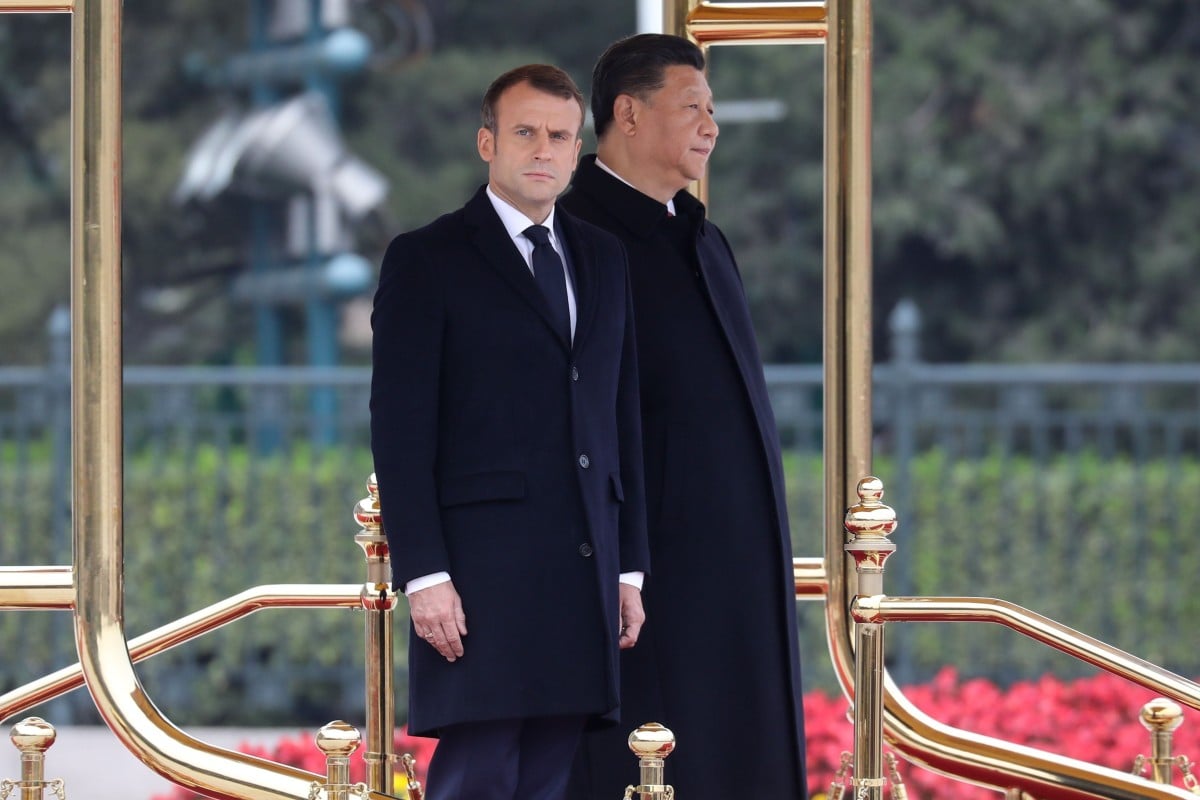
Xi Jinping and Emmanuel Macron at a welcome ceremony ahead of their talks in Beijing on Wednesday. Photo: AFP

French President Emmanuel Macron said he raised human rights and the Hong Kong situation during his talks with his Chinese counterpart Xi Jinping on Wednesday.

Macron’s visit to China concluded with pledges to work together on climate change, but the French leader also said he also called for a de-escalation of the situation in the city through dialogue after months of protests.

Macron, who had promised to raise “taboo” topics during the visit, told a press conference: “I obviously raised this with President Xi Jinping on several occasions.

“We have repeatedly called on the parties involved to [engage in] dialogue, to show restraint, to de-escalate.”

The discussion followed Xi’s meeting with Hong Kong’s embattled Chief Executive Carrie Lam Cheng Yuet-ngor in Shanghai on Monday, where he expressed “high trust” in her and “fully affirmed” support for her response to the unrest that has gripped the city since June.

Earlier the French and Chinese leaders had restated their commitment to protect free trade and pledged their continued support for the Paris Agreement as the United States begins the process of formally withdrawing from the global climate deal.

Macron expressed “regret” over “some countries’ negative attitude” towards environmental protection and the fight against climate change and pledged to work with China to halt the loss of biodiversity.

The French president’s office also released a statement on Wednesday that reaffirmed France and China’s joint support for the “irreversible” Paris Agreement.

Macron points to common ground with China on tariffs and climate action

With the European Union, China and Russia backing the pact, he added, “the isolated choice of one or another is not enough to change the course of the world. It only leads to marginalisation.”

The two countries also agreed to work together to develop joint nuclear power projects and signed a series of contracts worth US$15 billion.

The deals covered aeronautics, energy and agriculture, including approval for 20 French companies to export poultry, beef and pork to China.

An additional action plan released after the talks said French utility giant EDF and China General Nuclear Power should be encouraged to cooperate on projects in China or third countries, citing the joint efforts by the two companies to build nuclear reactors at the Hinkley Point C station in Britain as an example.

The two sides also committed to signing a contract for the construction of a nuclear fuel recycling plant in China, which would involve French energy giant Orano, by January 31.

Xi took what appeared to be a veiled swipe at the United States, which is still embroiled in a protracted trade war and other confrontations with Beijing.

“We advocate for mutual respect and equal treatment, and are opposed to the law of the jungle and acts of intimidation,” Xi said.

“We advocate for openness, inclusion and for mutually beneficial cooperation, and are opposed to protectionism and a zero-sum game.”

Macron said China and the European Union should work in partnership as the world became more unstable, calling on the two sides to further open up market access.

“We call again for trade multilateralism to respond to distortions that have appeared in the global economy, which have led to a profound rise in inequalities and imbalances that explain the surge of challenges to the international systems,” he said.

“China and Europe also share the same views that the trade war only leads to loss.”

Macron kicks off China visit with deal to protect wine and cheese from counterfeiting

Chinese state news agency Xinhua said the two countries agreed to work together to push forward with plans to assemble Airbus’s A350 model in China.

Meanwhile, Beijing Gas Group and French utility firm Engie will collaborate on a liquefied natural gas terminal and storage in the northern city of Tianjin, while France’s Total will set up a joint venture with China’s Shenergy Group to distribute liquid nitrogen gas by truck in the Yangtze River Delta.

The two countries also agreed to reach an agreement by the end of January 2020 on the cost and location of a nuclear fuel reprocessing facility to be built by Orano, formerly known as Areva.

Wu Libo a professor and director of the Centre for Energy Economics and Strategies Studies at Fudan University, said there was “great potential” for further cooperation between the two countries on nuclear energy.

“France has many useful experiences in the operation and management of nuclear power plants and its plants have long-term safe and stable operation records,” she said.
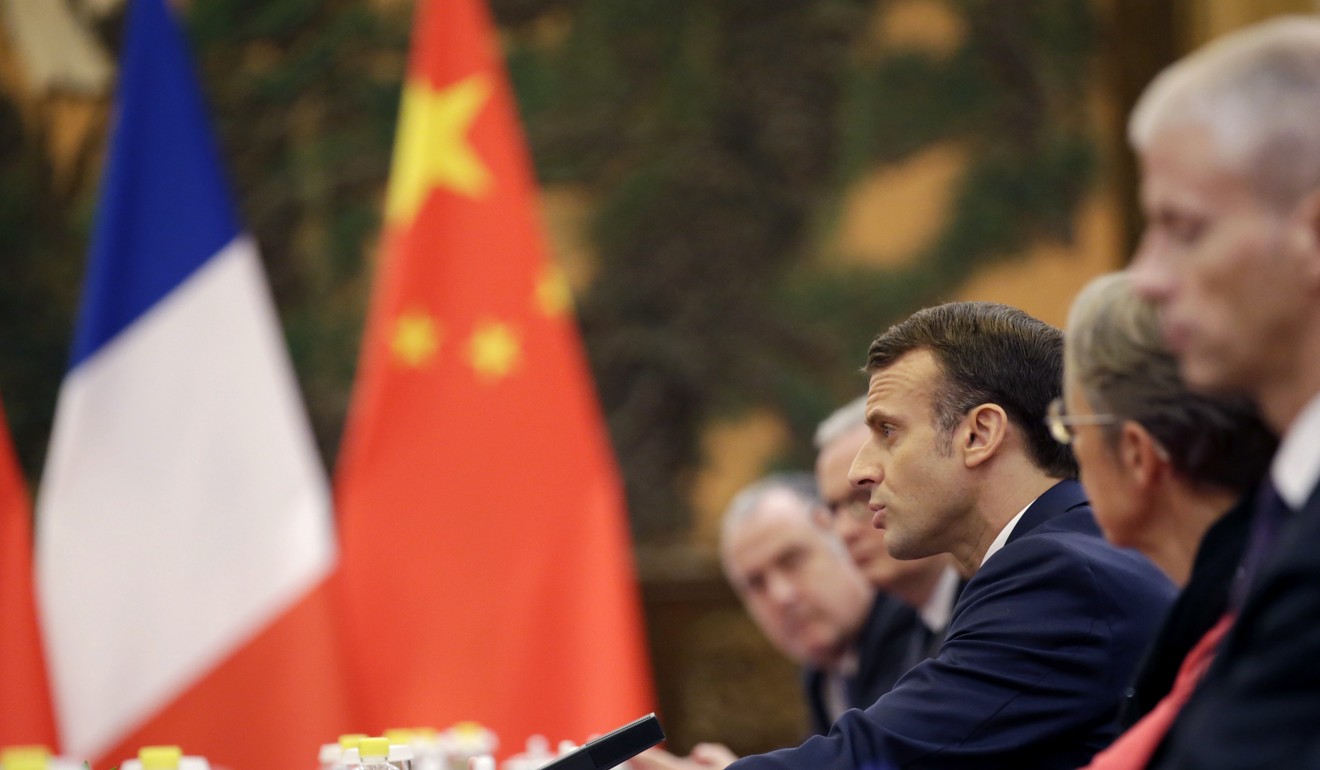
The two sides agreed to work together on joint nuclear power projects. Photo: AP

Jiang Kejun, a senior researcher at the Energy Research Institute of China’s National Development and Reform Commission, said China’s cooperation with France would add credibility to potential third-country projects.

“China has advanced third-generation technology but it’s still a new member in the nuclear power market, while France has developed nuclear energy for a long time, and its EPR reactors – a technology designed and developed in France – are in business operation,” he said.

Jiang said possible markets for the joint projects included Argentina and India, while some Middle Eastern states – such as Saudi Arabia and Qatar – had expressed interest in nuclear energy.

China’s ambassador hits out at Macron’s team for backing ‘hypocritical’ EU stance on Hong Kong

Tong Jiadong, professor of international trade at Nankai University, said that the deals between the two sides helped show that France and China could work together to counteract US unilateralism.

“Objectively speaking, this will form, or at least imply, an opposition to US unilateralism,” Tong said. “China hopes the cooperation between these two countries produces demonstrable effects for other EU member states.”

Ding Chun, a professor of European Studies at Fudan University, said he did not think the EU wanted to “choose a side” between the US and China.

But Ding continued: “If we are talking about free trade and multilateralism, there’s no doubt that the EU and China share a common view and can balance Donald Trump’s unilateralism.”

Source: SCMP

21/06/2019

Xi says China supports political settlement of Korean Peninsula issue

DPRK-PYONGYANG-CHINA-XI JINPING-KIM JONG UN-TALKS

Xi Jinping, general secretary of the Central Committee of the Communist Party of China (CPC) and Chinese president, holds talks with Kim Jong Un, chairman of the Workers’ Party of Korea (WPK) and chairman of the State Affairs Commission of the Democratic People’s Republic of Korea (DPRK), in Pyongyang, DPRK, June 20, 2019. (Xinhua/Ju Peng)

PYONGYANG, June 20 (Xinhua) — Visiting Chinese top leader Xi Jinping on Thursday reaffirmed China’s support for efforts to push forward the political settlement process on the Korean Peninsula issue and build up conditions for its resolution.

Xi, general secretary of the Central Committee of the Communist Party of China and Chinese president, made the remarks in talks with Kim Jong Un, chairman of the Workers’ Party of Korea and chairman of the State Affairs Commission of the Democratic People’s Republic of Korea (DPRK).

Xi spoke highly of the DPRK’s efforts to safeguard peace and stability on the Korean Peninsula and promote the denuclearization of the peninsula.

The situation of the Korean Peninsula concerns regional peace and stability, Xi pointed out, noting that a bright prospect of resolving the issue through dialogue has appeared over the past year, which has gained recognition and raised expectations of the international community.

The international community hopes that talks between the DPRK and the United States will move forward and bear fruit, Xi added.

Stressing that the Korean Peninsula issue is highly sensitive and complex, Xi said a strategic and long-term perspective is needed to accurately guide the evolution of the situation and effectively maintain peace and stability on the peninsula.

China, Xi said, is willing to provide assistance within its capacity for the DPRK to address its legitimate security and development concerns, strengthen coordination and cooperation with the DPRK as well as other relevant parties, and play a positive and constructive role in achieving denuclearization of the Korean Peninsula and long-term stability in the region.

For his part, Kim said that over the past year, the DPRK has taken many active measures to avoid tensions and control the situation on the Korean Peninsula, but has not received positive responses from the party concerned, which the DPRK does not want to see.

The DPRK is willing to stay patient, and hopes that the relevant party will work with the DPRK to seek solutions that accommodate each other’s legitimate concerns and push for results from the dialogue process, Kim said.

The DPRK highly appreciates the important role played by China in solving the Korean Peninsula issue, he said, adding that his country is ready to continue to strengthen communication and coordination with China to strive for new progress in the political settlement of the issue and safeguard peace and stability on the peninsula.

Xi arrived in Pyongyang earlier Thursday for a state visit to the DPRK. The visit, Xi’s first as CPC chief and Chinese head of state and also the first of its kind in 14 years, came as the two neighboring countries are celebrating the 70th anniversary of their diplomatic ties.

Source: Xinhua

06/05/2019

Warren Buffett says U.S.-China trade war ‘bad for the whole world’

(Reuters) – Warren Buffett said on Monday that a trade war between the United States and China would be “bad for the whole world.”

Buffett spoke after U.S. President Donald Trump tweeted on Sunday that he will raise tariffs on $200 billion of Chinese imports to 25 percent from 10 percent beginning on Friday, and “shortly” slap a 25-percent tariff on $325 billion of Chinese goods that have not been taxed.

Major stock markets fell worldwide on Monday in response to the president’s tweet, which came ahead of scheduled trade talks this week, and was a “rational” response, Buffett said on CNBC television.

Buffett’s conglomerate Berkshire Hathaway Inc owns or invests in many companies that do business in China, including Apple Inc, in which it has a more than $50-billion stake.

“If we actually have a trade war it will be bad for the whole world,” Buffett said.

A full-scale trade war is unlikely but “would be bad for everything Berkshire owns,” Buffett added.

He nonetheless said it would be “nonsense” for investors to sell stocks based on headlines, and that the U.S.-China would not affect how Omaha, Nebraska-based Berkshire operates.

“We will buy the same stocks today that we were buying last week,” he said.

Trump on Monday tweeted that the United States has for many years lost $600 billion to $800 billion annually on trade, and “with China we lose 500 Billion Dollars. Sorry, we’re not going to be doing that anymore!”

Buffett said tough talk ahead of trade negotiations was understandable, saying that for some people “the best technique is to act half-crazy,” but it would be ineffective to “shake your fist first and then shake your finger later on.”

He added that Trump’s threat raises the stakes for Chinese leader Xi Jinping.

“You’re talking about two personalities who are very much used to getting their way in politics, and talking about how they will be perceived in their own country in terms of their behavior,” Buffett said. “It gets very complicated.”

Buffett said the trade dispute has already had an effect on Berkshire’s BNSF railroad.

Last week, Jim Weber, the chief executive officer of Berkshire’s Brooks Running unit, said in an interview that his company was ending most shoe production in China and moving it to Vietnam because of tariff concerns.

Buffett also said the United States should bolster its trade relations with Canada and Mexico.

“We’ve got lots and lots and lots of common interests,” he said. “Trade with Mexico and Canada is enormously important. We should treat them as neighbors, and not adversaries.”

Berkshire ended March with $191.8 billion of equity investments. It also owns more than 90 companies including energy and utility companies, Geico auto insurance and Dairy Queen ice cream.

Source: Reuters

Law of Unintended Consequences

continuously updated blog about China & India

ChiaHou's Book Reviews

continuously updated blog about China & India

What's wrong with the world; and its economy

continuously updated blog about China & India