Archive for ‘Chinese mainland’

29/05/2020

Under shadow of Beijing’s security law, Taiwan president thanks Hong Kong bookseller for supporting democracy

  • Tsai Ing-wen visited exiled Hong Kong bookseller a day after NPC voted in favour of legislation
  • Lam Wing-kee said fleeing Hongkongers saw Taiwan as a step towards applying for asylum in the West
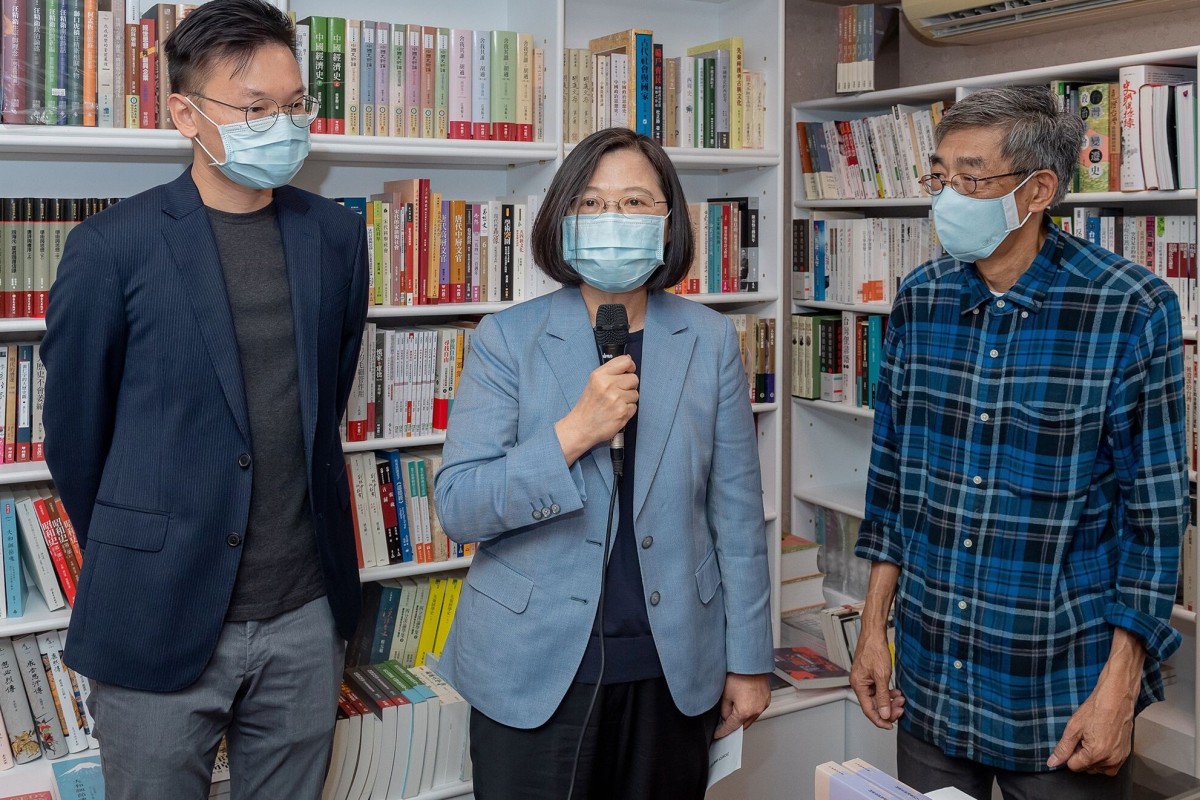
President Tsai Ing-wen (centre) shows her support for Hong Kong bookseller Lam Wing-kee (right) with Lin Fei-fan, deputy secretary general of the ruling Democratic Progressive Party. Photo: Taiwan presidential office/AFP
Taiwan’s President Tsai Ing-wen visited exiled Hong Kong bookseller Lam Wing-kee
on Friday in a show of support for Hongkongers amid Beijing’s plan to introduce a controversial national security law.
Her visit came a day after China’s legislature, the National People’s Congress, voted in favour of a resolution to initiate the legal process for a national security law to be imposed on Hong Kong, despite concerns from the United States, the European Union and elsewhere that the move would erode human rights, freedom and autonomy in the city.
“We want to thank the bookstore boss Lam Wing-kee for his persistent support of human rights, freedom and democracy in Hong Kong from the past to the present stage,” Tsai told Lam, who recently reopened the now-defunct Hong Kong Causeway Bay Books in Taipei.

Tsai said on behalf of all Taiwanese people, she welcomed Lam to stay in Taiwan where he could bolster the island’s efforts to further freedom and democracy.

Hongkongers who want to flee to Taiwan ‘will go through strict screening’

28 May 2020

Lam, one of the five shareholders and staff at Hong Kong’s Causeway Bay Books, fled to Taiwan in April last year after he was detained by Chinese agents for eight months in 2015 for selling books critical of the Chinese leadership.

All five went missing

between October and December that year and it emerged they had been detained on the Chinese mainland.
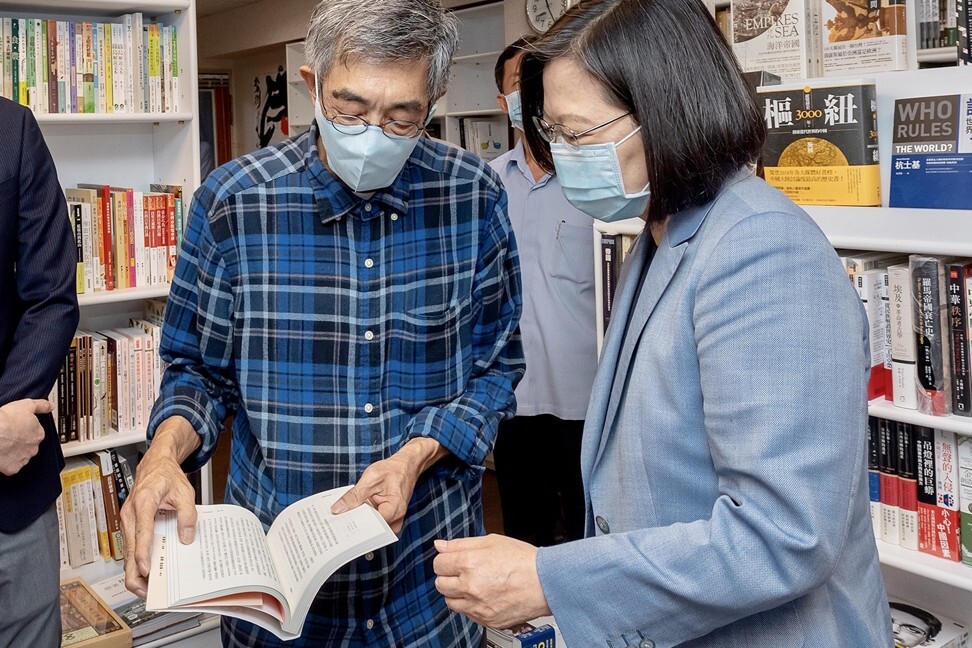
President Tsai Ing-wen looks at a book while visiting Lam Wing-kee on Friday. Photo: Taiwan presidential office/AFP
Lam later said he had been detained and blindfolded by police after crossing the border into mainland China from Hong Kong in October 2015.

The case triggered a huge controversy and raised fears of growing Chinese control in the city.

Seeing Lam as a representative of Hongkongers fleeing to Taiwan to avoid political persecution, Tsai said she wanted to understand what challenges these exiles faced and what help they needed during their stay on the self-ruled island.

“I want to tell Boss Lam [Wing-kee] and our Hong Kong friends that the government here has set up an ad hoc committee to offer help to them very soon,” she said.

On Wednesday, Tsai called for the government to set up an ad hoc committee to work out a “humanitarian help action plan” for Hong Kong people seeking to live in Taiwan or immigrate to the island. It was borne out of concern they would be arrested or prosecuted for taking part in months of anti-government protests triggered last year by the now-shelved extradition bill.

Chen Ming-tong, head of the Mainland Affairs Council, the island’s top mainland policy planner, said on Thursday his council would draft the measures for cabinet’s approval in a week.

Under the plan, the Mainland Affairs Council would issue special measures and coordinate with the island’s authorities on how to help Hongkongers relocate to Taiwan and take care of them.

Bookseller Lam told Tsai what Hongkongers needed most was to have their stay in Taiwan extended.

Lam said that currently, because of the absence of a political asylum law, Hongkongers could only apply to live in Taiwan through study, work, investment, their professional skills or close relatives.

He said fleeing Hongkongers usually came to Taiwan on tourist permits, which at most allowed them to stay for up to six months, giving them not enough time to apply for long-term residence in Taiwan.

“It would be better if they can stay for nine months and preferably one year,” he said.

Lam said some fleeing Hongkongers saw Taiwan as an intermediary base as they hoped to apply for asylum in the West, but it took a long time for Western countries to screen and approve their asylum requests.

Meanwhile, Premier Su Tseng-chang said Article 18 of the Laws and Regulations Regarding Hong Kong and Macau Affairs was good enough to deal with the current crisis in the absence of a political asylum law in Taiwan.

That article states that “necessary help shall be provided to Hong Kong or Macau residents whose safety and liberty are immediately threatened for political reasons”.

Source: SCMP

10/05/2020

Update: Chinese mainland reports 14 new confirmed COVID-19 cases

A customer buys products at a time-honored food store in east China’s Shanghai Municipality, April 26, 2020. (Xinhua/Wang Xiang)

Twelve cases were domestically transmitted, with 11 reported in Jilin Province and the other one in Hubei Province.

BEIJING, May 10 (Xinhua) — Chinese health authority said Sunday that it received report of 14 new confirmed COVID-19 cases on the Chinese mainland Saturday, of which two were imported cases reported in Shanghai.

Twelve cases were domestically transmitted, with 11 reported in Jilin Province and the other one in Hubei Province, the National Health Commission said in a daily report.

One new suspected case imported from abroad was reported in the Inner Mongolia Autonomous Region.

No deaths were reported Saturday on the mainland, according to the commission.

On Saturday, 74 people were discharged from hospitals after recovery, while the number of severe cases decreased by two to 13.

As of Saturday, the overall confirmed cases on the mainland had reached 82,901, including 148 patients who were still being treated, and 78,120 people who had been discharged after recovery.

Altogether 4,633 people had died of the disease, the commission said.

By Saturday, the mainland had reported a total of 1,683 imported cases. Of the cases, 1,568 had been discharged from hospitals after recovery, and 115 remained hospitalized with three in severe conditions. No deaths from the imported cases had been reported.

The commission said four people, all from overseas, were still suspected of being infected with the virus.

According to the commission, 5,840 close contacts were still under medical observation after 427 people were discharged from medical observation Saturday.

Also on Saturday, 20 new asymptomatic cases were reported on the mainland. One case was re-categorized as a confirmed case, and 61 asymptomatic cases, including 16 from overseas, were discharged from medical observation, according to the commission.

The commission said 794 asymptomatic cases, including 48 from overseas, were still under medical observation.

By Saturday, 1,044 confirmed cases including four deaths had been reported in the Hong Kong Special Administrative Region (SAR), 45 confirmed cases in the Macao SAR, and 440 in Taiwan including six deaths.

A total of 967 patients in Hong Kong, 40 in Macao, and 361 in Taiwan had been discharged from hospitals after recovery.

Source: Xinhua

31/03/2020

Chinese mainland reports zero increase in domestic COVID-19 cases

BEIJING, March 31 (Xinhua) — Chinese health authority said Tuesday that no new domestically transmitted cases of the novel coronavirus disease (COVID-19) were reported on the Chinese mainland on Monday.

The National Health Commission received reports of 48 new confirmed cases on the mainland on Monday, all of which were imported.

By the end of Monday, 771 imported cases had been reported, said the commission.

Also on Monday, one death which was in Hubei Province, and 44 new suspected cases, all imported ones, were reported on the mainland.

On Monday, 282 people were discharged from hospitals after recovery, while the number of severe cases decreased by 105 to 528.

The overall confirmed cases on the mainland had reached 81,518 by Monday, including 2,161 patients who were still being treated, 76,052 patients who had been discharged after recovery, and 3,305 people who died of the disease.

The commission said that 183 people were still suspected of being infected with the virus, adding that 19,853 close contacts were still under medical observation. On Monday, 1,199 people were discharged from medical observation.

By Monday, 682 confirmed cases including four deaths had been reported in the Hong Kong Special Administrative Region (SAR), 39 confirmed cases in the Macao SAR, and 306 in Taiwan including five deaths.

A total of 124 patients in Hong Kong, 10 in Macao and 39 in Taiwan had been discharged from hospitals after recovery.

Source: Xinhua

19/03/2020

Commentary: China’s zero increase in coronavirus infection a positive sign for world

BEIJING, March 19 (Xinhua) — China’s report of no new local infections of the novel coronavirus in the mainland for the first time is a positive sign amid the news of sharply increasing infections worldwide.

No new infections of the novel coronavirus were reported Wednesday in Wuhan, the epicenter of the outbreak, and Hubei Province. The Chinese mainland reported 34 new confirmed COVID-19 cases, however, all were imported from overseas.

The progress highlights China’s continually improving trend in its prevention and control of COVID-19 despite a growing challenge of imported cases from abroad. It shows China’s tactics and methods in controlling the virus have continued to deliver positive results.

With a unified and highly efficient command system, the country has launched a people’s war against the epidemic featuring full mobilization, transparency, timely activation and adjustment of response levels by provinces, a model of early detection, reporting, isolation and treatment and orderly resumption of production with targeted preventive moves.

In less than two months, China has efficiently contained the spread of the deadly virus with unprecedented measures including the lockdown of Wuhan and mobilization of medical resources nationwide. The 1.4 billion people have pulled together as one to tackle the tough task.

The measures that China has adopted are law-based, scientific and well-targeted. The country has given play to its technological strength to rapidly identify the virus, advance vaccine development and raise testing capacities in a very short time.

The epidemic situation both in and outside China remains complex and severe. The Chinese mainland still had 7,263 COVID-19 patients in hospitals as of Wednesday. The world faces a vital fight against the pandemic as the number of infections in other countries has exceeded 110,000, outnumbering that of China.

As a community with a shared future, the globe needs more solidarity, communication, responsibility and action than ever. What China has done can serve as a reference for those who are confronting the urgent and grave global pandemic.

China has bought the world time by containing the virus. As the country vows to prevent a reversal of the positive trend and clinch a complete victory over the epidemic, it will continue working closely with others and contribute more to the global fight via sharing experience and information and providing help to those in need.

Source: Xinhua

12/02/2020

New confirmed coronavirus infections drop by nearly half in China: spokesperson

BEIJING, Feb. 12 (Xinhua) — The number of daily new confirmed cases of the novel coronavirus infection fell from a peak of 3,887 on Feb. 4 to 2,015 on Tuesday, with a decrease of 48.2 percent, according to the National Health Commission (NHC).

Noting that the epidemic situation remains grave at the moment, NHC spokesperson Mi Feng identified some positive changes in the statistics as a result of a series of effective measures.

For example, the number of newly reported suspected cases dropped by 37.3 percent from 5,328 on Feb. 5 to Tuesday’s 3,342.

He also highlighted the rapid increase in the number of people cured and discharged from hospitals, bringing the recovery rate to 10.6 percent by Tuesday from the lowest level of 1.3 percent on Jan. 27.

The overall confirmed cases on the Chinese mainland reached 44,653 by the end of Tuesday, and 16,067 people remain suspected of being infected with the virus.

A total of 4,740 people had been discharged from hospitals after recovery.

Source: Xinhua

30/01/2020

Coronavirus: turbulent times ahead for air travellers as carriers cancel China flights

  • Lufthansa, British Airways, Air Canada among several big name airlines to halt flights, while others reduce services
  • Travel agents expecting slump in sales amid rising uncertainty over how epidemic will play out
Many airlines have cancelled flights into mainland China because of the coronavirus outbreak. Photo: AP
International air travellers and ticketing agents are in for a turbulent time in the weeks ahead as airlines around the world react to the coronavirus epidemic by cancelling or limiting flights to and from the Chinese mainland.
Lufthansa, British Airways, Air Canada and Indonesia’s Lion Air have 
cancelled all of their flights

, while United Airlines, American Airlines, IndiGo, Finnair, Delta Air Lines and Jetstar Asia have significantly reduced their services.

“It’s going to be pretty bad for travel agencies. We’ve had a lot of cancellations. Everyone is afraid of coming to China,” said Annabelle Auger from Travel Stone in Beijing.
“Many of our European clients are very worried because of the media coverage they’ve seen. Still, people are willing to wait and see for a few weeks to see how things go,” she said.
For foreigners looking to leave China, Auger said they should contact their embassy to find out about repatriation flights.

“The situation is very unclear, so it’s difficult to give any general recommendations,” she said.

Already this week, the embassies of the United States, Japan, South Korea and Britain have cleared flights to evacuate their nationals from Hubei, the central China province at the heart of the outbreak.

Auger said she and her colleagues had been busy rearranging flights for China-based foreigners who had gone away for the holidays.

“The schools are closed, so families with children abroad are thinking, ‘OK, let’s extend our stay for another week’,” she said.

Politics may have stalled information in coronavirus crisis, scientist says

30 Jan 2020
The Beijing government said on Monday it would extend the Lunar New Year
holiday until Sunday to help stop the spread of the disease, while school breaks have also been extended.

Another travel agent in Beijing, who asked not to be named, said the virus outbreak had yet to have a significant impact on business but concerns were growing.

“We are a bit worried that things may get difficult in the coming months,” she said. “But we trust that the government is doing all it can and will take the appropriate measures to solve the problems.”

Zhu Tao, director of the flight standards department at the Civil Aviation Administration of China (CAAC), said at a press conference in Beijing on Thursday that the relevant authorities were working closely with airlines to help Chinese nationals trapped overseas to get home.

The government had already chartered flights from Japan, Myanmar and South Korea to bring Chinese nationals back to Hubei, he said.

While all flights out of Hubei have been suspended since last week, Zhu said air transport was playing its part in fighting the disease.

As of Wednesday, the CAAC had sent 86 flights carrying 5,129 medical workers and 115,000 items of equipment and other supplies into Wuhan, he said.

Wu Zunyou, the chief epidemiologist at the China Centre for Disease Control and Prevention, said that efforts to prevent the coronavirus spreading outside the country had been successful, as only about 1 per cent of the confirmed infections were outside China.

Despite the flight cancellations, Beijing’s Capital International Airport was operating as normal on Thursday.

Andre Muchanga, a student from Abu Dhabi at the Beijing Institute of Technology, said he made a late decision to fly home.

“I decided to buy my ticket last night,” he said. “At school, our dormitory is almost completely empty. I knocked on a friend’s door last night and found there was no one there, so I decided I better just go home and spend some time with my family.”

He said he decided not to buy a return flight as it he did not know when his classes would resume.

Signs at check-in counters reminded passengers who had travelled to Hubei or had a Hubei address to put themselves in isolation for 14 days.

While flights out of Hubei have been stopped, there was still plenty of inbound traffic.

“The number of domestic inbound travellers seems pretty normal for this time of year,” a man working on an information desk at Capital airport said.

“It’s the sixth day of the Lunar New Year. Lots of people have to return to work.”

An Air China employee, surnamed Hu, said that the airport had stepped up its disinfecting and general cleaning work. Body temperature checks had been installed at all access points and employees had been told to wear masks, he said.

“I don’t mind working during the Lunar New Year holiday,” he said. “I’m not afraid of the virus, I’m here to serve the people.”

SOurce: SCMP

20/09/2019

Across China: Guangzhou incubator gives HK and Macao entrepreneurs a leg-up

GUANGZHOU, Sept. 19 (Xinhua) — After exploring registering a company in Shenzhen and Zhuhai in 2013 and 2015, ChiMan Chan, a Hong Kong entrepreneur, finally made the plunge and launched a business on the Chinese mainland in 2017 when he came across the Tianhe District Service Center for Hong Kong and Macao Youth Entrepreneurship.

The service center, a non-profit organization which acts as an incubator for emerging enterprises, is located in the heart of Guangzhou’s bustling CBD, Zhujiang New Town.

Since it was established in 2017, the center has embraced more than 2,200 young entrepreneurs from the two Special Administrative Regions, and 45 Hong Kong and Macao enterprises have settled down at the center.

Thanks to the assistance from the center, Chan is now the founder and chief executive officer of Deming ProDevelop, an engineering consultant agency with four offices scattered across the Guangdong-Hong Kong-Macao Greater Bay Area.

In Chan’s view, the service center played an instrumental role in his company’s current success. “Without the help of the service center, there is no way we could have thrived to such an extent on the Chinese mainland,” Chan said.

Establishing a business is tough in itself, but for newcomers to the mainland, the application and registration process can especially present a massive initial hurdle, according to Chan. Luckily, the service center reduced some of that pressure for him.

Chen Jingzhan, director of the center’s entrepreneurship and innovation department, said many Hong Kong and Macao entrepreneurs that have set their eyes on development on the mainland often face similar headaches.

“It’s not just a matter of investing enough time to complete the registration process. Without professional guidance, many Hong Kong and Macao newcomers to the mainland simply do not know where to start,” said Chen, adding that is where the service center comes in.

Not only does the center help entrepreneurs get started, but it also offers support as they continue to develop through free registration, entrepreneurship, policy, intellectual property rights, law, and market resource consulting services.

To enterprises that meet specific requirements, the center even provides office space for two to three people free of charge, with aims of “reducing the operational costs associated with startups, and offering more development opportunities to Hong Kong and Macao enterprises,” said Chen.

Since the Outline Development Plan for the Guangdong-Hong Kong-Macao Greater Bay Area was released in February, more and more youths from Hong Kong and Macao have set their sights on Guangdong.

Ye Zhengqiao, a young entrepreneur from Hong Kong, is one of them. Drawn to the Greater Bay Area after graduating from university in the U.S., Ye now is the founder of Geometry Technology Co., Ltd., a company that has launched an online intelligent pet platform. Ye’s platform lists pet-related service providers and product sellers in a one-stop online solution for pet owners in China.

Ye said the construction of the Guangdong-Hong Kong-Macao Greater Bay Area has given young people like him “more confidence and opportunity.” He said he believes “the rate of success in Guangdong is higher than in Hong Kong,” and that the Greater Bay Area gives young people “more room to try new things with lower capital requirements.”

The concept behind the Greater Bay Area also provided the inspiration for ChiMan Chan’s business. While working on a project related to the construction of the Hong Kong-Zhuhai-Macao Bridge, the Greater Bay Area’s most iconic feat of engineering, Chan saw the potential for deepened cooperation and wanted to build a bridge of his own: a platform to connect Chinese mainland engineers and their Hong Kong, Macao and overseas counterparts.

Chen hopes more services like those on offer at the Tianhe District Service Center for Hong Kong and Macao youth entrepreneurship will be offered to young Hong Kong entrepreneurs, both in the mainland and in Hong Kong itself.

Ye Zhengqiao agrees that the mainland offers new pathways to Hong Kong and Macao youths, adding that he hopes more young people from the two SARs can latch on to the new possibilities provided by the Greater Bay Area, and “come to the mainland more often to appreciate the opportunities available.”

Source: Xinhua

Law of Unintended Consequences

continuously updated blog about China & India

ChiaHou's Book Reviews

continuously updated blog about China & India

What's wrong with the world; and its economy

continuously updated blog about China & India