Chindia Alert: You’ll be Living in their World Very Soon
aims to alert you to the threats and opportunities that China and India present. China and India require serious attention; case of ‘hidden dragon and crouching tiger’.
Without this attention, governments, businesses and, indeed, individuals may find themselves at a great disadvantage sooner rather than later.
The POSTs (front webpages) are mainly 'cuttings' from reliable sources, updated continuously.
The PAGEs (see Tabs, above) attempt to make the information more meaningful by putting some structure to the information we have researched and assembled since 2006.
Chinese military takes aim at operations by American warships near the Spratly and Paracel islands
US says sweeping maritime claims in the area pose a threat to freedom of the seas
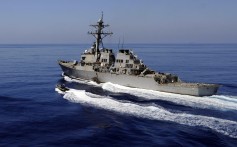
The USS Bunker Hill (front) and the USS Barry have been conducting operations in the South China Sea. Photo: US Navy
The Chinese military called the United States a “troublemaker” in the disputed South China Sea on Thursday, stressing that China was on “high alert” to safeguard its interests in the contested waters.
The two powers, already mired in a dispute over the handling of the coronavirus pandemic, have engaged in tense stand-offs over the South China Sea, with two back-to-back operations by the US to challenge China’s expansive claims in the region in the last few days.
The US’ guided-missile cruiser USS Bunker Hill conducted a “freedom of navigation operation” in the Spratly Islands on Wednesday, a day after the guided-missile destroyer USS Barry conducted a similar operation near the Paracel Islands.
The US 7th Fleet said the operations were in response to “unlawful and sweeping maritime claims in the South China Sea [that] pose a serious threat to the freedom of the seas, including the freedoms of navigation and overflight and the right of innocent passage of all ships”.
More footage emerges from 2018 near collision of US and China warships in South China Sea
And last week, an Australian frigate joined US warships in a joint exercise in the South China Sea after the Chinese research ship Haiyang Dizhi 8, accompanied by a Chinese coastguard vessel, tailed a Malaysian state oil company ship conducting exploration in the area.
China’s defence ministry spokesman Wu Qian said China had been “closely watching and on high alert” against the activities by the US and Australian militaries.
“The frequent military operations in the South China Sea by extra-regional countries like the US and Australia are not conducive to the peace and stability in the South China Sea and we resolutely oppose them,” Wu said.
“Time and again, the US has proven itself to be the biggest force in pushing militarisation in the South China Sea and a troublemaker in preventing peace and stability in the region.”
China military lashes out at US warship’s ‘intrusion’ in South China Sea
29 Apr 2020
On Tuesday, the People’s Liberation Army’s Southern Theatre Command said the
The command said it scrambled air and sea patrols to “track, monitor, verify, identify and expel” the American vessels.
Also on Thursday, Wu rejected a US report that China had secretly conducted an underground nuclear test.
Citing a report from the US State Department, The Wall Street Journal reported two weeks ago that Washington was concerned by an increase in activity at China’s Lop Nur test site in the far western region of Xinjiang, including extensive excavations that raised the suspicion of an explosion.
“The report by the US is fabricated and nonsense,” Wu said. “China, unlike the US, has always kept its promise on international arms control.”
Researchers say they have developed a substance that is 13 times better in tests than widely used alternative
Experiments could help solve a power source problem that has plagued commercial and military devices
Scientists at the Fujian Institute of Research on the Structure of Matter think they have found a super efficient crystal to make high-energy beams from low-energy lasers. Photo: Alamy
Scientists in southeast China say they have synthesised a crystal with the potential to significantly improve the performance of lasers used in consumer and military equipment.
Crystals of caesium bismuth germanate (CBGO) can turn low-energy beams into high-energy emissions with unparalleled efficiency, according to Professor Mao Jianggao, team leader at the Fujian Institute of Research on the Structure of Matter, part of the Chinese Academy of Sciences, in Fuzhou.
The team looked at several candidate crystals in their experiments. Compared with widely used potassium dihydrogen phosphate crystals, the CBGO crystal was 13 times more efficient at turning infrared lasers into more energised green beams.
“This is a record performance,” Mao said on Tuesday. “This is why we think the crystal may have potential.”
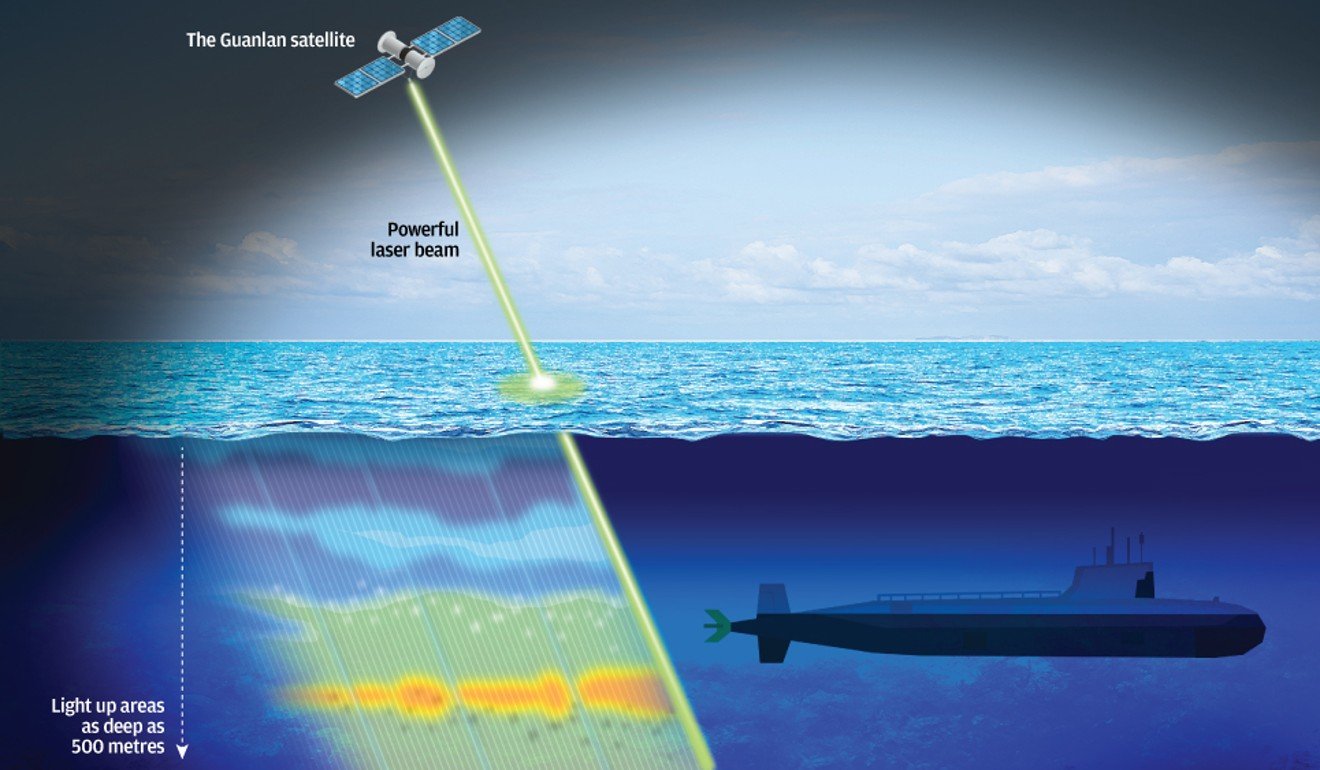
China’s prototype Guanlan anti-submarine warfare satellite uses a high-energy laser to sweep beneath the sea to a depth of 500 metres. Illustration: SCMP
Their findings were published in the German weekly scientific peer-reviewed journal Angewandte Chemie, or Applied Chemistry, last month.
The researchers said CBGO crystals could be a way around a problem that has limited the performance of lasers – the huge amount of electricity needed to power them.
China is building world’s most powerful laser radar to study Earth’s solar shield
The demand on power is great because existing technology is not efficient at converting low-energy beams to high-energy ones – one reason that laser weapons are not yet as common as scientists predicted in the 1960s.
CBGO belongs to a family known as non-linear crystals, which cause abrupt changes to energy that passes through them. The scientists found that CBGO crystals could double the frequency of a laser beam.
As high-energy lasers can be created by merging two low-energy photons, or particles of light, a process known as frequency doubling, CBGO crystals are an ideal medium, and the higher frequency of the laser, the more energy it carries.
Many military and civilian applications required high-energy beams, they said. These included directed energy weapons designed to destroy drones or missiles, or China’s prototype Guanlan anti-submarine warfare satellite, which will use a green laser to penetrate water to a depth of 500 metres (1,640 feet) to detect a target.
Mao said his team’s research was at an early stage and that years of testing would be needed before the CBGO crystals found their way to market.
The CBGO crystal grown in the Fuzhou laboratory was the size of a grain of sand, he said. For industrial use, crystals would need to be at least the size of a dice.
Growing them was a very slow and challenging job, and there was no certainty that CBGO crystals could be grown on an industrial scale, Mao said.
Chinese military could soon disable sensors on enemy missiles using suitcase-sized device after ‘groundbreaking’ study on ultrafast lasers
China is a world leader in crystal research, and some of those most commonly used in laser devices were developed by Chinese scientists thanks to heavy investment from central government.
Professor Li Qiang, deputy director with the Institute of Laser Engineering at Beijing University of Technology, said the discovery of CBGO was encouraging, but its success should be evaluated not only on its efficiency, but also on attributes such as mechanical strength, tolerance to laser damage, and stability in extreme environments such as high humidity.
“Lots of crystals have been proposed over the decades, but only a handful are useful. It’s a high-risk business,” Li said. “China has achieved a leading position in this field not because of luck, but by continuous effort by several generations of researchers through countless failures.”



 CHINDIA ALERT: You'll be living in their world, very soon