22/03/2020
- Move will help air force with patrols and combat-readiness near Taiwan and in the East and South China seas, according to observers
- Markings including national flag and service insignia will also be standardised under new guidelines
Chinese military aircraft will get “low observable” coatings and standardised markings. Photo: Xinhua
Chinese military aircraft are to be painted with “low observable” coatings and standardised markings under new guidelines, a move observers say will assist with operations near Taiwan and in the East and South China seas.
The guidelines require markings including the national flag and service insignia to be gradually standardised on both active and future warplanes, the official PLA Daily newspaper said earlier this month.
The move comes two years after the Chinese navy started experimenting with its J-16 strike fighter, using a dark grey low-visibility coating instead of blue-grey, and replacing its service insignia with a new design, according to military magazine Ordnance Industry Science Technology.
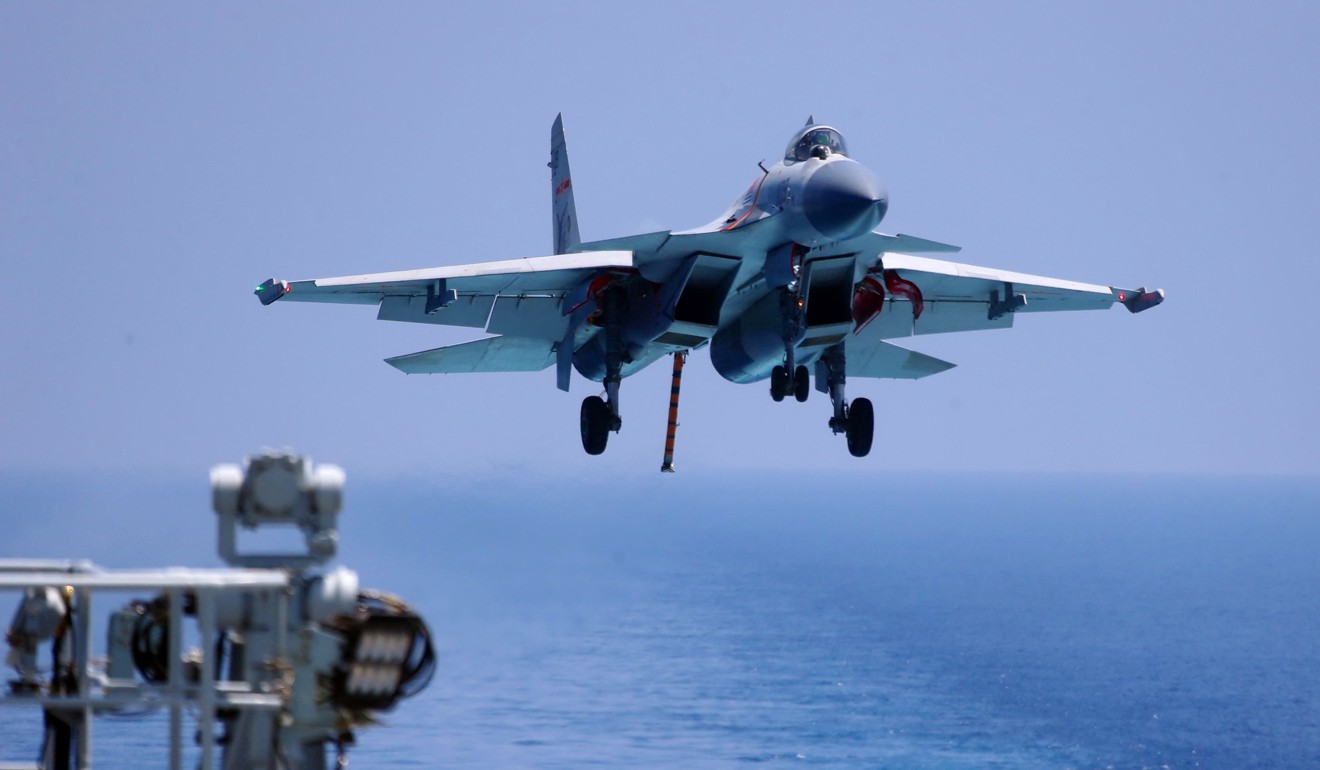
Some of the navy’s only active aircraft carrier-based fighter jets, the J-15s, have also been given new coatings and markings, according to the People’s Liberation Army’s official website.
PLA Daily said the move aimed to give Chinese warplanes a combat advantage as they “will be less likely to be detected by both the naked eye and military radar”. It said the new guidelines would be gradually implemented this year.
Some of the aircraft carrier-based J-15 fighter jets already have the new coatings. Photo: AFP
Macau-based military observer Antony Wong Dong said the move would help the air force improve patrols and combat-readiness as it carried out more drills near the Taiwan Strait and in the East and South China seas.
China’s air force and navy have sent warplanes including Su-35 fighter jets, H-6K strategic bombers and advanced KJ-2000 airborne early warning aircraft to conduct “encirclement” drills around Taiwan since 2018, as Beijing applies pressure on the self-ruled island that it sees as part of its territory. But none of the aircraft seen in photographs of the exercises had low-visibility coatings or standardised markings, as used on the navy’s J-16s and J-15s.
US spy plane pilots use China’s satellite navigation system as backup
“Aircraft used by the PLA Air Force have different coatings and markings because they are still in a transitional period,” Wong said. “Its counterparts like Taiwan have learned from Western countries like the United States to standardise coatings and markings and designs [since the 1990s].”
Beijing insists that Taiwan, which split from the mainland in 1949, remains part of China and they will eventually be reunited – by force if necessary.
The PLA also regularly sends aircraft to monitor freedom of navigation operations by the US Navy in the
South China Sea. Beijing has territorial disputes in the resource-rich waterway with countries including Vietnam, the Philippines, Malaysia and Brunei.
A military insider in Beijing said the US move to send hundreds of its new-generation F-35 stealth fighter jets to South Korea and Japan had also pushed the PLA to upgrade the coatings on its aircraft.
“These coatings are a highly technical area, and China puts a tremendous amount of resources into research on this every year,” said the insider, who requested anonymity due to the sensitivity of the issue. “The coating that’s used on
China’s first stealth fighter jet, the J-20, is more advanced than they used on the Lockheed Martin F-22s, but it’s not yet at the level of the F-35s.”
Hong Kong-based military expert Song Zhongping said military aircraft used to have a bright red national flag and service insignia that made them more detectable on radar systems, or even with the naked eye.
“The red they used is striking, but it’s not in line with the ‘low observable’ requirement for all fighter jets,” said Song, who is a military commentator for Phoenix Television.
“All fighter jets must have stealth and low-visibility capabilities, and the coatings and markings on them are part of how they can do this and meet requirements for combat.”
Source: SCMP
Posted in Beijing, Brunei, Chinese, Chinese navy, Chinese warplanes, coatings, detect, East China Sea, F-35 stealth fighter jets, H-6K strategic bombers, harder, J-16 strike fighter, Japan, KJ-2000 airborne early warning aircraft, Lockheed Martin F-22s,, Malaysia, national flag, Ordnance Industry Science Technology, Philippines, PLA Air Force, PLA Daily, service insignia, South China Sea, South Korea, Su-35 fighter jets,, Taiwan, Taiwan Strait, Uncategorized, United States, Vietnam |
Leave a Comment »
11/12/2019
- Best pilots from carrier-borne squadrons sent to naval academy for warship training to meet ‘urgent need’ for commanders
- They had to pass more than 10 assessments – from political thought to psychological testing – before they could join the programme
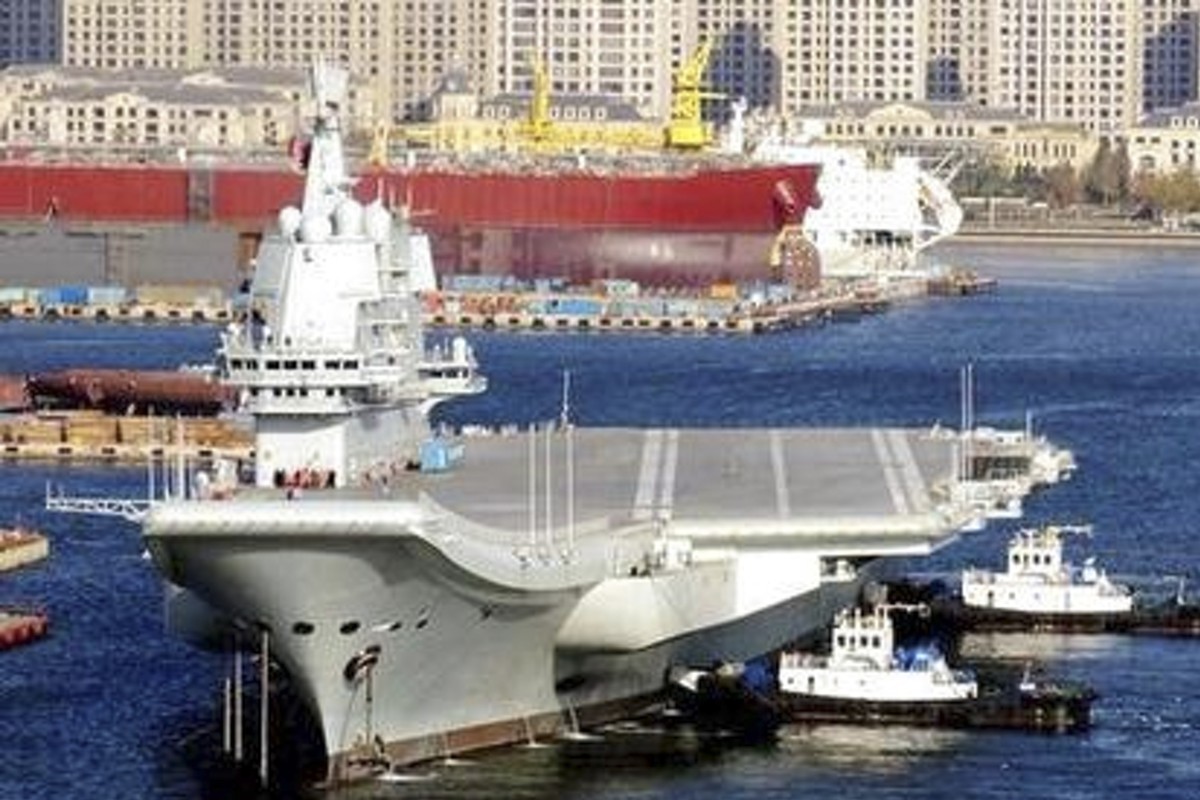
China’s second aircraft carrier, the Type 001A, is expected to be operational by the end of this year. Photo: Sina
The Chinese navy is training fighter pilots experienced in carrier-borne operations to command and manage its warships as it seeks to expand its global naval power.
Its best pilots from carrier-borne squadrons – including some qualified to fly fighter jets during both daytime and at night – were sent to a naval academy for warship combat and command training late last month, PLA Daily reported on Monday.
It did not say how many pilots had been selected, but all of them were required to pass more than 10 assessments – ranging from political thought to psychological testing – before they could join the training programme, the official People’s Liberation Army newspaper said.
Beijing-based naval expert Li Jie said the programme would focus on command and control skills for air and sea operations, and some of the pilots would ultimately be selected to command China’s new aircraft carrier strike groups.
As part of its ambition to build a powerful blue-water navy that can operate globally, China plans to have four aircraft carriers in service by 2035. Its second aircraft carrier – the first built in China, known as the Type 001A – is undergoing sea trials and is expected to be operational by the end of this year.
Work on the more modern Type 002 carrier started two years ago and a naval source told the South China Morning Post that construction of a second Type 002 vessel could begin as early as 2021.
But they will need suitable carrier pilots to take command.
“It’s quite an urgent need for the Chinese navy to have carrier group commanders – like its Western counterparts do – who are capable of commanding different warships and aircraft in modern joint-operation combat situations,” Li said.
China to deploy Sharp Sword stealth drone for new Type 001A aircraft carrier
“Aircraft carrier strike groups are supposed to sail on the high seas and into unfamiliar territory, so aside from having a background as naval aviators, all commanding officers should have a broad set of skills and knowledge – from foreign languages and international maritime law to air and sea operations – to help them make good decisions,” he said.
Other navies, such as the United States Navy, require more experience for the role – commanding officers of US aircraft carriers must be former naval aviators as well as former captains of different types of warships.
For example, Captain Pat “Fin” Hannifin, commanding officer of the Nimitz-class aircraft carrier USS Ronald Reagan, has over 2,800 flight hours in 33 different aircraft under his belt. He was also executive officer on another aircraft carrier and commander of an amphibious transport dock.
Rear Admiral Li Xiaoyan, the first captain of China’s only active aircraft carrier, the Liaoning, was a pilot with no experience on carrier-borne aircraft, though he did have experience on a destroyer and frigates. He was replaced by Zhang Zheng just days after the Liaoning formally joined the PLA Navy in 2012, and later by Liu Zhe – neither of whom had naval aviator backgrounds.
Li Xiaoyan was one of the first group of 10 pilots selected for a training programme designed specifically for China’s future aircraft carriers back in 1987. But the whole aircraft carrier plan was suspended in 1998 by premier Zhu Rongji for political and economic reasons, according to China’s Carrier, a book published by China Development Press.
China’s navy begins national search for trainee top-gun pilots
Naval expert Li Jie said the Chinese navy now had to catch up in terms of training pilots, and especially commanding officers, for its aircraft carriers.
“China resumed the aircraft carrier plan and in 2004 started refitting the hull of the Varyag. But after that first group of pilots was trained in 1987, there was no formal training in air and sea operations because there was no aircraft carrier training platform until 2012,” Li said, referring to the unfinished Admiral Kuznetsov-class vessel China bought from Ukraine in 1998, which became the Liaoning.
He said the latest training programme for commanding officers was a continuation of the one that began more than 30 years ago.
Source: SCMP
Posted in Admiral Kuznetsov-class vessel, Aircraft carrier, assessments, blue water navy, carrier-borne squadrons, China’s Carrier, Chinese navy, command, expanding, fleet, foreign languages, international maritime law, Liaoning, naval academy, newspaper, People’s Liberation Army, People’s Liberation Army (PLA), PLA Daily, political thought, psychological testing, Sharp Sword stealth drone, top guns, trains, Ukraine, Uncategorized |
Leave a Comment »
09/07/2019
- Ambassador to China Vikram Misri says they will be ‘meeting more and more in common waters’, and more exchanges are needed
- He also says preparations are under way for President Xi Jinping to visit India
The INS Kolkata arrives in Qingdao for PLA Navy 70th anniversary celebrations in April.
The Indian ambassador called for more communication between the two navies. Photo: Reuters
The Chinese and Indian navies should establish communication because they are increasingly operating within close proximity, according to India’s ambassador to China.
While the two nations’ militaries communicated extensively, it was mainly between their land forces, and that should be extended to the navies and air forces, Vikram Misri said.
“We need to talk about the two air forces and the two navies – especially the two navies – because we are operating in the same waters and increasingly in the coming years, we will be meeting more and more in common waters,” Misri said.
“I think it is important for us to develop those levels of understanding and communication,” he said. “There are some [navy and air force] exchanges now, but not as well developed as in the case of the land force.”
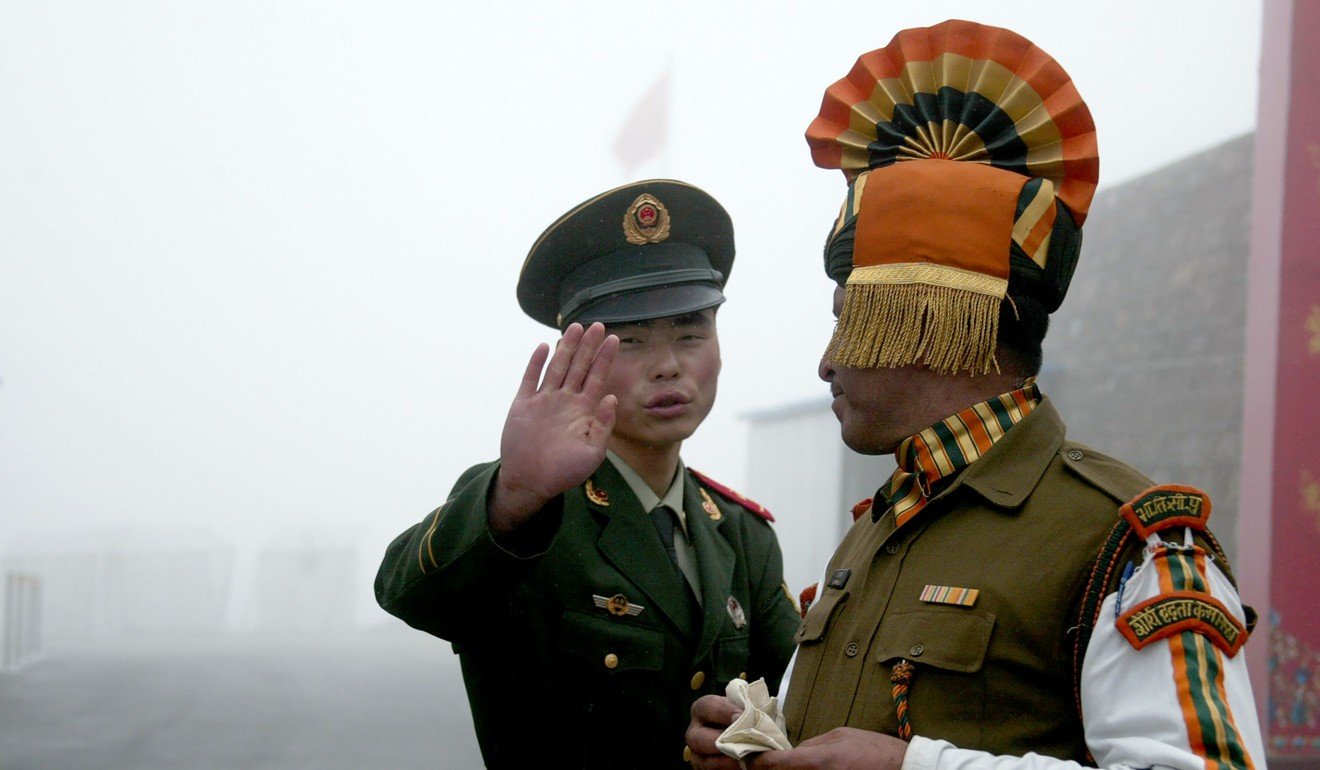
China and India have made efforts to repair their relations since a tense stand-off at the Doklam plateau two years ago, when communications between their forces along the border were seen as inadequate to contain the tension.
China and India have sought to repair relations after a tense stand-off at Doklam. Photo: AFP
Misri said the two nations had made incremental progress, and opened new points where “border personnel can meet and exchange information, or exchange views about any particular situation”.
The ambassador was visiting the Indian consulate in Hong Kong over the weekend, six months after taking up the post and six weeks after Prime Minister Narendra Modi was re-elected.
He said preparations were under way for Chinese President Xi Jinping to visit India, which was expected to happen in the fourth quarter, after they pledged earlier to strengthen cooperation.
Tensions between
have periodically flared along their 4,000km (2,485-mile) border, resulting in a brief war in 1962. Relations have also been strained by China’s ties with Pakistan, and India’s concern over China’s growing presence in the Indian Ocean.
India has also not signed on to China’s global trade and infrastructure strategy, the
, which has projects that run through the disputed Kashmir region.
“Our concerns with regards to this particular initiative are very clear, and we have continued to share them very, very frankly with our Chinese partners,” Misri said. “I think there is understanding on the part of our Chinese partners with regard to this.”
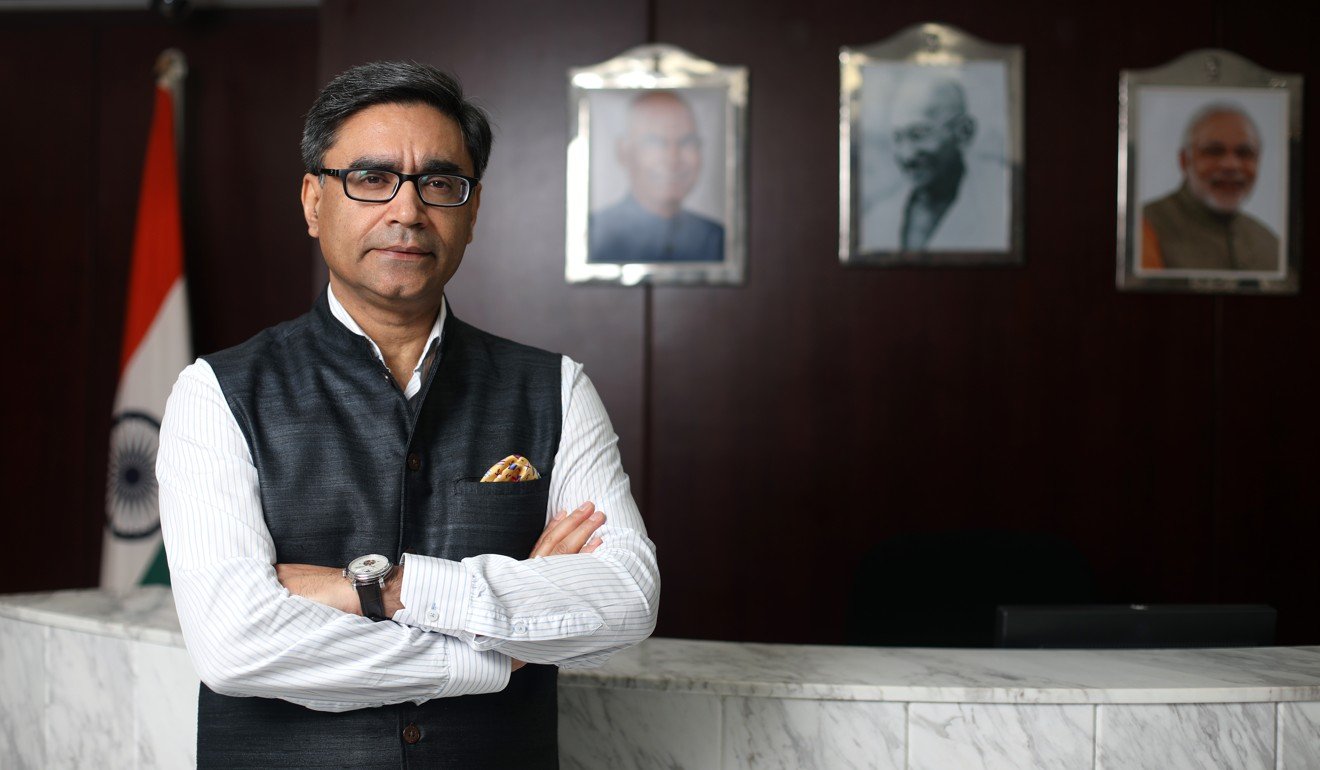
Indian ambassador to China Vikram Misri said New Delhi’s concerns on the Belt and Road Initiative were clear. Photo: Xiaomei Chen
But he said the two nations should not let their differences evolve into disputes, and they should focus on areas where they can cooperate.
One such area was maritime and investment cooperation in the Indo-Pacific region, including infrastructure and disaster response. The US in recent years has focused on the Indo-Pacific region, and has asked its allies to send naval vessels to the area as a counterbalance to Beijing.
“We have made the point that our vision of the Indo-Pacific is not a strategy, which sometimes is a concern on the part of some partners, aimed against any particular country,” Misri said. “It is definitely not a military alliance in any format.
“It is on the other hand a vision that aims at economic and development cooperation with our partners in the Indo-Pacific space,” he said, adding that India was discussing such cooperation with China.
He also said trilateral meetings between China, India and Russia would become more regular after their three leaders met on the sidelines of the
summit in Osaka, Japan last month, when they vowed to uphold multilateralism.
Those meetings would allow the nations to address challenges facing the international trading system and pushback against globalisation, but Misri said they should not be seen as a bid to counter the US, which is also involved in a trade battle with India.
India also had a trilateral meeting with Japan and the United States during the G20 summit.
“The fact that these countries seek us out also shows that they see value in engaging with India, and we have important issues to discuss in each of these settings,” he said. “None of our individual relationships is going to come at the cost of a relationship with any other partner.”
The ambassador said there could be a broader consensus on counterterrorism. Photo: AP
Misri also said there could be a broader consensus between China and India on counterterrorism. The two nations have clashed over Indian efforts to blacklist Masood Azhar, leader of the Pakistan-based terror group Jaish-e-Mohammed (JeM), at the United Nations, which China objected to for years – a move seen in India as being done at the behest of Islamabad.
Azhar was finally listed as a global terrorist by the UN in May, after JeM claimed responsibility for a deadly terror attack on Indian security forces in Pulwama in February, although the listing did not directly reference the attack.
“It could have happened earlier … but I’m glad that it did happen, and we hope to build on that – that should be taken as progress, and we hope to build on that in the coming years,” Misri said.
“Everybody is aware of the context in which the listing happened, and therefore, I don’t think it’s hidden from anybody as to what this was aimed at or who this was aimed at, or what the motivation for the action might have been.”
As for the tensions between India and Pakistan following the terror strike in Indian-controlled Kashmir, Misri said progress would be “largely dependent on Pakistan” and the actions it needed to take to address the “ecosystem of terror that prevails in different parts of that country”.
Source: SCMP
Posted in 70th anniversary, Ambassador Vikram Misri, Belt and Road Initiative (BRI), celebrations, Chinese navy, Chinese President Xi Jinping, communicate, counterterrorism, Doklam plateau, ecosystem of terror, Group of 20 (G20), Hong Kong, Indian ambassador to China, Indian consulate, indian navy, Indian-controlled Kashmir, INS Kolkata, Jaish-e-Mohammed (JeM), Japan, Masood Azhar, Osaka, pla navy, President Xi Jinping, Prime Minister Narendra Modi, Qingdao, Russia, Uncategorized, US, We need to talk |
Leave a Comment »
12/06/2019
- Radar expert Liu Yongtan says surface wave system could track ships and planes from hundreds of kilometres away and is protected from anti-radiation missiles
Stealth aircraft like the US F-35 are less well protected against high-frequency surface wave radars. Photo: AP
China has developed a radar system that could detect stealth fighters from a long distance, its creator has told state media.
Liu Yongtan, a member of the Chinese Academy of Sciences, told Naval and Merchant Ships that the new high-frequency surface wave radar (HFSWR) was also masked from anti-radiation missiles which can detect and destroy radio waves from other early warning systems.
The interview with the monthly magazine, which is published by the China Shipbuilding Engineering Academy, was reprinted by state-owned tabloid Global Times on Monday.
Liu, an 83-year-old who has dedicated his life to studying radar systems, said the new radar features “high-frequency electromagnetic waves that have long wavelengths and wide beams”.
Unlike microwave or skywave signals, surface waves travel along the spherical surface of the earth.
“A land-based version of the system can detect naval and aerial hostile objects from hundreds of kilometres away, which helps expand the range of China’s maritime early warning and defence systems,” Liu said.
He also said the long wavelength could help detect stealth aircraft, which use special protective materials and designs to make them “invisible” to microwave radars, but have no such protection against high-frequency surface waves.
Chinese navy’s new ‘compact’ radar will allow it to keep watch over an area the size of India
Another advantage of the maritime radar system is what Global Times described as “immunity” to attack from anti-radiation missiles, which track and destroy the origin of the electromagnetic waves.
Liu said that anti-radiation missiles would need huge antennas to track high-frequency surface waves because their beams are too wide for the antennas currently in use to track.
Plenty of practical challenges – such as signal loss and noise interference – need to be overcome to use high-frequency surface waves in radar.
Liu Yongtan was given China’s top scientific honour for his work on the radar. Photo: Weibo
However, Shi Lao, a Shanghai-based military commentator, said Liu’s team must have overcome those challenges.
Shi said he believed that as Liu’s technology developed it could be used as a low-cost coastal monitoring system that could protect the coastline within a range of 400km (250 miles).
Japan boosts island radar surveillance to catch Chinese, North Korean ships
The technology can also be used in conjunction with skywave radar systems, which usually have a longer monitoring range of 1,000km (621 miles).
“HFSWR could work 24 hours in all weathers, which would be much cheaper than operating early warning aircraft,” Shi said.
“They can be deployed relatively quickly with high mobility if they are mounted on vehicles, and may be loaded onto warships in the future.”
State broadcaster CCTV has previously reported that China has built a high-frequency surface wave radar test centre in Weihai, on China’s east coast in Shandong province.
In January
, China’s highest award for scientists which includes prize money of 8 million yuan (US$1.2 million), for his work on the radar system.
Source: SCMP
Posted in antennas, anti-radiation missiles, CCTV, China Shipbuilding Engineering Academy, China’s maritime early warning and defence systems, Chinese Academy of Sciences, Chinese navy, creator, electromagnetic waves, Global Times, high-frequency radar system, high-frequency surface wave radar (HFSWR), India alert, invisible, Japan, long distance, microwave radars, Naval and Merchant Ships, North Korean ships, shandong province, spot, State Pre-eminent Science and Technology Award, stealth aircraft, surface wave system, Uncategorized, Weihai |
Leave a Comment »








 CHINDIA ALERT: You'll be living in their world, very soon